
UNIX System Programming Signals 1 Overview 1 2

![Usage $ sig_examp & [1] 4720 0 $ kill -USR 1 4720 Received SIGUSR](https://slidetodoc.com/presentation_image_h/0e6bbf2a6463b15bf9b111a3cfe35290/image-18.jpg "Usage $ sig_examp & [1] 4720 0 $ kill -USR 1 4720 Received SIGUSR")
- Slides: 60
UNIX System Programming Signals 1
Overview 1. 2. 3. 4. 5. 6. 7. Definition Signal Types Generating a Signal Responding to a Signal Common Uses of Signals Timeout on a read() 7. POSIX Signal Functions 2
1. Definition v A signal is an asynchronous event which is delivered to a process. v Asynchronous means that the event can occur at any time – may be unrelated to the execution of the process – e. g. user types ctrl-C, or the modem hangs 3
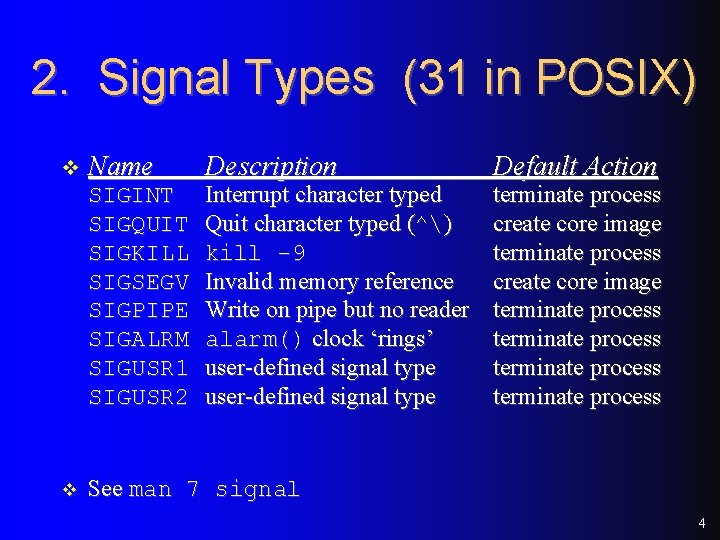
2. Signal Types (31 in POSIX) v Name SIGINT SIGQUIT SIGKILL SIGSEGV SIGPIPE SIGALRM SIGUSR 1 SIGUSR 2 v Description Interrupt character typed Quit character typed (^) kill -9 Invalid memory reference Write on pipe but no reader alarm() clock ‘rings’ user-defined signal type Default Action terminate process create core image terminate process See man 7 signal 4
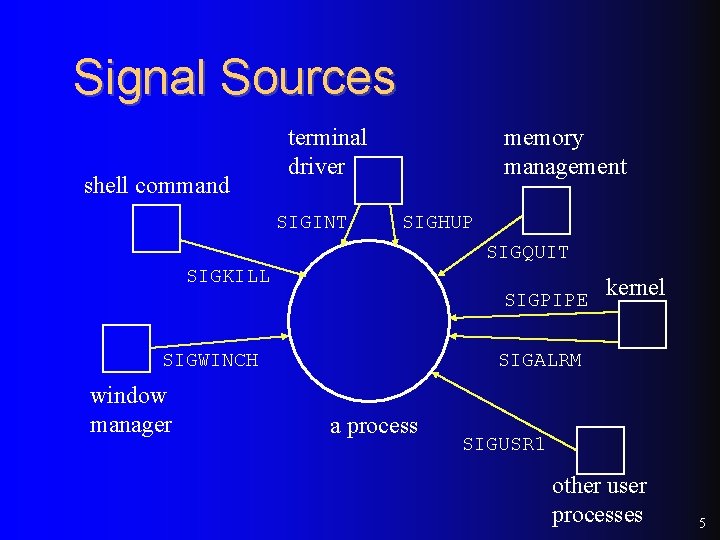
Signal Sources shell command terminal driver SIGINT memory management SIGHUP SIGQUIT SIGKILL SIGPIPE SIGWINCH window manager kernel SIGALRM a process SIGUSR 1 other user processes 5
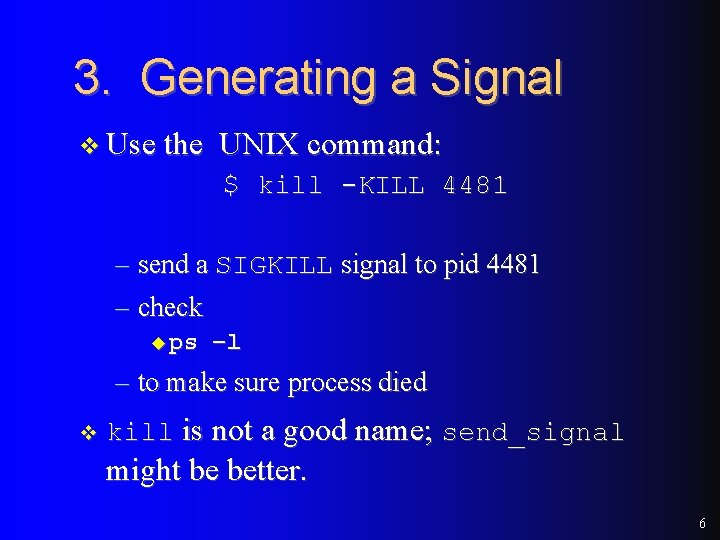
3. Generating a Signal v Use the UNIX command: $ kill -KILL 4481 – send a SIGKILL signal to pid 4481 – check u ps –l – to make sure process died v kill is not a good name; send_signal might be better. 6
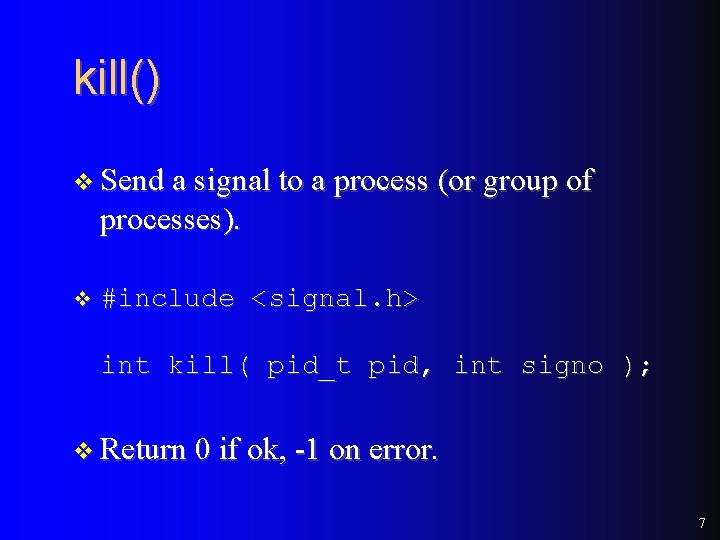
kill() v Send a signal to a process (or group of processes). v #include <signal. h> int kill( pid_t pid, int signo ); v Return 0 if ok, -1 on error. 7
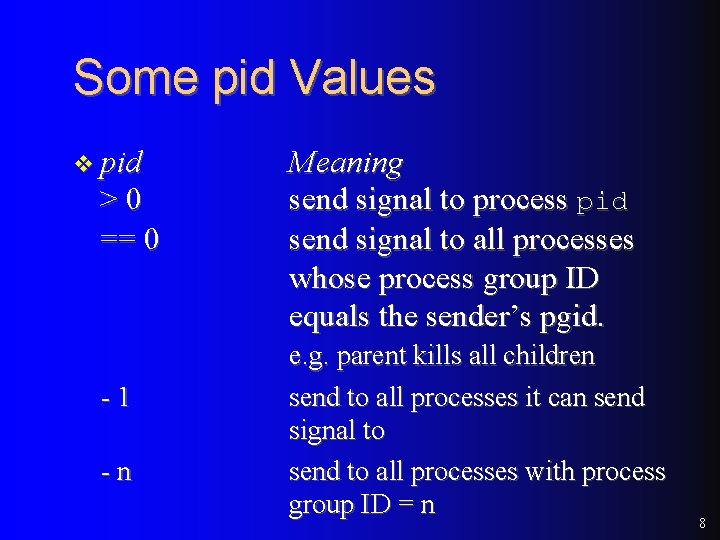
Some pid Values v pid >0 == 0 -1 -n Meaning send signal to process pid send signal to all processes whose process group ID equals the sender’s pgid. e. g. parent kills all children send to all processes it can send signal to send to all processes with process group ID = n 8
9
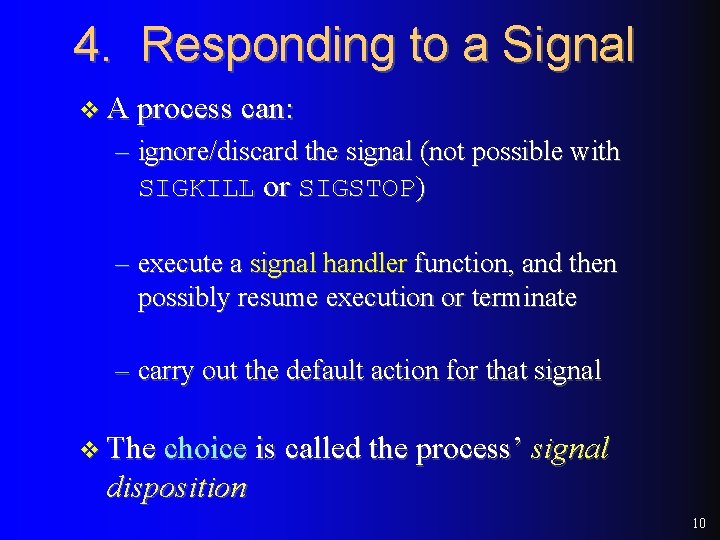
4. Responding to a Signal v A process can: – ignore/discard the signal (not possible with SIGKILL or SIGSTOP) – execute a signal handler function, and then possibly resume execution or terminate – carry out the default action for that signal v The choice is called the process’ signal disposition 10
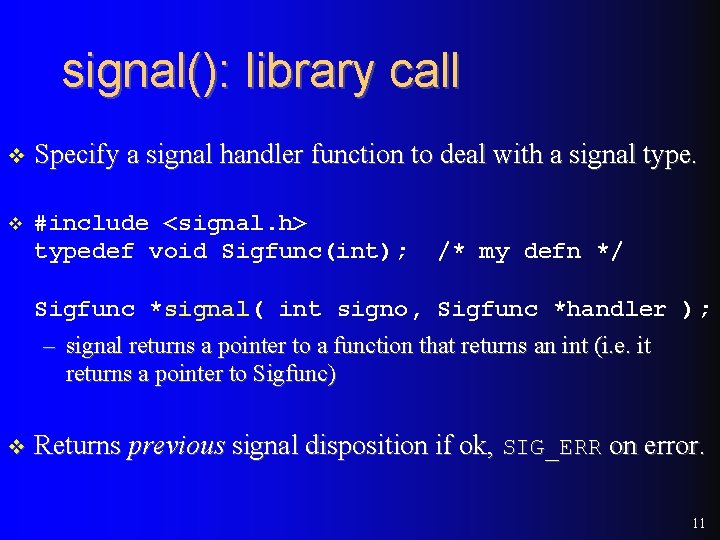
signal(): library call v Specify a signal handler function to deal with a signal type. v #include <signal. h> typedef void Sigfunc(int); /* my defn */ Sigfunc *signal( int signo, Sigfunc *handler ); – signal returns a pointer to a function that returns an int (i. e. it returns a pointer to Sigfunc) v Returns previous signal disposition if ok, SIG_ERR on error. 11
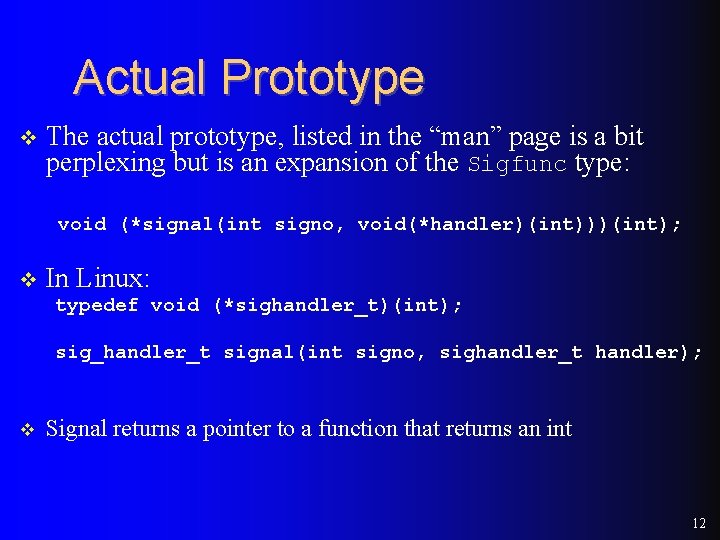
Actual Prototype v The actual prototype, listed in the “man” page is a bit perplexing but is an expansion of the Sigfunc type: void (*signal(int signo, void(*handler)(int)))(int); v In Linux: typedef void (*sighandler_t)(int); sig_handler_t signal(int signo, sighandler_t handler); v Signal returns a pointer to a function that returns an int 12
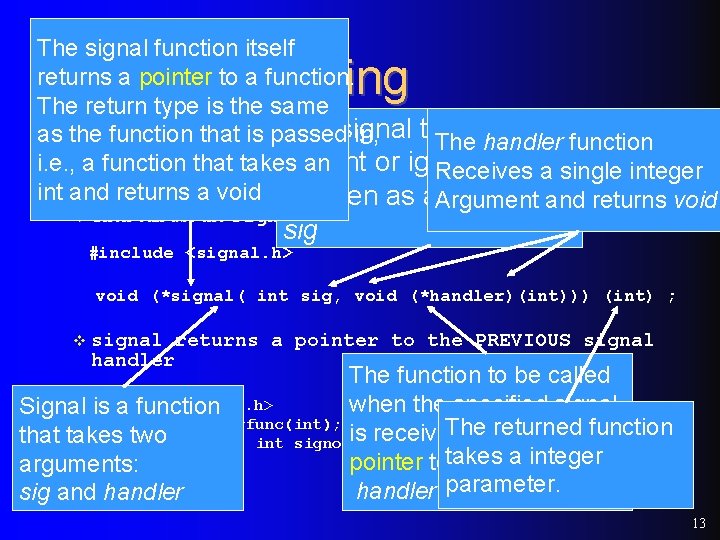
The signal function itself returns a pointer to a function. The return type is the same The signal to. The behandler function as the function that is passed in, i. e. , va. Use function that takes an signal. h caught or ignored the signal handling library: Receives a single integer int and returns a void is given as argument Argument and returns void Signal Handling v Then can use the signal call: sig #include <signal. h> void (*signal( int sig, void (*handler)(int))) (int) ; v signal returns a pointer to the PREVIOUS signal handler The function to be called v #include <signal. h> when the specified signal Signal is a function typedef void Sigfunc(int); /* my defn */ returned function The is received is given that takes two Sigfunc *signal( int signo, Sigfunc *handler ); as a a integer pointer totakes the function arguments: handler parameter. sig and handler 13
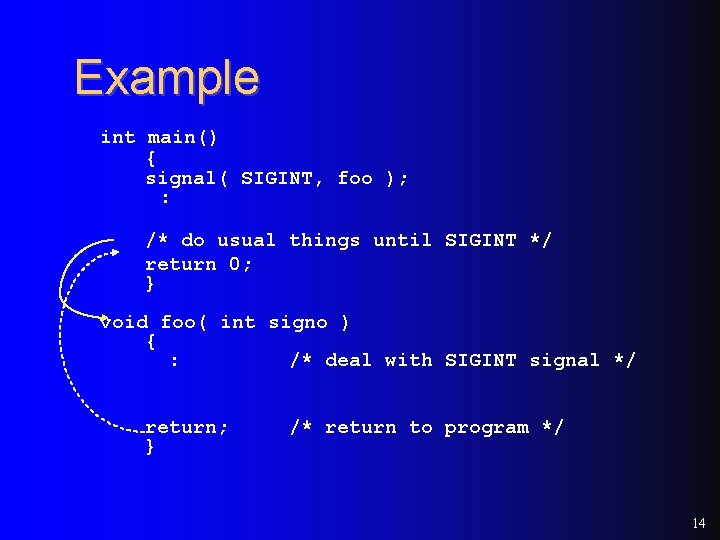
Example int main() { signal( SIGINT, foo ); : /* do usual things until SIGINT */ return 0; } void foo( int signo ) { : /* deal with SIGINT signal */ return; } /* return to program */ 14
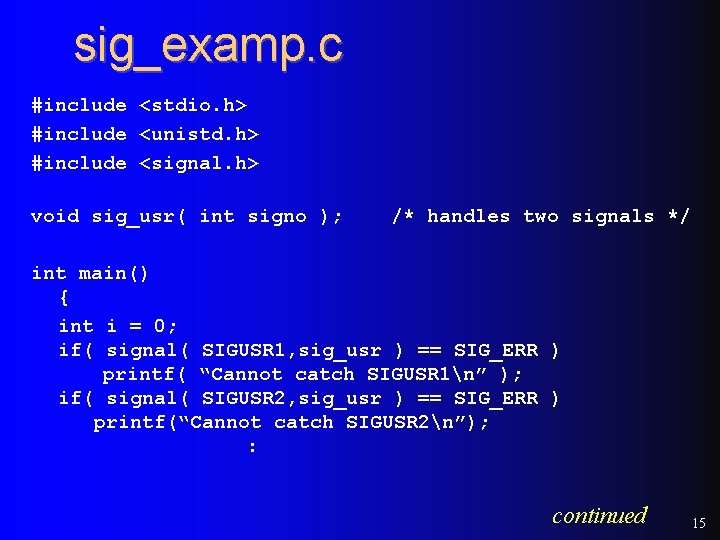
sig_examp. c #include <stdio. h> #include <unistd. h> #include <signal. h> void sig_usr( int signo ); /* handles two signals */ int main() { int i = 0; if( signal( SIGUSR 1, sig_usr ) == SIG_ERR ) printf( “Cannot catch SIGUSR 1n” ); if( signal( SIGUSR 2, sig_usr ) == SIG_ERR ) printf(“Cannot catch SIGUSR 2n”); : continued 15
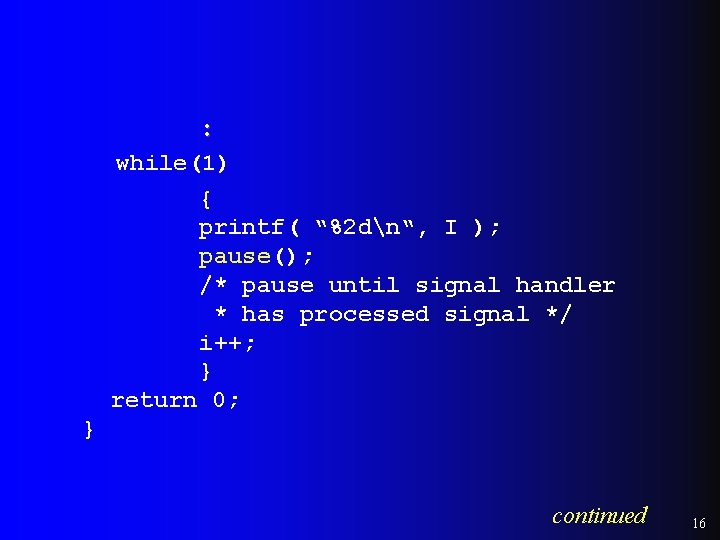
: while(1) { printf( “%2 dn“, I ); pause(); /* pause until signal handler * has processed signal */ i++; } return 0; } continued 16
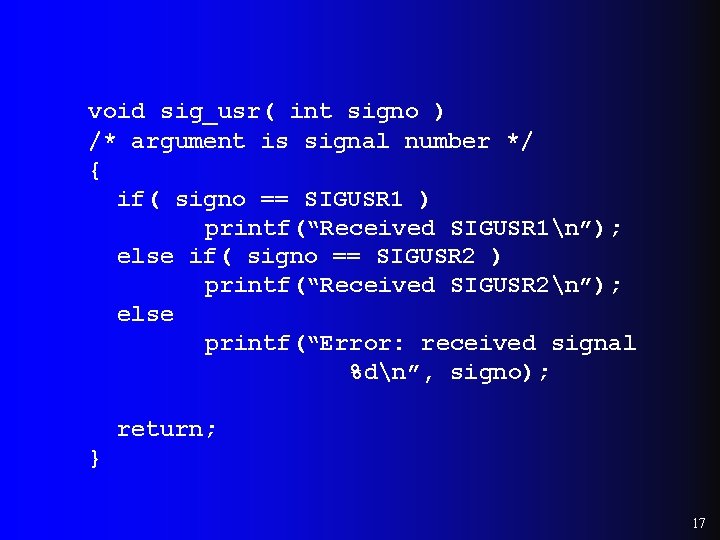
void sig_usr( int signo ) /* argument is signal number */ { if( signo == SIGUSR 1 ) printf(“Received SIGUSR 1n”); else if( signo == SIGUSR 2 ) printf(“Received SIGUSR 2n”); else printf(“Error: received signal %dn”, signo); return; } 17
Usage $ sig_examp & [1] 4720 0 $ kill -USR 1 4720 Received SIGUSR 1 1 $ kill -USR 2 4720 Received SIGUSR 2 2 $ kill 4720 [1] + Terminated $ /* send SIGTERM */ sig_examp & 18
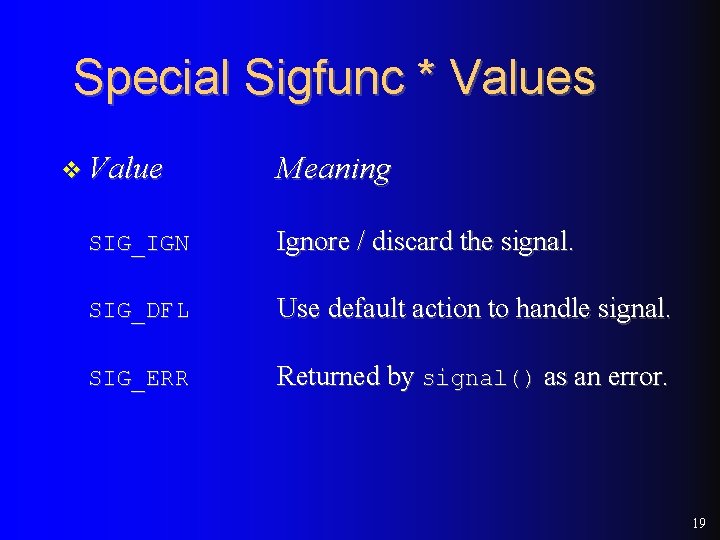
Special Sigfunc * Values v Value Meaning SIG_IGN Ignore / discard the signal. SIG_DFL Use default action to handle signal. SIG_ERR Returned by signal() as an error. 19
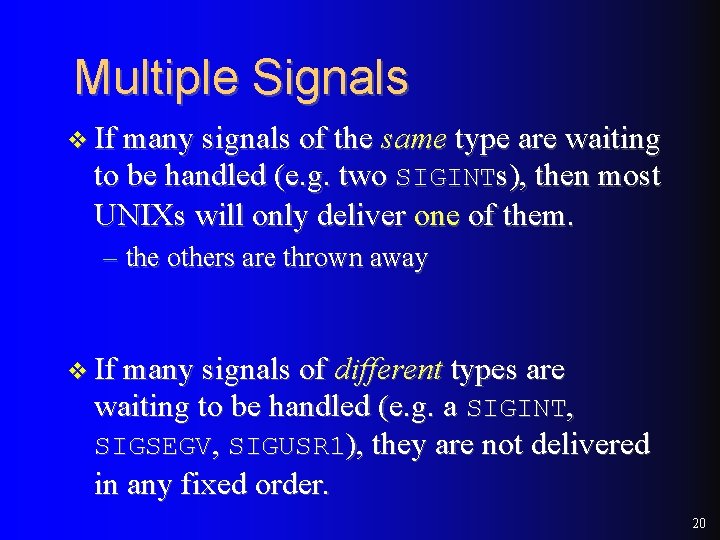
Multiple Signals v If many signals of the same type are waiting to be handled (e. g. two SIGINTs), then most UNIXs will only deliver one of them. – the others are thrown away v If many signals of different types are waiting to be handled (e. g. a SIGINT, SIGSEGV, SIGUSR 1), they are not delivered in any fixed order. 20
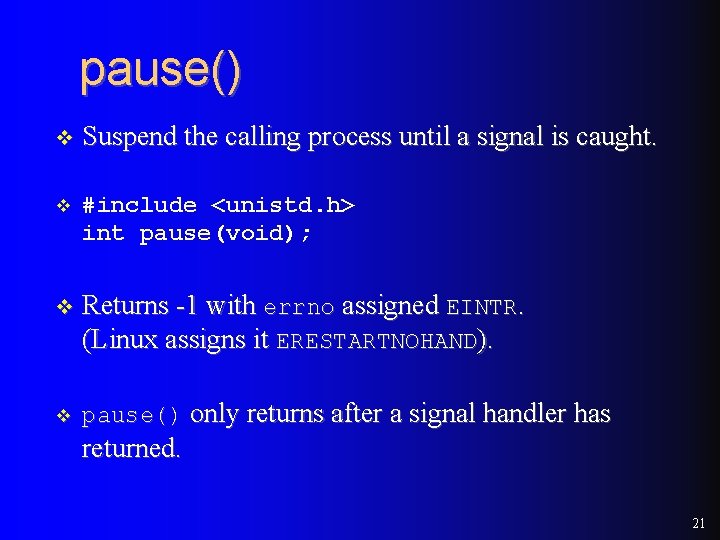
pause() v Suspend the calling process until a signal is caught. v #include <unistd. h> int pause(void); v Returns -1 with errno assigned EINTR. (Linux assigns it ERESTARTNOHAND). v pause() only returns after a signal handler has returned. 21
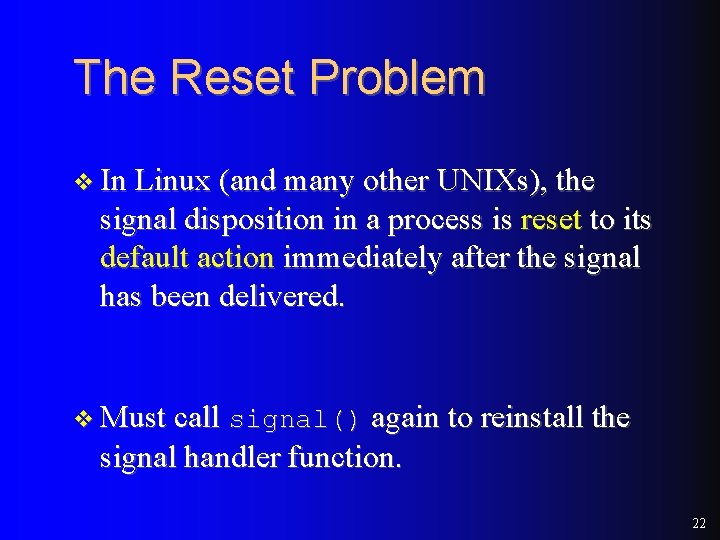
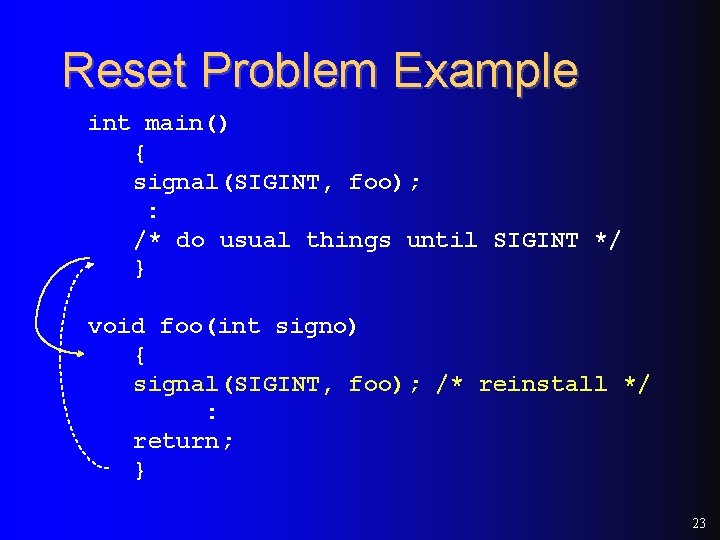
The Reset Problem v In Linux (and many other UNIXs), the signal disposition in a process is reset to its default action immediately after the signal has been delivered. v Must call signal() again to reinstall the signal handler function. 22
Reset Problem Example int main() { signal(SIGINT, foo); : /* do usual things until SIGINT */ } void foo(int signo) { signal(SIGINT, foo); /* reinstall */ : return; } 23
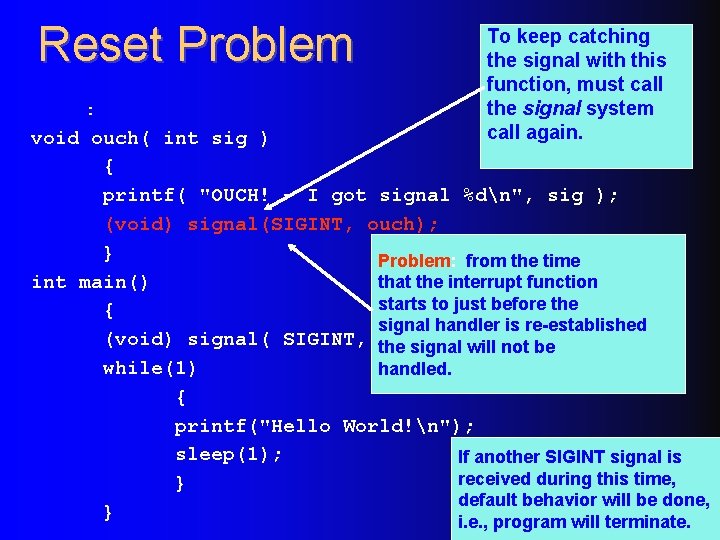
Reset Problem : To keep catching the signal with this function, must call the signal system call again. void ouch( int sig ) { printf( "OUCH! - I got signal %dn", sig ); (void) signal(SIGINT, ouch); } Problem: from the time int main() that the interrupt function starts to just before the { signal handler is re-established (void) signal( SIGINT, the ouch ); will not be signal while(1) handled. { printf("Hello World!n"); sleep(1); If another SIGINT signal is received during this time, } default behavior will be done, } i. e. , program will terminate. 24
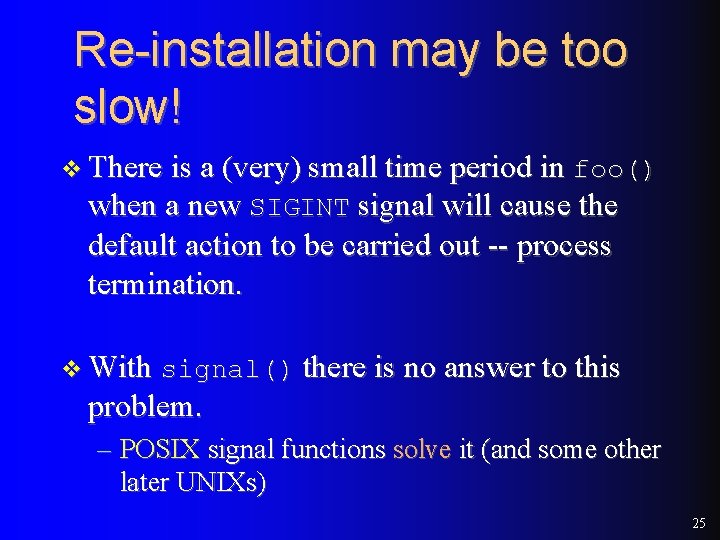
Re-installation may be too slow! v There is a (very) small time period in foo() when a new SIGINT signal will cause the default action to be carried out -- process termination. v With signal() there is no answer to this problem. – POSIX signal functions solve it (and some other later UNIXs) 25
5. Common Uses of Signals 5. 1. Ignore a Signal 5. 2. Clean up and Terminate 5. 3. Dynamic Reconfiguration 5. 4. Report Status 5. 5. Turn Debugging on/off 5. 6. Restore Previous Handler 26
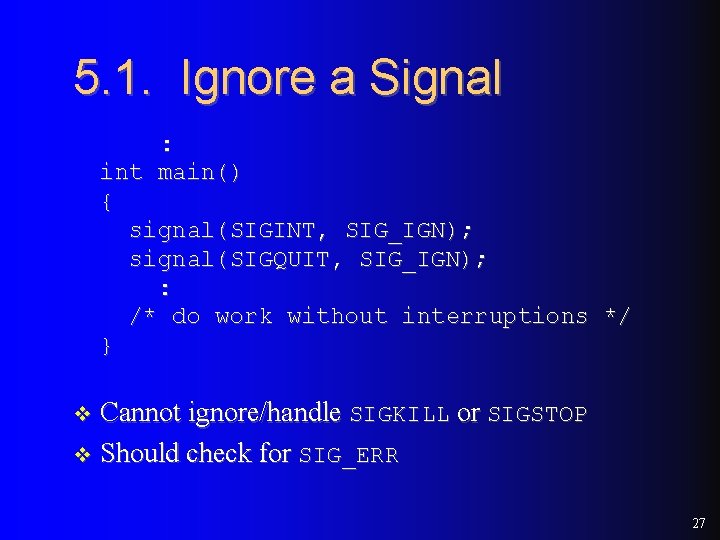
5. 1. Ignore a Signal : int main() { signal(SIGINT, SIG_IGN); signal(SIGQUIT, SIG_IGN); : /* do work without interruptions */ } Cannot ignore/handle SIGKILL or SIGSTOP v Should check for SIG_ERR v 27
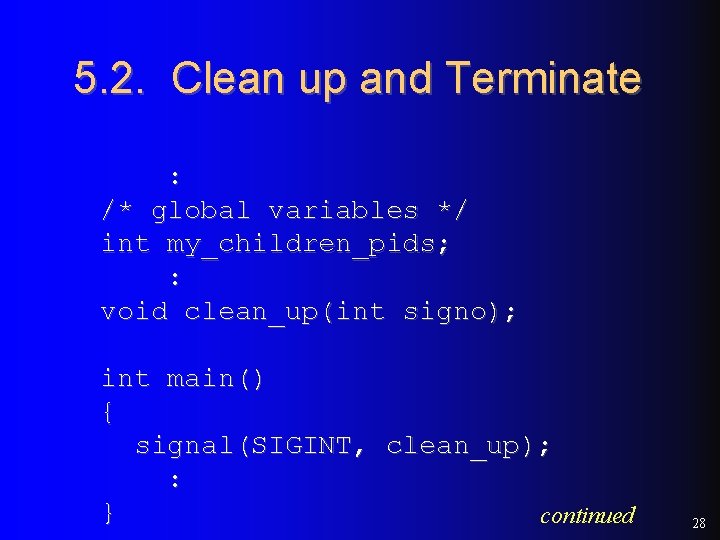
5. 2. Clean up and Terminate : /* global variables */ int my_children_pids; : void clean_up(int signo); int main() { signal(SIGINT, clean_up); : } continued 28
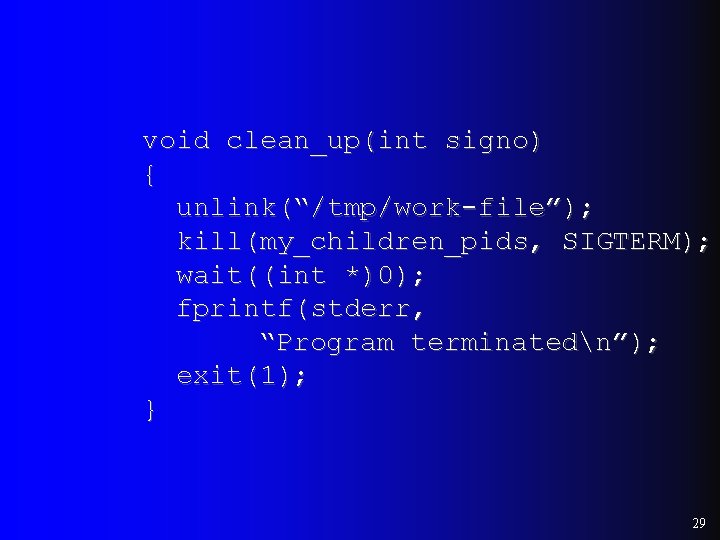
void clean_up(int signo) { unlink(“/tmp/work-file”); kill(my_children_pids, SIGTERM); wait((int *)0); fprintf(stderr, “Program terminatedn”); exit(1); } 29
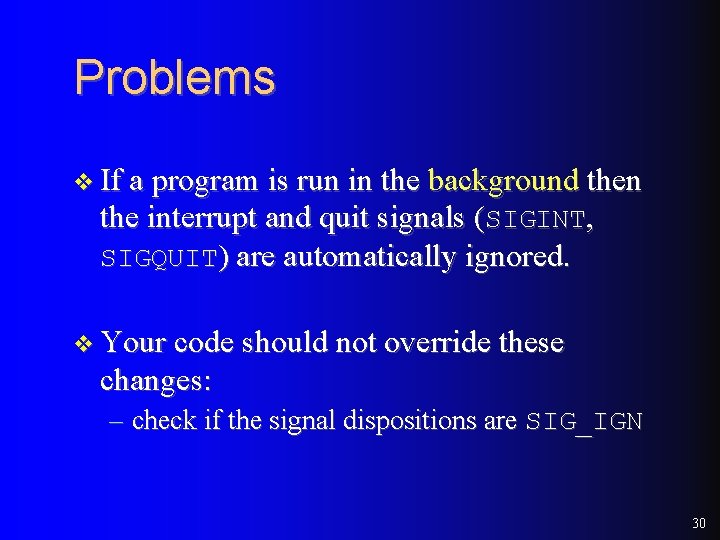
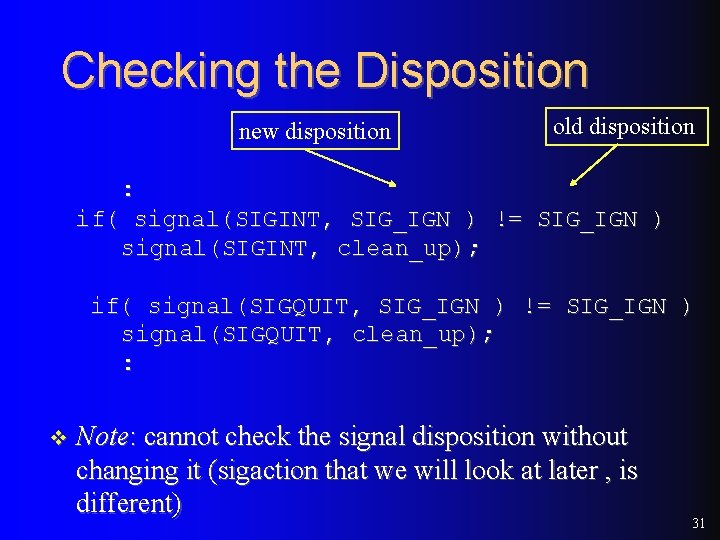
Problems v If a program is run in the background then the interrupt and quit signals (SIGINT, SIGQUIT) are automatically ignored. v Your code should not override these changes: – check if the signal dispositions are SIG_IGN 30
Checking the Disposition new disposition old disposition : if( signal(SIGINT, SIG_IGN ) != SIG_IGN ) signal(SIGINT, clean_up); if( signal(SIGQUIT, SIG_IGN ) != SIG_IGN ) signal(SIGQUIT, clean_up); : v Note: cannot check the signal disposition without changing it (sigaction that we will look at later , is different) 31
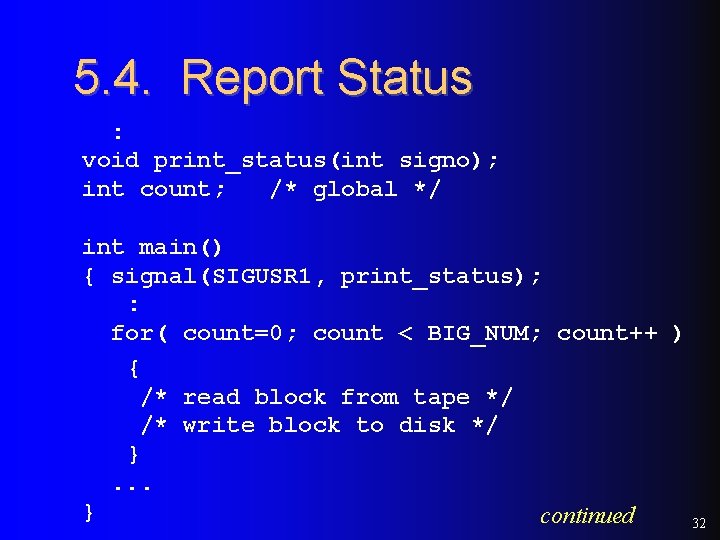
5. 4. Report Status : void print_status(int signo); int count; /* global */ int main() { signal(SIGUSR 1, print_status); : for( count=0; count < BIG_NUM; count++ ) { /* read block from tape */ /* write block to disk */ }. . . } continued 32
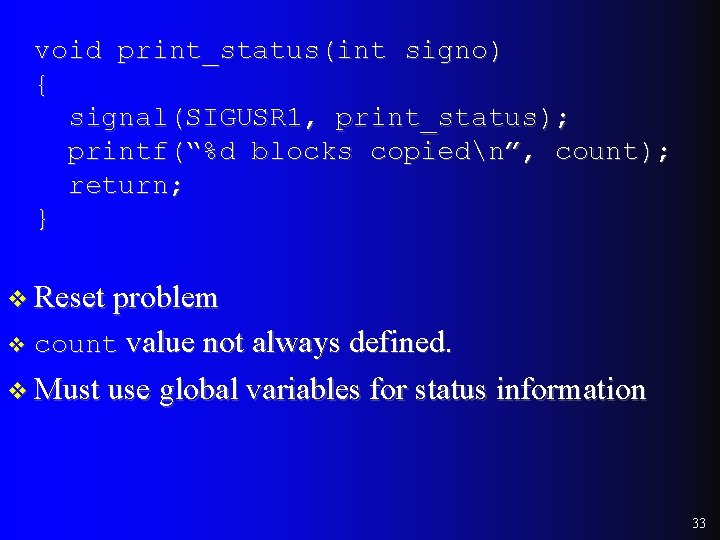
void print_status(int signo) { signal(SIGUSR 1, print_status); printf(“%d blocks copiedn”, count); return; } v Reset problem v count value not always defined. v Must use global variables for status information 33
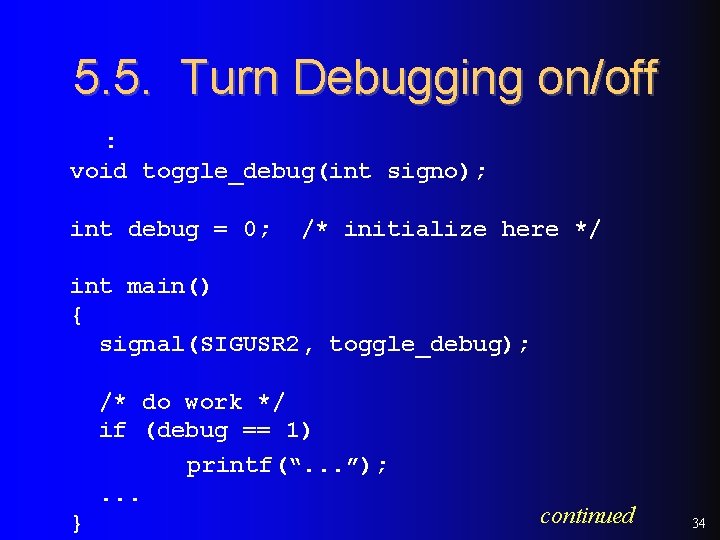
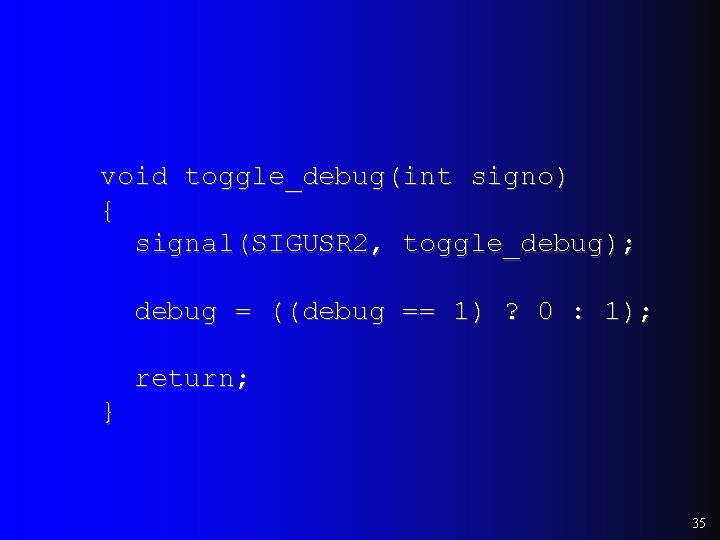
5. 5. Turn Debugging on/off : void toggle_debug(int signo); int debug = 0; /* initialize here */ int main() { signal(SIGUSR 2, toggle_debug); /* do work */ if (debug == 1) printf(“. . . ”); . . . } continued 34
void toggle_debug(int signo) { signal(SIGUSR 2, toggle_debug); debug = ((debug == 1) ? 0 : 1); return; } 35
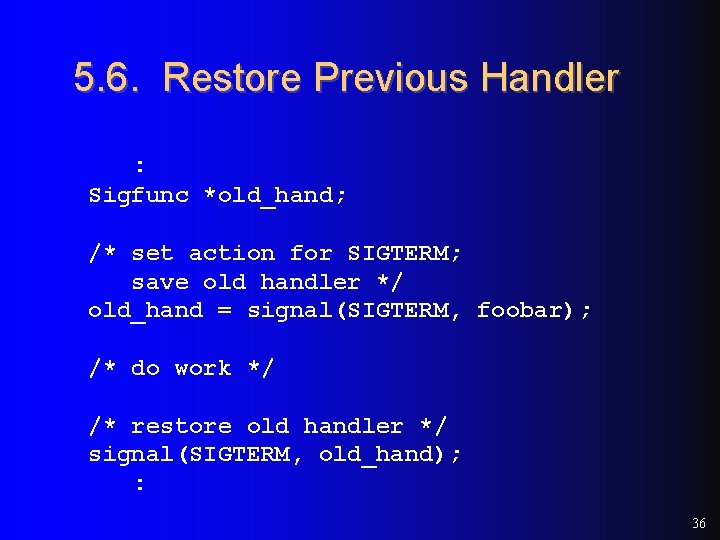
5. 6. Restore Previous Handler : Sigfunc *old_hand; /* set action for SIGTERM; save old handler */ old_hand = signal(SIGTERM, foobar); /* do work */ /* restore old handler */ signal(SIGTERM, old_hand); : 36
6. Implementing a read() Timeout v Put an upper limit on an operation that might block forever – e. g. read() v 6. 1. alarm() 6. 2. Bad read() Timeout 6. 3. setjmp() and longjmp() 6. 4. Better read() Timeout 37
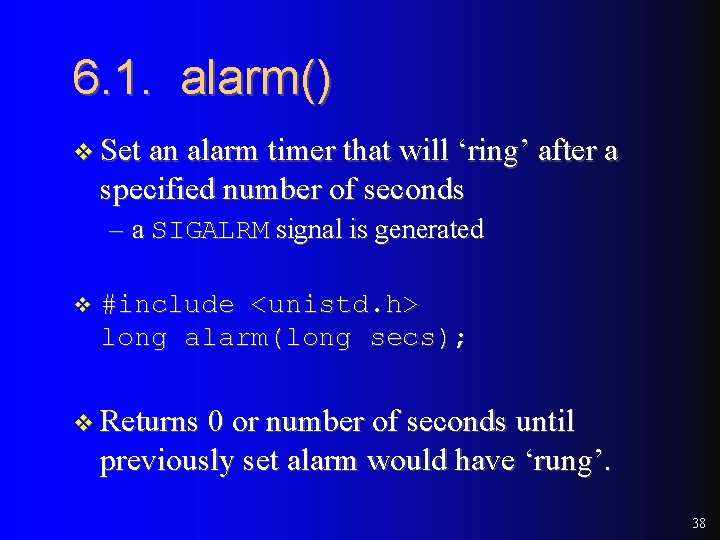
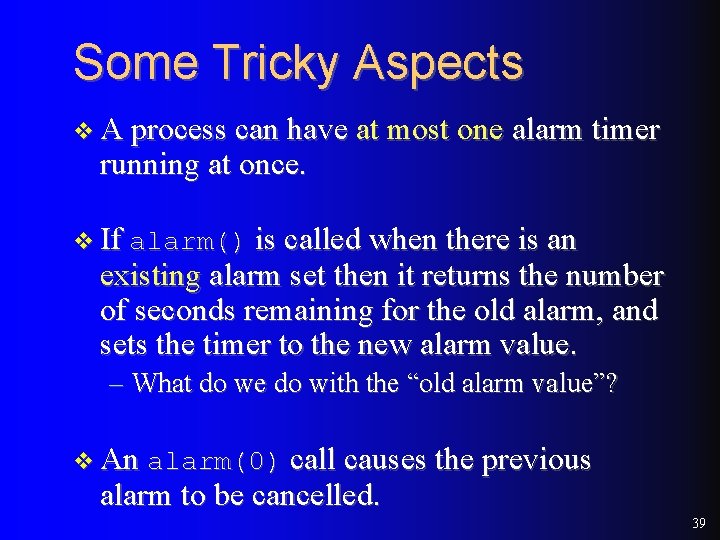
6. 1. alarm() v Set an alarm timer that will ‘ring’ after a specified number of seconds – a SIGALRM signal is generated v #include <unistd. h> long alarm(long secs); v Returns 0 or number of seconds until previously set alarm would have ‘rung’. 38
Some Tricky Aspects v A process can have at most one alarm timer running at once. v If alarm() is called when there is an existing alarm set then it returns the number of seconds remaining for the old alarm, and sets the timer to the new alarm value. – What do we do with the “old alarm value”? v An alarm(0) call causes the previous alarm to be cancelled. 39
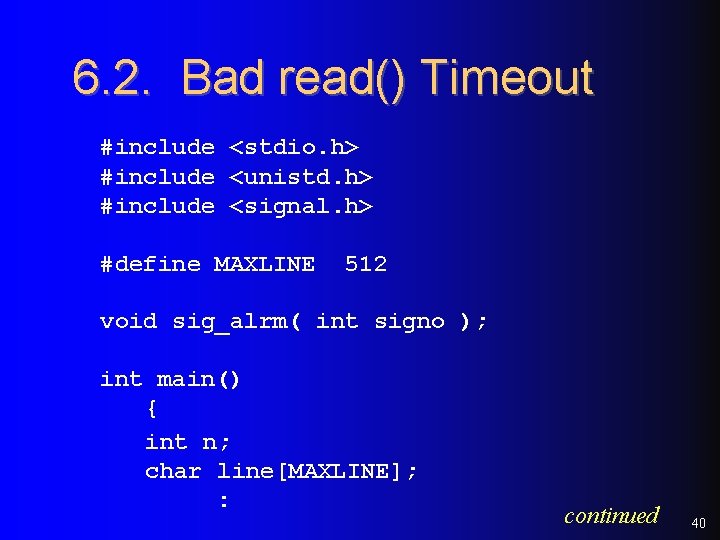
6. 2. Bad read() Timeout #include <stdio. h> #include <unistd. h> #include <signal. h> #define MAXLINE 512 void sig_alrm( int signo ); int main() { int n; char line[MAXLINE]; : continued 40
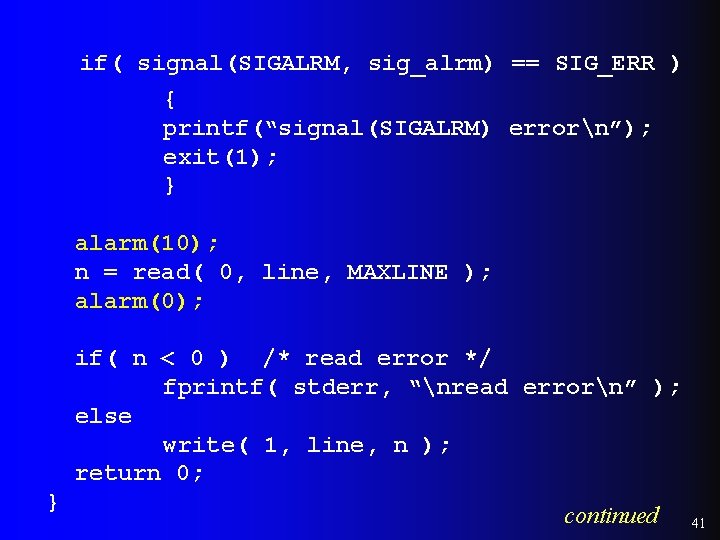
if( signal(SIGALRM, sig_alrm) == SIG_ERR ) { printf(“signal(SIGALRM) errorn”); exit(1); } alarm(10); n = read( 0, line, MAXLINE ); alarm(0); if( n < 0 ) /* read error */ fprintf( stderr, “nread errorn” ); else write( 1, line, n ); return 0; } continued 41
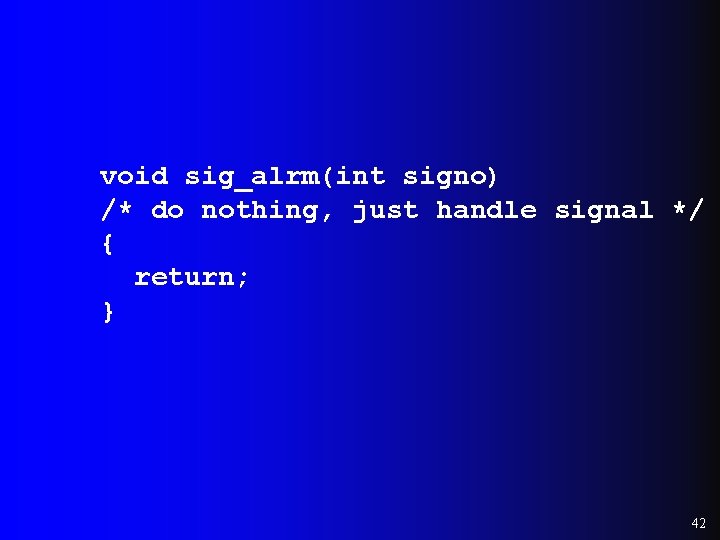
void sig_alrm(int signo) /* do nothing, just handle signal */ { return; } 42
Problems v The code assumes that the read() call terminates with an error after being interrupted ( talk about this later). v Race Conditon: The kernel may take longer than 10 seconds to start the read() after the alarm() call. – – – the alarm may ‘ring’ before the read() starts then the read() is not being timed; may block forever Two ways two solve this: setjmp u sigprocmask and sigsuspend u 43
7. POSIX Signal Functions v The POSIX signal functions can control signals in more ways: – can block signals for a while, and deliver them later (good for coding critical sections) – can switch off the resetting of the signal disposition when a handler is called (no reset problem) 44
v The POSIX signal system, uses signal sets, to deal with pending signals that might otherwise be missed while a signal is being processed 45
7. 1. Signal Sets v The signal set stores collections of signal types. v Sets are used by signal functions to define which signal types are to be processed. v POSIX contains several functions for creating, changing and examining signal sets. 46
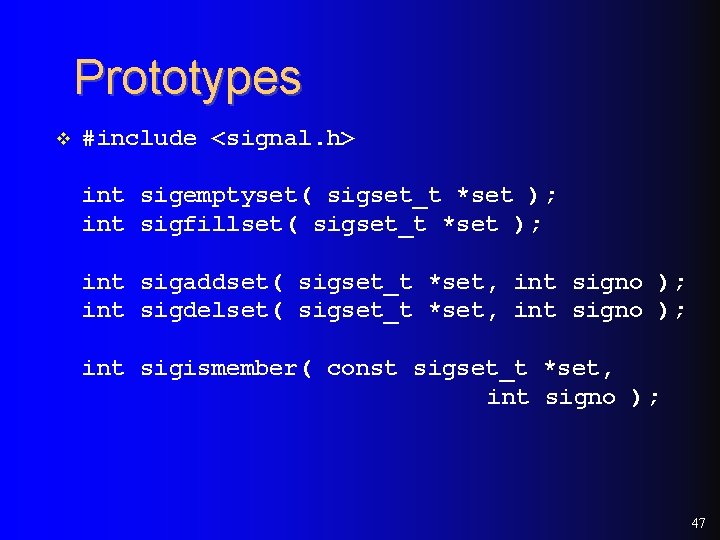
Prototypes v #include <signal. h> int sigemptyset( sigset_t *set ); int sigfillset( sigset_t *set ); int sigaddset( sigset_t *set, int signo ); int sigdelset( sigset_t *set, int signo ); int sigismember( const sigset_t *set, int signo ); 47
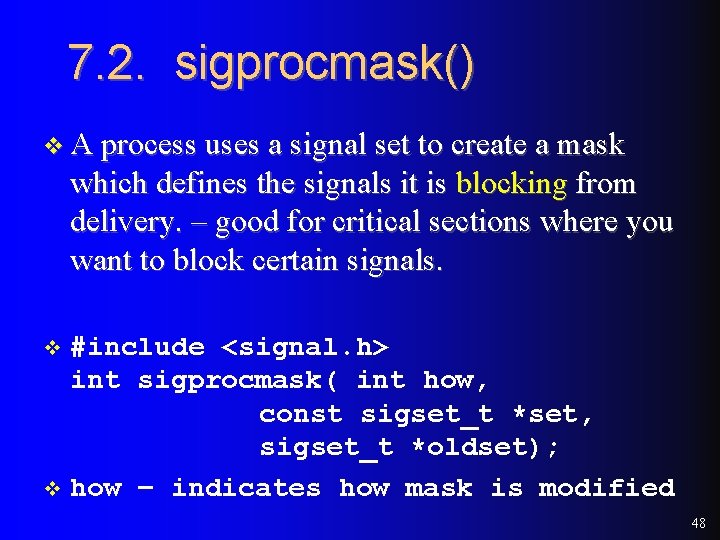
7. 2. sigprocmask() v A process uses a signal set to create a mask which defines the signals it is blocking from delivery. – good for critical sections where you want to block certain signals. #include <signal. h> int sigprocmask( int how, const sigset_t *set, sigset_t *oldset); v how – indicates how mask is modified v 48
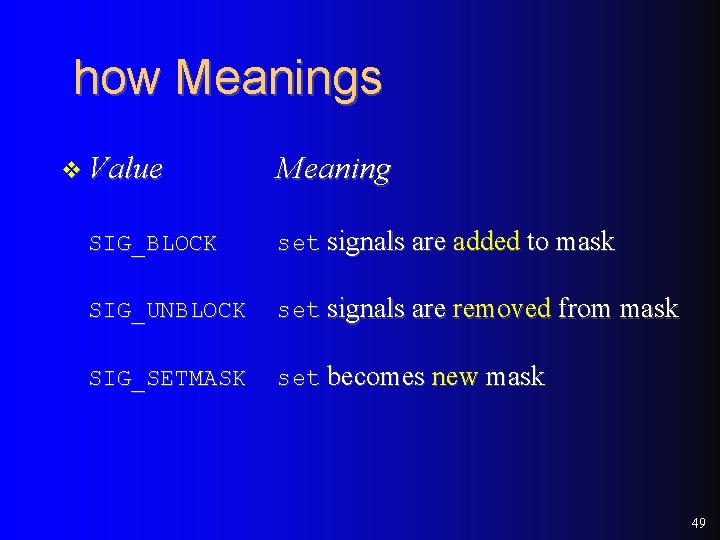
how Meanings v Value Meaning SIG_BLOCK set signals are added to mask SIG_UNBLOCK set signals are removed from mask SIG_SETMASK set becomes new mask 49
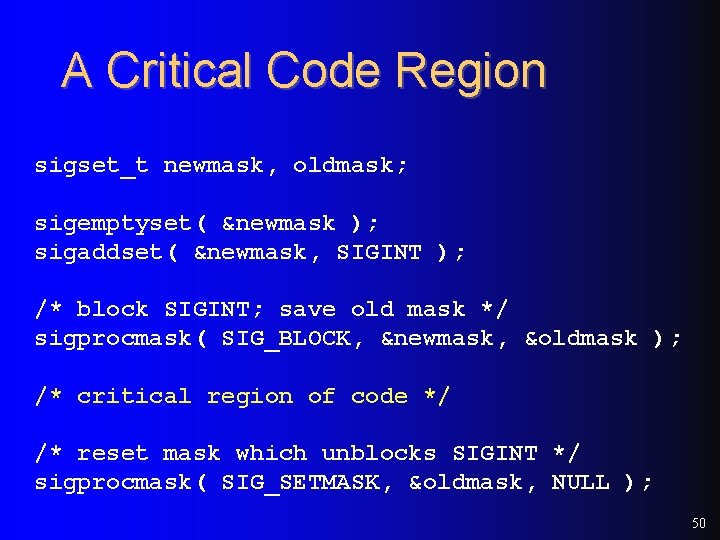
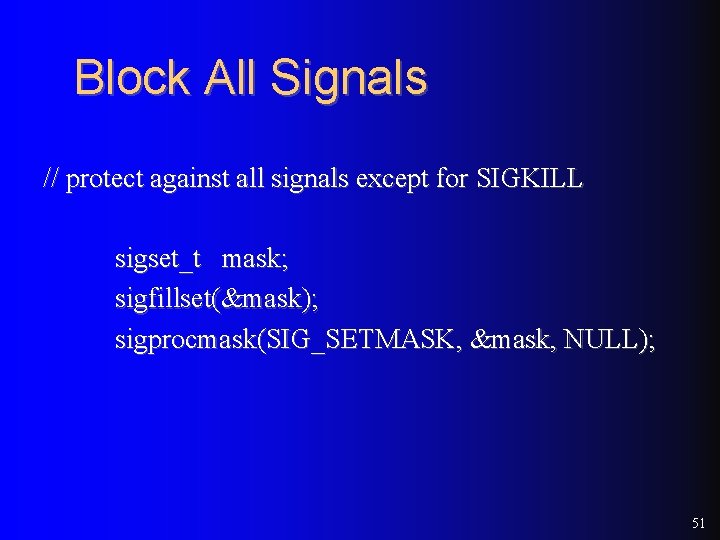
A Critical Code Region sigset_t newmask, oldmask; sigemptyset( &newmask ); sigaddset( &newmask, SIGINT ); /* block SIGINT; save old mask */ sigprocmask( SIG_BLOCK, &newmask, &oldmask ); /* critical region of code */ /* reset mask which unblocks SIGINT */ sigprocmask( SIG_SETMASK, &oldmask, NULL ); 50
Block All Signals // protect against all signals except for SIGKILL sigset_t mask; sigfillset(&mask); sigprocmask(SIG_SETMASK, &mask, NULL); 51
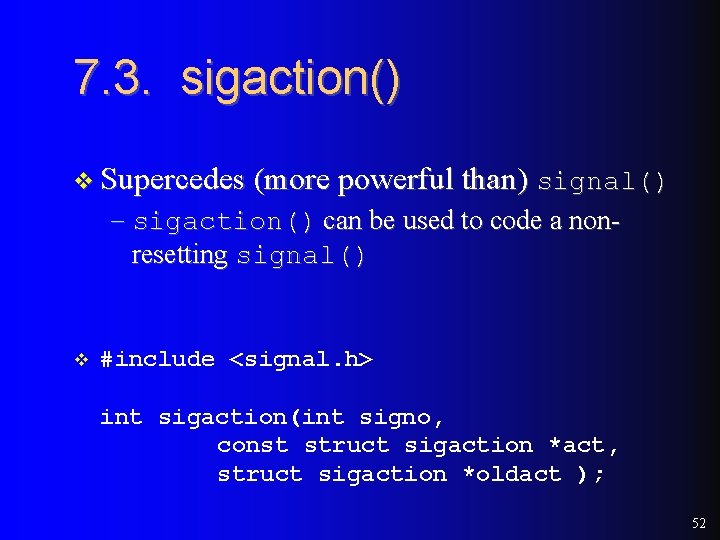
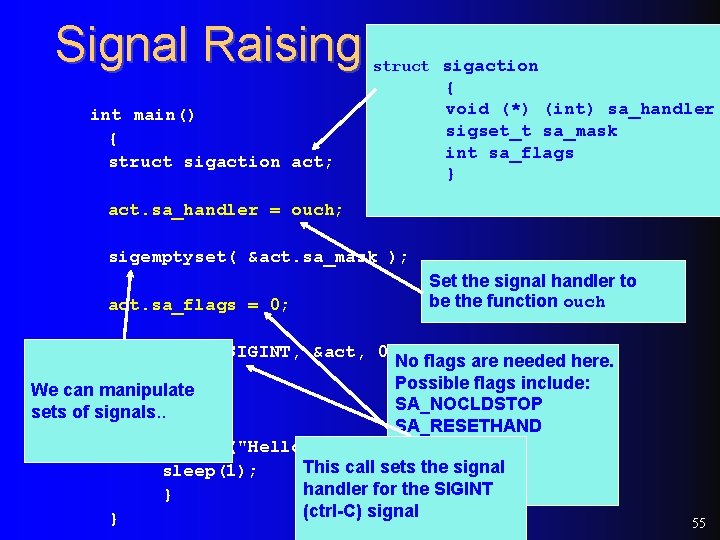
7. 3. sigaction() v Supercedes (more powerful than) signal() – sigaction() can be used to code a nonresetting signal() v #include <signal. h> int sigaction(int signo, const struct sigaction *act, struct sigaction *oldact ); 52
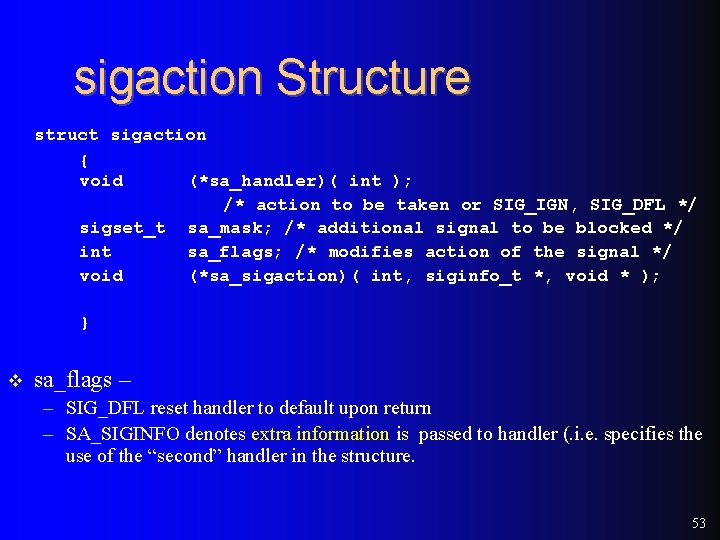
sigaction Structure struct sigaction { void (*sa_handler)( int ); /* action to be taken or SIG_IGN, SIG_DFL */ sigset_t sa_mask; /* additional signal to be blocked */ int sa_flags; /* modifies action of the signal */ void (*sa_sigaction)( int, siginfo_t *, void * ); } v sa_flags – – SIG_DFL reset handler to default upon return – SA_SIGINFO denotes extra information is passed to handler (. i. e. specifies the use of the “second” handler in the structure. 53
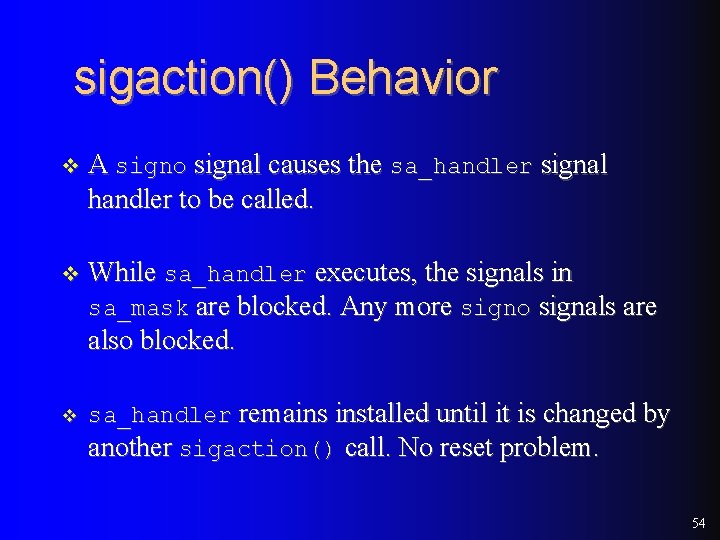
sigaction() Behavior v A signo signal causes the sa_handler signal handler to be called. v While sa_handler executes, the signals in sa_mask are blocked. Any more signo signals are also blocked. v sa_handler remains installed until it is changed by another sigaction() call. No reset problem. 54
Signal Raising struct sigaction int main() { struct sigaction act; { void (*) (int) sa_handler sigset_t sa_mask int sa_flags } act. sa_handler = ouch; sigemptyset( &act. sa_mask ); act. sa_flags = 0; Set the signal handler to be the function ouch sigaction( SIGINT, &act, 0 ); No flags are needed here. Possible flags include: We can manipulate while(1) SA_NOCLDSTOP sets of signals. . { SA_RESETHAND printf("Hello World!n"); SA_RESTART This call sets the signal SA_NODEFER sleep(1); handler for the SIGINT } (ctrl-C) signal } 55
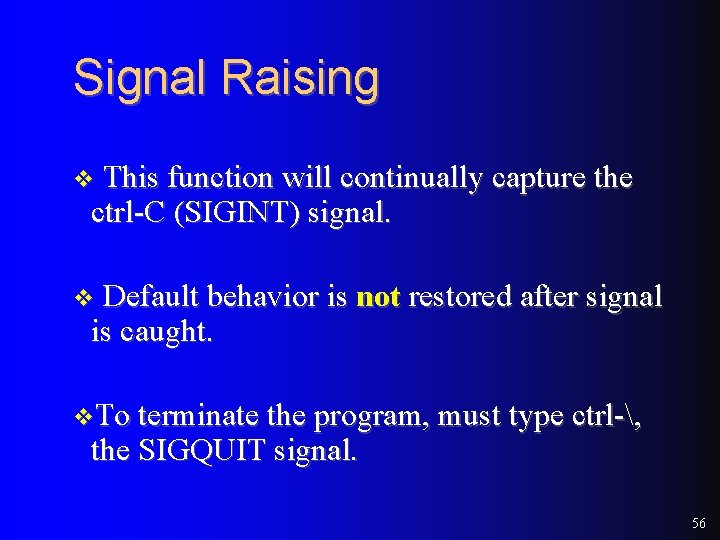
Signal Raising v This function will continually capture the ctrl-C (SIGINT) signal. v Default behavior is not restored after signal is caught. v. To terminate the program, must type ctrl-, the SIGQUIT signal. 56
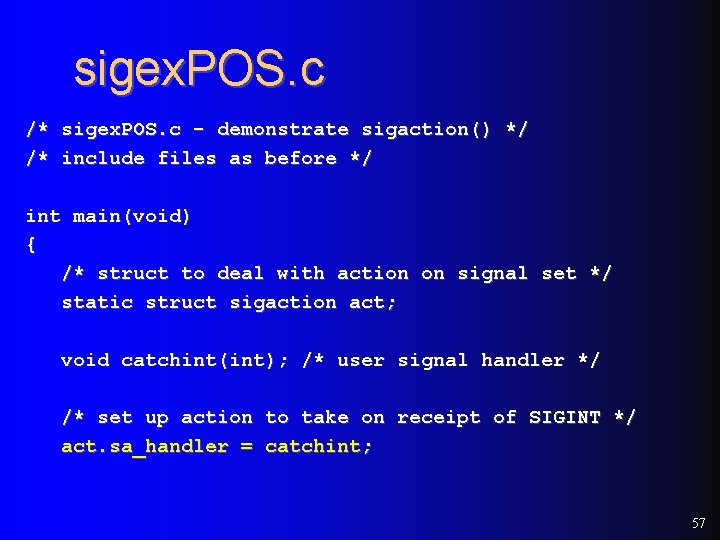
sigex. POS. c /* sigex. POS. c - demonstrate sigaction() */ /* include files as before */ int main(void) { /* struct to deal with action on signal set */ static struct sigaction act; void catchint(int); /* user signal handler */ /* set up action to take on receipt of SIGINT */ act. sa_handler = catchint; 57
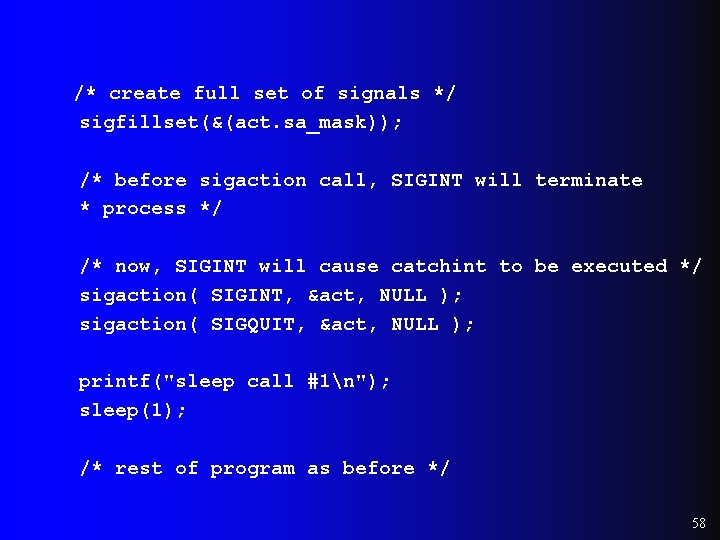
/* create full set of signals */ sigfillset(&(act. sa_mask)); /* before sigaction call, SIGINT will terminate * process */ /* now, SIGINT will cause catchint to be executed */ sigaction( SIGINT, &act, NULL ); sigaction( SIGQUIT, &act, NULL ); printf("sleep call #1n"); sleep(1); /* rest of program as before */ 58
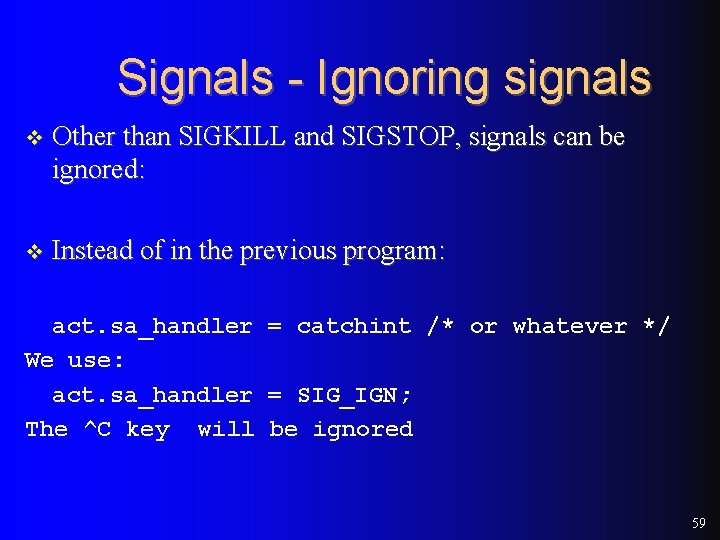
Signals - Ignoring signals v Other than SIGKILL and SIGSTOP, signals can be ignored: v Instead of in the previous program: act. sa_handler = catchint /* or whatever */ We use: act. sa_handler = SIG_IGN; The ^C key will be ignored 59
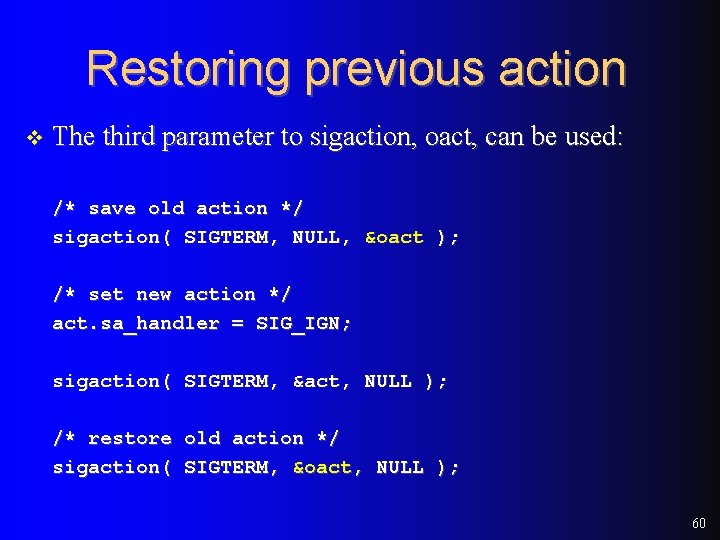
Restoring previous action v The third parameter to sigaction, oact, can be used: /* save old action */ sigaction( SIGTERM, NULL, &oact ); /* set new action */ act. sa_handler = SIG_IGN; sigaction( SIGTERM, &act, NULL ); /* restore old action */ sigaction( SIGTERM, &oact, NULL ); 60