
University Privacy Campaign Introduction to the Personal Data

- Slides: 46
University Privacy Campaign Introduction to the Personal Data (Privacy) Ordinance 1
Personal Data (Privacy) Ordinance Legislative Background • Personal Data (Privacy) Ordinance came into effect on 20 December 1996, based on internationally accepted data protection principles Amendment to the Ordinance • Gazette published on 6 July 2012 • All provisions are implemented 2
Objectives of the Ordinance • Protecting the privacy right of a “data subject” in respect of “personal data”, but general privacy issues are not protected. “Data Subject” A data subject refers to the living individual who is the subject of the “personal data” concerned. 3
Definitions under the Ordinance “Personal Data” should satisfy three conditions: (1) relating directly or indirectly to a living individual; (2) from which it is practicable for the identity of the individual to be directly or indirectly ascertained; and (3) in a form in which “access to” or “processing of” the data is practicable. 4
CHAN Tai Man 9123 4567
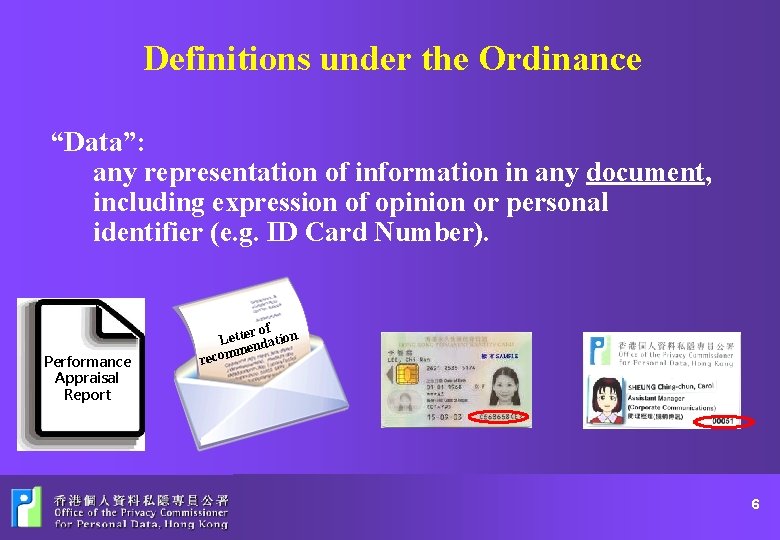
Definitions under the Ordinance “Data”: any representation of information in any document, including expression of opinion or personal identifier (e. g. ID Card Number). Performance Appraisal Report r of Lette ndation me recom 6
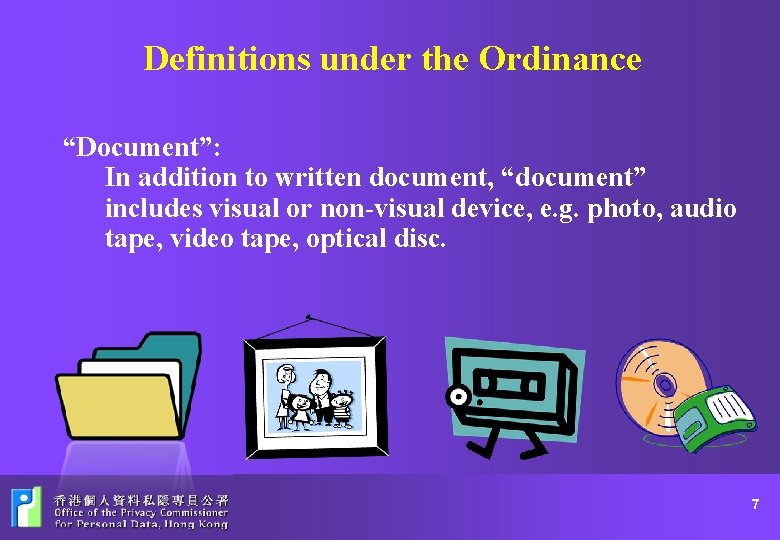
Definitions under the Ordinance “Document”: In addition to written document, “document” includes visual or non-visual device, e. g. photo, audio tape, video tape, optical disc. 7
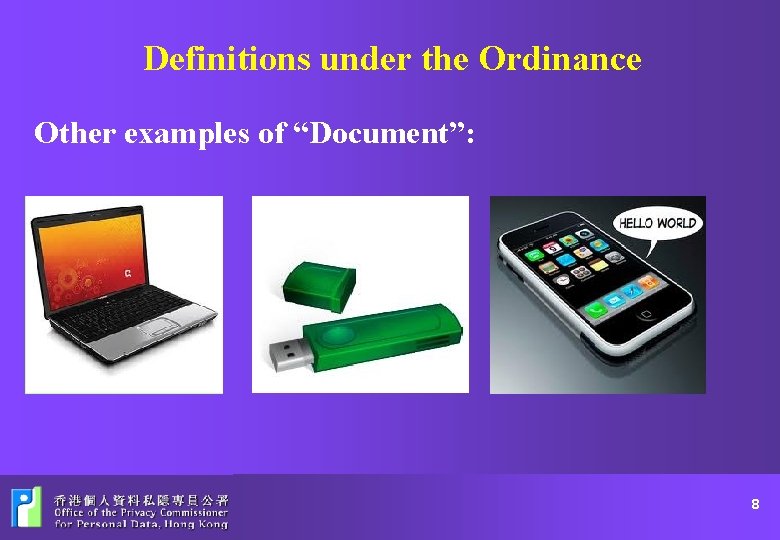
Definitions under the Ordinance Other examples of “Document”: 8
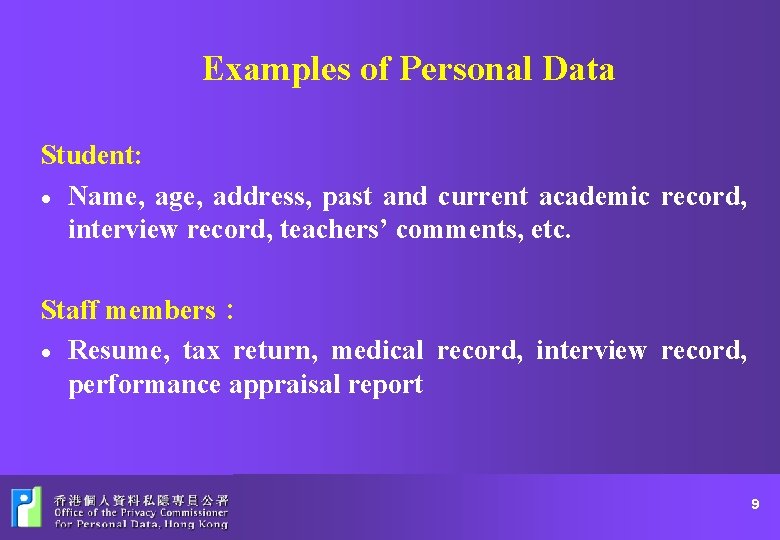
Examples of Personal Data Student: · Name, age, address, past and current academic record, interview record, teachers’ comments, etc. Staff members: · Resume, tax return, medical record, interview record, performance appraisal report 9
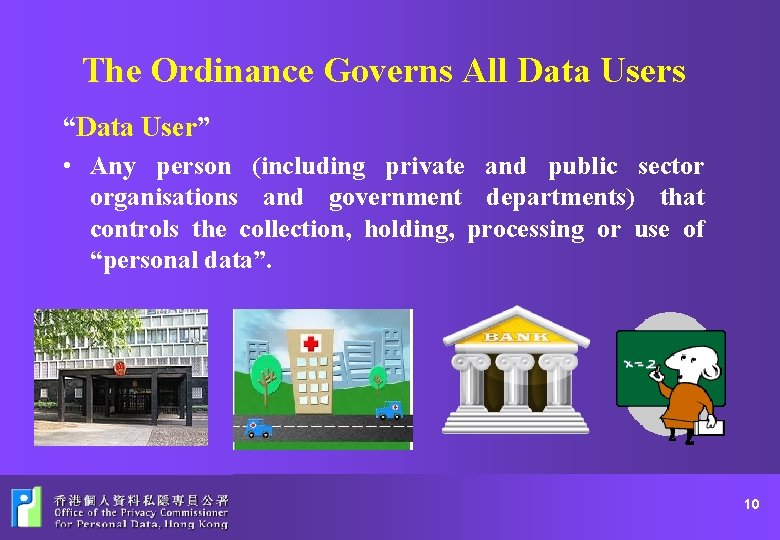
The Ordinance Governs All Data Users “Data User” • Any person (including private and public sector organisations and government departments) that controls the collection, holding, processing or use of “personal data”. 10
Data Protection Principles under the Ordinance • The six data protection principles form the base of the Ordinance. • Data users must comply with the six data protection principles in the collection, holding, accuracy, retention period, security, privacy policy and access to and correction of personal data. 11
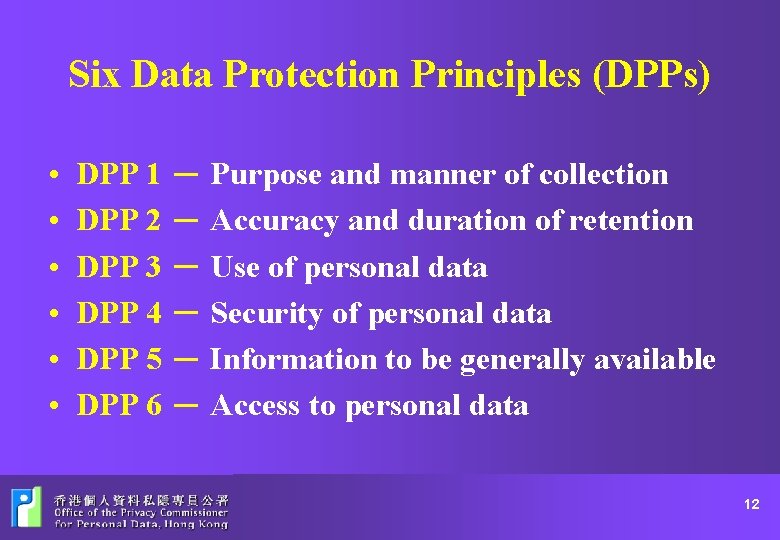
Six Data Protection Principles (DPPs) • • • DPP 1 - Purpose and manner of collection DPP 2 - Accuracy and duration of retention DPP 3 - Use of personal data DPP 4 - Security of personal data DPP 5 - Information to be generally available DPP 6 - Access to personal data 12
Principle 1 – Purpose and manner of collection • shall be collected for purposes related to the functions or activities of the data user • the data collected should be adequate but not excessive • the means of collection must be lawful and fair 13
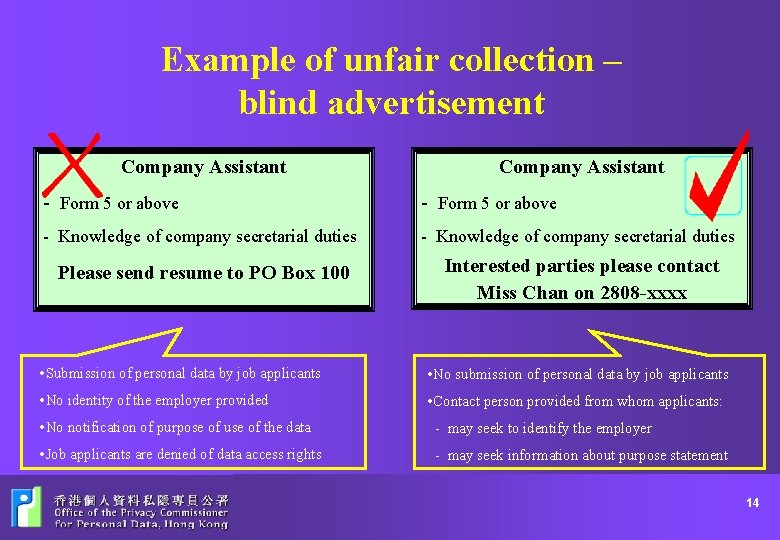
Example of unfair collection – blind advertisement Company Assistant - Form 5 or above - Knowledge of company secretarial duties Please send resume to PO Box 100 Interested parties please contact Miss Chan on 2808 -xxxx • Submission of personal data by job applicants • No submission of personal data by job applicants • No identity of the employer provided • Contact person provided from whom applicants: • No notification of purpose of use of the data - may seek to identify the employer • Job applicants are denied of data access rights - may seek information about purpose statement 14
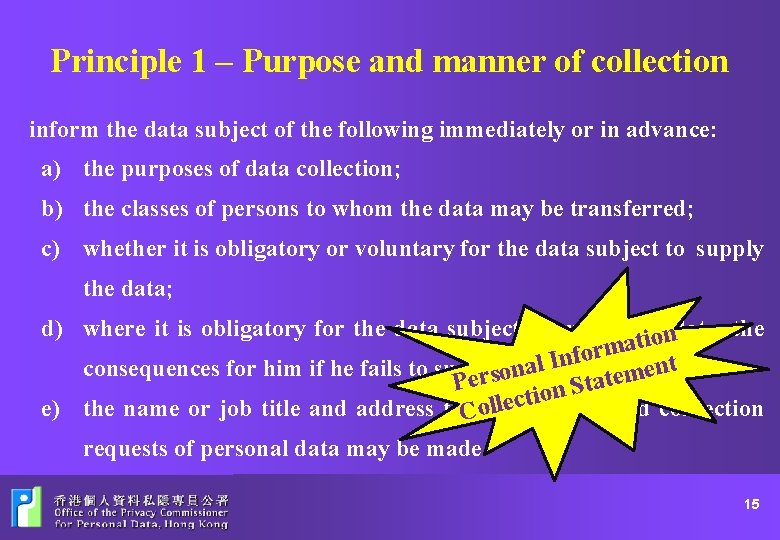
Principle 1 – Purpose and manner of collection inform the data subject of the following immediately or in advance: a) the purposes of data collection; b) the classes of persons to whom the data may be transferred; c) whether it is obligatory or voluntary for the data subject to supply the data; d) where it is obligatory for the data subject to supply the data, the n o i at m r o f n and ent I l a consequences for him if he fails to supply the data; n Perso ion Statem e) the name or job title and address to. Cwhich ollect access and correction requests of personal data may be made. 15
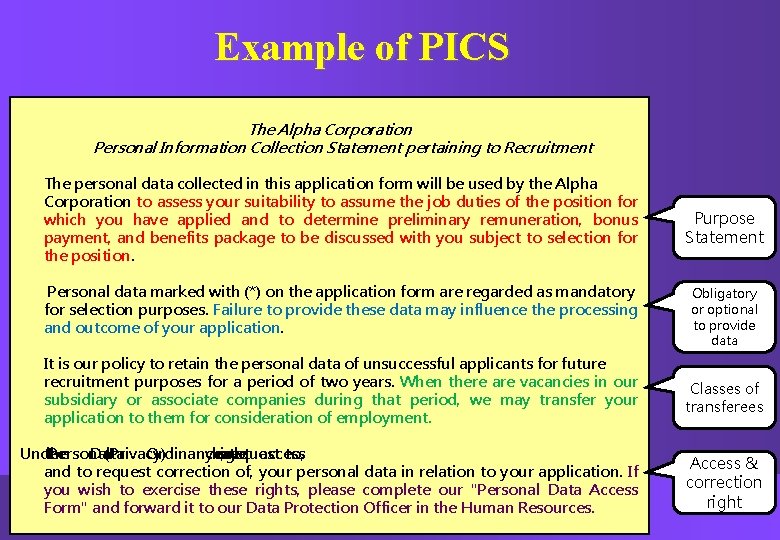
Example of PICS The Alpha Corporation Personal Information Collection Statement pertaining to Recruitment The personal data collected in this application form will be used by the Alpha Corporation to assess your suitability to assume the job duties of the position for which you have applied and to determine preliminary remuneration, bonus payment, and benefits package to be discussed with you subject to selection for the position. Personal data marked with (*) on the application form are regarded as mandatory for selection purposes. Failure to provide these data may influence the processing and outcome of your application. Purpose Statement Obligatory or optional to provide data It is our policy to retain the personal data of unsuccessful applicants for future recruitment purposes for a period of two years. When there are vacancies in our subsidiary or associate companies during that period, we may transfer your application to them for consideration of employment. Classes of transferees Under the Personal Data (Privacy) Ordinance, you have right request ato access to, and to request correction of, your personal data in relation to your application. If you wish to exercise these rights, please complete our "Personal Data Access Form" and forward it to our Data Protection Officer in the Human Resources. Access & correction right 16
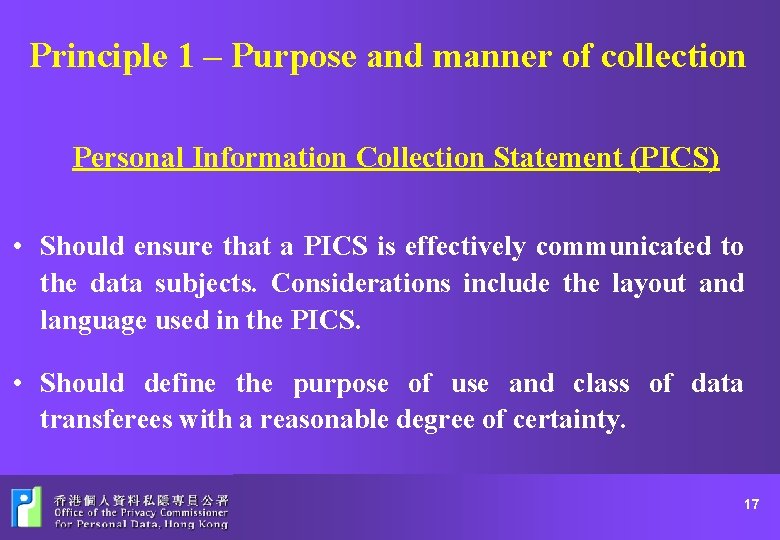
Principle 1 – Purpose and manner of collection Personal Information Collection Statement (PICS) • Should ensure that a PICS is effectively communicated to the data subjects. Considerations include the layout and language used in the PICS. • Should define the purpose of use and class of data transferees with a reasonable degree of certainty. 17
Principle 2 – Accuracy and duration of retention • Data users shall take practicable steps to ensure the accuracy of personal data held by them. • All practicable steps must be taken to ensure that personal data is not kept longer than is necessary for the fulfilment of the purpose. • If a data user engages a data processor to process personal data on the data user’s behalf, the data user must adopt contractual or other means to prevent any personal data transferred to the data processor from being kept longer than is necessary for processing of the data. 18
Principle 2 – Accuracy and duration of retention http: //fmis. hku. hk/vod/infosec/pdpo/home. html 19
Principle 3 – Use of personal data • Personal data shall not, without the prescribed consent of the data subject, be used for a new purpose. • Allow a “relevant person” to give prescribed consent for the data subject under specified conditions New purpose means any purpose other than the purposes for which they were collected or directly related purposes 20
Principle 3 – Use of personal data http: //fmis. hku. hk/vod/infosec/pdpo/home. html 21
Principle 4 – Security of personal data • All practicable steps shall be taken to ensure that personal data is protected against unauthorised or accidental access, processing, erasure, loss and use. • Security in the storage, processing and transmission of data. • If a data user engages a data processor to process personal data on the data user’s behalf, the data user must adopt contractual or other means to prevent unauthorised or accidental access, processing, erasure, loss or use of the data transferred to the data processor for processing. 22
Principle 4 – Security of personal data 23
Principle 4 – Security of personal data http: //fmis. hku. hk/vod/infosec/pdpo/home. html 24
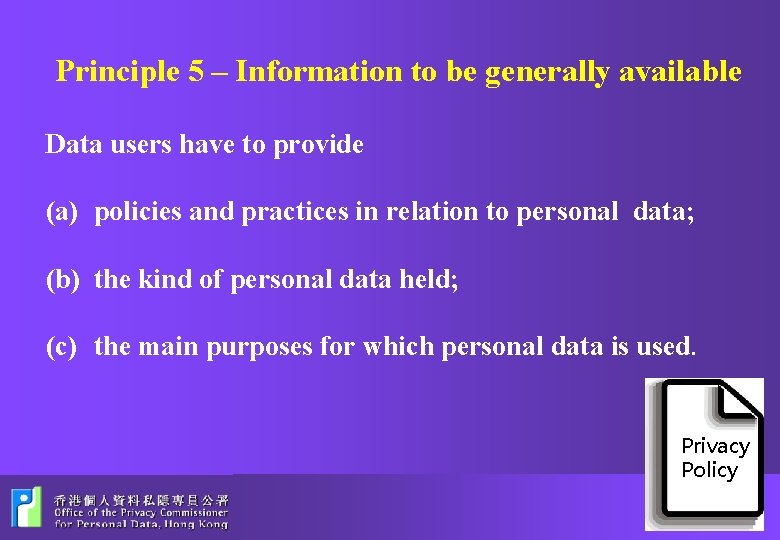
Principle 5 – Information to be generally available Data users have to provide (a) policies and practices in relation to personal data; (b) the kind of personal data held; (c) the main purposes for which personal data is used. Privacy Policy 25
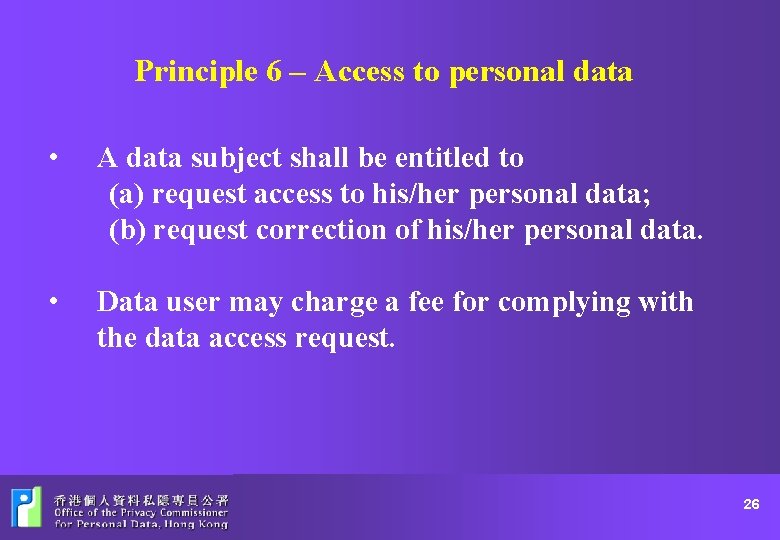
Principle 6 – Access to personal data • A data subject shall be entitled to (a) request access to his/her personal data; (b) request correction of his/her personal data. • Data user may charge a fee for complying with the data access request. 26
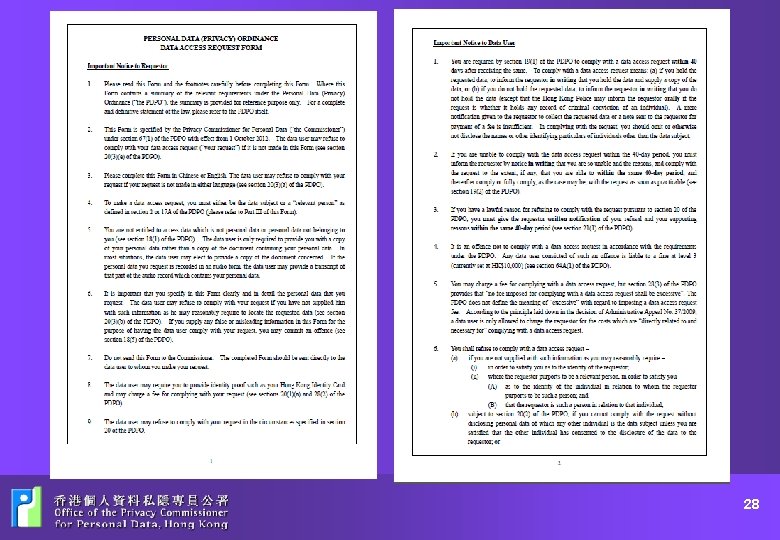
Principle 6 – Access to personal data 27
28
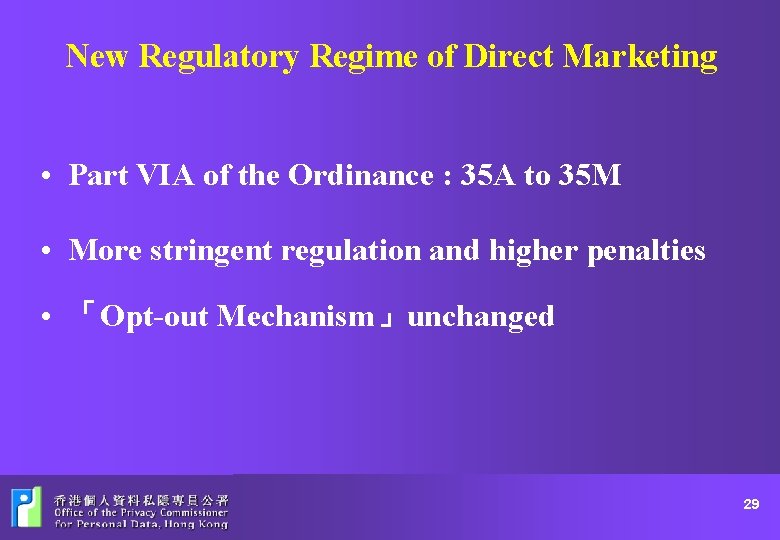
New Regulatory Regime of Direct Marketing • Part VIA of the Ordinance : 35 A to 35 M • More stringent regulation and higher penalties • 「Opt-out Mechanism」unchanged 29
Use of Personal Data in Direct Marketing • What is Direct Marketing? “Direct Marketing” is defined to mean a. the offering, or advertising of the availability, of goods, facilities or services; or b. the solicitation of donations or contributions for charitable, cultural, philanthropic, recreational, political or other purposes, through direct marketing means 30
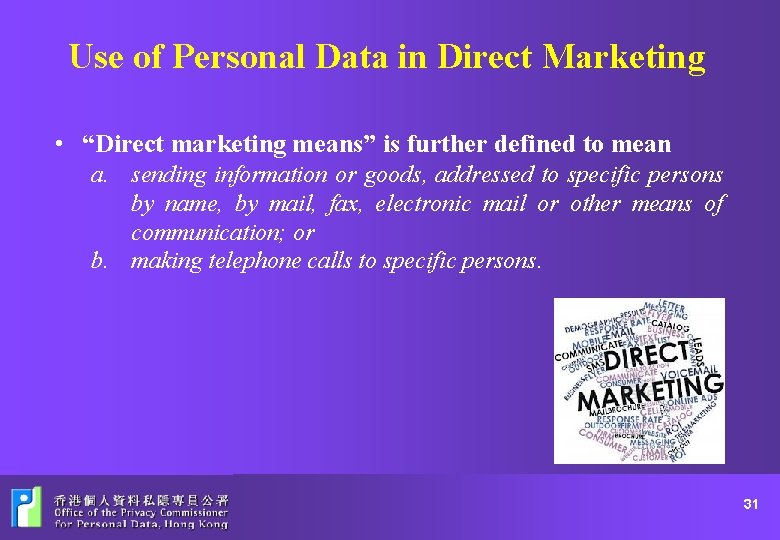
Use of Personal Data in Direct Marketing • “Direct marketing means” is further defined to mean a. sending information or goods, addressed to specific persons by name, by mail, fax, electronic mail or other means of communication; or b. making telephone calls to specific persons. 31
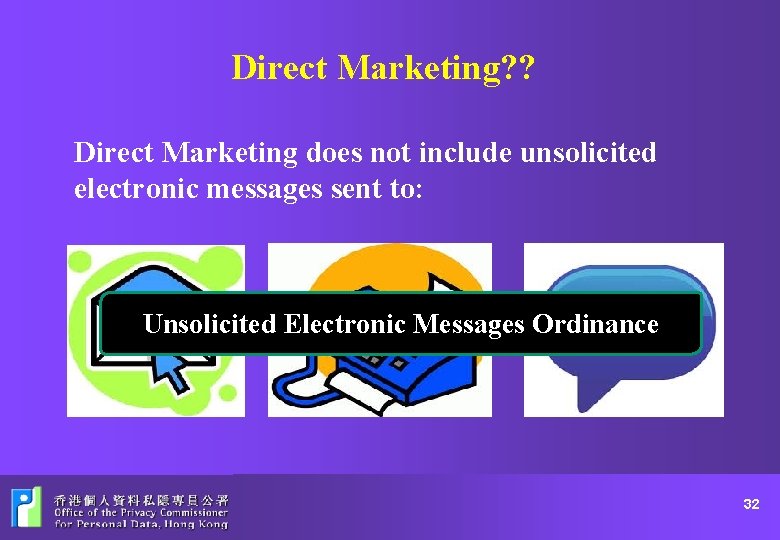
Direct Marketing? ? Direct Marketing does not include unsolicited electronic messages sent to: Unsolicited Electronic Messages Ordinance 32
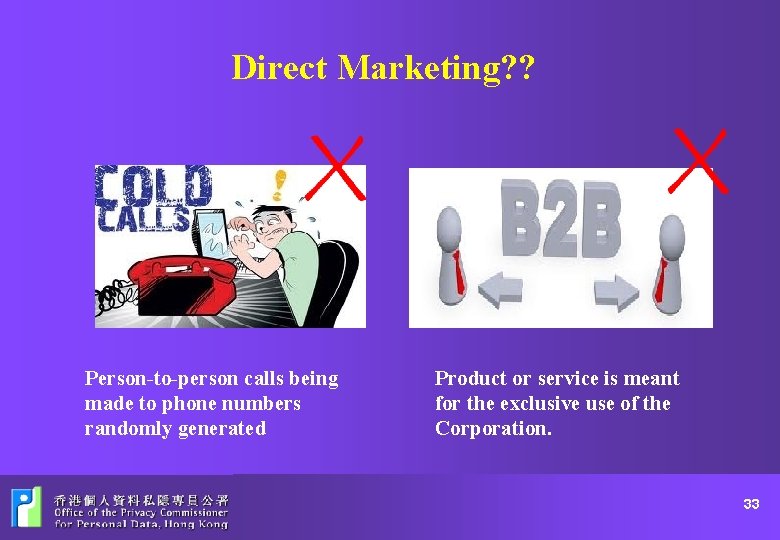
Direct Marketing? ? Person-to-person calls being made to phone numbers randomly generated Product or service is meant for the exclusive use of the Corporation. 33
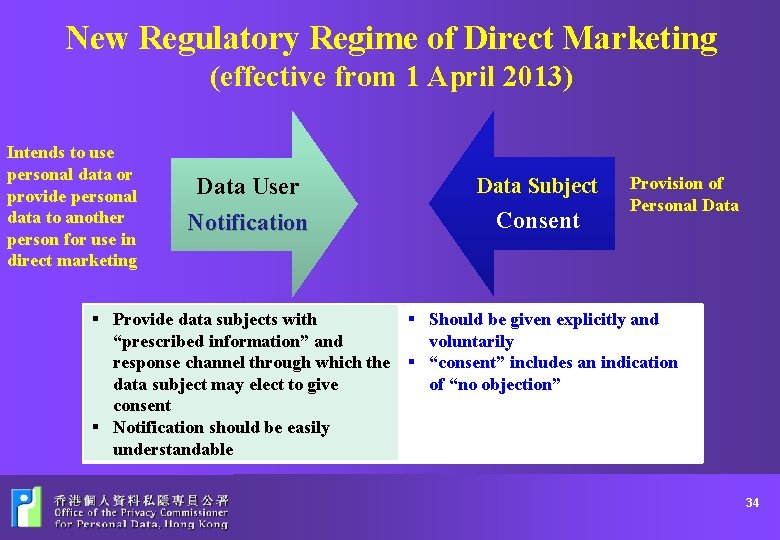
New Regulatory Regime of Direct Marketing (effective from 1 April 2013) Intends to use personal data or provide personal data to another person for use in direct marketing Data User Data Subject Notification Consent Provision of Personal Data § Provide data subjects with § Should be given explicitly and “prescribed information” and voluntarily response channel through which the § “consent” includes an indication data subject may elect to give of “no objection” consent § " § Notification should be easily understandable 34
New Regulatory Regime of Direct Marketing http: //www. pcpd. org. hk/english/review_ordinance/files/dm. wmv 35
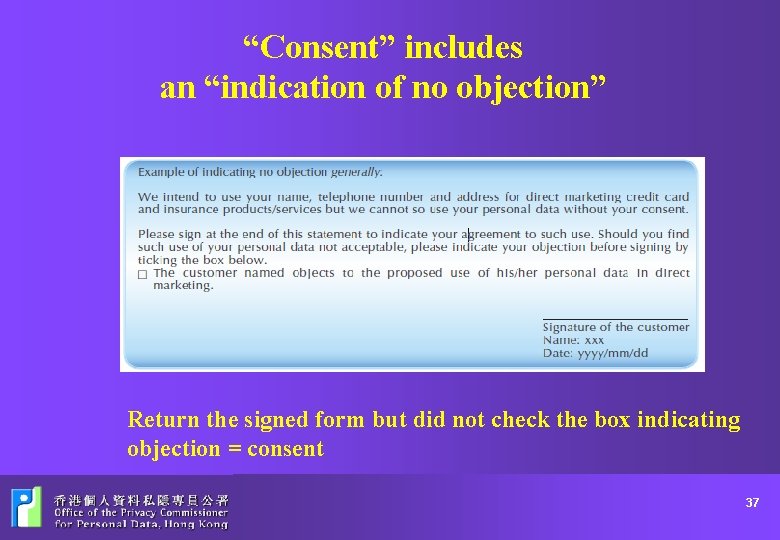
“Consent” includes an “indication of no objection” Return the signed form but did not check the box indicating objection = consent 37
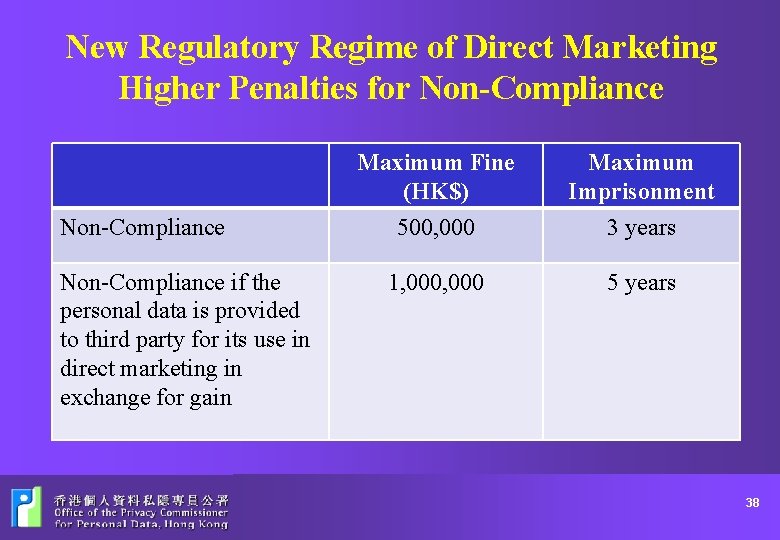
New Regulatory Regime of Direct Marketing Higher Penalties for Non-Compliance if the personal data is provided to third party for its use in direct marketing in exchange for gain Maximum Fine (HK$) Maximum Imprisonment 500, 000 3 years 1, 000 5 years 38
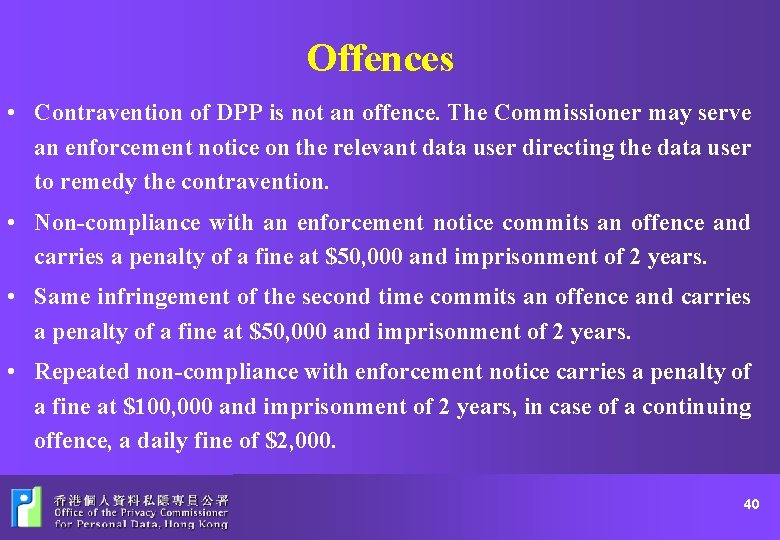
Offences • Contravention of DPP is not an offence. The Commissioner may serve an enforcement notice on the relevant data user directing the data user to remedy the contravention. • Non-compliance with an enforcement notice commits an offence and carries a penalty of a fine at $50, 000 and imprisonment of 2 years. • Same infringement of the second time commits an offence and carries a penalty of a fine at $50, 000 and imprisonment of 2 years. • Repeated non-compliance with enforcement notice carries a penalty of a fine at $100, 000 and imprisonment of 2 years, in case of a continuing offence, a daily fine of $2, 000. 40
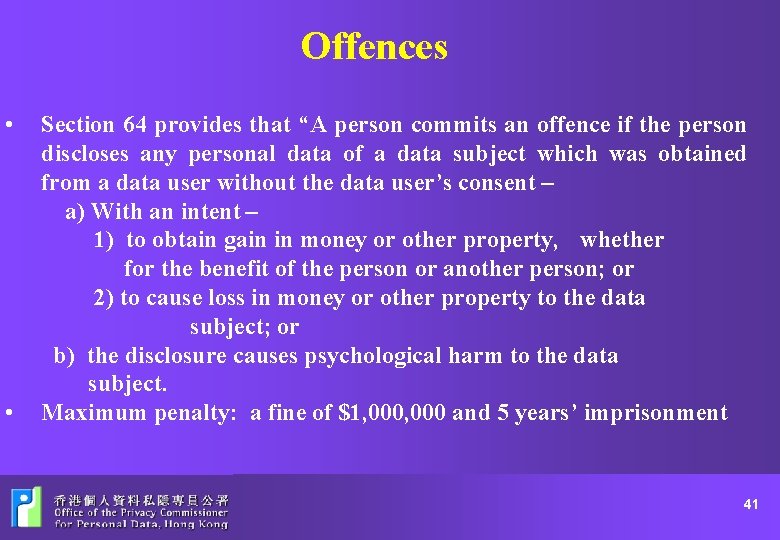
Offences • • Section 64 provides that “A person commits an offence if the person discloses any personal data of a data subject which was obtained from a data user without the data user’s consent – a) With an intent – 1) to obtain gain in money or other property, whether for the benefit of the person or another person; or 2) to cause loss in money or other property to the data subject; or b) the disclosure causes psychological harm to the data subject. Maximum penalty: a fine of $1, 000 and 5 years’ imprisonment 41
Compensation • New section 66 B : Privacy Commissioner can grant assistance to data subject in respect of these legal proceedings 42
Code of Practice • Identity Card Number and other Personal Identifiers • Human Resource Management • Consumer Credit Data 43
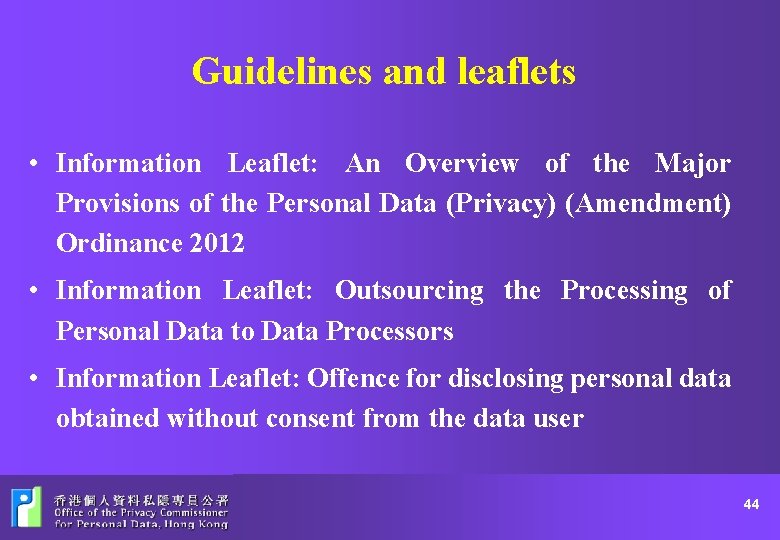
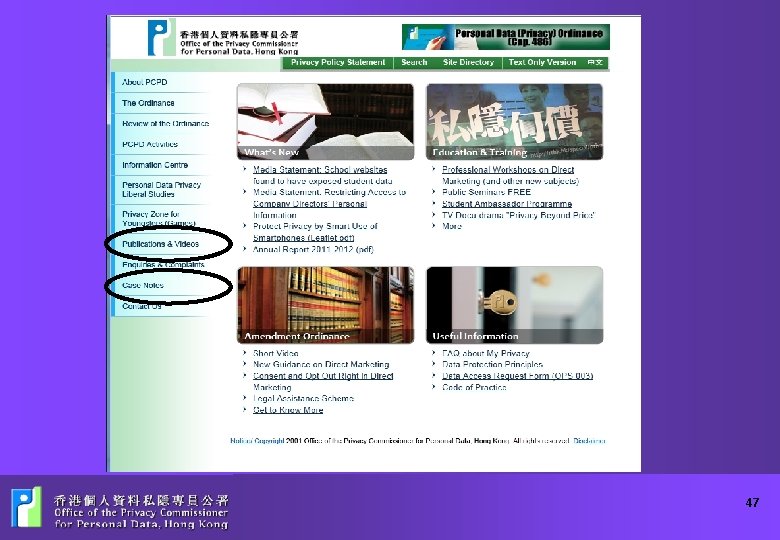
Guidelines and leaflets • Information Leaflet: An Overview of the Major Provisions of the Personal Data (Privacy) (Amendment) Ordinance 2012 • Information Leaflet: Outsourcing the Processing of Personal Data to Data Processors • Information Leaflet: Offence for disclosing personal data obtained without consent from the data user 44
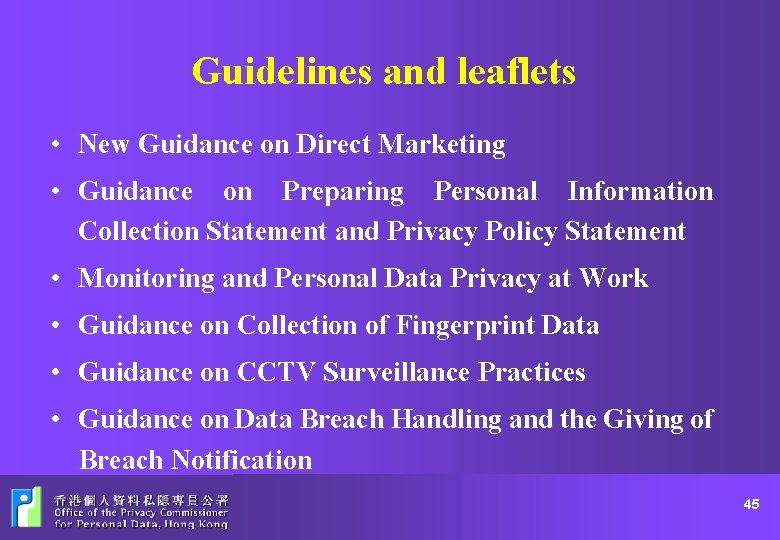
Guidelines and leaflets • New Guidance on Direct Marketing • Guidance on Preparing Personal Information Collection Statement and Privacy Policy Statement • Monitoring and Personal Data Privacy at Work • Guidance on Collection of Fingerprint Data • Guidance on CCTV Surveillance Practices • Guidance on Data Breach Handling and the Giving of Breach Notification 45
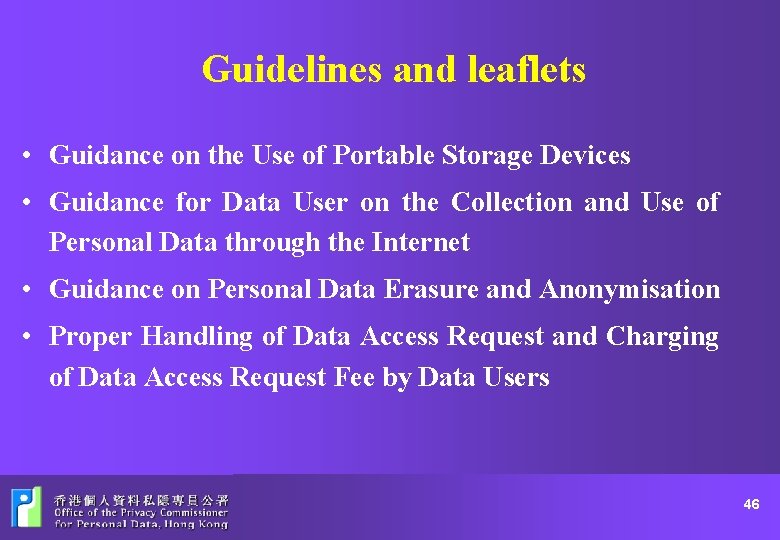
Guidelines and leaflets • Guidance on the Use of Portable Storage Devices • Guidance for Data User on the Collection and Use of Personal Data through the Internet • Guidance on Personal Data Erasure and Anonymisation • Proper Handling of Data Access Request and Charging of Data Access Request Fee by Data Users 46
47
Contact Us q Hotline q Fax q Website q E-mail - 2827 - 2877 7026 - www. pcpd. org. hk - enquiry@pcpd. org. hk q Address - 12/F, 248 Queen’s Road East, Wanchai, HK © Office of the Privacy Commissioner for Personal Data, 2014 The above Power. Point may not be reproduced without the written consent of the Office of the Privacy Commissioner for Personal Data. 48