
University Physics Midterm Exam Overview 16 THE NATURE

- Slides: 32
University Physics Midterm Exam Overview
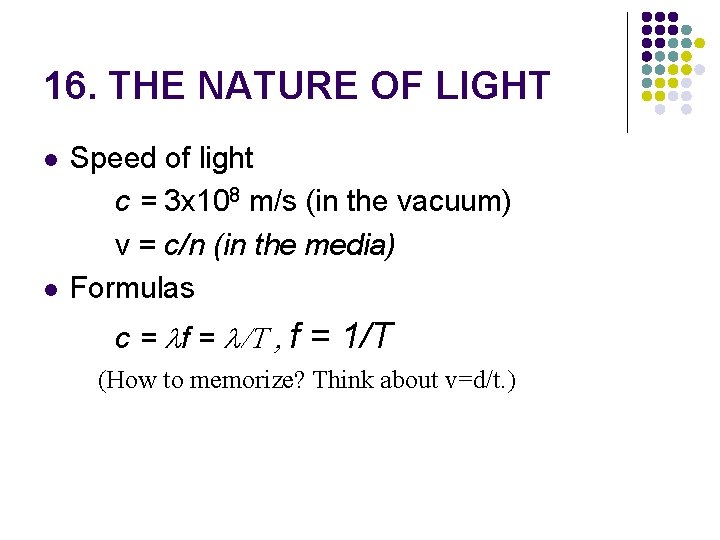
16. THE NATURE OF LIGHT l l Speed of light c = 3 x 10⁸ m/s (in the vacuum) v = c/n (in the media) Formulas c = lf = l/T , f = 1/T (How to memorize? Think about v=d/t. )
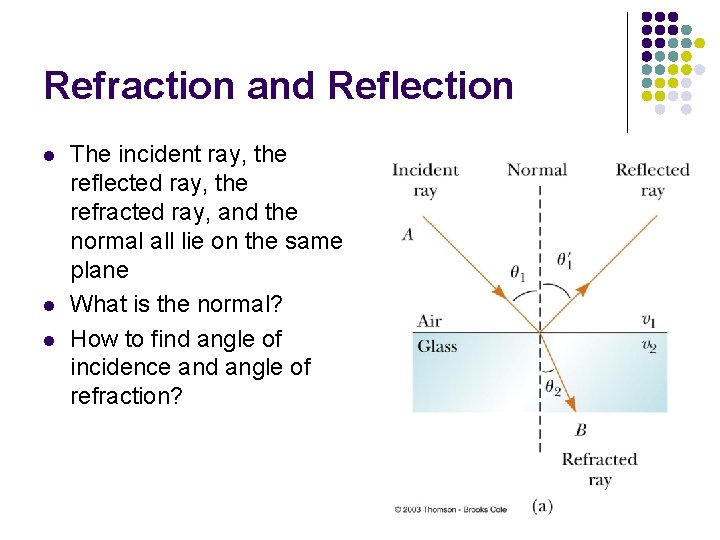
Refraction and Reflection l l l The incident ray, the reflected ray, the refracted ray, and the normal all lie on the same plane What is the normal? How to find angle of incidence and angle of refraction?
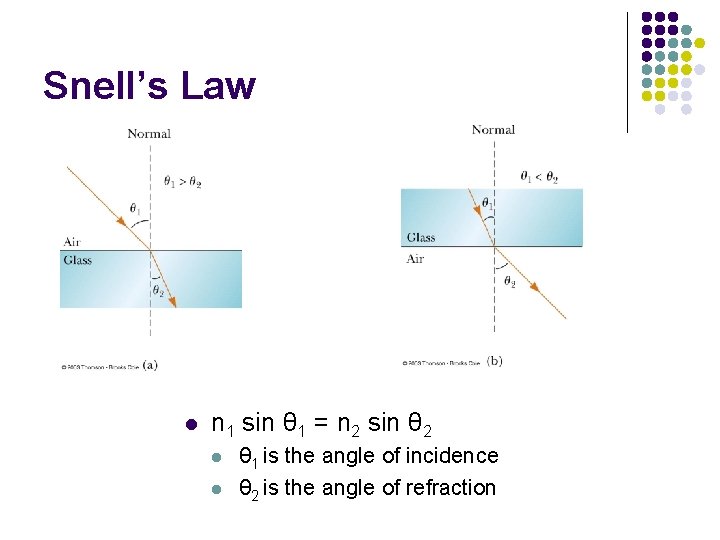
Snell’s Law l n 1 sin θ 1 = n 2 sin θ 2 l l θ 1 is the angle of incidence θ 2 is the angle of refraction
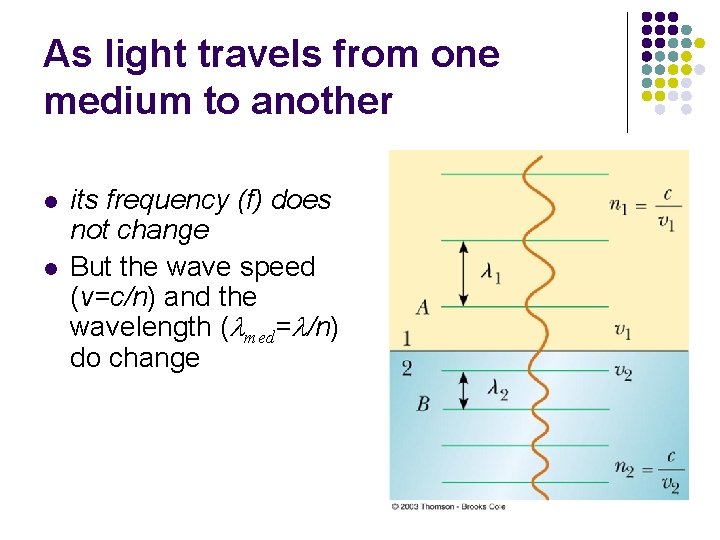
As light travels from one medium to another l l its frequency (f) does not change But the wave speed (v=c/n) and the wavelength (lmed=l/n) do change
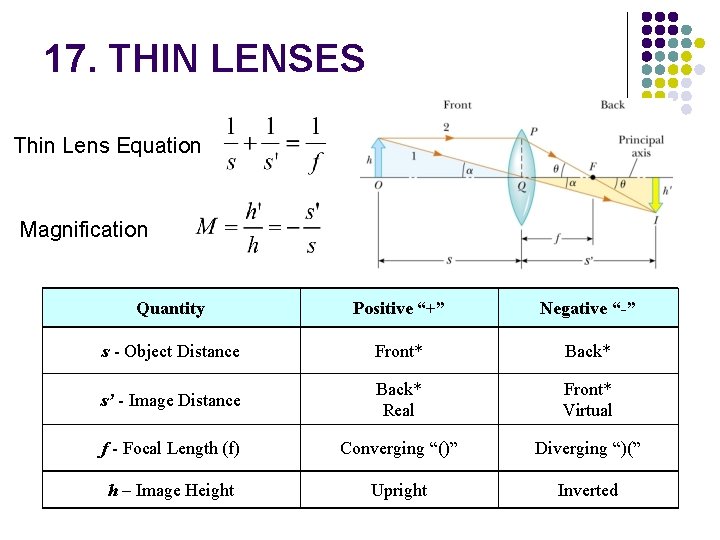
17. THIN LENSES Thin Lens Equation Magnification Quantity Positive “+” Negative “-” s - Object Distance Front* Back* s’ - Image Distance Back* Real Front* Virtual f - Focal Length (f) Converging “()” Diverging “)(” h – Image Height Upright Inverted
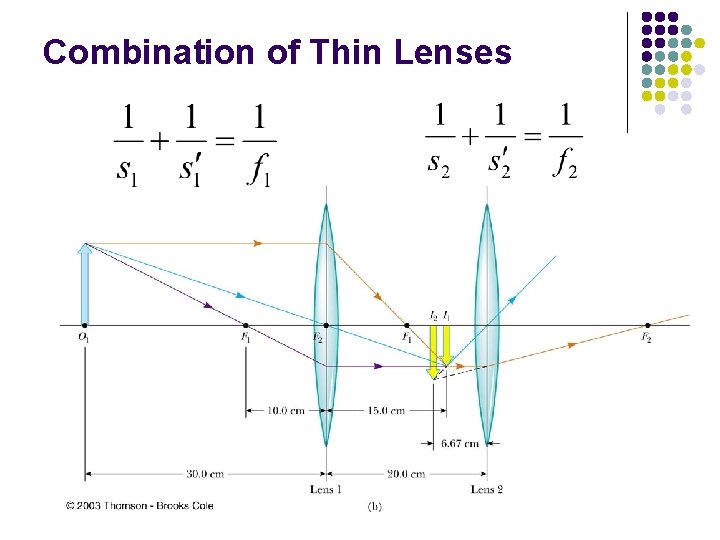
Combination of Thin Lenses
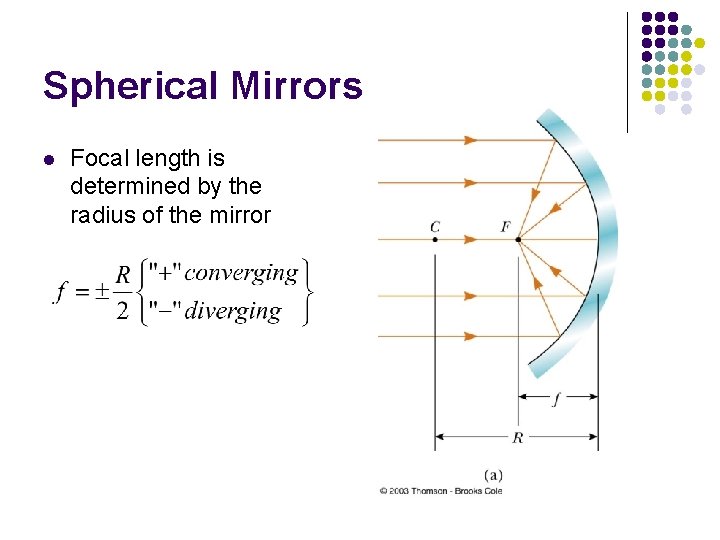
Spherical Mirrors l Focal length is determined by the radius of the mirror
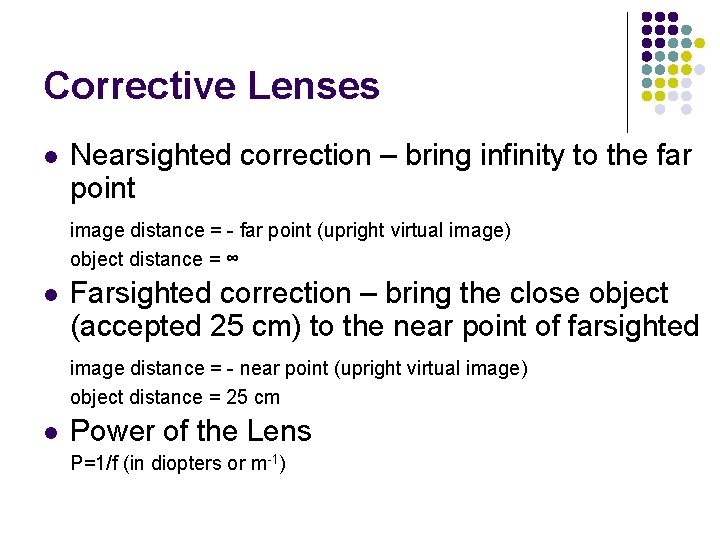
Corrective Lenses l Nearsighted correction – bring infinity to the far point image distance = - far point (upright virtual image) object distance = ∞ l Farsighted correction – bring the close object (accepted 25 cm) to the near point of farsighted image distance = - near point (upright virtual image) object distance = 25 cm l Power of the Lens P=1/f (in diopters or m-1)
18. Wave Motion l l A wave is the motion of a disturbance Mechanical waves require l l Some source of disturbance A medium that can be disturbed Some physical connection between or mechanism though which adjacent portions of the medium influence each other All waves carry energy and momentum
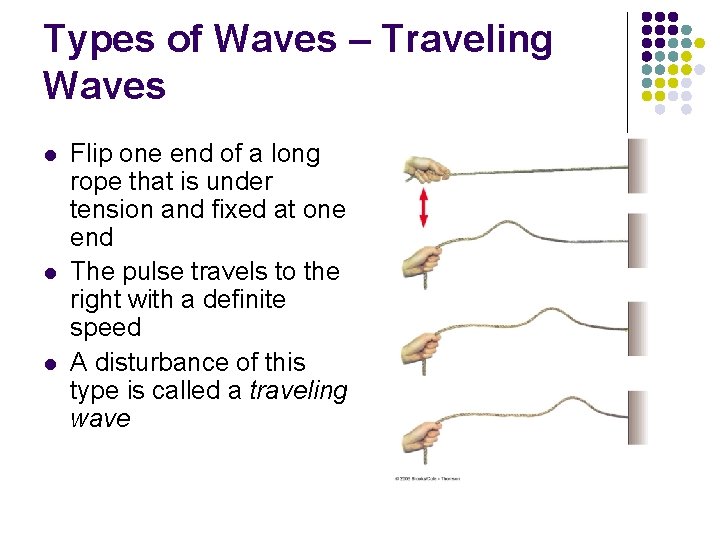
Types of Waves – Traveling Waves l l l Flip one end of a long rope that is under tension and fixed at one end The pulse travels to the right with a definite speed A disturbance of this type is called a traveling wave
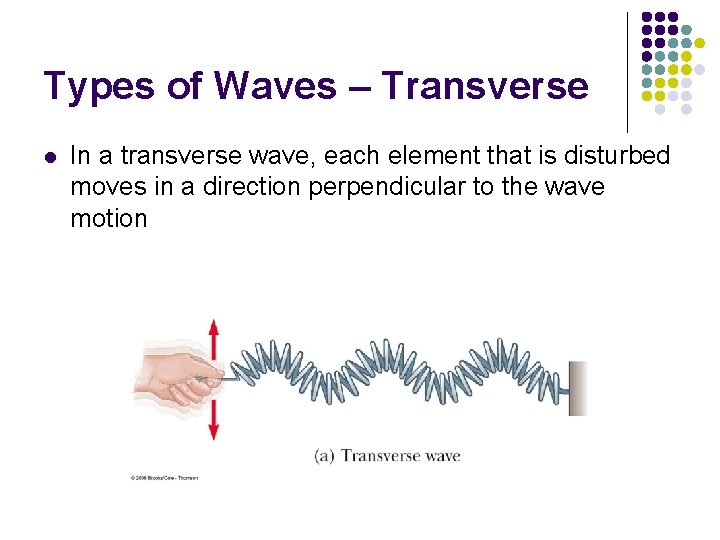
Types of Waves – Transverse l In a transverse wave, each element that is disturbed moves in a direction perpendicular to the wave motion
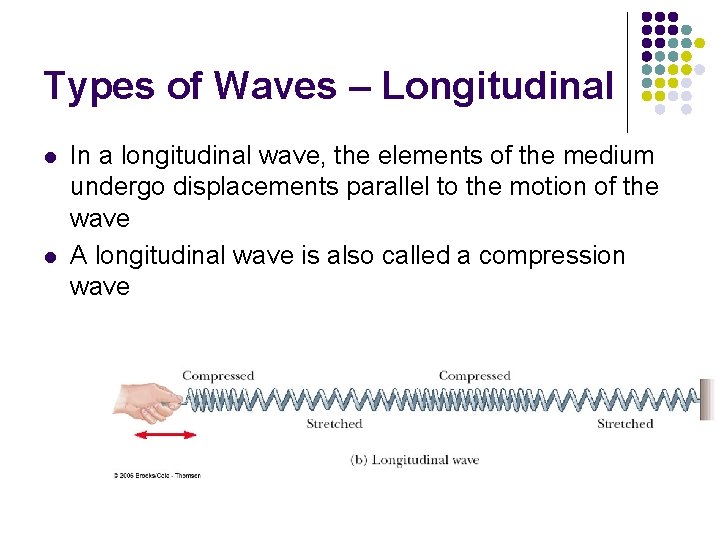
Types of Waves – Longitudinal l l In a longitudinal wave, the elements of the medium undergo displacements parallel to the motion of the wave A longitudinal wave is also called a compression wave
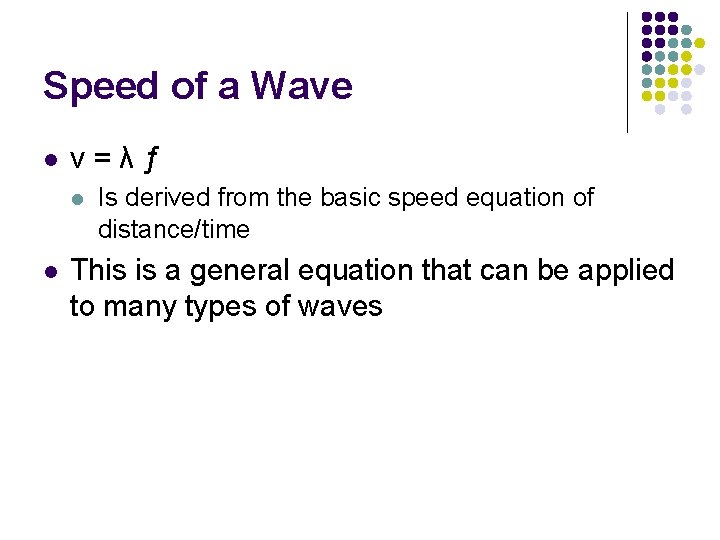
Speed of a Wave l v=λƒ l l Is derived from the basic speed equation of distance/time This is a general equation that can be applied to many types of waves
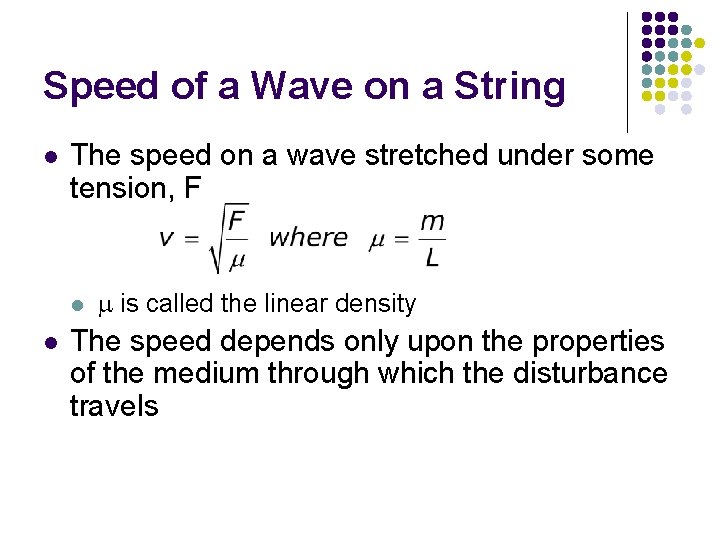
Speed of a Wave on a String l The speed on a wave stretched under some tension, F l l m is called the linear density The speed depends only upon the properties of the medium through which the disturbance travels
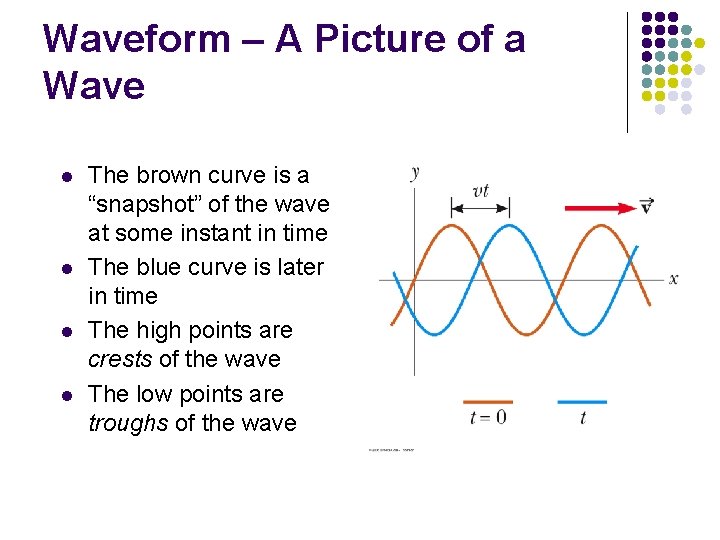
Waveform – A Picture of a Wave l l The brown curve is a “snapshot” of the wave at some instant in time The blue curve is later in time The high points are crests of the wave The low points are troughs of the wave
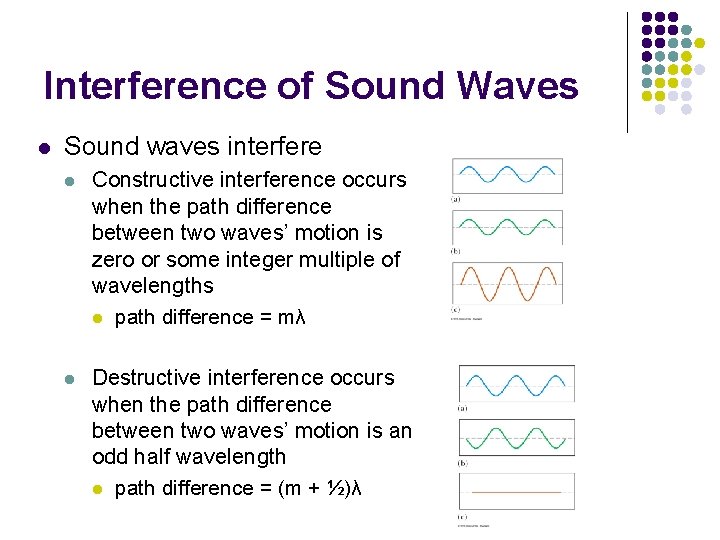
Interference of Sound Waves l Sound waves interfere l Constructive interference occurs when the path difference between two waves’ motion is zero or some integer multiple of wavelengths l path difference = mλ l Destructive interference occurs when the path difference between two waves’ motion is an odd half wavelength l path difference = (m + ½)λ
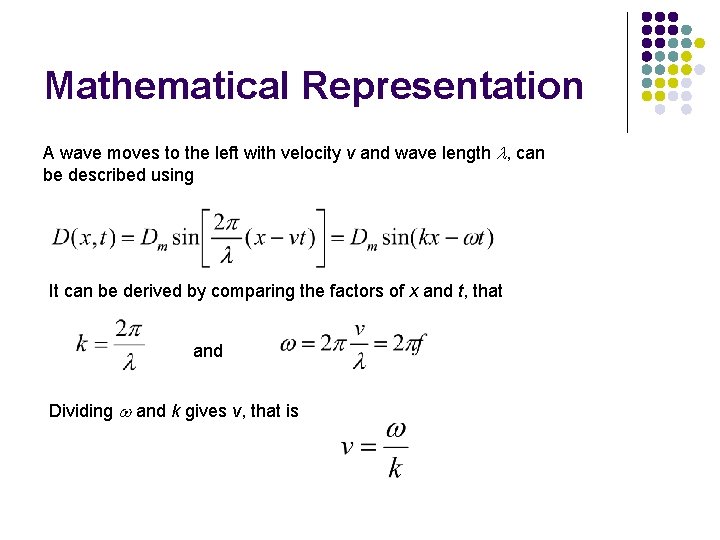
Mathematical Representation A wave moves to the left with velocity v and wave length l, can be described using It can be derived by comparing the factors of x and t, that and Dividing w and k gives v, that is
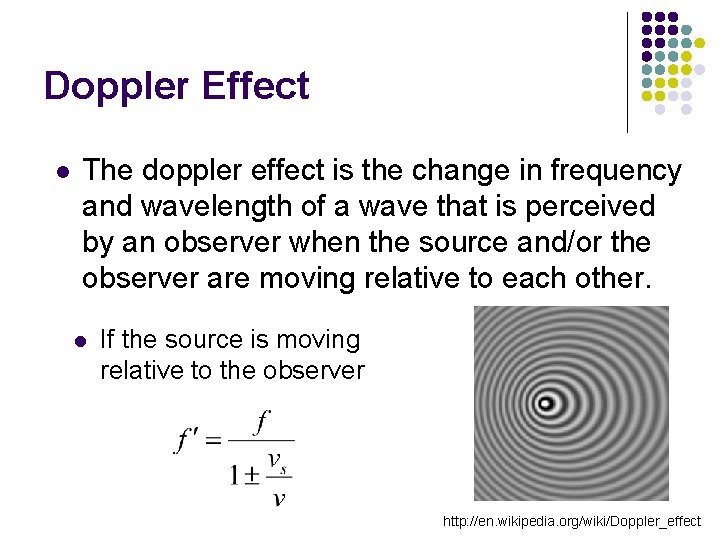
Doppler Effect l The doppler effect is the change in frequency and wavelength of a wave that is perceived by an observer when the source and/or the observer are moving relative to each other. l If the source is moving relative to the observer http: //en. wikipedia. org/wiki/Doppler_effect
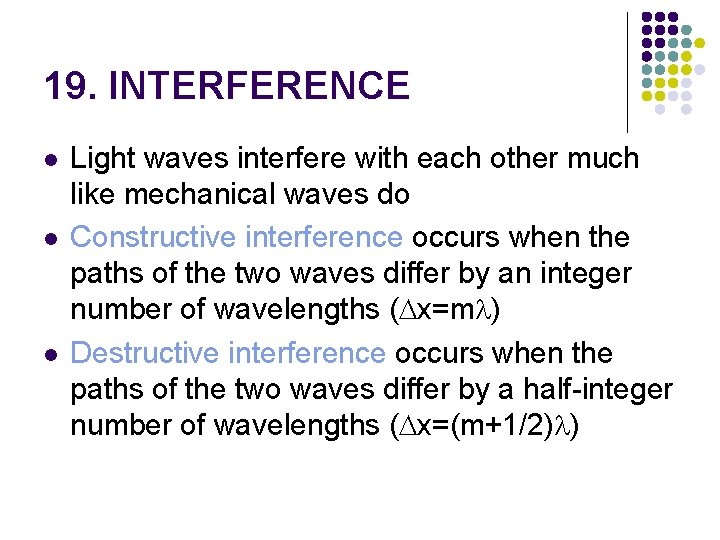
19. INTERFERENCE l l l Light waves interfere with each other much like mechanical waves do Constructive interference occurs when the paths of the two waves differ by an integer number of wavelengths (Dx=ml) Destructive interference occurs when the paths of the two waves differ by a half-integer number of wavelengths (Dx=(m+1/2)l)
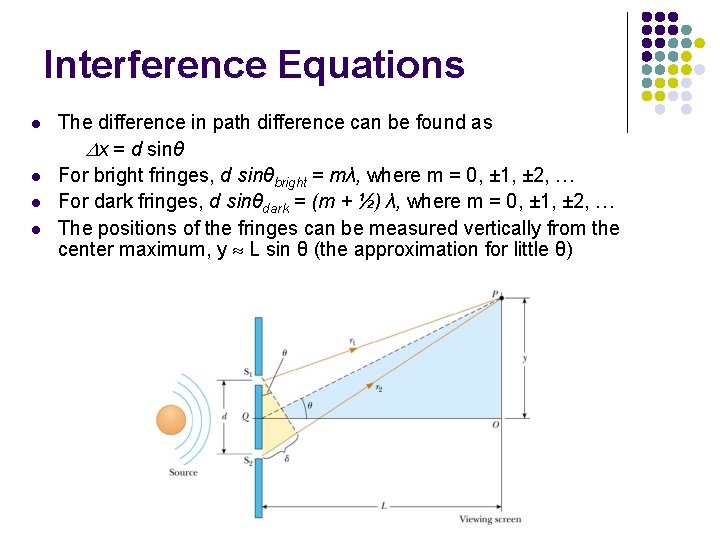
Interference Equations l l The difference in path difference can be found as Dx = d sinθ For bright fringes, d sinθbright = mλ, where m = 0, ± 1, ± 2, … For dark fringes, d sinθdark = (m + ½) λ, where m = 0, ± 1, ± 2, … The positions of the fringes can be measured vertically from the center maximum, y L sin θ (the approximation for little θ)
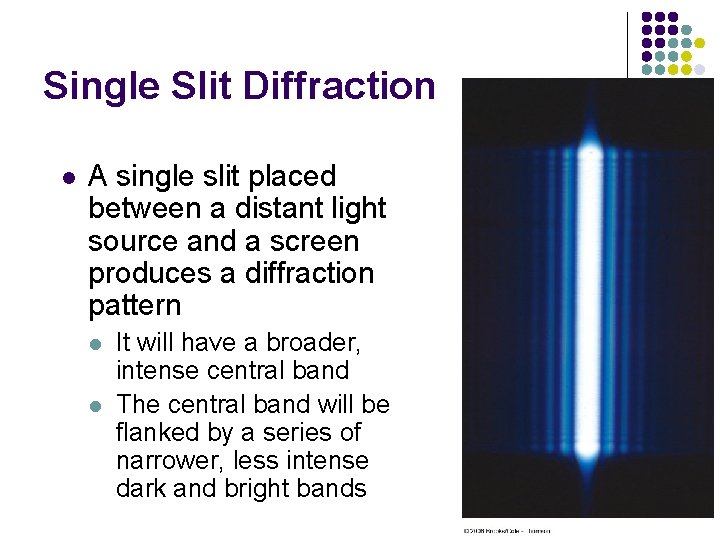
Single Slit Diffraction l A single slit placed between a distant light source and a screen produces a diffraction pattern l l It will have a broader, intense central band The central band will be flanked by a series of narrower, less intense dark and bright bands
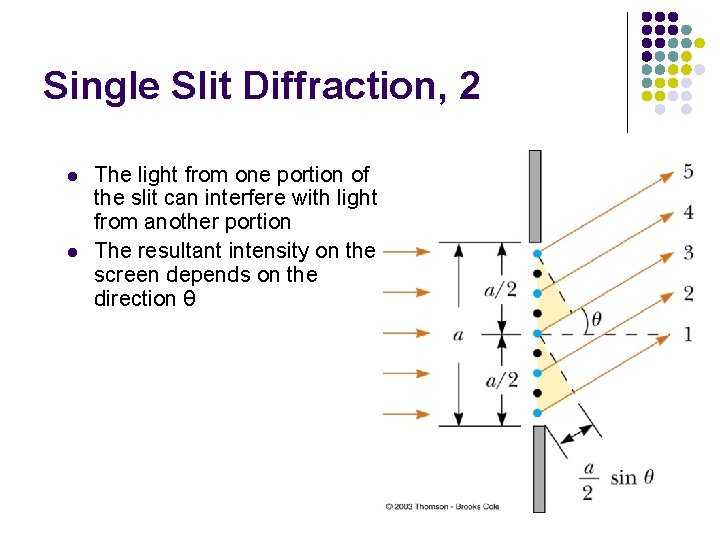
Single Slit Diffraction, 2 l l The light from one portion of the slit can interfere with light from another portion The resultant intensity on the screen depends on the direction θ
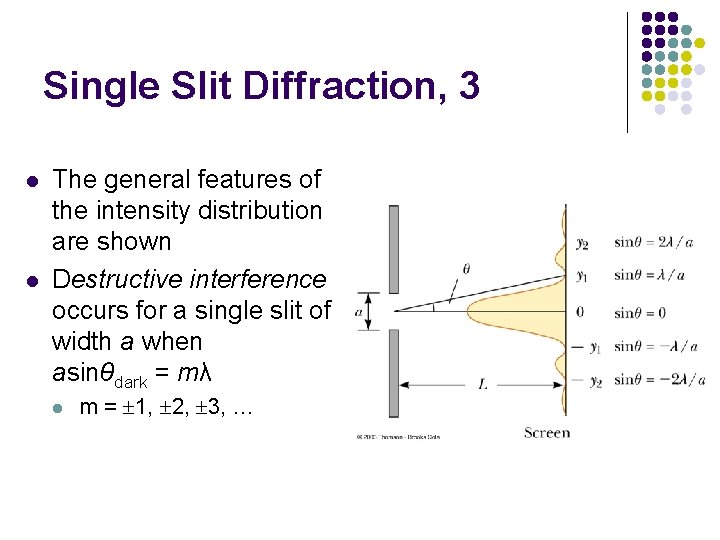
Single Slit Diffraction, 3 l l The general features of the intensity distribution are shown Destructive interference occurs for a single slit of width a when asinθdark = mλ l m = 1, 2, 3, …
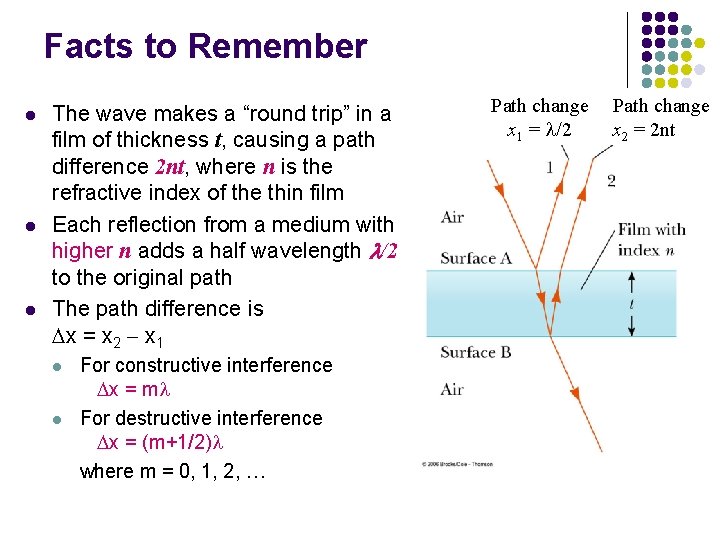
Interference in Thin Films l The interference is due to the interaction of the waves reflected from both surfaces of the film l Be sure to include two effects when analyzing the interference pattern from a thin film l l Path length Phase change
Facts to Remember l l l The wave makes a “round trip” in a film of thickness t, causing a path difference 2 nt, where n is the refractive index of the thin film Each reflection from a medium with higher n adds a half wavelength l/2 to the original path The path difference is Dx = x 2 x 1 l l For constructive interference Dx = ml For destructive interference Dx = (m+1/2)l where m = 0, 1, 2, … Path change x 1 = l/2 Path change x 2 = 2 nt
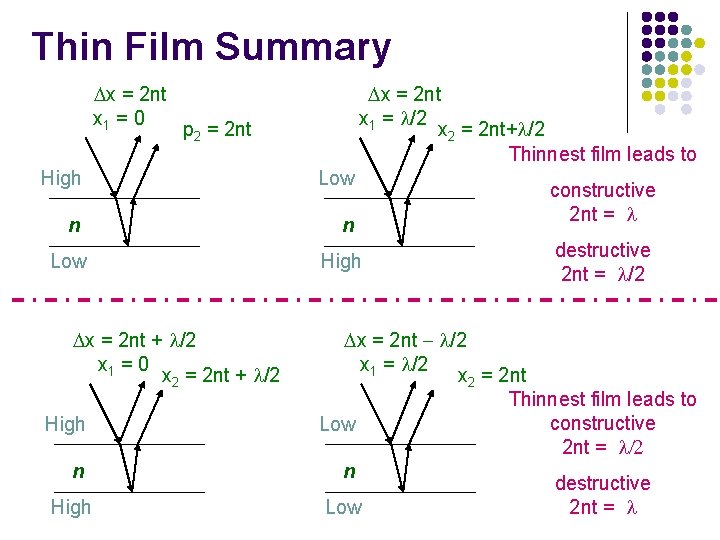
Thin Film Summary Dx = 2 nt x 1 = 0 Dx = 2 nt x 1 = l/2 x 2 = 2 nt+l/2 Thinnest film leads to p 2 = 2 nt High Low n n Low High Dx = 2 nt + l/2 x 1 = 0 x 2 = 2 nt + l/2 High n High constructive 2 nt = l destructive 2 nt = l/2 Dx = 2 nt l/2 x 1 = l/2 x 2 = 2 nt Thinnest film leads to constructive Low 2 nt = l/2 n destructive Low 2 nt = l
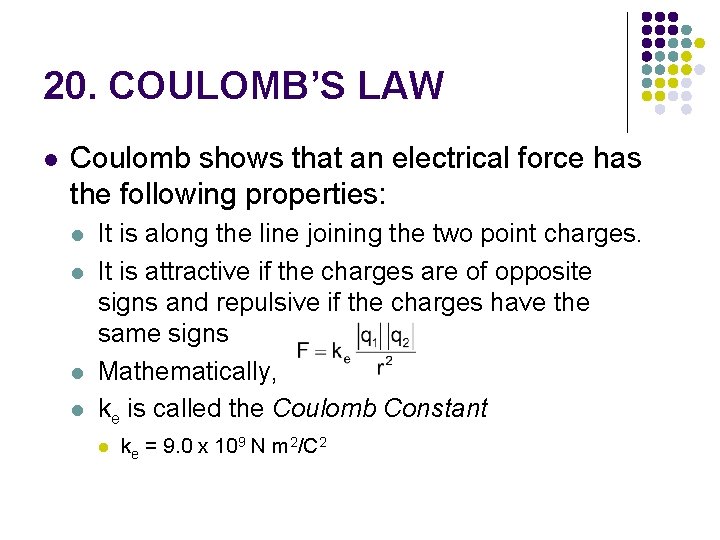
20. COULOMB’S LAW l Coulomb shows that an electrical force has the following properties: l l It is along the line joining the two point charges. It is attractive if the charges are of opposite signs and repulsive if the charges have the same signs Mathematically, ke is called the Coulomb Constant l ke = 9. 0 x 109 N m 2/C 2
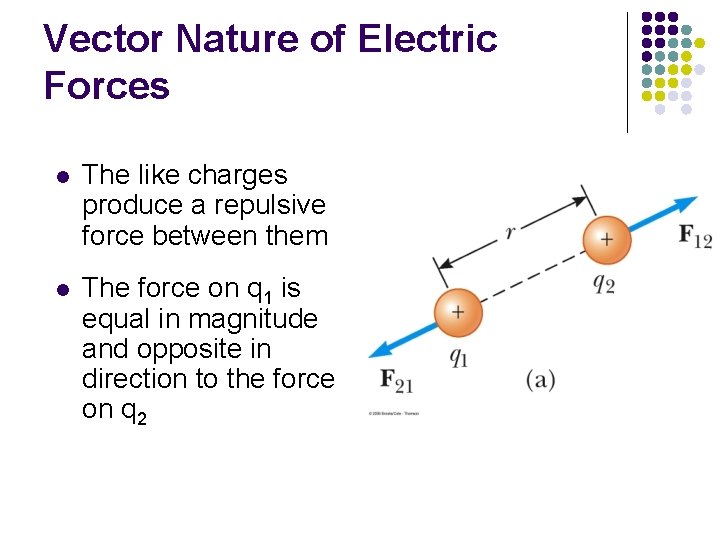
Vector Nature of Electric Forces l The like charges produce a repulsive force between them l The force on q 1 is equal in magnitude and opposite in direction to the force on q 2
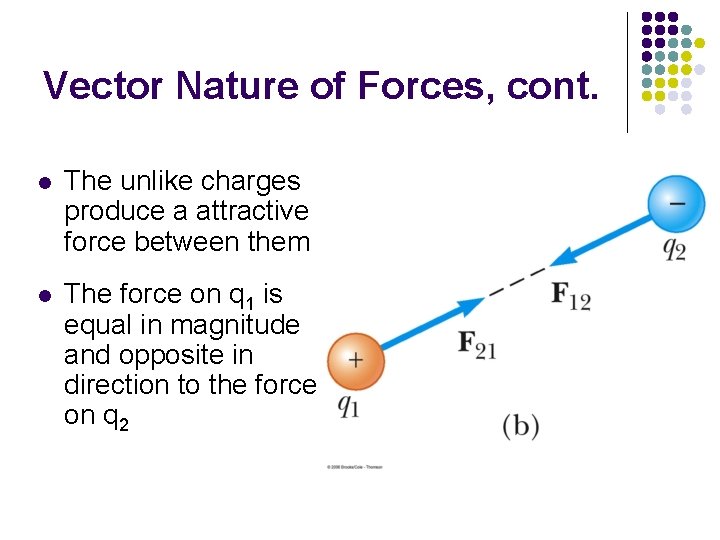
Vector Nature of Forces, cont. l The unlike charges produce a attractive force between them l The force on q 1 is equal in magnitude and opposite in direction to the force on q 2
The Superposition Principle l The resultant force on any one charge equals the vector sum of the forces exerted by the other individual charges that are present. l Remember to add the forces as vectors
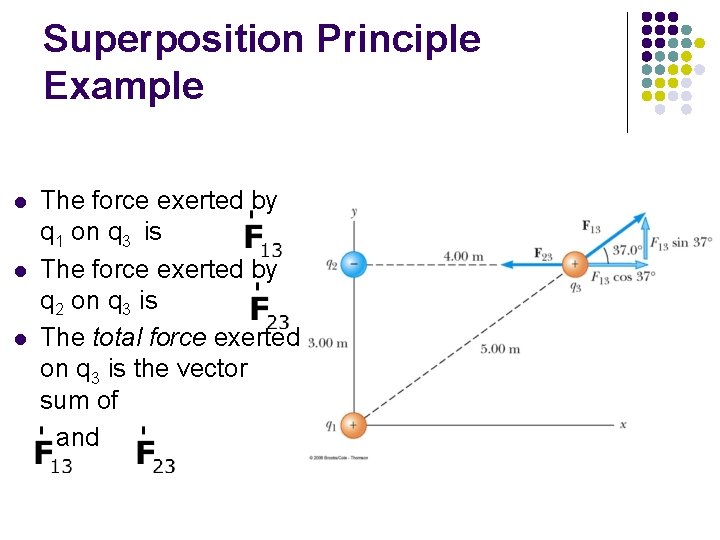
Superposition Principle Example l l l The force exerted by q 1 on q 3 is The force exerted by q 2 on q 3 is The total force exerted on q 3 is the vector sum of and