
UNIVERSITY of WISCONSINMADISON Computer Sciences Department CS 537
![Dining Philosophers: Solution sem_t may. Eat[5]; // how to initialize? sem_t mutex; // how](https://slidetodoc.com/presentation_image_h2/66c1d95604fc7c934c404f316b66d5da/image-7.jpg "Dining Philosophers: Solution sem_t may. Eat[5]; // how to initialize? sem_t mutex; // how")
- Slides: 16
UNIVERSITY of WISCONSIN-MADISON Computer Sciences Department CS 537 Introduction to Operating Systems Andrea C. Arpaci-Dusseau Remzi H. Arpaci-Dusseau Dining Philosophers & Monitors Questions answered in this lecture: How to synchronize dining philosophers? What are monitors and condition variables? What are the differences between Hoare and Mesa specifications?
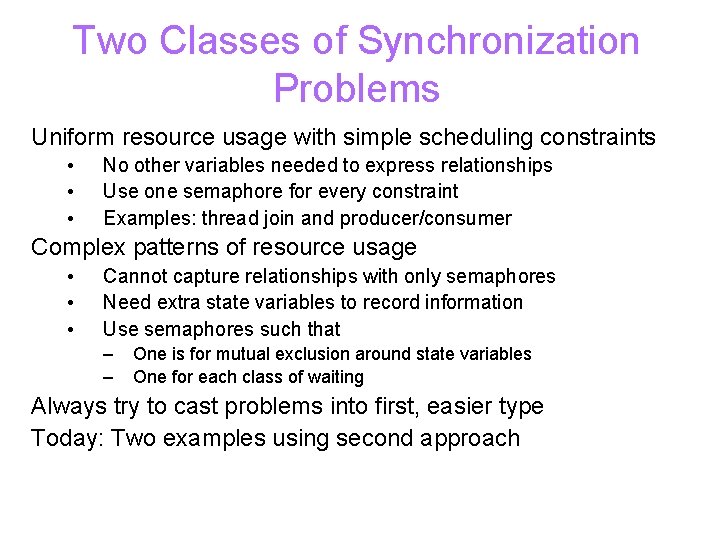
Two Classes of Synchronization Problems Uniform resource usage with simple scheduling constraints • • • No other variables needed to express relationships Use one semaphore for every constraint Examples: thread join and producer/consumer Complex patterns of resource usage • • • Cannot capture relationships with only semaphores Need extra state variables to record information Use semaphores such that – – One is for mutual exclusion around state variables One for each class of waiting Always try to cast problems into first, easier type Today: Two examples using second approach
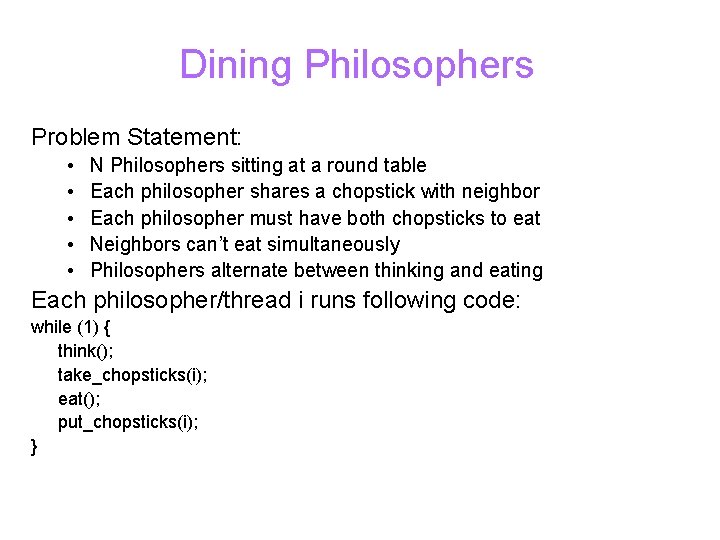
Dining Philosophers Problem Statement: • • • N Philosophers sitting at a round table Each philosopher shares a chopstick with neighbor Each philosopher must have both chopsticks to eat Neighbors can’t eat simultaneously Philosophers alternate between thinking and eating Each philosopher/thread i runs following code: while (1) { think(); take_chopsticks(i); eat(); put_chopsticks(i); }
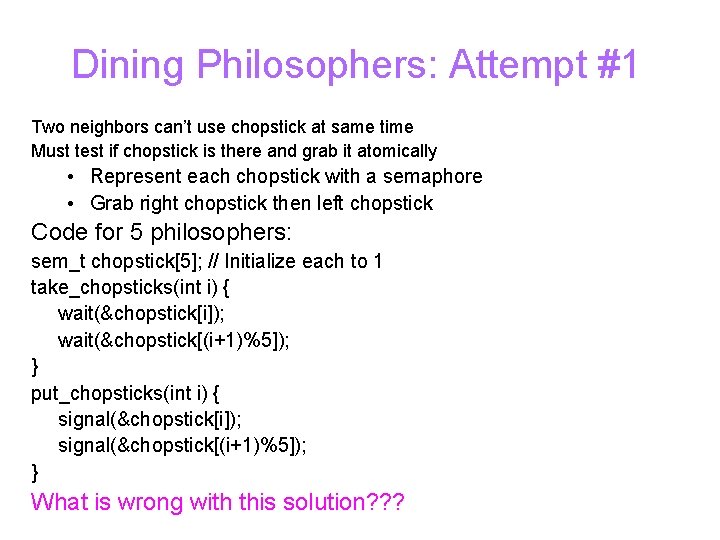
Dining Philosophers: Attempt #1 Two neighbors can’t use chopstick at same time Must test if chopstick is there and grab it atomically • Represent each chopstick with a semaphore • Grab right chopstick then left chopstick Code for 5 philosophers: sem_t chopstick[5]; // Initialize each to 1 take_chopsticks(int i) { wait(&chopstick[i]); wait(&chopstick[(i+1)%5]); } put_chopsticks(int i) { signal(&chopstick[i]); signal(&chopstick[(i+1)%5]); } What is wrong with this solution? ? ?
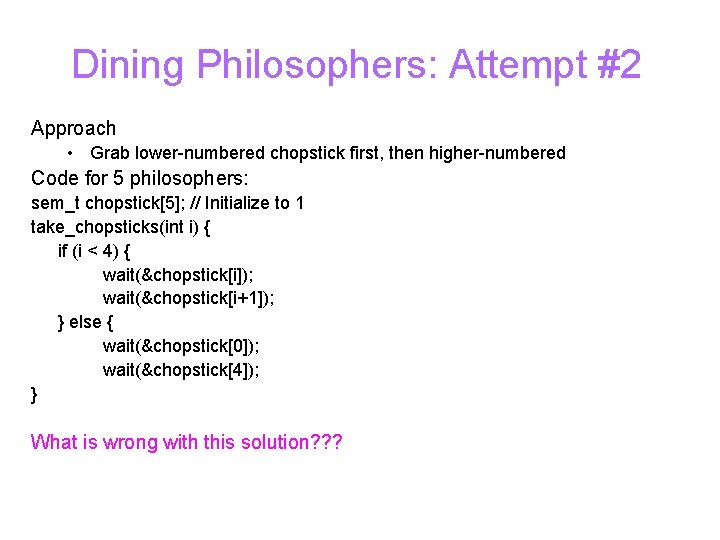
Dining Philosophers: Attempt #2 Approach • Grab lower-numbered chopstick first, then higher-numbered Code for 5 philosophers: sem_t chopstick[5]; // Initialize to 1 take_chopsticks(int i) { if (i < 4) { wait(&chopstick[i]); wait(&chopstick[i+1]); } else { wait(&chopstick[0]); wait(&chopstick[4]); } What is wrong with this solution? ? ?
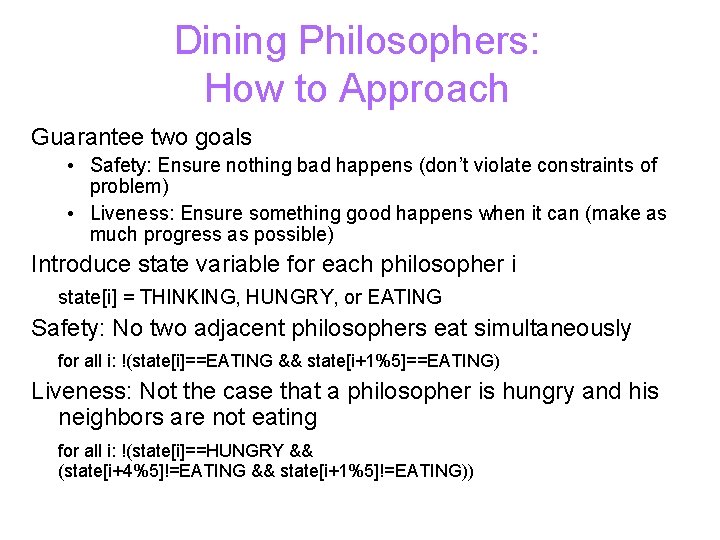
Dining Philosophers: How to Approach Guarantee two goals • Safety: Ensure nothing bad happens (don’t violate constraints of problem) • Liveness: Ensure something good happens when it can (make as much progress as possible) Introduce state variable for each philosopher i state[i] = THINKING, HUNGRY, or EATING Safety: No two adjacent philosophers eat simultaneously for all i: !(state[i]==EATING && state[i+1%5]==EATING) Liveness: Not the case that a philosopher is hungry and his neighbors are not eating for all i: !(state[i]==HUNGRY && (state[i+4%5]!=EATING && state[i+1%5]!=EATING))
Dining Philosophers: Solution sem_t may. Eat[5]; // how to initialize? sem_t mutex; // how to init? int state[5] = {THINKING}; take_chopsticks(int i) { wait(&mutex); // enter critical section state[i] = HUNGRY; test. Safety. And. Liveness(i); // check if I can run signal(&mutex); // exit critical section wait(&may. Eat[i]); } put_chopsticks(int i) { wait(&mutex); // enter critical section state[i] = THINKING; test(i+1 %5); // check if neighbor can run now test(i+4 %5); signal(&mutex); // exit critical section } test. Safety. And. Liveness(int i) { if (state[i]==HUNGRY && state[i+4%5]!=EATING&&state[i+1%5]!=EATING) { state[i] = EATING; signal(&may. Eat[i]); } }
Dining Philosophers: Example Execution
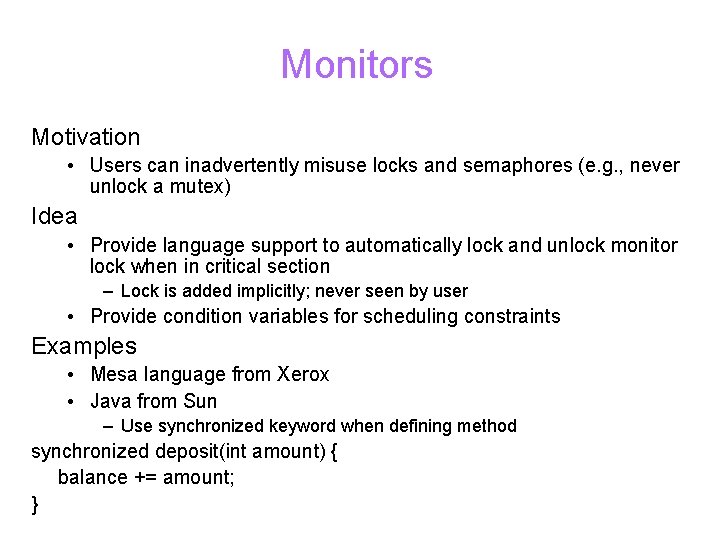
Monitors Motivation • Users can inadvertently misuse locks and semaphores (e. g. , never unlock a mutex) Idea • Provide language support to automatically lock and unlock monitor lock when in critical section – Lock is added implicitly; never seen by user • Provide condition variables for scheduling constraints Examples • Mesa language from Xerox • Java from Sun – Use synchronized keyword when defining method synchronized deposit(int amount) { balance += amount; }
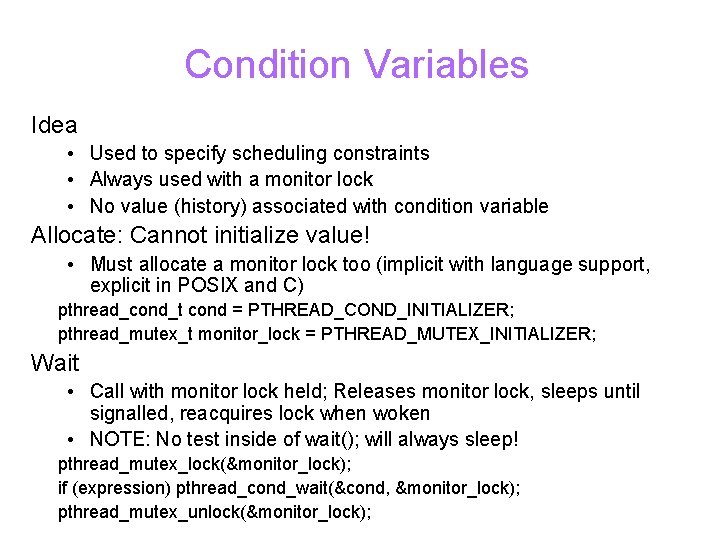
Condition Variables Idea • Used to specify scheduling constraints • Always used with a monitor lock • No value (history) associated with condition variable Allocate: Cannot initialize value! • Must allocate a monitor lock too (implicit with language support, explicit in POSIX and C) pthread_cond_t cond = PTHREAD_COND_INITIALIZER; pthread_mutex_t monitor_lock = PTHREAD_MUTEX_INITIALIZER; Wait • Call with monitor lock held; Releases monitor lock, sleeps until signalled, reacquires lock when woken • NOTE: No test inside of wait(); will always sleep! pthread_mutex_lock(&monitor_lock); if (expression) pthread_cond_wait(&cond, &monitor_lock); pthread_mutex_unlock(&monitor_lock);
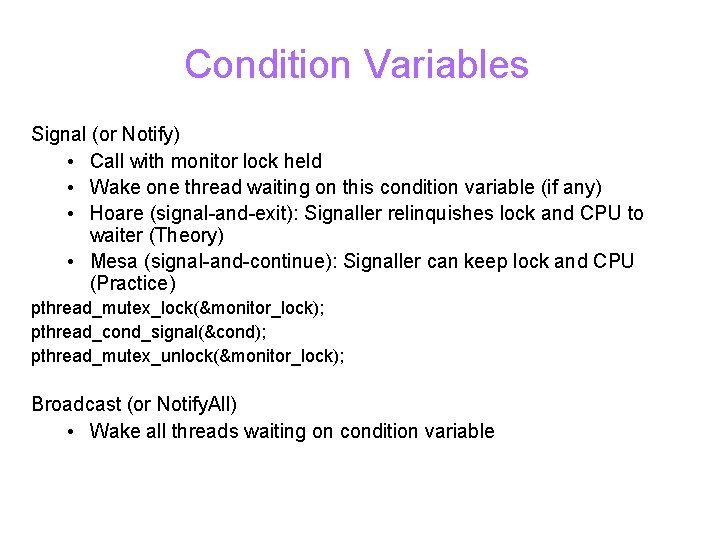
Condition Variables Signal (or Notify) • Call with monitor lock held • Wake one thread waiting on this condition variable (if any) • Hoare (signal-and-exit): Signaller relinquishes lock and CPU to waiter (Theory) • Mesa (signal-and-continue): Signaller can keep lock and CPU (Practice) pthread_mutex_lock(&monitor_lock); pthread_cond_signal(&cond); pthread_mutex_unlock(&monitor_lock); Broadcast (or Notify. All) • Wake all threads waiting on condition variable
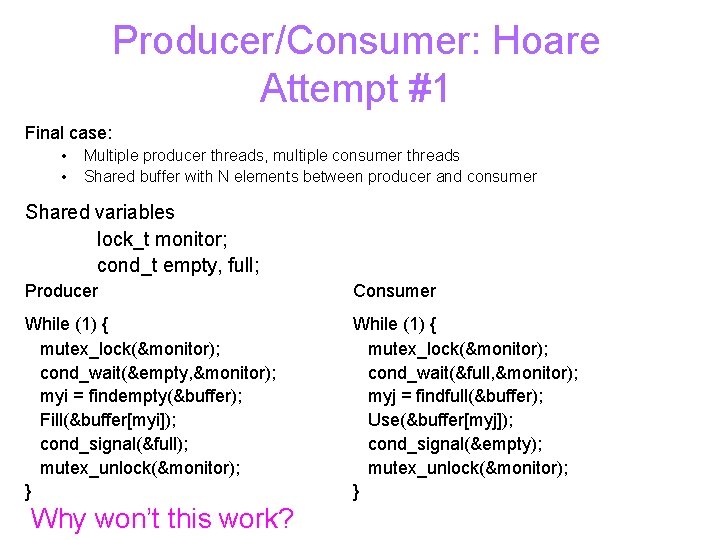
Producer/Consumer: Hoare Attempt #1 Final case: • • Multiple producer threads, multiple consumer threads Shared buffer with N elements between producer and consumer Shared variables lock_t monitor; cond_t empty, full; Producer Consumer While (1) { mutex_lock(&monitor); cond_wait(&empty, &monitor); myi = findempty(&buffer); Fill(&buffer[myi]); cond_signal(&full); mutex_unlock(&monitor); } While (1) { mutex_lock(&monitor); cond_wait(&full, &monitor); myj = findfull(&buffer); Use(&buffer[myj]); cond_signal(&empty); mutex_unlock(&monitor); } Why won’t this work?
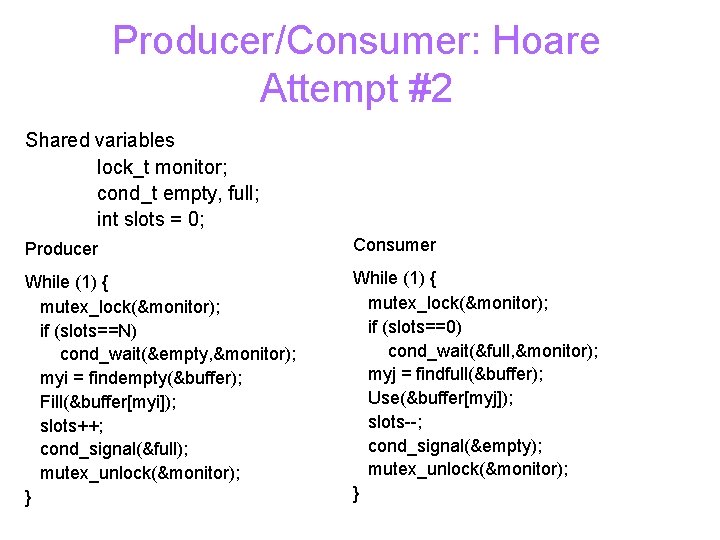
Producer/Consumer: Hoare Attempt #2 Shared variables lock_t monitor; cond_t empty, full; int slots = 0; Producer Consumer While (1) { mutex_lock(&monitor); if (slots==N) cond_wait(&empty, &monitor); myi = findempty(&buffer); Fill(&buffer[myi]); slots++; cond_signal(&full); mutex_unlock(&monitor); } While (1) { mutex_lock(&monitor); if (slots==0) cond_wait(&full, &monitor); myj = findfull(&buffer); Use(&buffer[myj]); slots--; cond_signal(&empty); mutex_unlock(&monitor); }
Producer/Consumer: Hoare Example Two producers, two consumers. . .
Producer/Consumer: Mesa: Another thread may be scheduled and acquire lock before signalled thread runs Repeat Example: Two producers, two consumers. . . What can go wrong?
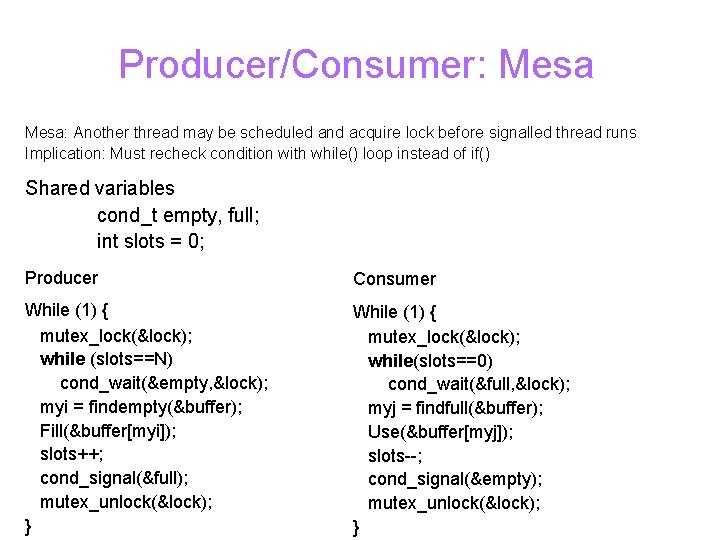
Producer/Consumer: Mesa: Another thread may be scheduled and acquire lock before signalled thread runs Implication: Must recheck condition with while() loop instead of if() Shared variables cond_t empty, full; int slots = 0; Producer Consumer While (1) { mutex_lock(&lock); while (slots==N) cond_wait(&empty, &lock); myi = findempty(&buffer); Fill(&buffer[myi]); slots++; cond_signal(&full); mutex_unlock(&lock); } While (1) { mutex_lock(&lock); while(slots==0) cond_wait(&full, &lock); myj = findfull(&buffer); Use(&buffer[myj]); slots--; cond_signal(&empty); mutex_unlock(&lock); }