
University of Windsor Department of Chemistry and Biochemistry
University of Windsor Department of Chemistry and Biochemistry Chemistry: Centre for Catalysis and Materials Research Biochemistry & Biotechnology Research
University of Windsor Department of Chemistry and Biochemistry
Welcome to Chemistry & Biochemistry at the University of Windsor What is Chemistry? Programs: Chemistry, Biochemistry & Biotechnology What Are Our Programs and Courses Like? About the Department Scholarship Opportunities Undergraduate Research Opportunities Faculty Profiles What can you do with a degree in Chemistry?
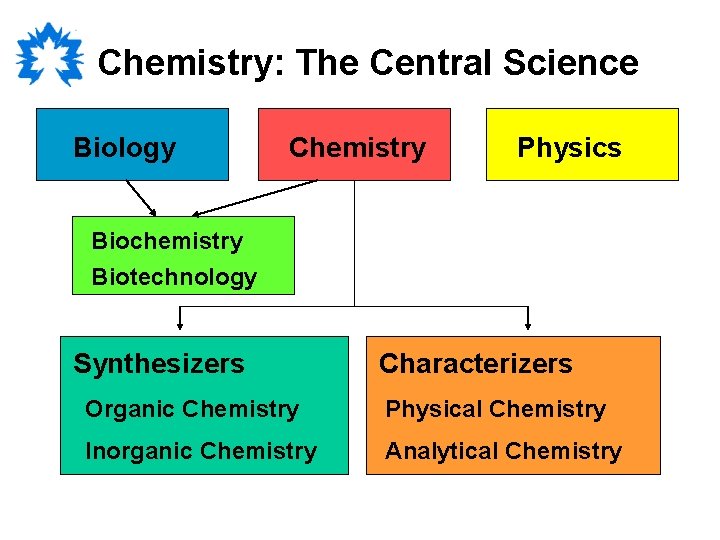
Chemistry: The Central Science Biology Chemistry Physics Biochemistry Biotechnology Synthesizers Characterizers Organic Chemistry Physical Chemistry Inorganic Chemistry Analytical Chemistry
What Programs are Available? Chemistry Most general of the degrees, trains student in a broad variety of chemistry sub-disciplines Biochemistry Emphasis upon chemistry of living systems Biochemistry & Biotechnology Similar to biochemistry, with slightly different course focus Chemistry & Physics and physical chemistry focus
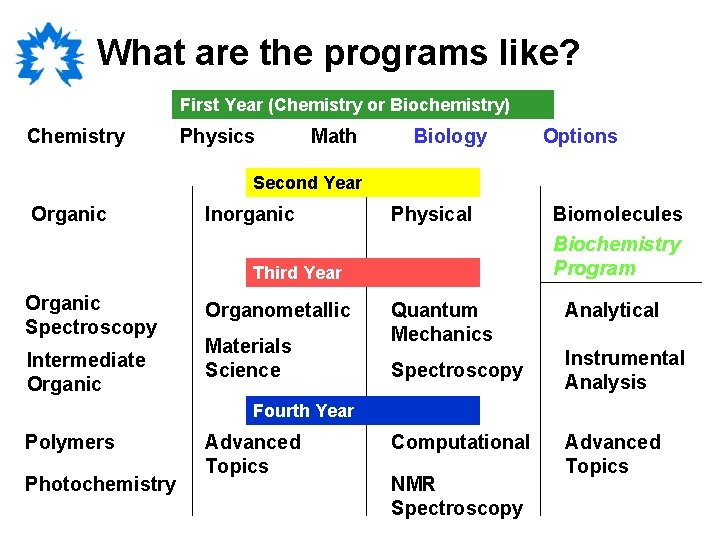
What are the programs like? First Year (Chemistry or Biochemistry) Chemistry Physics Math Biology Options Second Year Organic Inorganic Physical Third Year Organic Spectroscopy Intermediate Organic Organometallic Materials Science Quantum Mechanics Spectroscopy Biomolecules Biochemistry Program Analytical Instrumental Analysis Fourth Year Polymers Photochemistry Advanced Topics Computational NMR Spectroscopy Advanced Topics
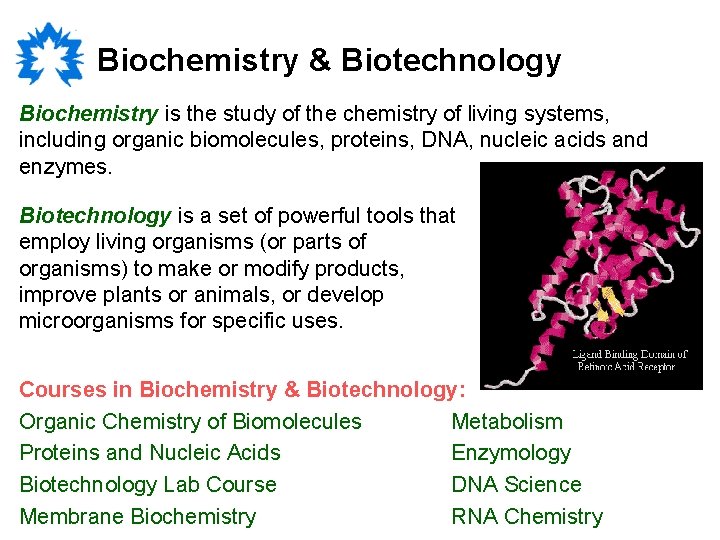
Biochemistry & Biotechnology Biochemistry is the study of the chemistry of living systems, including organic biomolecules, proteins, DNA, nucleic acids and enzymes. Biotechnology is a set of powerful tools that employ living organisms (or parts of organisms) to make or modify products, improve plants or animals, or develop microorganisms for specific uses. Courses in Biochemistry & Biotechnology: Organic Chemistry of Biomolecules Metabolism Proteins and Nucleic Acids Enzymology Biotechnology Lab Course DNA Science Membrane Biochemistry RNA Chemistry
Our department… Our department places emphasis on teaching and research – our students are exposed to junior and senior level courses taught by some of the top scientists in Canada. Professors supervise graduate and undergraduate students in world-class research projects in a variety of areas. From 2000 – 2005, over 12 million dollars in renovations of research laboratories and purchase of scientific instruments makes our department one of the best equipped in Canada, and comparable (or better) than top U. S. institutions! In Chemistry, 2004: #6 in Canada for overall funding from NSERC #5 in Canada for funding per faculty member (20 funded faculty!) #1 in Canada for research funding in Inorganic Chemistry
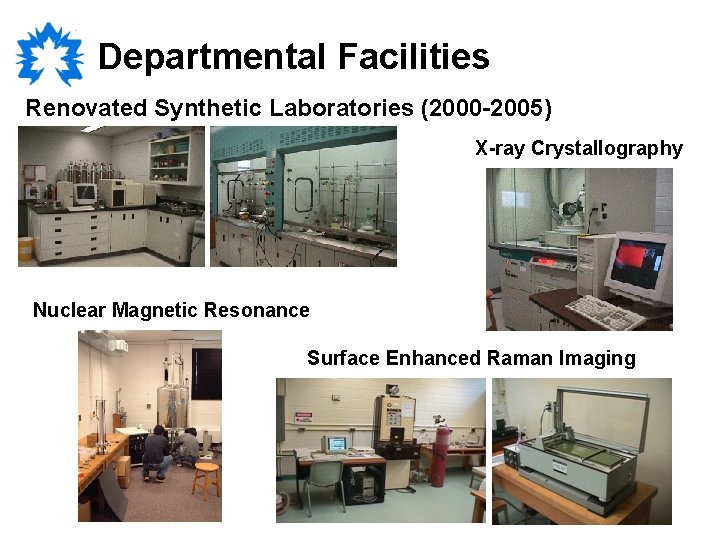
Departmental Facilities Renovated Synthetic Laboratories (2000 -2005) X-ray Crystallography Nuclear Magnetic Resonance Surface Enhanced Raman Imaging
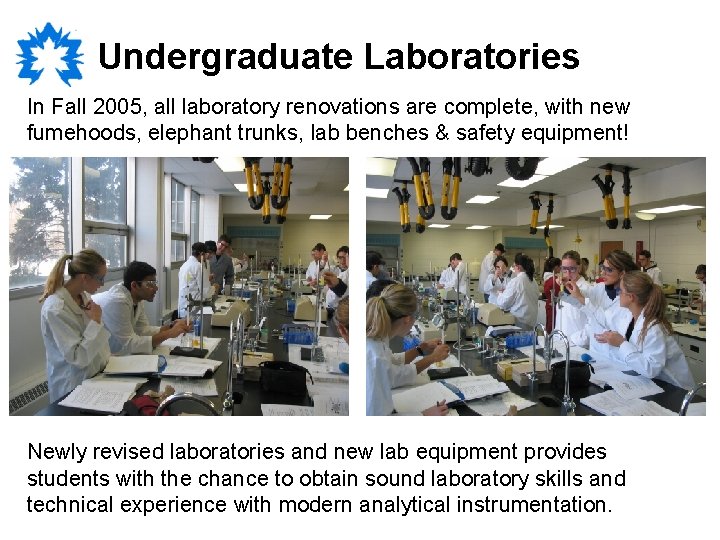
Undergraduate Laboratories In Fall 2005, all laboratory renovations are complete, with new fumehoods, elephant trunks, lab benches & safety equipment! Newly revised laboratories and new lab equipment provides students with the chance to obtain sound laboratory skills and technical experience with modern analytical instrumentation.
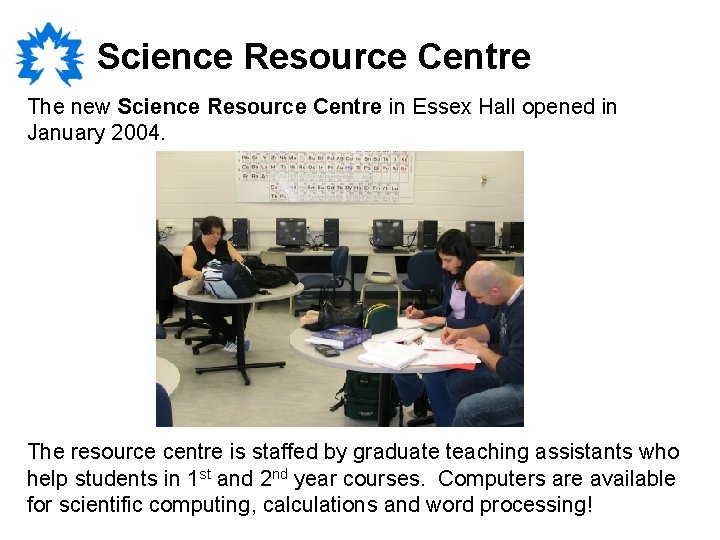
Science Resource Centre The new Science Resource Centre in Essex Hall opened in January 2004. The resource centre is staffed by graduate teaching assistants who help students in 1 st and 2 nd year courses. Computers are available for scientific computing, calculations and word processing!
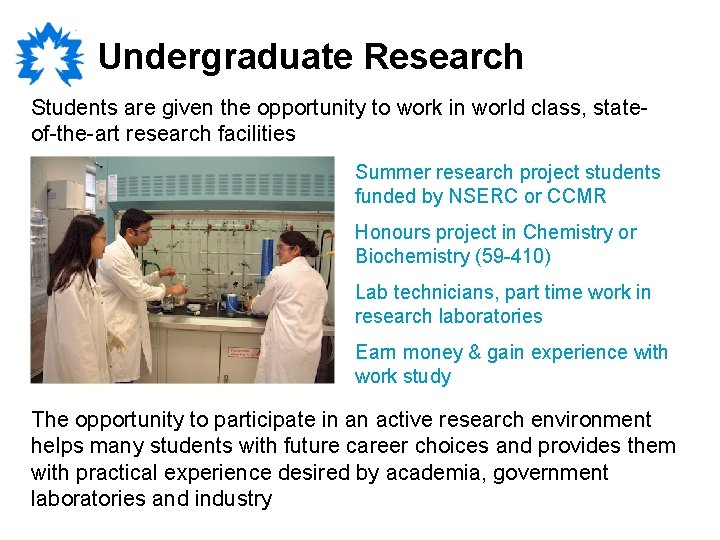
Undergraduate Research Students are given the opportunity to work in world class, stateof-the-art research facilities Summer research project students funded by NSERC or CCMR Honours project in Chemistry or Biochemistry (59 -410) Lab technicians, part time work in research laboratories Earn money & gain experience with work study The opportunity to participate in an active research environment helps many students with future career choices and provides them with practical experience desired by academia, government laboratories and industry
Scholarships & Awards Students with good academic track records can receive/apply for a variety of awards: - Outstanding Scholars (Chemistry, Chem & Phys) - 1 st Year Entrance Scholarships ($1000) - 2 nd Year Book Prizes - Summer NSERC Research Scholarships ($6000) - Centre for Catalysis & Materials Research (CCMR) Undergraduate Research Scholarships ($5500) - Peter Wyzinski Memorial Award (3 rd year: Chemistry, $500) - Canadian Society for Chemistry Prizes (4 th year: Chemistry, Biochemistry) - Society for Chemical Industry Award (4 th year: Chemistry, Biochemistry) - Hutnik Research Award (Best research project, Biochemistry, $500) - Dennis Tuck Memorial Award (Best research project, Chemistry, $500)
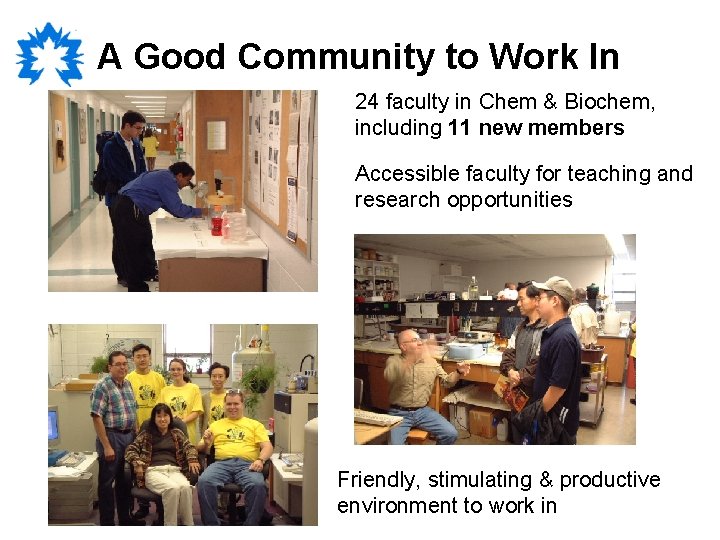
A Good Community to Work In 24 faculty in Chem & Biochem, including 11 new members Accessible faculty for teaching and research opportunities Friendly, stimulating & productive environment to work in
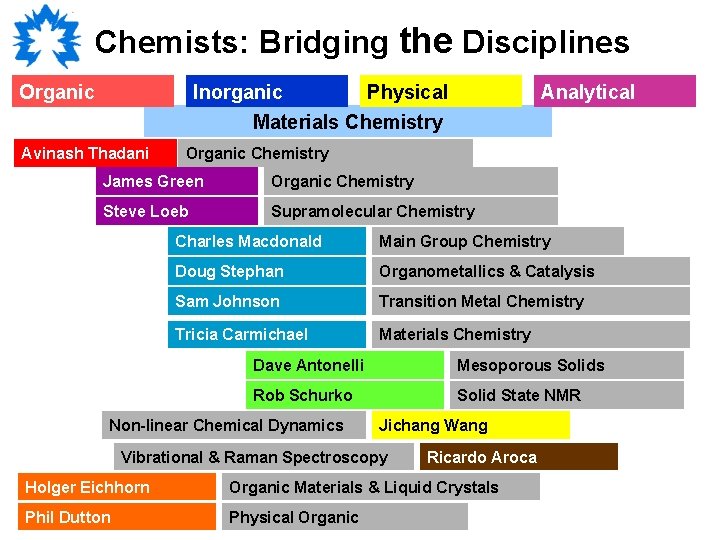
Chemists: Bridging the Disciplines Organic Inorganic Physical Materials Chemistry Avinash Thadani Analytical Organic Chemistry James Green Organic Chemistry Steve Loeb Supramolecular Chemistry Charles Macdonald Main Group Chemistry Doug Stephan Organometallics & Catalysis Sam Johnson Transition Metal Chemistry Tricia Carmichael Materials Chemistry Dave Antonelli Mesoporous Solids Rob Schurko Solid State NMR Non-linear Chemical Dynamics Jichang Wang Vibrational & Raman Spectroscopy Ricardo Aroca Holger Eichhorn Organic Materials & Liquid Crystals Phil Dutton Physical Organic
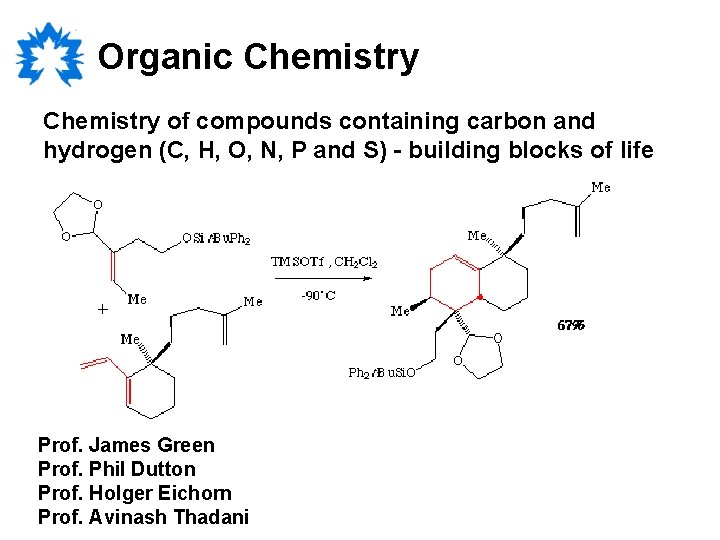
Organic Chemistry of compounds containing carbon and hydrogen (C, H, O, N, P and S) - building blocks of life Picture of some reaction mechanism Prof. James Green Prof. Phil Dutton Prof. Holger Eichorn Prof. Avinash Thadani
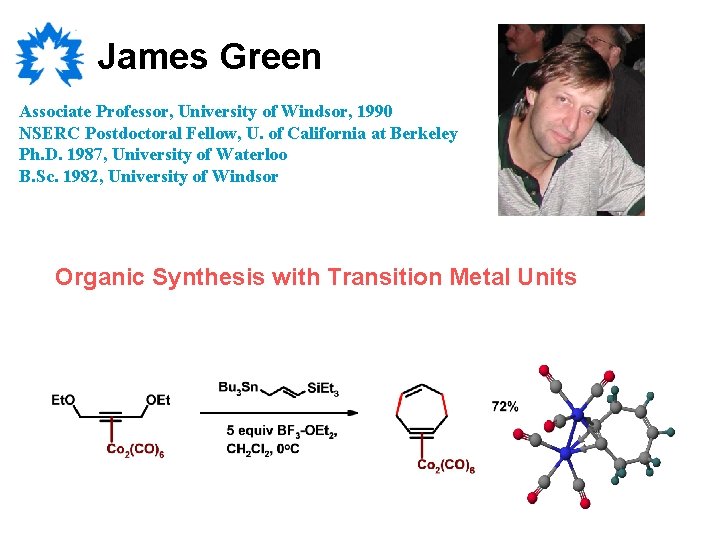
James Green Associate Professor, University of Windsor, 1990 NSERC Postdoctoral Fellow, U. of California at Berkeley Ph. D. 1987, University of Waterloo B. Sc. 1982, University of Windsor Organic Synthesis with Transition Metal Units
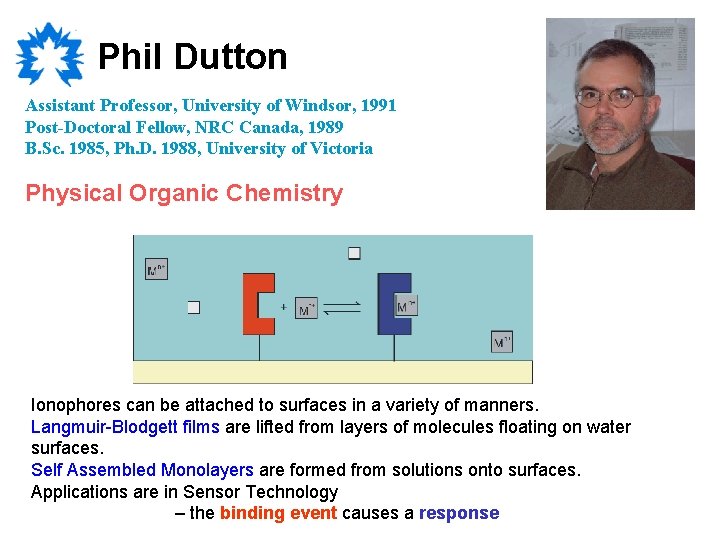
Phil Dutton Assistant Professor, University of Windsor, 1991 Post-Doctoral Fellow, NRC Canada, 1989 B. Sc. 1985, Ph. D. 1988, University of Victoria Physical Organic Chemistry Ionophores can be attached to surfaces in a variety of manners. Langmuir-Blodgett films are lifted from layers of molecules floating on water surfaces. Self Assembled Monolayers are formed from solutions onto surfaces. Applications are in Sensor Technology – the binding event causes a response
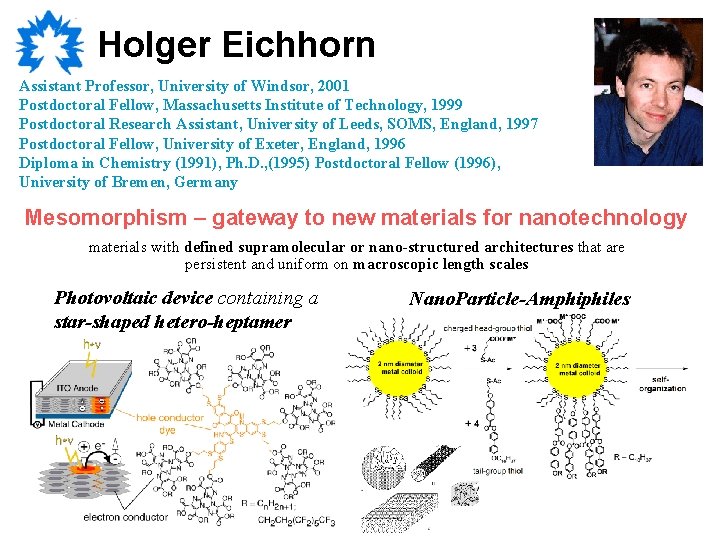
Holger Eichhorn Assistant Professor, University of Windsor, 2001 Postdoctoral Fellow, Massachusetts Institute of Technology, 1999 Postdoctoral Research Assistant, University of Leeds, SOMS, England, 1997 Postdoctoral Fellow, University of Exeter, England, 1996 Diploma in Chemistry (1991), Ph. D. , (1995) Postdoctoral Fellow (1996), University of Bremen, Germany Mesomorphism – gateway to new materials for nanotechnology materials with defined supramolecular or nano-structured architectures that are persistent and uniform on macroscopic length scales Photovoltaic device containing a star-shaped hetero-heptamer Nano. Particle-Amphiphiles
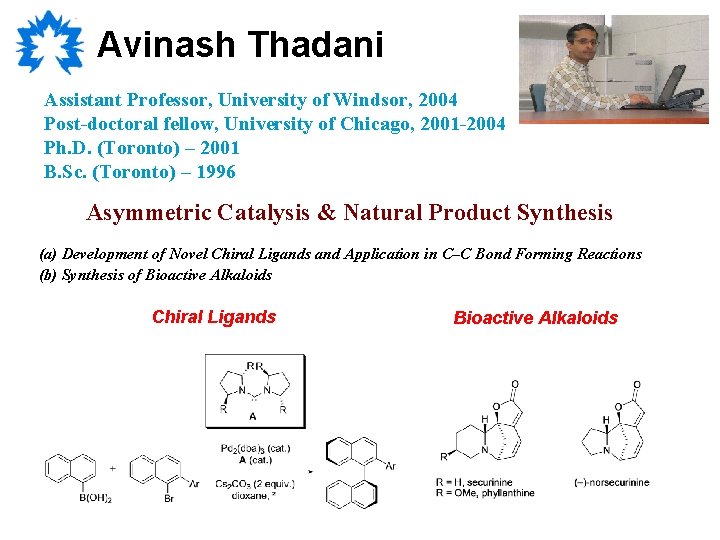
Avinash Thadani Assistant Professor, University of Windsor, 2004 Post-doctoral fellow, University of Chicago, 2001 -2004 Ph. D. (Toronto) – 2001 B. Sc. (Toronto) – 1996 Asymmetric Catalysis & Natural Product Synthesis (a) Development of Novel Chiral Ligands and Application in C–C Bond Forming Reactions (b) Synthesis of Bioactive Alkaloids Chiral Ligands Bioactive Alkaloids
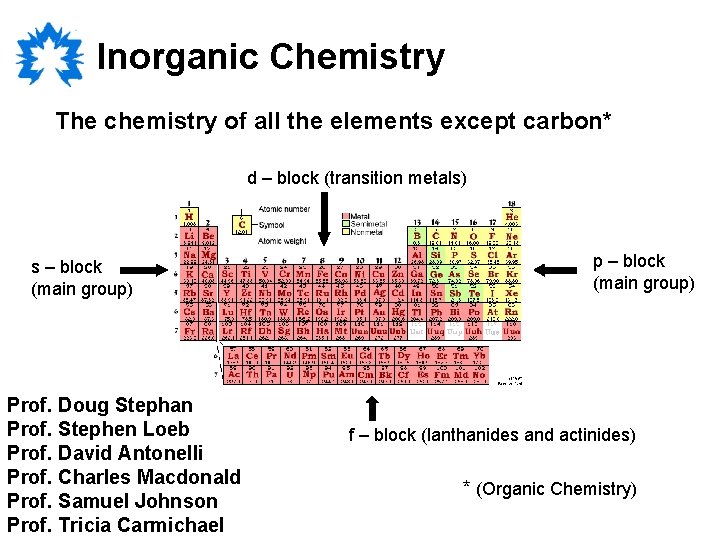
Inorganic Chemistry The chemistry of all the elements except carbon* d – block (transition metals) s – block (main group) Prof. Doug Stephan Prof. Stephen Loeb Prof. David Antonelli Prof. Charles Macdonald Prof. Samuel Johnson Prof. Tricia Carmichael p – block (main group) f – block (lanthanides and actinides) * (Organic Chemistry)
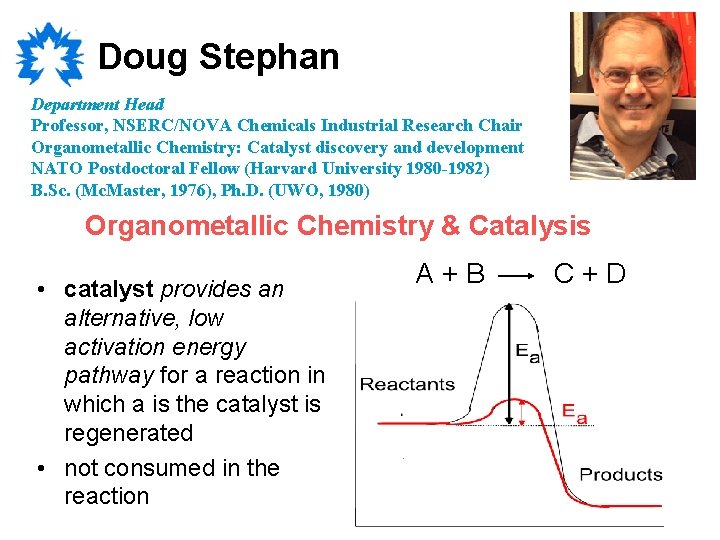
Doug Stephan Department Head Professor, NSERC/NOVA Chemicals Industrial Research Chair Organometallic Chemistry: Catalyst discovery and development NATO Postdoctoral Fellow (Harvard University 1980 -1982) B. Sc. (Mc. Master, 1976), Ph. D. (UWO, 1980) Organometallic Chemistry & Catalysis • catalyst provides an alternative, low activation energy pathway for a reaction in which a is the catalyst is regenerated • not consumed in the reaction A+B C+D
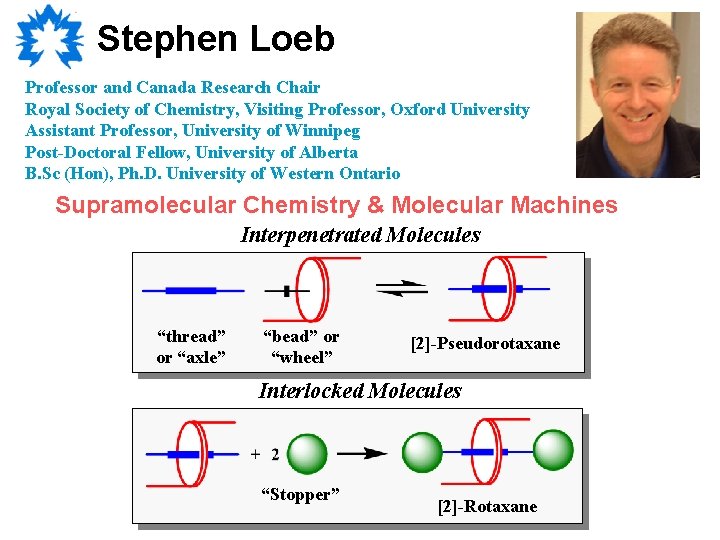
Stephen Loeb Professor and Canada Research Chair Royal Society of Chemistry, Visiting Professor, Oxford University Assistant Professor, University of Winnipeg Post-Doctoral Fellow, University of Alberta B. Sc (Hon), Ph. D. University of Western Ontario Supramolecular Chemistry & Molecular Machines Interpenetrated Molecules “thread” or “axle” “bead” or “wheel” [2]-Pseudorotaxane Interlocked Molecules “Stopper” [2]-Rotaxane
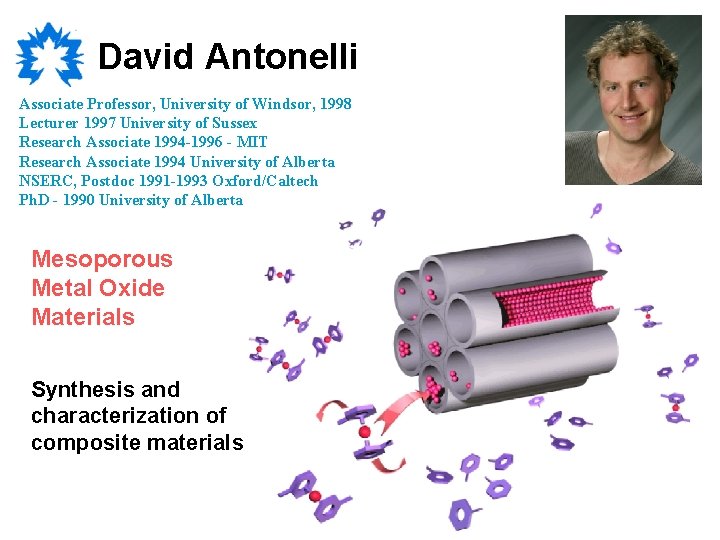
David Antonelli Associate Professor, University of Windsor, 1998 Lecturer 1997 University of Sussex Research Associate 1994 -1996 - MIT Research Associate 1994 University of Alberta NSERC, Postdoc 1991 -1993 Oxford/Caltech Ph. D - 1990 University of Alberta Mesoporous Metal Oxide Materials Synthesis and characterization of composite materials
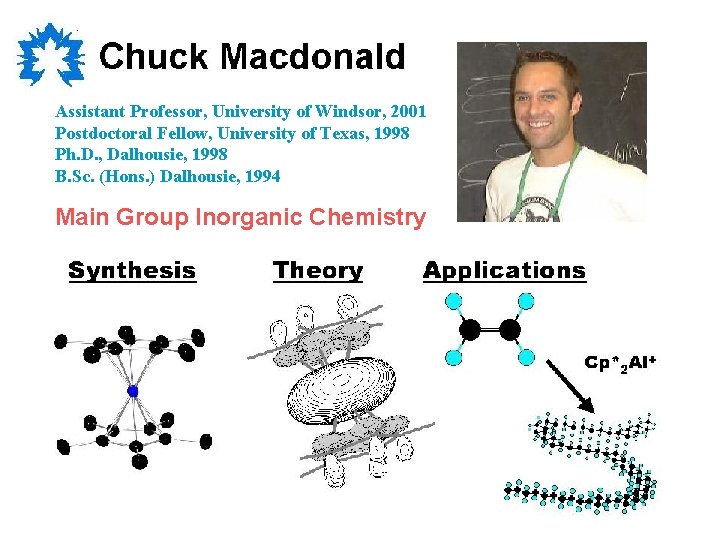
Assistant Professor, University of Windsor, 2001 Postdoctoral Fellow, University of Texas, 1998 Ph. D. , Dalhousie, 1998 B. Sc. (Hons. ) Dalhousie, 1994 Main Group Inorganic Chemistry
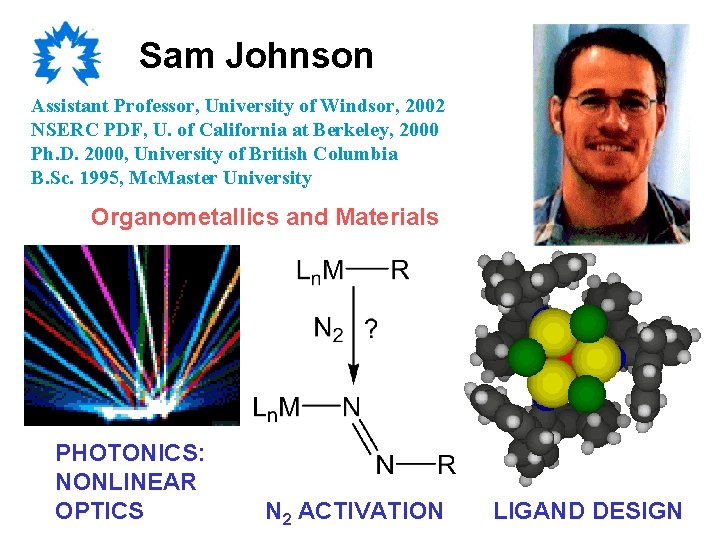
Sam Johnson Assistant Professor, University of Windsor, 2002 NSERC PDF, U. of California at Berkeley, 2000 Ph. D. 2000, University of British Columbia B. Sc. 1995, Mc. Master University Organometallics and Materials PHOTONICS: NONLINEAR OPTICS N 2 ACTIVATION LIGAND DESIGN
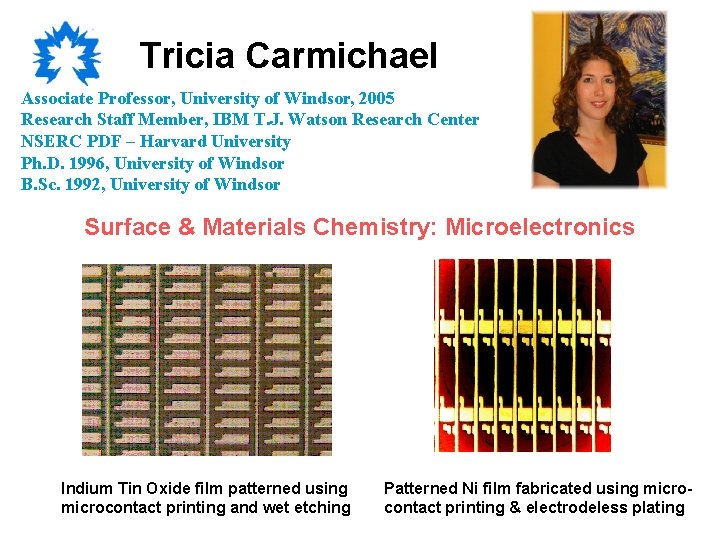
Tricia Carmichael Associate Professor, University of Windsor, 2005 Research Staff Member, IBM T. J. Watson Research Center NSERC PDF – Harvard University Ph. D. 1996, University of Windsor B. Sc. 1992, University of Windsor Surface & Materials Chemistry: Microelectronics Indium Tin Oxide film patterned using microcontact printing and wet etching Patterned Ni film fabricated using microcontact printing & electrodeless plating
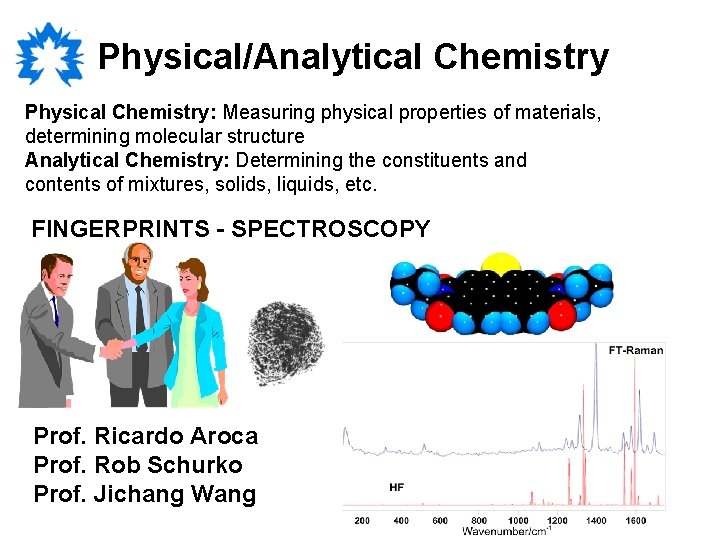
Physical/Analytical Chemistry Physical Chemistry: Measuring physical properties of materials, determining molecular structure Analytical Chemistry: Determining the constituents and contents of mixtures, solids, liquids, etc. FINGERPRINTS - SPECTROSCOPY Prof. Ricardo Aroca Prof. Rob Schurko Prof. Jichang Wang
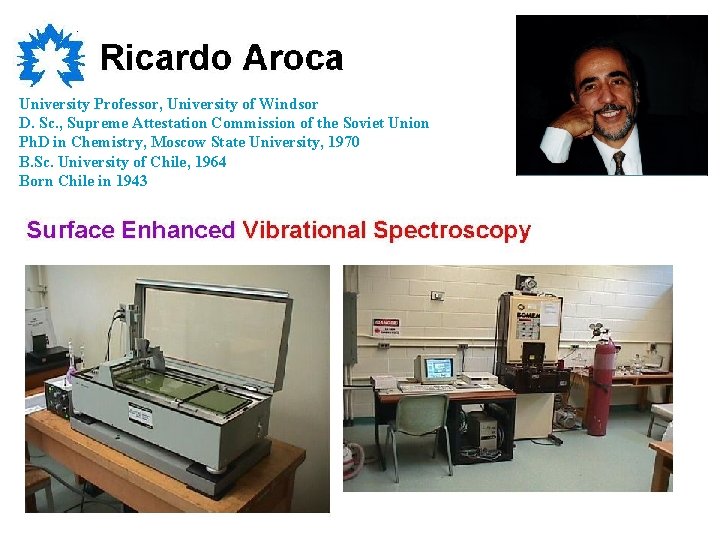
University Professor, University of Windsor D. Sc. , Supreme Attestation Commission of the Soviet Union Ph. D in Chemistry, Moscow State University, 1970 B. Sc. University of Chile, 1964 Born Chile in 1943
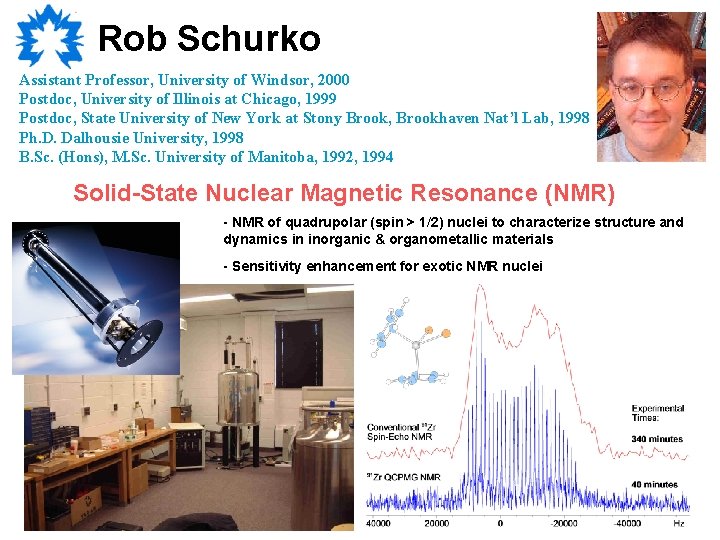
Rob Schurko Assistant Professor, University of Windsor, 2000 Postdoc, University of Illinois at Chicago, 1999 Postdoc, State University of New York at Stony Brook, Brookhaven Nat’l Lab, 1998 Ph. D. Dalhousie University, 1998 B. Sc. (Hons), M. Sc. University of Manitoba, 1992, 1994 Solid-State Nuclear Magnetic Resonance (NMR) - NMR of quadrupolar (spin > 1/2) nuclei to characterize structure and dynamics in inorganic & organometallic materials - Sensitivity enhancement for exotic NMR nuclei
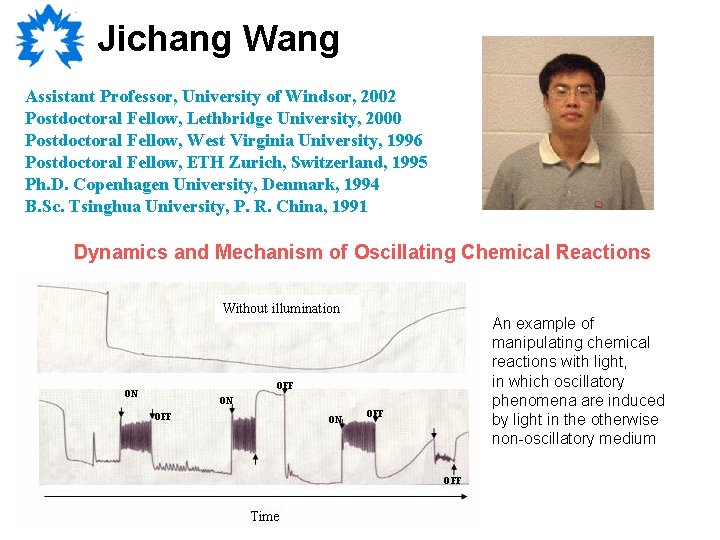
Jichang Wang Assistant Professor, University of Windsor, 2002 Postdoctoral Fellow, Lethbridge University, 2000 Postdoctoral Fellow, West Virginia University, 1996 Postdoctoral Fellow, ETH Zurich, Switzerland, 1995 Ph. D. Copenhagen University, Denmark, 1994 B. Sc. Tsinghua University, P. R. China, 1991 Dynamics and Mechanism of Oscillating Chemical Reactions An example of manipulating chemical reactions with light, in which oscillatory phenomena are induced by light in the otherwise non-oscillatory medium
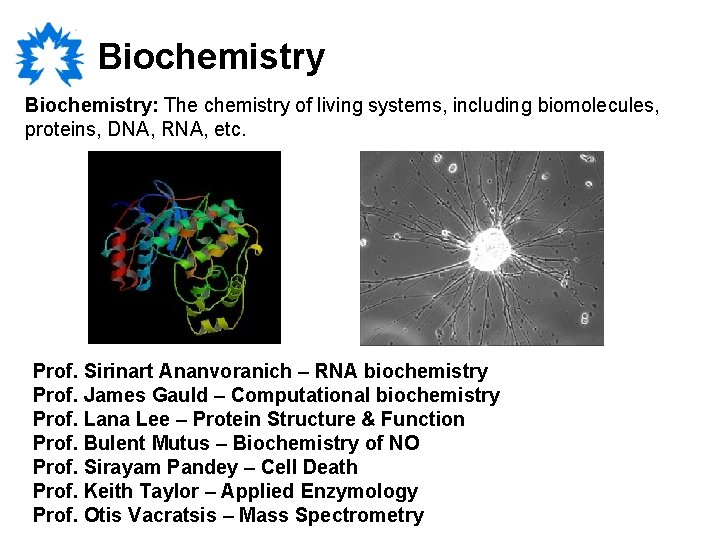
Biochemistry: The chemistry of living systems, including biomolecules, proteins, DNA, RNA, etc. Prof. Sirinart Ananvoranich – RNA biochemistry Prof. James Gauld – Computational biochemistry Prof. Lana Lee – Protein Structure & Function Prof. Bulent Mutus – Biochemistry of NO Prof. Sirayam Pandey – Cell Death Prof. Keith Taylor – Applied Enzymology Prof. Otis Vacratsis – Mass Spectrometry
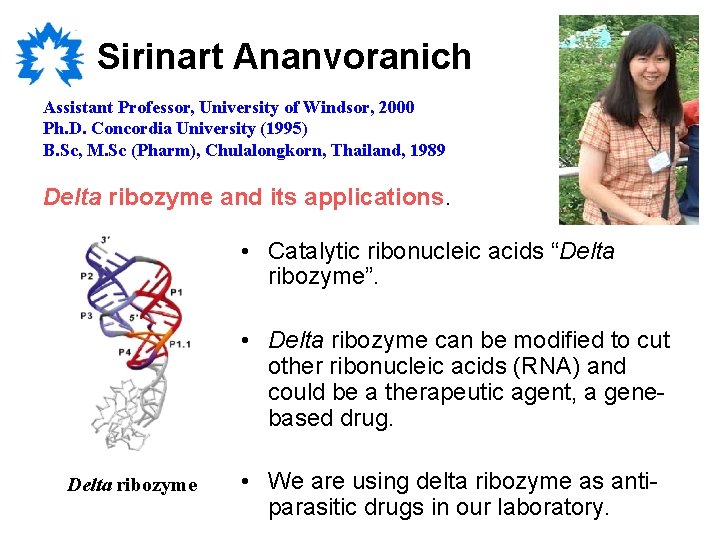
Sirinart Ananvoranich Assistant Professor, University of Windsor, 2000 Ph. D. Concordia University (1995) B. Sc, M. Sc (Pharm), Chulalongkorn, Thailand, 1989 Delta ribozyme and its applications. • Catalytic ribonucleic acids “Delta ribozyme”. • Delta ribozyme can be modified to cut other ribonucleic acids (RNA) and could be a therapeutic agent, a genebased drug. Delta ribozyme • We are using delta ribozyme as antiparasitic drugs in our laboratory.
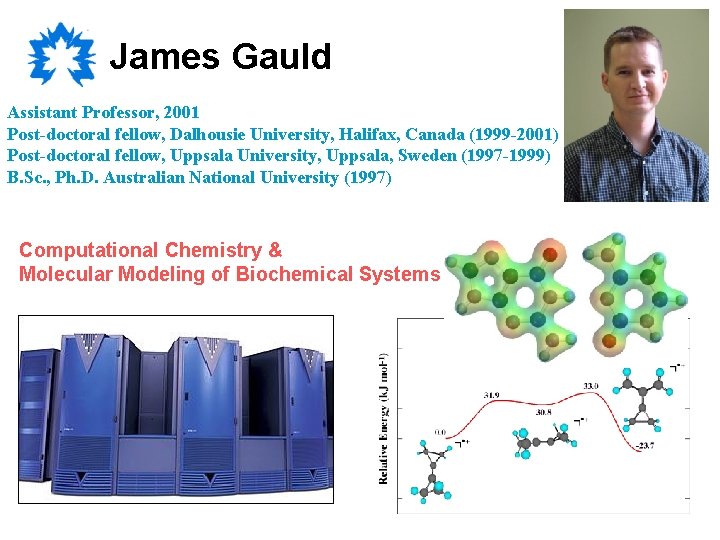
James Gauld Assistant Professor, 2001 Post-doctoral fellow, Dalhousie University, Halifax, Canada (1999 -2001) Post-doctoral fellow, Uppsala University, Uppsala, Sweden (1997 -1999) B. Sc. , Ph. D. Australian National University (1997) Computational Chemistry & Molecular Modeling of Biochemical Systems
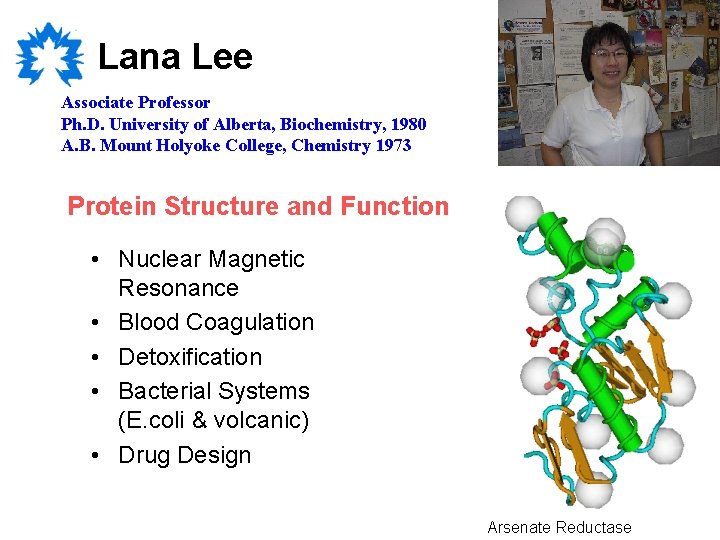
Lana Lee Associate Professor Ph. D. University of Alberta, Biochemistry, 1980 A. B. Mount Holyoke College, Chemistry 1973 Protein Structure and Function • Nuclear Magnetic Resonance • Blood Coagulation • Detoxification • Bacterial Systems (E. coli & volcanic) • Drug Design Cys-12 N C NMR structure of Arsenate Reductase
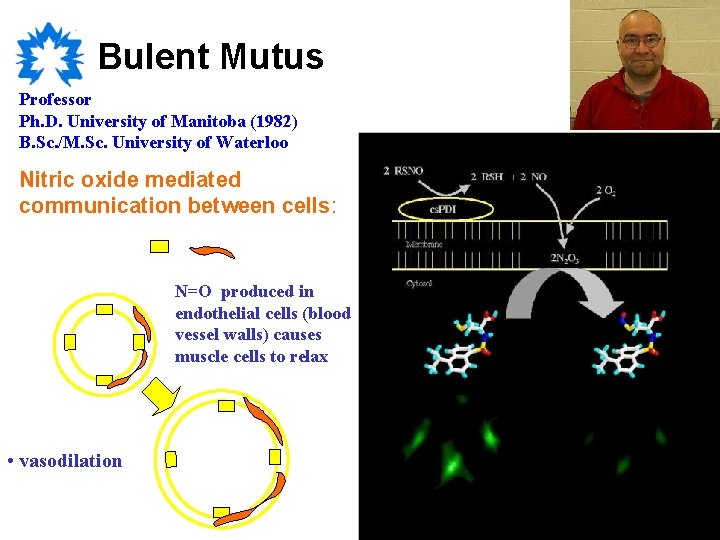
Bulent Mutus Professor Ph. D. University of Manitoba (1982) B. Sc. /M. Sc. University of Waterloo Nitric oxide mediated communication between cells: N=O produced in endothelial cells (blood vessel walls) causes muscle cells to relax • vasodilation
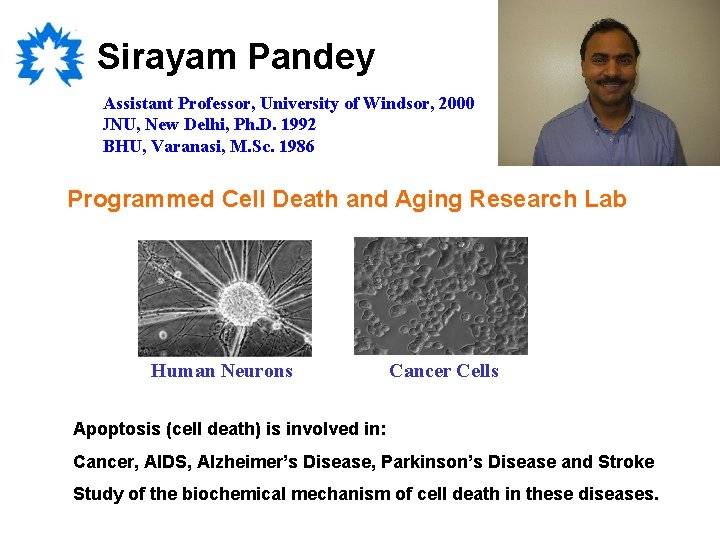
Sirayam Pandey Assistant Professor, University of Windsor, 2000 JNU, New Delhi, Ph. D. 1992 BHU, Varanasi, M. Sc. 1986 Programmed Cell Death and Aging Research Lab Human Neurons Cancer Cells Apoptosis (cell death) is involved in: Cancer, AIDS, Alzheimer’s Disease, Parkinson’s Disease and Stroke Study of the biochemical mechanism of cell death in these diseases.
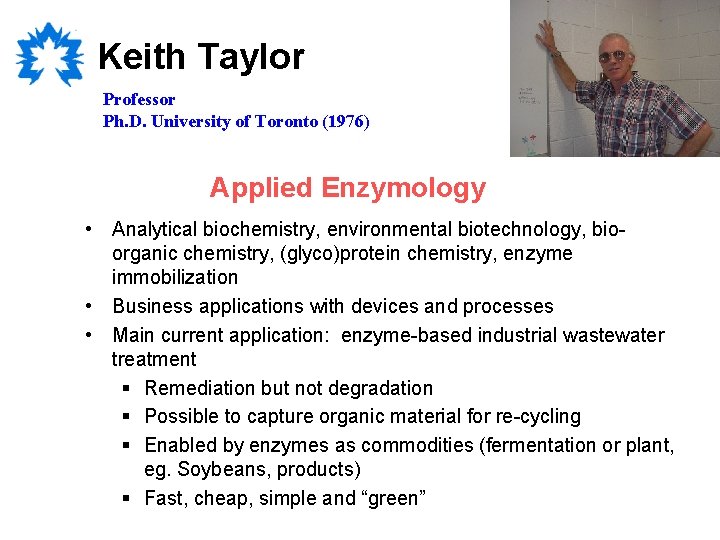
Keith Taylor Professor Ph. D. University of Toronto (1976) Applied Enzymology • Analytical biochemistry, environmental biotechnology, bioorganic chemistry, (glyco)protein chemistry, enzyme immobilization • Business applications with devices and processes • Main current application: enzyme-based industrial wastewater treatment § Remediation but not degradation § Possible to capture organic material for re-cycling § Enabled by enzymes as commodities (fermentation or plant, eg. Soybeans, products) § Fast, cheap, simple and “green”
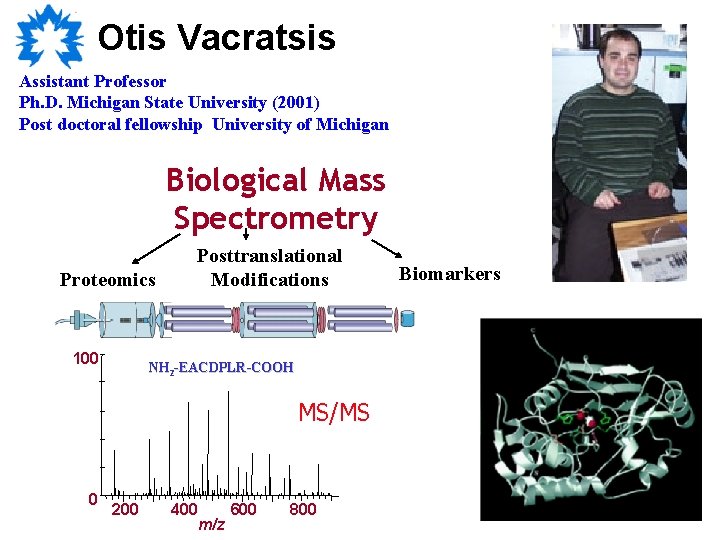
Otis Vacratsis Assistant Professor Ph. D. Michigan State University (2001) Post doctoral fellowship University of Michigan Biological Mass Spectrometry Proteomics 100 Posttranslational Modifications NH 2 -EACDPLR-COOH MS/MS 0 200 400 m/z 600 800 Biomarkers
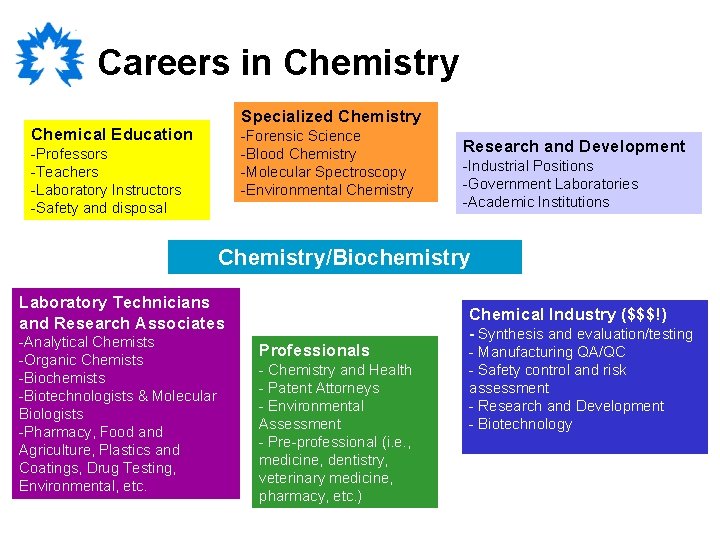
Careers in Chemistry Specialized Chemistry Chemical Education -Forensic Science -Blood Chemistry -Molecular Spectroscopy -Environmental Chemistry -Professors -Teachers -Laboratory Instructors -Safety and disposal Research and Development -Industrial Positions -Government Laboratories -Academic Institutions Chemistry/Biochemistry Laboratory Technicians and Research Associates -Analytical Chemists -Organic Chemists -Biochemists -Biotechnologists & Molecular Biologists -Pharmacy, Food and Agriculture, Plastics and Coatings, Drug Testing, Environmental, etc. Chemical Industry ($$$!) Professionals - Chemistry and Health - Patent Attorneys - Environmental Assessment - Pre-professional (i. e. , medicine, dentistry, veterinary medicine, pharmacy, etc. ) - Synthesis and evaluation/testing - Manufacturing QA/QC - Safety control and risk assessment - Research and Development - Biotechnology
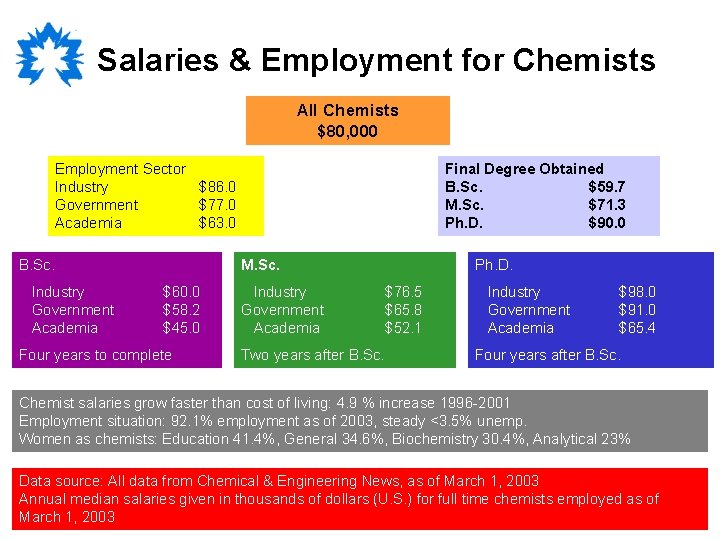
Salaries & Employment for Chemists All Chemists $80, 000 Employment Sector Industry $86. 0 Government $77. 0 Academia $63. 0 B. Sc. Industry Government Academia Final Degree Obtained B. Sc. $59. 7 M. Sc. $71. 3 Ph. D. $90. 0 M. Sc. $60. 0 $58. 2 $45. 0 Four years to complete Industry Government Academia Two years after B. Sc. Ph. D. $76. 5 $65. 8 $52. 1 Industry Government Academia $98. 0 $91. 0 $65. 4 Four years after B. Sc. Chemist salaries grow faster than cost of living: 4. 9 % increase 1996 -2001 Employment situation: 92. 1% employment as of 2003, steady <3. 5% unemp. Women as chemists: Education 41. 4%, General 34. 6%, Biochemistry 30. 4%, Analytical 23% Data source: All data from Chemical & Engineering News, as of March 1, 2003 Annual median salaries given in thousands of dollars (U. S. ) for full time chemists employed as of March 1, 2003
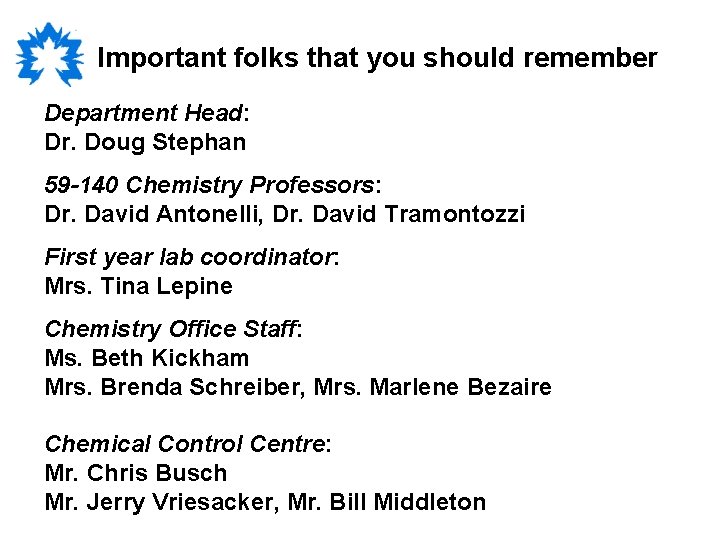
Important folks that you should remember Department Head: Dr. Doug Stephan 59 -140 Chemistry Professors: Dr. David Antonelli, Dr. David Tramontozzi First year lab coordinator: Mrs. Tina Lepine Chemistry Office Staff: Ms. Beth Kickham Mrs. Brenda Schreiber, Mrs. Marlene Bezaire Chemical Control Centre: Mr. Chris Busch Mr. Jerry Vriesacker, Mr. Bill Middleton
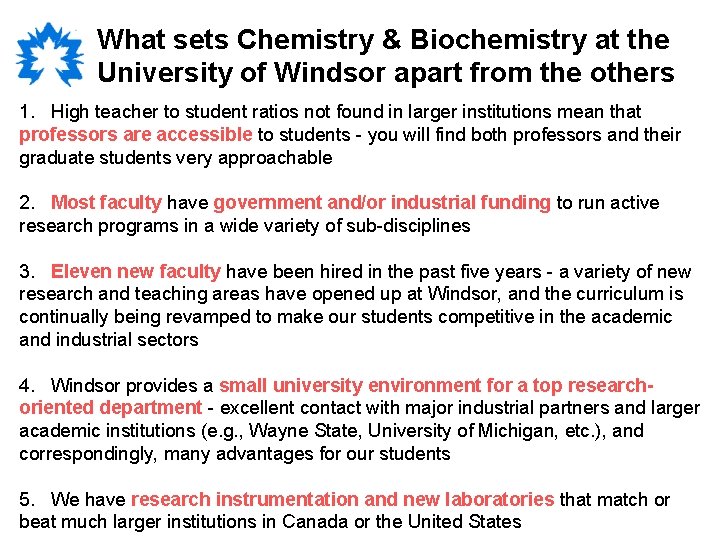
What sets Chemistry & Biochemistry at the University of Windsor apart from the others 1. High teacher to student ratios not found in larger institutions mean that professors are accessible to students - you will find both professors and their graduate students very approachable 2. Most faculty have government and/or industrial funding to run active research programs in a wide variety of sub-disciplines 3. Eleven new faculty have been hired in the past five years - a variety of new research and teaching areas have opened up at Windsor, and the curriculum is continually being revamped to make our students competitive in the academic and industrial sectors 4. Windsor provides a small university environment for a top researchoriented department - excellent contact with major industrial partners and larger academic institutions (e. g. , Wayne State, University of Michigan, etc. ), and correspondingly, many advantages for our students 5. We have research instrumentation and new laboratories that match or beat much larger institutions in Canada or the United States
Chemistry & Biochemistry at the University of Windsor For more information: Chemistry and Biochemistry University of Windsor 401 Sunset Avenue Windsor, Ontario Canada N 9 B 3 P 4 Phone: (519) 253 -3000 ext: 3521 FAX: (519)-973 -7098 Email: chembio@uwindsor. ca Website: www. uwindsor. ca/chemistry
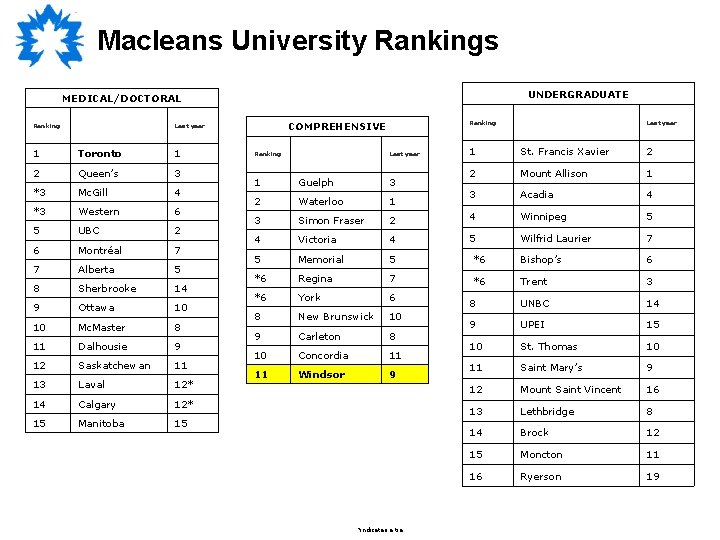
Macleans University Rankings UNDERGRADUATE MEDICAL/DOCTORAL Ranking Last year 1 Toronto 1 2 Queen’s 3 *3 Mc. Gill 4 *3 Western 6 5 UBC 2 6 Montréal 7 7 Alberta 5 8 Sherbrooke 14 9 Ottawa 10 10 Mc. Master 8 11 Dalhousie 9 12 Saskatchewan 11 13 Laval 12* 14 Calgary 12* 15 Manitoba 15 COMPREHENSIVE Ranking Last year 1 St. Francis Xavier 2 2 Mount Allison 1 3 Acadia 4 Ranking Last year 1 Guelph 3 2 Waterloo 1 3 Simon Fraser 2 4 Winnipeg 5 4 Victoria 4 5 Wilfrid Laurier 7 5 Memorial 5 *6 Bishop’s 6 *6 Regina 7 *6 Trent 3 *6 York 6 8 UNBC 14 8 New Brunswick 10 9 Carleton 8 9 UPEI 15 10 Concordia 11 10 St. Thomas 10 11 Windsor 9 11 Saint Mary’s 9 12 Mount Saint Vincent 16 13 Lethbridge 8 14 Brock 12 15 Moncton 11 16 Ryerson 19 *indicates a tie
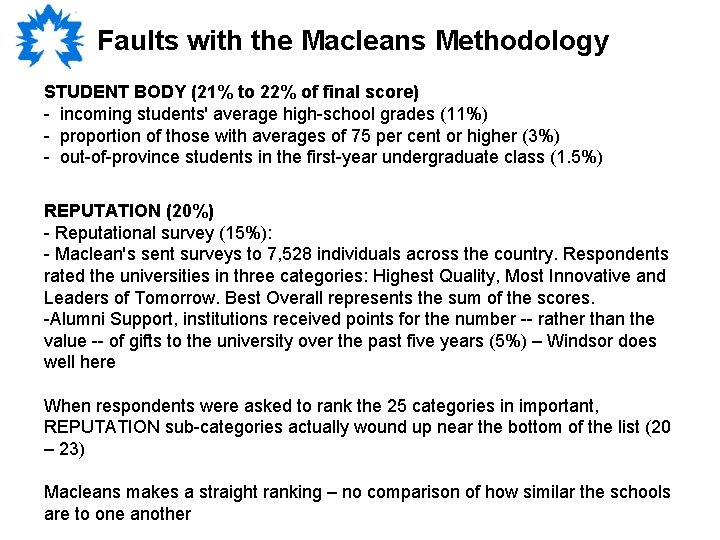
Faults with the Macleans Methodology STUDENT BODY (21% to 22% of final score) - incoming students' average high-school grades (11%) - proportion of those with averages of 75 per cent or higher (3%) - out-of-province students in the first-year undergraduate class (1. 5%) REPUTATION (20%) - Reputational survey (15%): - Maclean's sent surveys to 7, 528 individuals across the country. Respondents rated the universities in three categories: Highest Quality, Most Innovative and Leaders of Tomorrow. Best Overall represents the sum of the scores. -Alumni Support, institutions received points for the number -- rather than the value -- of gifts to the university over the past five years (5%) – Windsor does well here When respondents were asked to rank the 25 categories in important, REPUTATION sub-categories actually wound up near the bottom of the list (20 – 23) Macleans makes a straight ranking – no comparison of how similar the schools are to one another
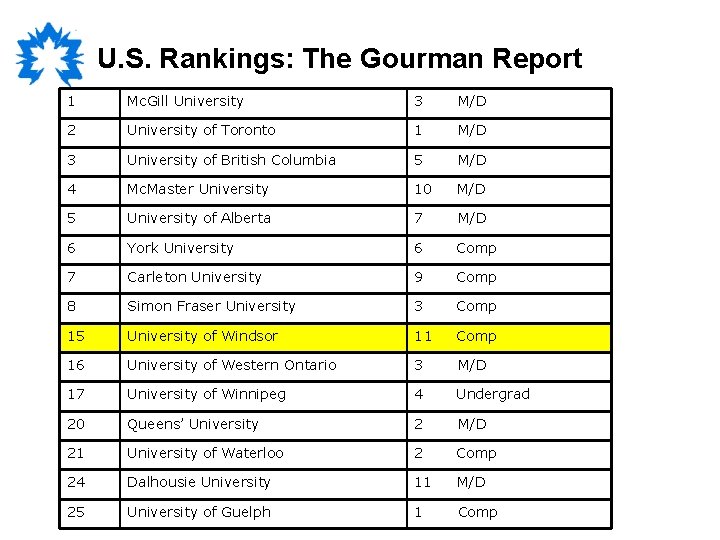
U. S. Rankings: The Gourman Report 1 Mc. Gill University 3 M/D 2 University of Toronto 1 M/D 3 University of British Columbia 5 M/D 4 Mc. Master University 10 M/D 5 University of Alberta 7 M/D 6 York University 6 Comp 7 Carleton University 9 Comp 8 Simon Fraser University 3 Comp 15 University of Windsor 11 Comp 16 University of Western Ontario 3 M/D 17 University of Winnipeg 4 20 Queens’ University 2 M/D 21 University of Waterloo 2 24 Dalhousie University 11 M/D 25 University of Guelph 1 Comp Undergrad Comp
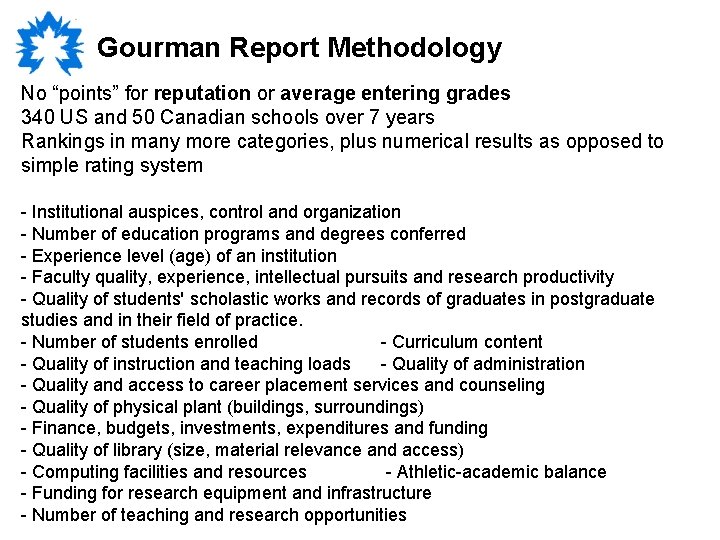
Gourman Report Methodology No “points” for reputation or average entering grades 340 US and 50 Canadian schools over 7 years Rankings in many more categories, plus numerical results as opposed to simple rating system - Institutional auspices, control and organization - Number of education programs and degrees conferred - Experience level (age) of an institution - Faculty quality, experience, intellectual pursuits and research productivity - Quality of students' scholastic works and records of graduates in postgraduate studies and in their field of practice. - Number of students enrolled - Curriculum content - Quality of instruction and teaching loads - Quality of administration - Quality and access to career placement services and counseling - Quality of physical plant (buildings, surroundings) - Finance, budgets, investments, expenditures and funding - Quality of library (size, material relevance and access) - Computing facilities and resources - Athletic-academic balance - Funding for research equipment and infrastructure - Number of teaching and research opportunities
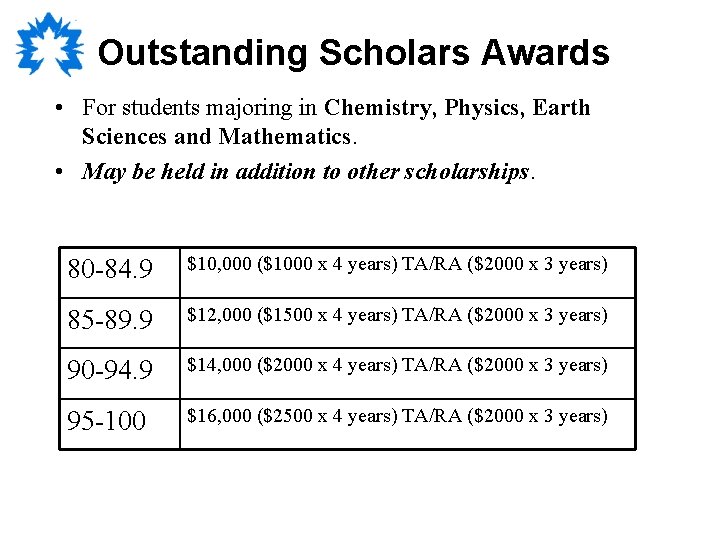
Outstanding Scholars Awards • For students majoring in Chemistry, Physics, Earth Sciences and Mathematics. • May be held in addition to other scholarships. 80 -84. 9 $10, 000 ($1000 x 4 years) TA/RA ($2000 x 3 years) 85 -89. 9 $12, 000 ($1500 x 4 years) TA/RA ($2000 x 3 years) 90 -94. 9 $14, 000 ($2000 x 4 years) TA/RA ($2000 x 3 years) 95 -100 $16, 000 ($2500 x 4 years) TA/RA ($2000 x 3 years)
- Slides: 49