
University of West Hungary Department of Physics Quantum


- Slides: 14
University of West Hungary Department of Physics Quantum Theory of the Coherently Pumped Micromaser István Németh and János Bergou CEWQO 2008 Belgrade, 30 May – 03 June, 2008
University of West Hungary Department of Physics Introduction and motivation The single-atom maser or micromaser* consists of a stream of two-level Rydberg atoms and a single mode of a high-Q cavity. The system has many advantages: The interaction of the maser field and the passing atoms is described by the Jaynes-Cummings Hamiltonian, the most commonly used interaction Hamiltonian of theoretical quantum optics. ¨ The microwave cavities used in today’s experiments have long decay times (approx. 0. 3 s), therefore effects occur on a macroscopic time scale in which the dynamics can be observed in great detail. ¨ This system's ability to coherently transfer quantum states between atoms and photons made it relevant in the context of quantum computation as well. ¨ Although considerable work, both theoretical and experimental, has been devoted to this system, with a few exceptions, most cases involved only noncoherent pumping. As a result, the density matrix describing the field remained always diagonal, preventing the appearance of coherences, which are central to quantum information processing. *Phys. Rev. A 34, 3077 (1986); Phys. Rev. Lett. 64, 2783 (1990)
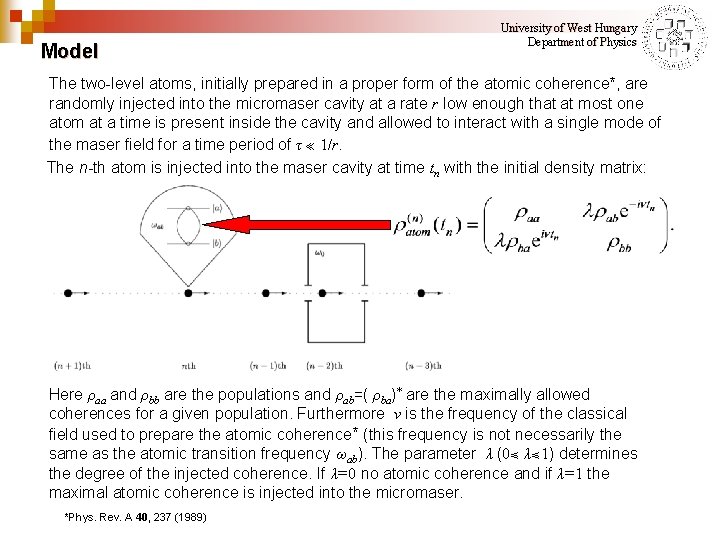
Model University of West Hungary Department of Physics The two-level atoms, initially prepared in a proper form of the atomic coherence*, are randomly injected into the micromaser cavity at a rate r low enough that at most one atom at a time is present inside the cavity and allowed to interact with a single mode of the maser field for a time period of τ 1/r. The n-th atom is injected into the maser cavity at time tn with the initial density matrix: Here ρaa and ρbb are the populations and ρab=( ρba)* are the maximally allowed coherences for a given population. Furthermore ν is the frequency of the classical field used to prepare the atomic coherence* (this frequency is not necessarily the same as the atomic transition frequency ωab). The parameter λ (0 λ 1) determines the degree of the injected coherence. If λ=0 no atomic coherence and if λ=1 the maximal atomic coherence is injected into the micromaser. *Phys. Rev. A 40, 237 (1989)
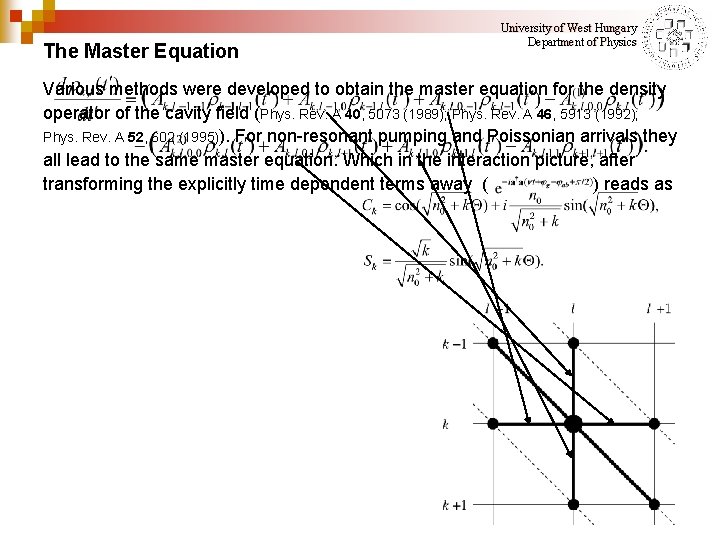
The Master Equation University of West Hungary Department of Physics Various methods were developed to obtain the master equation for the density operator of the cavity field (Phys. Rev. A 40, 5073 (1989); Phys. Rev. A 46, 5913 (1992); Phys. Rev. A 52, 602 (1995)). For non-resonant pumping and Poissonian arrivals they all lead to the same master equation. Which in the interaction picture, after transforming the explicitly time dependent terms away ( ) reads as
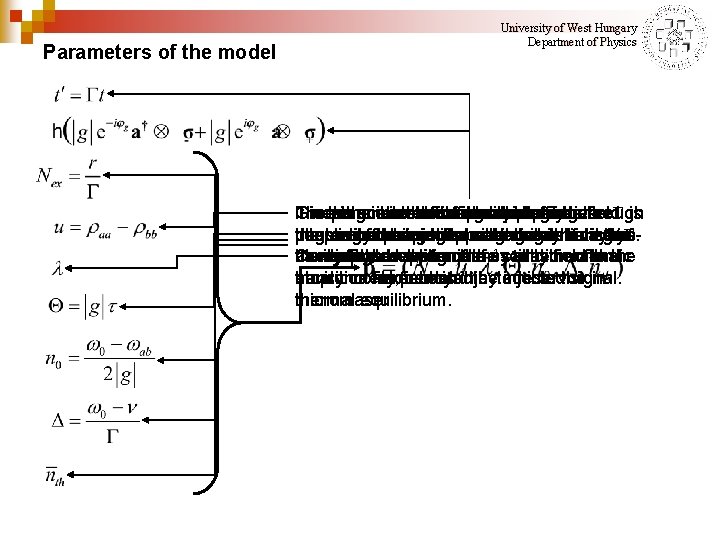
Parameters of the model University of West Hungary Department of Physics Time isthe to cavity decay time. Gives The It is the magnitude atomic parameter mean scaled number inversion detuning which describes ofthe of ofatoms parameter. thermal determines complex which the passing effective photons. gives atom the through field the Γ is the degree cavity ofconstant, during the injected the cavity coherence. time Ifand λ=01/ no coupling interaction photon phase cavity-damping shift number phase accumulated shift ofappearing constant adue single to decay during the atom which indetuning the arises cavity Jaynesthe ofΓ. atomic coherence and if oscillation λ=1 thethe maximal Cummings due cavity the decay empty to field. time the cavity coupling Hamiltonian. between frequency ofthe cavity and field of atomic to thethe environment, atomic transition empty cavity coherence frequency. field modeled and is injected the by a injected reservoir into the signal. in thermal equilibrium. micromaser.
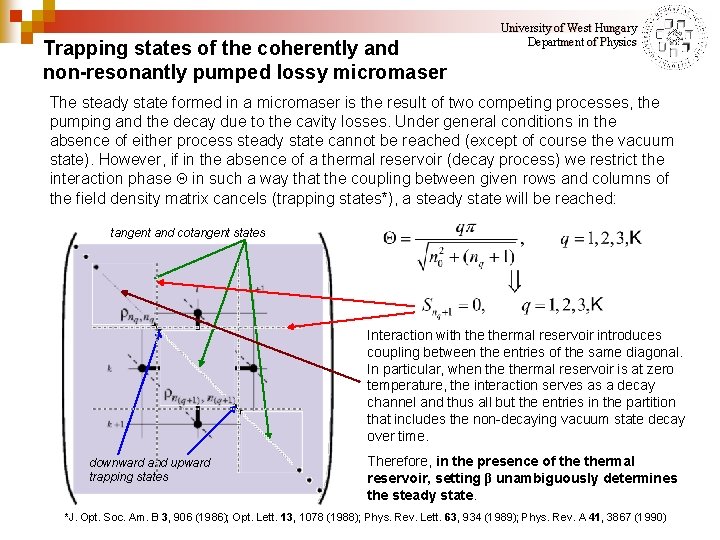
Trapping states of the coherently and non-resonantly pumped lossy micromaser University of West Hungary Department of Physics The steady state formed in a micromaser is the result of two competing processes, the pumping and the decay due to the cavity losses. Under general conditions in the absence of either process steady state cannot be reached (except of course the vacuum state). However, if in the absence of a thermal reservoir (decay process) we restrict the interaction phase Θ in such a way that the coupling between given rows and columns of the field density matrix cancels (trapping states*), a steady state will be reached: tangent and cotangent states Interaction with thermal reservoir introduces coupling between the entries of the same diagonal. In particular, when thermal reservoir is at zero temperature, the interaction serves as a decay channel and thus all but the entries in the partition that includes the non-decaying vacuum state decay over time. downward and upward trapping states Therefore, in the presence of thermal reservoir, setting β unambiguously determines the steady state. *J. Opt. Soc. Am. B 3, 906 (1986); Opt. Lett. 13, 1078 (1988); Phys. Rev. Lett. 63, 934 (1989); Phys. Rev. A 41, 3867 (1990)
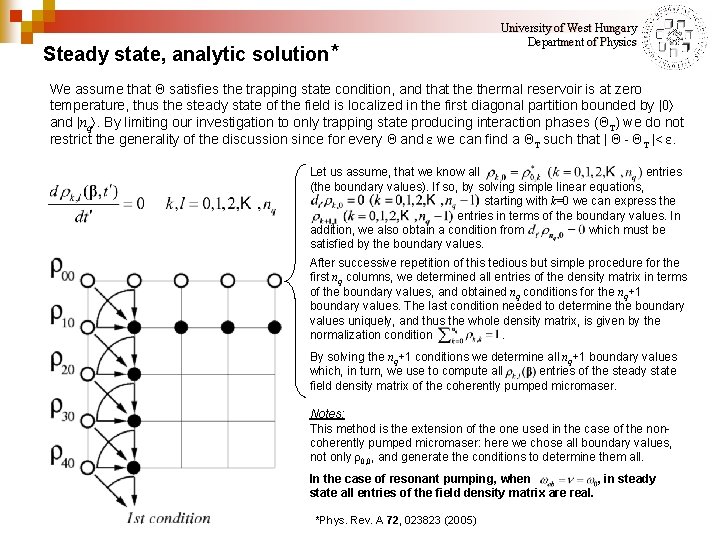
Steady state, analytic solution* University of West Hungary Department of Physics We assume that Θ satisfies the trapping state condition, and that thermal reservoir is at zero temperature, thus the steady state of the field is localized in the first diagonal partition bounded by and nq. By limiting our investigation to only trapping state producing interaction phases (ΘT) we do not restrict the generality of the discussion since for every Θ and ε we can find a ΘT such that Θ - ΘT < ε. Let us assume, that we know all entries (the boundary values). If so, by solving simple linear equations, starting with k=0 we can express the entries in terms of the boundary values. In addition, we also obtain a condition from which must be satisfied by the boundary values. After successive repetition of this tedious but simple procedure for the first nq columns, we determined all entries of the density matrix in terms of the boundary values, and obtained nq conditions for the nq+1 boundary values. The last condition needed to determine the boundary values uniquely, and thus the whole density matrix, is given by the normalization condition. By solving the nq+1 conditions we determine all nq+1 boundary values which, in turn, we use to compute all entries of the steady state field density matrix of the coherently pumped micromaser. Notes: This method is the extension of the one used in the case of the noncoherently pumped micromaser: here we chose all boundary values, not only ρ0, 0, and generate the conditions to determine them all. In the case of resonant pumping, when , in steady state all entries of the field density matrix are real. *Phys. Rev. A 72, 023823 (2005)
University of West Hungary Department of Physics The photon distribution and the purity of the steady state of the coherently pumped micromaser Coherent pumping Non-coherent pumping
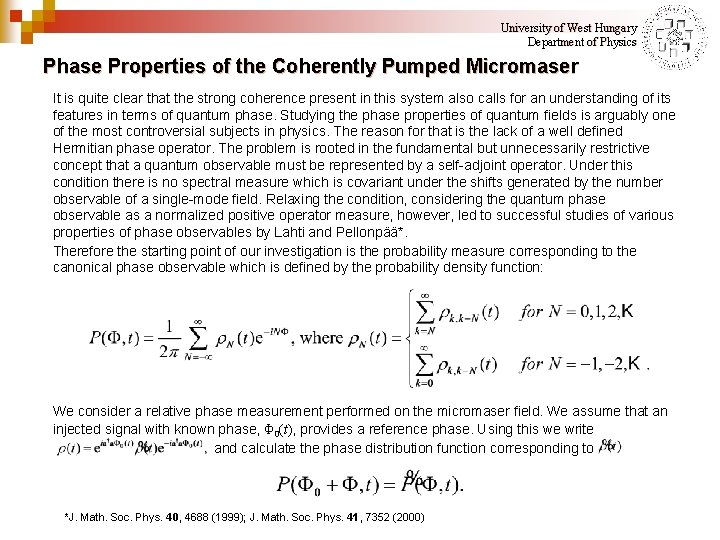
University of West Hungary Department of Physics Phase Properties of the Coherently Pumped Micromaser It is quite clear that the strong coherence present in this system also calls for an understanding of its features in terms of quantum phase. Studying the phase properties of quantum fields is arguably one of the most controversial subjects in physics. The reason for that is the lack of a well defined Hermitian phase operator. The problem is rooted in the fundamental but unnecessarily restrictive concept that a quantum observable must be represented by a self-adjoint operator. Under this condition there is no spectral measure which is covariant under the shifts generated by the number observable of a single-mode field. Relaxing the condition, considering the quantum phase observable as a normalized positive operator measure, however, led to successful studies of various properties of phase observables by Lahti and Pellonpää*. Therefore the starting point of our investigation is the probability measure corresponding to the canonical phase observable which is defined by the probability density function: We consider a relative phase measurement performed on the micromaser field. We assume that an injected signal with known phase, Φ 0(t), provides a reference phase. Using this we write and calculate the phase distribution function corresponding to *J. Math. Soc. Phys. 40, 4688 (1999); J. Math. Soc. Phys. 41, 7352 (2000)
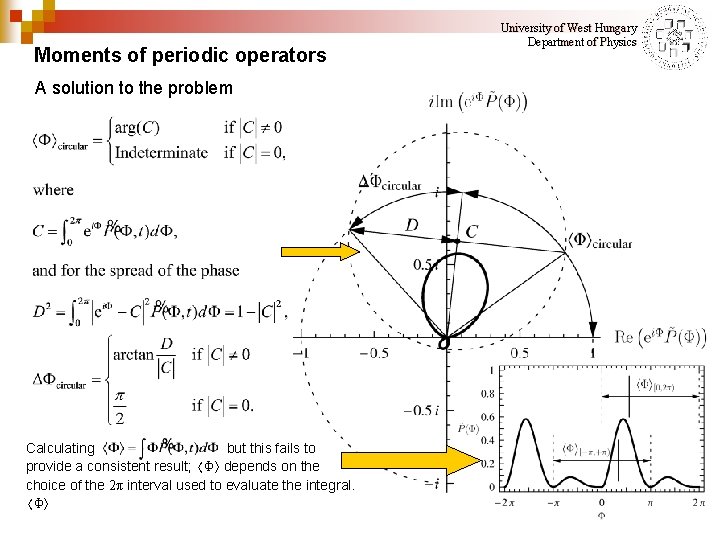
Moments of periodic operators A solution to the problem Calculating but this fails to provide a consistent result; Φ depends on the choice of the 2π interval used to evaluate the integral. Φ University of West Hungary Department of Physics
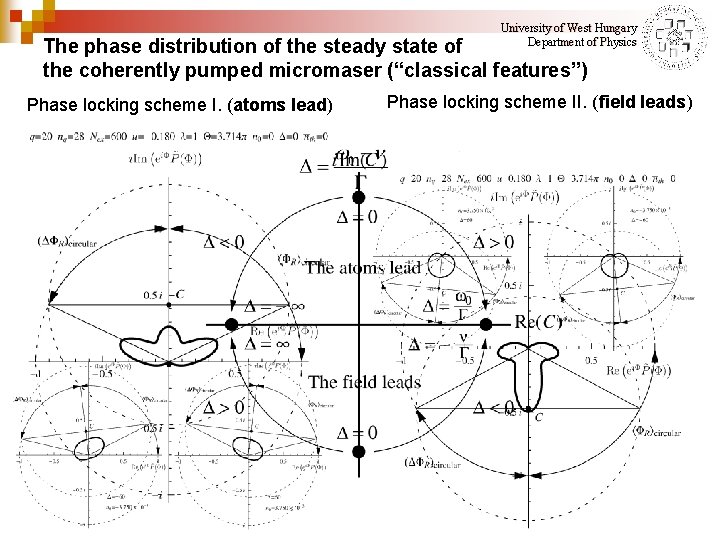
University of West Hungary Department of Physics The phase distribution of the steady state of the coherently pumped micromaser (“classical features”) Phase locking scheme I. (atoms lead) Phase locking scheme II. (field leads)
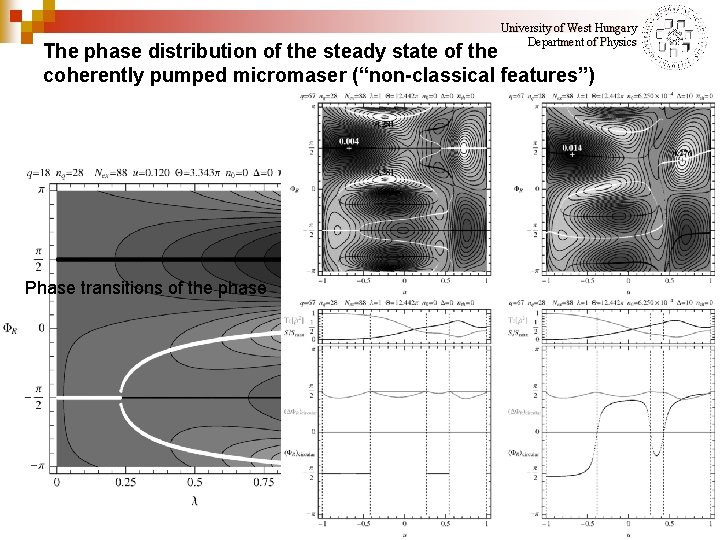
University of West Hungary Department of Physics The phase distribution of the steady state of the coherently pumped micromaser (“non-classical features”) Bifurcations Phase transitions of the phase
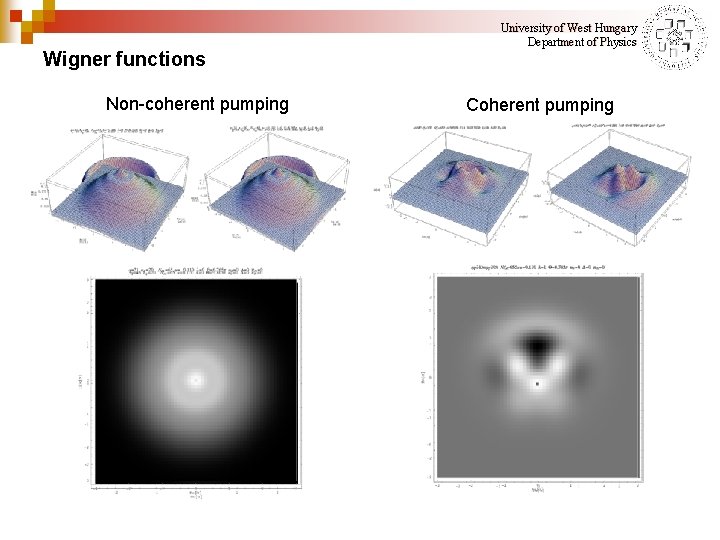
Wigner functions Non-coherent pumping University of West Hungary Department of Physics Coherent pumping
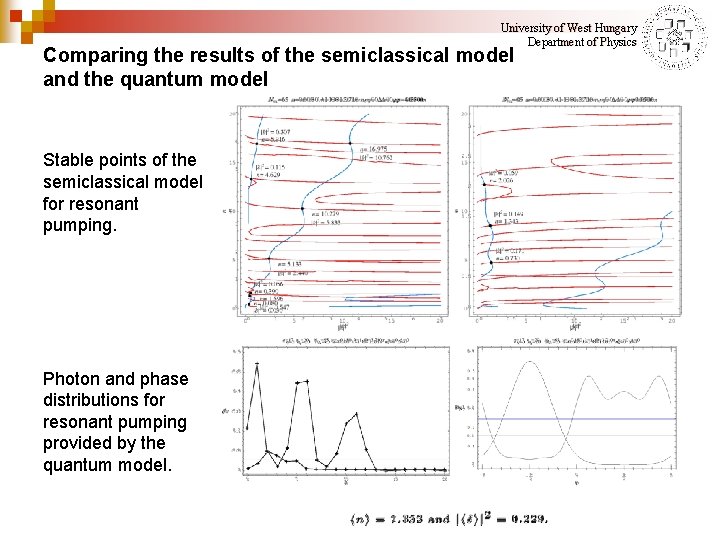
University of West Hungary Department of Physics Comparing the results of the semiclassical model and the quantum model Stable points of the semiclassical model for resonant pumping. Photon and phase distributions for resonant pumping provided by the quantum model.