
University of Waterloo Department of Mechanical Engineering ME

- Slides: 70
University of Waterloo Department of Mechanical Engineering ME 322 - Mechanical Design 1 Partial notes – Part 4 (Fatigue) (G. Glinka) Fall 2005 1
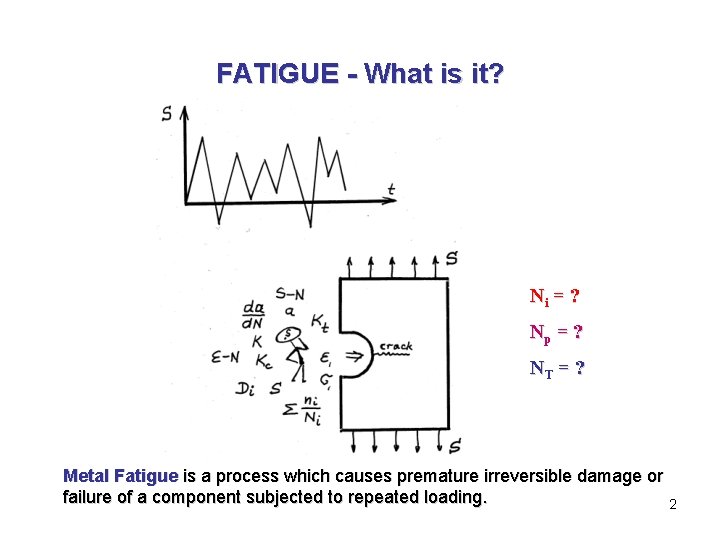
FATIGUE - What is it? Ni = ? Np = ? NT = ? Metal Fatigue is a process which causes premature irreversible damage or failure of a component subjected to repeated loading. 2
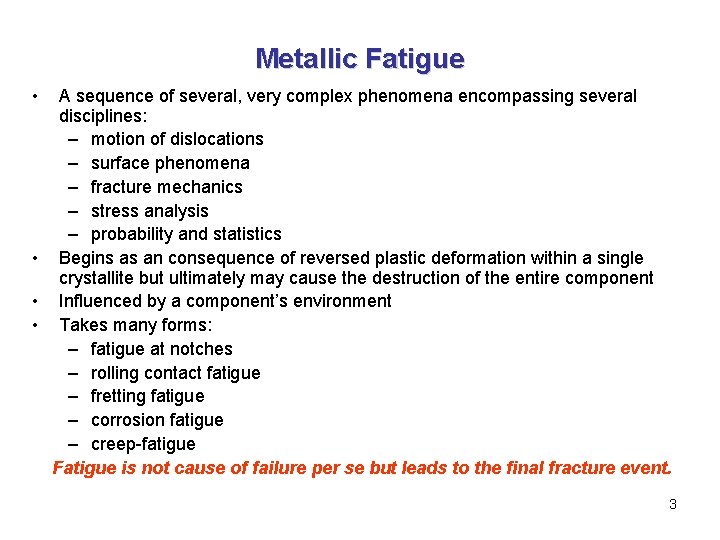
Metallic Fatigue • A sequence of several, very complex phenomena encompassing several disciplines: – motion of dislocations – surface phenomena – fracture mechanics – stress analysis – probability and statistics • Begins as an consequence of reversed plastic deformation within a single crystallite but ultimately may cause the destruction of the entire component • Influenced by a component’s environment • Takes many forms: – fatigue at notches – rolling contact fatigue – fretting fatigue – corrosion fatigue – creep-fatigue Fatigue is not cause of failure per se but leads to the final fracture event. 3
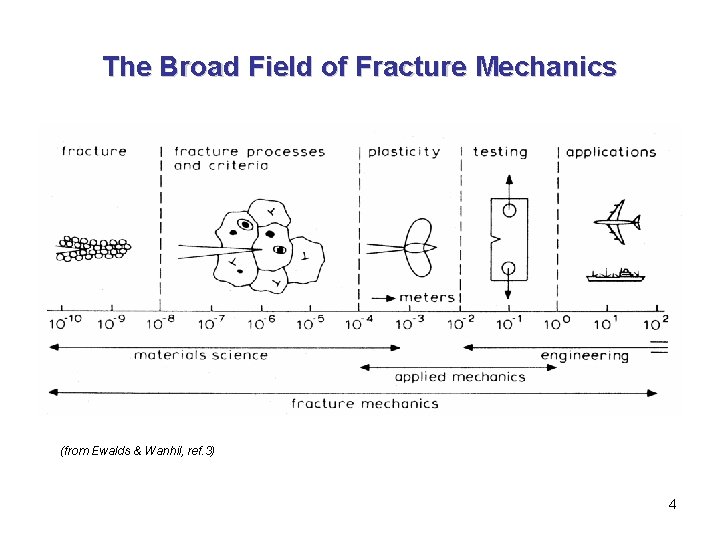
The Broad Field of Fracture Mechanics (from Ewalds & Wanhil, ref. 3) 4
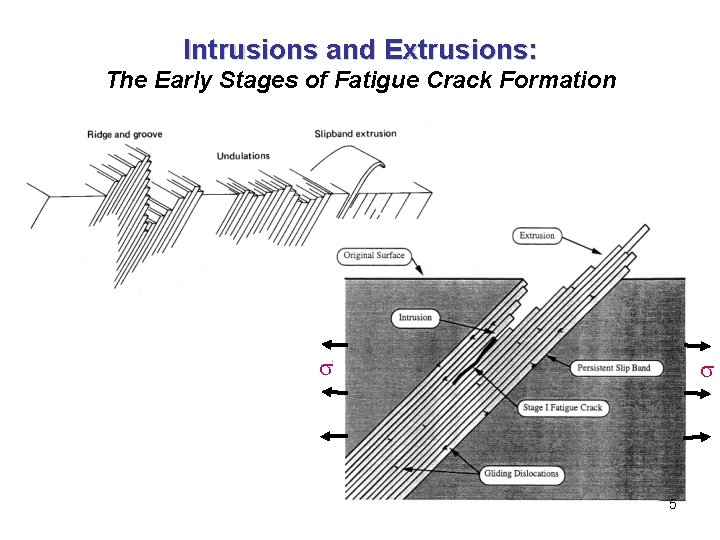
Intrusions and Extrusions: The Early Stages of Fatigue Crack Formation 5
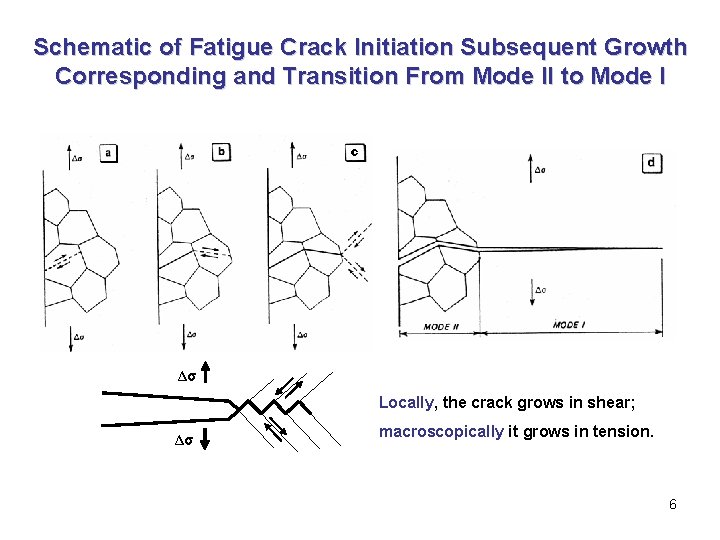
Schematic of Fatigue Crack Initiation Subsequent Growth Corresponding and Transition From Mode II to Mode I c Δσ Locally, the crack grows in shear; Δσ macroscopically it grows in tension. 6
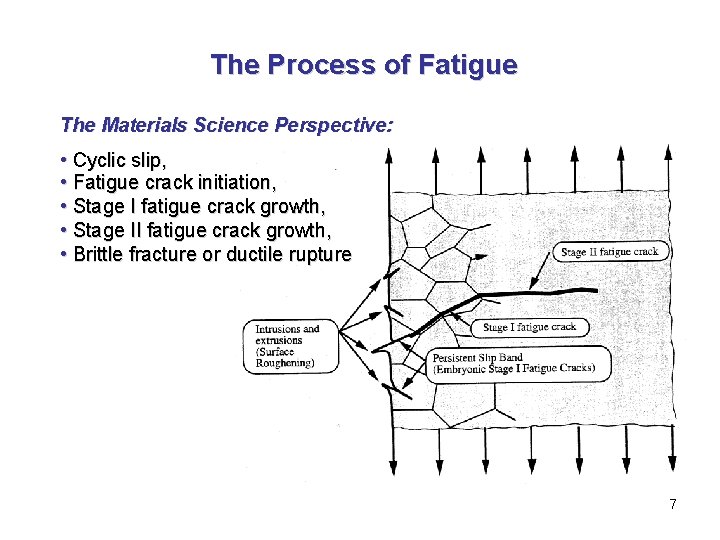
The Process of Fatigue The Materials Science Perspective: • Cyclic slip, • Fatigue crack initiation, • Stage I fatigue crack growth, • Stage II fatigue crack growth, • Brittle fracture or ductile rupture 7
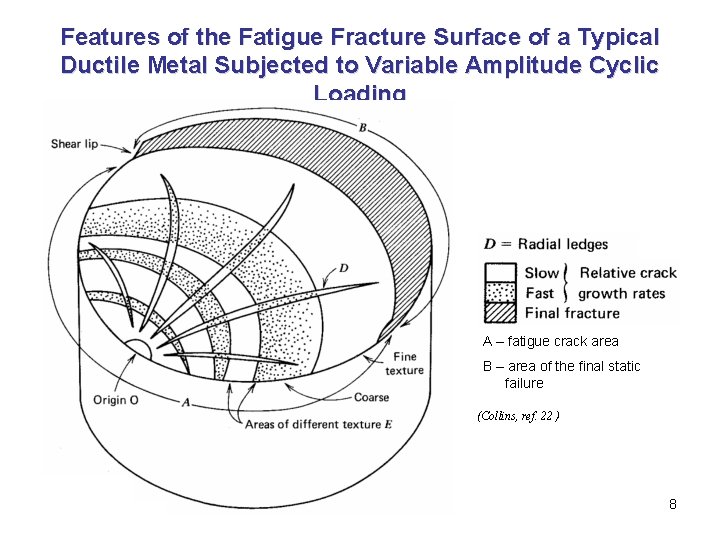
Features of the Fatigue Fracture Surface of a Typical Ductile Metal Subjected to Variable Amplitude Cyclic Loading A – fatigue crack area B – area of the final static failure (Collins, ref. 22 ) 8
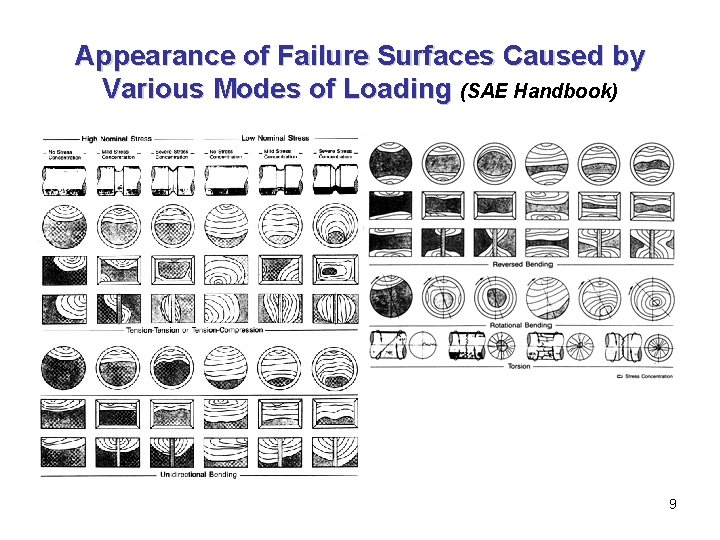
Appearance of Failure Surfaces Caused by Various Modes of Loading (SAE Handbook) 9
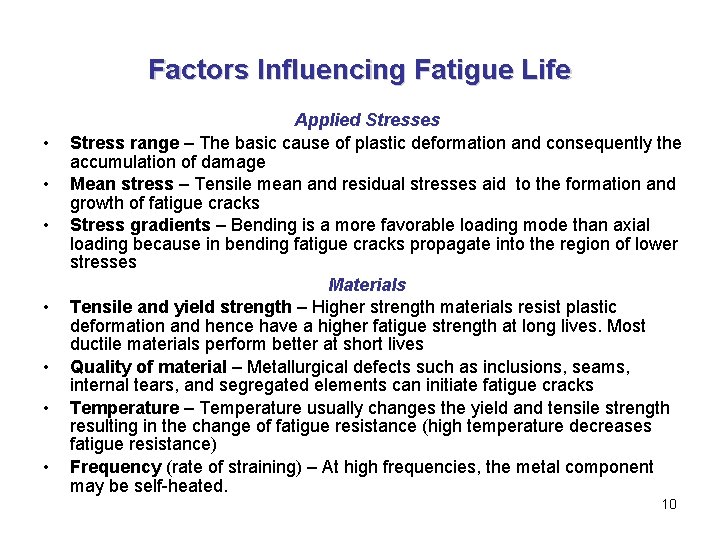
Factors Influencing Fatigue Life • • Applied Stresses Stress range – The basic cause of plastic deformation and consequently the accumulation of damage Mean stress – Tensile mean and residual stresses aid to the formation and growth of fatigue cracks Stress gradients – Bending is a more favorable loading mode than axial loading because in bending fatigue cracks propagate into the region of lower stresses Materials Tensile and yield strength – Higher strength materials resist plastic deformation and hence have a higher fatigue strength at long lives. Most ductile materials perform better at short lives Quality of material – Metallurgical defects such as inclusions, seams, internal tears, and segregated elements can initiate fatigue cracks Temperature – Temperature usually changes the yield and tensile strength resulting in the change of fatigue resistance (high temperature decreases fatigue resistance) Frequency (rate of straining) – At high frequencies, the metal component may be self-heated. 10
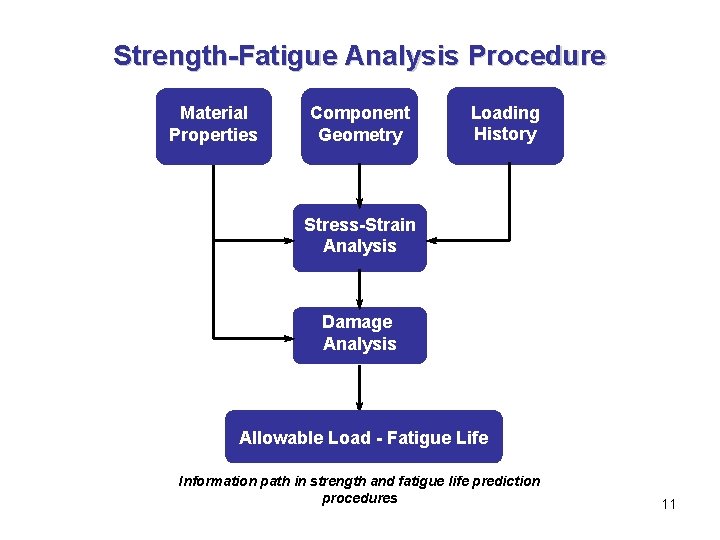
Strength-Fatigue Analysis Procedure Material Properties Component Geometry Loading History Stress-Strain Analysis Damage Analysis Allowable Load - Fatigue Life Information path in strength and fatigue life prediction procedures 11
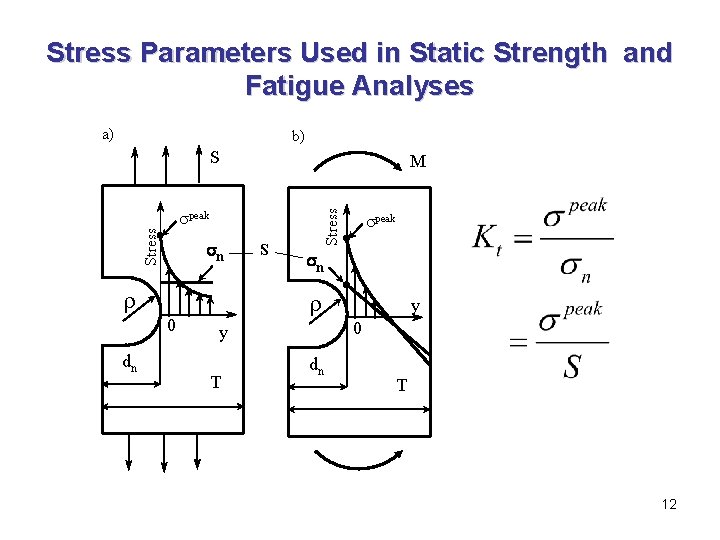
Stress Parameters Used in Static Strength and Fatigue Analyses a) b) S Stress M Stress peak n r 0 dn S peak n r 0 y T y dn T 12
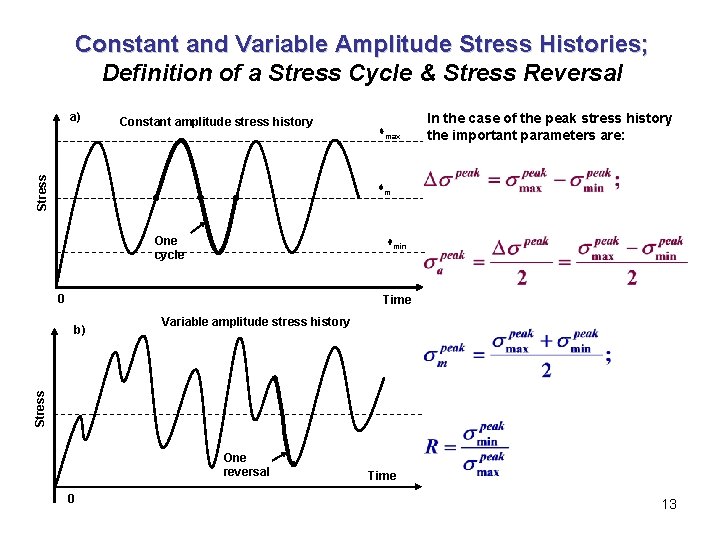
Constant and Variable Amplitude Stress Histories; Definition of a Stress Cycle & Stress Reversal Constant amplitude stress history Stress a) max In the case of the peak stress history the important parameters are: m One cycle min 0 Time Variable amplitude stress history Stress b) One reversal 0 Time 13
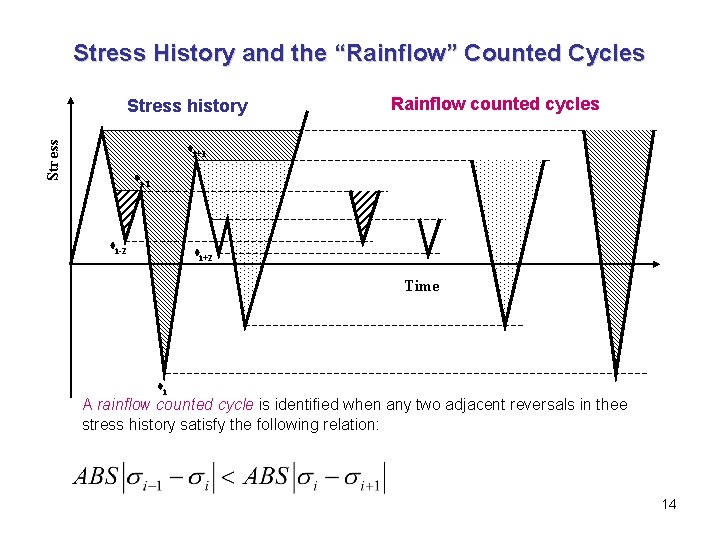
Stress History and the “Rainflow” Counted Cycles Stress history Rainflow counted cycles i+1 i-1 i-2 i+2 Time i A rainflow counted cycle is identified when any two adjacent reversals in thee stress history satisfy the following relation: 14
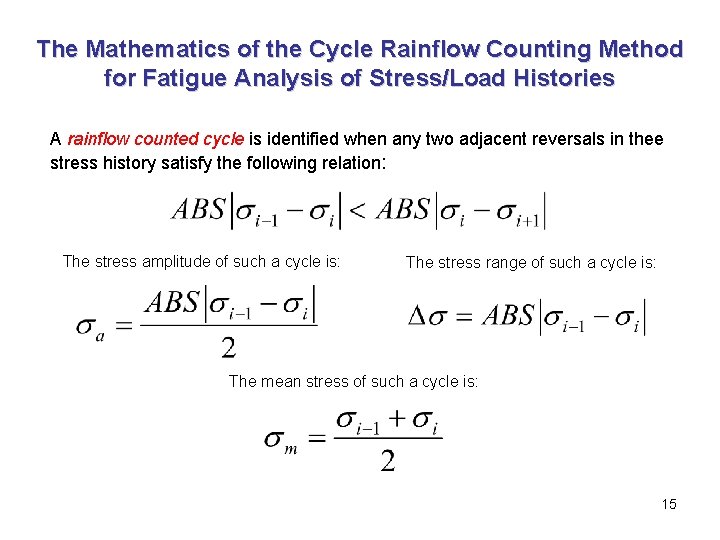
The Mathematics of the Cycle Rainflow Counting Method for Fatigue Analysis of Stress/Load Histories A rainflow counted cycle is identified when any two adjacent reversals in thee stress history satisfy the following relation: The stress amplitude of such a cycle is: The stress range of such a cycle is: The mean stress of such a cycle is: 15
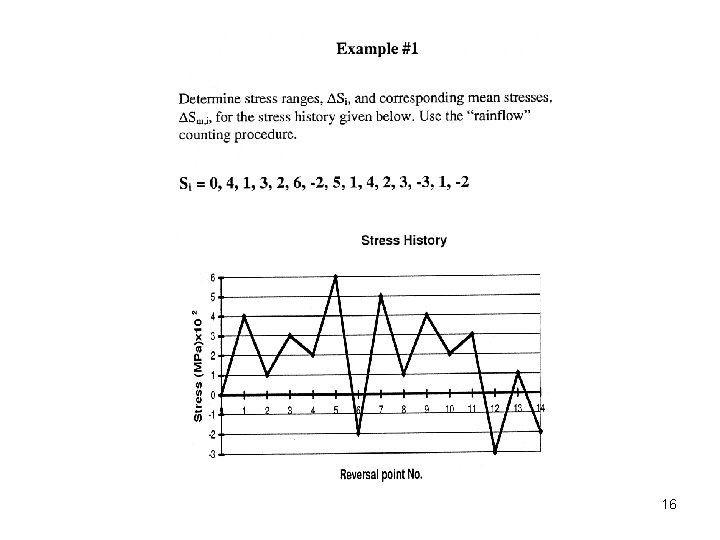
16
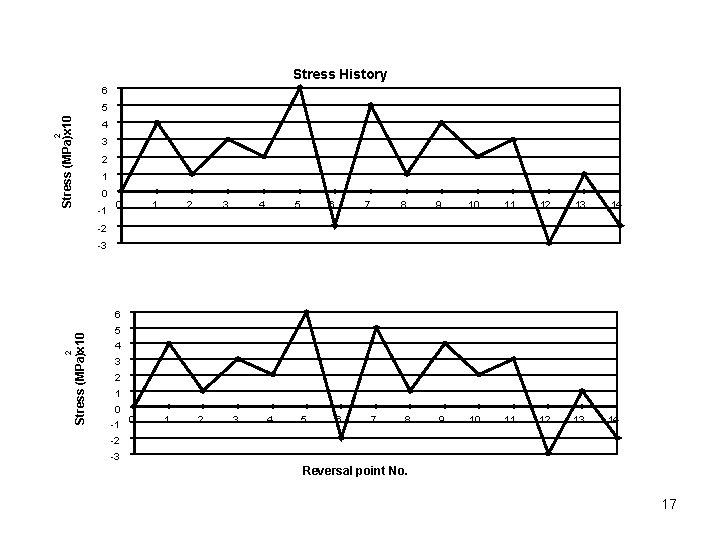
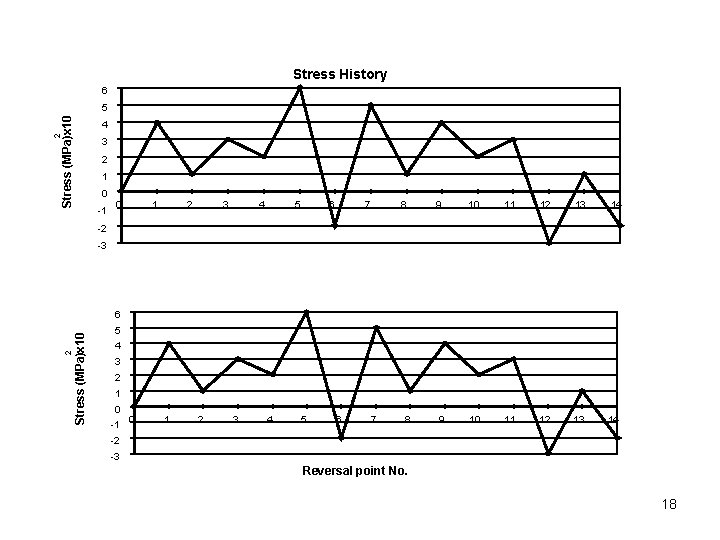
Stress History 6 2 Stress (MPa)x 10 5 4 3 2 1 0 -1 0 1 2 3 4 5 6 7 8 9 10 11 12 13 14 -2 -3 2 Stress (MPa)x 10 6 5 4 3 2 1 0 -1 0 1 2 3 4 5 6 7 8 9 -2 -3 Reversal point No. 17
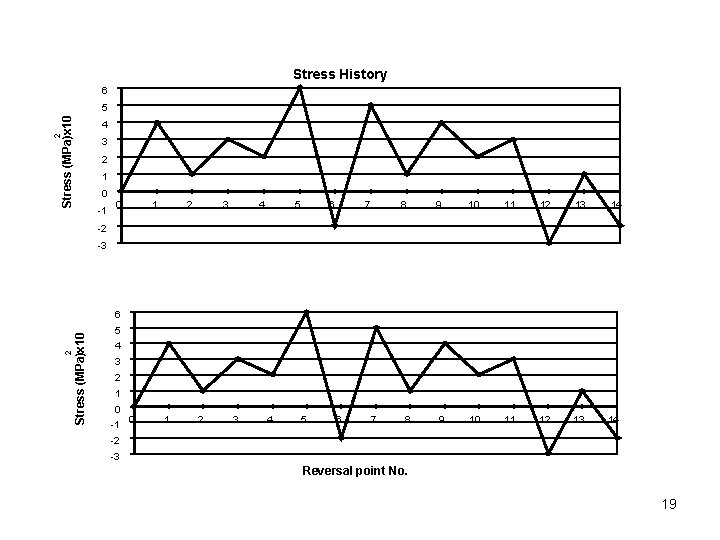
Stress History 6 2 Stress (MPa)x 10 5 4 3 2 1 0 -1 0 1 2 3 4 5 6 7 8 9 10 11 12 13 14 -2 -3 2 Stress (MPa)x 10 6 5 4 3 2 1 0 -1 0 1 2 3 4 5 6 7 8 9 -2 -3 Reversal point No. 18
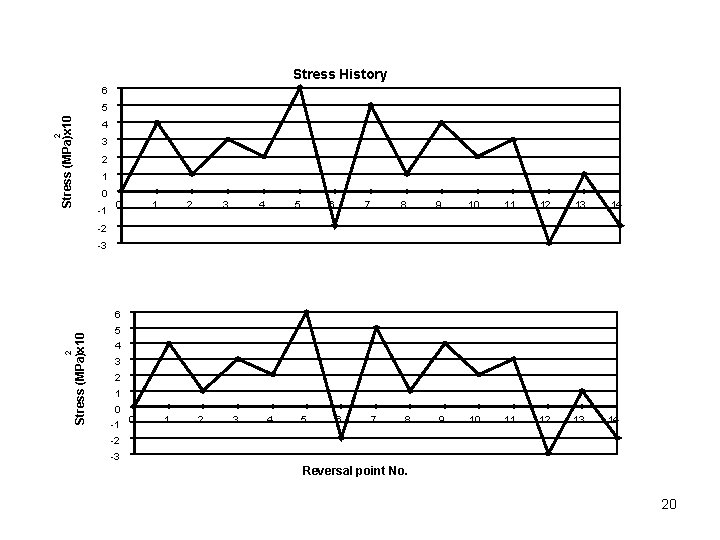
Stress History 6 2 Stress (MPa)x 10 5 4 3 2 1 0 -1 0 1 2 3 4 5 6 7 8 9 10 11 12 13 14 -2 -3 2 Stress (MPa)x 10 6 5 4 3 2 1 0 -1 0 1 2 3 4 5 6 7 8 9 -2 -3 Reversal point No. 19
Stress History 6 2 Stress (MPa)x 10 5 4 3 2 1 0 -1 0 1 2 3 4 5 6 7 8 9 10 11 12 13 14 -2 -3 2 Stress (MPa)x 10 6 5 4 3 2 1 0 -1 0 1 2 3 4 5 6 7 8 9 -2 -3 Reversal point No. 20
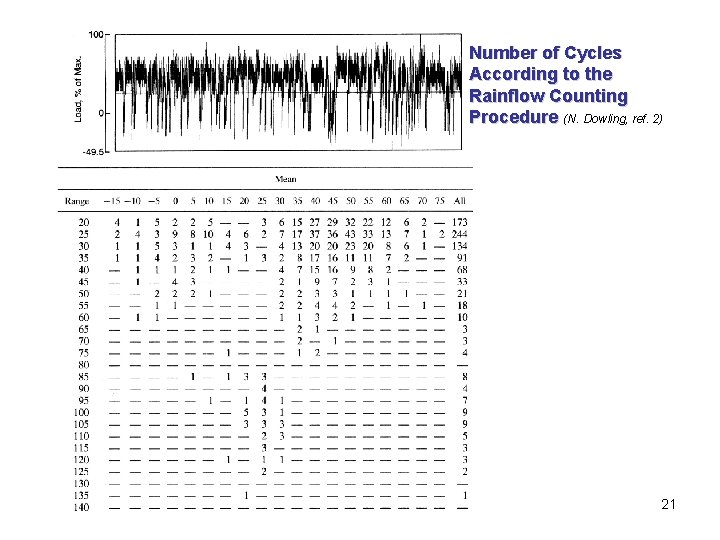
Number of Cycles According to the Rainflow Counting Procedure (N. Dowling, ref. 2) 21
The Fatigue S-N method (Nominal Stress Approach) • The principles of the S-N approach (the nominal stress method) • Fatigue damage accumulation • Significance of geometry (notches) and stress analysis in fatigue evaluations of engineering structures • • Fatigue life prediction in the design process 22
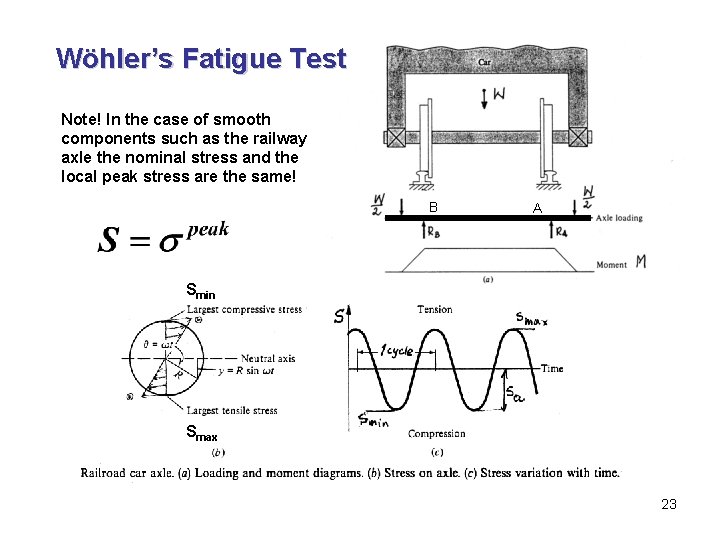
Wöhler’s Fatigue Test Note! In the case of smooth components such as the railway axle the nominal stress and the local peak stress are the same! B A Smin Smax 23
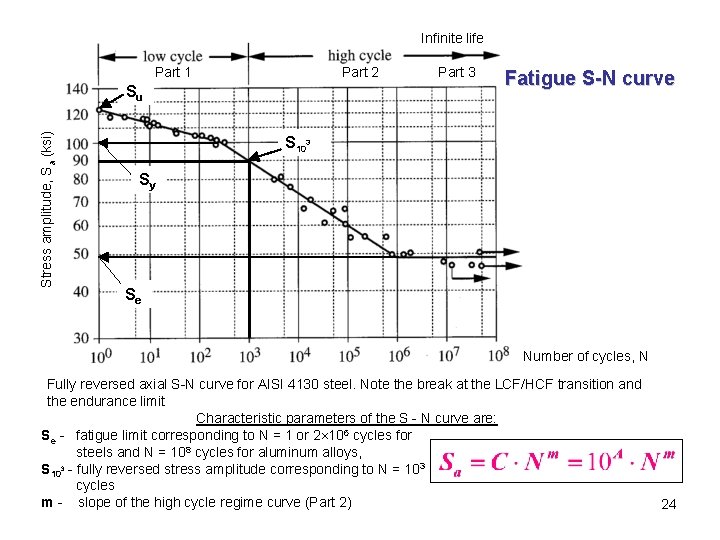
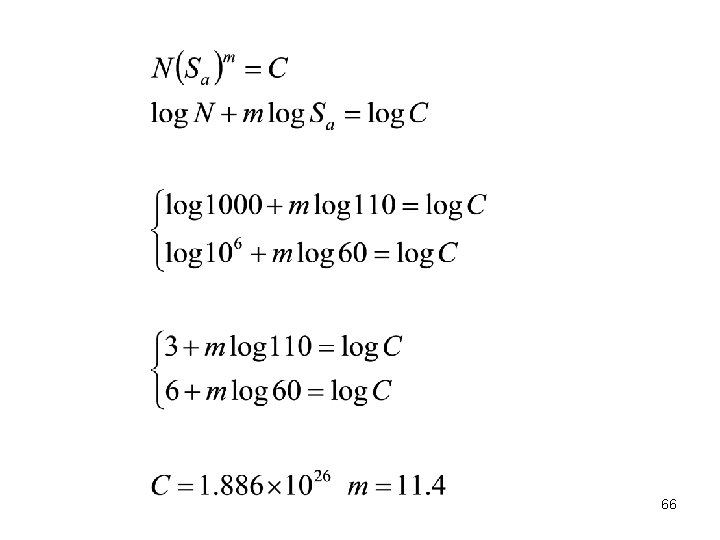
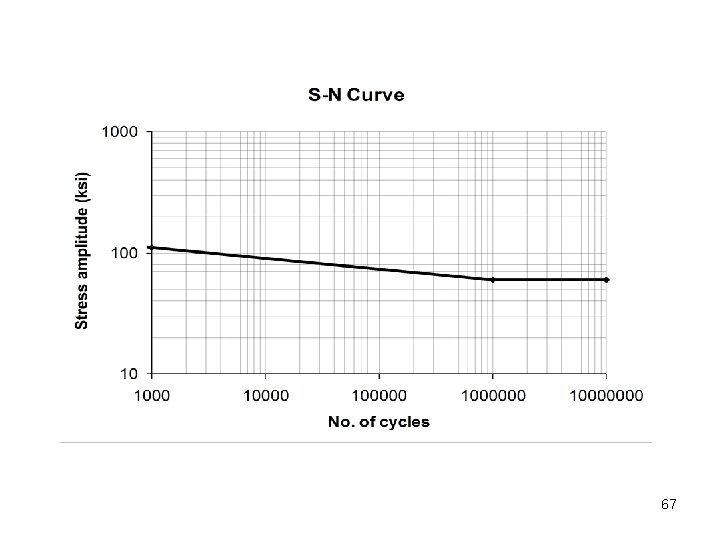
Infinite life Part 1 Part 2 Stress amplitude, Sa (ksi) Su Part 3 Fatigue S-N curve S 103 Sy Se Number of cycles, N Fully reversed axial S-N curve for AISI 4130 steel. Note the break at the LCF/HCF transition and the endurance limit Characteristic parameters of the S - N curve are: Se - fatigue limit corresponding to N = 1 or 2 106 cycles for steels and N = 108 cycles for aluminum alloys, S 103 - fully reversed stress amplitude corresponding to N = 103 cycles m - slope of the high cycle regime curve (Part 2) 24
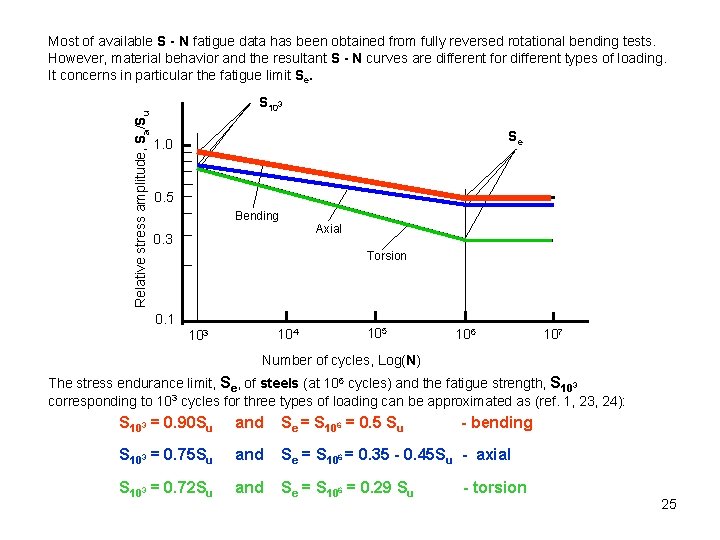
Relative stress amplitude, Sa/Su Most of available S - N fatigue data has been obtained from fully reversed rotational bending tests. However, material behavior and the resultant S - N curves are different for different types of loading. It concerns in particular the fatigue limit Se. S 103 Se 1. 0 0. 5 Bending Axial 0. 3 Torsion 0. 1 104 103 105 106 107 Number of cycles, Log(N) The stress endurance limit, Se, of steels (at 106 cycles) and the fatigue strength, S 103 corresponding to 103 cycles for three types of loading can be approximated as (ref. 1, 23, 24): S 103 = 0. 90 Su and Se = S 106 = 0. 5 Su - bending S 103 = 0. 75 Su and Se = S 106 = 0. 35 - 0. 45 Su - axial S 103 = 0. 72 Su and Se = S 106 = 0. 29 Su - torsion 25
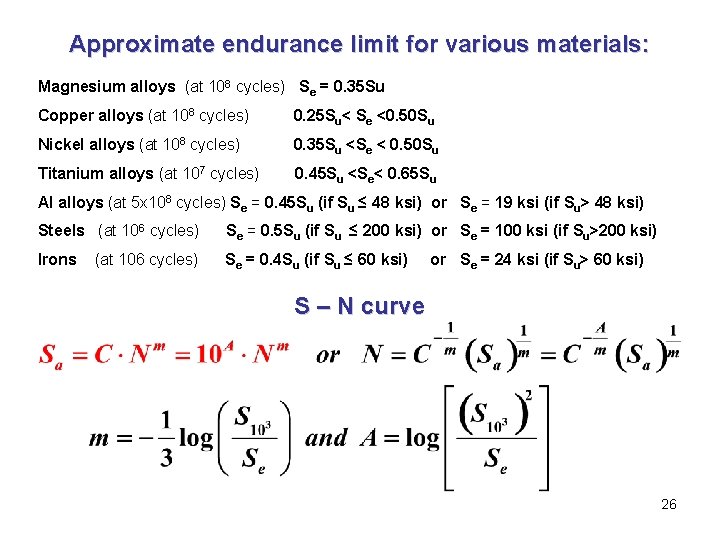
Approximate endurance limit for various materials: Magnesium alloys (at 108 cycles) Se = 0. 35 Su Copper alloys (at 108 cycles) 0. 25 Su< Se <0. 50 Su Nickel alloys (at 108 cycles) 0. 35 Su <Se < 0. 50 Su Titanium alloys (at 107 cycles) 0. 45 Su <Se< 0. 65 Su Al alloys (at 5 x 10⁸ cycles) Se = 0. 45 Su (if Su ≤ 48 ksi) or Se = 19 ksi (if Su> 48 ksi) Steels (at 106 cycles) Se = 0. 5 Su (if Su ≤ 200 ksi) or Se = 100 ksi (if Su>200 ksi) Irons Se = 0. 4 Su (if Su ≤ 60 ksi) (at 106 cycles) or Se = 24 ksi (if Su> 60 ksi) S – N curve 26
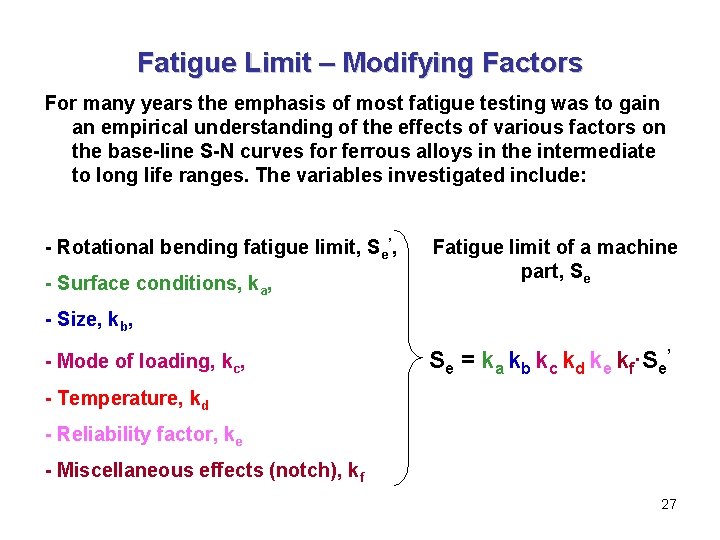
Fatigue Limit – Modifying Factors For many years the emphasis of most fatigue testing was to gain an empirical understanding of the effects of various factors on the base-line S-N curves for ferrous alloys in the intermediate to long life ranges. The variables investigated include: - Rotational bending fatigue limit, Se’, - Surface conditions, ka, Fatigue limit of a machine part, Se - Size, kb, - Mode of loading, kc, Se = ka kb kc kd ke kf·Se’ - Temperature, kd - Reliability factor, ke - Miscellaneous effects (notch), kf 27
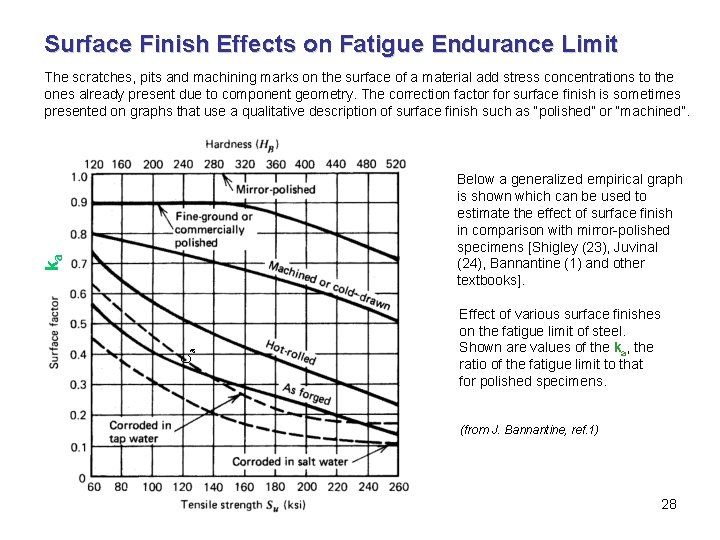
Surface Finish Effects on Fatigue Endurance Limit The scratches, pits and machining marks on the surface of a material add stress concentrations to the ones already present due to component geometry. The correction factor for surface finish is sometimes presented on graphs that use a qualitative description of surface finish such as “polished” or “machined”. Ca ka Below a generalized empirical graph is shown which can be used to estimate the effect of surface finish in comparison with mirror-polished specimens [Shigley (23), Juvinal (24), Bannantine (1) and other textbooks]. Effect of various surface finishes on the fatigue limit of steel. Shown are values of the ka, the ratio of the fatigue limit to that for polished specimens. (from J. Bannantine, ref. 1) 28
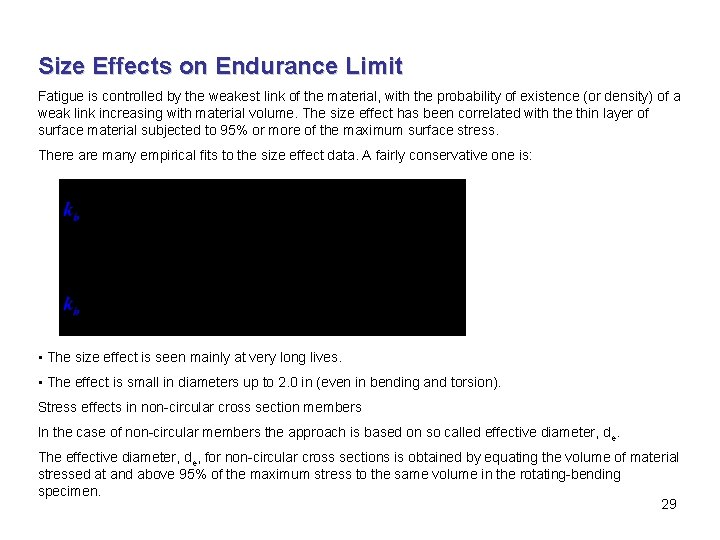
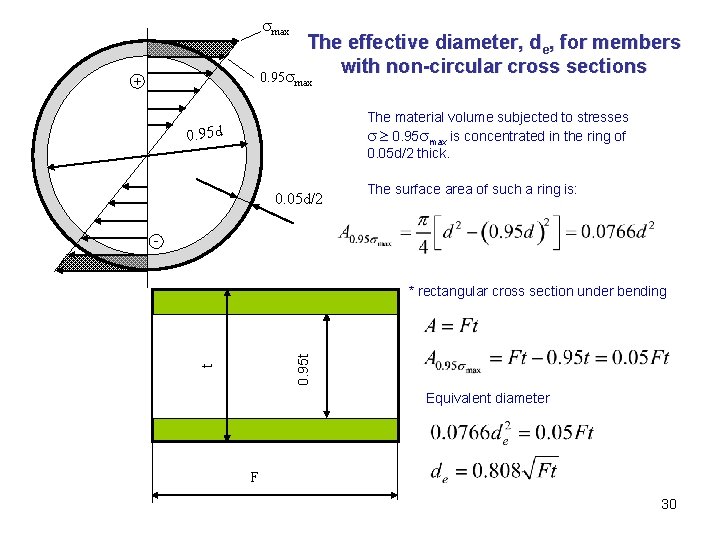
Size Effects on Endurance Limit Fatigue is controlled by the weakest link of the material, with the probability of existence (or density) of a weak link increasing with material volume. The size effect has been correlated with the thin layer of surface material subjected to 95% or more of the maximum surface stress. There are many empirical fits to the size effect data. A fairly conservative one is: • The size effect is seen mainly at very long lives. • The effect is small in diameters up to 2. 0 in (even in bending and torsion). Stress effects in non-circular cross section members In the case of non-circular members the approach is based on so called effective diameter, de. The effective diameter, de, for non-circular cross sections is obtained by equating the volume of material stressed at and above 95% of the maximum stress to the same volume in the rotating-bending specimen. 29
max The effective diameter, de, for members with non-circular cross sections 0. 95 max + The material volume subjected to stresses 0. 95 max is concentrated in the ring of 0. 05 d/2 thick. 0. 95 d 0. 05 d/2 The surface area of such a ring is: - t 0. 95 t * rectangular cross section under bending Equivalent diameter F 30
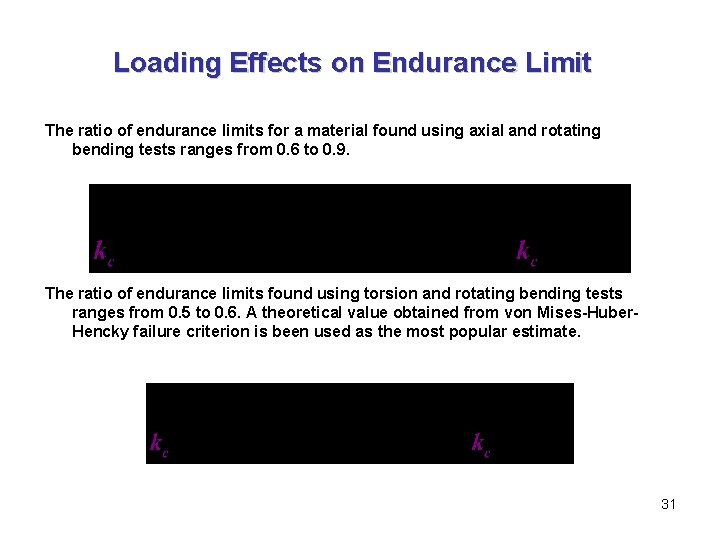
Loading Effects on Endurance Limit The ratio of endurance limits for a material found using axial and rotating bending tests ranges from 0. 6 to 0. 9. The ratio of endurance limits found using torsion and rotating bending tests ranges from 0. 5 to 0. 6. A theoretical value obtained from von Mises-Huber. Hencky failure criterion is been used as the most popular estimate. 31
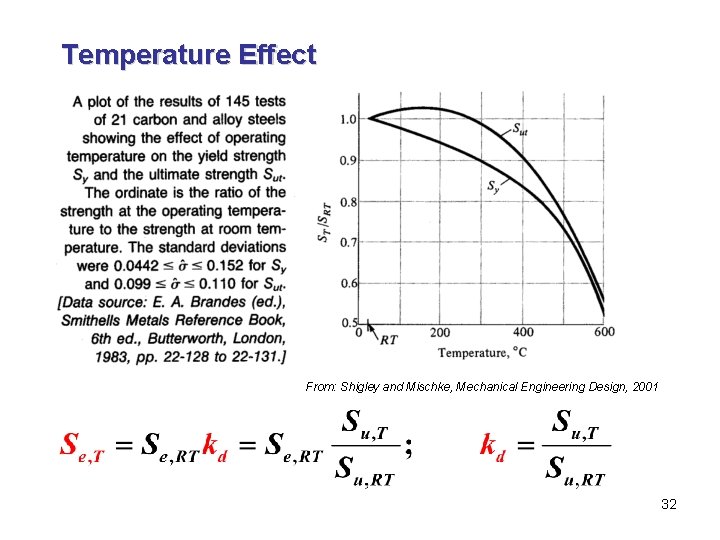
Temperature Effect From: Shigley and Mischke, Mechanical Engineering Design, 2001 32
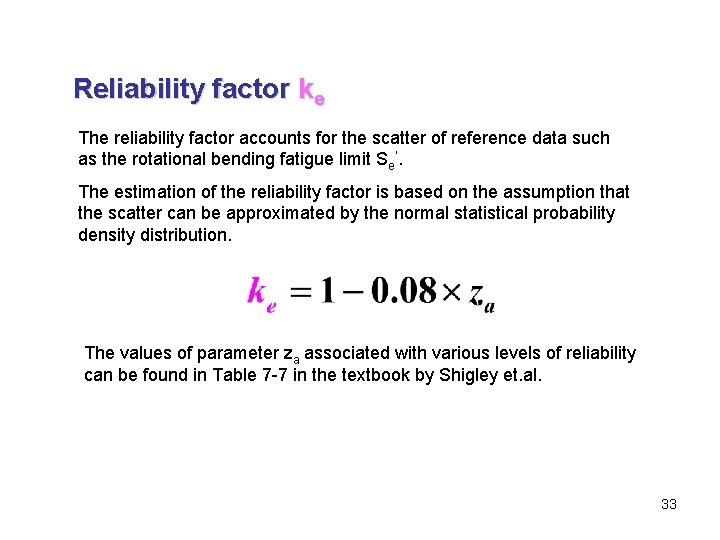
Reliability factor ke The reliability factor accounts for the scatter of reference data such as the rotational bending fatigue limit Se’. The estimation of the reliability factor is based on the assumption that the scatter can be approximated by the normal statistical probability density distribution. The values of parameter za associated with various levels of reliability can be found in Table 7 -7 in the textbook by Shigley et. al. 33
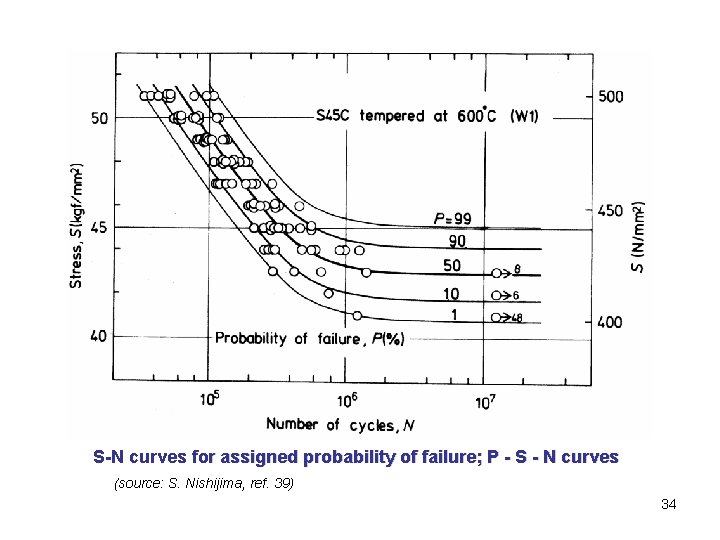
S-N curves for assigned probability of failure; P - S - N curves (source: S. Nishijima, ref. 39) 34
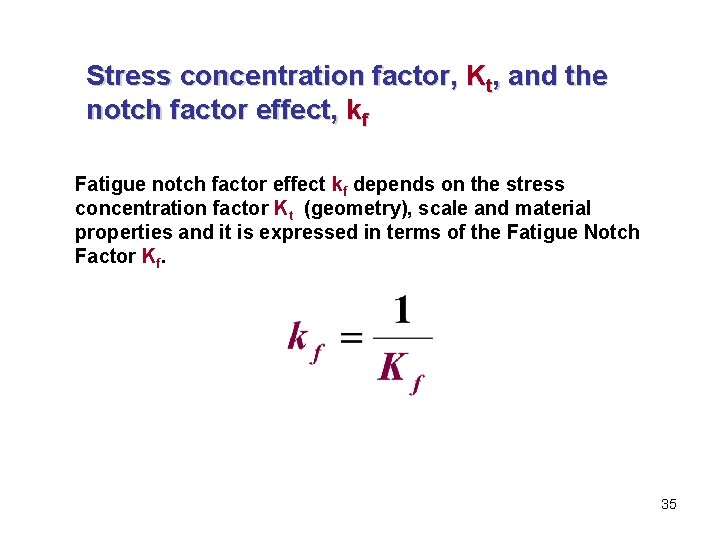
Stress concentration factor, Kt, and the notch factor effect, kf Fatigue notch factor effect kf depends on the stress concentration factor Kt (geometry), scale and material properties and it is expressed in terms of the Fatigue Notch Factor Kf. 35
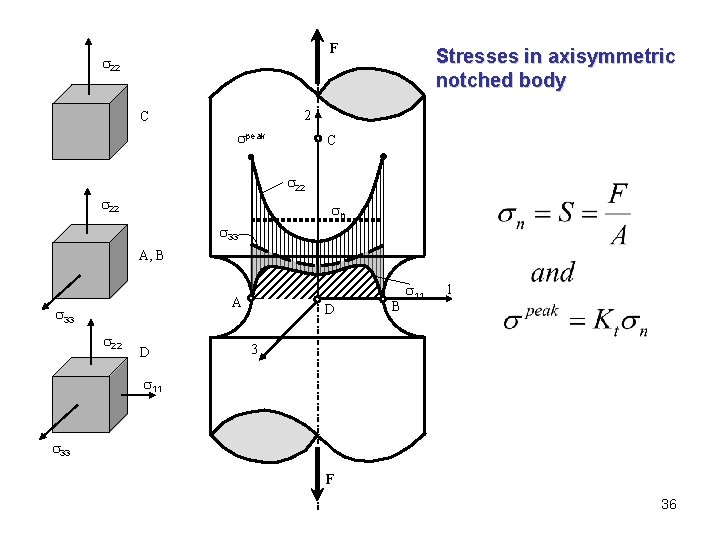
F 22 Stresses in axisymmetric notched body 2 C peak C 22 n 33 A, B A 33 22 D D B 11 1 3 11 33 F 36
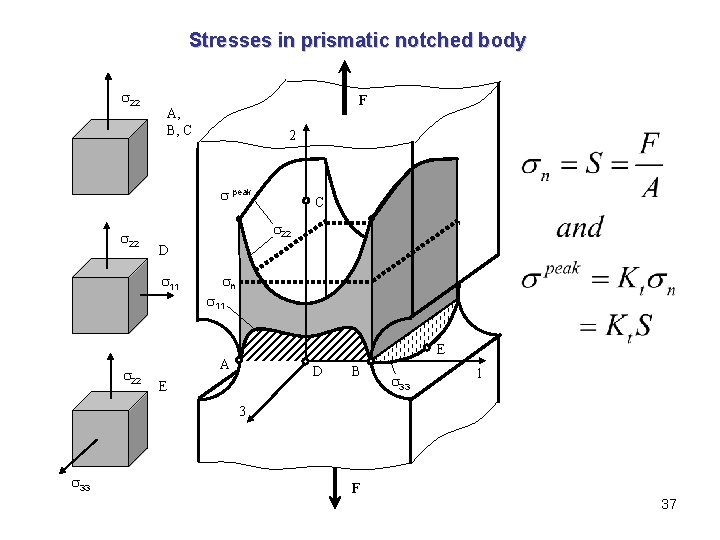
Stresses in prismatic notched body 22 F A, B, C 2 peak 22 D 11 22 C n 11 E A D E B 33 1 3 33 F 37
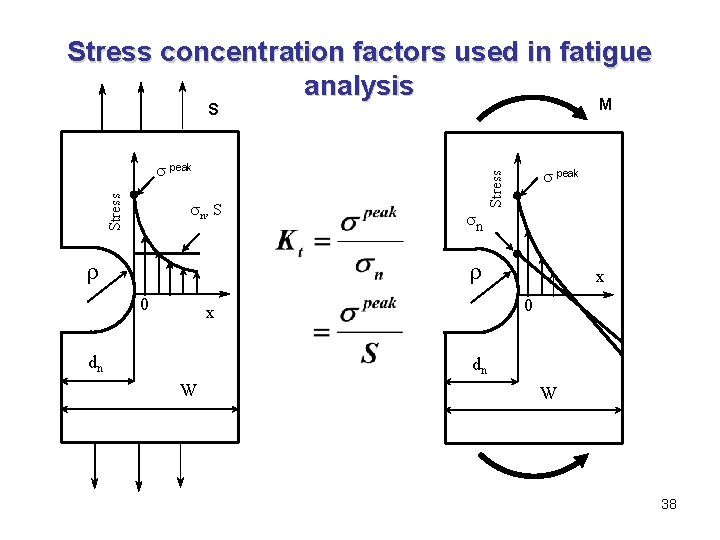
Stress concentration factors used in fatigue analysis M S n, S r peak Stress peak n r 0 0 x dn W W 38
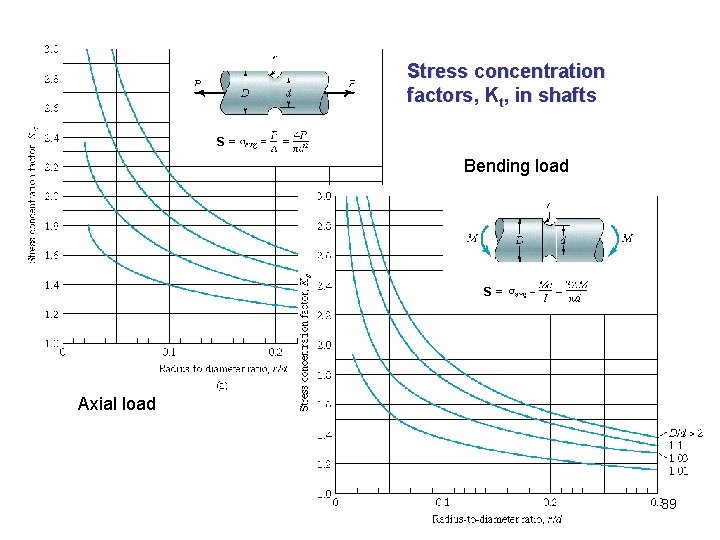
Stress concentration factors, Kt, in shafts S= Bending load S= Axial load 39
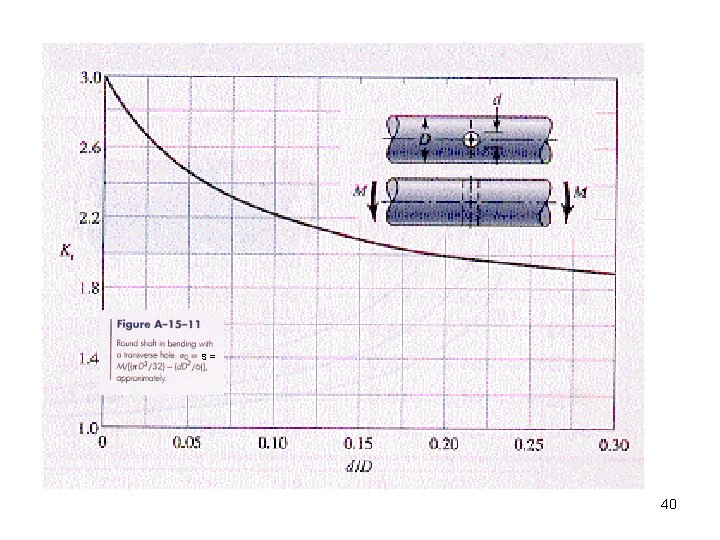
S= 40
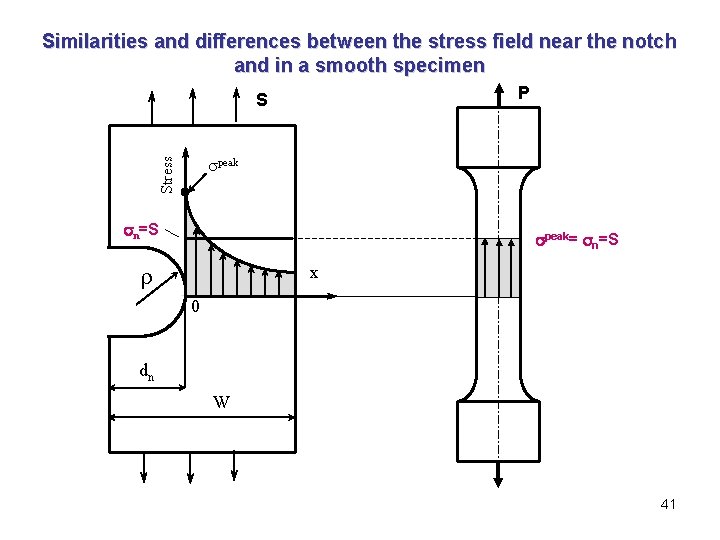
Similarities and differences between the stress field near the notch and in a smooth specimen P S Stress peak n=S peak= n=S r x 0 dn W 41
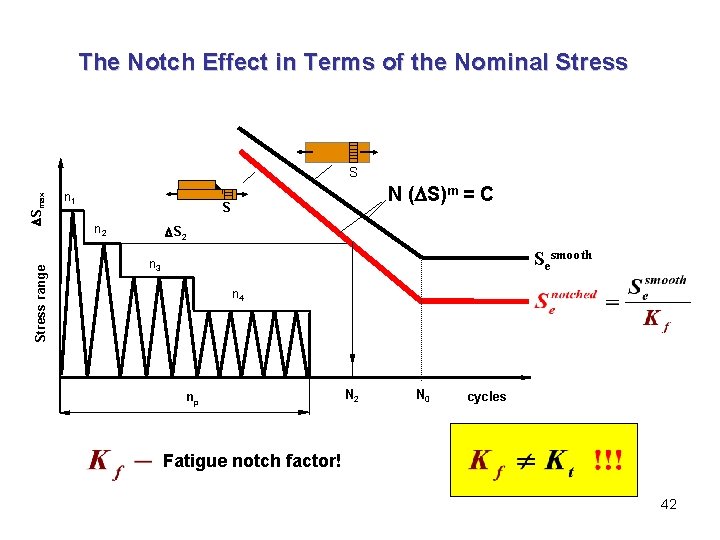
The Notch Effect in Terms of the Nominal Stress range Smax S n 1 N ( S)m = C S n 2 S 2 Sesmooth n 3 n 4 np N 2 N 0 cycles Fatigue notch factor! 42
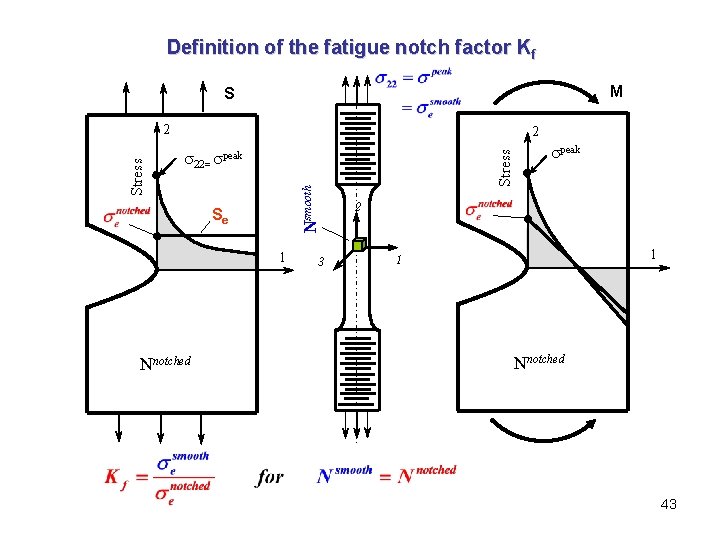
Definition of the fatigue notch factor Kf M S 2 Se 1 Nnotched 3 Stress 22= peak Nsmooth Stress 2 peak 2 1 1 Nnotched 43
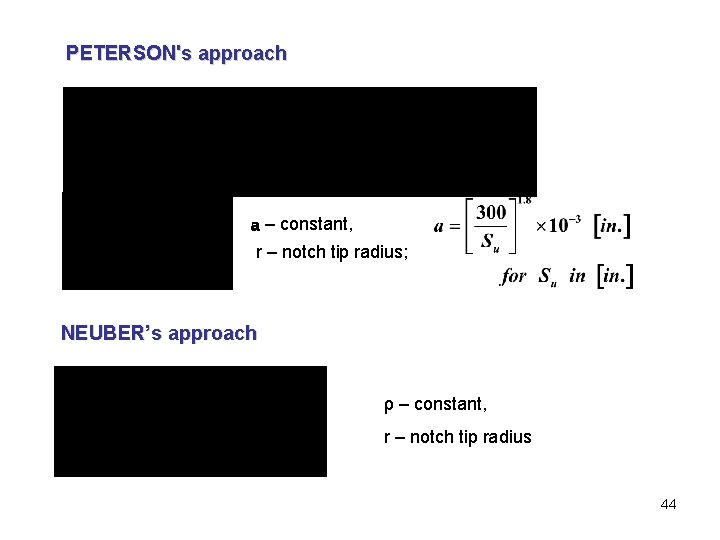
PETERSON's approach a – constant, r – notch tip radius; NEUBER’s approach ρ – constant, r – notch tip radius 44
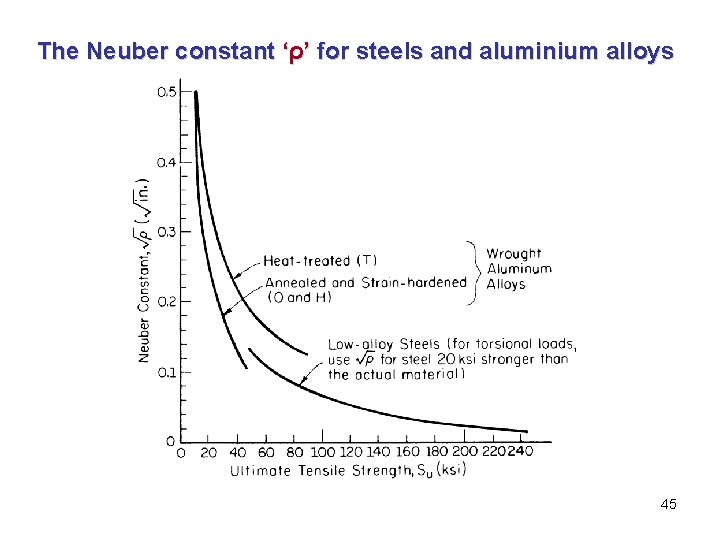
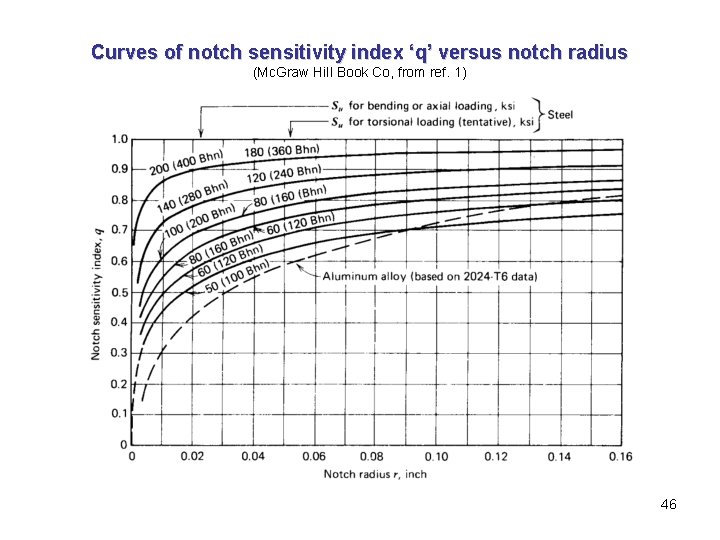
The Neuber constant ‘ρ’ for steels and aluminium alloys 45
Curves of notch sensitivity index ‘q’ versus notch radius (Mc. Graw Hill Book Co, from ref. 1) 46
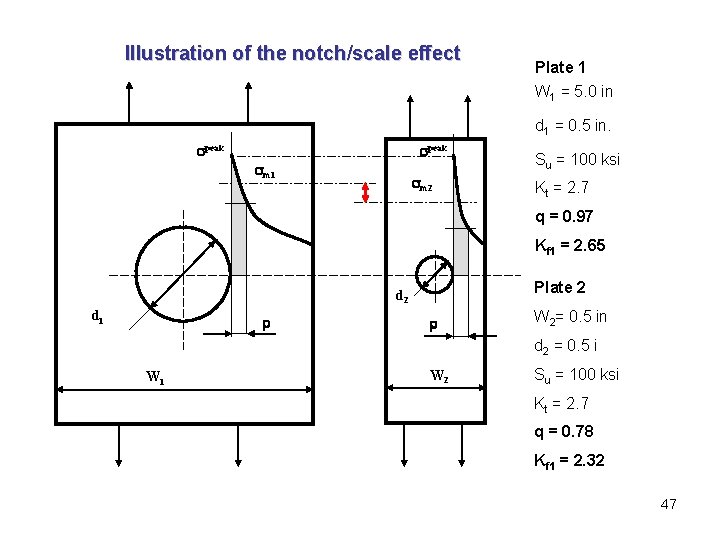
Illustration of the notch/scale effect Plate 1 W 1 = 5. 0 in d 1 = 0. 5 in. peak m 1 m 2 Su = 100 ksi Kt = 2. 7 q = 0. 97 Kf 1 = 2. 65 Plate 2 d 1 W 2= 0. 5 in d 2 = 0. 5 i W 1 W 2 Su = 100 ksi Kt = 2. 7 q = 0. 78 Kf 1 = 2. 32 47
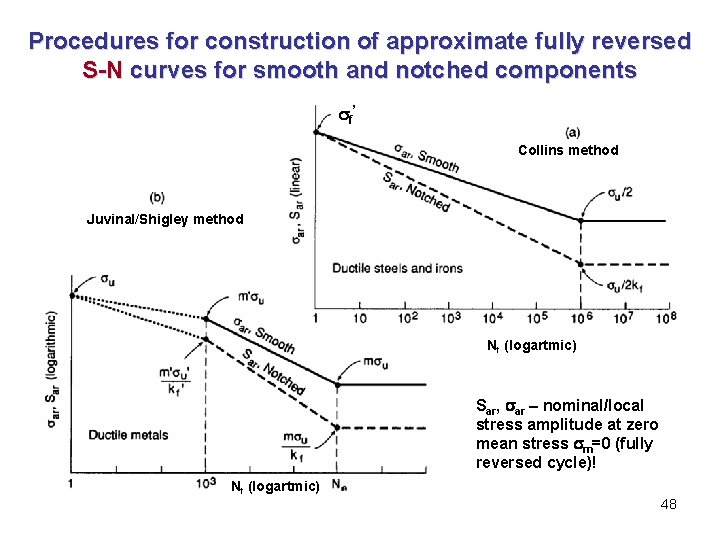
Procedures for construction of approximate fully reversed S-N curves for smooth and notched components f ’ Collins method Juvinal/Shigley method Nf (logartmic) Sar, ar – nominal/local stress amplitude at zero mean stress m=0 (fully reversed cycle)! Nf (logartmic) 48
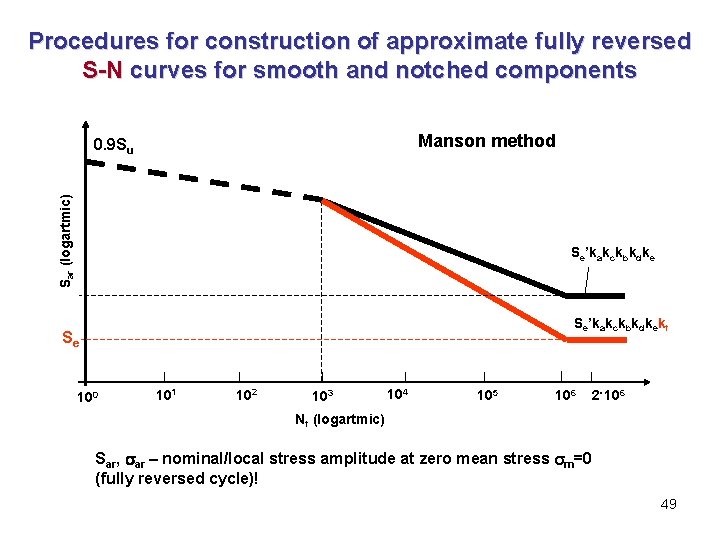
Procedures for construction of approximate fully reversed S-N curves for smooth and notched components Manson method Sar (logartmic) 0. 9 Su Se’kakckbkdkekf Se 100 101 102 103 104 105 106 2·106 Nf (logartmic) Sar, ar – nominal/local stress amplitude at zero mean stress m=0 (fully reversed cycle)! 49
NOTE! • The empirical relationships concerning the S –N curve data are only estimates! Depending on the acceptable level of uncertainty in the fatigue design, actual test data may be necessary. • The most useful concept of the S - N method is the endurance limit, which is used in “infinite-life”, or “safe stress” design philosophy. • In general, the S – N approach should not be used to estimate lives below 1000 cycles (N < 1000). 50
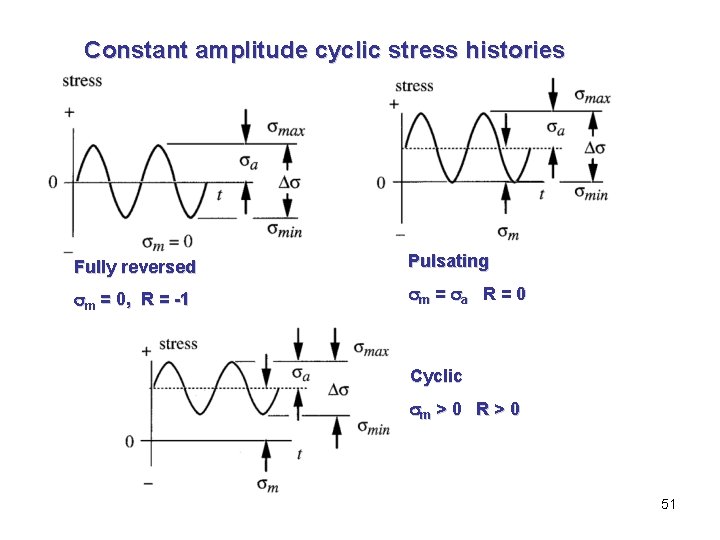
Constant amplitude cyclic stress histories Fully reversed Pulsating m = 0, R = -1 m = a R = 0 Cyclic m > 0 R > 0 51
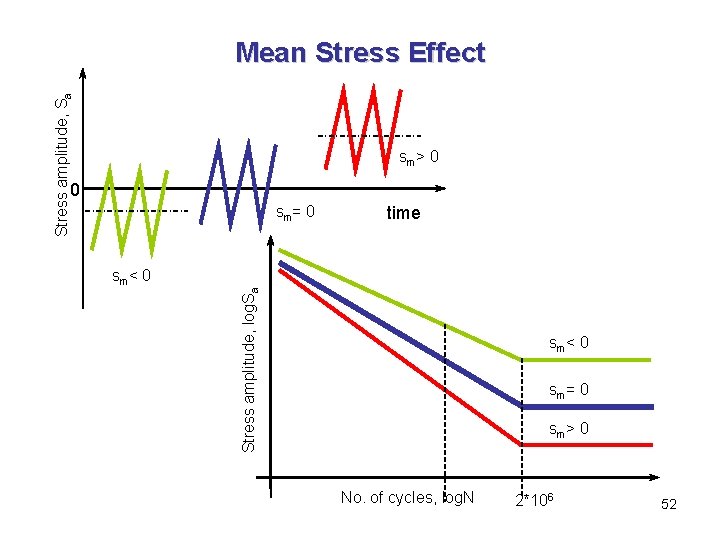
Stress amplitude, Sa Mean Stress Effect sm> 0 0 sm< 0 time Stress amplitude, log. Sa sm= 0 sm< 0 sm= 0 sm> 0 No. of cycles, log. N 2*106 52
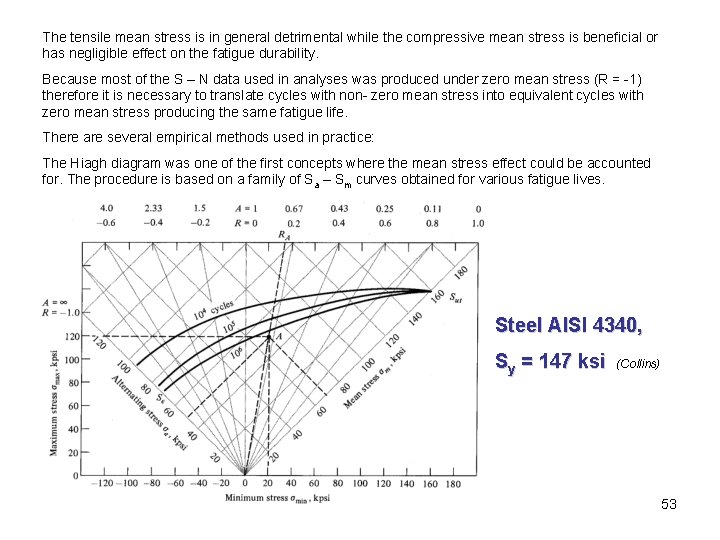
The tensile mean stress is in general detrimental while the compressive mean stress is beneficial or has negligible effect on the fatigue durability. Because most of the S – N data used in analyses was produced under zero mean stress (R = -1) therefore it is necessary to translate cycles with non- zero mean stress into equivalent cycles with zero mean stress producing the same fatigue life. There are several empirical methods used in practice: The Hiagh diagram was one of the first concepts where the mean stress effect could be accounted for. The procedure is based on a family of Sa – Sm curves obtained for various fatigue lives. Steel AISI 4340, Sy = 147 ksi (Collins) 53
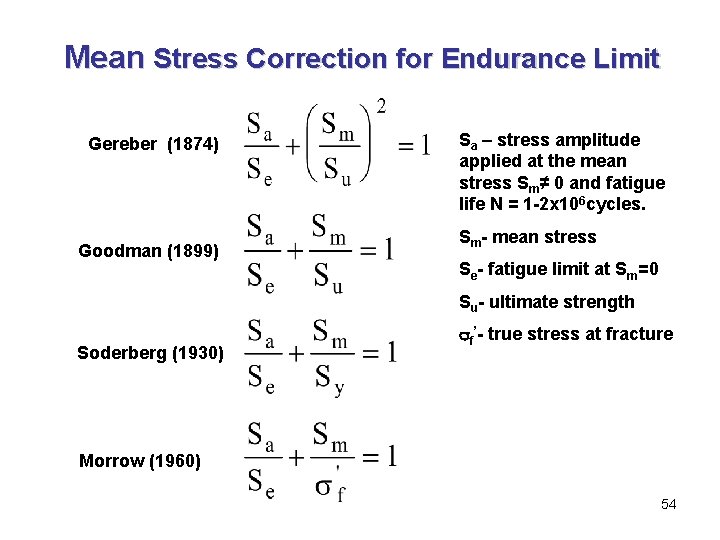
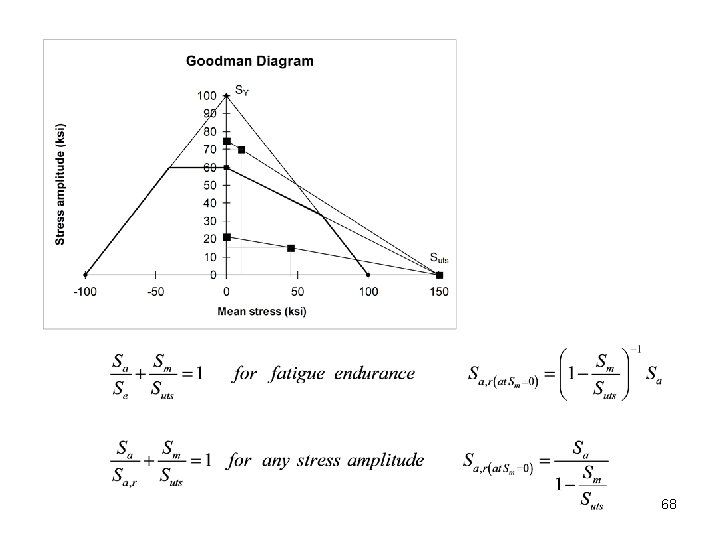
Mean Stress Correction for Endurance Limit Gereber (1874) Goodman (1899) Sa – stress amplitude applied at the mean stress Sm≠ 0 and fatigue life N = 1 -2 x 10⁶ cycles. Sm- mean stress Se- fatigue limit at Sm=0 Su- ultimate strength Soderberg (1930) f’- true stress at fracture Morrow (1960) 54
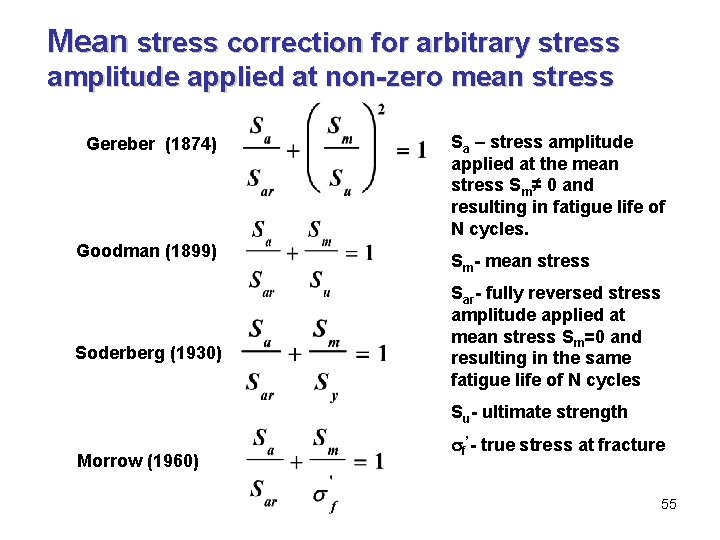
Mean stress correction for arbitrary stress amplitude applied at non-zero mean stress Gereber (1874) Goodman (1899) Soderberg (1930) Sa – stress amplitude applied at the mean stress Sm≠ 0 and resulting in fatigue life of N cycles. Sm- mean stress Sar- fully reversed stress amplitude applied at mean stress Sm=0 and resulting in the same fatigue life of N cycles Su- ultimate strength Morrow (1960) f’- true stress at fracture 55
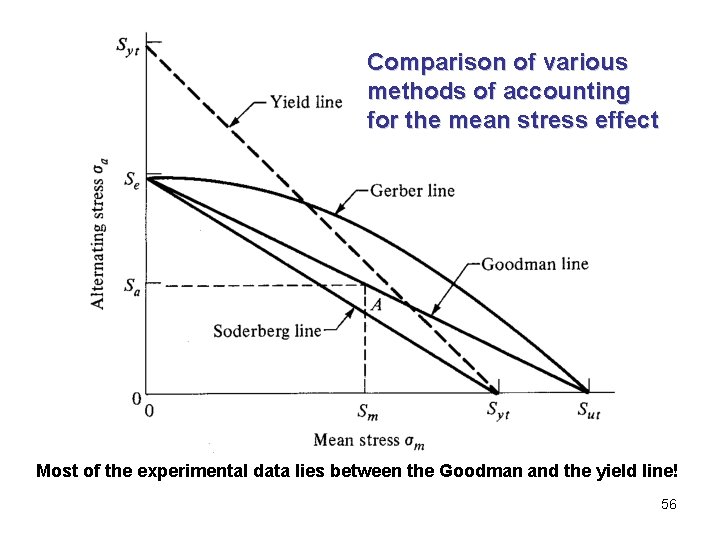
Comparison of various methods of accounting for the mean stress effect Most of the experimental data lies between the Goodman and the yield line! 56
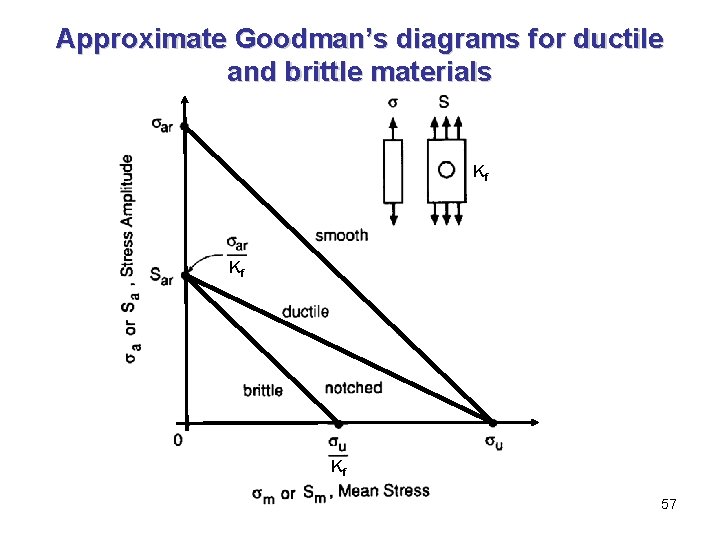
Approximate Goodman’s diagrams for ductile and brittle materials Kf Kf Kf 57
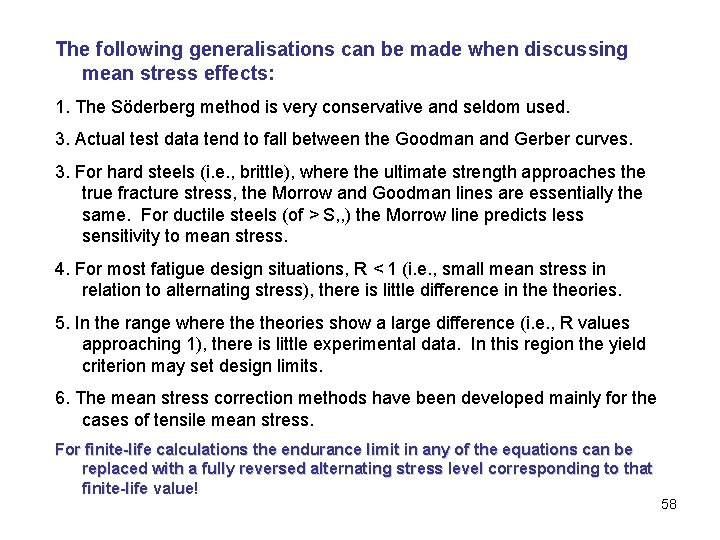
The following generalisations can be made when discussing mean stress effects: 1. The Söderberg method is very conservative and seldom used. 3. Actual test data tend to fall between the Goodman and Gerber curves. 3. For hard steels (i. e. , brittle), where the ultimate strength approaches the true fracture stress, the Morrow and Goodman lines are essentially the same. For ductile steels (of > S, , ) the Morrow line predicts less sensitivity to mean stress. 4. For most fatigue design situations, R < 1 (i. e. , small mean stress in relation to alternating stress), there is little difference in theories. 5. In the range where theories show a large difference (i. e. , R values approaching 1), there is little experimental data. In this region the yield criterion may set design limits. 6. The mean stress correction methods have been developed mainly for the cases of tensile mean stress. For finite-life calculations the endurance limit in any of the equations can be replaced with a fully reversed alternating stress level corresponding to that finite-life value! 58
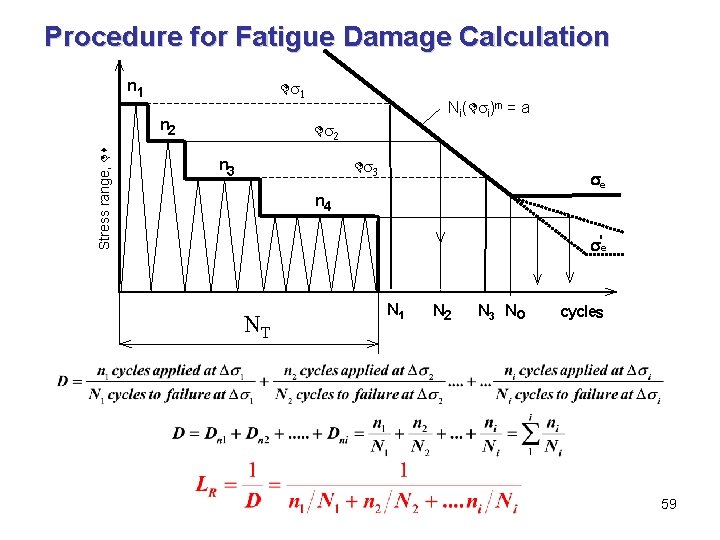
Procedure for Fatigue Damage Calculation n 1 1 Stress range, n 2 Ni( i)m = a 2 n 3 3 e n 4 'e NT N 1 N 2 N 3 No cycles 59
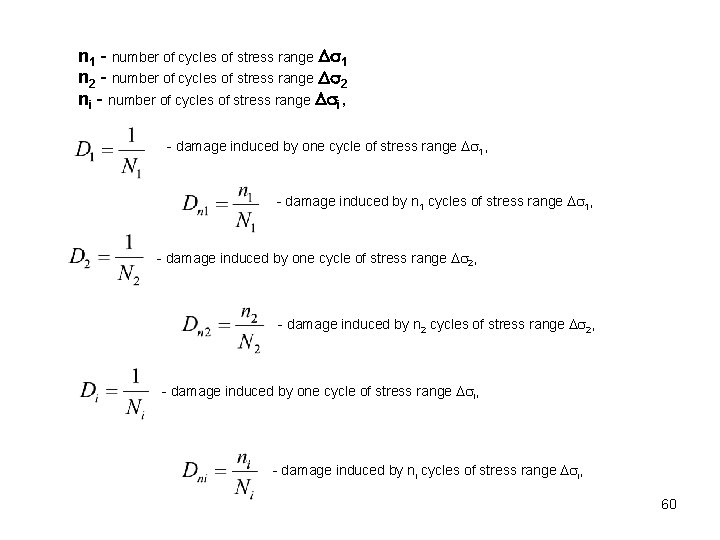
n 1 - number of cycles of stress range 1 n 2 - number of cycles of stress range 2 ni - number of cycles of stress range i, - damage induced by one cycle of stress range 1, - damage induced by n 1 cycles of stress range 1, - damage induced by one cycle of stress range 2, - damage induced by n 2 cycles of stress range 2, - damage induced by one cycle of stress range i, - damage induced by ni cycles of stress range i, 60
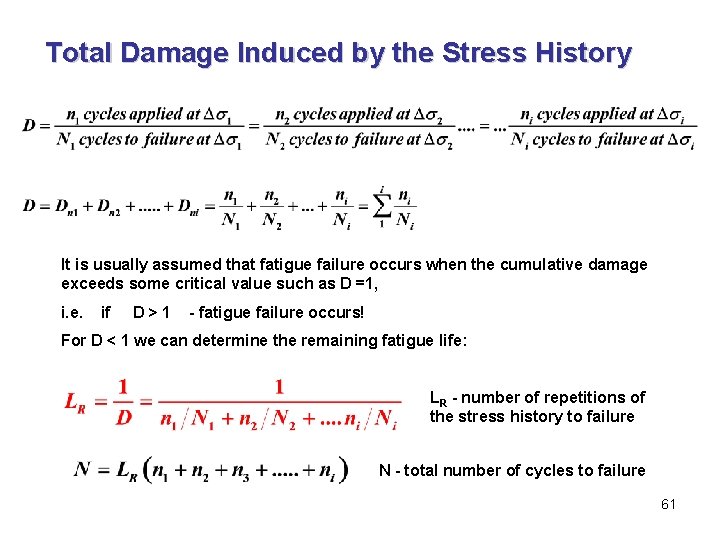
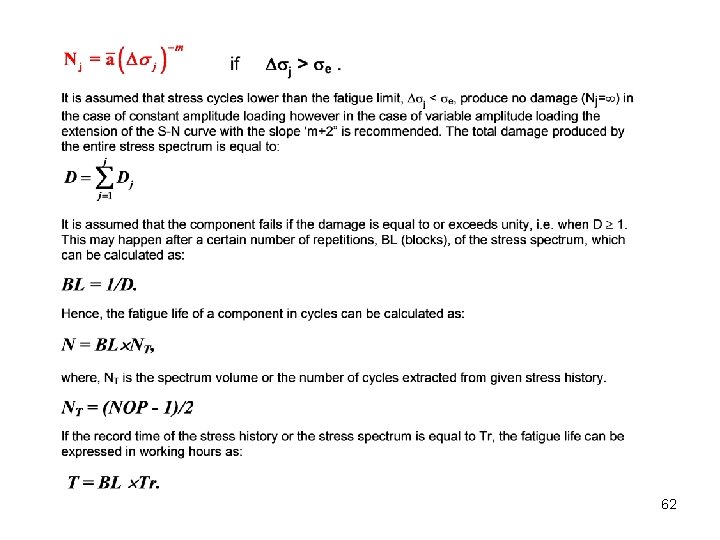
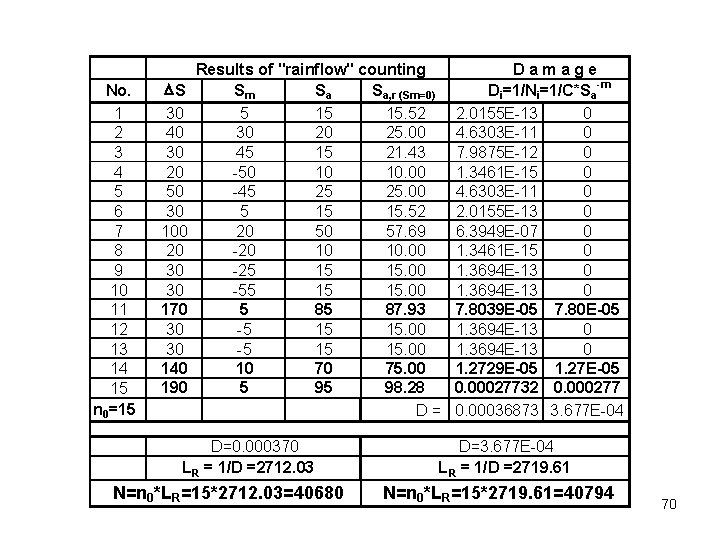
Total Damage Induced by the Stress History It is usually assumed that fatigue failure occurs when the cumulative damage exceeds some critical value such as D =1, i. e. if D>1 - fatigue failure occurs! For D < 1 we can determine the remaining fatigue life: LR - number of repetitions of the stress history to failure N - total number of cycles to failure 61
62
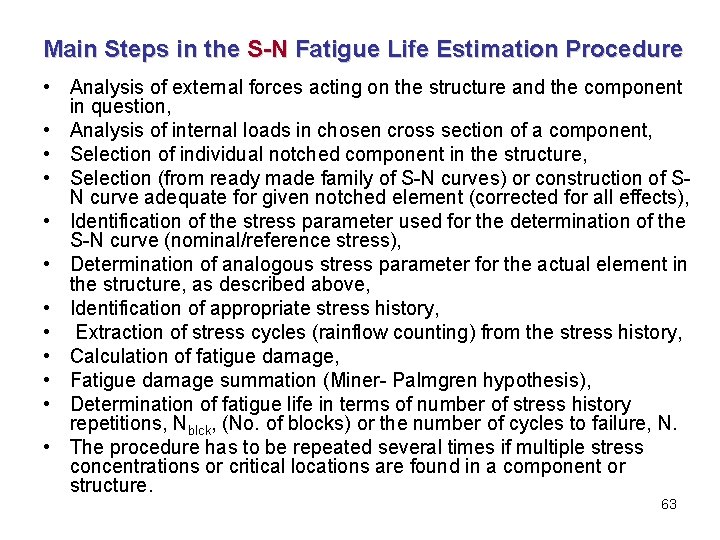
Main Steps in the S-N Fatigue Life Estimation Procedure • Analysis of external forces acting on the structure and the component in question, • Analysis of internal loads in chosen cross section of a component, • Selection of individual notched component in the structure, • Selection (from ready made family of S-N curves) or construction of SN curve adequate for given notched element (corrected for all effects), • Identification of the stress parameter used for the determination of the S-N curve (nominal/reference stress), • Determination of analogous stress parameter for the actual element in the structure, as described above, • Identification of appropriate stress history, • Extraction of stress cycles (rainflow counting) from the stress history, • Calculation of fatigue damage, • Fatigue damage summation (Miner- Palmgren hypothesis), • Determination of fatigue life in terms of number of stress history repetitions, Nblck, (No. of blocks) or the number of cycles to failure, N. • The procedure has to be repeated several times if multiple stress concentrations or critical locations are found in a component or structure. 63
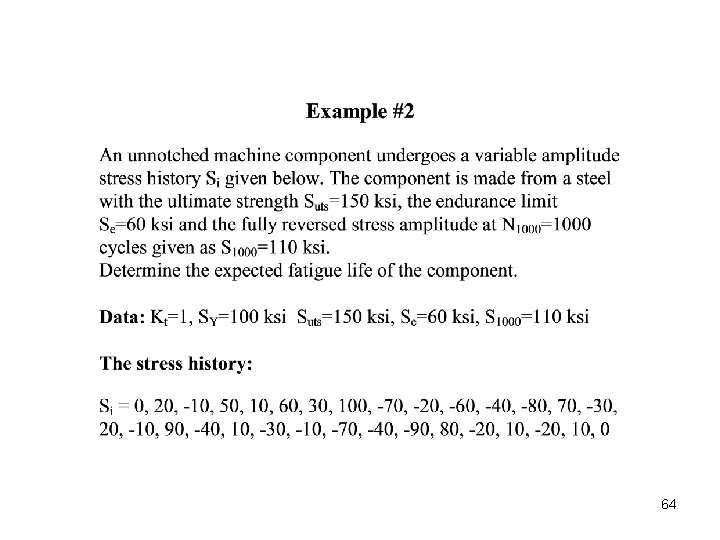
64
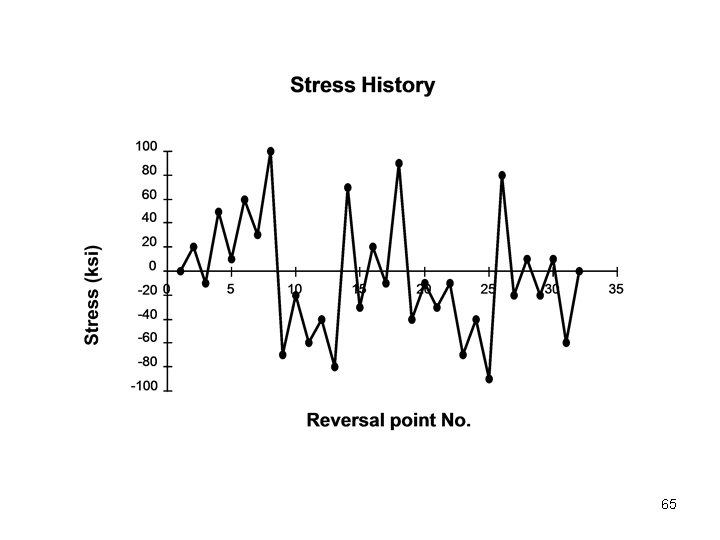
65
66
67
68
69
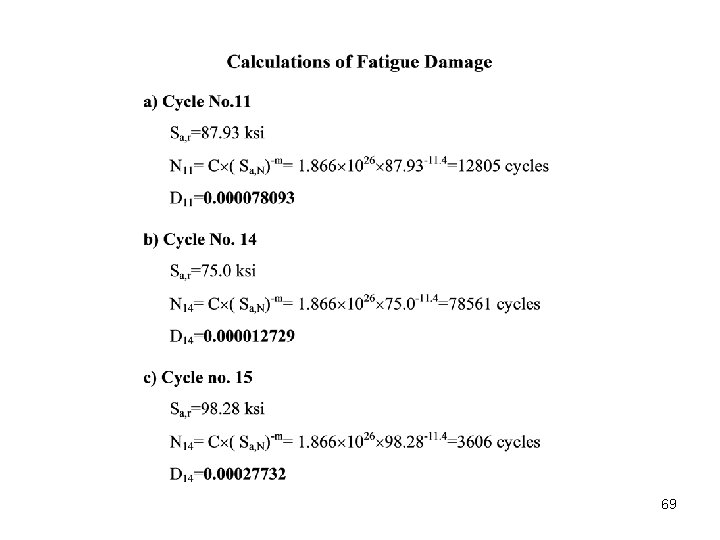
No. 1 2 3 4 5 6 7 8 9 10 11 12 13 14 15 n 0=15 S 30 40 30 20 50 30 100 20 30 30 170 30 30 140 190 Results of "rainflow" counting Sm Sa Sa, r (Sm=0) 5 15 15. 52 30 20 25. 00 45 15 21. 43 -50 10 10. 00 -45 25 25. 00 5 15 15. 52 20 50 57. 69 -20 10 10. 00 -25 15 15. 00 -55 15 15. 00 5 85 87. 93 -5 15 15. 00 10 70 75. 00 5 95 98. 28 D= D=0. 000370 LR = 1/D =2712. 03 N=n 0*LR=15*2712. 03=40680 Damage Di=1/Ni=1/C*Sa-m 2. 0155 E-13 0 4. 6303 E-11 0 7. 9875 E-12 0 1. 3461 E-15 0 4. 6303 E-11 0 2. 0155 E-13 0 6. 3949 E-07 0 1. 3461 E-15 0 1. 3694 E-13 0 7. 8039 E-05 7. 80 E-05 1. 3694 E-13 0 1. 2729 E-05 1. 27 E-05 0. 00027732 0. 000277 0. 00036873 3. 677 E-04 D=3. 677 E-04 L R = 1/D =2719. 61 N=n 0*LR=15*2719. 61=40794 70