
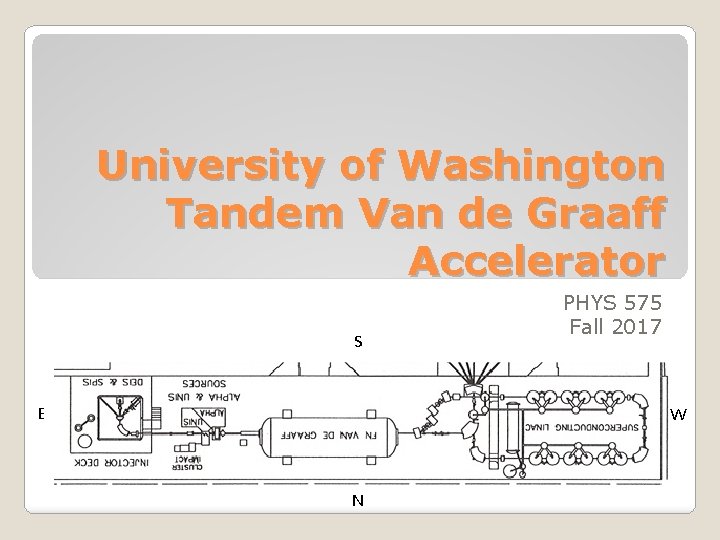
University of Washington Tandem Van de Graaff Accelerator
- Slides: 30
University of Washington Tandem Van de Graaff Accelerator S E PHYS 575 Fall 2017 W N
�Beamline Tube & Vacuum System �Electrostatic Acceleration (-DP. E. = DK. E. ) �Ion Source & Ion Source DECK �Low Energy Ion Selection (analysis) �Beam Current & Beam Profile �Steering & Focusing Elements (optics) �Mega High Voltage (generation, isolation, control) �Tandem Acceleration (stripping) �High Energy Ion Selection & Stability Main Components & Concepts
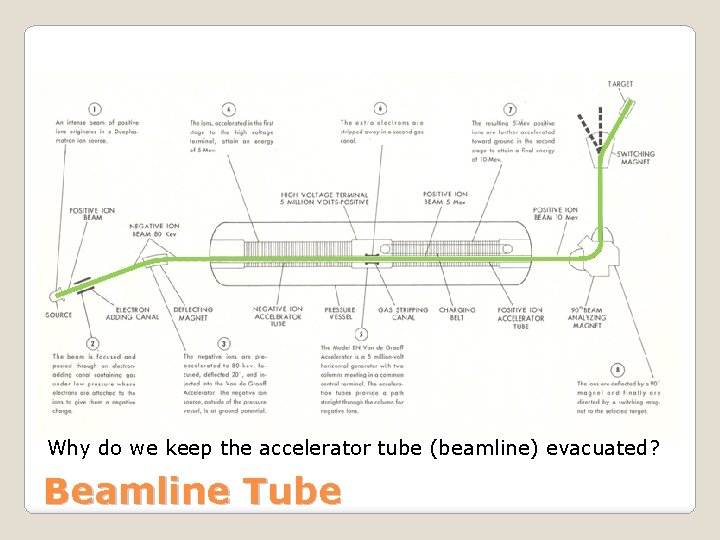
Why do we keep the accelerator tube (beamline) evacuated? Beamline Tube
� Very low pressure (a. k. a. high vacuum) is a dynamic equilibrium between leaks+outgassing vs. pumping. � Pumping involves removing free moving molecules/atoms from a vacuum space (mechanical pump, turbo pump), or trapping them onto/into a surface inside the vacuum space (liquid He cryopump, liquid N 2 (LN 2) sorption pump, ion pump). � Vacuum measured using ion gauges (< 10 -3 torr)(760 torr = 1 atm), and pirani and thermocouple gauges (10 -3 torr to atm). � Typically torr. beamline vacuum is mid 10 -7 torr to low 10 -6 Vacuum System
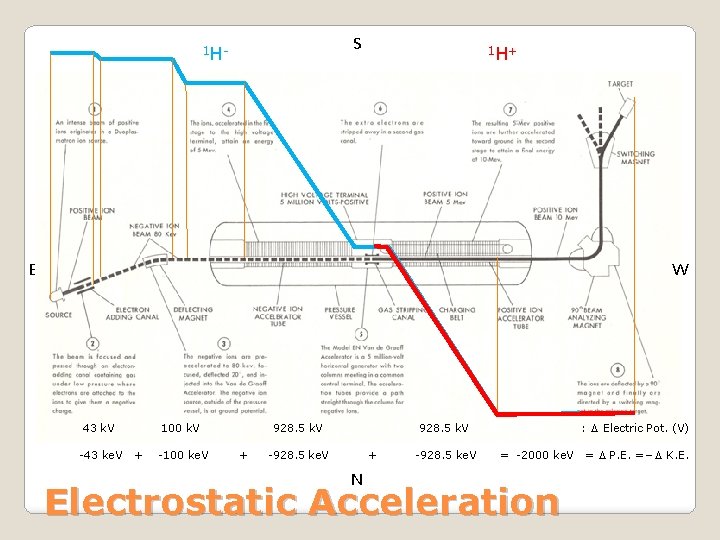
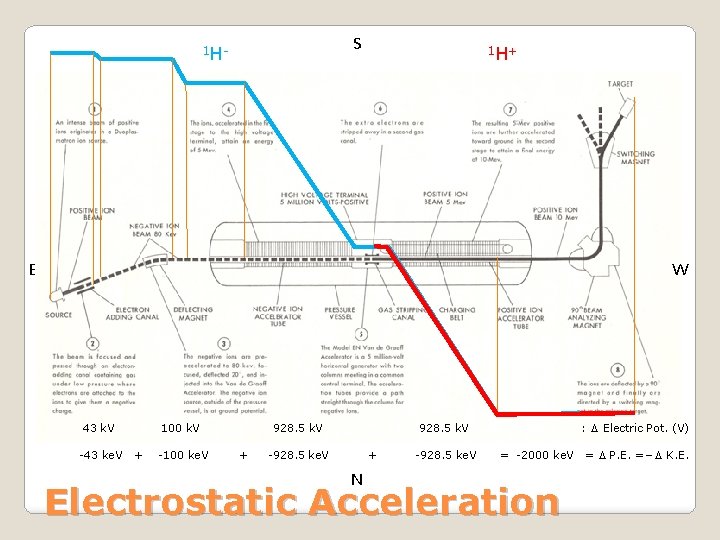
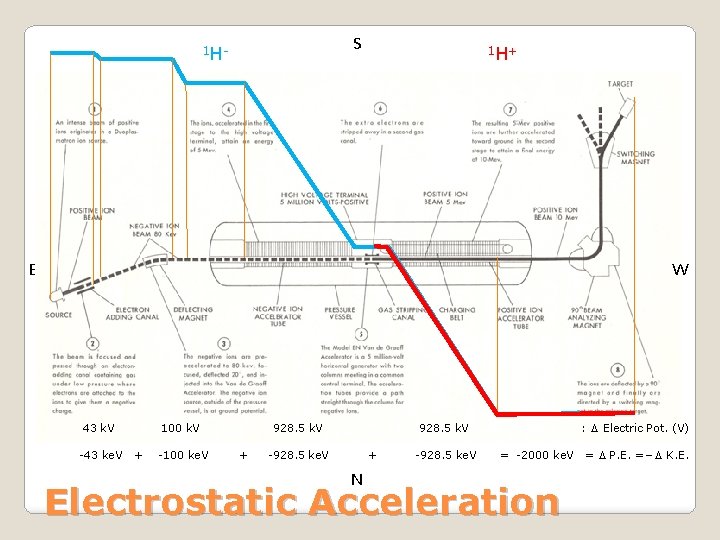
S 1 H- 1 H+ E W 43 k. V -43 ke. V 100 k. V + -100 ke. V 928. 5 k. V + : D Electric Pot. (V) 928. 5 k. V -928. 5 ke. V + N -928. 5 ke. V = -2000 ke. V Electrostatic Acceleration = D P. E. = - D K. E.
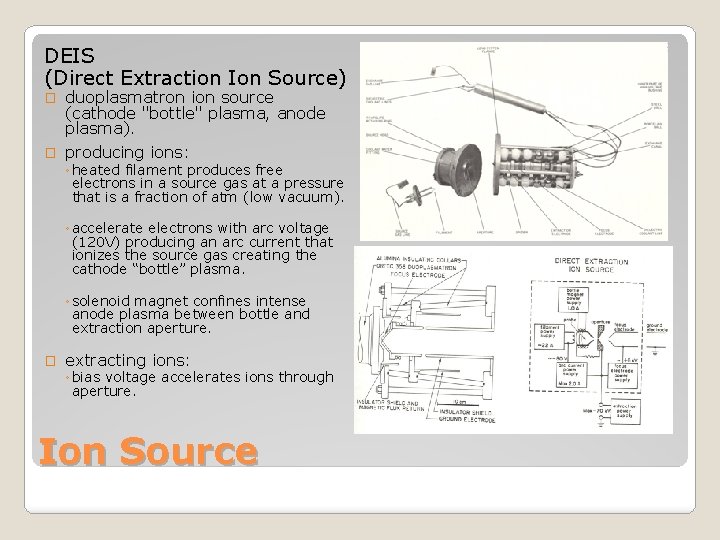
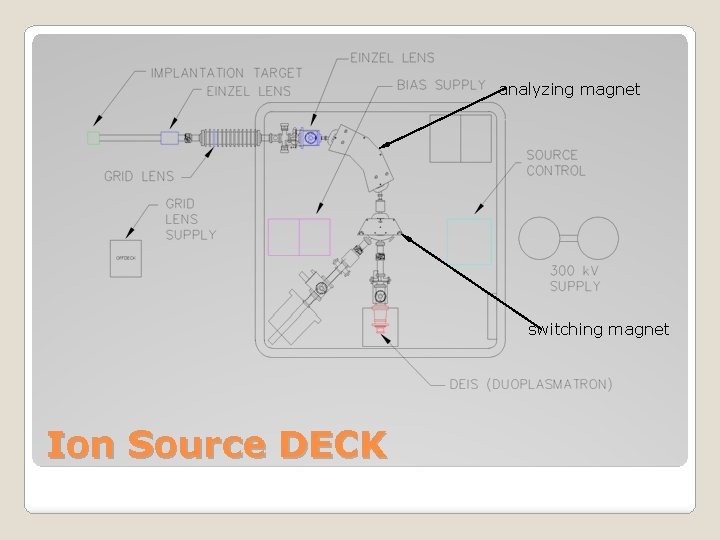
DEIS (Direct Extraction Ion Source) � duoplasmatron ion source (cathode "bottle" plasma, anode plasma). � producing ions: ◦ heated filament produces free electrons in a source gas at a pressure that is a fraction of atm (low vacuum). ◦ accelerate electrons with arc voltage (120 V) producing an arc current that ionizes the source gas creating the cathode “bottle” plasma. ◦ solenoid magnet confines intense anode plasma between bottle and extraction aperture. � extracting ions: ◦ bias voltage accelerates ions through aperture. Ion Source
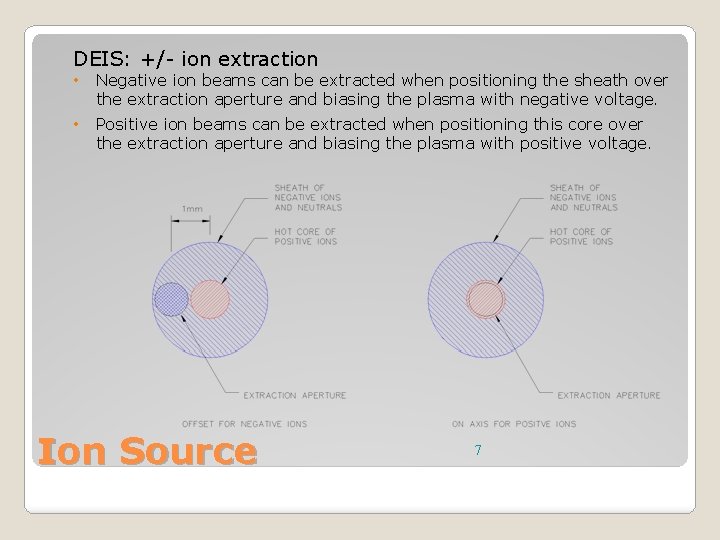
DEIS: +/- ion extraction • Negative ion beams can be extracted when positioning the sheath over the extraction aperture and biasing the plasma with negative voltage. • Positive ion beams can be extracted when positioning this core over the extraction aperture and biasing the plasma with positive voltage. Ion Source 7
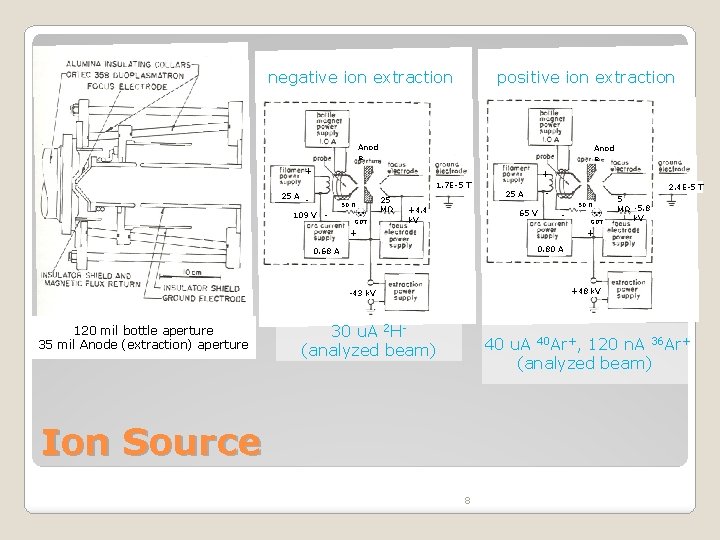
negative ion extraction positive ion extraction Anod e + + 1. 7 E-5 T 25 A - 50 Ω 109 V - GDT 25 MΩ +4. 4 k. V 2. 4 E-5 T - 25 A 65 V 50 Ω - + + 0. 80 A 0. 68 A +48 k. V -43 k. V 120 mil bottle aperture 35 mil Anode (extraction) aperture GDT 5 MΩ -5. 8 k. V 30 u. A 2 H(analyzed beam) 40 u. A 40 Ar+, 120 n. A 36 Ar+ (analyzed beam) Ion Source 8
analyzing magnet switching magnet Ion Source DECK
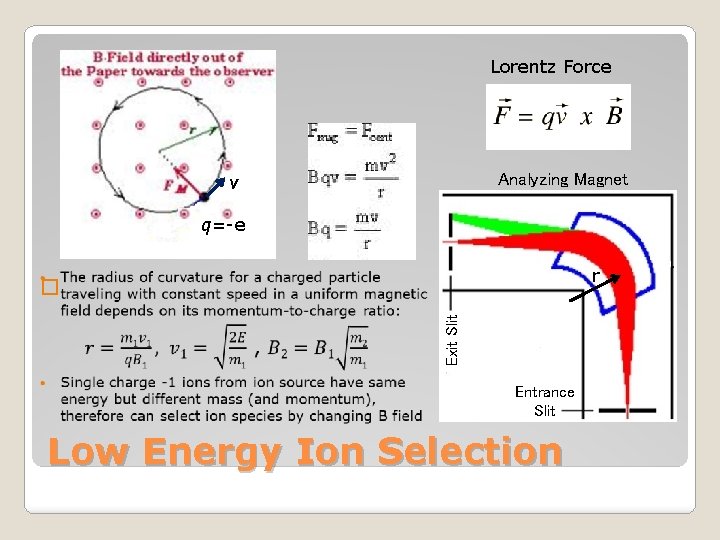
Lorentz Force Analyzing Magnet v q=-e r Exit Slit � Entrance Slit Low Energy Ion Selection
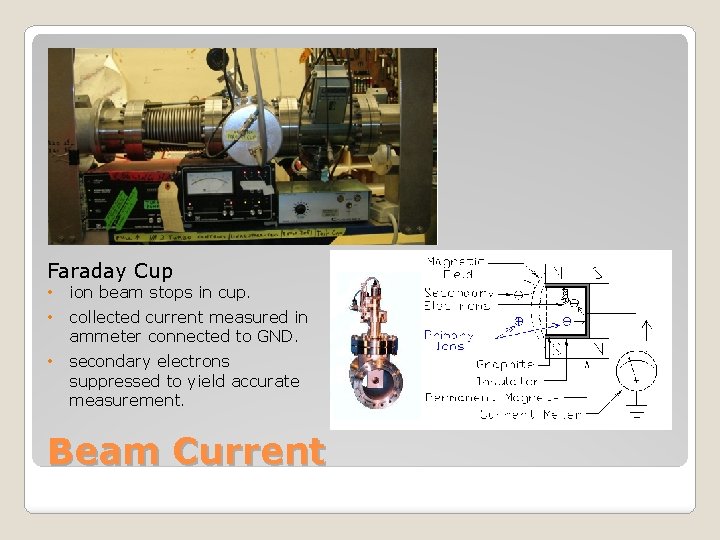
Faraday Cup • ion beam stops in cup. • collected current measured in ammeter connected to GND. • secondary electrons suppressed to yield accurate measurement. Beam Current
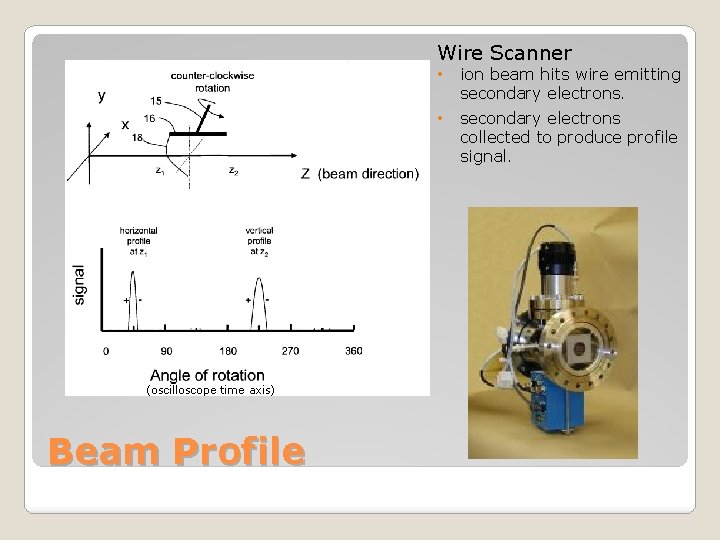
Wire Scanner (oscilloscope time axis) Beam Profile • ion beam hits wire emitting secondary electrons. • secondary electrons collected to produce profile signal.
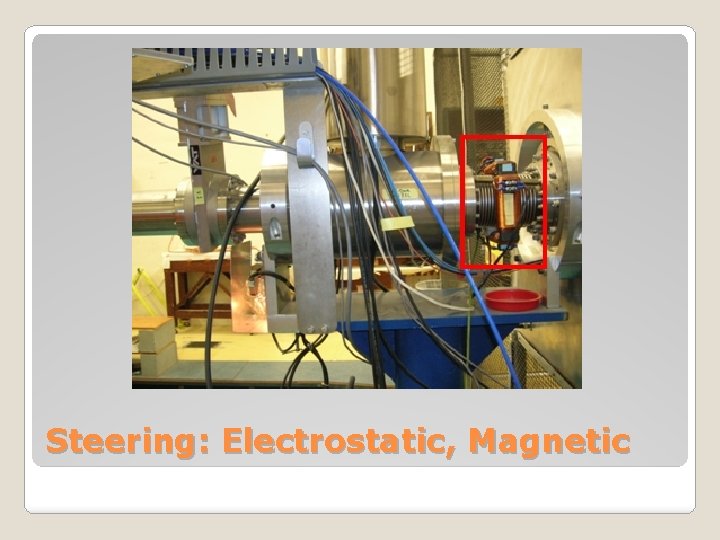
Steering: Electrostatic, Magnetic
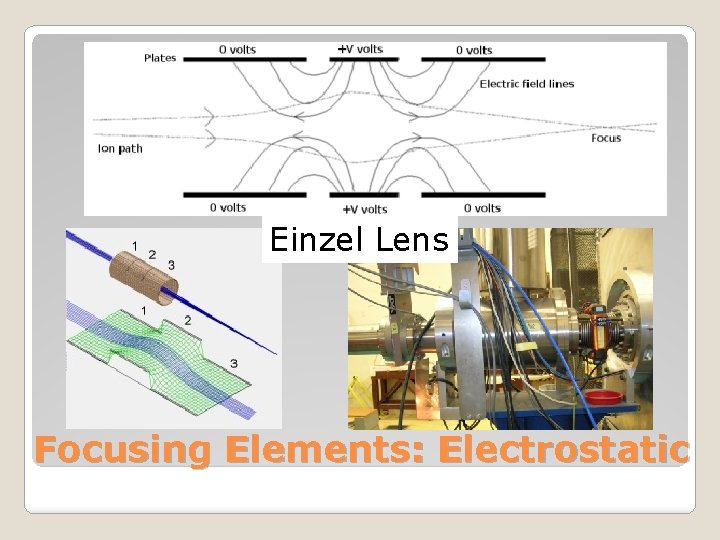
Einzel Lens Focusing Elements: Electrostatic
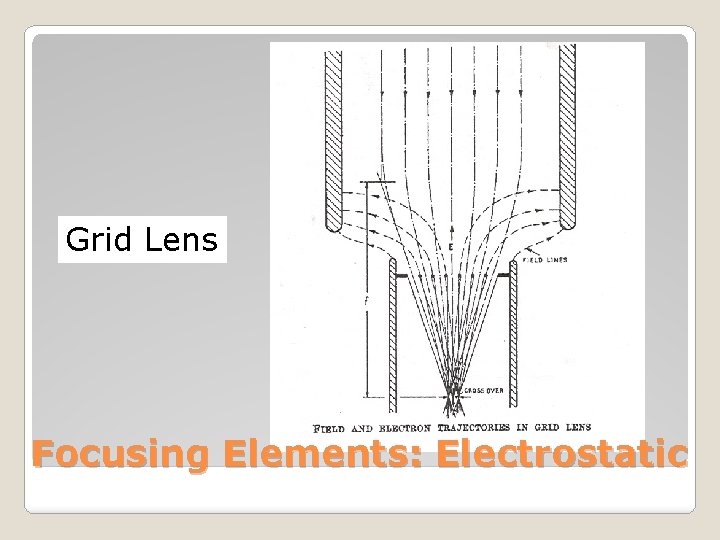
Grid Lens Focusing Elements: Electrostatic
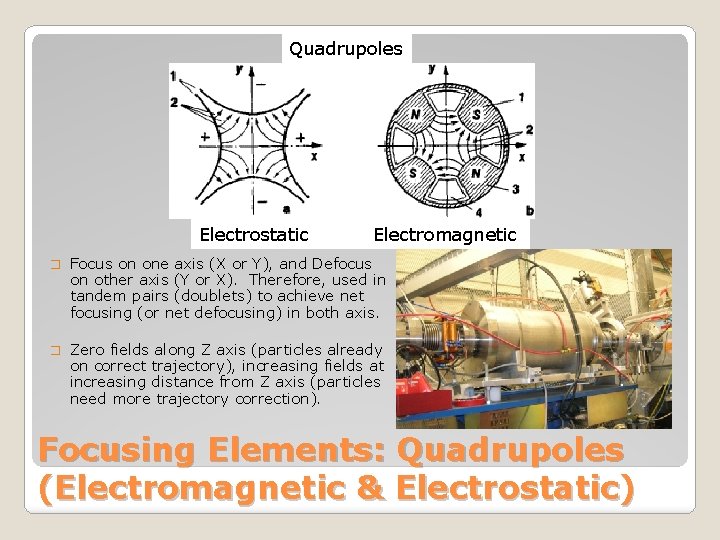
Quadrupoles Electrostatic Electromagnetic � Focus on one axis (X or Y), and Defocus on other axis (Y or X). Therefore, used in tandem pairs (doublets) to achieve net focusing (or net defocusing) in both axis. � Zero fields along Z axis (particles already on correct trajectory), increasing fields at increasing distance from Z axis (particles need more trajectory correction). Focusing Elements: Quadrupoles (Electromagnetic & Electrostatic)
S 1 H- 1 H+ E W 43 k. V -43 ke. V 100 k. V + -100 ke. V 928. 5 k. V + : D Electric Pot. (V) 928. 5 k. V -928. 5 ke. V + N -928. 5 ke. V = -2000 ke. V Electrostatic Acceleration = D P. E. = - D K. E.
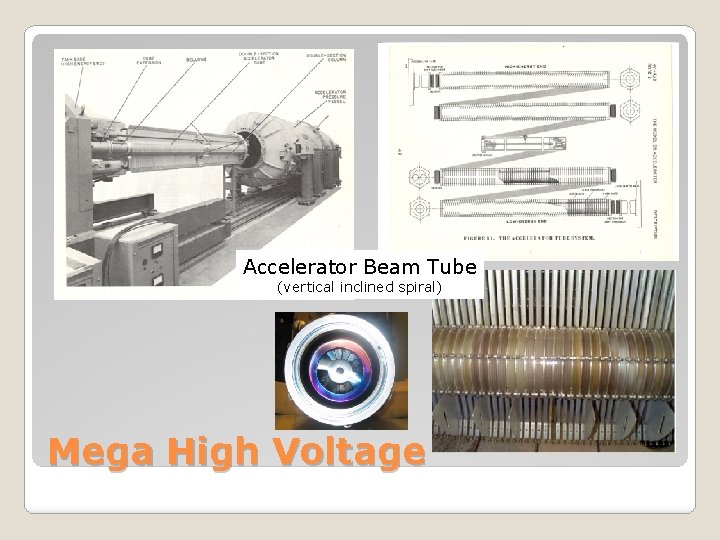
Accelerator Beam Tube (vertical inclined spiral) Mega High Voltage
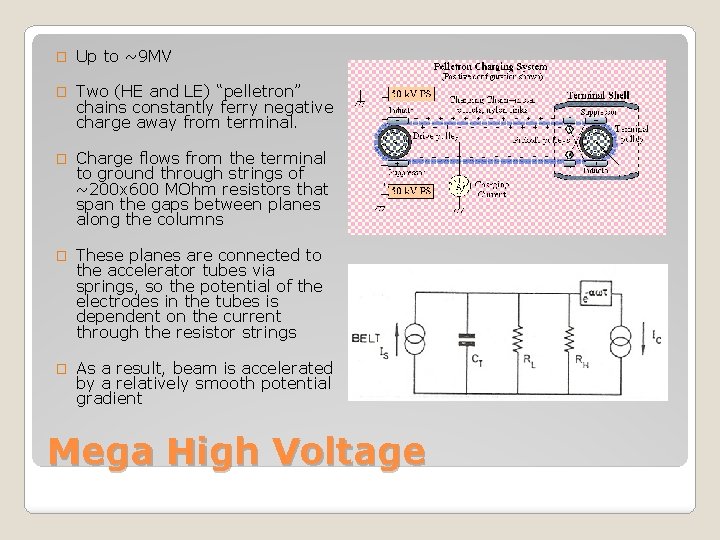
� Up to ~9 MV � Two (HE and LE) “pelletron” chains constantly ferry negative charge away from terminal. � Charge flows from the terminal to ground through strings of ~200 x 600 MOhm resistors that span the gaps between planes along the columns � These planes are connected to the accelerator tubes via springs, so the potential of the electrodes in the tubes is dependent on the current through the resistor strings � As a result, beam is accelerated by a relatively smooth potential gradient Mega High Voltage
Mega High Voltage
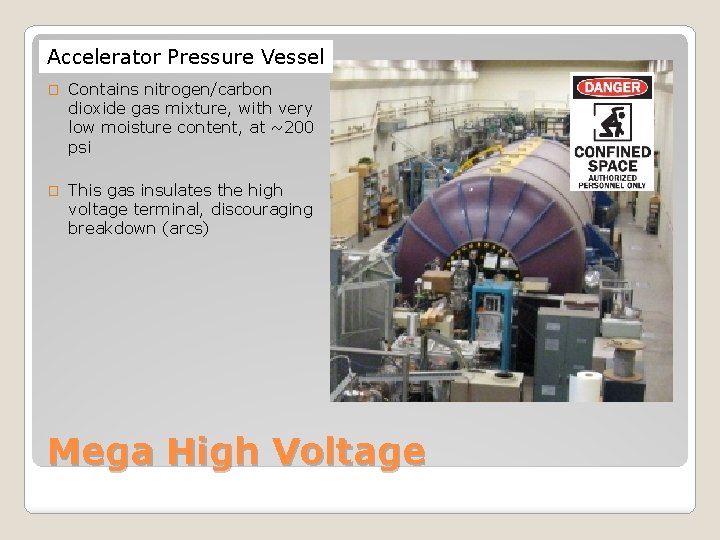
Accelerator Pressure Vessel � Contains nitrogen/carbon dioxide gas mixture, with very low moisture content, at ~200 psi � This gas insulates the high voltage terminal, discouraging breakdown (arcs) Mega High Voltage
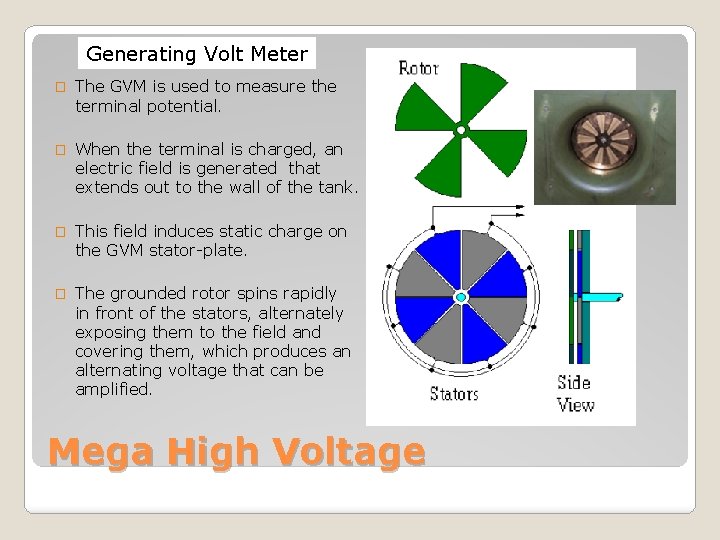
Generating Volt Meter � The GVM is used to measure the terminal potential. � When the terminal is charged, an electric field is generated that extends out to the wall of the tank. � This field induces static charge on the GVM stator-plate. � The grounded rotor spins rapidly in front of the stators, alternately exposing them to the field and covering them, which produces an alternating voltage that can be amplified. Mega High Voltage
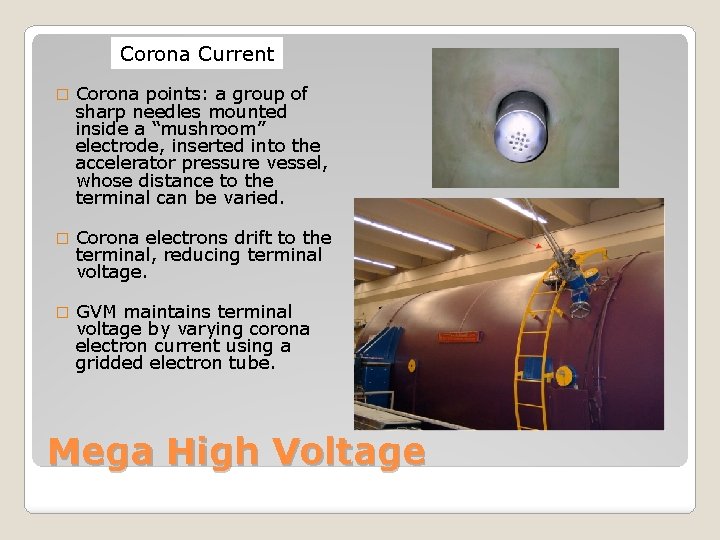
Corona Current � Corona points: a group of sharp needles mounted inside a “mushroom” electrode, inserted into the accelerator pressure vessel, whose distance to the terminal can be varied. � Corona electrons drift to the terminal, reducing terminal voltage. � GVM maintains terminal voltage by varying corona electron current using a gridded electron tube. Mega High Voltage
S 1 H- 1 H+ E W 43 k. V -43 ke. V 100 k. V + -100 ke. V 928. 5 k. V + : D Electric Pot. (V) 928. 5 k. V -928. 5 ke. V + N -928. 5 ke. V = -2000 ke. V Electrostatic Acceleration = D P. E. = - D K. E.
Stripper Foil � ion beam passes through 2 microgram/cm 2 carbon foils at the terminal, which strip electrons off of the incoming negatively charged ions accelerated through the low energy (LE) end of the accelerator. � results in a distribution of positive ion charge states for multi proton atoms/molecules. � positive ions accelerated away from positive voltage terminal through high energy (HE) end of accelerator. Tandem Acceleration
Question What is the energy of an ion when it leaves the HE end of the tank?
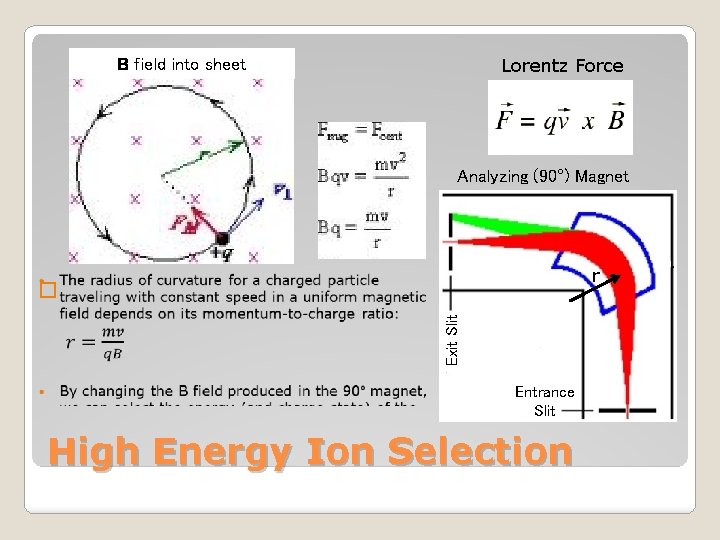
Lorentz Force B field into sheet Analyzing (90°) Magnet r Exit Slit � Entrance Slit High Energy Ion Selection
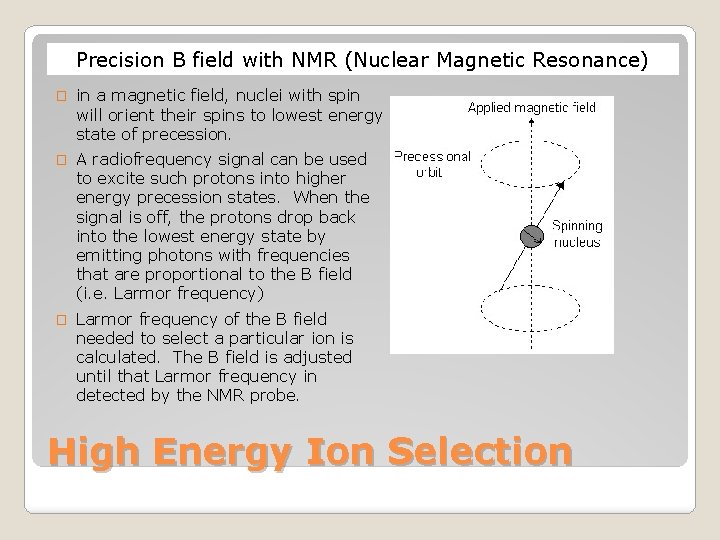
Precision B field with NMR (Nuclear Magnetic Resonance) � in a magnetic field, nuclei with spin will orient their spins to lowest energy state of precession. � A radiofrequency signal can be used to excite such protons into higher energy precession states. When the signal is off, the protons drop back into the lowest energy state by emitting photons with frequencies that are proportional to the B field (i. e. Larmor frequency) � Larmor frequency of the B field needed to select a particular ion is calculated. The B field is adjusted until that Larmor frequency in detected by the NMR probe. High Energy Ion Selection
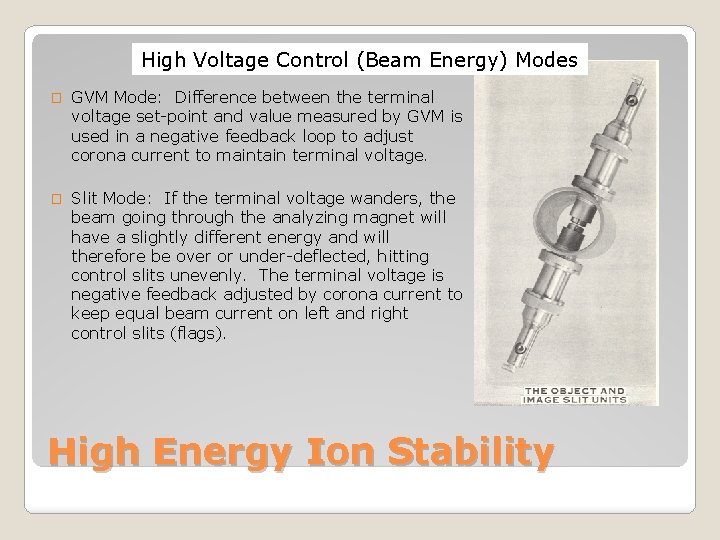
High Voltage Control (Beam Energy) Modes � GVM Mode: Difference between the terminal voltage set-point and value measured by GVM is used in a negative feedback loop to adjust corona current to maintain terminal voltage. � Slit Mode: If the terminal voltage wanders, the beam going through the analyzing magnet will have a slightly different energy and will therefore be over or under-deflected, hitting control slits unevenly. The terminal voltage is negative feedback adjusted by corona current to keep equal beam current on left and right control slits (flags). High Energy Ion Stability