
University of Washington Mar 2 Announcements Lab 5
University of Washington Mar 2 ¢ Announcements: § Lab 5 out, last one! § No class on Wednesday (video assignment to be posted soon) § Winter 2015 SIMBIOTECH! Memory Allocation 1
University of Washington Roadmap C: Java: car *c = malloc(sizeof(car)); c->miles = 100; c->gals = 17; float mpg = get_mpg(c); free(c); Car c = new Car(); c. set. Miles(100); c. set. Gals(17); float mpg = c. get. MPG(); Assembly language: Machine code: get_mpg: pushq movq. . . popq ret %rbp %rsp, %rbp Memory & data Integers & floats Machine code & C x 86 assembly Procedures & stacks Arrays & structs Memory & caches Processes Virtual memory Memory allocation Java vs. C %rbp OS: 011101000001100011010000000010 1000100111000010 110000011111101000011111 Computer system: Winter 2015 Memory Allocation 2
University of Washington Memory Allocation Topics ¢ Dynamic memory allocation § Size/number of data structures may only be known at run time § Need to allocate space on the heap § Need to de-allocate (free) unused memory so it can be re-allocated ¢ Implementation § Implicit free lists § Explicit free lists – subject of next programming assignment § Segregated free lists ¢ ¢ Winter 2015 Garbage collection Common memory-related bugs in C programs Memory Allocation 3
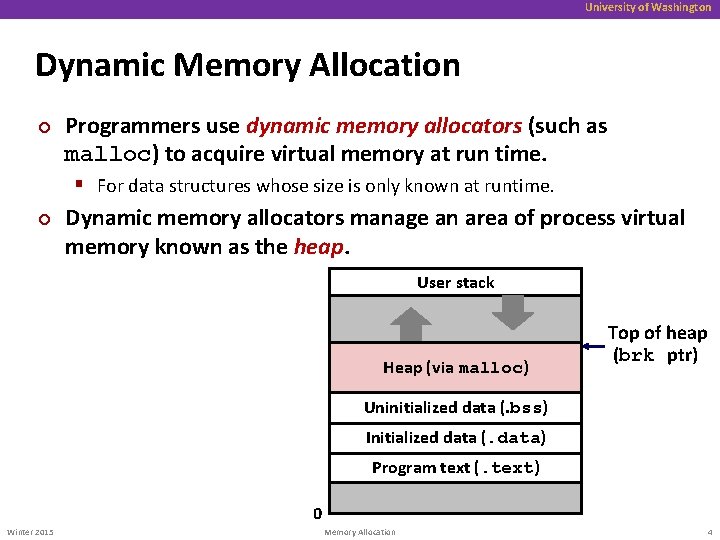
University of Washington Dynamic Memory Allocation ¢ Programmers use dynamic memory allocators (such as malloc) to acquire virtual memory at run time. § For data structures whose size is only known at runtime. ¢ Dynamic memory allocators manage an area of process virtual memory known as the heap. User stack Heap (via malloc) Top of heap (brk ptr) Uninitialized data (. bss) Initialized data (. data) Program text (. text) 0 Winter 2015 Memory Allocation 4
University of Washington Dynamic Memory Allocation ¢ Allocator maintains heap as collection of variable sized blocks, which are either allocated or free § Allocator requests pages in heap region; virtual memory hardware and OS kernel allocate these pages to the process. § Application objects are typically smaller than pages, so the allocator manages blocks within pages. (Sometimes larger) ¢ Types of allocators § Explicit allocator: application allocates and frees space E. g. malloc and free in C § Implicit allocator: application allocates, but does not free space § E. g. garbage collection in Java, ML, and Lisp § Winter 2015 Memory Allocation 5
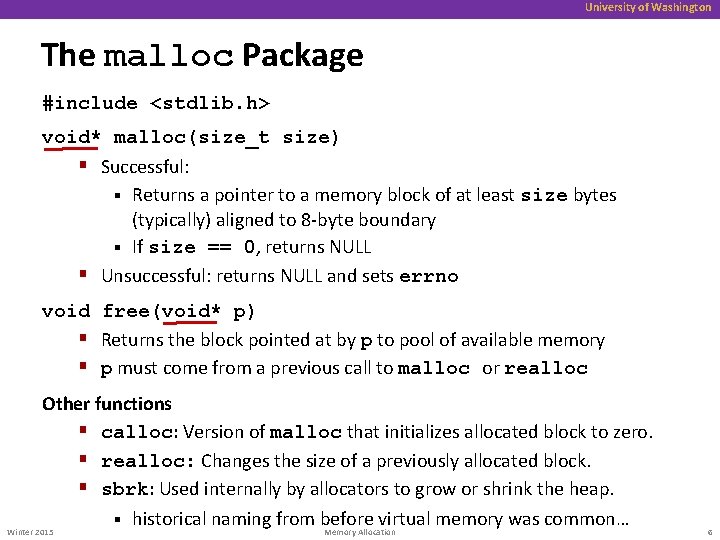
University of Washington The malloc Package #include <stdlib. h> void* malloc(size_t size) § Successful: § Returns a pointer to a memory block of at least size bytes (typically) aligned to 8 -byte boundary § If size == 0, returns NULL § Unsuccessful: returns NULL and sets errno void free(void* p) § Returns the block pointed at by p to pool of available memory § p must come from a previous call to malloc or realloc Other functions § calloc: Version of malloc that initializes allocated block to zero. § realloc: Changes the size of a previously allocated block. § sbrk: Used internally by allocators to grow or shrink the heap. § historical naming from before virtual memory was common… Winter 2015 Memory Allocation 6
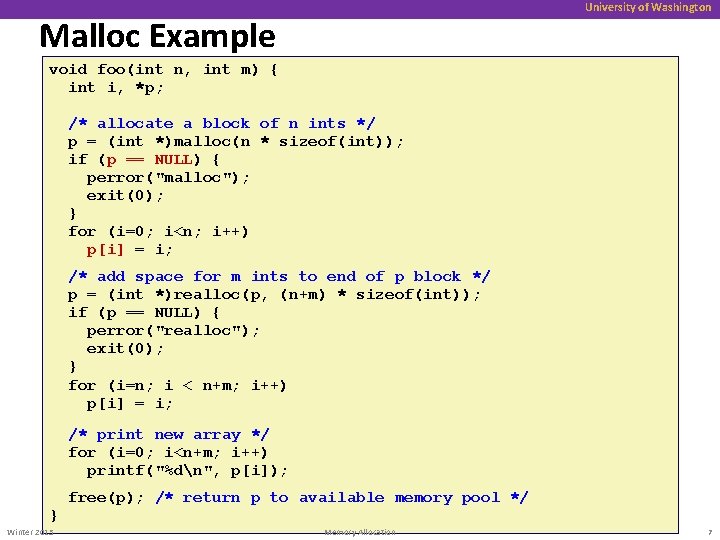
University of Washington Malloc Example void foo(int n, int m) { int i, *p; /* allocate a block of n ints */ p = (int *)malloc(n * sizeof(int)); if (p == NULL) { perror("malloc"); exit(0); } for (i=0; i<n; i++) p[i] = i; /* add space for m ints to end of p block */ p = (int *)realloc(p, (n+m) * sizeof(int)); if (p == NULL) { perror("realloc"); exit(0); } for (i=n; i < n+m; i++) p[i] = i; /* print new array */ for (i=0; i<n+m; i++) printf("%dn", p[i]); } Winter 2015 free(p); /* return p to available memory pool */ Memory Allocation 7
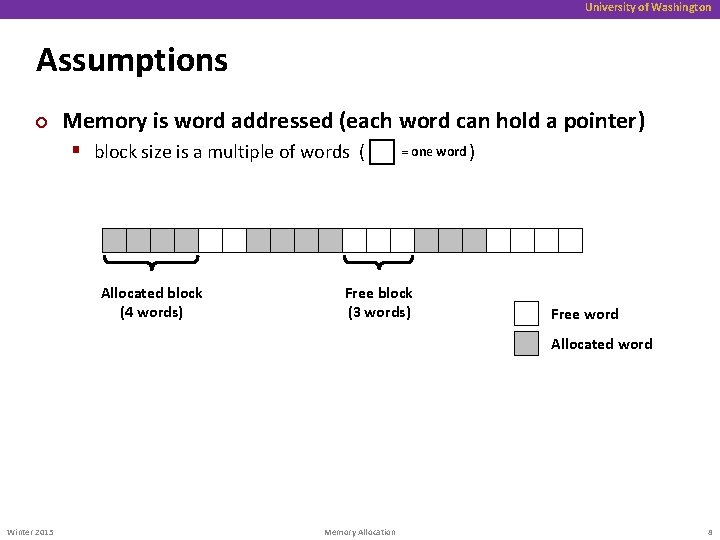
University of Washington Assumptions ¢ Memory is word addressed (each word can hold a pointer) § block size is a multiple of words ( Allocated block (4 words) = one word ) Free block (3 words) Free word Allocated word Winter 2015 Memory Allocation 8
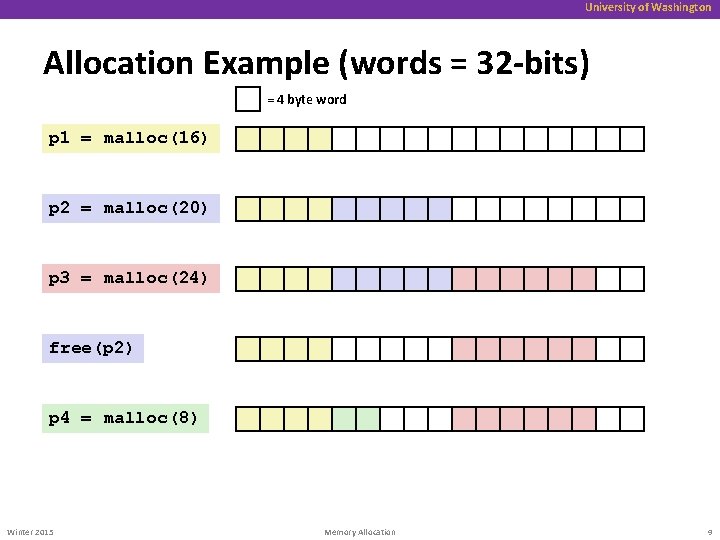
University of Washington Allocation Example (words = 32 -bits) = 4 byte word p 1 = malloc(16) p 2 = malloc(20) p 3 = malloc(24) free(p 2) p 4 = malloc(8) Winter 2015 Memory Allocation 9
University of Washington Constraints ¢ Applications § Can issue arbitrary sequence of malloc() and free() requests § free() requests must be made only for a previously malloc()’d block ¢ Allocators § Can’t control number or size of allocated blocks § Must respond immediately to malloc() requests i. e. , can’t reorder or buffer requests § Must allocate blocks from free memory § i. e. , blocks can’t overlap, why not? § Must align blocks so they satisfy all alignment requirements § 8 byte alignment for GNU malloc (libc malloc) on Linux § Can’t move the allocated blocks once they are malloc()’d § i. e. , compaction is not allowed. Why not? § Winter 2015 Memory Allocation 10
University of Washington Performance Goal #1: Throughput ¢ Given some sequence of malloc and free requests: § R 0, R 1, . . . , Rk, . . . , Rn-1 ¢ Goals: maximize throughput and peak memory utilization § These goals are often conflicting ¢ Throughput: § Number of completed requests per unit time § Example: 5, 000 malloc() calls and 5, 000 free() calls in 10 seconds § Throughput is 1, 000 operations/second § Winter 2015 Memory Allocation 11
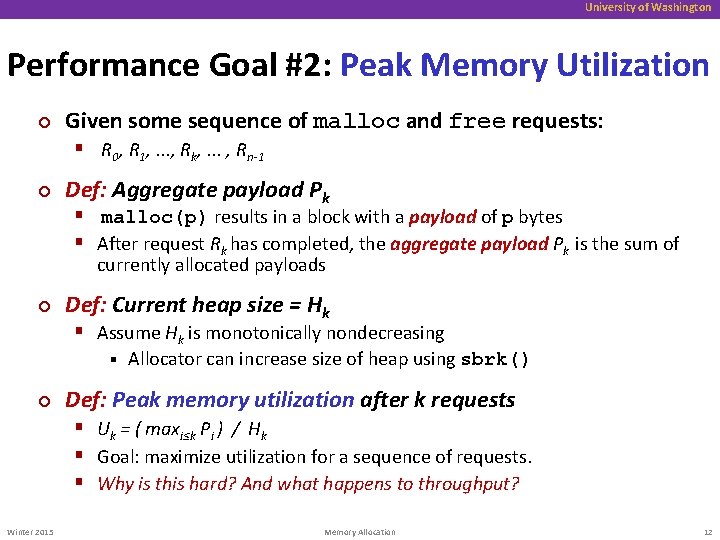
University of Washington Performance Goal #2: Peak Memory Utilization ¢ Given some sequence of malloc and free requests: § R 0, R 1, . . . , Rk, . . . , Rn-1 ¢ Def: Aggregate payload Pk § malloc(p) results in a block with a payload of p bytes § After request Rk has completed, the aggregate payload Pk is the sum of currently allocated payloads ¢ Def: Current heap size = Hk § Assume Hk is monotonically nondecreasing § ¢ Allocator can increase size of heap using sbrk() Def: Peak memory utilization after k requests § Uk = ( maxi≤k Pi ) / Hk § Goal: maximize utilization for a sequence of requests. § Why is this hard? And what happens to throughput? Winter 2015 Memory Allocation 12
University of Washington Fragmentation ¢ ¢ Winter 2015 Poor memory utilization is caused by fragmentation. Sections of memory are not used to store anything useful, but cannot be allocated. internal fragmentation external fragmentation Memory Allocation 13
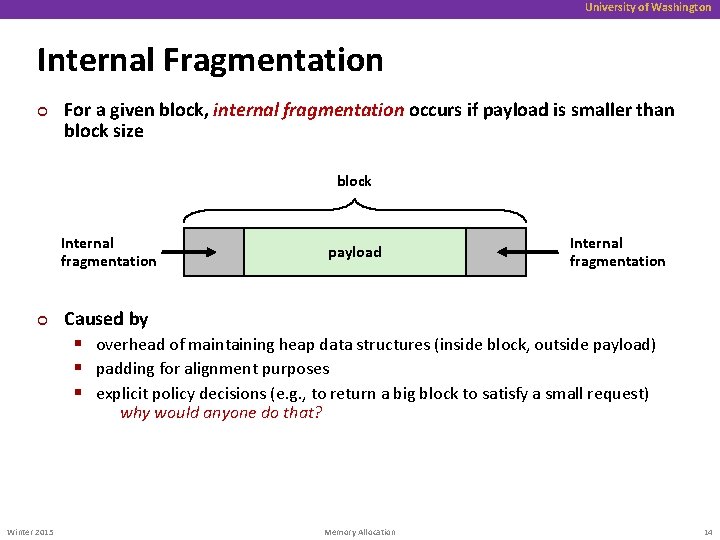
University of Washington Internal Fragmentation ¢ For a given block, internal fragmentation occurs if payload is smaller than block size block Internal fragmentation ¢ payload Internal fragmentation Caused by § overhead of maintaining heap data structures (inside block, outside payload) § padding for alignment purposes § explicit policy decisions (e. g. , to return a big block to satisfy a small request) why would anyone do that? Winter 2015 Memory Allocation 14
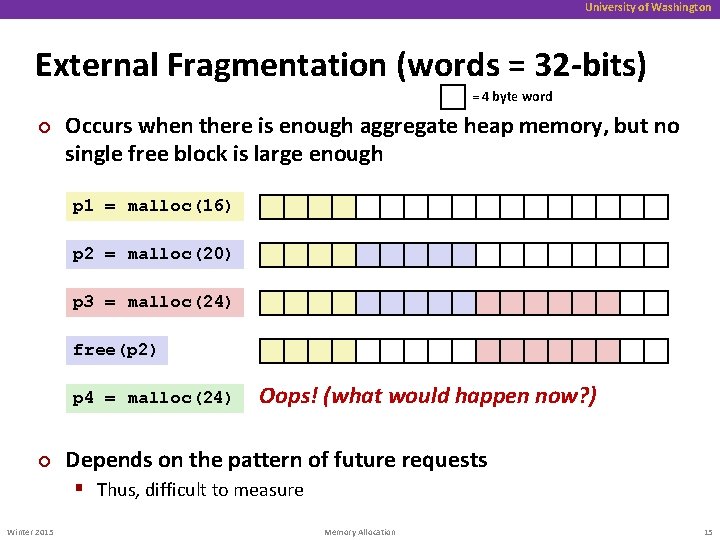
University of Washington External Fragmentation (words = 32 -bits) = 4 byte word ¢ Occurs when there is enough aggregate heap memory, but no single free block is large enough p 1 = malloc(16) p 2 = malloc(20) p 3 = malloc(24) free(p 2) p 4 = malloc(24) ¢ Oops! (what would happen now? ) Depends on the pattern of future requests § Thus, difficult to measure Winter 2015 Memory Allocation 15
University of Washington Implementation Issues ¢ ¢ ¢ Winter 2015 How do we know how much memory to free given just a pointer? How do we keep track of the free blocks? How do we pick a block to use for allocation (when many might fit)? What do we do with the extra space when allocating a structure that is smaller than the free block it is placed in? How do we reinsert freed block into the heap? Memory Allocation 16
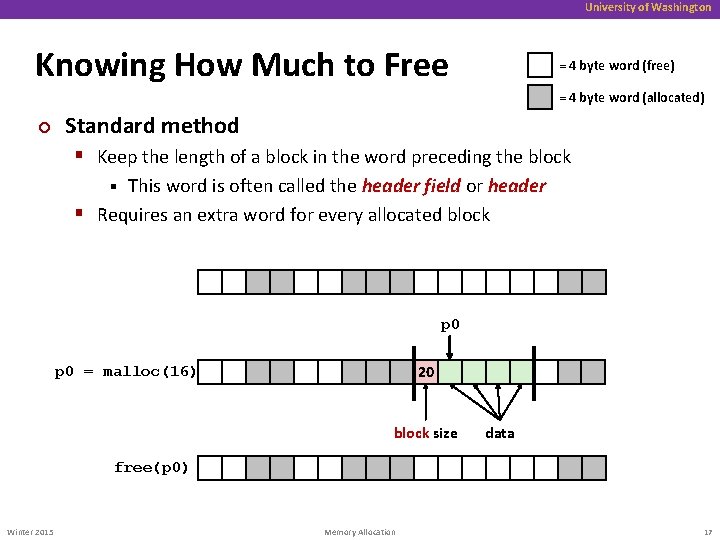
University of Washington Knowing How Much to Free = 4 byte word (free) = 4 byte word (allocated) ¢ Standard method § Keep the length of a block in the word preceding the block This word is often called the header field or header § Requires an extra word for every allocated block § p 0 20 p 0 = malloc(16) block size data free(p 0) Winter 2015 Memory Allocation 17
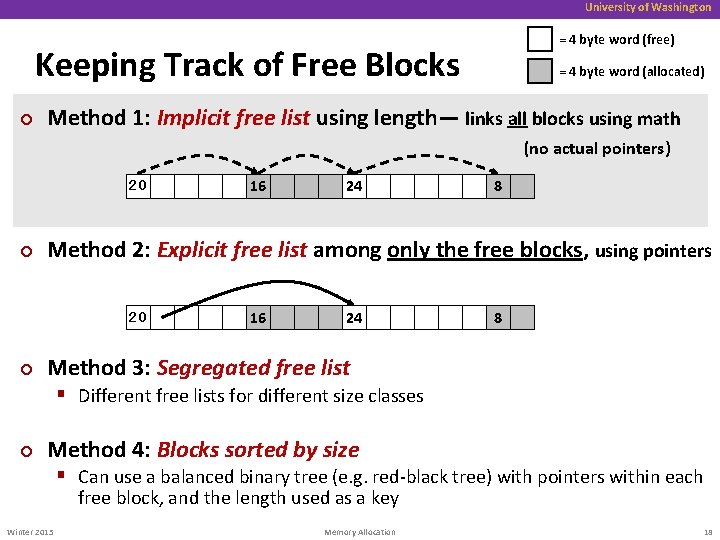
University of Washington = 4 byte word (free) Keeping Track of Free Blocks ¢ = 4 byte word (allocated) Method 1: Implicit free list using length— links all blocks using math (no actual pointers) 20 ¢ 24 8 Method 2: Explicit free list among only the free blocks, using pointers 20 ¢ 16 16 24 8 Method 3: Segregated free list § Different free lists for different size classes ¢ Method 4: Blocks sorted by size § Can use a balanced binary tree (e. g. red-black tree) with pointers within each free block, and the length used as a key Winter 2015 Memory Allocation 18
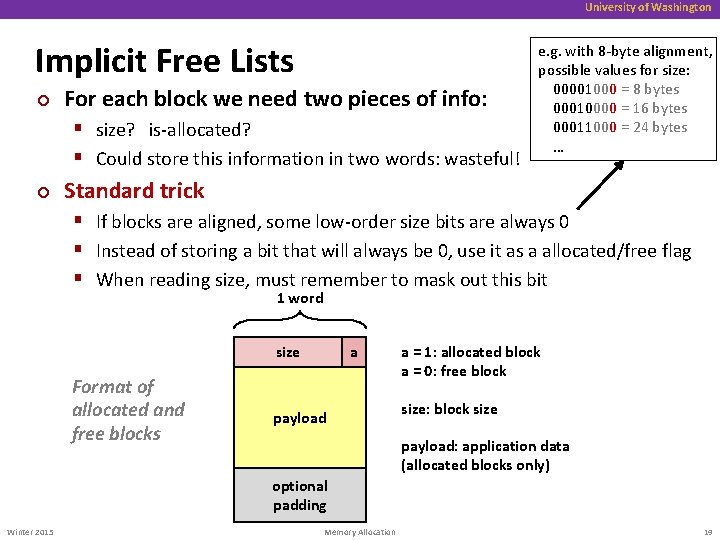
University of Washington Implicit Free Lists ¢ For each block we need two pieces of info: § size? is-allocated? § Could store this information in two words: wasteful! ¢ e. g. with 8 -byte alignment, possible values for size: 00001000 = 8 bytes 00010000 = 16 bytes 00011000 = 24 bytes … Standard trick § If blocks are aligned, some low-order size bits are always 0 § Instead of storing a bit that will always be 0, use it as a allocated/free flag § When reading size, must remember to mask out this bit 1 word size Format of allocated and free blocks a payload a = 1: allocated block a = 0: free block size: block size payload: application data (allocated blocks only) optional padding Winter 2015 Memory Allocation 19
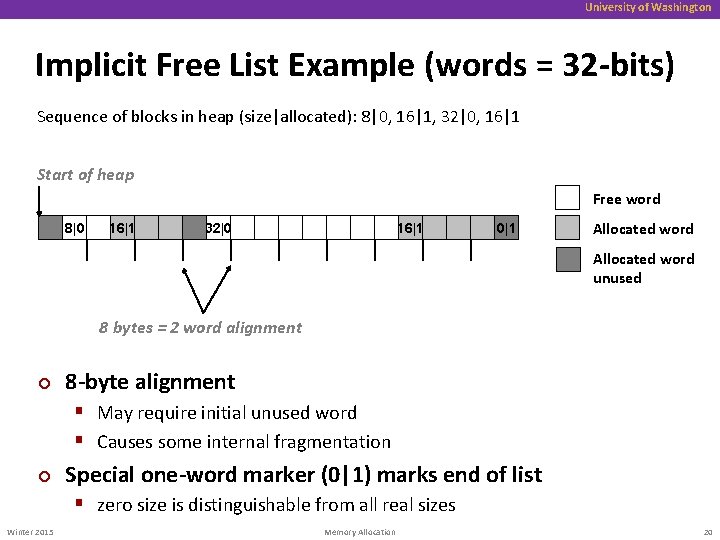
University of Washington Implicit Free List Example (words = 32 -bits) Sequence of blocks in heap (size|allocated): 8|0, 16|1, 32|0, 16|1 Start of heap Free word 8|0 16|1 32|0 16|1 0|1 Allocated word unused 8 bytes = 2 word alignment ¢ 8 -byte alignment § May require initial unused word § Causes some internal fragmentation ¢ Special one-word marker (0|1) marks end of list § zero size is distinguishable from all real sizes Winter 2015 Memory Allocation 20
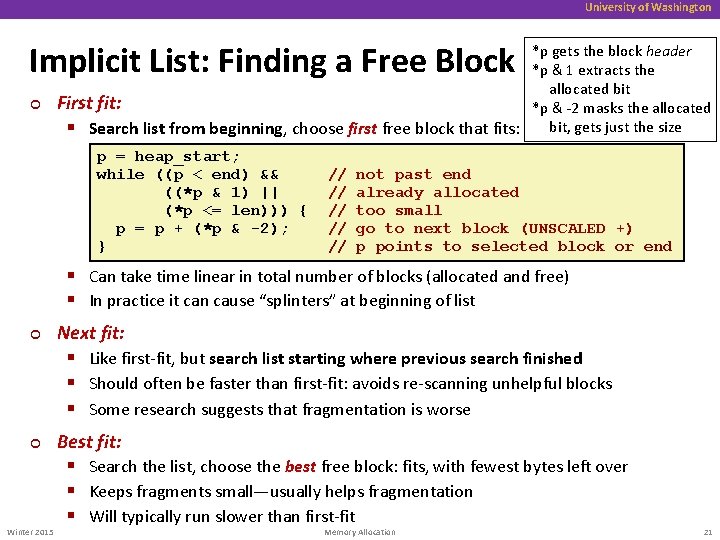
University of Washington Implicit List: Finding a Free Block ¢ *p gets the block header *p & 1 extracts the allocated bit First fit: *p & -2 masks the allocated § Search list from beginning, choose first free block that fits: bit, gets just the size p = heap_start; while ((p < end) && ((*p & 1) || (*p <= len))) { p = p + (*p & -2); } // // // not past end already allocated too small go to next block (UNSCALED +) p points to selected block or end § Can take time linear in total number of blocks (allocated and free) § In practice it can cause “splinters” at beginning of list ¢ ¢ Winter 2015 Next fit: § Like first-fit, but search list starting where previous search finished § Should often be faster than first-fit: avoids re-scanning unhelpful blocks § Some research suggests that fragmentation is worse Best fit: § Search the list, choose the best free block: fits, with fewest bytes left over § Keeps fragments small—usually helps fragmentation § Will typically run slower than first-fit Memory Allocation 21
University of Washington Mar 6 Winter 2015 Memory Allocation 22
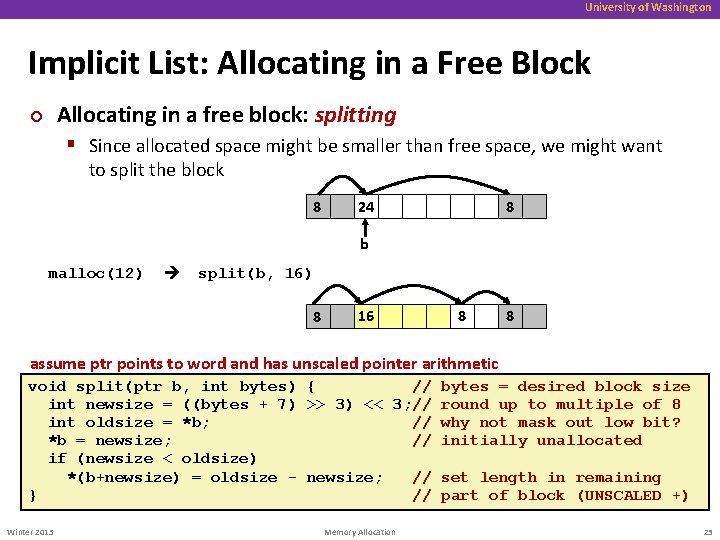
University of Washington Implicit List: Allocating in a Free Block Allocating in a free block: splitting ¢ § Since allocated space might be smaller than free space, we might want to split the block 8 24 8 b malloc(12) split(b, 16) 8 16 8 8 assume ptr points to word and has unscaled pointer arithmetic void split(ptr b, int bytes) { // bytes = desired block size int newsize = ((bytes + 7) >> 3) << 3; // round up to multiple of 8 int oldsize = *b; // why not mask out low bit? *b = newsize; // initially unallocated if (newsize < oldsize) *(b+newsize) = oldsize - newsize; // set length in remaining } // part of block (UNSCALED +) Winter 2015 Memory Allocation 23
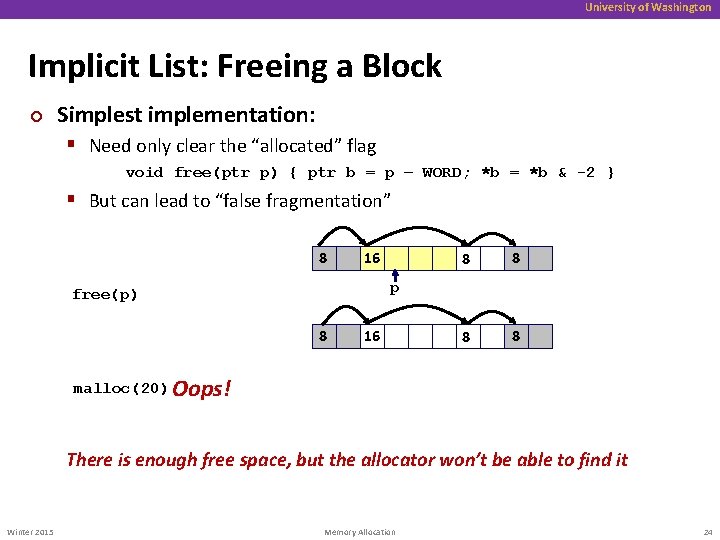
University of Washington Implicit List: Freeing a Block ¢ Simplest implementation: § Need only clear the “allocated” flag void free(ptr p) { ptr b = p – WORD; *b = *b & -2 } § But can lead to “false fragmentation” 8 16 8 8 p free(p) 8 16 malloc(20) Oops! There is enough free space, but the allocator won’t be able to find it Winter 2015 Memory Allocation 24
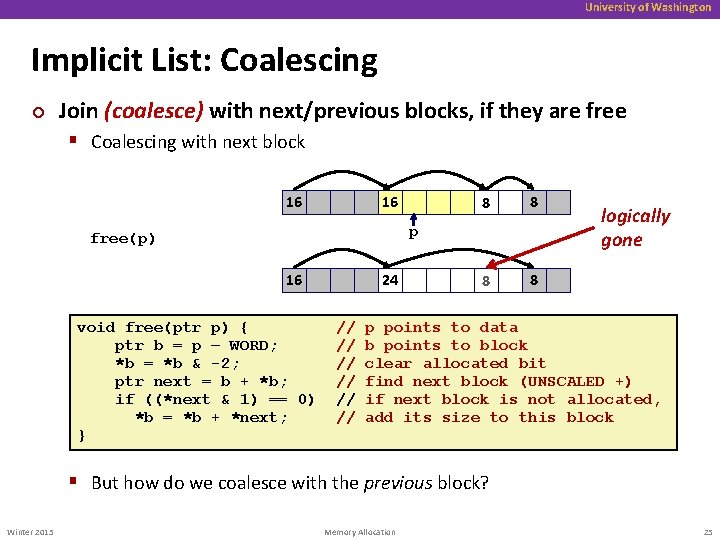
University of Washington Implicit List: Coalescing ¢ Join (coalesce) with next/previous blocks, if they are free § Coalescing with next block 16 16 8 8 p free(p) 16 void free(ptr p) { ptr b = p – WORD; *b = *b & -2; ptr next = b + *b; if ((*next & 1) == 0) *b = *b + *next; } 24 // // // logically gone p points to data b points to block clear allocated bit find next block (UNSCALED +) if next block is not allocated, add its size to this block § But how do we coalesce with the previous block? Winter 2015 Memory Allocation 25
![University of Washington Implicit List: Bidirectional Coalescing ¢ Boundary tags [Knuth 73] § Replicate](http://slidetodoc.com/presentation_image_h2/6faed1acbe30158588e52145e63788d9/image-26.jpg "University of Washington Implicit List: Bidirectional Coalescing ¢ Boundary tags [Knuth 73] § Replicate")
University of Washington Implicit List: Bidirectional Coalescing ¢ Boundary tags [Knuth 73] § Replicate size/allocated word at “bottom” (end) of free blocks § Allows us to traverse the “list” backwards, but requires extra space § Important and general technique! 16 16 16 Header Format of allocated and free blocks Boundary tag (footer) Winter 2015 16 24 size 24 16 a payload and padding size 16 a = 1: allocated block a = 0: free block size: total block size a Memory Allocation payload: application data (allocated blocks only) 26
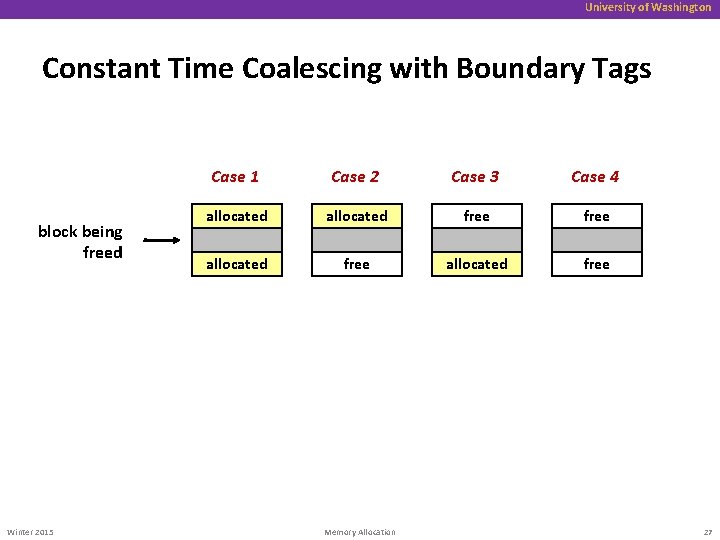
University of Washington Constant Time Coalescing with Boundary Tags block being freed Winter 2015 Case 1 Case 2 Case 3 Case 4 allocated free Memory Allocation 27
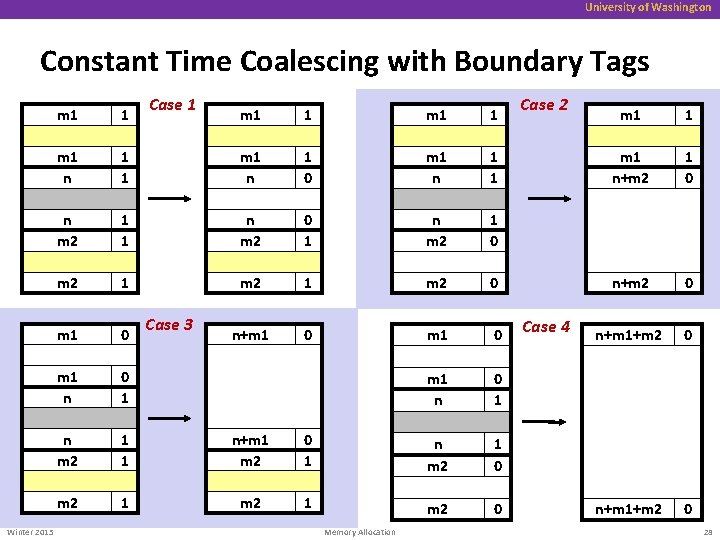
University of Washington Constant Time Coalescing with Boundary Tags Winter 2015 m 1 1 m 1 n Case 1 m 1 1 1 1 m 1 n 1 0 m 1 n 1 1 n m 2 0 1 n m 2 1 0 m 2 1 m 2 0 m 1 0 n+m 1 0 m 1 n 0 1 n m 2 1 1 n+m 1 m 2 0 1 n m 2 1 0 m 2 1 m 2 0 Case 3 Memory Allocation Case 2 Case 4 m 1 1 m 1 n+m 2 1 0 n+m 2 0 n+m 1+m 2 0 28
University of Washington Implicit Free Lists: Summary ¢ ¢ Implementation: very simple Allocate cost: § linear time (in total number of heap blocks) worst case ¢ Free cost: § constant time worst case § even with coalescing ¢ Memory utilization: § will depend on placement policy § First-fit, next-fit or best-fit ¢ Not used in practice for malloc()/free() because of linear-time allocation § used in some special purpose applications ¢ Winter 2015 The concepts of splitting and boundary tag coalescing are general to allocators Memory Allocation 29
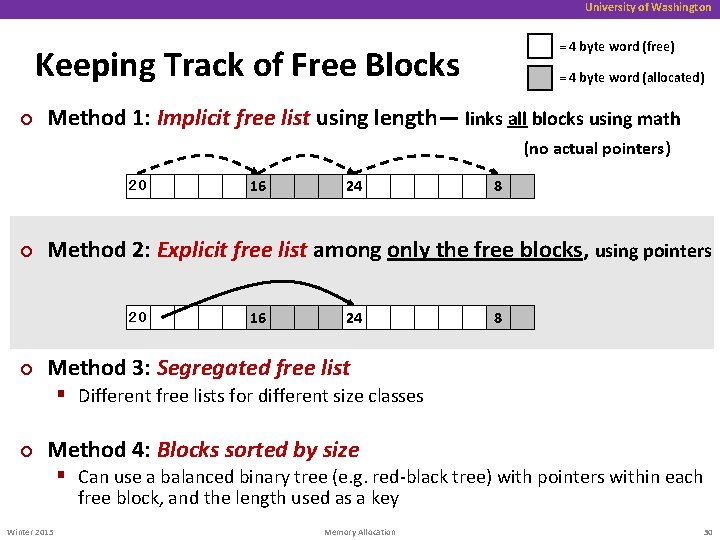
University of Washington = 4 byte word (free) Keeping Track of Free Blocks ¢ = 4 byte word (allocated) Method 1: Implicit free list using length— links all blocks using math (no actual pointers) 20 ¢ 24 8 Method 2: Explicit free list among only the free blocks, using pointers 20 ¢ 16 16 24 8 Method 3: Segregated free list § Different free lists for different size classes ¢ Method 4: Blocks sorted by size § Can use a balanced binary tree (e. g. red-black tree) with pointers within each free block, and the length used as a key Winter 2015 Memory Allocation 30
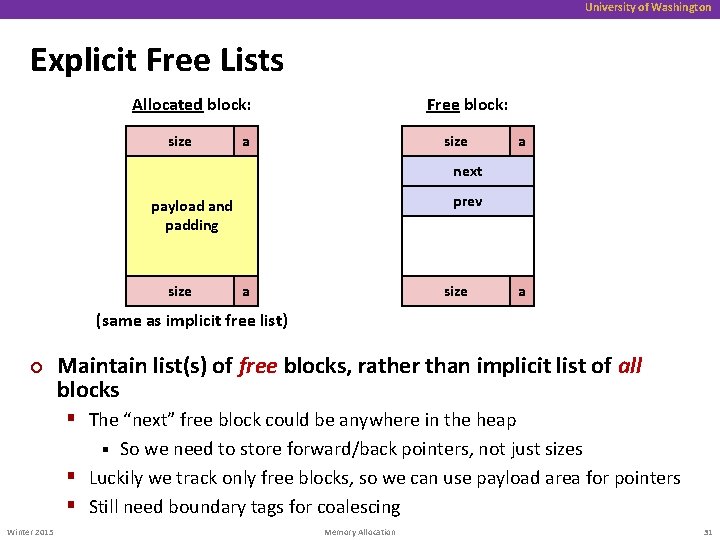
University of Washington Explicit Free Lists Allocated block: size Free block: a size a next prev payload and padding size a (same as implicit free list) ¢ Maintain list(s) of free blocks, rather than implicit list of all blocks § The “next” free block could be anywhere in the heap So we need to store forward/back pointers, not just sizes § Luckily we track only free blocks, so we can use payload area for pointers § Still need boundary tags for coalescing § Winter 2015 Memory Allocation 31
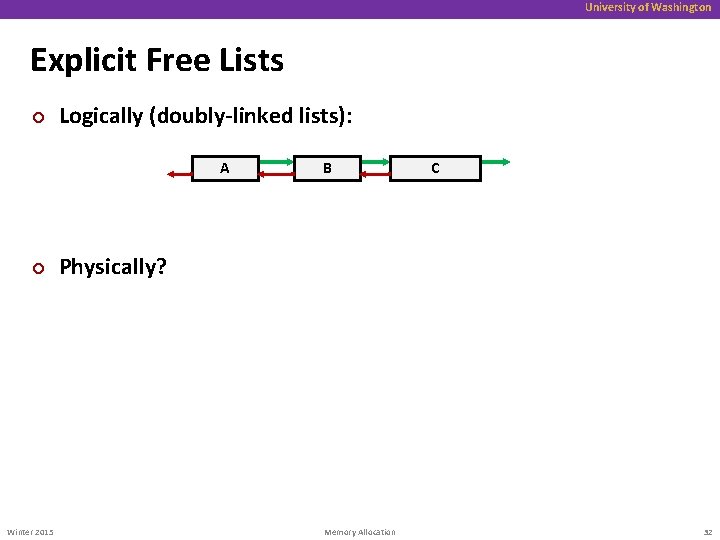
University of Washington Explicit Free Lists ¢ Logically (doubly-linked lists): A ¢ Winter 2015 B C Physically? Memory Allocation 32
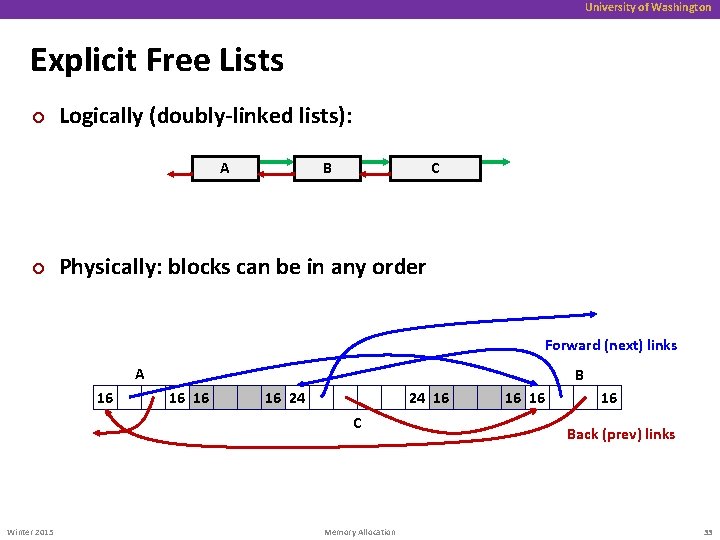
University of Washington Explicit Free Lists ¢ Logically (doubly-linked lists): A ¢ B C Physically: blocks can be in any order Forward (next) links A 16 B 16 16 16 24 24 16 C Winter 2015 Memory Allocation 16 16 16 Back (prev) links 33
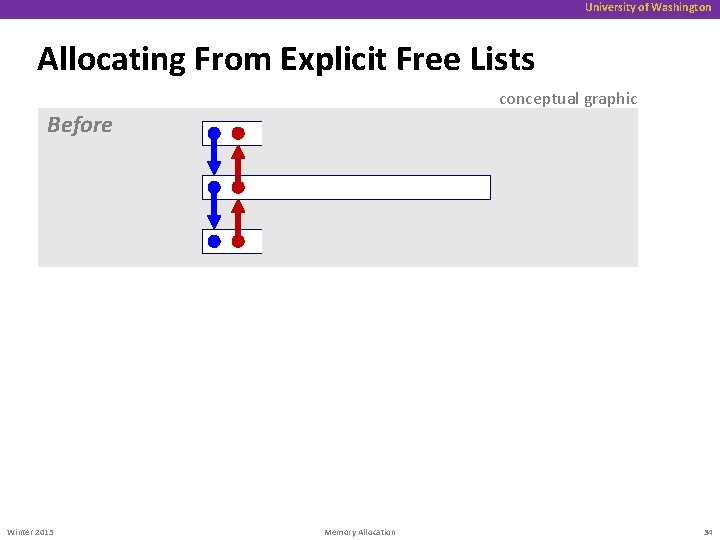
University of Washington Allocating From Explicit Free Lists conceptual graphic Before Winter 2015 Memory Allocation 34
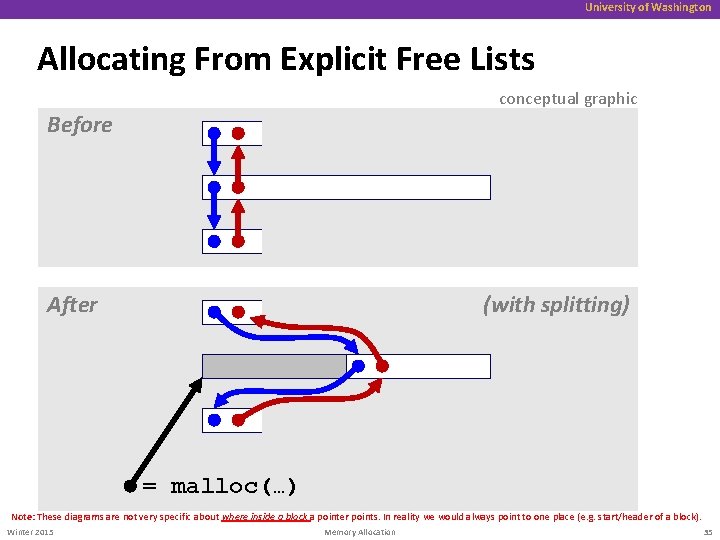
University of Washington Allocating From Explicit Free Lists conceptual graphic Before After (with splitting) = malloc(…) Note: These diagrams are not very specific about where inside a block a pointer points. In reality we would always point to one place (e. g. start/header of a block). Winter 2015 Memory Allocation 35
University of Washington Freeing With Explicit Free Lists ¢ Winter 2015 Insertion policy: Where in the free list do you put a newly freed block? Memory Allocation 36
University of Washington Freeing With Explicit Free Lists ¢ Insertion policy: Where in the free list do you put a newly freed block? § LIFO (last-in-first-out) policy § Insert freed block at the beginning of the free list § Pro: simple and constant time § Con: studies suggest fragmentation is worse than address ordered § Address-ordered policy Winter 2015 § Insert freed blocks so that free list blocks are always in address order: addr(prev) < addr(curr) < addr(next) § Con: requires linear-time search when blocks are freed § Pro: studies suggest fragmentation is lower than LIFO Memory Allocation 37
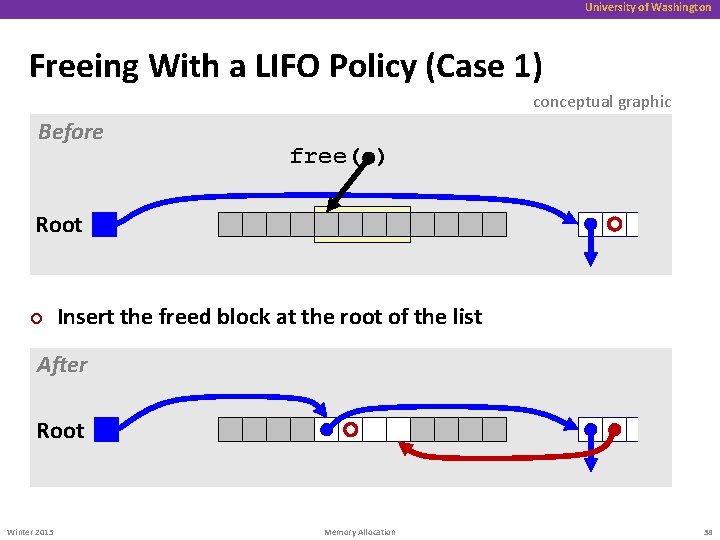
University of Washington Freeing With a LIFO Policy (Case 1) conceptual graphic Before free( ) Root ¢ Insert the freed block at the root of the list After Root Winter 2015 Memory Allocation 38
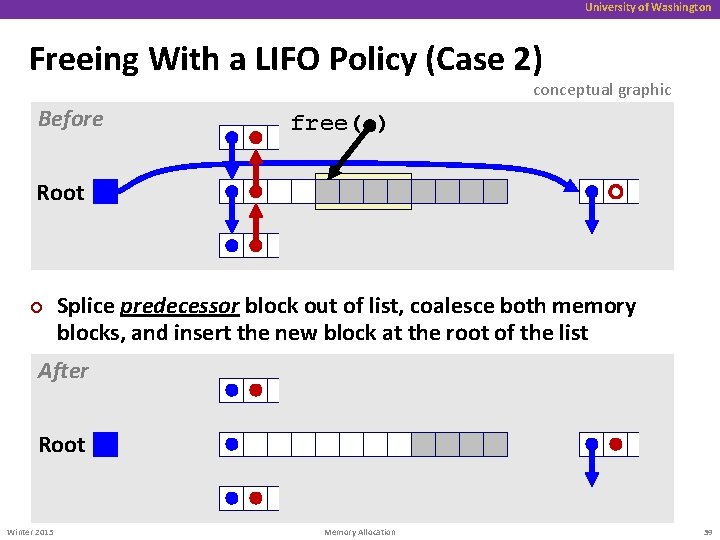
University of Washington Freeing With a LIFO Policy (Case 2) conceptual graphic Before free( ) Root ¢ Splice predecessor block out of list, coalesce both memory blocks, and insert the new block at the root of the list After Root Winter 2015 Memory Allocation 39
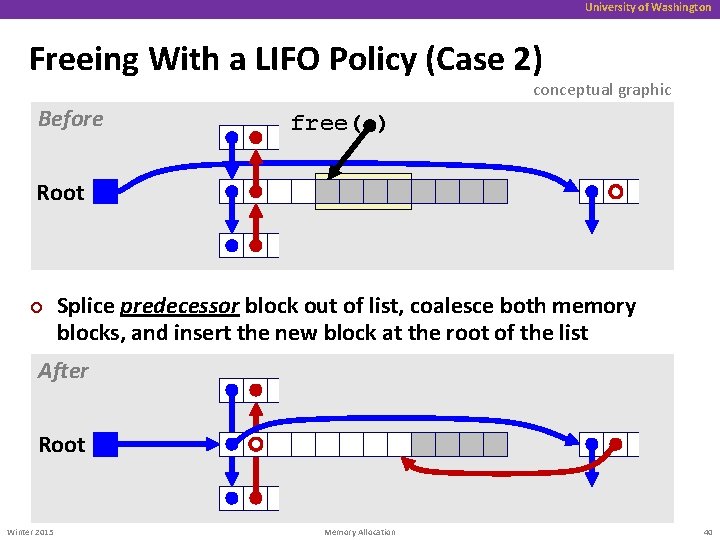
University of Washington Freeing With a LIFO Policy (Case 2) conceptual graphic Before free( ) Root ¢ Splice predecessor block out of list, coalesce both memory blocks, and insert the new block at the root of the list After Root Winter 2015 Memory Allocation 40
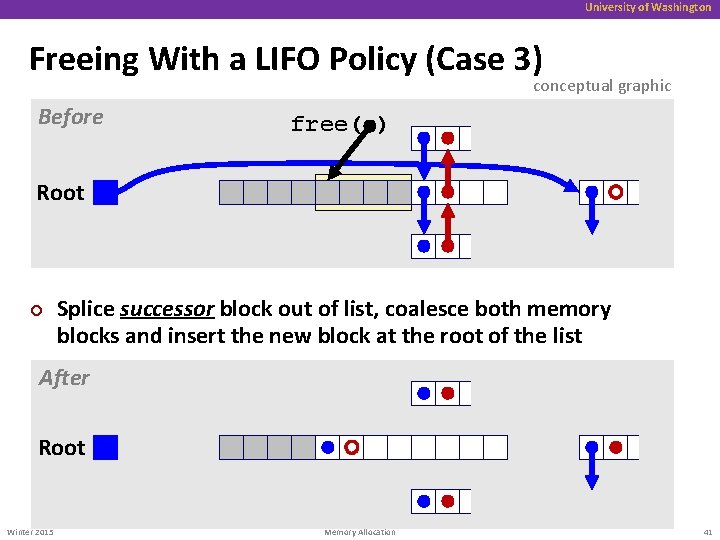
University of Washington Freeing With a LIFO Policy (Case 3) conceptual graphic Before free( ) Root ¢ Splice successor block out of list, coalesce both memory blocks and insert the new block at the root of the list After Root Winter 2015 Memory Allocation 41
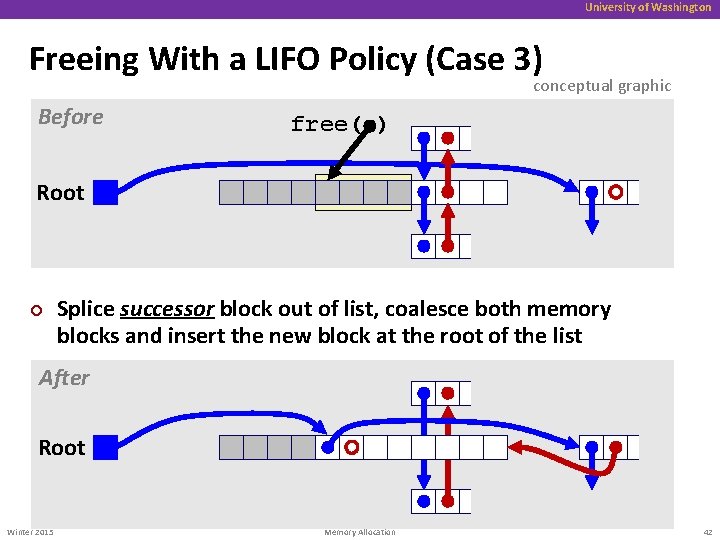
University of Washington Freeing With a LIFO Policy (Case 3) conceptual graphic Before free( ) Root ¢ Splice successor block out of list, coalesce both memory blocks and insert the new block at the root of the list After Root Winter 2015 Memory Allocation 42
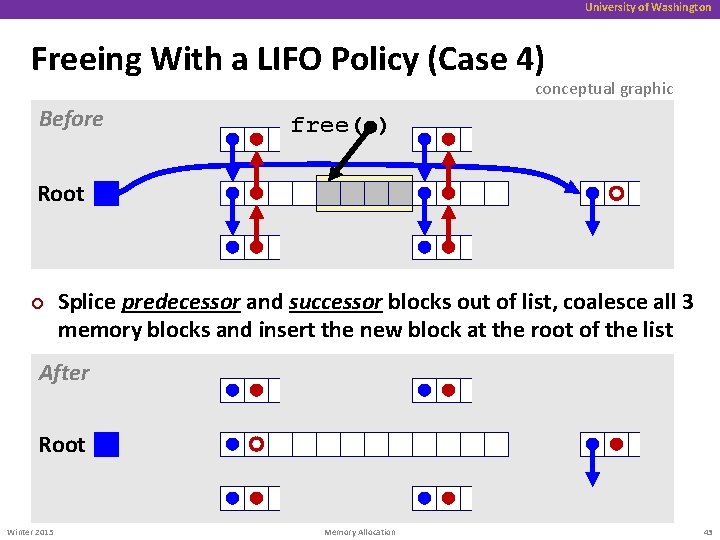
University of Washington Freeing With a LIFO Policy (Case 4) conceptual graphic Before free( ) Root ¢ Splice predecessor and successor blocks out of list, coalesce all 3 memory blocks and insert the new block at the root of the list After Root Winter 2015 Memory Allocation 43
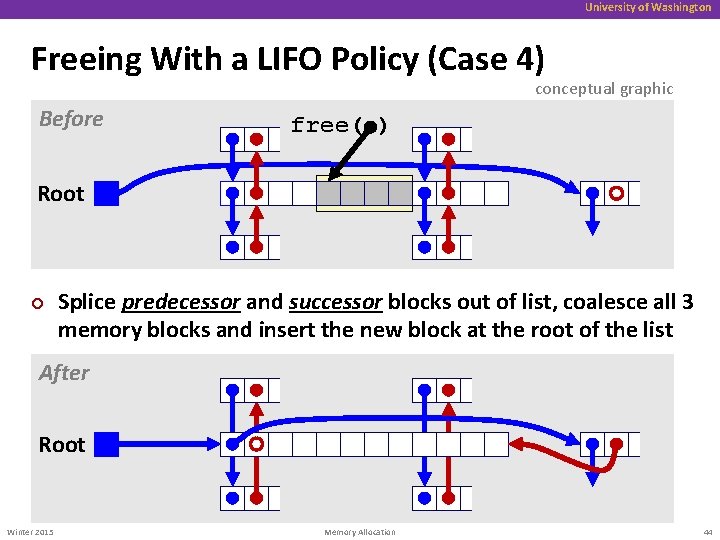
University of Washington Freeing With a LIFO Policy (Case 4) conceptual graphic Before free( ) Root ¢ Splice predecessor and successor blocks out of list, coalesce all 3 memory blocks and insert the new block at the root of the list After Root Winter 2015 Memory Allocation 44
University of Washington Explicit List Summary ¢ Comparison to implicit list: § Allocate is linear time in number of free blocks instead of all blocks Much faster when most of the memory is full § Slightly more complicated allocate and free since needs to splice blocks in and out of the list § Some extra space for the links (2 extra words needed for each block) § Possibly increases minimum block size, leading to more internal fragmentation § ¢ Most common use of explicit lists is in conjunction with segregated free lists § Keep multiple linked lists of different size classes, or possibly for different types of objects Winter 2015 Memory Allocation 46
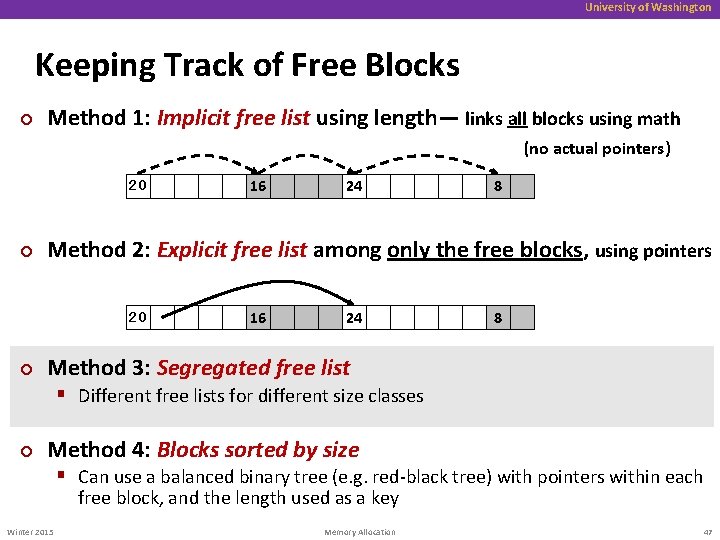
University of Washington Keeping Track of Free Blocks ¢ Method 1: Implicit free list using length— links all blocks using math (no actual pointers) 20 ¢ 24 8 Method 2: Explicit free list among only the free blocks, using pointers 20 ¢ 16 16 24 8 Method 3: Segregated free list § Different free lists for different size classes ¢ Method 4: Blocks sorted by size § Can use a balanced binary tree (e. g. red-black tree) with pointers within each free block, and the length used as a key Winter 2015 Memory Allocation 47
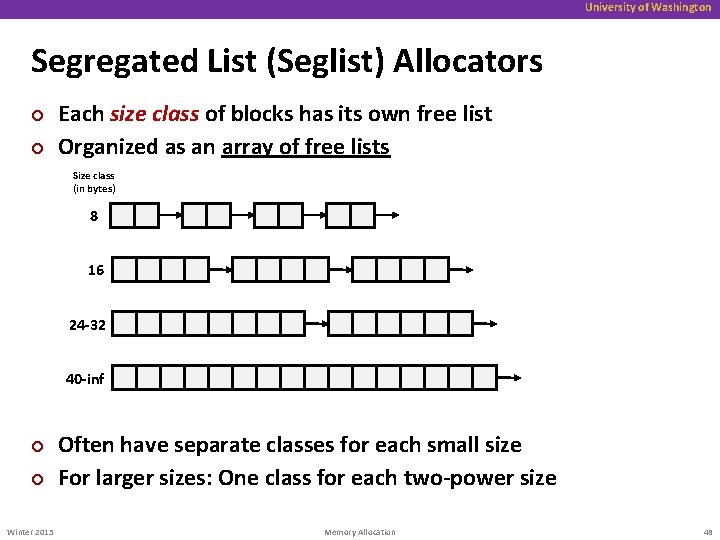
University of Washington Segregated List (Seglist) Allocators ¢ ¢ Each size class of blocks has its own free list Organized as an array of free lists Size class (in bytes) 8 16 24 -32 40 -inf ¢ ¢ Winter 2015 Often have separate classes for each small size For larger sizes: One class for each two-power size Memory Allocation 48
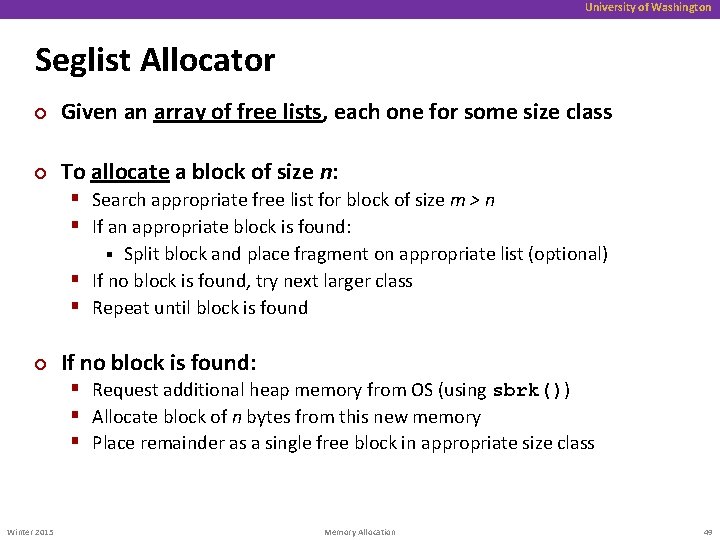
University of Washington Seglist Allocator ¢ Given an array of free lists, each one for some size class ¢ To allocate a block of size n: § Search appropriate free list for block of size m > n § If an appropriate block is found: Split block and place fragment on appropriate list (optional) § If no block is found, try next larger class § Repeat until block is found § ¢ If no block is found: § Request additional heap memory from OS (using sbrk()) § Allocate block of n bytes from this new memory § Place remainder as a single free block in appropriate size class Winter 2015 Memory Allocation 49
University of Washington Seglist Allocator ¢ To free a block: § Coalesce and place on appropriate list (optional) ¢ Advantages of seglist allocators § Higher throughput log time for power-of-two size classes § Better memory utilization § Winter 2015 § First-fit search of segregated free list approximates a best-fit search of entire heap. § Extreme case: Giving each block its own size class is equivalent to best-fit. Memory Allocation 50
University of Washington Summary of Key Allocator Policies ¢ Placement policy: § First-fit, next-fit, best-fit, etc. § Trades off lower throughput for less fragmentation § Observation: segregated free lists approximate a best fit placement policy without having to search entire free list ¢ Splitting policy: § When do we go ahead and split free blocks? § How much internal fragmentation are we willing to tolerate? ¢ Coalescing policy: § Immediate coalescing: coalesce each time free() is called § Deferred coalescing: try to improve performance of free() by deferring coalescing until needed. Examples: § Coalesce as you scan the free list for malloc() § Coalesce when the amount of external fragmentation reaches some threshold Winter 2015 Memory Allocation 51
University of Washington More Info on Allocators ¢ D. Knuth, “The Art of Computer Programming”, 2 nd edition, Addison Wesley, 1973 § The classic reference on dynamic storage allocation ¢ Wilson et al, “Dynamic Storage Allocation: A Survey and Critical Review”, Proc. 1995 Int’l Workshop on Memory Management, Kinross, Scotland, Sept, 1995. § Comprehensive survey § Available from CS: APP student site (csapp. cs. cmu. edu) Winter 2015 Memory Allocation 52
University of Washington Wouldn’t it be nice… ¢ ¢ Winter 2015 If we never had to free memory? Do you free objects in Java? Memory Allocation 53
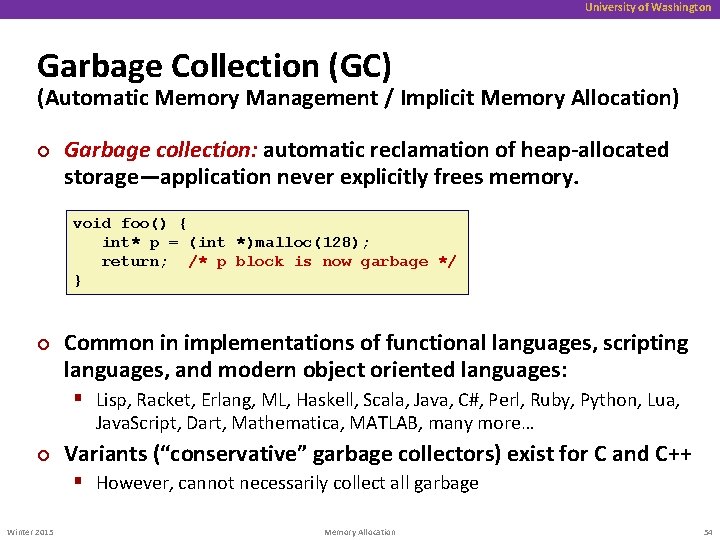
University of Washington Garbage Collection (GC) (Automatic Memory Management / Implicit Memory Allocation) ¢ Garbage collection: automatic reclamation of heap-allocated storage—application never explicitly frees memory. void foo() { int* p = (int *)malloc(128); return; /* p block is now garbage */ } ¢ Common in implementations of functional languages, scripting languages, and modern object oriented languages: § Lisp, Racket, Erlang, ML, Haskell, Scala, Java, C#, Perl, Ruby, Python, Lua, Java. Script, Dart, Mathematica, MATLAB, many more… ¢ Variants (“conservative” garbage collectors) exist for C and C++ § However, cannot necessarily collect all garbage Winter 2015 Memory Allocation 54
University of Washington Garbage Collection ¢ How does the memory allocator know when memory can be freed? § In general, we cannot know what is going to be used in the future since it depends on conditionals (halting problem, etc. ) Winter 2015 Memory Allocation 55
University of Washington Garbage Collection ¢ How does the memory allocator know when memory can be freed? § In general, we cannot know what is going to be used in the future since it depends on conditionals (halting problem, etc. ) § But, we can tell that certain blocks cannot be used if there are no pointers to them ¢ ¢ So the memory allocator needs to know what is a pointer and what is not – how can it do this? We’ll make some assumptions about pointers: § Memory allocator can distinguish pointers from non-pointers § All pointers point to the start of a block in the heap § Application cannot hide pointers (e. g. , by coercing them to an int, and then back again) Winter 2015 Memory Allocation 56
University of Washington Classical GC Algorithms ¢ Mark-and-sweep collection (Mc. Carthy, 1960) § Does not move blocks (unless you also “compact”) ¢ Reference counting (Collins, 1960) § Does not move blocks (not discussed) ¢ Copying collection (Minsky, 1963) § Moves blocks (not discussed) ¢ Generational Collectors (Lieberman and Hewitt, 1983) § Most allocations become garbage very soon, so focus reclamation work on zones of memory recently allocated. ¢ For more information: § Jones, Hosking, and Moss, The Garbage Collection Handbook: The Art of Automatic Memory Management, CRC Press, 2012. § Jones and Lin, Garbage Collection: Algorithms for Automatic Dynamic Memory, John Wiley & Sons, 1996. Winter 2015 Memory Allocation 57
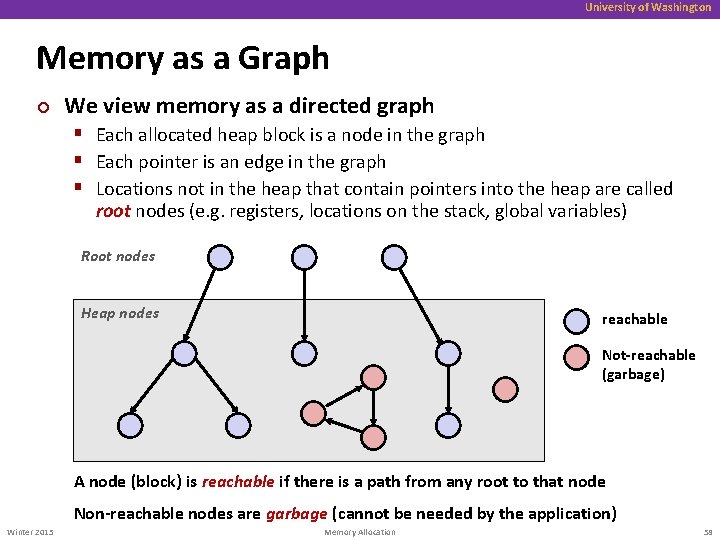
University of Washington Memory as a Graph ¢ We view memory as a directed graph § Each allocated heap block is a node in the graph § Each pointer is an edge in the graph § Locations not in the heap that contain pointers into the heap are called root nodes (e. g. registers, locations on the stack, global variables) Root nodes Heap nodes reachable Not-reachable (garbage) A node (block) is reachable if there is a path from any root to that node Non-reachable nodes are garbage (cannot be needed by the application) Winter 2015 Memory Allocation 58
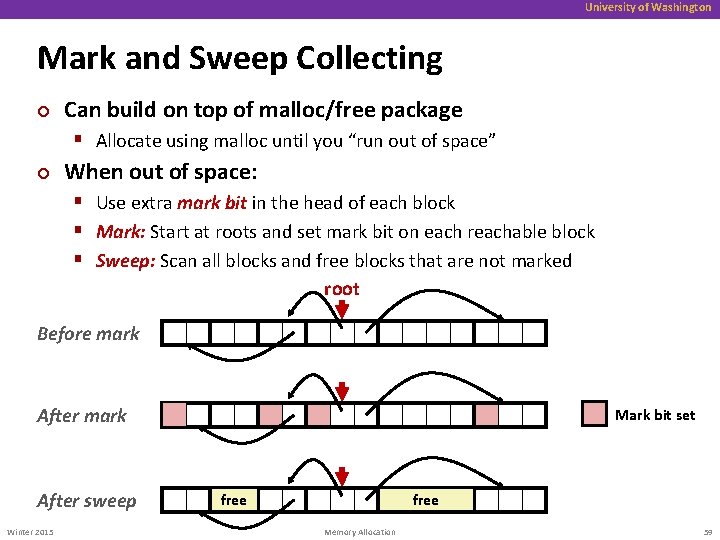
University of Washington Mark and Sweep Collecting ¢ Can build on top of malloc/free package § Allocate using malloc until you “run out of space” ¢ When out of space: § Use extra mark bit in the head of each block § Mark: Start at roots and set mark bit on each reachable block § Sweep: Scan all blocks and free blocks that are not marked root Before mark After sweep Winter 2015 Mark bit set free Memory Allocation 59
University of Washington Assumptions For a Simple Implementation ¢ Application can use functions to allocate memory: § b = new(n) : returns pointer, b, to new block with all locations cleared § b[i] : read location i of block b into register § b[i] = v : write v into location i of block b ¢ Each block will have a header word § b[-1] ¢ Functions used by the garbage collector: § is_ptr(p): determines whether p is a pointer to a block § length(p): returns length of block pointed to by p, not including header § get_roots(): returns all the roots Winter 2015 Memory Allocation 60
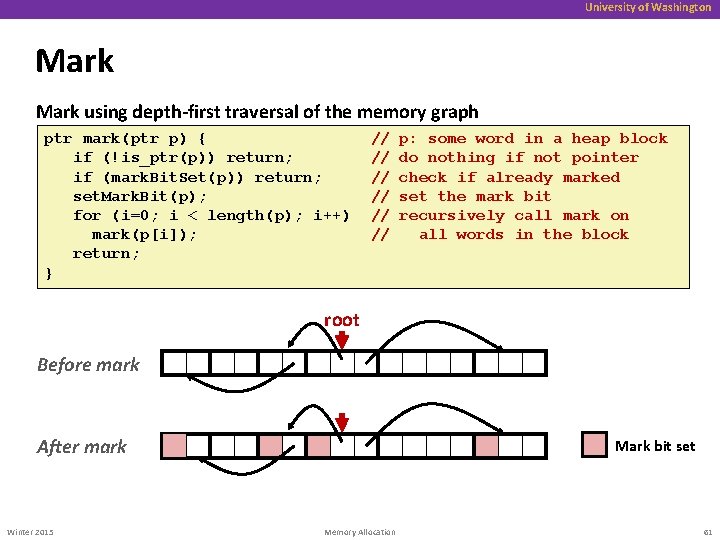
University of Washington Mark using depth-first traversal of the memory graph ptr mark(ptr p) { if (!is_ptr(p)) return; if (mark. Bit. Set(p)) return; set. Mark. Bit(p); for (i=0; i < length(p); i++) mark(p[i]); return; } // // // p: some word in a heap block do nothing if not pointer check if already marked set the mark bit recursively call mark on all words in the block root Before mark After mark Winter 2015 Mark bit set Memory Allocation 61
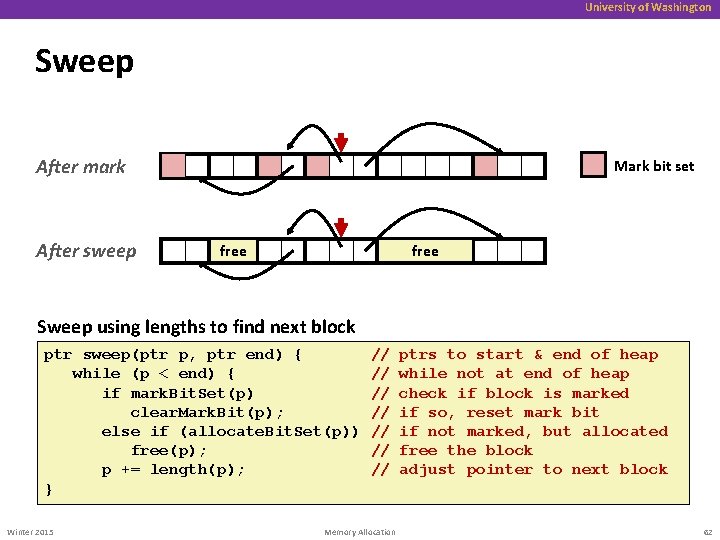
University of Washington Sweep After mark After sweep Mark bit set free Sweep using lengths to find next block ptr sweep(ptr p, ptr end) { while (p < end) { if mark. Bit. Set(p) clear. Mark. Bit(p); else if (allocate. Bit. Set(p)) free(p); p += length(p); } Winter 2015 // // Memory Allocation ptrs to start & end of heap while not at end of heap check if block is marked if so, reset mark bit if not marked, but allocated free the block adjust pointer to next block 62
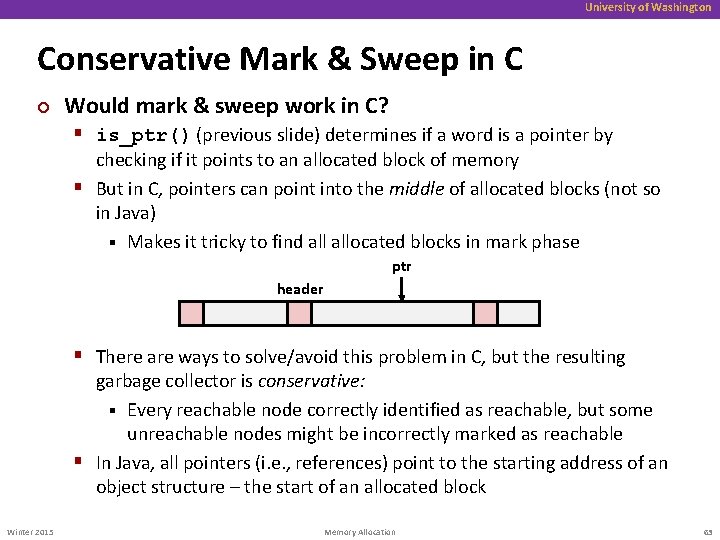
University of Washington Conservative Mark & Sweep in C ¢ Would mark & sweep work in C? § is_ptr() (previous slide) determines if a word is a pointer by checking if it points to an allocated block of memory § But in C, pointers can point into the middle of allocated blocks (not so in Java) § Makes it tricky to find allocated blocks in mark phase ptr header § There are ways to solve/avoid this problem in C, but the resulting garbage collector is conservative: § Every reachable node correctly identified as reachable, but some unreachable nodes might be incorrectly marked as reachable § In Java, all pointers (i. e. , references) point to the starting address of an object structure – the start of an allocated block Winter 2015 Memory Allocation 63
University of Washington Mar 9 ¢ Today: § Memory bugs § Java vs. C Winter 2015 Memory Allocation 64
University of Washington Winter 2015 Memory Allocation 65
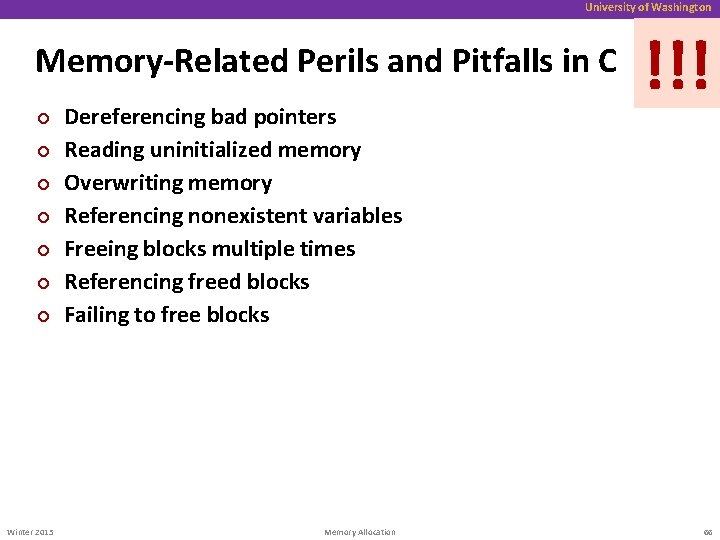
University of Washington Memory-Related Perils and Pitfalls in C ¢ ¢ ¢ ¢ Winter 2015 Dereferencing bad pointers Reading uninitialized memory Overwriting memory Referencing nonexistent variables Freeing blocks multiple times Referencing freed blocks Failing to free blocks Memory Allocation !!! 66
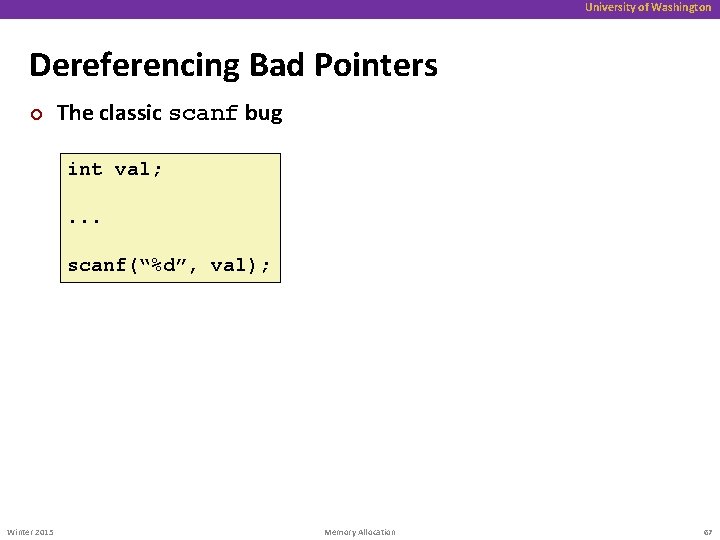
University of Washington Dereferencing Bad Pointers ¢ The classic scanf bug int val; . . . scanf(“%d”, val); Winter 2015 Memory Allocation 67
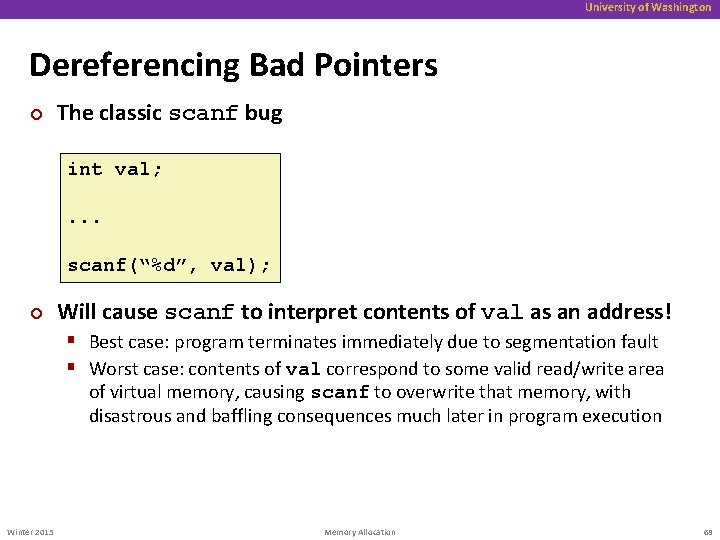
University of Washington Dereferencing Bad Pointers ¢ The classic scanf bug int val; . . . scanf(“%d”, val); ¢ Will cause scanf to interpret contents of val as an address! § Best case: program terminates immediately due to segmentation fault § Worst case: contents of val correspond to some valid read/write area of virtual memory, causing scanf to overwrite that memory, with disastrous and baffling consequences much later in program execution Winter 2015 Memory Allocation 68
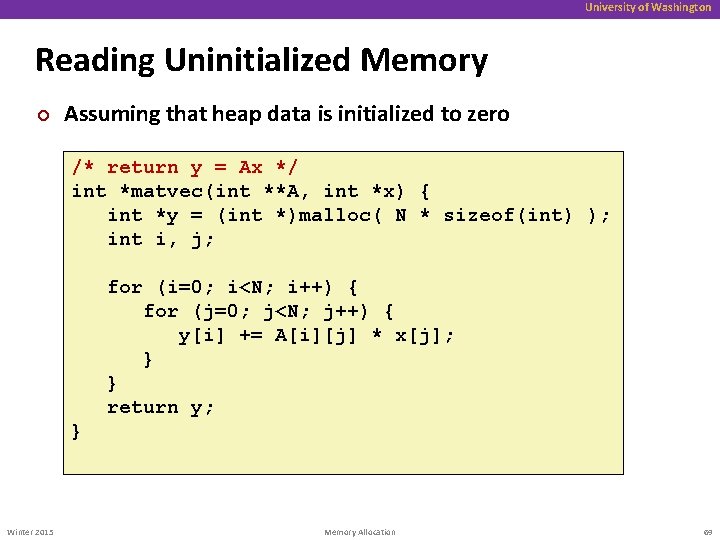
University of Washington Reading Uninitialized Memory ¢ Assuming that heap data is initialized to zero /* return y = Ax */ int *matvec(int **A, int *x) { int *y = (int *)malloc( N * sizeof(int) ); int i, j; for (i=0; i<N; i++) { for (j=0; j<N; j++) { y[i] += A[i][j] * x[j]; } } return y; } Winter 2015 Memory Allocation 69
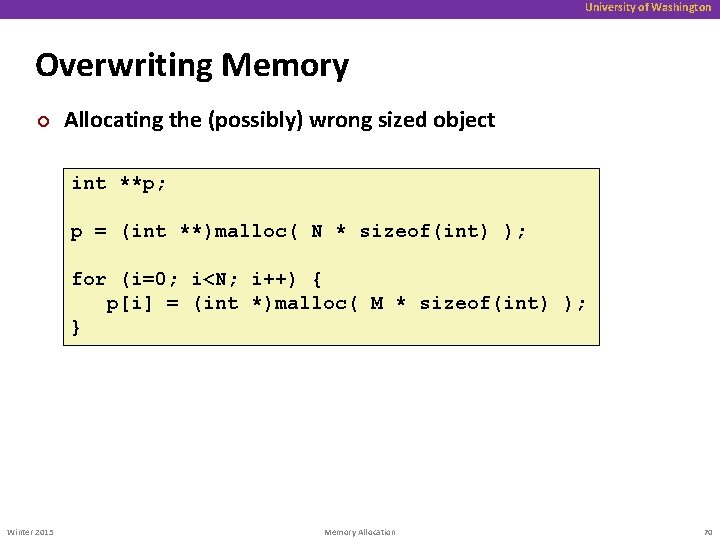
University of Washington Overwriting Memory ¢ Allocating the (possibly) wrong sized object int **p; p = (int **)malloc( N * sizeof(int) ); for (i=0; i<N; i++) { p[i] = (int *)malloc( M * sizeof(int) ); } Winter 2015 Memory Allocation 70
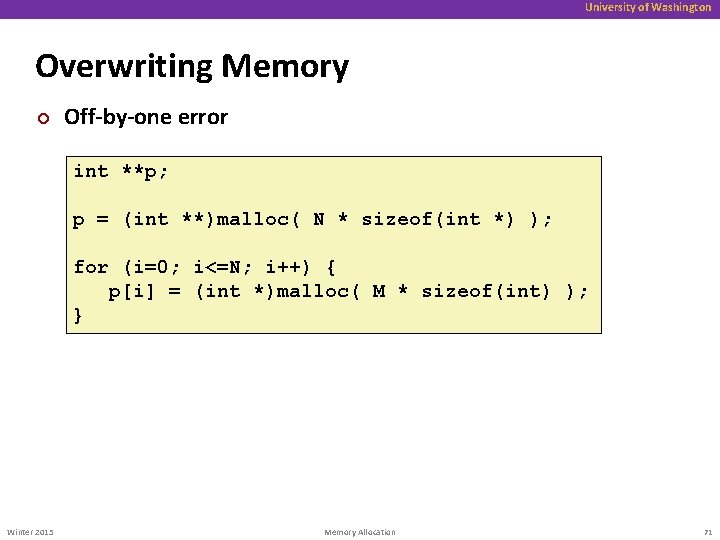
University of Washington Overwriting Memory ¢ Off-by-one error int **p; p = (int **)malloc( N * sizeof(int *) ); for (i=0; i<=N; i++) { p[i] = (int *)malloc( M * sizeof(int) ); } Winter 2015 Memory Allocation 71
![University of Washington Overwriting Memory ¢ Not checking the max string size char s[8];](http://slidetodoc.com/presentation_image_h2/6faed1acbe30158588e52145e63788d9/image-71.jpg "University of Washington Overwriting Memory ¢ Not checking the max string size char s[8];")
University of Washington Overwriting Memory ¢ Not checking the max string size char s[8]; int i; gets(s); ¢ /* reads “ 123456789” from stdin */ Basis for classic buffer overflow attacks § Your lab assignment #3 Winter 2015 Memory Allocation 72
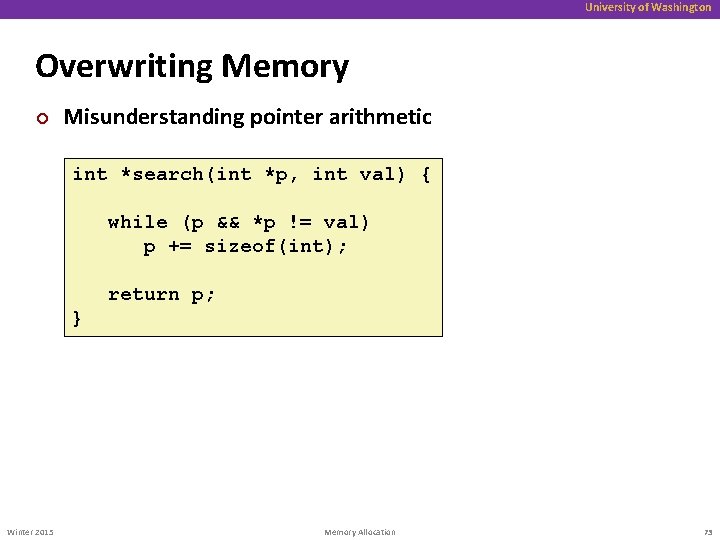
University of Washington Overwriting Memory ¢ Misunderstanding pointer arithmetic int *search(int *p, int val) { while (p && *p != val) p += sizeof(int); return p; } Winter 2015 Memory Allocation 73
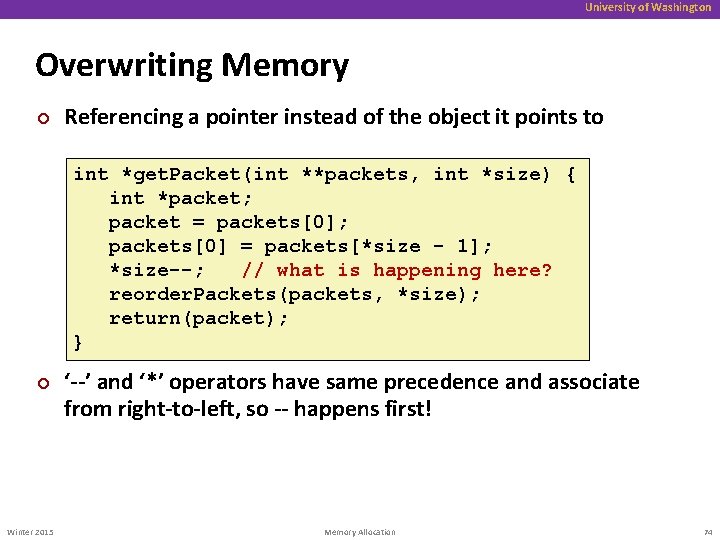
University of Washington Overwriting Memory ¢ Referencing a pointer instead of the object it points to int *get. Packet(int **packets, int *size) { int *packet; packet = packets[0]; packets[0] = packets[*size - 1]; *size--; // what is happening here? reorder. Packets(packets, *size); return(packet); } ¢ Winter 2015 ‘--’ and ‘*’ operators have same precedence and associate from right-to-left, so -- happens first! Memory Allocation 74
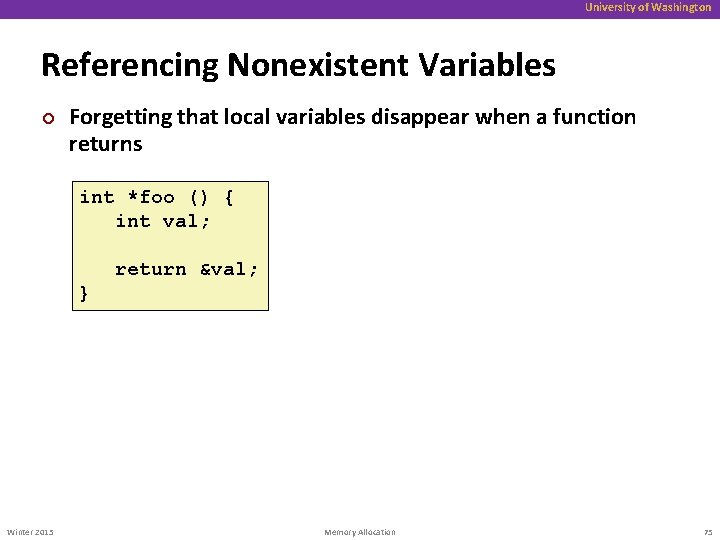
University of Washington Referencing Nonexistent Variables ¢ Forgetting that local variables disappear when a function returns int *foo () { int val; return &val; } Winter 2015 Memory Allocation 75
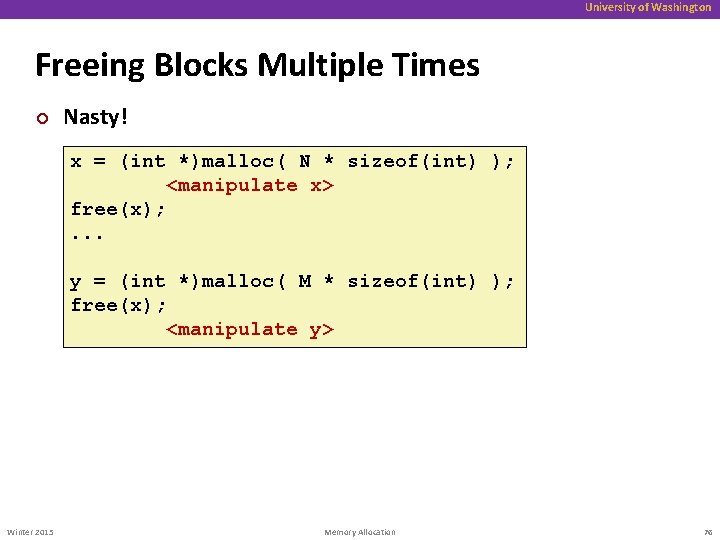
University of Washington Freeing Blocks Multiple Times ¢ Nasty! x = (int *)malloc( N * sizeof(int) ); <manipulate x> free(x); . . . y = (int *)malloc( M * sizeof(int) ); free(x); <manipulate y> Winter 2015 Memory Allocation 76
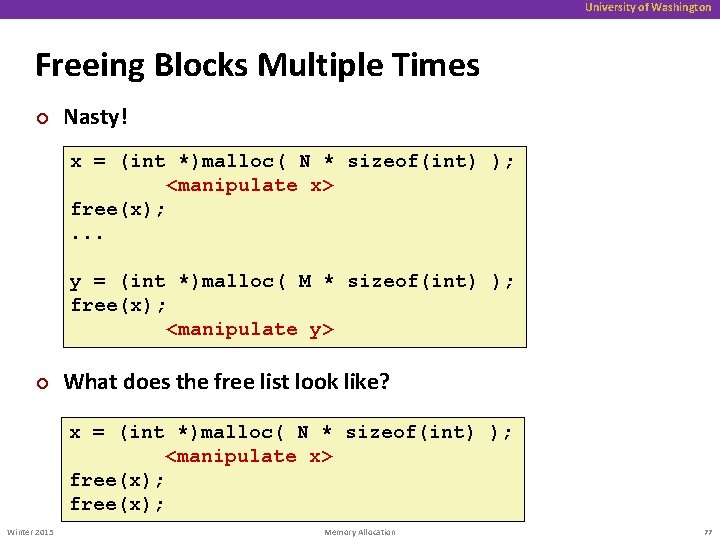
University of Washington Freeing Blocks Multiple Times ¢ Nasty! x = (int *)malloc( N * sizeof(int) ); <manipulate x> free(x); . . . y = (int *)malloc( M * sizeof(int) ); free(x); <manipulate y> ¢ What does the free list look like? x = (int *)malloc( N * sizeof(int) ); <manipulate x> free(x); Winter 2015 Memory Allocation 77
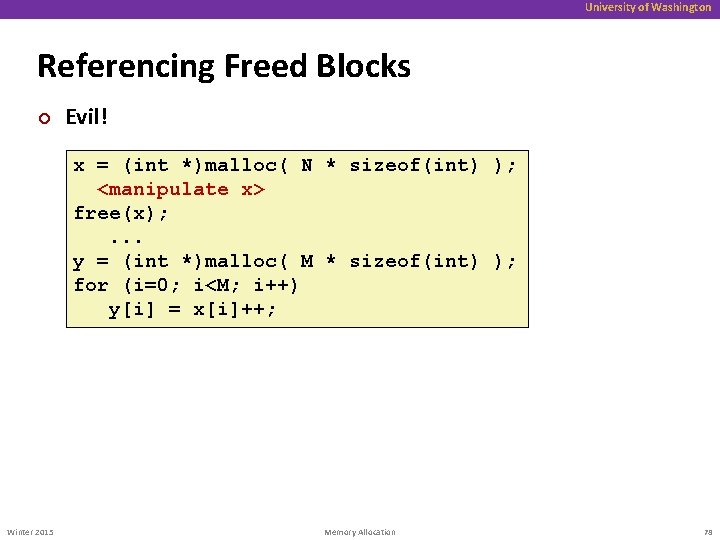
University of Washington Referencing Freed Blocks ¢ Evil! x = (int *)malloc( N * sizeof(int) ); <manipulate x> free(x); . . . y = (int *)malloc( M * sizeof(int) ); for (i=0; i<M; i++) y[i] = x[i]++; Winter 2015 Memory Allocation 78
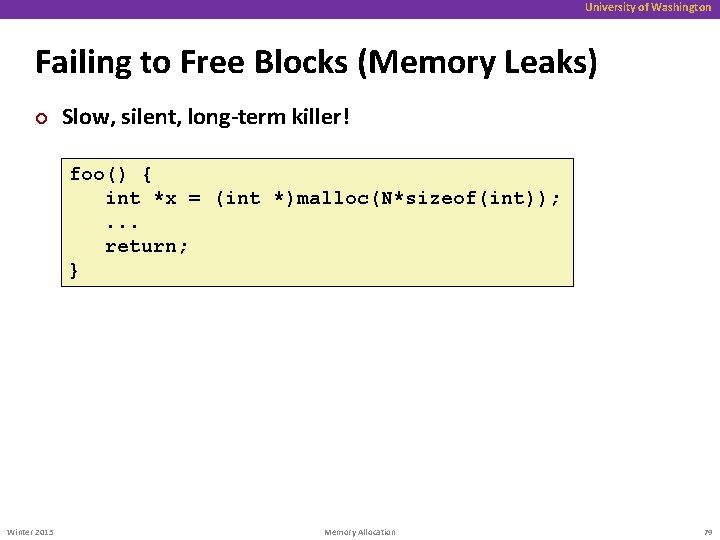
University of Washington Failing to Free Blocks (Memory Leaks) ¢ Slow, silent, long-term killer! foo() { int *x = (int *)malloc(N*sizeof(int)); . . . return; } Winter 2015 Memory Allocation 79
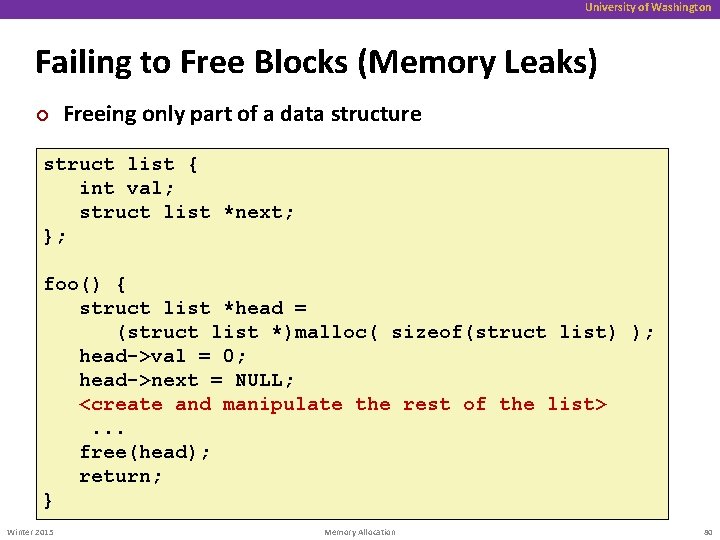
University of Washington Failing to Free Blocks (Memory Leaks) ¢ Freeing only part of a data structure struct list { int val; struct list *next; }; foo() { struct list *head = (struct list *)malloc( sizeof(struct list) ); head->val = 0; head->next = NULL; <create and manipulate the rest of the list>. . . free(head); return; } Winter 2015 Memory Allocation 80
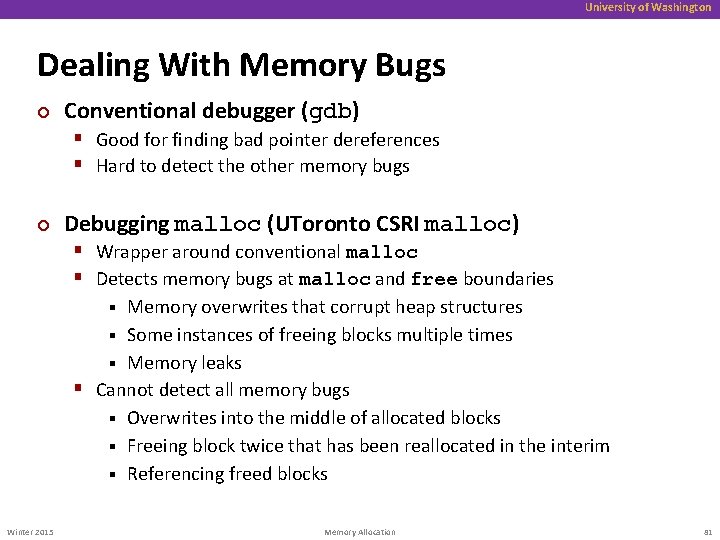
University of Washington Dealing With Memory Bugs ¢ Conventional debugger (gdb) § Good for finding bad pointer dereferences § Hard to detect the other memory bugs ¢ Debugging malloc (UToronto CSRI malloc) § Wrapper around conventional malloc § Detects memory bugs at malloc and free boundaries Memory overwrites that corrupt heap structures § Some instances of freeing blocks multiple times § Memory leaks § Cannot detect all memory bugs § Overwrites into the middle of allocated blocks § Freeing block twice that has been reallocated in the interim § Referencing freed blocks § Winter 2015 Memory Allocation 81
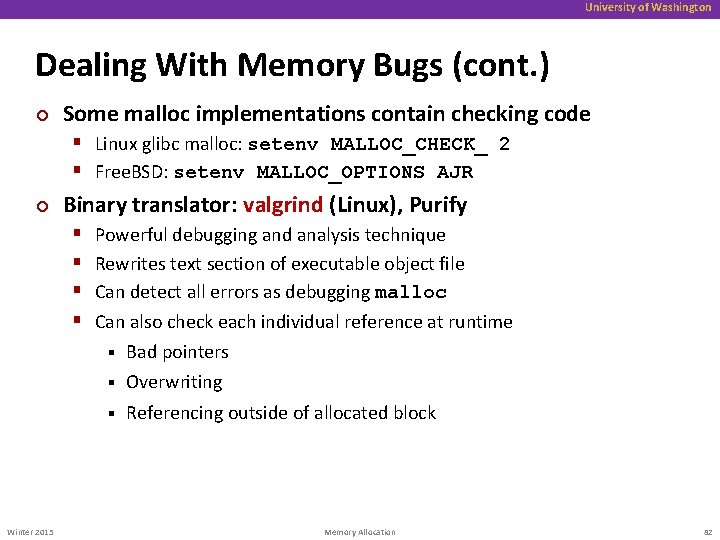
University of Washington Dealing With Memory Bugs (cont. ) ¢ Some malloc implementations contain checking code § Linux glibc malloc: setenv MALLOC_CHECK_ 2 § Free. BSD: setenv MALLOC_OPTIONS AJR ¢ Binary translator: valgrind (Linux), Purify § § Winter 2015 Powerful debugging and analysis technique Rewrites text section of executable object file Can detect all errors as debugging malloc Can also check each individual reference at runtime § Bad pointers § Overwriting § Referencing outside of allocated block Memory Allocation 82
University of Washington What about Java or ML or Python or …? ¢ In memory-safe languages, most of these bugs are impossible § § ¢ Winter 2015 Cannot perform arbitrary pointer manipulation Cannot get around the type system Array bounds checking, null pointer checking Automatic memory management But one of the bugs we saw earlier is possible. Which one? Memory Allocation 83
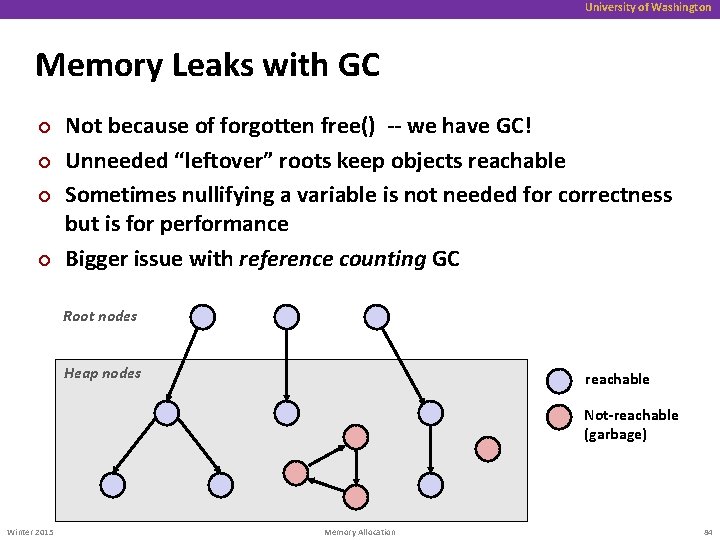
University of Washington Memory Leaks with GC ¢ ¢ Not because of forgotten free() -- we have GC! Unneeded “leftover” roots keep objects reachable Sometimes nullifying a variable is not needed for correctness but is for performance Bigger issue with reference counting GC Root nodes Heap nodes reachable Not-reachable (garbage) Winter 2015 Memory Allocation 84
- Slides: 83