
University of Washington EMBA Program Regional 20 Marketing
University of Washington EMBA Program Regional 20 Marketing Management “Setting Objectives & Marketing Strategy: Segmentation, Targeting and Positioning (STP)” Instructor: Elizabeth Stearns
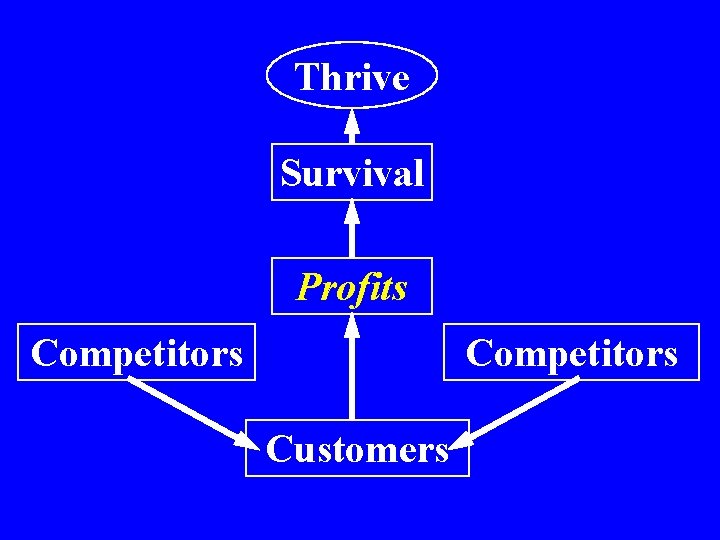
Thrive Survival Profits Competitors Customers
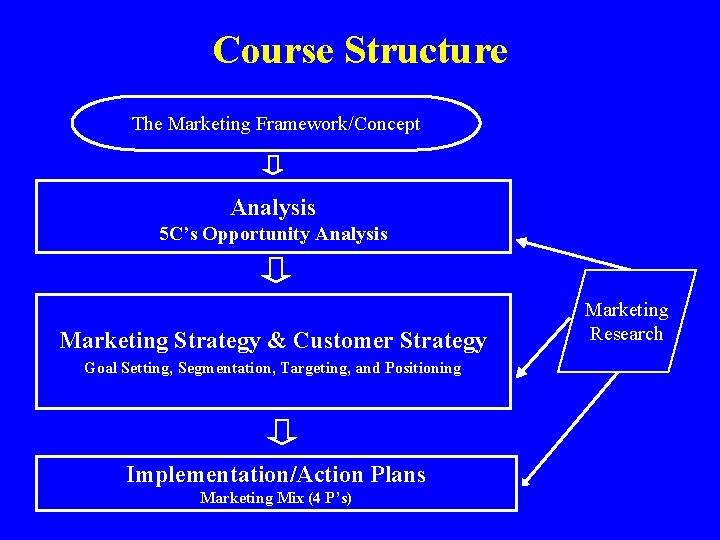
Course Structure The Marketing Framework/Concept Analysis 5 C’s Opportunity Analysis Marketing Strategy & Customer Strategy Goal Setting, Segmentation, Targeting, and Positioning Implementation/Action Plans Marketing Mix (4 P’s) Marketing Research
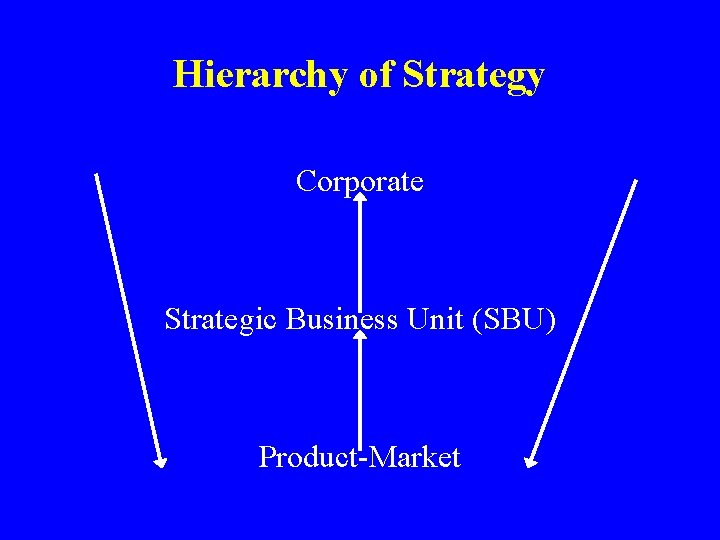
Hierarchy of Strategy Corporate Strategic Business Unit (SBU) Product-Market
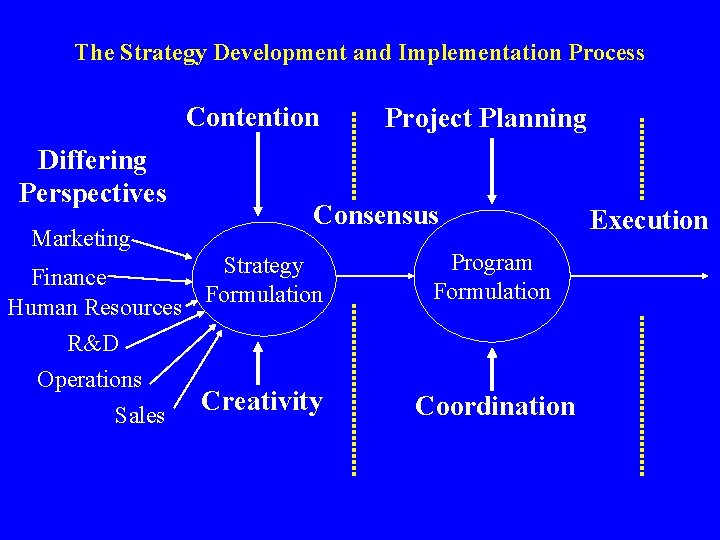
The Strategy Development and Implementation Process Contention Differing Perspectives Marketing Project Planning Consensus Strategy Formulation Finance Human Resources R&D Operations Creativity Sales Program Formulation Coordination Execution
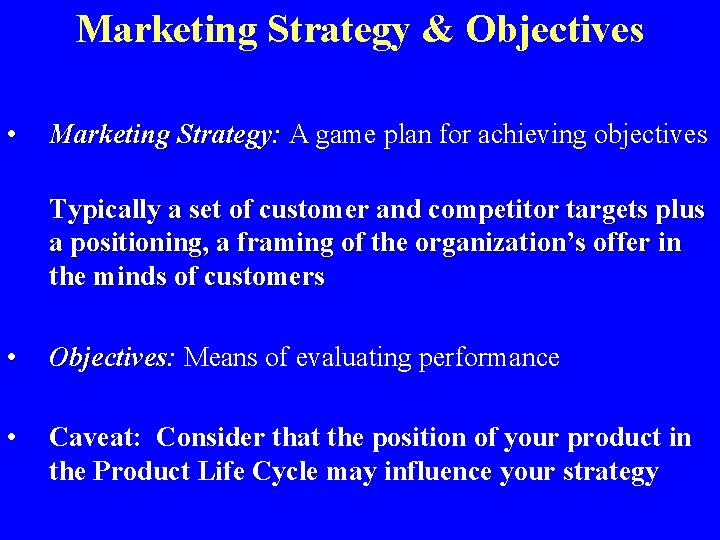
Marketing Strategy & Objectives • Marketing Strategy: A game plan for achieving objectives Typically a set of customer and competitor targets plus a positioning, a framing of the organization’s offer in the minds of customers • Objectives: Means of evaluating performance • Caveat: Consider that the position of your product in the Product Life Cycle may influence your strategy
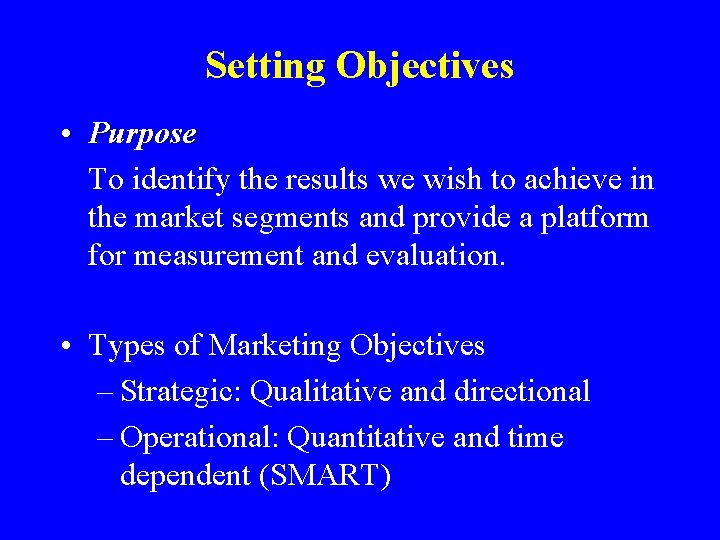
Setting Objectives • Purpose To identify the results we wish to achieve in the market segments and provide a platform for measurement and evaluation. • Types of Marketing Objectives – Strategic: Qualitative and directional – Operational: Quantitative and time dependent (SMART)
Select Dimensions for Operational Marketing Objectives


A Note on Sources of Volume Many objectives are “growth” oriented. • Where does growth come from? – Primary demand = “New” volume • New users into the market • Getting current users to use more • Get same users to use for a “new” purpose – Secondary demand = “Somebody else’s” volume • Take volume from competitors • Caveats – Beware of cannibalization—it’s not really growth – Stimulating secondary demand implies a competitive response
Using Objectives in Alternatives & Recommendations Choice • Write an operational marketing objective • Project all viable alternatives onto the dimension of the objective use expected value of outcome • Measure the “attractiveness” of each alternative according to whether/the degree to which it satisfies your operational marketing objective – If only 1 alternative meets your objective—choose it – If 2 or more alternatives meet your objective… • Choose the one which performs best on the dimension underlying your objective • Move to “tiebreaker” criteria – – Risk/variance in performance Cost “Fit” Etc.
Objectives Statements • Our primary objective in the loudspeaker market is to grow market share from 25% to 30% by stealing share from competitors in 2003 while maintaining margins at 23%. (What is wrong with this? ) • Our task is to generate $70 million cash flow from mainframes in both 2003 and 2004, while maintaining dollar-denominated market share at 45%. – Primary objectives are most important – Secondary objectives are relevant and desirable, but tradeoffs for primary objectives are acceptable
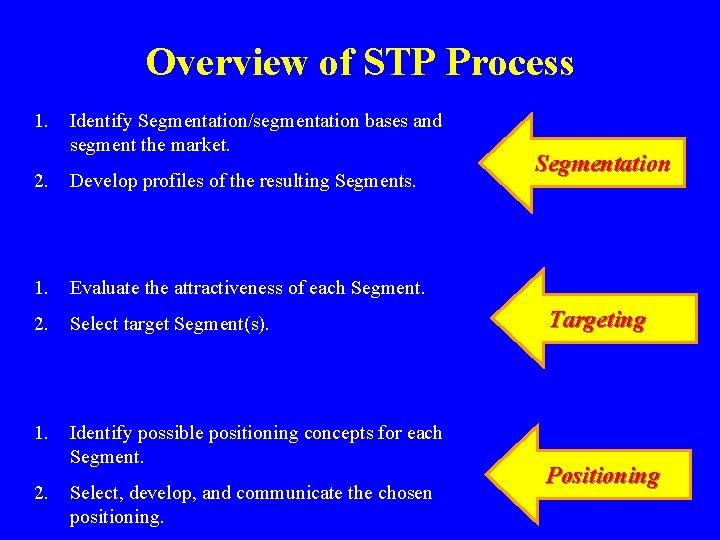
Overview of STP Process 1. Identify Segmentation/segmentation bases and segment the market. 2. Develop profiles of the resulting Segments. 1. Evaluate the attractiveness of each Segment. 2. Select target Segment(s). 1. Identify possible positioning concepts for each Segment. 2. Select, develop, and communicate the chosen positioning. Segmentation Targeting Positioning
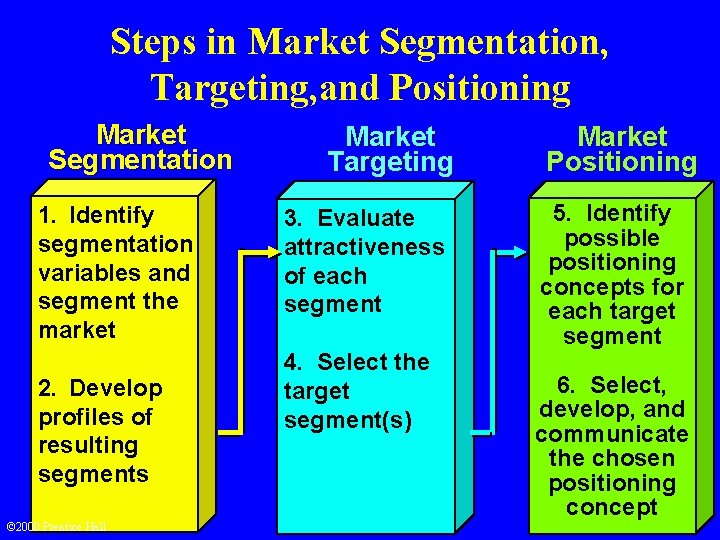
Steps in Market Segmentation, Targeting, and Positioning Market Segmentation 1. Identify segmentation variables and segment the market 2. Develop profiles of resulting segments © 2000 Prentice Hall Market Targeting 3. Evaluate attractiveness of each segment 4. Select the target segment(s) Market Positioning 5. Identify possible positioning concepts for each target segment 6. Select, develop, and communicate the chosen positioning concept
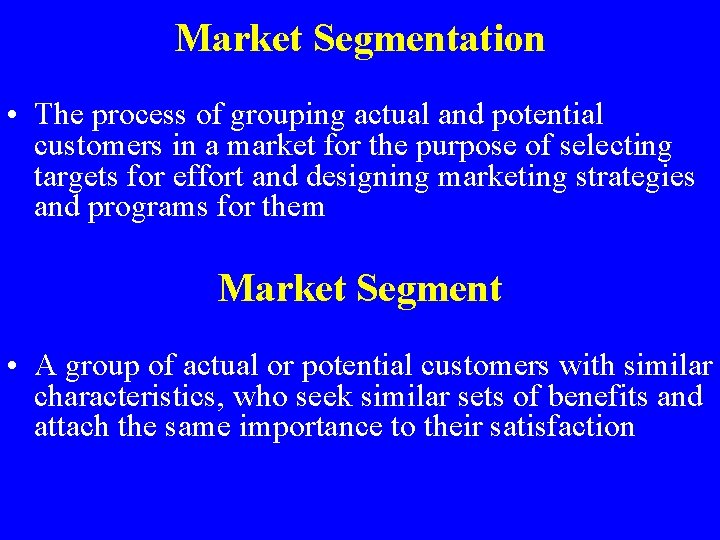
Market Segmentation • The process of grouping actual and potential customers in a market for the purpose of selecting targets for effort and designing marketing strategies and programs for them Market Segment • A group of actual or potential customers with similar characteristics, who seek similar sets of benefits and attach the same importance to their satisfaction
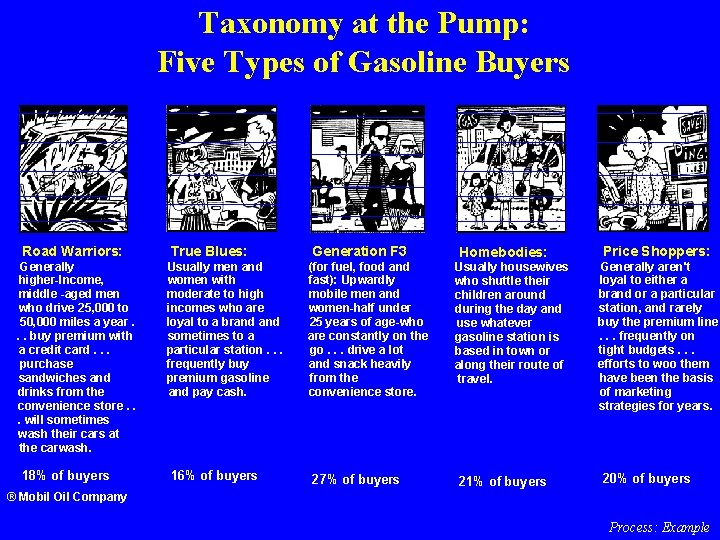
Taxonomy at the Pump: Five Types of Gasoline Buyers Road Warriors: Generally higher-Income, middle -aged men who drive 25, 000 to 50, 000 miles a year. . . buy premium with a credit card. . . purchase sandwiches and drinks from the convenience store. . . will sometimes wash their cars at the carwash. 18% of buyers True Blues: Usually men and women with moderate to high incomes who are loyal to a brand sometimes to a particular station. . . frequently buy premium gasoline and pay cash. 16% of buyers Generation F 3 (for fuel, food and fast): Upwardly mobile men and women-half under 25 years of age-who are constantly on the go. . . drive a lot and snack heavily from the convenience store. 27% of buyers Homebodies: Usually housewives who shuttle their children around during the day and use whatever gasoline station is based in town or along their route of travel. 21% of buyers Price Shoppers: Generally aren't loyal to either a brand or a particular station, and rarely buy the premium line. . . frequently on tight budgets. . . efforts to woo them have been the basis of marketing strategies for years. 20% of buyers ® Mobil Oil Company Process: Example
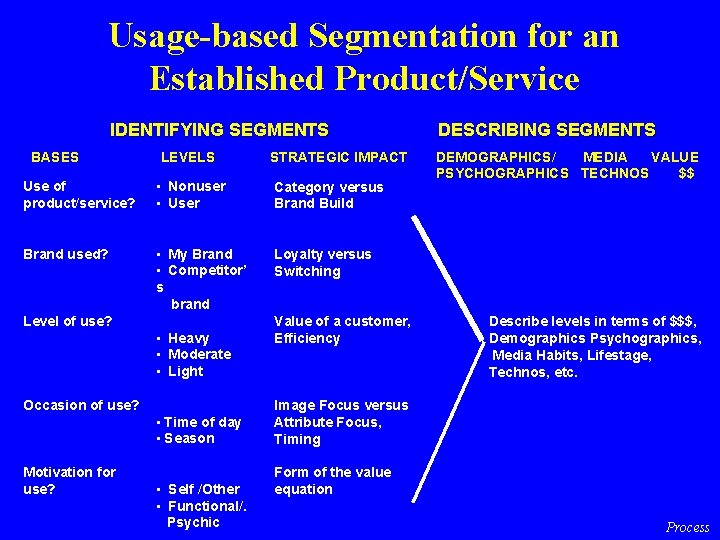
Usage-based Segmentation for an Established Product/Service IDENTIFYING SEGMENTS BASES LEVELS STRATEGIC IMPACT Use of product/service? • Nonuser • User Category versus Brand Build Brand used? • My Brand • Competitor’ s brand Loyalty versus Switching Level of use? • Heavy • Moderate • Light Occasion of use? • Time of day • Season Motivation for use? • Self /Other • Functional/. Psychic Value of a customer, Efficiency DESCRIBING SEGMENTS DEMOGRAPHICS/ MEDIA VALUE PSYCHOGRAPHICS TECHNOS $$ Describe levels in terms of $$$, Demographics Psychographics, Media Habits, Lifestage, Technos, etc. Image Focus versus Attribute Focus, Timing Form of the value equation Process
Purpose of Forming Market Segments • To form the closest possible match between customers’ needs or wants and priorities, and the firm’s offer, such that customer satisfaction is maximized and competitive advantage is created. As a result, unit volume and/or price increases, and profits are enhanced
Segmentation • Dividing up the market into groups of consumers who share similar needs (and who respond similarly to marketing mix variables) – Account for customers’ diverse needs and differing behaviors in its strategy – Design the marketing mix to more closely match customer needs – Improve efficiency and effectiveness of resource allocation
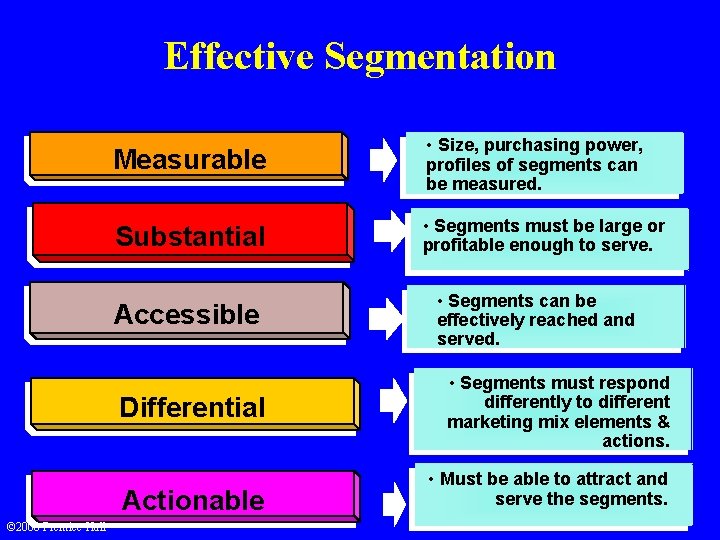
Effective Segmentation Measurable • Size, purchasing power, profiles of segments can be measured. Substantial • Segments must be large or profitable enough to serve. Accessible Differential Actionable © 2000 Prentice Hall • Segments can be effectively reached and served. • Segments must respond differently to different marketing mix elements & actions. • Must be able to attract and serve the segments.
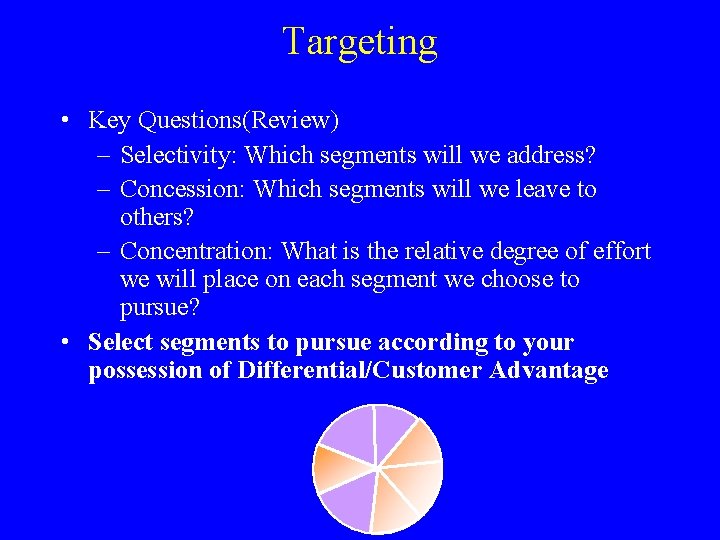
Targeting • Key Questions(Review) – Selectivity: Which segments will we address? – Concession: Which segments will we leave to others? – Concentration: What is the relative degree of effort we will place on each segment we choose to pursue? • Select segments to pursue according to your possession of Differential/Customer Advantage
Reis and Trout Positioning: The battle for your customer’s mind


Positioning Maps/Perceptual Space
Simmons Data
Positioning and Perceptual Maps • What brands are perceived as similar to others? – Deals with issue of substitutability. – if customer’s brand is not available, what brand is most likely to be purchased? – Unique Position » Or – Easy switching
Positioning and Perceptual Maps • What holes exist for repositioning an old, or new product introduction? (Point on map where no competitive brands exist) – Opportunity or not? • Ideal points = Preference maps – If customer could have any product they wished.
Positioning …is the act of designing the company’s offering and image to occupy a distinctive place in the target market’s mind. © 2000 Prentice Hall
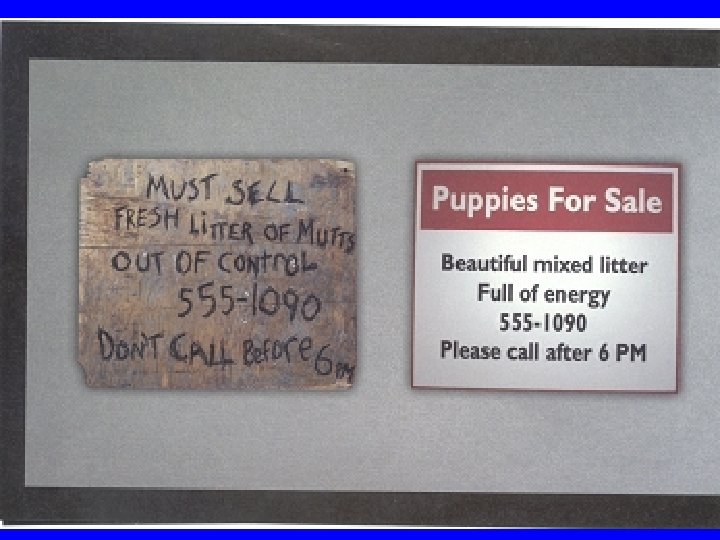
Positioning • Positioning: The act of framing the organization’s image and its offer in the target customer’s minds, so it occupies a distinct and valued place relative to competition. • The process we use to set ourselves apart from competitors in the minds of the customer.
Four D’s of Effective Positioning Successful positioning requires: • Defining what the brand is. • Differentiating the brand from other similar offers. • Deepening the brand’s connection to consumer’s goals. • Defending the position as competitors react.

Example: Competitor Targets 7 UP • Direct Competitors in the same product form • The Generalized Set of Competitors in the same product form • Competitors in a different product form that satisfies the same basic need.
Think of your positioning statement as leading to a piece of advertising (define, differentiate, deepen, defend) • Does it help overcome the pitfalls of positioning: - Underpositioning Customers cannot sense the difference. - Overpositioning Our offer projects too narrow an image. - Confusing Positioning We make too many claims, or keep changing the claims over time. - Doubtful Positioning Consumers find our claims hard to believe. • Will it find a way into our customer’s mind and will it stay there? • Is it about your customer or is it about the product? (selling or marketing? )





Developing Positioning Statements • Customer Target: Person(s) in whose mind(s) we want to create the perception or image and whose behavior we hope to affect • Frame of Reference: Competitive offer(s) from whom we wish to differentiate ourselves in order to provide a reference point for the customer • Compelling Point of Difference: How our offer fits into the customer’s frame of reference better than competing alternatives—and reasons to believe that difference.
Developing Positioning Statements Selecting Frames of Reference • Competitive – Direct competitors in the same product form – Generalized set of competitors in the same product form – Competitors in a different product form that satisfy the same basic benefit requirements • Benefit-based – Reference is customers’ goals and values
Developing Positioning Statements Point of Difference • Core Strategy: The benefits we intend to emphasize in our communications to our core customer targets (how we get customers to buy from us rather than competitors) – Exploit Differential Advantage – Communicate key benefit in a clear, concise statement
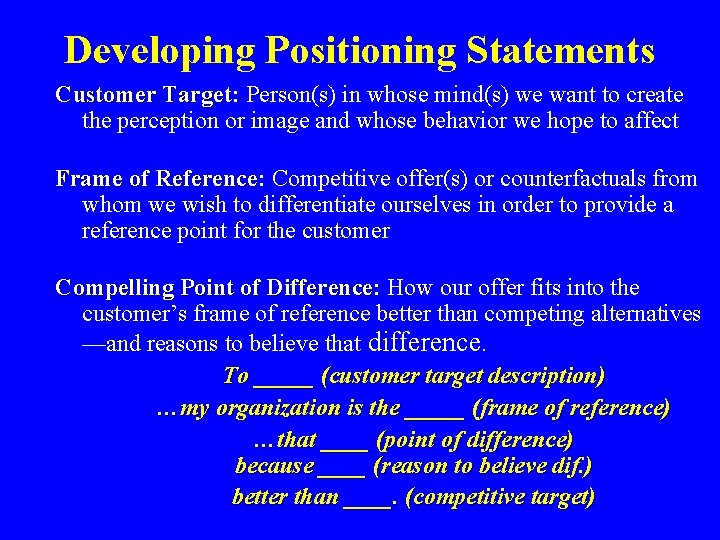
Developing Positioning Statements Customer Target: Person(s) in whose mind(s) we want to create the perception or image and whose behavior we hope to affect Frame of Reference: Competitive offer(s) or counterfactuals from whom we wish to differentiate ourselves in order to provide a reference point for the customer Compelling Point of Difference: How our offer fits into the customer’s frame of reference better than competing alternatives —and reasons to believe that difference. To _____ (customer target description) …my organization is the _____ (frame of reference) …that ____ (point of difference) because ____ (reason to believe dif. ) better than ____. (competitive target)
Positioning: Asics Gel MC Plus Positioning Statement: To Michele, the recreational marathoner who risks injury when she trains on uneven surfaces, Asics Motion. Control Plus puts you back in control because it prevents overpronation better than any other training shoe. • Tag-line: You can’t control the road, but you can control the way your foot reacts to it with Asics Gel MC Plus.
Positioning: Asics Gel Kayano • Positioning Statement: To Marc, the recreational runner who places a premium on enjoying the running experience, the Asics Gel Kayano provides better cushioning than any other shoe on every stride he takes through the Impact Guidance System. • Tag-line: Heel-to-toe comfort for a smooth ride.
Positioning: Reebok Boston Road • Positioning Statement: To Marc, the recreational runner who places a premium on enjoying the running experience, the Brooks Boston Road provides better cushioning than any other shoe on every stride he takes through DMX technology. • Tag-line: Enjoy the sunrise in complete comfort.

Whom does Marc believe?
Positioning: New Balance • Positioning Statement: For Suzanne, the working professional, New Balance shoes let you leave behind the daily office grind and discover the natural, simple beauty in life. • Tag-line: Your computer has a key labeled “escape. ” Does your life have one too?
Positioning: Common Errors • Underpositioning Customers cannot sense the difference. • Overpositioning Our offer projects too narrow an image. • Confusing Positioning We make too many claims, or keep changing the claims over time. • Doubtful Positioning Consumers find our claims hard to believe.

Thank you! Now, how about a little Pizza! Contadina!
- Slides: 52