
University of Venice Ca Foscari Pierre de GioiaCarabellese
University of Venice – Ca’ Foscari Pierre de Gioia-Carabellese Lecturer in Business Law Heriot-Watt University (Professore universitario di business law) Solicitor & Notary Public - Avvocato

Contents Ø Concept of Trade Unions Ø Employers’ Associations
Law and Employment Relations Ø Law affects employment relations in a number of areas: q The relationship between the employer and the employee q The relationship between the employer and a trade union q The organisation of a trade union q The consequences of industrial action for the union and any striking employees

Collective Labour Law History Ø Legal policy has changed q Combination Act (18 th century) § Unions unlawful because in restraint of trade q Trade Union Act 1871 § Union’s purposes should not be deemed unlawful Ø Freedom of association has not been seen as a fundamental right in Britain as in continental Europe
Recent History Ø Successive governments supported voluntary collective bargaining as a way of minimising disputes Ø Public services embraced collective bargaining at a much rate than the private sector Ø Industrial Relations Act 1971 q A right to join a union (and a right not to join a union) q Trade unions have the right to seek compulsory recognition for collective bargaining q Recognised unions had the right to information from employers in relation to collective bargaining and the right to be consulted in certain areas
1979/1997 Ø Ms Thatcher’s Conservative government moved quickly to reverse this policy q. Repealed the recognition procedures q. Strict controls placed on the internal workings of unions themselves q. Outlawed the closed shops

1997 -2010 Ø Election of a Labour Government in 1997 q. Emphasis on partnership with the unions q. UK committed to adopt the Social Chapter which includes the Works Council Directive
Employment Rights Act 1999 Ø Extended the protection of union members against discrimination Ø Re-introduced a procedure for compulsory recognition Ø New measures in accordance with European requirements establishing a EU-wide framework of minimum standards of consultation Ø Protection for striking employees has also been introduced
Current Legislation – Employers’ Associations Ø Sect. 122 TULRCA 1992 Ø An employers’ association is an organisation which: q Either consists wholly or mainly of employers or individual proprietors, and whose principal purposes include the regulation of relations between employers and workers or trade unions; or q Consists wholly or mainly of constituent or affiliated organisations with those purposes or representatives of such constituents or affiliated organisations, whose principal objects include the regulation of relations between employers and workers or between the constituent or affiliated organisations
Current Legislation – Employers’ Associations Ø An employers’ association may be incorporated: q Either under the Companies Act 2006; or q As an incorporated organisation
Current Legislation – Trade Unions Ø Sect. 1 – TULRCA 1992 q An organisation (whether permanent or temporary) which either: q Consists wholly or mainly of workers of one or more descriptions and whose principal purposes include the regulation of relations between workers and employers or employers’ association; or q Consists wholly or mainly of: • Constituent or affiliated organisations which have those purposes; or • Representatives of such constituent or affiliated organisations, and in either case whose principal purposes include the regulation of relations between workers and employers or workers’ and employers’ associations, or include the regulation of relations between the constituent or affiliated organisations.
Current Legislation – Trade Unions Ø Main characteristics of a trade unions q An organisation consisting wholly or mainly of workers on one or more descriptions and whose principal purposes include the regulation of relations between workers of that description and employers or employers association q Cannot be solely political q No minimum size for effectiveness q May well other purposes q No requirement for registration to exist q However, Certification Officer has a list of unions q In nay case, the union must be listed if it wants to be independent
Trade Unions’ Nature Ø Section 10 – TULRCA 1992 q It is not a body corporate; q However, capable: § Of making contracts § Suing and being sued in its own name; § Capable of being prosecuted for any offences committed in its name
Trade Unions’ Nature Ø Section 12 – TULRCA 1992 q Properties of a trade union must be held by its trustee q Any judgement, order or award shall be enforced against the property held by the trustees
Trade Unions’ Liability Ø Section 20 – TULRCA 1992 q Liability of a trade union for an action in tort § Particularly if: § An act induces another person to break a contract or interferes or induces another person to interfere with its performance; or § An act consists in threatening that a contract (whether one to which the union is a party or not) will be broken or its performance interfered with, or that the union will induce another person to break a contract or interfere with its performance
Trade Unions’ Liability Ø Section 20 – TULRCA 1992 q Liability of a trade union also in respect of an agreement or combination by two or more persons to do or to procure the doing of an act which, if it were done without any such agreement or combination, would be actionable in tort on such a ground.
Trade Unions’ Liability Ø Section 22 – TULRCA 1992 q General limit on the damages awarded against trade unions in actions in tort § General rule § For any proceeding in tort (delict) the amount that may be awarded against the union by way of damages is limited
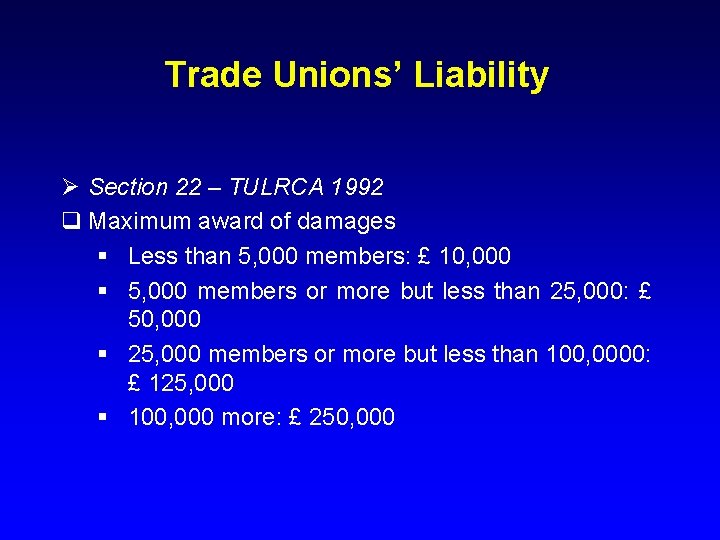
Trade Unions’ Liability Ø Section 22 – TULRCA 1992 q Maximum award of damages § Less than 5, 000 members: £ 10, 000 § 5, 000 members or more but less than 25, 000: £ 50, 000 § 25, 000 members or more but less than 100, 0000: £ 125, 000 § 100, 000 more: £ 250, 000
Trade Unions’ Liability Ø Section 22 – TULRCA 1992 (cntd) q This does not apply to: § Proceedings for personal injury as a result of negligence, nuisance or breach of duty § Proceedings for breach of duty in connection with the ownership, occupation, possession, control or use of property § Proceedings brought by virtue of Part I of the Consumer Protection Act 1987
Recognition of a Trade Union Ø An employer may elect to recognise a union Ø May be forced to recognise an independent union (if 21 or more workers are employed) in relation to pay, hours and holidays Ø Procedure introduced in 1999 Ø Recognition means that “the recognition of the union by an employer or two or more associated employers, to any extent, for the purposes of collective bargaining”
Consequence of the Recognition of a Trade Union Ø It is evidence of the fact that the organisation is a trade union Ø Entitlement to tax relief on income tax and corporation tax Ø Simplified procedure for vesting union property in newly appointed trustees Ø “Stepping stone” for the trade union to be recognised as “independent trade union”
Concept of Independence Ø Certification of independence essential for access to certain statutory rights (protection of members against discrimination; time-off; consultation and information) Ø Independence refers to independence from the employer rather than from the state Ø It will be crucial to establish that a union could survive without employer backing Ø The certificate of independence is given by the certification officer
Concept of Independence (cntd) Ø Sect. 6 TULRCA 1992 q Any trade union which is on the list may apply to the certification officer for a certificate of independence q A union is independent if: § It is not under the domination or control of an employer or groups of employers or an employers’ association; and § It is not liable to interference by an employer or any such group or association arising out of the provision of financial or material support or by any other means whatsoever tending towards such control
Advantages of Certification Ø A member is entitled not to suffer a detriment (Sect. 146)(1) or to be dismissed (Sect. 152(1) on grounds of trade union membership or activities, or making use of trade union services (Sect. 152); Ø An independent union may negotiate a dismissal procedure agreement which will replace individual statutory rights (Sect. 110 ERA); Ø An independent trade union may negotiate away the right of employees to strike (Sect. 180);

Advantages of Certification (cntd) Ø An independent trade union may negotiate a collective agreement modifying or derogating from rights contained in the Working Time Regulations, the Fixed Term Employees (Prevention of Less Favourable Treatment) Regulations 2002; Ø An official or member of an independent trade union can act as an independent adviser for the purpose of compromised agreements (Sect. 303(3 A) ERA); Ø An independent trade union will be able to receive money from the Secretary of State under the trade union modernisation scheme.
Concept of Independence (cntd) • Only a trade union aggrieved by a decision not to grant a certificate is entitled to appeal • General and Municipal Workers Union v Certification Office [1977] 1 All ER 771 – Trade union objected to a decision of the Certification Officer to grant a certificate to another organisation – Held that the trade union was not entitled to appeal that decision
Staff Association Ø Trade Unions formed exclusively within a firm and made up by workers of that firm only Ø Issues: these association may be “weak”, because theoretically less independent Ø Under the threat of the master Ø From a legal point of view, sometimes they may have problems in getting the certificate of independence
Staff Associations (cntd) Ø Blue Circle Staff Association v Certification Officer [1977] 2 All ER 145 q In 1971 top management of the company formed a staff association for salaried staff of the same company q Later on changes were made to the constitution of the company q EAT held that the certification officer was right in his refusal to grant a certificate q Association not yet free from the domination of the company which created it
Staff Associations (cntd) Ø Association of HSD (Hartfield) Employees v Certification officer [1978] ICR 21 q Association formed with the active encouragement of the employer q Both employees and employer were against the nationalisation of the sector q The nationalisation was eventually achieved q The head of the industry, on visiting the premises, was welcomed by a heavy protest q The request of the certificate of independence was refused by the certification officer q The EAT held that this was wrong; q With the heavy protest they had demonstrated to be independent.
Staff Associations (cntd) Ø The fact that an association is based on the premises of the employer in itself is not prejudicial to the certificate of independence Ø Also the fact that the employer puts at disposal of the union facilities
Staff Associations (cntd) Ø Squibb UK Staff Association v Certification Officer [1978] ICR 115 q. Certificate of independence refused because of fears of vulnerability of the staff union q. This staff union utilised extensive facilities put at disposal by the employer (rooms for meetings, free use of telephones, conference rooms of the employer) q. Certification officer refused to give the approval (assumption that, without this support, the staff union would not have been able to work at all)
Staff Associations (cntd) Ø Squibb UK Staff Association v Certification Officer (cntd) q. EAT reversed this decision q. Court of Appeal confirmed it q. The test of liability to interference by the employer, which would be fatal to the association’s independence, meant vulnerability q. There was the likelihood of interference

Privileges of a Recognised Trade Union Ø Where an employer recognises a union, the employer must disclose to the union on request information, for the purposes of collective bargaining, about matters and in relation to workers for whom the union is recognised.
Privileges of a Recognised Trade Union: Redundancy Ø Redundancy (Sect. 188 ERA 1996) Ø Where an employer is proposing to dismiss as redundant 20 or more employees at one establishment, he has got an obligation to consult with appropriate representatives of affected employees
Privileges of a Recognised Trade Union: Redundancy Ø When? q When he redundancies are “proposed” and “in good time” Ø If employees to be made redundant are 100 plus within 90 days, consultation should take place at least 90 days before the first dismissal; Ø Otherwise (not within 90 days), within 30 days of first dismissal
Privileges of a Recognised Trade Union: Redundancy Ø Who need be consulted? q Recognised independent unions q Representatives of the trade unions q The employer must undertake consultation with a view to reaching an agreement
Privileges of a Recognised Trade Union: Transfer of Undertaking Ø Transfer of Undertaking q Transferor and transferee employer q Obligation to inform and consult appropriate representatives of affected employees q Obligation to consult arises only where the employer envisages that it will be taking measures in relation to affected employees
Privileges of a Recognised Trade Union: Rights of Union Members • Individuals are protected against discrimination on account of their membership/non-membership of a trade union • Refusal of Employment on grounds of union membership (non union activities) or nonmembership is unlawful
Privileges of a Recognised Trade Union: Rights of Union Members Ø An employee also has the right not to be subjected to any detriment as an individual for the purposes of preventing or deterring him from joining a union or refusing to join one or from taking part in union activities Ø Associated Newspapers Ltd v Wilson Ø Associated Ports v Palmer 1995 IRLR 258 q Dismissal is unlawful if the main reason is that the employee was or proposed to become a member of an independent trade union, or q Had taken in or proposed to take part in the activities of an independent trade union at an appropriate time
Privileges of a Recognised Independent: Trade Union Rights to Time-off Work Ø Members of recognised, independent trade union are allowed reasonable time off during their working hours to take part in activities of that union Ø Union officials are allowed reasonable time-off to carry out their functions Ø Such time-off is unpaid Ø What is reasonable and what constitutes “union activities” is for the employment tribunal
Control of the Internal Union Affairs Ø The internal running of trade unions is heavily regulated covering matters such as exclusions and expulsions from membership; disciplining; the conduct of ballots for elections of officials and the collections and accounting for union funds and subscriptions
Disciplinary Action Ø Power must be specified in the rules of the TU q Spring v Amalgamated Stevedores and Dockers’ Society [1956] 2 All ER 221 § Spring member of the union against Bidlington Agreement (prohibition to poach members among TUC affiliated unions) § The Union expelled Spring § However held that it was void because rules of that TU did not contain any power to expulsion
Disciplinary Action (cntd) Ø Sometimes this power can be implied q Mc. Vitae v Unison [1996] ILRL 33 § Claimant was member of an Officers’ Association (NALGO) § Different complaints for sexism and intimidation made against him § Disciplinary proceedings started against him § However, NALGO amalgamated with other two unions to form Unison
Disciplinary Action (cntd) Ø Mc. Vitae v Unison q Union decided to reinstate disciplinary action against Mc. Vitae q Mc. Vitae objected that the conducted related to a time preceding the amalgamation q Held that in this case the disciplinary power was implied
Disciplinary Action (cntd) Ø Other authorities q Lee v Showmen’s Guild [1952] 2 QB 329 § Lee expelled from the guild because he had allegedly violated competition rules § Held that the guild had misinterpreted the rules of the guild § The court entitled to replace the decision with its own interpretation
Disciplinary Action (cntd) Ø Other authorities q Evans v National Union of Printing, Bookbinding and Paperworkers [1938] 4 All ER 51 § According to the internal rules a member acting against the interests of the union might be expelled § The claimant was absent from work on different cases § This was contrary to an arrangement between the union and the employers
Disciplinary Action (cntd) Ø Other authorities (cntd) q Evans v National Union of Printing, Bookbinding and Paperworkers [1938] 4 All ER 51 (cntd) § He was expelled § Expulsion was valid
Conduct of Union Affairs (cntd) Ø Membership of a TU means the conferment and/or enjoyment of certain rights Ø If these rights are not pursued properly by the TU, there is a breach of contract
Conduct of Union Affairs (cntd) • For instance legal advice • Right conferred on a member but activated with lateness by the TU • Therefore, member entitled to sue for damages • However, reasonableness
Conduct of Union Affairs (cntd) Ø Buckley v National Union of General and Municipal Workers [1967] 3 All ER 767 q No breach of contract arises if the member fails to show that his action has a reasonable prospect of success Ø Friend v Institution of Professional Managers and Specialists q The Union can fulfil the duty to use ordinary care and skill by handing over a potential claim to a firm or competent solicitors

Conclusions Ø Trade Unions and the way they are organised q Trade unions q Recognised trade unions q Certified independent unions Ø Independence relevant for the purposes of some privileges Ø Recognition relevant for the purposes of collective bargaining/redundancy
Bibliography Ø N. Selwyn, Selwyn’s Law of Employment (16 th edn Oxford University Press, Oxford 2010) Chapter 22 (the Law Relating to Trade Unions) Ø S Deakin & G Morris, Labour Law (5 th edn Hart Publishing, Oxford Portland 2009) Chapter 7, Chapter 8, Chapter 9, Chapter 10 Ø P de Gioia-Carabellese, University Lectures, Employment Law and Law of HR Management, Heriot-Watt University, Academic year 2011/2012
- Slides: 52