
UNIVERSITY OF TURKU Relevant European Environmental Legislation and

- Slides: 42
UNIVERSITY OF TURKU Relevant European Environmental Legislation and International Standards Antti-Jussi Lankinen Researcher, L. L. M. Turku University, Faculty of Law
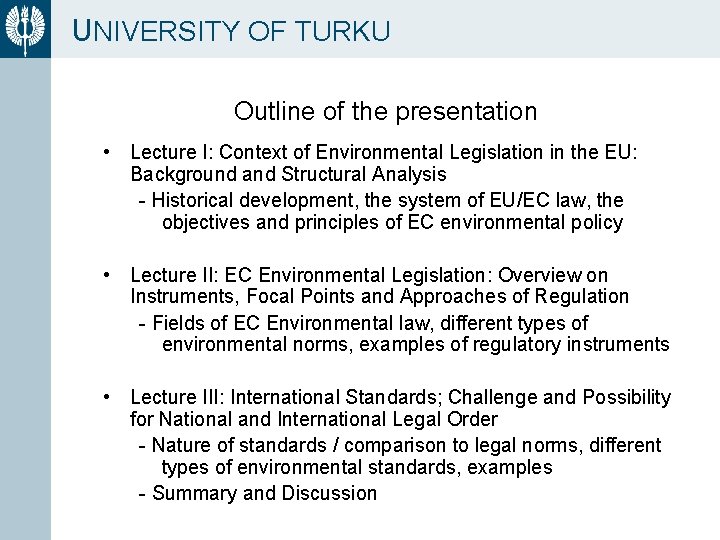
UNIVERSITY OF TURKU Outline of the presentation • Lecture I: Context of Environmental Legislation in the EU: Background and Structural Analysis - Historical development, the system of EU/EC law, the objectives and principles of EC environmental policy • Lecture II: EC Environmental Legislation: Overview on Instruments, Focal Points and Approaches of Regulation - Fields of EC Environmental law, different types of environmental norms, examples of regulatory instruments • Lecture III: International Standards; Challenge and Possibility for National and International Legal Order - Nature of standards / comparison to legal norms, different types of environmental standards, examples - Summary and Discussion
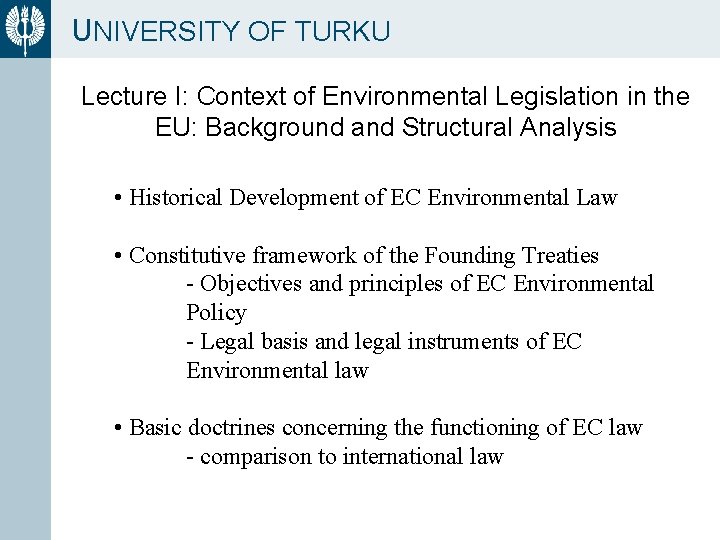
UNIVERSITY OF TURKU Lecture I: Context of Environmental Legislation in the EU: Background and Structural Analysis • Historical Development of EC Environmental Law • Constitutive framework of the Founding Treaties - Objectives and principles of EC Environmental Policy - Legal basis and legal instruments of EC Environmental law • Basic doctrines concerning the functioning of EC law - comparison to international law
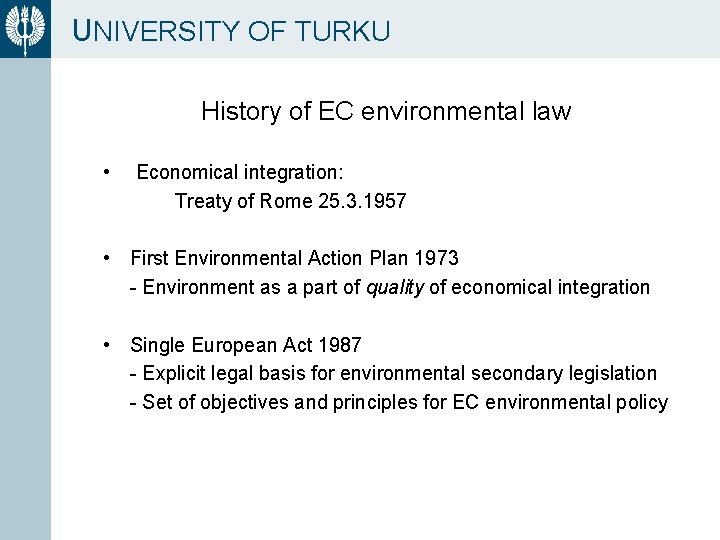
UNIVERSITY OF TURKU History of EC environmental law • Economical integration: Treaty of Rome 25. 3. 1957 • First Environmental Action Plan 1973 - Environment as a part of quality of economical integration • Single European Act 1987 - Explicit legal basis for environmental secondary legislation - Set of objectives and principles for EC environmental policy
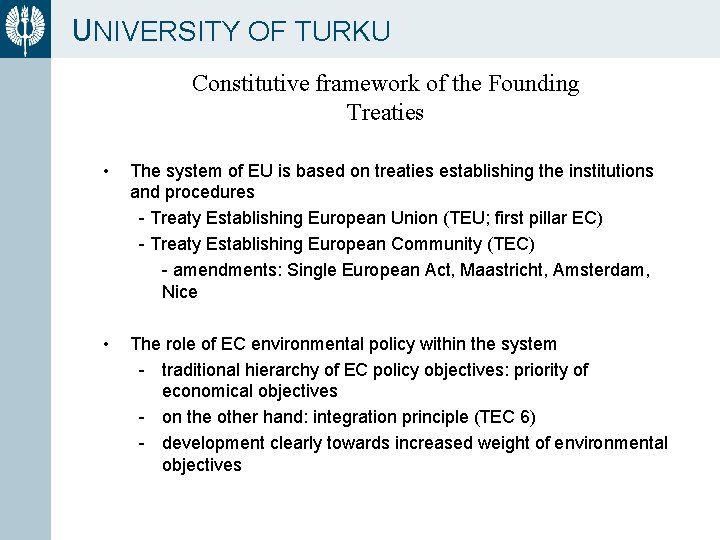
UNIVERSITY OF TURKU Constitutive framework of the Founding Treaties • The system of EU is based on treaties establishing the institutions and procedures - Treaty Establishing European Union (TEU; first pillar EC) - Treaty Establishing European Community (TEC) - amendments: Single European Act, Maastricht, Amsterdam, Nice • The role of EC environmental policy within the system - traditional hierarchy of EC policy objectives: priority of economical objectives - on the other hand: integration principle (TEC 6) - development clearly towards increased weight of environmental objectives
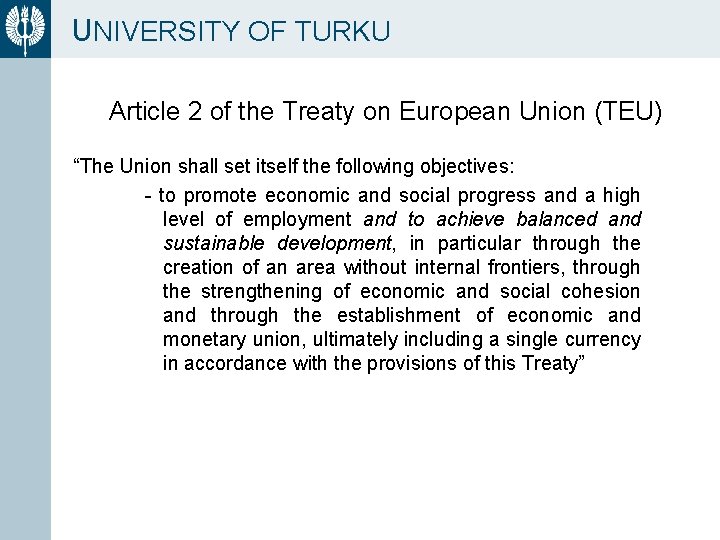
UNIVERSITY OF TURKU Article 2 of the Treaty on European Union (TEU) “The Union shall set itself the following objectives: - to promote economic and social progress and a high level of employment and to achieve balanced and sustainable development, in particular through the creation of an area without internal frontiers, through the strengthening of economic and social cohesion and through the establishment of economic and monetary union, ultimately including a single currency in accordance with the provisions of this Treaty”
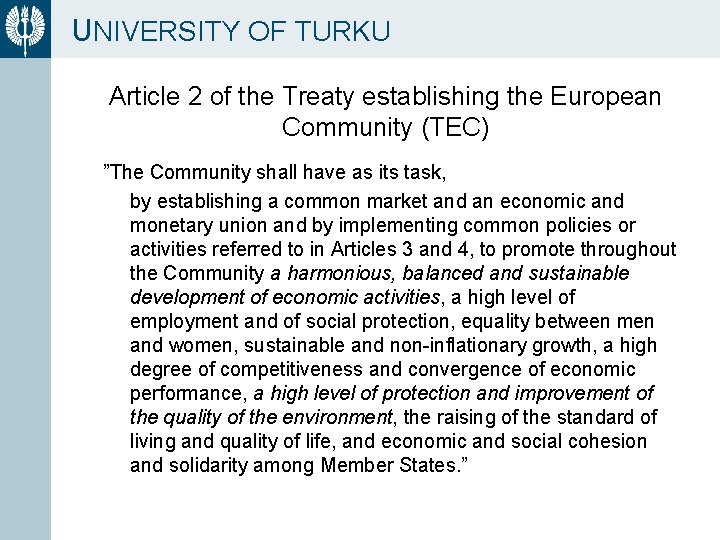
UNIVERSITY OF TURKU Article 2 of the Treaty establishing the European Community (TEC) ”The Community shall have as its task, by establishing a common market and an economic and monetary union and by implementing common policies or activities referred to in Articles 3 and 4, to promote throughout the Community a harmonious, balanced and sustainable development of economic activities, a high level of employment and of social protection, equality between men and women, sustainable and non-inflationary growth, a high degree of competitiveness and convergence of economic performance, a high level of protection and improvement of the quality of the environment, the raising of the standard of living and quality of life, and economic and social cohesion and solidarity among Member States. ”
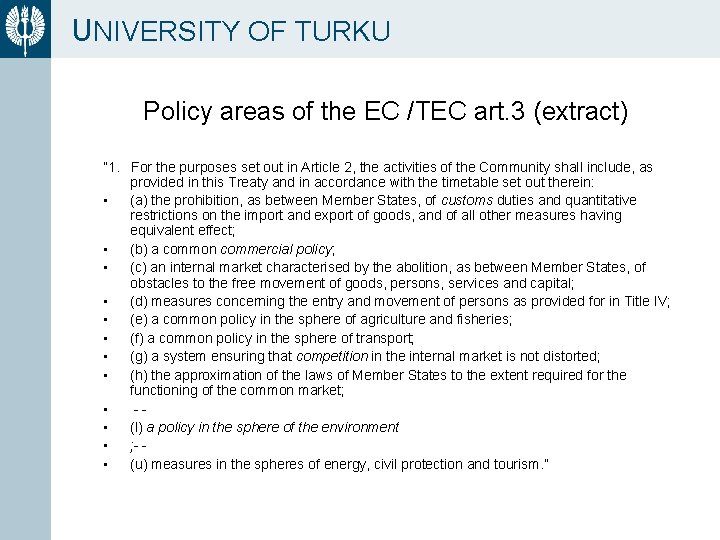
UNIVERSITY OF TURKU Policy areas of the EC /TEC art. 3 (extract) ” 1. For the purposes set out in Article 2, the activities of the Community shall include, as provided in this Treaty and in accordance with the timetable set out therein: • (a) the prohibition, as between Member States, of customs duties and quantitative restrictions on the import and export of goods, and of all other measures having equivalent effect; • (b) a common commercial policy; • (c) an internal market characterised by the abolition, as between Member States, of obstacles to the free movement of goods, persons, services and capital; • (d) measures concerning the entry and movement of persons as provided for in Title IV; • (e) a common policy in the sphere of agriculture and fisheries; • (f) a common policy in the sphere of transport; • (g) a system ensuring that competition in the internal market is not distorted; • (h) the approximation of the laws of Member States to the extent required for the functioning of the common market; • - • (l) a policy in the sphere of the environment • ; - • (u) measures in the spheres of energy, civil protection and tourism. ”
UNIVERSITY OF TURKU Integration principle On the basis of the objectives of the EU/EC, the position of environmental policy seems subordinate to the economical objectives. On the other hand, and most importantly, the position of environmental policy has been strengthened by the integration principle as formulated in the article 6 TEC: ”Environmental protection requirements must be integrated into the definition and implementation of the Community policies and activities referred to in Article 3, in particular with a view to promoting sustainable development. ”
UNIVERSITY OF TURKU Objectives and principles of EC Environmental Policy I Treaty on European Community (TEC) article 174(1) ” 1. Community policy on the environment shall contribute to pursuit of the following objectives: - preserving, protecting and improving the quality of the environment, - protecting human health, - prudent and rational utilisation of natural resources, - promoting measures at international level to deal with regional or worldwide environmental problems. ”
UNIVERSITY OF TURKU Objectives and principles of EC Environmental Policy II TEC art. 174(2) 2. Community policy on the environment shall aim at a high level of protection taking into account the diversity of situations in the various regions of the Community. It shall be based on the • [-] precautionary principle and on the principles that • [-] preventive action should be taken, that • [-] environmental damage should as a priority be rectified at source and that • [-] the polluter should pay. - -”
UNIVERSITY OF TURKU Legal basis and legal instruments of EC Environmental law I The legal basis for stipulating secondary environmental legislation in order to execute the environmental policy objectives and principles is set in art. 175 TEC - the procedure requires (only) qualified majority decisions in the Council, and co-operation with the European Parliament - minimum harmonization (in contrast to internal market issues) Article 176 TEC: • ”The protective measures adopted pursuant to Article 175 shall not prevent any Member State from maintaining or introducing more stringent protective measures. Such measures must be compatible with this Treaty. They shall be notified to the Commission. ”
UNIVERSITY OF TURKU Legal basis and legal instruments of EC Environmental law II Most of the EC environmental legislation has been given in the form of directives - require implementation to the national legislation - bind the Member States as to their objective In technical matters and where no room for national variation can be given, the EC environmental legislation is given as regulations - do not require implemention, directly applicable - the use of regulations is increasing (e. g. international agreements)
UNIVERSITY OF TURKU Basic doctrines concerning the functioning of EC law • The legal constitutive framework of the Treaties lacks essential doctrines concerning the supranational nature of EC law, that are developed much on the European Court of Justice (ECJ) case law • Most important doctrines concerning the relationship between EC law and national legislation: – supremacy – direct effect – indirect effect – state liability • The European Commission as supervisory organ
UNIVERSITY OF TURKU Lecture II: EU Environmental Legislation: Overview on Instruments, Focal Points and Approaches of Regulation • Different types of environmental norms • Fields of EC Environmental law • Examples of regulatory instruments
UNIVERSITY OF TURKU Categories of environmental norms • Environmental norms can be divided in: - Substantial norms, containing – Emission limits and production standards – Quality norms; - Procedural and administrative norms • Similar distinction can be made on the basis of vertical and horizontal norms • In regulatory instruments combinations of different types are being used
UNIVERSITY OF TURKU Fields of substantive EC environmental legislation • • • natural protection water protection climate protection air quality and noise prevention waste and chemicals genetically modified organisms (GMO’s)
UNIVERSITY OF TURKU Environmental norms I / Emission limit norms • the most traditional way of environmental regulation (end-ofpipe regulation) • sets maximum level of concentration of environmentally harmful compound • Similarly one-dimensional as emission limit norms are production standards • Enforcement requires national authorities and licence procedure
UNIVERSITY OF TURKU Emission limit norms (2) Example of emission limit norm: Carbon monoxide (CO) ”concentrations shall not be exceeded in the combustion gases (excluding the start-up and shut-down phase): - 50 milligrams/m 3 of combustion gas determined as daily average value - -. ” In cases of product standards, the EC legislation is often total harmonization, (e. g. the noise emissions of lawnmovers)
UNIVERSITY OF TURKU Environmental norms II / Quality norms • regulate the accepted level of (change in) the environment • present more holistic view than emission limit norms, as taking into account the actual state of the environment • e. g. water framework directive
UNIVERSITY OF TURKU Quality norms (2) Example scenario of licence procedure with quality norms: Lake X, water quality norm setting accepted level of certain pollutant to 50 - Factories A and B have licences with emission limit norms for discharging each 20 - New factory C will not be granted a licence although it would meet the emission limit norm of 20, but only if it limits discharges to 10
UNIVERSITY OF TURKU Environmental norms III / procedural and administrative norms Procedural and administrave norms within EC environmental law - heterogenic group as most often combined with substantial norms, regulating i. a. - licence procedures - environmental planning, decision making and supervision - gathering and assessing of environmental information - public participation - play important role also in the market based instruments such as emission trading and environmental management systems
UNIVERSITY OF TURKU Procedural and administrative norms (2) • Two selective examples of the procedural norms: - Environmental Impact Assessment - Integrated Pollution Prevention and Pontrol • Together with the norms concerning access to environmental information and public participation present the core of development towards horizontal environmental legislation
UNIVERSITY OF TURKU Environmental Impact Assessment (EIA) EIA ia a procedure in which information on significant environmental effects of a project or plan is being gathered, analyzed and assessed. - concerns both public and private projects of certain magnitude - not a part of licence procedure, but serves it considerably by offering a prepared evaluation for the decision making - an essential dimension of EIA is public participation and hearing of authorities and individuals
UNIVERSITY OF TURKU Integrated Pollution Prevention and Control (IPPC) IPPC offers a normative framework for horizontal, holistic licence procedure for larger industrial plants. - Objective: fully coordinated environmental permit, taking all relevant environmental impacts into account - Reference to “best available techniques” (BAT) in emission limit values, the level of which has to be regularly followed by the licence authorities. - Minimum harmonisation
UNIVERSITY OF TURKU Integrated Pollution Prevention and Control (IPPC) (2) IPPC reduces the possibility of avoiding environmental regulation by transforming pollution from one media to other. Example: Emission limit of air pollution is 20, and water pollution 20. Factory with factual air pollution of 35 could “wash” 15 into waters, if the licence procedure would be sectoral. IPPC procedure requiring BAT for pollution prevention of all media and taking into account the overall impact, could consider the approach of the factory inappropriate.
UNIVERSITY OF TURKU Example of interplay of different types of environmental norms: Landfill scenario • If a private or public actor wishes to establish a landfill, at least following Community environmental legislation would apply: - Directive on waste, requiring i. a. that all waste management installations apply for a licence before competent authority - EIA directive, requiring that all significant environmental effects have to be assessed - IPPC directive, requiring integrated licence procedure taking all environmental media into account and that the BAT for the waste management is being filled - Directive on landfills, setting detailed technical requirement for the landfill installation, its usage, supervision etc. - Directive on public access to environmental information, supplementing the procedural norms
UNIVERSITY OF TURKU Lecture III: International Standards; Challenge and Possibility for National and International Legal Order • Characteristics of standards • Comparison to legal norms • Different types of environmental standards - examples on environmental management • Summary and Discussion
UNIVERSITY OF TURKU Standards: Introduction • Standards present utmost heterogenic group of norms, varying from vague guidelines to strictly binding detailed norms resembling legislation • The essence of standards is to offer a benchmark, a measurement after which an activity can be evaluated • Globalization has increased the importance and use of international standards – within EC wider use of international and european standards is being promoted
UNIVERSITY OF TURKU Characteristics of standards Despite the lack of general definition of standards, some criteria are commonly agreed upon. - formation of standards is not connected to states; they are stipulated by group of experts - the scope of application of the standards often overlap with the fields traditionally regulated by states - structurally standards often resemble legal norms - standards affect the normative systems and regulate the behaviour of individuals globally - standards constitute neither national or international law; to become legally binding they need to have a reference in legislation - despite the voluntary nature connected to standards, they often contain economical sanctions connected to non-compliance, and de facto bind the actors
UNIVERSITY OF TURKU Characteristics of standards (2) - variation within • The notion of standards covers a large variation within the intensity of connection to traditional legislation : - standards incorporated to the binding legislation (e. g. emission limits, BREF’s) - standards supported by legislative framework binding actors on the basis of voluntary attendance (e. g. EMAS) - standards without explicit connection to state authorities (e. g. ISO 14001)
UNIVERSITY OF TURKU Characteristics of standards (3) - comparison to traditional legal norms • Advantages of international standards: • • flexibility in the formation process tendency to proactivity lower costs expert knowledge guaranteeing high credibility
UNIVERSITY OF TURKU Comparison of standards to traditional legal norms (2) • Disadvantages connected to standards: - “democracy deficit” in the formation process, i. a. o in selection of the experts consulted o lacking transparency of the procedure o lacking possibilities of participation for the audience - tendency to rupture the powers of nation states; as the scope of application is often shared, there is less to decide upon for the legislator
UNIVERSITY OF TURKU Environmental standards • Equally to legal norms, not all environmentally relevant standards are environmentally orientated – however within EC the integration principle (TEC art. 6) applies also to standards • Explicitly environmentally orientated standards can be found on: - production / product standards testing methods to analyse the state of environmental technology environmental management
UNIVERSITY OF TURKU Examples of environemtal standards: the environmental auditing and management systems • Environmental management and auditing systems offer standard for the companies and organisations to voluntarily improve their environmental performance – reasonable environmental policy may decrease costs (materials, logistics, waste management) – proved high environmental performance can be used in green marketing
UNIVERSITY OF TURKU ISO 14001 • Part of the Environmental Standard series 14000 of the International Standard Organisation and • Concentrates mainly to the environmental management • As a true international standard creates a global benchmark - also for the actors not adopting the standard
UNIVERSITY OF TURKU ISO 14001 (2) • In order to fill the criteria of the standard the company needs to - establish an environmental policy - identify the environmental aspects of its past, present and future activities - identify the relevant legislative and regulatory requirements - identify priorities and set environmental objectives - establish a structure to implement the policy - ensure (planning, monitoring, review) compliance with the environmental policy and the maintenance of its appropriate level
UNIVERSITY OF TURKU EMAS Eco-Management and Audit Scheme • a European Union standard (Council Regulation 761/01) • its environmental management system (EMS) is based on ISO 14001, but it additionally contains the requirements of - continuous improvement of environmental performance - participation of employees to the development process - public reporting on environmental performance
UNIVERSITY OF TURKU Summary • EC Environmental policy has managed to get from the margins to one of the central policy sectors • EC Environmental legislation is a multilayered system with various kinds of norms from strictly binding command control norms to voluntary standards • Development of both the policy and the legislation has clearly been towards horizontal, more flexible and not legally binding regulation • growing tendency of market based instruments • novelty on the policy level: integrated product policy
UNIVERSITY OF TURKU Summary (2) • The development depicted seems to serve the principles of environmental policy, e. g. preventive action, polluter pays and source principle • The underlying hypothesis is that the actors concerned would have best information and possibility to develop their activities to environmentally sound direction - transition of power and responsibility from the legislator to the actors
UNIVERSITY OF TURKU Summary (3) • Nevertheless non-binding norms rest on the framework of binding legal rules and societal infrastructure – should be seen and used as supplementary instruments, not as alternative with intrinsic value – the profound test of environmental instrument is the correlation from the objective to the state of environment (only to remind the lawyers)
UNIVERSITY OF TURKU • Thank you for your interest.