
University of St Andrews School of Physics and
![Sample raw Magnetocaloric Effect data from Sr 3 Ru 2 O 7 T [mk]](https://slidetodoc.com/presentation_image_h2/dfd2b93acdc6d7e41d03132b7cfb6c58/image-15.jpg "Sample raw Magnetocaloric Effect data from Sr 3 Ru 2 O 7 T [mk]")
![Magnetocaloric quantum oscillations T=150 m. K T [m. K] ΔT [m. K] 1 0](https://slidetodoc.com/presentation_image_h2/dfd2b93acdc6d7e41d03132b7cfb6c58/image-16.jpg "Magnetocaloric quantum oscillations T=150 m. K T [m. K] ΔT [m. K] 1 0")
![Magnetocaloric quantum oscillations T=150 m. K T [m. K] ΔT [m. K] 1 0](https://slidetodoc.com/presentation_image_h2/dfd2b93acdc6d7e41d03132b7cfb6c58/image-17.jpg "Magnetocaloric quantum oscillations T=150 m. K T [m. K] ΔT [m. K] 1 0")
![T [K] Taking the next step: the ‘entropic landscape’ μ 0 H [T]](https://slidetodoc.com/presentation_image_h2/dfd2b93acdc6d7e41d03132b7cfb6c58/image-20.jpg "T [K] Taking the next step: the ‘entropic landscape’ μ 0 H [T]")
![Taking the next step: the ‘entropic landscape’ S/T [J/mol K 2] 0. 27 0.](https://slidetodoc.com/presentation_image_h2/dfd2b93acdc6d7e41d03132b7cfb6c58/image-21.jpg "Taking the next step: the ‘entropic landscape’ S/T [J/mol K 2] 0. 27 0.")
![Taking the next step: the ‘entropic landscape’ S/T [J/mol K 2] 0. 27 0.](https://slidetodoc.com/presentation_image_h2/dfd2b93acdc6d7e41d03132b7cfb6c58/image-22.jpg "Taking the next step: the ‘entropic landscape’ S/T [J/mol K 2] 0. 27 0.")
![Taking the next step: the ‘entropic landscape’ S/T [J/mol K 2] 0. 27 0.](https://slidetodoc.com/presentation_image_h2/dfd2b93acdc6d7e41d03132b7cfb6c58/image-23.jpg "Taking the next step: the ‘entropic landscape’ S/T [J/mol K 2] 0. 27 0.")
![Taking the next step: the ‘entropic landscape’ S/T [J/mol K 2] 0. 27 0.](https://slidetodoc.com/presentation_image_h2/dfd2b93acdc6d7e41d03132b7cfb6c58/image-24.jpg "Taking the next step: the ‘entropic landscape’ S/T [J/mol K 2] 0. 27 0.")
![Taking the next step: the ‘entropic landscape’ S/T [J/mol K 2] T [K] 0.](https://slidetodoc.com/presentation_image_h2/dfd2b93acdc6d7e41d03132b7cfb6c58/image-25.jpg "Taking the next step: the ‘entropic landscape’ S/T [J/mol K 2] T [K] 0.")
![T [K] S/T [J/mol K 2] μ 0 H [T]](https://slidetodoc.com/presentation_image_h2/dfd2b93acdc6d7e41d03132b7cfb6c58/image-29.jpg "T [K] S/T [J/mol K 2] μ 0 H [T]")

![Example of magneto-thermal oscillation with field aligned to c-axis H [T]](https://slidetodoc.com/presentation_image_h2/dfd2b93acdc6d7e41d03132b7cfb6c58/image-37.jpg "Example of magneto-thermal oscillation with field aligned to c-axis H [T]")

![(S(H)-S(5 T))/T [J / mol K^2] Entropy Surface T [K] H [T]](https://slidetodoc.com/presentation_image_h2/dfd2b93acdc6d7e41d03132b7cfb6c58/image-44.jpg "(S(H)-S(5 T))/T [J / mol K^2] Entropy Surface T [K] H [T]")
![(S(H)-S(5 T))/T [J / mol K^2] Entropy Surface T [K] H [T]](https://slidetodoc.com/presentation_image_h2/dfd2b93acdc6d7e41d03132b7cfb6c58/image-45.jpg "(S(H)-S(5 T))/T [J / mol K^2] Entropy Surface T [K] H [T]")
![Entropy Surface T [k] H [T]](https://slidetodoc.com/presentation_image_h2/dfd2b93acdc6d7e41d03132b7cfb6c58/image-46.jpg "Entropy Surface T [k] H [T]")
![T [K] Isentropes d. S=0 H [T]](https://slidetodoc.com/presentation_image_h2/dfd2b93acdc6d7e41d03132b7cfb6c58/image-53.jpg "T [K] Isentropes d. S=0 H [T]")
- Slides: 56
University of St Andrews School of Physics and Astronomy Thermodynamics of phase formation in Sr 3 Ru 2 O 7 Andy Mackenzie University of St Andrews, UK PITP Toronto 2008
University of St Andrews Collaborators M. Allan 1, F. Baumberger 1, R. A. Borzi 1, J. C. Davis 1, 3, 4, J. Farrell 1, S. A. Grigera 1, J. Lee 4, Y. Maeno 5, J. F. Mercure 1, R. S. Perry 1, 2, A. Rost 1, Z. X. Shen 6, A. Tamai 1, A. Wang 3 University of St Andrews; 2 University of Edinburgh; 3 Cornell University; 4 Brookhaven National Laboratory 5 Kyoto University; 6 Stanford University 1
Contents 1. Introduction – materials and terminology 2. Metamagnetic quantum criticality and low-frequency dynamical susceptibility in slightly dirty Sr 3 Ru 2 O 7. 3. Phase formation in ultra-pure Sr 3 Ru 2 O 7 4. Magnetocaloric effect as a probe of the ‘entropic landscape’ 5. Spectroscopic imaging of conductance oscillations around scattering centres: a dynamics-to-statics transducer. 6. Conclusions
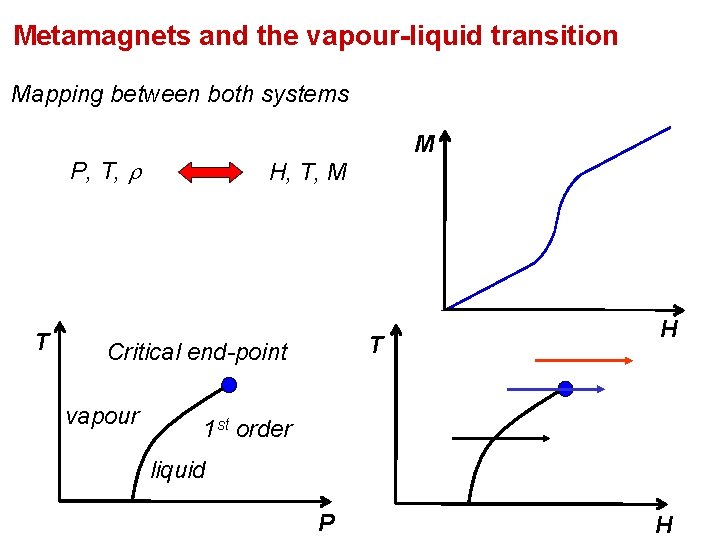
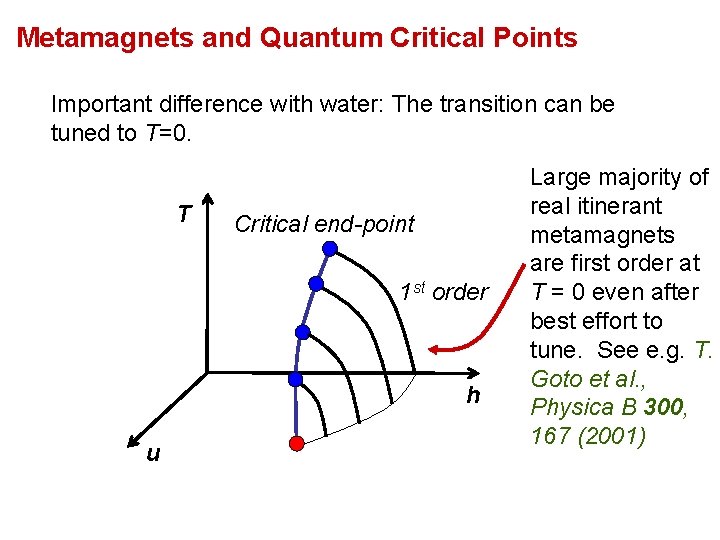
Metamagnets and the vapour-liquid transition Mapping between both systems M P, T, r T H, T, M T Critical end-point vapour H 1 st order liquid P H
Metamagnets and Quantum Critical Points Important difference with water: The transition can be tuned to T=0. T Critical end-point 1 st order h u Large majority of real itinerant metamagnets are first order at T = 0 even after best effort to tune. See e. g. T. Goto et al. , Physica B 300, 167 (2001)
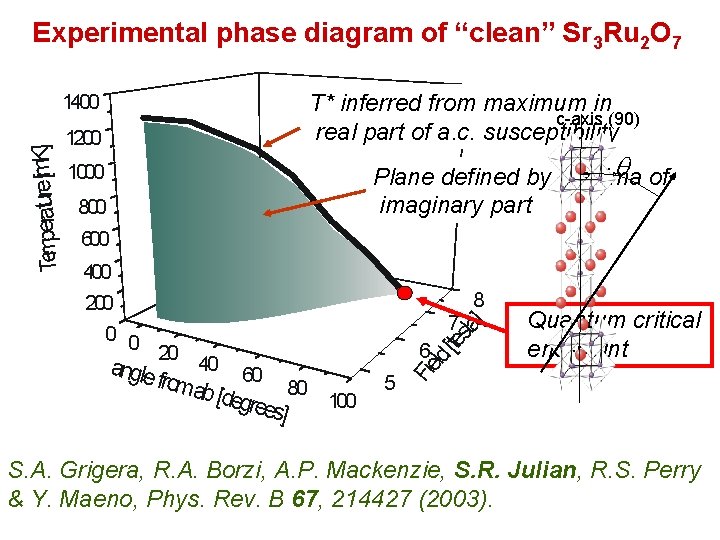
Experimental phase diagram of “clean” Sr 3 Ru 2 O 7 T* inferred from maximum in c-axis (90) real part of a. c. susceptibility 1200 q of Plane defined by maxima imaginary part 1000 800 600 400 200 0 0 20 angle from 7 40 6 60 80 ab [de 100 grees ] 5 8 Fie ld [te sla ] Temperature [m. K] 1400 Quantum critical end-point S. A. Grigera, R. A. Borzi, A. P. Mackenzie, S. R. Julian, R. S. Perry & Y. Maeno, Phys. Rev. B 67, 214427 (2003).
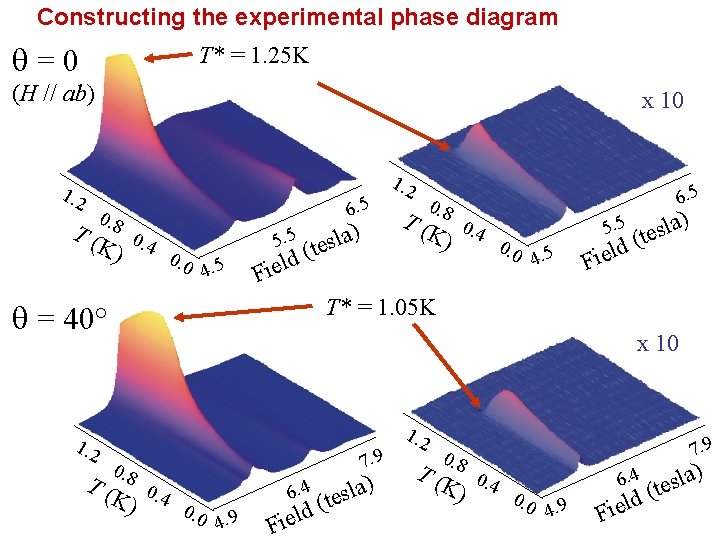
Constructing the experimental phase diagram q=0 T* = 1. 25 K (H // ab) x 10 1. 2 T( 6. 5 0. 8 K) 0. 4 0. 0 4. 5 5. 5 te ( F ield sla) 1. 2 T( 0. 8 K) 0. 4 0. 0 4. 5 6. 5 5. 5 tesla) ( ld e i F T* = 1. 05 K q = 40° 1. 2 x 10 T( 7. 9 0. 8 K) 0. 4 0. 0 4. 9 6. 4 te ( ield F sla) 1. 2 T( 0. 8 K) 0. 4 0. 0 4. 9 7. 9 6. 4 tesla) ( ld e i F
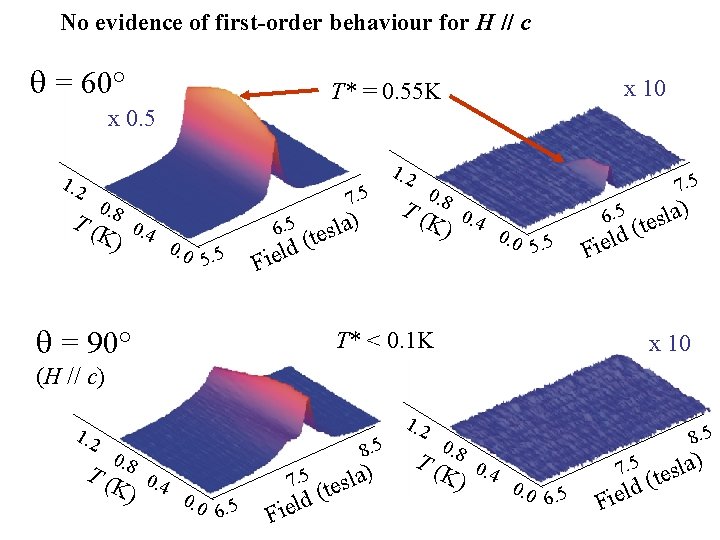
No evidence of first-order behaviour for H // c q = 60° x 10 T* = 0. 55 K x 0. 5 1. 2 T( 7. 5 0. 8 K) 0. 4 0. 0 5. 5 6. 5 tesla) ( F ield q = 90° 1. 2 T( 7. 5 0. 8 K) 0. 4 0. 0 5. 5 6. 5 tesla) ( ld Fie T* < 0. 1 K x 10 (H // c) 1. 2 T( 8. 5 0. 8 K) 0. 4 0. 0 6. 5 7. 5 tesla) ( F ield 1. 2 T( 8. 5 0. 8 K) 0. 4 0. 0 6. 5 7. 5 tesla) ( ld Fie
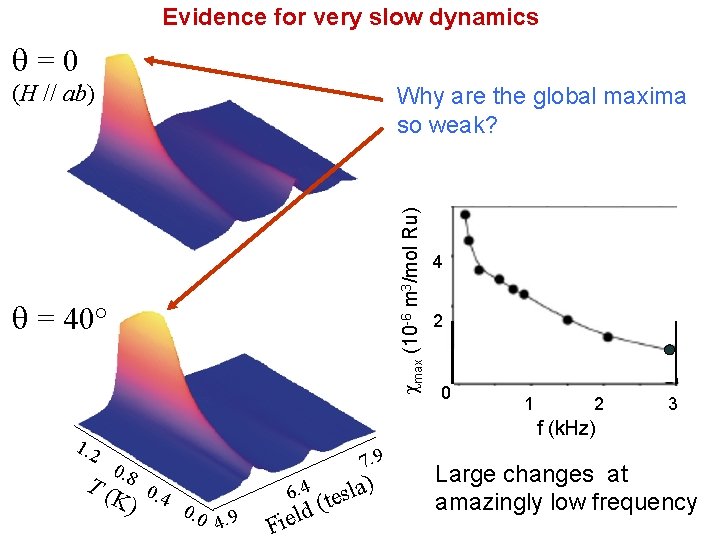
Evidence for very slow dynamics q=0 (H // ab) max (10 -6 m 3/mol Ru) Why are the global maxima so weak? q = 40° 1. 2 T( 0. 8 K) 0. 4 0. 0 4. 9 7. 9 6. 4 te ( sla) ld e i F 1. 2 4 2 0 1 2 f (k. Hz) 0. 8 3 7. 9 T (Large at 6. 4 sla) K) 0. 4 changes te ( 0 d. l amazingly 0 4 low. 9 frequency Fie
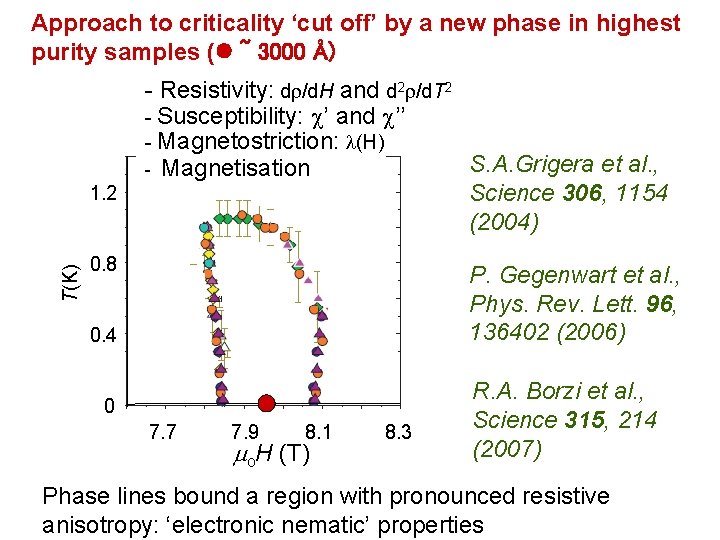
Approach to criticality ‘cut off’ by a new phase in highest purity samples (l ~ 3000 Å) T(K) 1. 2 - Resistivity: d /d. H and d 2 /d. T 2 - Susceptibility: ’ and ’’ - Magnetostriction: l(H) S. A. Grigera et al. , - Magnetisation Science 306, 1154 (2004) 0. 8 P. Gegenwart et al. , Phys. Rev. Lett. 96, 136402 (2006) 0. 4 0 7. 7 7. 9 8. 1 o. H (T) 8. 3 R. A. Borzi et al. , Science 315, 214 (2007) Phase lines bound a region with pronounced resistive anisotropy: ‘electronic nematic’ properties
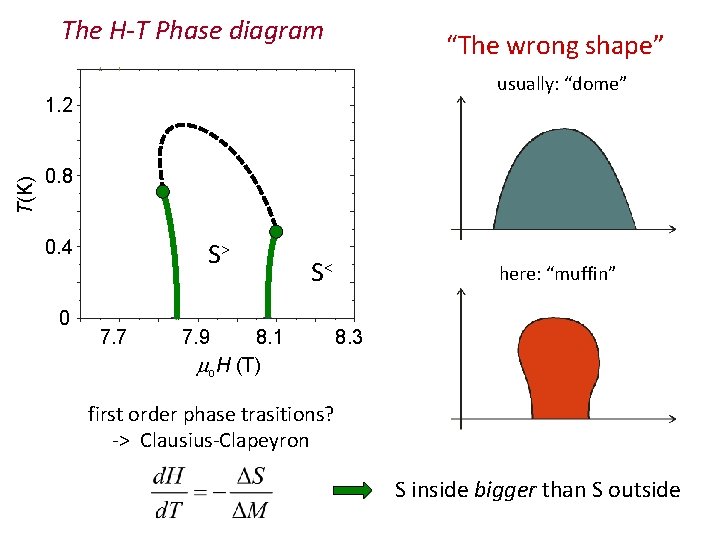
The H-T Phase diagram “The wrong shape” usually: “dome” T(K) 1. 2 0. 8 0. 4 0 S> 7. 7 S< 7. 9 8. 1 o. H (T) here: “muffin” 8. 3 first order phase trasitions? -> Clausius-Clapeyron S inside bigger than S outside
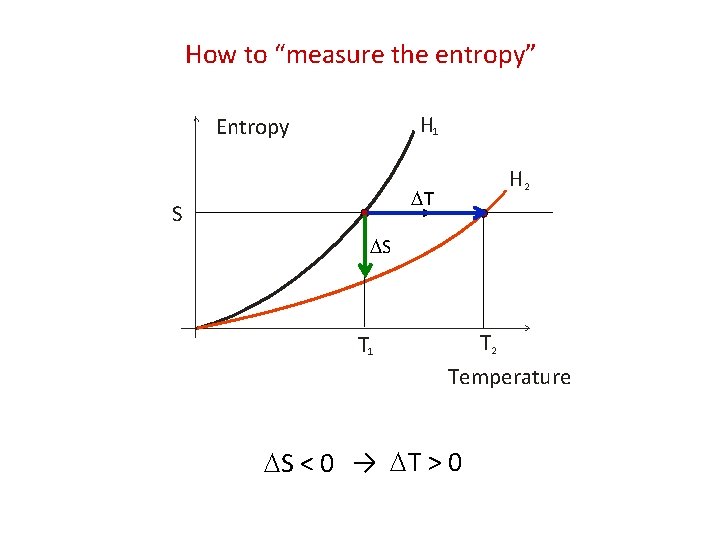
How to “measure the entropy” H 1 Entropy H 2 DT S DS T 2 T 1 Temperature DS < 0 → DT > 0
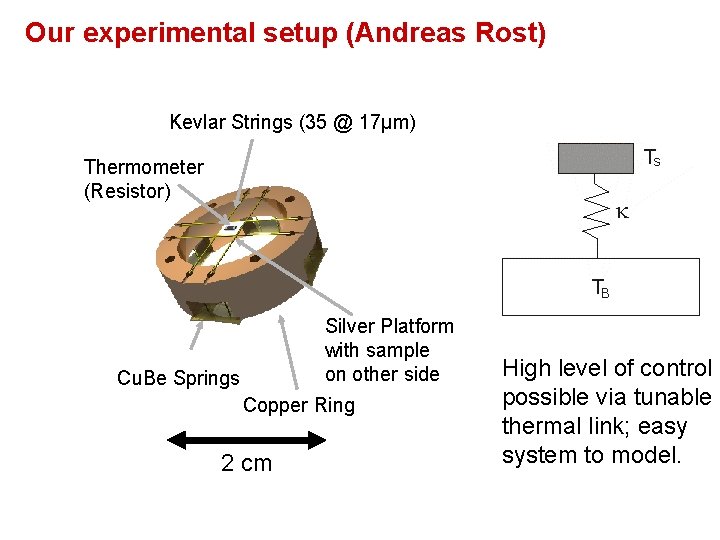
Our experimental setup (Andreas Rost) Kevlar Strings (35 @ 17μm) Thermometer (Resistor) Silver Platform with sample on other side Cu. Be Springs Copper Ring 2 cm High level of control possible via tunable thermal link; easy system to model.
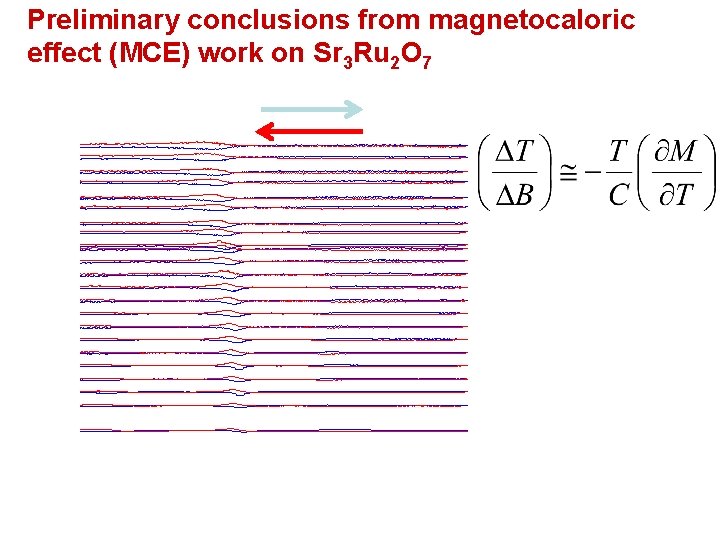
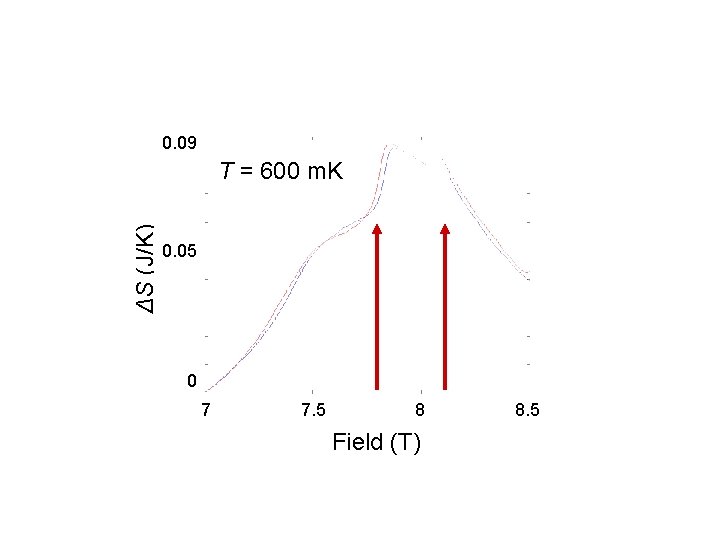
Sample raw Magnetocaloric Effect data from Sr 3 Ru 2 O 7 T [mk] Under fully adiabatic conditions H [T] Metamagnetic crossover seen in susceptibility Sharper features associated with first order transitions ‘Signs’ of changes confirm that entropy is higher between the two first order transitions than outside them.
Magnetocaloric quantum oscillations T=150 m. K T [m. K] ΔT [m. K] 1 0 -1 μ 0 H [T] 8. 5 9 Measurement noise level: 25 μK / √Hz 9. 5 10 μ 0 H [T] 10. 5 11 11. 5
Magnetocaloric quantum oscillations T=150 m. K T [m. K] ΔT [m. K] 1 0 -1 μ 0 H [T] 0. 09 Measurement noise level: 25 μK / √Hz 0. 11 1/μ 0 H [T-1]
Preliminary conclusions from magnetocaloric effect (MCE) work on Sr 3 Ru 2 O 7
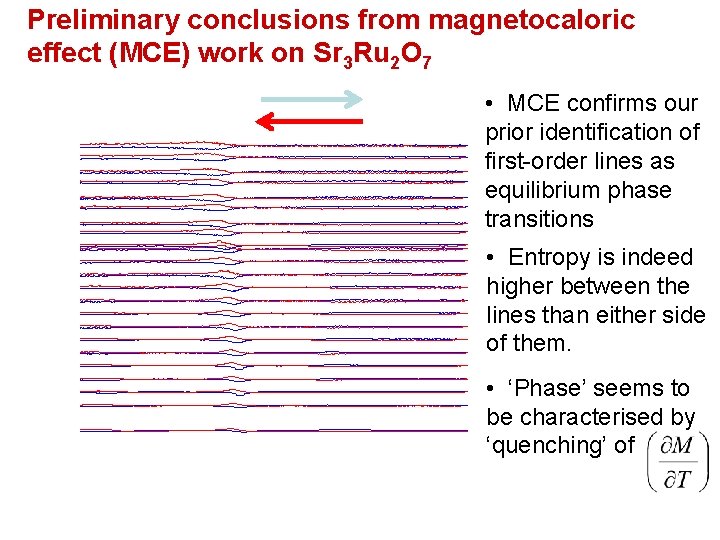
Preliminary conclusions from magnetocaloric effect (MCE) work on Sr 3 Ru 2 O 7 • MCE confirms our prior identification of first-order lines as equilibrium phase transitions • Entropy is indeed higher between the lines than either side of them. • ‘Phase’ seems to be characterised by ‘quenching’ of
T [K] Taking the next step: the ‘entropic landscape’ μ 0 H [T]
Taking the next step: the ‘entropic landscape’ S/T [J/mol K 2] 0. 27 0. 22 0. 17 T [K] 0. 12 μ 0 H [T]
Taking the next step: the ‘entropic landscape’ S/T [J/mol K 2] 0. 27 0. 22 T [K] 0. 17 T [K] 0. 12 μ 0 H [T]
Taking the next step: the ‘entropic landscape’ S/T [J/mol K 2] 0. 27 0. 22 T [K] 0. 17 T [K] 0. 12 μ 0 H [T]
Taking the next step: the ‘entropic landscape’ S/T [J/mol K 2] 0. 27 0. 22 T [K] 0. 17 T [K] 0. 12 μ 0 H [T]
Taking the next step: the ‘entropic landscape’ S/T [J/mol K 2] T [K] 0. 27 0. 22 0. 17 T [K μ 0 H [T] ] 0. 12 μ 0 H [T]
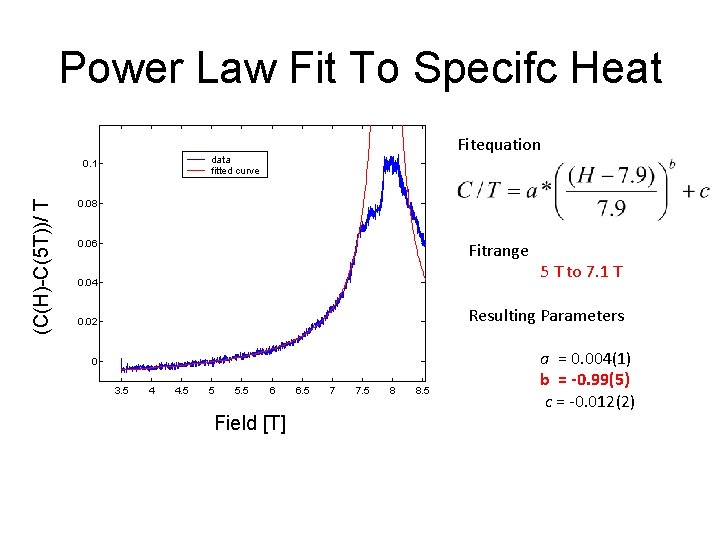
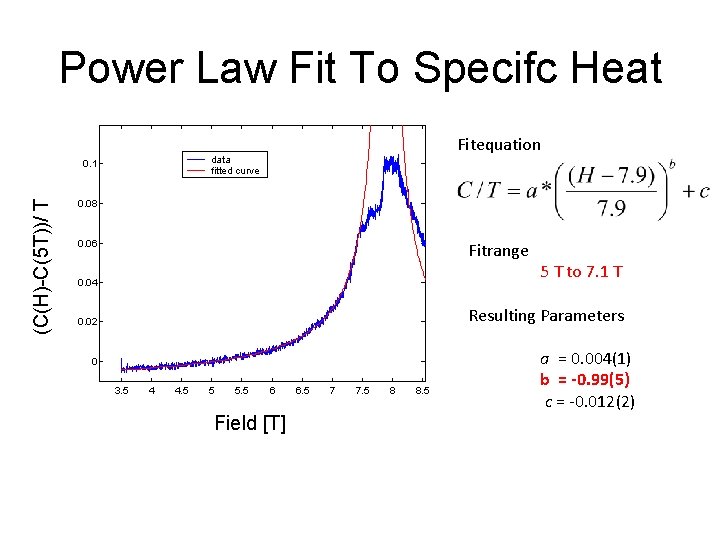
Power Law Fit To Specifc Heat 0. 1 (C(H)-C(5 T))/ T Fitequation data fitted curve 0. 08 0. 06 Fitrange 0. 04 5 T to 7. 1 T Resulting Parameters 0. 02 0 3. 5 4 4. 5 5 5. 5 6 Field [T] 6. 5 7 7. 5 8 8. 5 a = 0. 004(1) b = -0. 99(5) c = -0. 012(2)
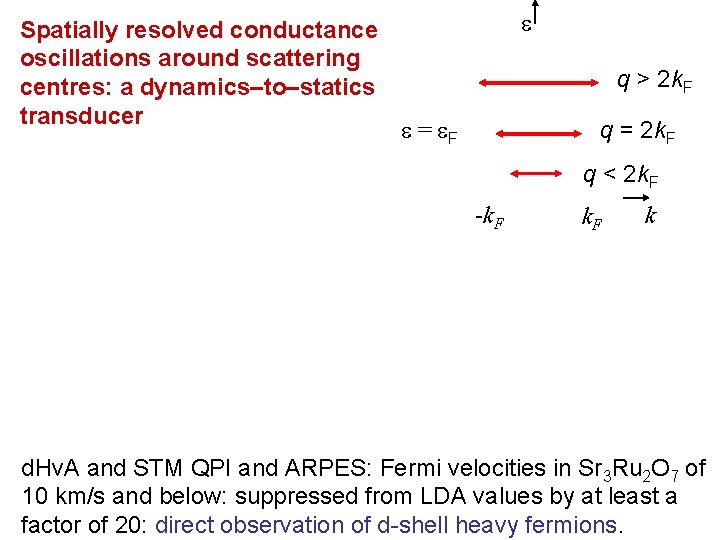
Spatially resolved conductance oscillations around scattering centres: a dynamics–to–statics transducer e q > 2 k. F e = e. F q = 2 k. F q < 2 k. F -k. F k G d. Hv. A and STM QPI and ARPES: Fermi velocities in Sr 3 Ru 2 O 7 of 10 km/s and below: suppressed from LDA values by at least a factor of 20: direct observation of d-shell heavy fermions.
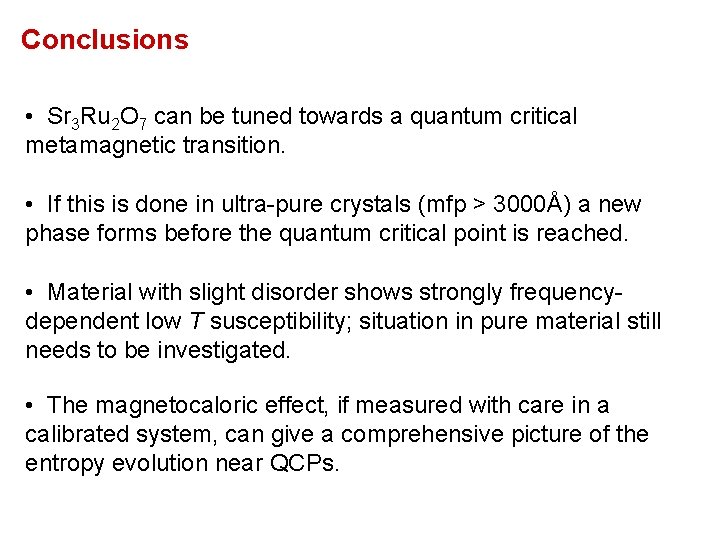
Conclusions • Sr 3 Ru 2 O 7 can be tuned towards a quantum critical metamagnetic transition. • If this is done in ultra-pure crystals (mfp > 3000Å) a new phase forms before the quantum critical point is reached. • Material with slight disorder shows strongly frequencydependent low T susceptibility; situation in pure material still needs to be investigated. • The magnetocaloric effect, if measured with care in a calibrated system, can give a comprehensive picture of the entropy evolution near QCPs.
T [K] S/T [J/mol K 2] μ 0 H [T]
0. 09 ΔS (J/K) T = 600 m. K 0. 05 0 7 7. 5 8 Field (T) 8. 5
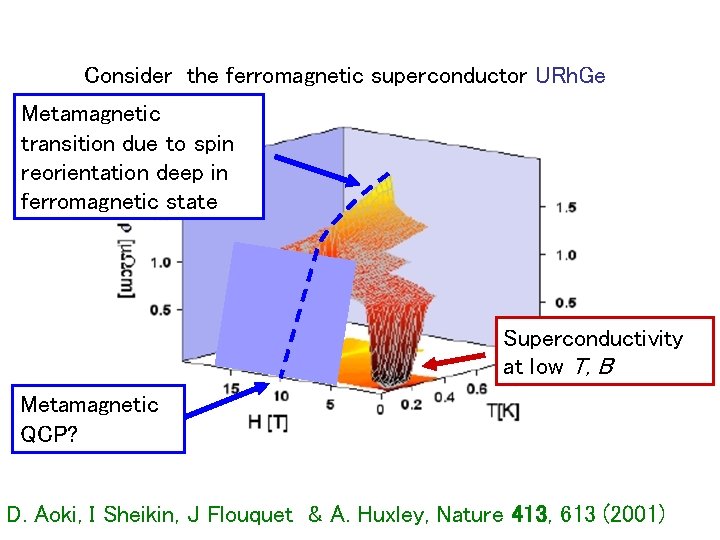
Consider the ferromagnetic superconductor URh. Ge Metamagnetic transition due to spin reorientation deep in ferromagnetic state Superconductivity at low T, B Metamagnetic QCP? D. Aoki, I Sheikin, J Flouquet & A. Huxley, Nature 413, 613 (2001)
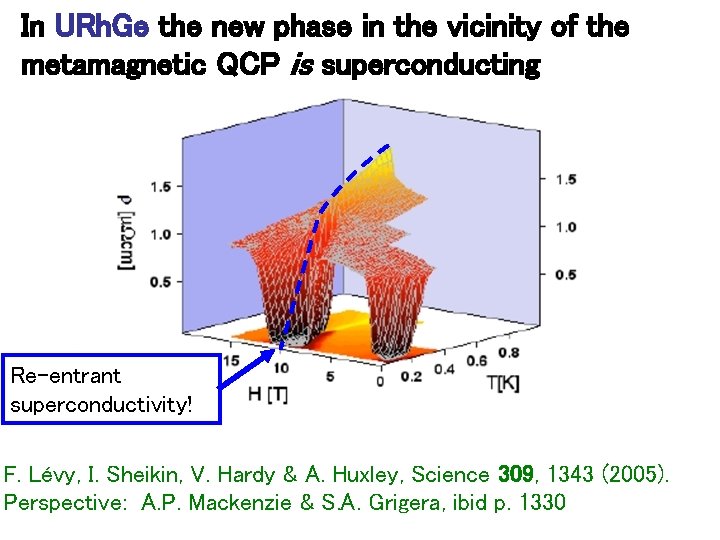
In URh. Ge the new phase in the vicinity of the metamagnetic QCP is superconducting Re-entrant superconductivity! F. Lévy, I. Sheikin, V. Hardy & A. Huxley, Science 309, 1343 (2005). Perspective: A. P. Mackenzie & S. A. Grigera, ibid p. 1330
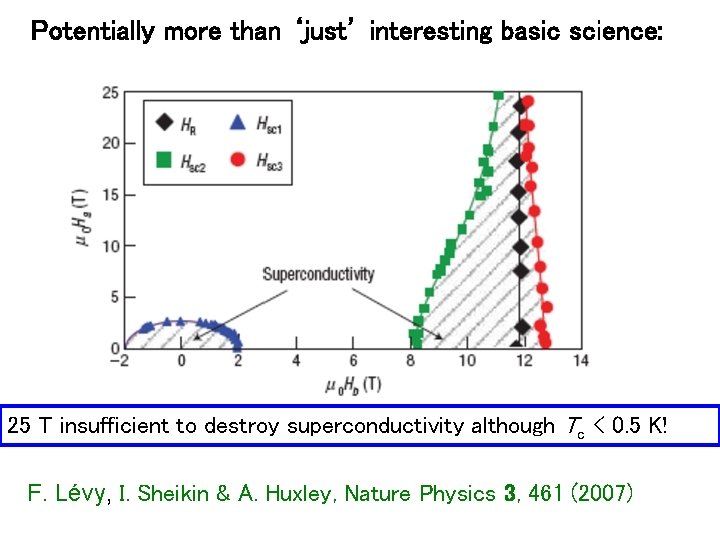
Potentially more than ‘just’ interesting basic science: 25 T insufficient to destroy superconductivity although Tc < 0. 5 K! F. Lévy, I. Sheikin & A. Huxley, Nature Physics 3, 461 (2007)
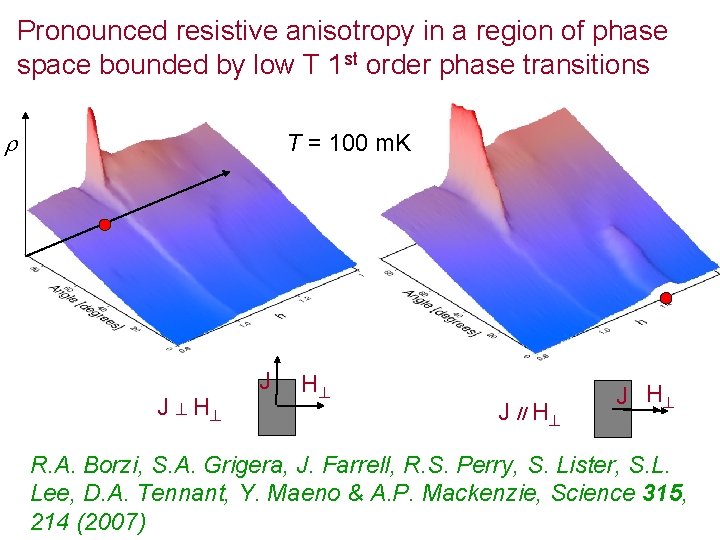
Pronounced resistive anisotropy in a region of phase space bounded by low T 1 st order phase transitions r T = 100 m. K J H J // H J H R. A. Borzi, S. A. Grigera, J. Farrell, R. S. Perry, S. Lister, S. L. Lee, D. A. Tennant, Y. Maeno & A. P. Mackenzie, Science 315, 214 (2007)
( cm) ac (arb. Units) T = 100 m. K
Example of magneto-thermal oscillation with field aligned to c-axis H [T]
of St Andrewsof Sr Ru O Basic. University bulk properties 3 2 7 At low temperature and low applied Structure magnetic field, chi(T) and refto Shinichi etc. it is an anisotropic Fermi liquid ( c / ab 100). Low-T susceptibility is remarkably isotropic and T-independent: strongly enhanced Pauli paramagnet on verge of ferromagnetism? S. I. Ikeda, Y. Maeno, S. Nakatsuji, M. Kosaka and Y. Uwatoko, Phys. Rev. B 62, R 6089 (2000).
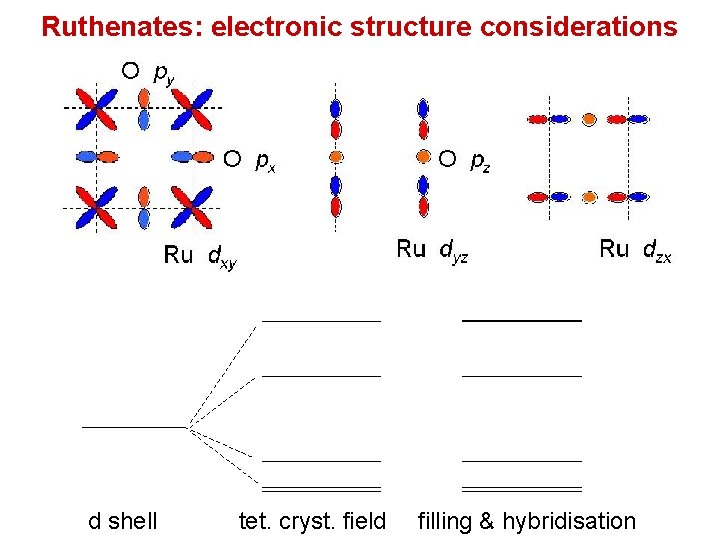
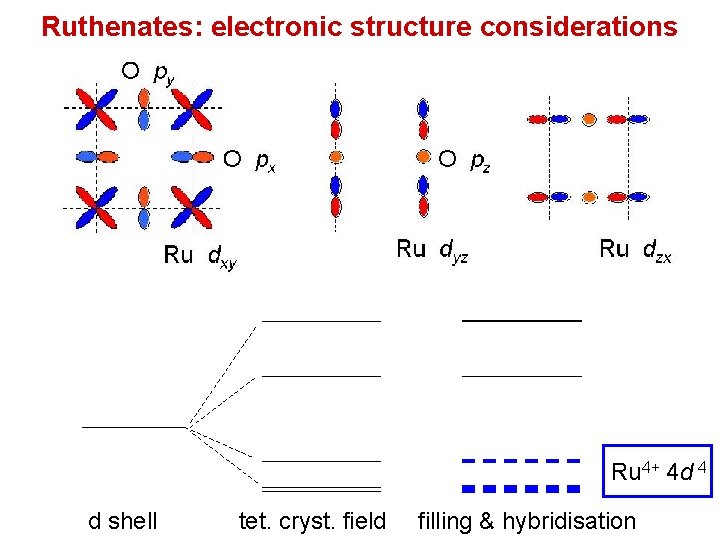
Ruthenates: electronic structure considerations d shell tet. cryst. field filling & hybridisation
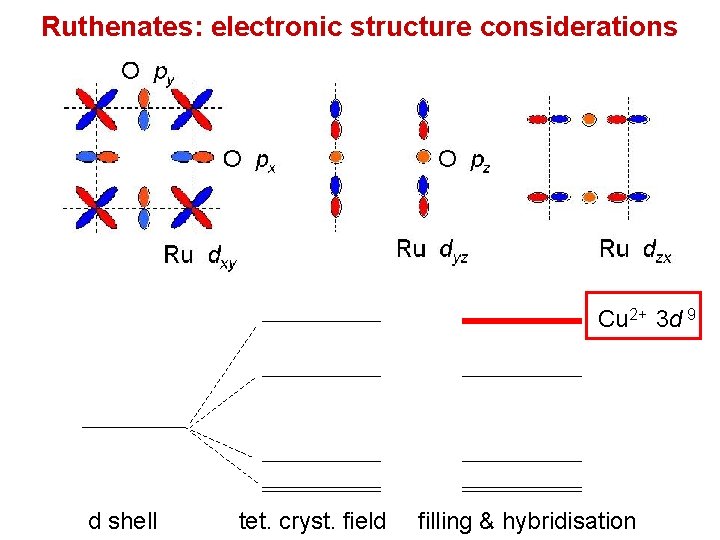
Ruthenates: electronic structure considerations Cu 2+ 3 d 9 d shell tet. cryst. field filling & hybridisation
Ruthenates: electronic structure considerations Ru 4+ 4 d 4 d shell tet. cryst. field filling & hybridisation
Intermediate Report 23 rd September 2008
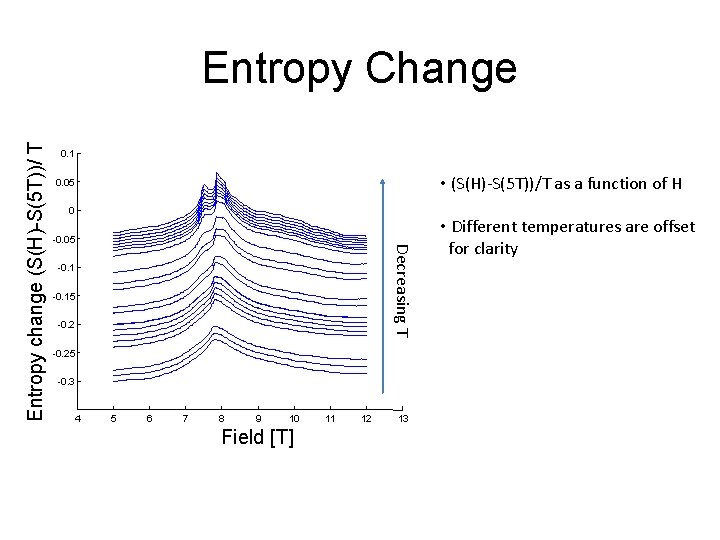
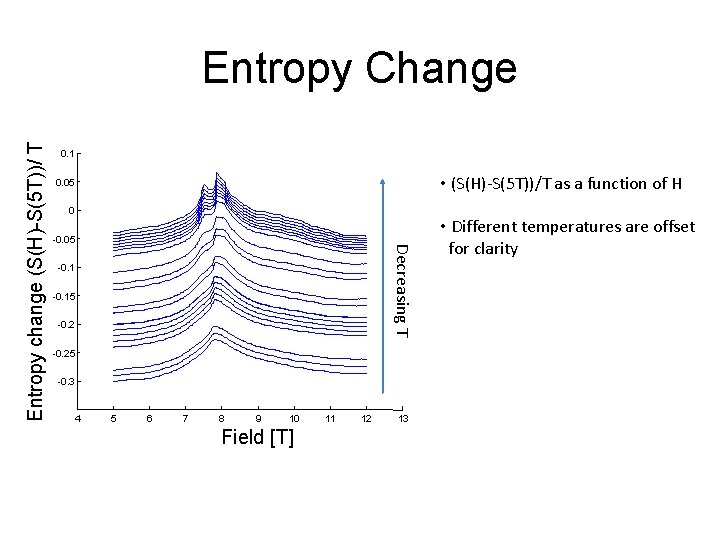
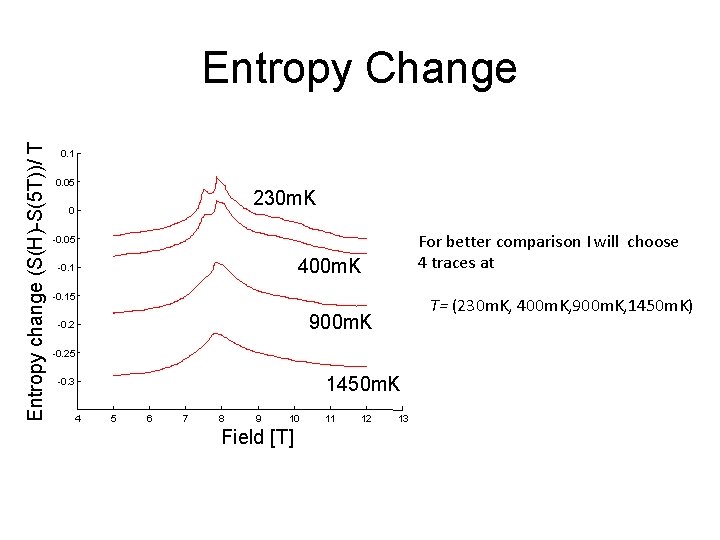
0. 1 • (S(H)-S(5 T))/T as a function of H 0. 05 0 -0. 05 Decreasing T Entropy change (S(H)-S(5 T))/ T Entropy Change -0. 15 -0. 25 -0. 3 4 5 6 7 8 9 10 Field [T] 11 12 13 • Different temperatures are offset for clarity
(S(H)-S(5 T))/T [J / mol K^2] Entropy Surface T [K] H [T]
(S(H)-S(5 T))/T [J / mol K^2] Entropy Surface T [K] H [T]
Entropy Surface T [k] H [T]
0. 1 • (S(H)-S(5 T))/T as a function of H 0. 05 0 -0. 05 Decreasing T Entropy change (S(H)-S(5 T))/ T Entropy Change -0. 15 -0. 25 -0. 3 4 5 6 7 8 9 10 Field [T] 11 12 13 • Different temperatures are offset for clarity
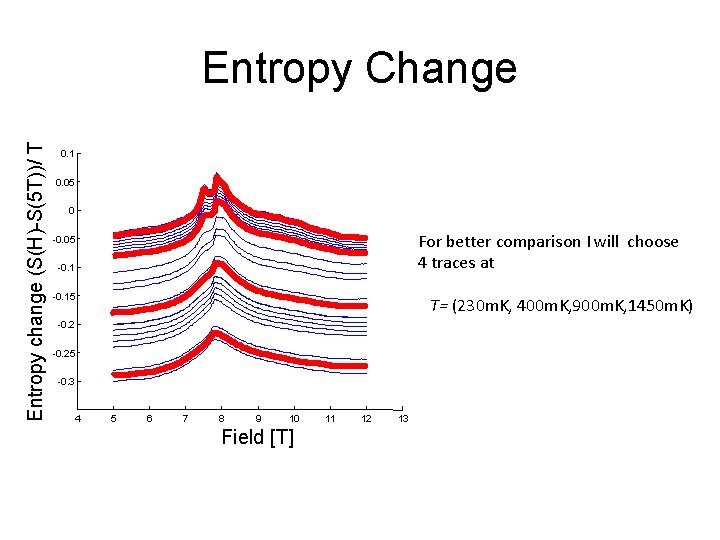
Entropy change (S(H)-S(5 T))/ T Entropy Change 0. 1 0. 05 0 For better comparison I will choose 4 traces at -0. 05 -0. 15 T= (230 m. K, 400 m. K, 900 m. K, 1450 m. K) -0. 25 -0. 3 4 5 6 7 8 9 10 Field [T] 11 12 13
Entropy change (S(H)-S(5 T))/ T Entropy Change 0. 1 0. 05 230 m. K 0 For better comparison I will choose 4 traces at -0. 05 400 m. K -0. 15 T= (230 m. K, 400 m. K, 900 m. K, 1450 m. K) 900 m. K -0. 25 1450 m. K -0. 3 4 5 6 7 8 9 10 Field [T] 11 12 13
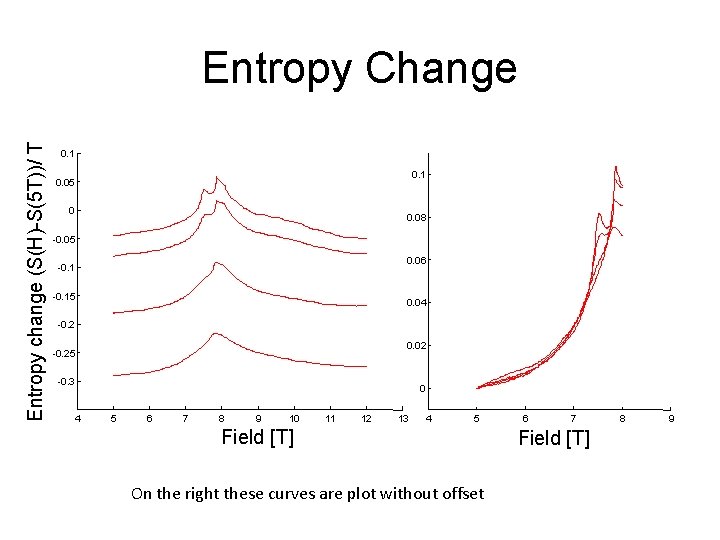
Entropy change (S(H)-S(5 T))/ T Entropy Change 0. 1 0. 05 0 0. 08 -0. 05 0. 06 -0. 15 0. 04 -0. 2 0. 02 -0. 25 -0. 3 0 4 5 6 7 8 9 10 11 12 13 4 5 Field [T] On the right these curves are plot without offset 6 7 Field [T] 8 9
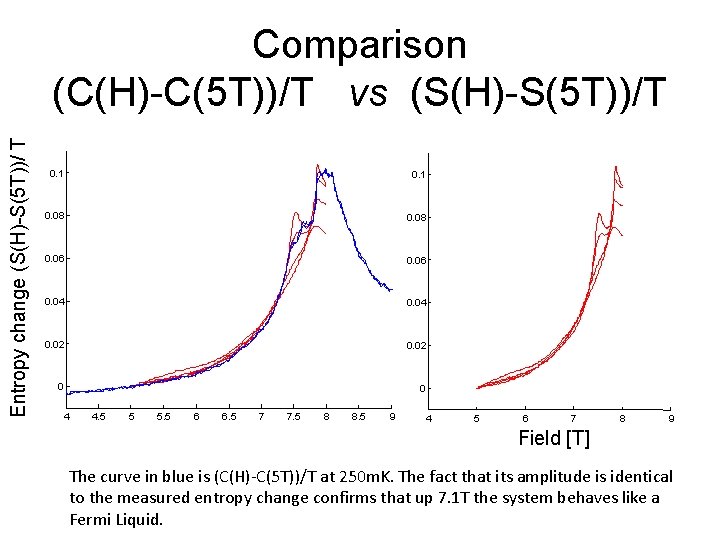
Entropy change (S(H)-S(5 T))/ T Comparison (C(H)-C(5 T))/T vs (S(H)-S(5 T))/T 0. 1 0. 08 0. 06 0. 04 0. 02 0 0 4 4. 5 5 5. 5 6 6. 5 7 7. 5 8 8. 5 9 4 5 6 7 8 9 Field [T] The curve in blue is (C(H)-C(5 T))/T at 250 m. K. The fact that its amplitude is identical to the measured entropy change confirms that up 7. 1 T the system behaves like a Fermi Liquid.
Power Law Fit To Specifc Heat 0. 1 (C(H)-C(5 T))/ T Fitequation data fitted curve 0. 08 0. 06 Fitrange 0. 04 5 T to 7. 1 T Resulting Parameters 0. 02 0 3. 5 4 4. 5 5 5. 5 6 Field [T] 6. 5 7 7. 5 8 8. 5 a = 0. 004(1) b = -0. 99(5) c = -0. 012(2)
T [K] Isentropes d. S=0 H [T]
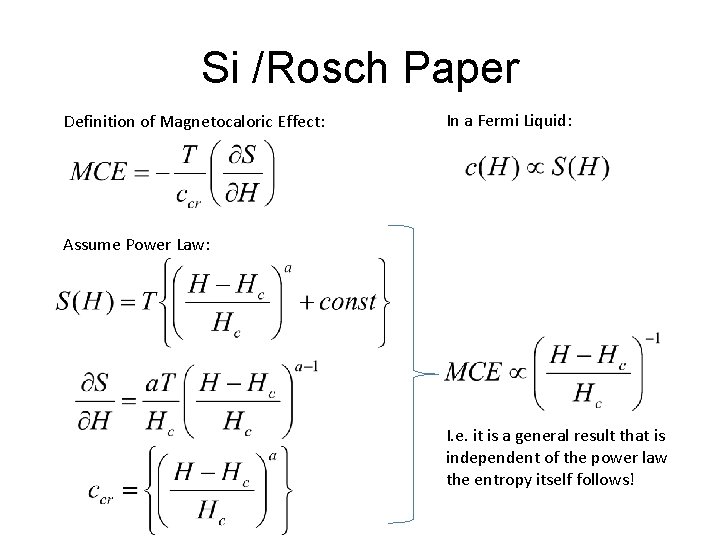
Si /Rosch Paper Definition of Magnetocaloric Effect: In a Fermi Liquid: Assume Power Law: I. e. it is a general result that is independent of the power law the entropy itself follows!
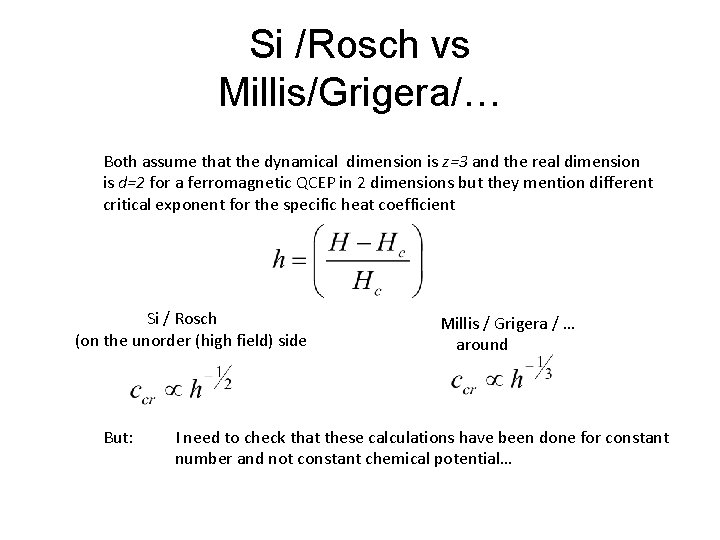
Si /Rosch vs Millis/Grigera/… Both assume that the dynamical dimension is z=3 and the real dimension is d=2 for a ferromagnetic QCEP in 2 dimensions but they mention different critical exponent for the specific heat coefficient Si / Rosch (on the unorder (high field) side But: Millis / Grigera / … around I need to check that these calculations have been done for constant number and not constant chemical potential…
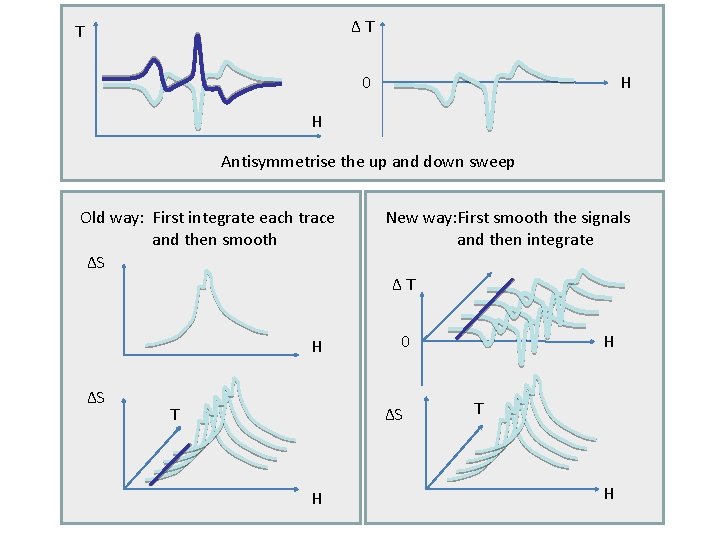
ΔT T 0 H H Antisymmetrise the up and down sweep Old way: First integrate each trace and then smooth ΔS New way: First smooth the signals and then integrate ΔT H ΔS T 0 ΔS H H T H