
University of Science and Technology Faculty of Computer

- Slides: 56
University of Science and Technology Faculty of Computer Science and Information Technology Artificial Intelligence (AI) 4 th Year B. Sc : Information Technology Academic Year : 2017 -2018 Instructor : Diaa Eldin Mustafa Ahmed Introduction to AI –(2/2)
What is Artificial Intelligence ? q Making computers that think? ﺟﻌﻞ ﺍﻟﺤﺎﺳﺐ ﻳﻔﻜﺮ ﻛﻤﺎ ﺍﻹﻧﺴﺎﻥ q The automation of activities we associate with human thinking, like : decision making( )ﺇﺗﺨﺎﺫ ﺍﻟﻘﺮﺍﺭﺍﺕ , learning , pattern matching( )ﻣﻄﺎﺑﻘﺔ ﺍﻷﻨﻤﺎﻁ , pattern recognition )ﺍﻟﺘﻌﺮﻑ ﻋﻠﻲ ( ﺍﻷﻨﻤﺎﻁ , . . . ? q The art of creating machines that perform functions that require intelligence when performed by people ? q The study of mental faculties( )ﺍﻟﻘﺪﺭﺍﺕ ﺍﻟﻌﻘﻠﻴﺔ through the use of computational models ? q The study of computations that make it possible to 2 perceive( ﻳﺸﻌﺮ )ﻳﺪﺭﻙ , reason AI - (2017 -2018) -Diaa/Eldein Mustafa - Lecture ( ﻳﻌﻠﻞ / )ﻳﻔﺴﺮ and act ? (1) -Introduction to Artificial Intelligence(2/2)
What is Artificial Intelligence ? A field of study that seeks to explain and emulate intelligent behaviour in terms of computational processes ? A branch of computer science that is concerned with the automation of intelligent behaviour ? Anything in Computing Science that we don't yet know how to do properly ? (!) 3 AI - (2017 -2018) -Diaa Eldein Mustafa - Lecture (1) -Introduction to Artificial Intelligence(2/2)
Overview of Artificial Intelligence Artificial Produced by human art or effort, rather than originating naturally. Intelligence is the ability to acquire knowledge and use it" [Pigford and Baur] So AI was defined as: AI is the study of ideas that enable computers to be intelligent. AI is the part of computer science concerned with design of computer systems that exhibit human intelligence(From the Concise Oxford Dictionary) 4 AI - (2017 -2018) -Diaa Eldein Mustafa - Lecture (1) -Introduction to Artificial Intelligence(2/2)
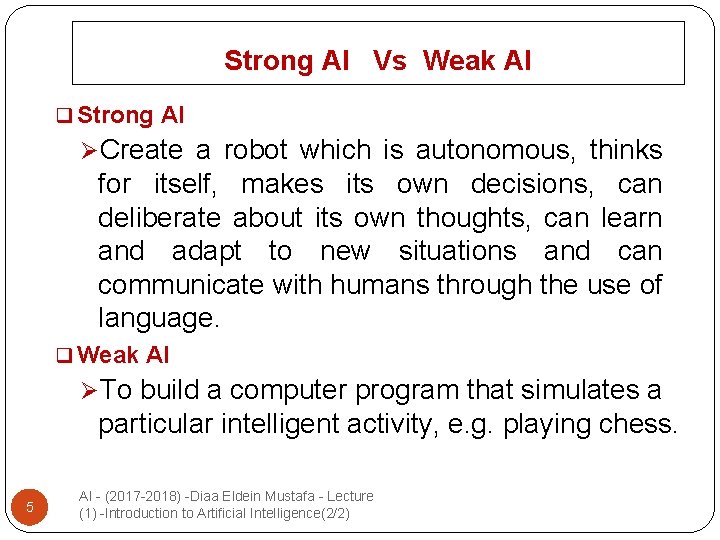
Strong AI Vs Weak AI q Strong AI ØCreate a robot which is autonomous, thinks for itself, makes its own decisions, can deliberate about its own thoughts, can learn and adapt to new situations and can communicate with humans through the use of language. q Weak AI ØTo build a computer program that simulates a particular intelligent activity, e. g. playing chess. 5 AI - (2017 -2018) -Diaa Eldein Mustafa - Lecture (1) -Introduction to Artificial Intelligence(2/2)
Overview of Artificial Intelligence What is AI ? Artificial intelligence is the study of how to make computers do things which, at the moment people do better. Some definitions of artificial intelligence, organized into four categories 6 AI - (2017 -2018) -Diaa Eldein Mustafa - Lecture (1) -Introduction to Artificial Intelligence(2/2)
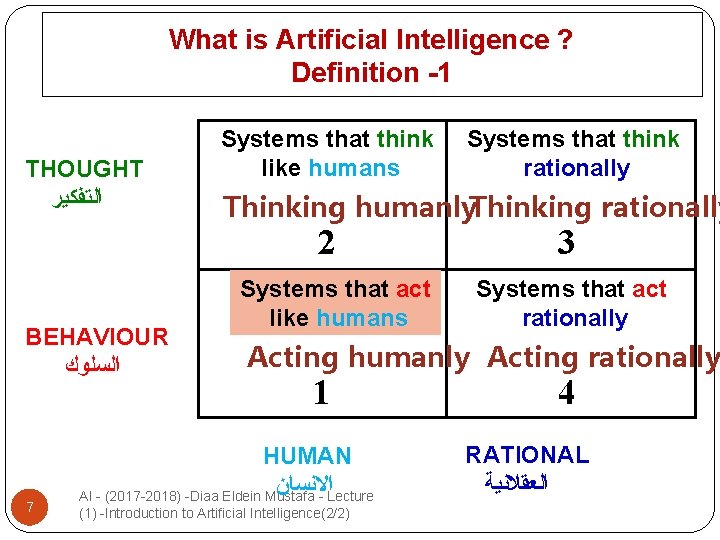
What is Artificial Intelligence ? Definition -1 THOUGHT ﺍﻟﺘﻔﻜﻴﺮ Systems that think like humans Thinking humanly. Thinking rationally 2 BEHAVIOUR ﺍﻟﺴﻠﻮﻙ 7 Systems that think rationally Systems that act like humans 3 Systems that act rationally Acting humanly Acting rationally 1 HUMAN ﺍﻻﻧﺴﺎﻥ AI - (2017 -2018) -Diaa Eldein Mustafa - Lecture (1) -Introduction to Artificial Intelligence(2/2) 4 RATIONAL ﺍﻟﻌﻘﻼﻧﻴﺔ
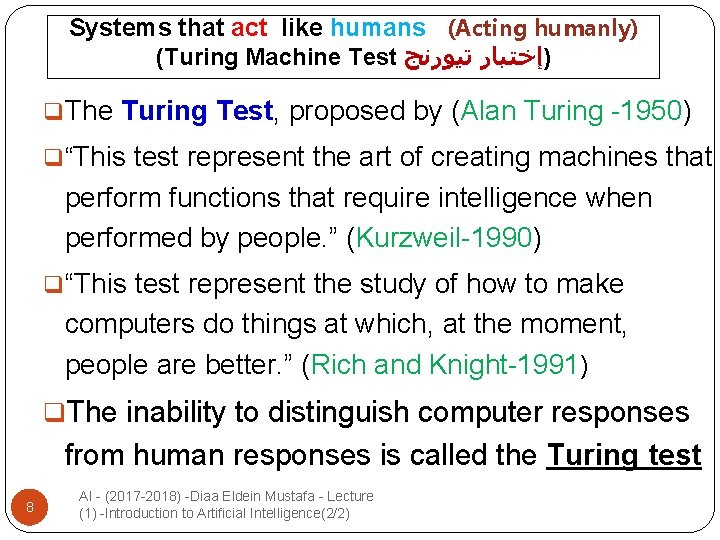
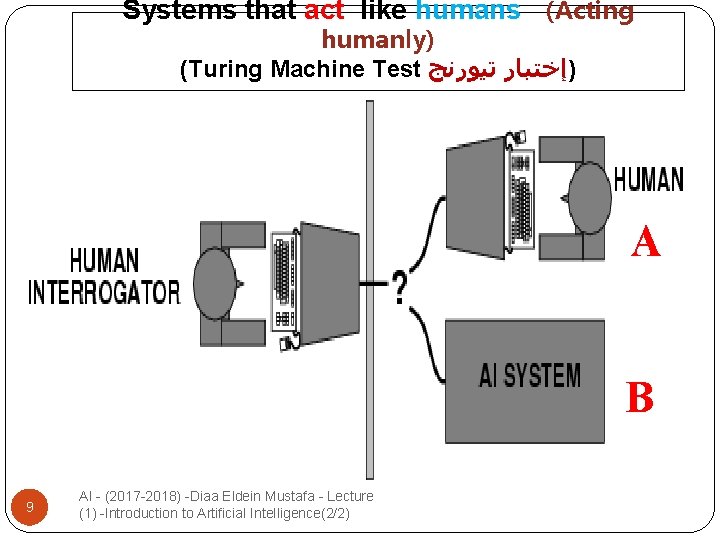
Systems that act like humans (Acting humanly) (Turing Machine Test )ﺇﺧﺘﺒﺎﺭ ﺗﻴﻮﺭﻧﺞ q. The Turing Test, proposed by (Alan Turing -1950) q “This test represent the art of creating machines that perform functions that require intelligence when performed by people. ” (Kurzweil-1990) q“This test represent the study of how to make computers do things at which, at the moment, people are better. ” (Rich and Knight-1991) q. The inability to distinguish computer responses from human responses is called the Turing test 8 AI - (2017 -2018) -Diaa Eldein Mustafa - Lecture (1) -Introduction to Artificial Intelligence(2/2)
Systems that act like humans (Acting humanly) (Turing Machine Test )ﺇﺧﺘﺒﺎﺭ ﺗﻴﻮﺭﻧﺞ A B 9 AI - (2017 -2018) -Diaa Eldein Mustafa - Lecture (1) -Introduction to Artificial Intelligence(2/2)
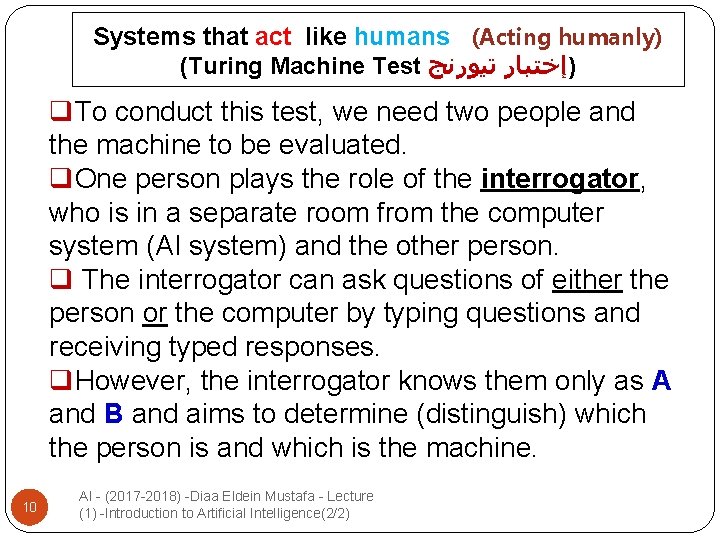
Systems that act like humans (Acting humanly) (Turing Machine Test )ﺇﺧﺘﺒﺎﺭ ﺗﻴﻮﺭﻧﺞ q. To conduct this test, we need two people and the machine to be evaluated. q. One person plays the role of the interrogator, who is in a separate room from the computer system (AI system) and the other person. q The interrogator can ask questions of either the person or the computer by typing questions and receiving typed responses. q. However, the interrogator knows them only as A and B and aims to determine (distinguish) which the person is and which is the machine. 10 AI - (2017 -2018) -Diaa Eldein Mustafa - Lecture (1) -Introduction to Artificial Intelligence(2/2)
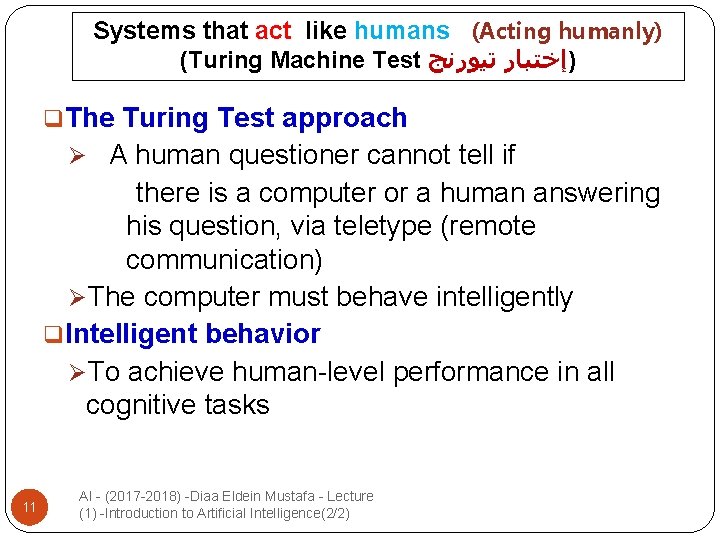
Systems that act like humans (Acting humanly) (Turing Machine Test )ﺇﺧﺘﺒﺎﺭ ﺗﻴﻮﺭﻧﺞ q. The Turing Test approach Ø A human questioner cannot tell if there is a computer or a human answering his question, via teletype (remote communication) ØThe computer must behave intelligently q. Intelligent behavior ØTo achieve human-level performance in all cognitive tasks 11 AI - (2017 -2018) -Diaa Eldein Mustafa - Lecture (1) -Introduction to Artificial Intelligence(2/2)
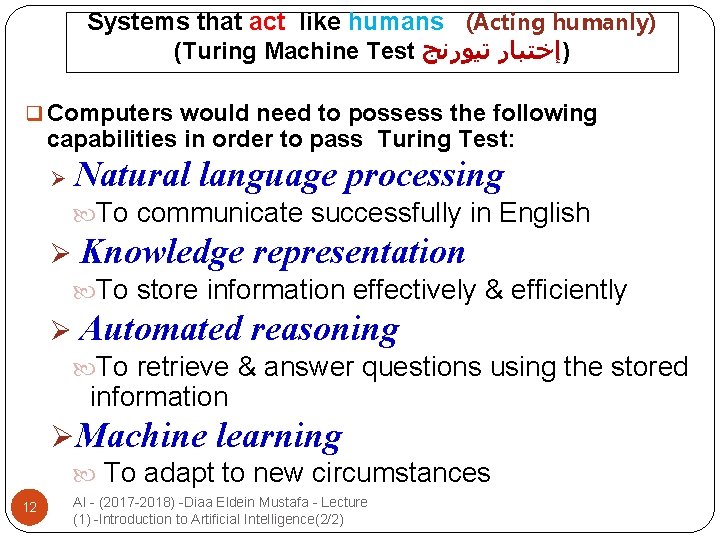
Systems that act like humans (Acting humanly) (Turing Machine Test )ﺇﺧﺘﺒﺎﺭ ﺗﻴﻮﺭﻧﺞ q Computers would need to possess the following capabilities in order to pass Turing Test: Ø Natural language processing To communicate successfully in English Ø Knowledge representation To store information effectively & efficiently Ø Automated reasoning To retrieve & answer questions using the stored information ØMachine learning To adapt to new circumstances 12 AI - (2017 -2018) -Diaa Eldein Mustafa - Lecture (1) -Introduction to Artificial Intelligence(2/2)
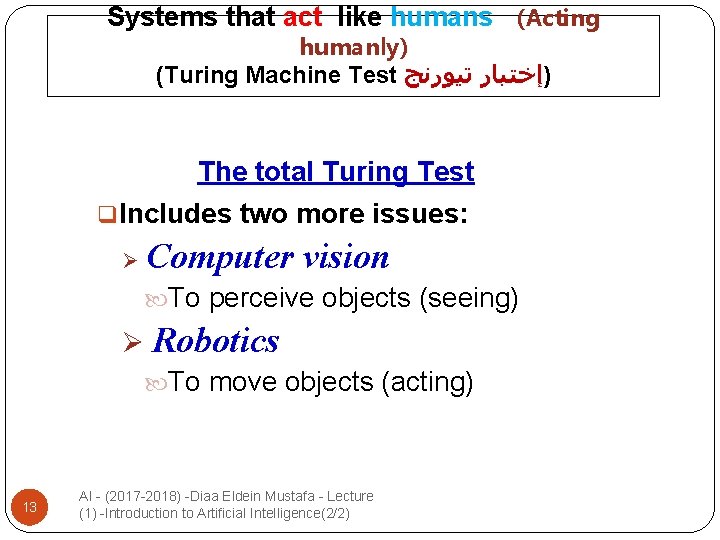
Systems that act like humans (Acting humanly) (Turing Machine Test )ﺇﺧﺘﺒﺎﺭ ﺗﻴﻮﺭﻧﺞ The total Turing Test q. Includes two more issues: Ø Computer vision To perceive objects (seeing) Ø Robotics To move objects (acting) 13 AI - (2017 -2018) -Diaa Eldein Mustafa - Lecture (1) -Introduction to Artificial Intelligence(2/2)
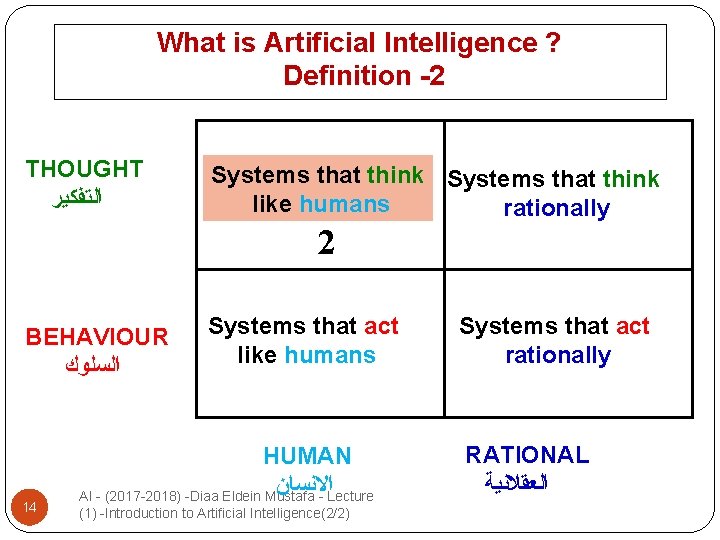
What is Artificial Intelligence ? Definition -2 THOUGHT ﺍﻟﺘﻔﻜﻴﺮ Systems that think like humans rationally 2 BEHAVIOUR ﺍﻟﺴﻠﻮﻙ 14 Systems that act like humans HUMAN ﺍﻻﻧﺴﺎﻥ AI - (2017 -2018) -Diaa Eldein Mustafa - Lecture (1) -Introduction to Artificial Intelligence(2/2) Systems that act rationally RATIONAL ﺍﻟﻌﻘﻼﻧﻴﺔ
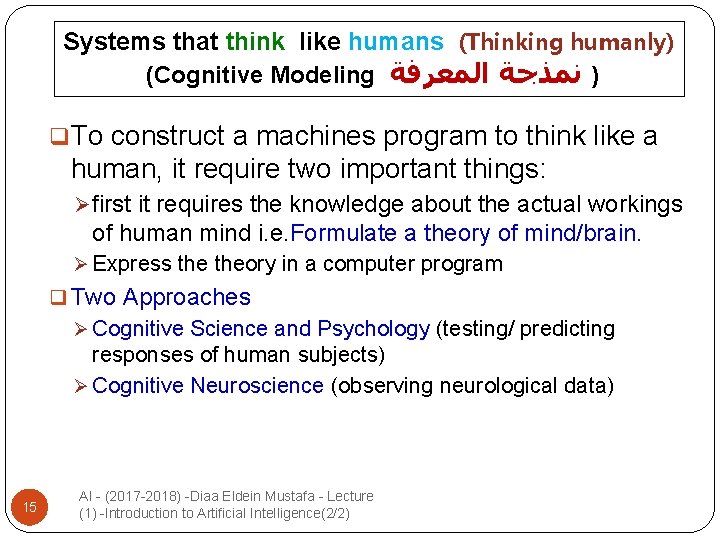
Systems that think like humans (Thinking humanly) (Cognitive Modeling ) ﻧﻤﺬﺟﺔ ﺍﻟﻤﻌﺮﻓﺔ q. To construct a machines program to think like a human, it require two important things: Ø first it requires the knowledge about the actual workings of human mind i. e. Formulate a theory of mind/brain. Ø Express theory in a computer program q Two Approaches Ø Cognitive Science and Psychology (testing/ predicting responses of human subjects) Ø Cognitive Neuroscience (observing neurological data) 15 AI - (2017 -2018) -Diaa Eldein Mustafa - Lecture (1) -Introduction to Artificial Intelligence(2/2)
Systems that think like humans (Thinking humanly) (Cognitive Modeling ) ﻧﻤﺬﺟﺔ ﺍﻟﻤﻌﺮﻓﺔ q After completing the study about human mind it is possible to express theory as a computer program. q If the program’s inputs/output and timing behavior matched with the human behavior then we can say that the program’s mechanism is working like a human mind. 16 AI - (2017 -2018) -Diaa Eldein Mustafa - Lecture (1) -Introduction to Artificial Intelligence(2/2)
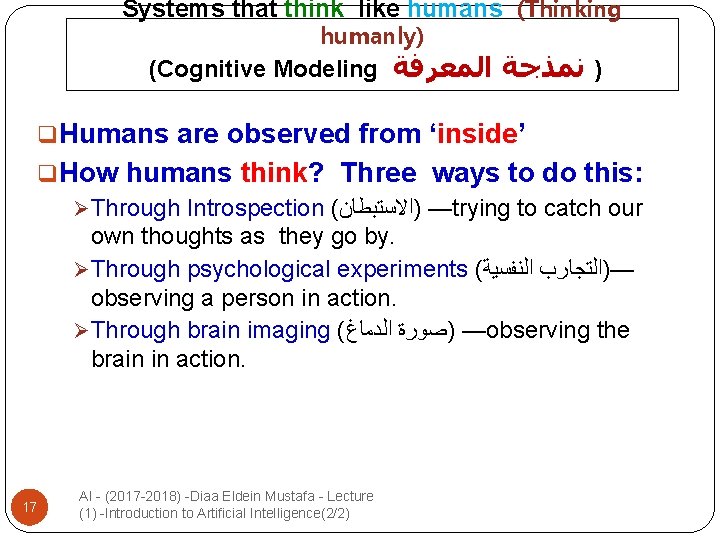
Systems that think like humans (Thinking humanly) (Cognitive Modeling ) ﻧﻤﺬﺟﺔ ﺍﻟﻤﻌﺮﻓﺔ q. Humans are observed from ‘inside’ q. How humans think? Three ways to do this: Ø Through Introspection ( — )ﺍﻻﺳﺘﺒﻄﺎﻥ trying to catch our own thoughts as they go by. Ø Through psychological experiments ( —)ﺍﻟﺘﺠﺎﺭﺏ ﺍﻟﻨﻔﺴﻴﺔ observing a person in action. Ø Through brain imaging ( — )ﺻﻮﺭﺓ ﺍﻟﺪﻣﺎﻍ observing the brain in action. 17 AI - (2017 -2018) -Diaa Eldein Mustafa - Lecture (1) -Introduction to Artificial Intelligence(2/2)
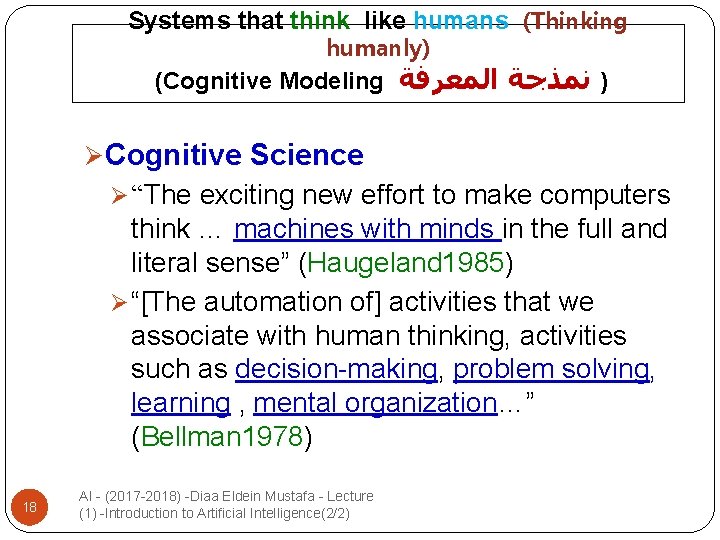
Systems that think like humans (Thinking humanly) (Cognitive Modeling ) ﻧﻤﺬﺟﺔ ﺍﻟﻤﻌﺮﻓﺔ Ø Cognitive Science Ø “The exciting new effort to make computers think … machines with minds in the full and literal sense” (Haugeland 1985) Ø “[The automation of] activities that we associate with human thinking, activities such as decision-making, problem solving, learning , mental organization…” (Bellman 1978) 18 AI - (2017 -2018) -Diaa Eldein Mustafa - Lecture (1) -Introduction to Artificial Intelligence(2/2)
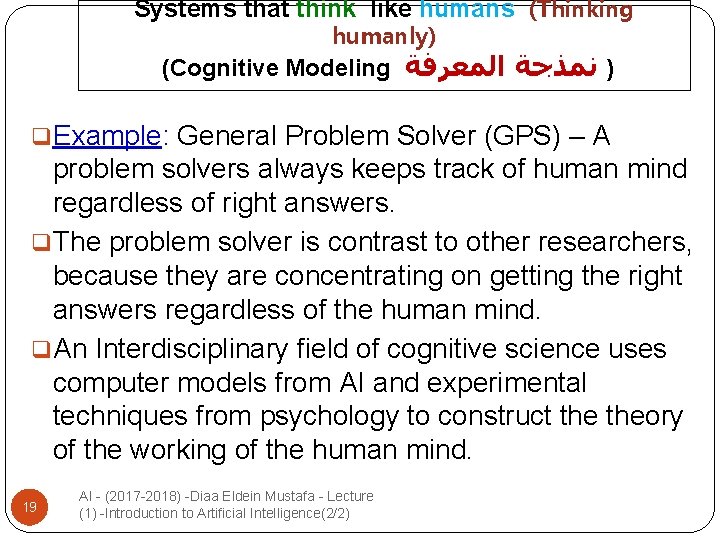
Systems that think like humans (Thinking humanly) (Cognitive Modeling ) ﻧﻤﺬﺟﺔ ﺍﻟﻤﻌﺮﻓﺔ q. Example: General Problem Solver (GPS) – A problem solvers always keeps track of human mind regardless of right answers. q. The problem solver is contrast to other researchers, because they are concentrating on getting the right answers regardless of the human mind. q. An Interdisciplinary field of cognitive science uses computer models from AI and experimental techniques from psychology to construct theory of the working of the human mind. 19 AI - (2017 -2018) -Diaa Eldein Mustafa - Lecture (1) -Introduction to Artificial Intelligence(2/2)
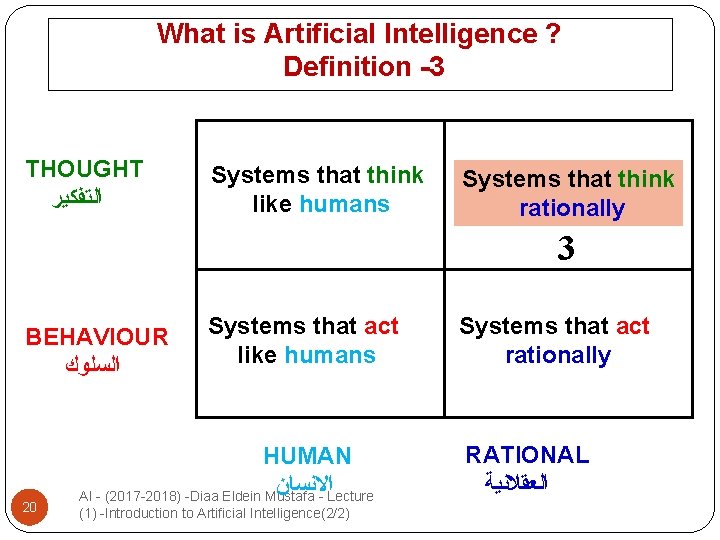
What is Artificial Intelligence ? Definition -3 THOUGHT ﺍﻟﺘﻔﻜﻴﺮ Systems that think like humans Systems that think rationally 3 BEHAVIOUR ﺍﻟﺴﻠﻮﻙ 20 Systems that act like humans HUMAN ﺍﻻﻧﺴﺎﻥ AI - (2017 -2018) -Diaa Eldein Mustafa - Lecture (1) -Introduction to Artificial Intelligence(2/2) Systems that act rationally RATIONAL ﺍﻟﻌﻘﻼﻧﻴﺔ
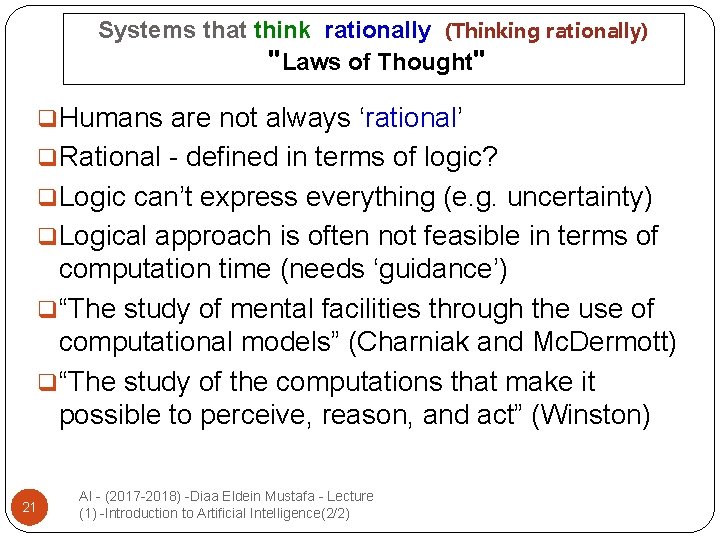
Systems that think rationally (Thinking rationally) "Laws of Thought" q. Humans are not always ‘rational’ q. Rational - defined in terms of logic? q. Logic can’t express everything (e. g. uncertainty) q. Logical approach is often not feasible in terms of computation time (needs ‘guidance’) q“The study of mental facilities through the use of computational models” (Charniak and Mc. Dermott) q“The study of the computations that make it possible to perceive, reason, and act” (Winston) 21 AI - (2017 -2018) -Diaa Eldein Mustafa - Lecture (1) -Introduction to Artificial Intelligence(2/2)
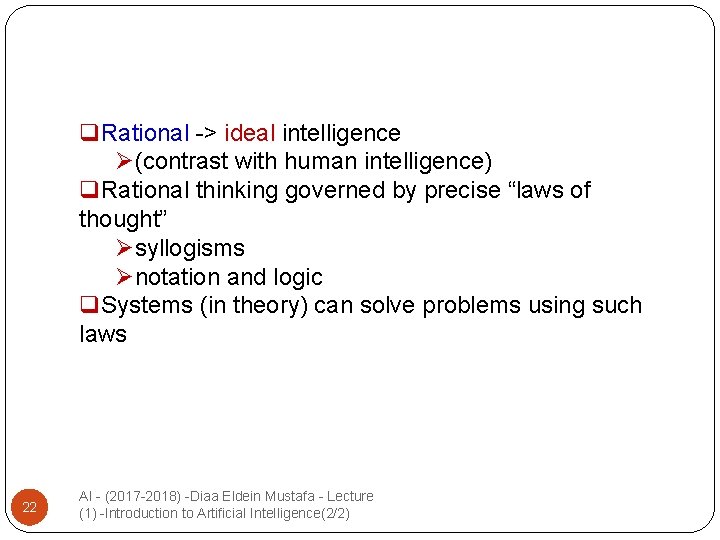
q. Rational -> ideal intelligence Ø(contrast with human intelligence) q. Rational thinking governed by precise “laws of thought” Øsyllogisms Ønotation and logic q. Systems (in theory) can solve problems using such laws 22 AI - (2017 -2018) -Diaa Eldein Mustafa - Lecture (1) -Introduction to Artificial Intelligence(2/2)
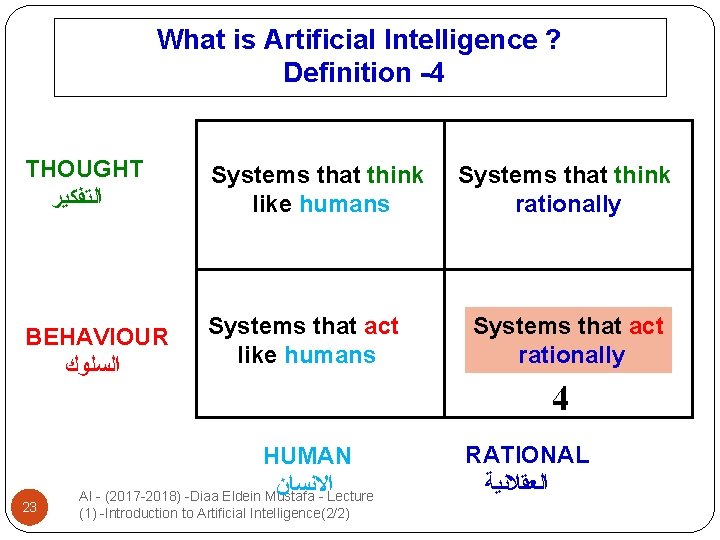
What is Artificial Intelligence ? Definition -4 THOUGHT ﺍﻟﺘﻔﻜﻴﺮ Systems that think like humans BEHAVIOUR ﺍﻟﺴﻠﻮﻙ Systems that act like humans 23 HUMAN ﺍﻻﻧﺴﺎﻥ AI - (2017 -2018) -Diaa Eldein Mustafa - Lecture (1) -Introduction to Artificial Intelligence(2/2) Systems that think rationally Systems that act rationally 4 RATIONAL ﺍﻟﻌﻘﻼﻧﻴﺔ
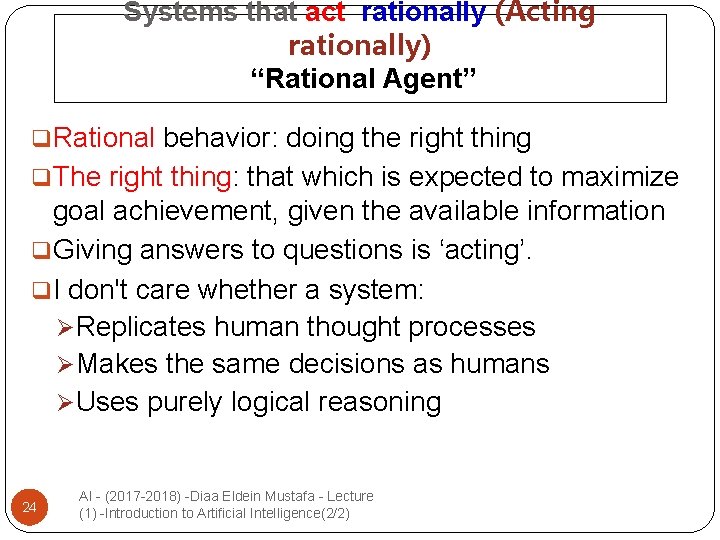
Systems that act rationally (Acting rationally) “Rational Agent” q. Rational behavior: doing the right thing q. The right thing: that which is expected to maximize goal achievement, given the available information q. Giving answers to questions is ‘acting’. q. I don't care whether a system: ØReplicates human thought processes ØMakes the same decisions as humans ØUses purely logical reasoning 24 AI - (2017 -2018) -Diaa Eldein Mustafa - Lecture (1) -Introduction to Artificial Intelligence(2/2)
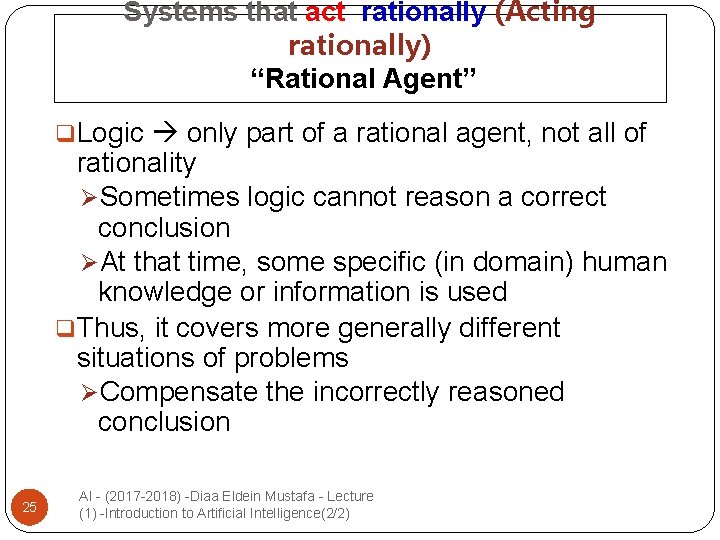
Systems that act rationally (Acting rationally) “Rational Agent” q. Logic only part of a rational agent, not all of rationality ØSometimes logic cannot reason a correct conclusion ØAt that time, some specific (in domain) human knowledge or information is used q. Thus, it covers more generally different situations of problems ØCompensate the incorrectly reasoned conclusion 25 AI - (2017 -2018) -Diaa Eldein Mustafa - Lecture (1) -Introduction to Artificial Intelligence(2/2)
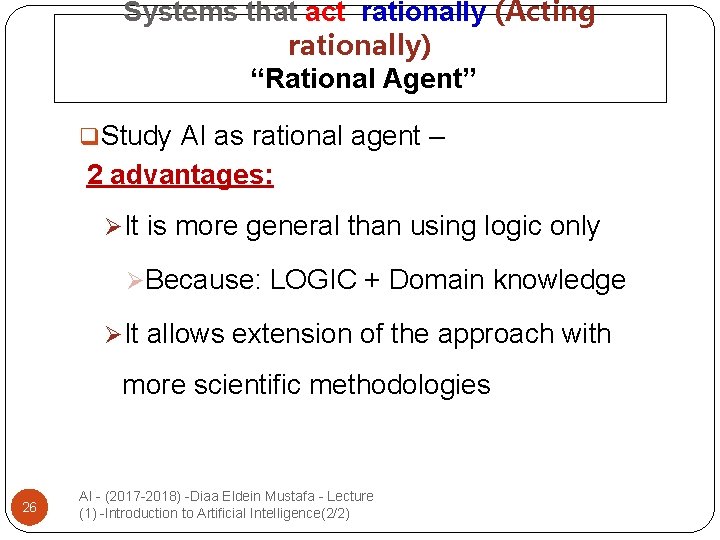
Systems that act rationally (Acting rationally) “Rational Agent” q. Study AI as rational agent – 2 advantages: ØIt is more general than using logic only ØBecause: LOGIC + Domain knowledge ØIt allows extension of the approach with more scientific methodologies 26 AI - (2017 -2018) -Diaa Eldein Mustafa - Lecture (1) -Introduction to Artificial Intelligence(2/2)
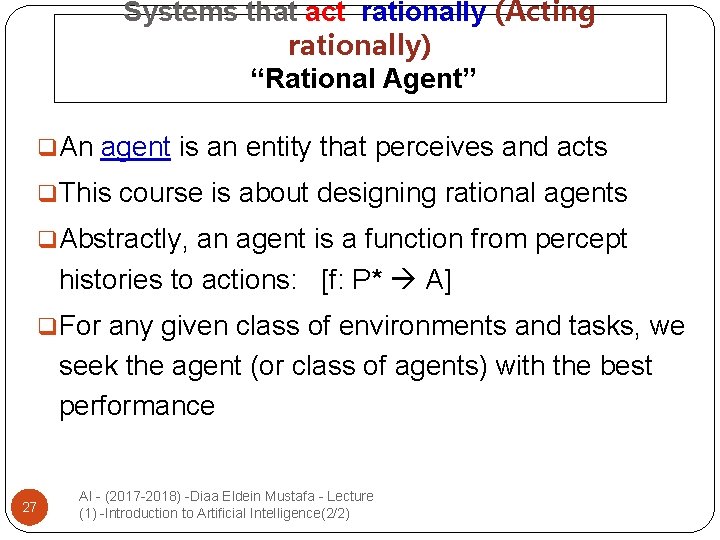
Systems that act rationally (Acting rationally) “Rational Agent” q. An agent is an entity that perceives and acts q. This course is about designing rational agents q. Abstractly, an agent is a function from percept histories to actions: [f: P* A] q. For any given class of environments and tasks, we seek the agent (or class of agents) with the best performance 27 AI - (2017 -2018) -Diaa Eldein Mustafa - Lecture (1) -Introduction to Artificial Intelligence(2/2)
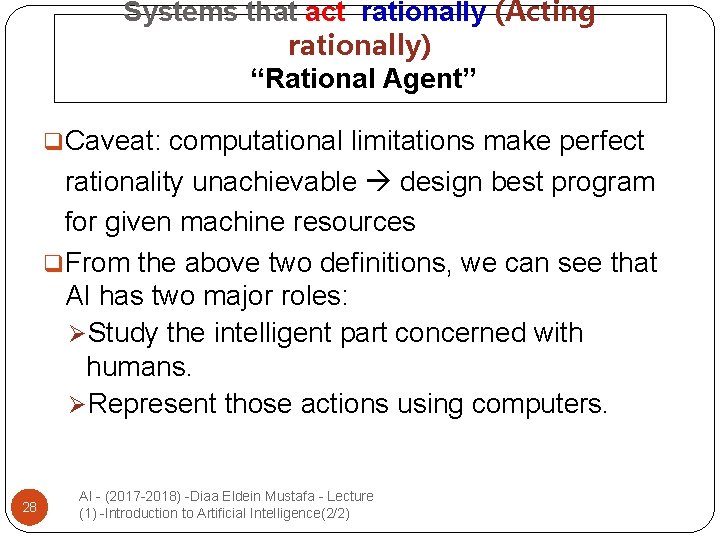
Systems that act rationally (Acting rationally) “Rational Agent” q. Caveat: computational limitations make perfect rationality unachievable design best program for given machine resources q. From the above two definitions, we can see that AI has two major roles: ØStudy the intelligent part concerned with humans. ØRepresent those actions using computers. 28 AI - (2017 -2018) -Diaa Eldein Mustafa - Lecture (1) -Introduction to Artificial Intelligence(2/2)
Systems that act rationally (Acting rationally) “Rational Agent” q. Building systems that carry out actions to achieve the best outcome. q. Rational behaviour : May or may not involve rational thinking i. e. , consider reflex actions. q. This is the definition we will adopt. 29 AI - (2017 -2018) -Diaa Eldein Mustafa - Lecture (1) -Introduction to Artificial Intelligence(2/2)
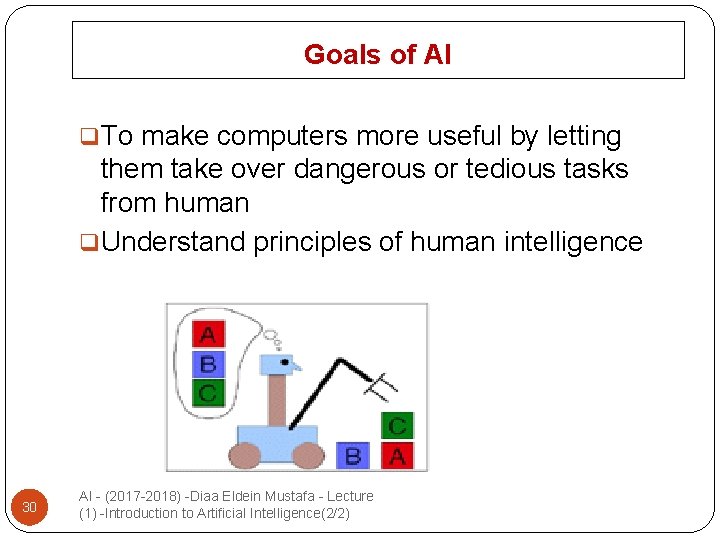
Goals of AI q. To make computers more useful by letting them take over dangerous or tedious tasks from human q. Understand principles of human intelligence 30 AI - (2017 -2018) -Diaa Eldein Mustafa - Lecture (1) -Introduction to Artificial Intelligence(2/2)
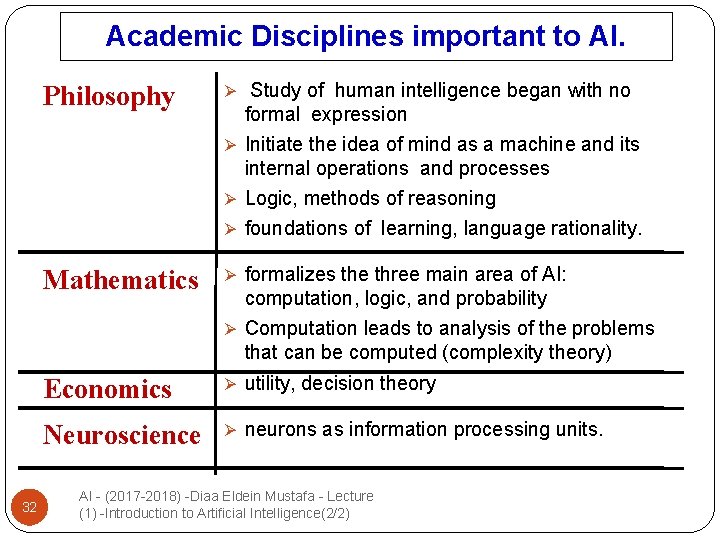
Academic Disciplines important to AI. Philosophy Cognitive Science Linguistics Mathematics AI Control Theory Neuroscience Computer Engineering 31 Economics AI - (2017 -2018) -Diaa Eldein Mustafa - Lecture (1) -Introduction to Artificial Intelligence(2/2) Psychology
Academic Disciplines important to AI. 32 Philosophy Ø Study of human intelligence began with no Mathematics Ø formalizes the three main area of AI: Economics Ø utility, decision theory Neuroscience Ø neurons as information processing units. formal expression Ø Initiate the idea of mind as a machine and its internal operations and processes Ø Logic, methods of reasoning Ø foundations of learning, language rationality. computation, logic, and probability Ø Computation leads to analysis of the problems that can be computed (complexity theory) AI - (2017 -2018) -Diaa Eldein Mustafa - Lecture (1) -Introduction to Artificial Intelligence(2/2)
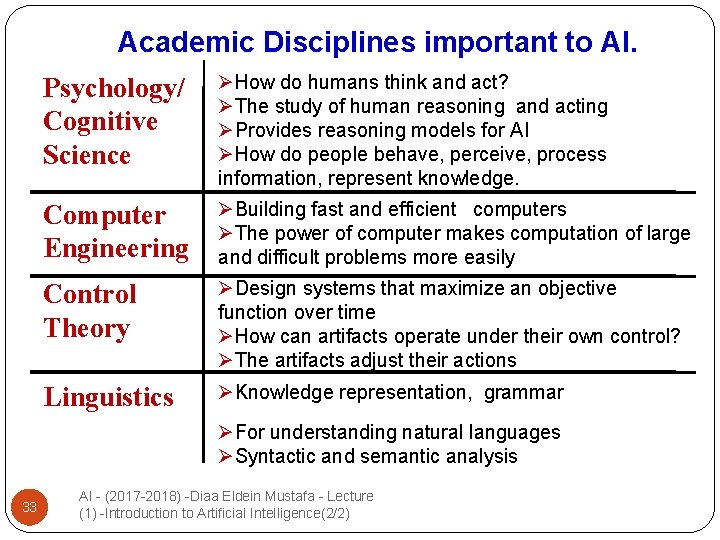
Academic Disciplines important to AI. Psychology/ Cognitive Science ØHow do humans think and act? ØThe study of human reasoning and acting ØProvides reasoning models for AI ØHow do people behave, perceive, process information, represent knowledge. Computer Engineering ØBuilding fast and efficient computers ØThe power of computer makes computation of large and difficult problems more easily Control Theory ØDesign systems that maximize an objective function over time ØHow can artifacts operate under their own control? ØThe artifacts adjust their actions Linguistics ØKnowledge representation, grammar ØFor understanding natural languages ØSyntactic and semantic analysis 33 AI - (2017 -2018) -Diaa Eldein Mustafa - Lecture (1) -Introduction to Artificial Intelligence(2/2)
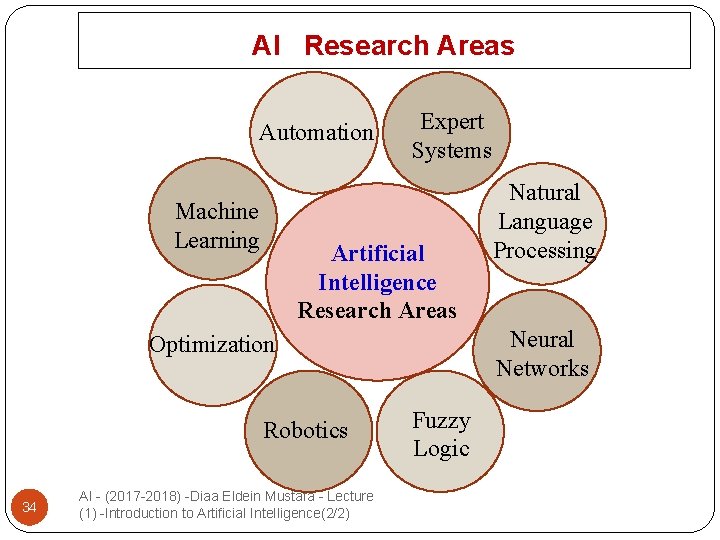
AI Research Areas Automation Machine Learning Expert Systems Artificial Intelligence Research Areas Neural Networks Optimization Robotics 34 AI - (2017 -2018) -Diaa Eldein Mustafa - Lecture (1) -Introduction to Artificial Intelligence(2/2) Natural Language Processing Fuzzy Logic
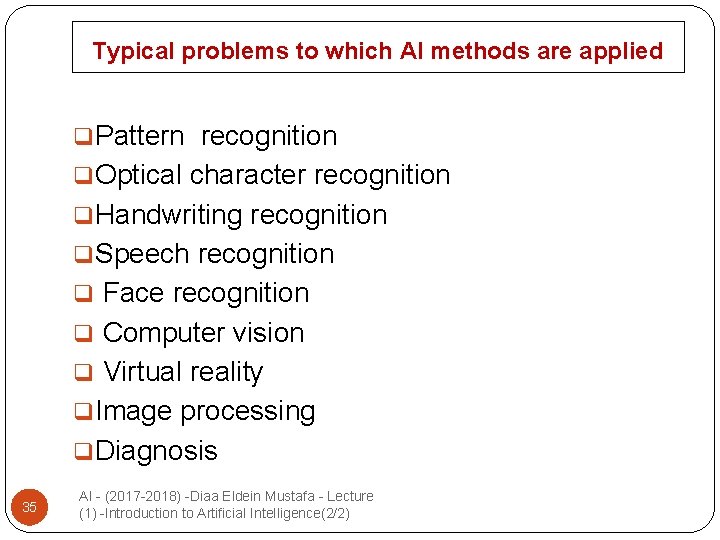
Typical problems to which AI methods are applied q. Pattern recognition q. Optical character recognition q. Handwriting recognition q. Speech recognition q Face recognition q Computer vision q Virtual reality q. Image processing q. Diagnosis 35 AI - (2017 -2018) -Diaa Eldein Mustafa - Lecture (1) -Introduction to Artificial Intelligence(2/2)
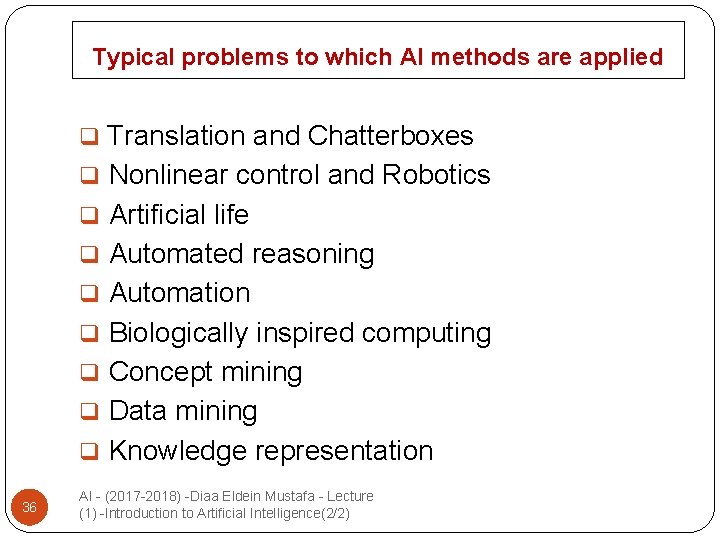
Typical problems to which AI methods are applied Translation and Chatterboxes q Nonlinear control and Robotics q Artificial life q Automated reasoning q Automation q Biologically inspired computing q Concept mining q Data mining q Knowledge representation q 36 AI - (2017 -2018) -Diaa Eldein Mustafa - Lecture (1) -Introduction to Artificial Intelligence(2/2)
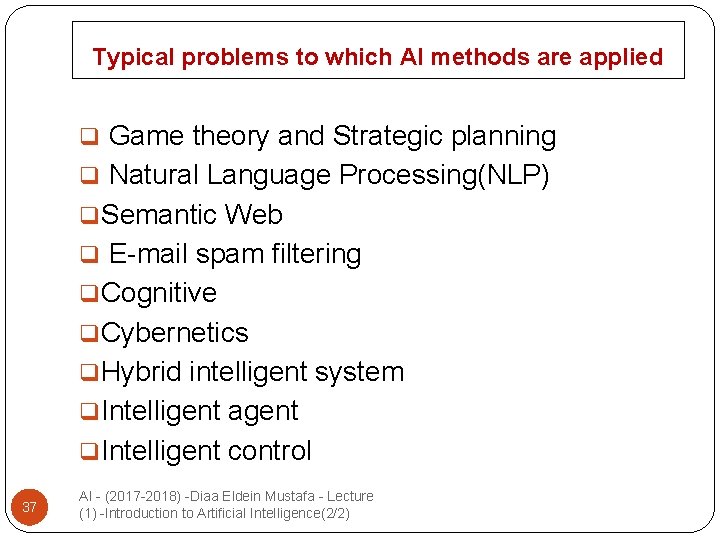
Typical problems to which AI methods are applied q Game theory and Strategic planning q Natural Language Processing(NLP) q. Semantic Web q E-mail spam filtering q. Cognitive q. Cybernetics q. Hybrid intelligent system q. Intelligent agent q. Intelligent control 37 AI - (2017 -2018) -Diaa Eldein Mustafa - Lecture (1) -Introduction to Artificial Intelligence(2/2)
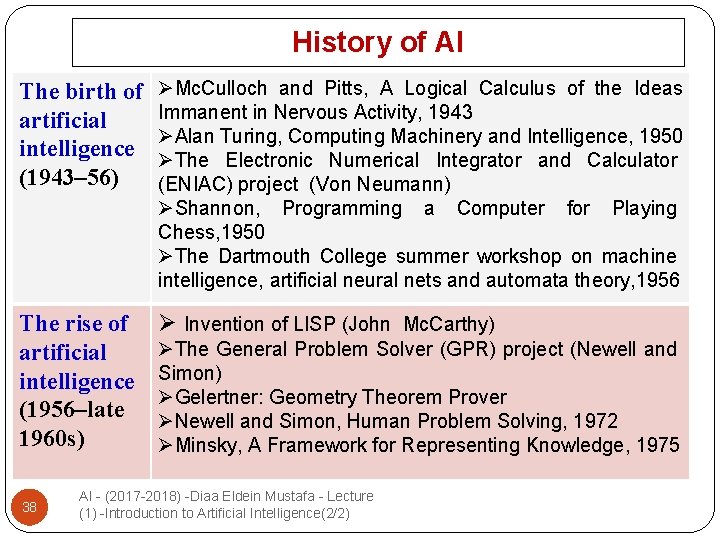
History of AI The birth of artificial intelligence (1943– 56) ØMc. Culloch and Pitts, A Logical Calculus of the Ideas Immanent in Nervous Activity, 1943 ØAlan Turing, Computing Machinery and Intelligence, 1950 ØThe Electronic Numerical Integrator and Calculator (ENIAC) project (Von Neumann) ØShannon, Programming a Computer for Playing Chess, 1950 ØThe Dartmouth College summer workshop on machine intelligence, artificial neural nets and automata theory, 1956 The rise of artificial intelligence (1956–late 1960 s) Ø Invention of LISP (John Mc. Carthy) 38 ØThe General Problem Solver (GPR) project (Newell and Simon) ØGelertner: Geometry Theorem Prover ØNewell and Simon, Human Problem Solving, 1972 ØMinsky, A Framework for Representing Knowledge, 1975 AI - (2017 -2018) -Diaa Eldein Mustafa - Lecture (1) -Introduction to Artificial Intelligence(2/2)
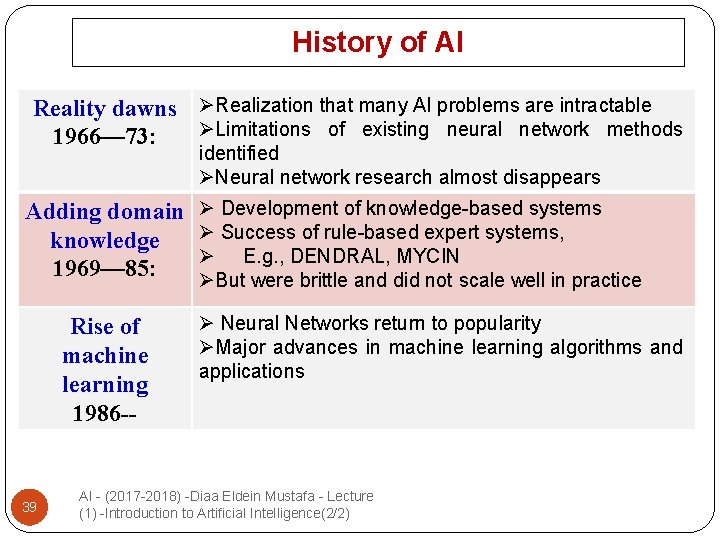
History of AI Reality dawns ØRealization that many AI problems are intractable ØLimitations of existing neural network methods 1966— 73: identified ØNeural network research almost disappears Adding domain knowledge 1969— 85: Rise of machine learning 1986 -- 39 Ø Development of knowledge-based systems Ø Success of rule-based expert systems, Ø E. g. , DENDRAL, MYCIN ØBut were brittle and did not scale well in practice Ø Neural Networks return to popularity ØMajor advances in machine learning algorithms and applications AI - (2017 -2018) -Diaa Eldein Mustafa - Lecture (1) -Introduction to Artificial Intelligence(2/2)
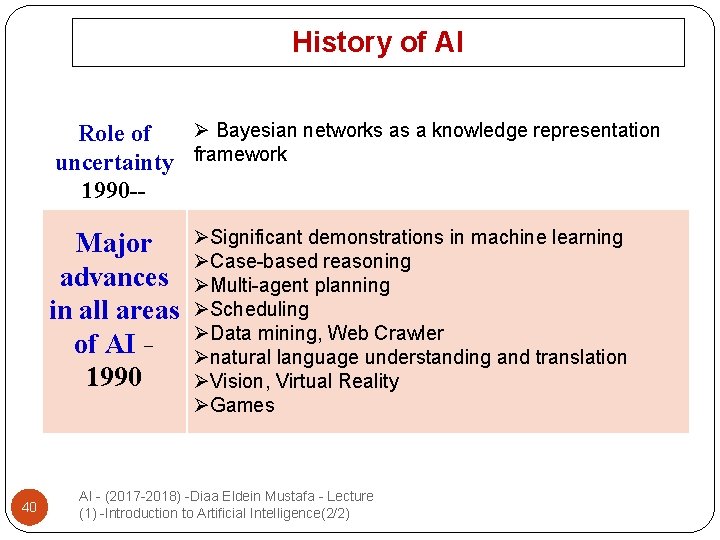
History of AI Ø Bayesian networks as a knowledge representation Role of uncertainty framework 1990 -- Major advances in all areas of AI − 1990 40 ØSignificant demonstrations in machine learning ØCase-based reasoning ØMulti-agent planning ØScheduling ØData mining, Web Crawler Ønatural language understanding and translation ØVision, Virtual Reality ØGames AI - (2017 -2018) -Diaa Eldein Mustafa - Lecture (1) -Introduction to Artificial Intelligence(2/2)
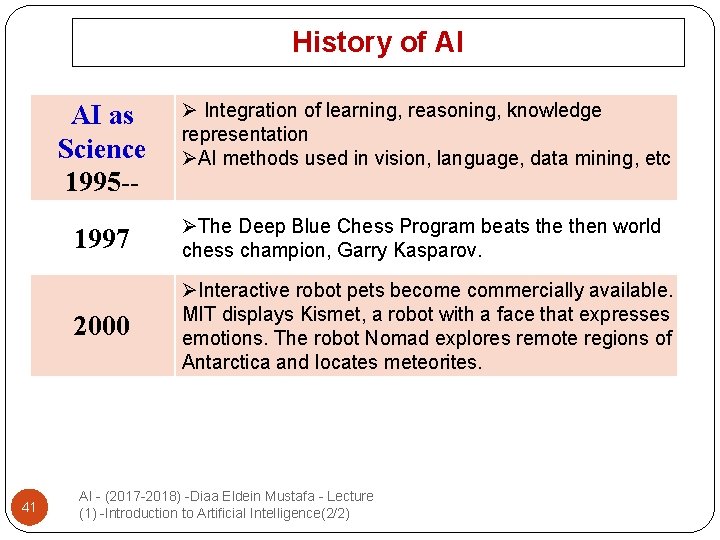
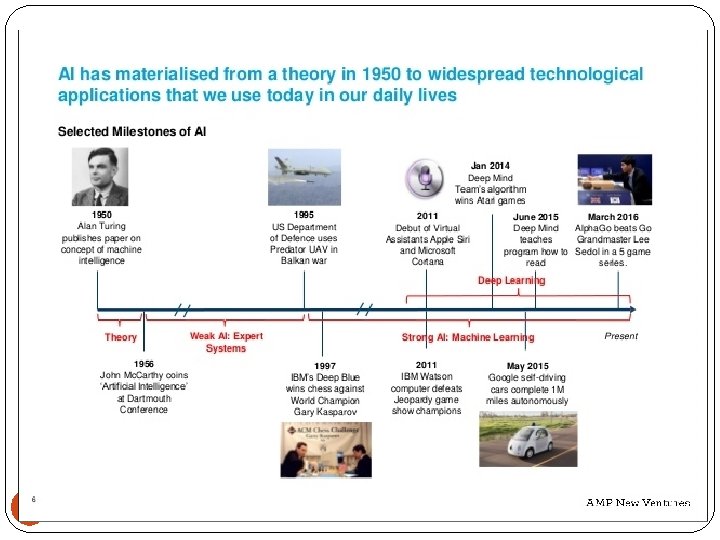
History of AI 41 AI as Science 1995 -- Ø Integration of learning, reasoning, knowledge representation ØAI methods used in vision, language, data mining, etc 1997 ØThe Deep Blue Chess Program beats then world chess champion, Garry Kasparov. 2000 ØInteractive robot pets become commercially available. MIT displays Kismet, a robot with a face that expresses emotions. The robot Nomad explores remote regions of Antarctica and locates meteorites. AI - (2017 -2018) -Diaa Eldein Mustafa - Lecture (1) -Introduction to Artificial Intelligence(2/2)
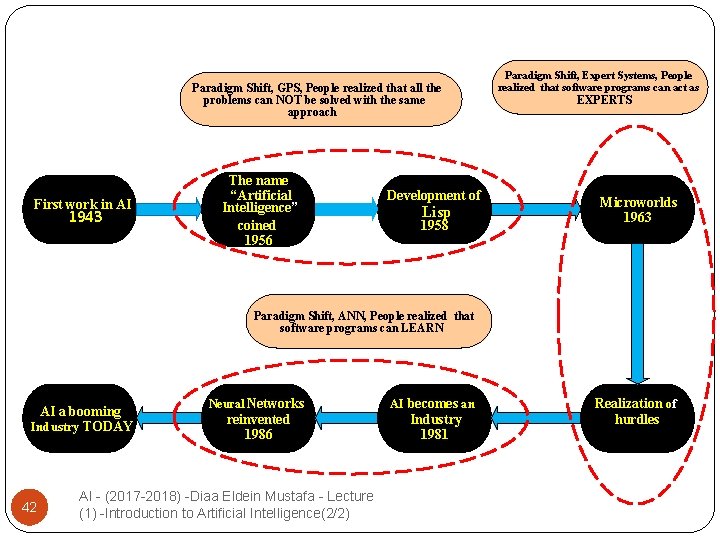
Paradigm Shift, GPS, People realized that all the problems can NOT be solved with the same approach First work in AI 1943 The name “Artificial Intelligence” coined 1956 Development of Lisp 1958 Paradigm Shift, Expert Systems, People realized that software programs can act as EXPERTS Microworlds 1963 Paradigm Shift, ANN, People realized that software programs can LEARN AI a booming Industry TODAY 42 Neural Networks reinvented 1986 AI - (2017 -2018) -Diaa Eldein Mustafa - Lecture (1) -Introduction to Artificial Intelligence(2/2) AI becomes an Industry 1981 Realization of hurdles
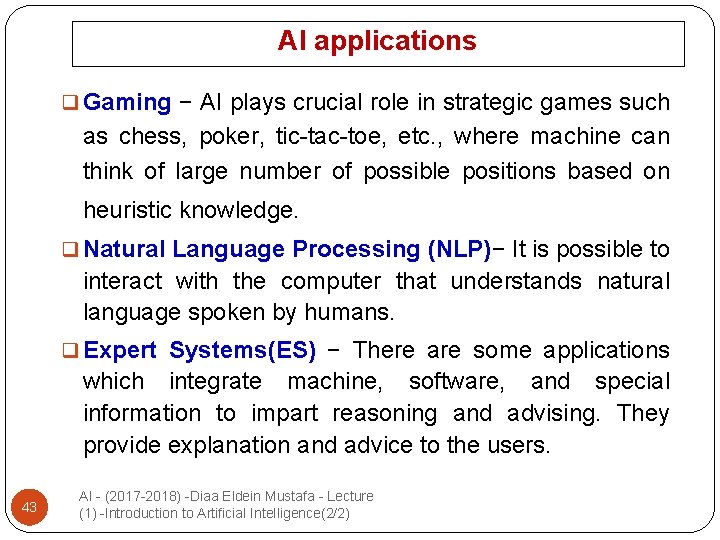
AI applications q Gaming − AI plays crucial role in strategic games such as chess, poker, tic-tac-toe, etc. , where machine can think of large number of possible positions based on heuristic knowledge. q Natural Language Processing (NLP)− It is possible to interact with the computer that understands natural language spoken by humans. q Expert Systems(ES) − There are some applications which integrate machine, software, and special information to impart reasoning and advising. They provide explanation and advice to the users. 43 AI - (2017 -2018) -Diaa Eldein Mustafa - Lecture (1) -Introduction to Artificial Intelligence(2/2)
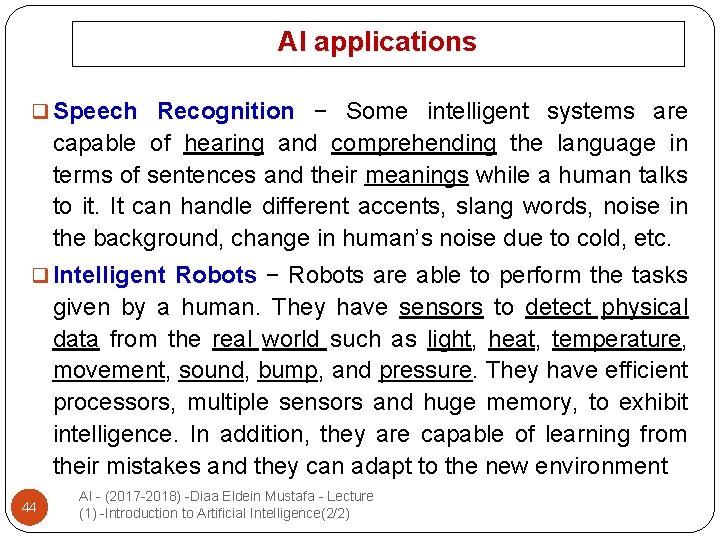
AI applications q Speech Recognition − Some intelligent systems are capable of hearing and comprehending the language in terms of sentences and their meanings while a human talks to it. It can handle different accents, slang words, noise in the background, change in human’s noise due to cold, etc. q Intelligent Robots − Robots are able to perform the tasks given by a human. They have sensors to detect physical data from the real world such as light, heat, temperature, movement, sound, bump, and pressure. They have efficient processors, multiple sensors and huge memory, to exhibit intelligence. In addition, they are capable of learning from their mistakes and they can adapt to the new environment 44 AI - (2017 -2018) -Diaa Eldein Mustafa - Lecture (1) -Introduction to Artificial Intelligence(2/2)
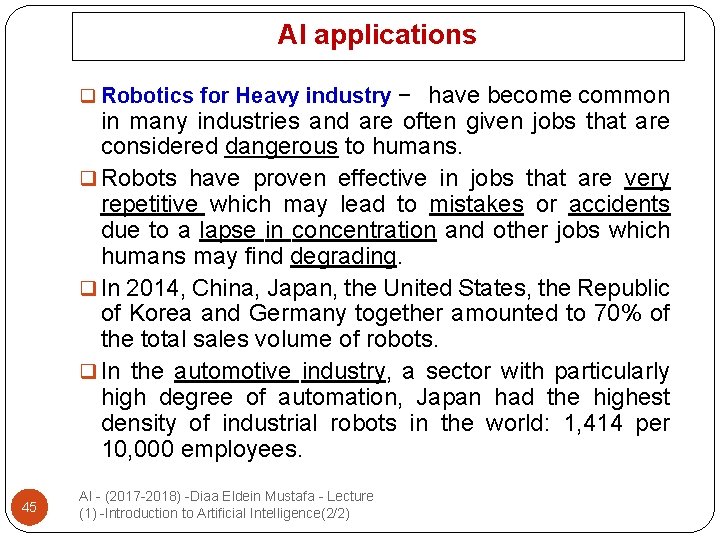
AI applications have become common in many industries and are often given jobs that are considered dangerous to humans. q Robots have proven effective in jobs that are very repetitive which may lead to mistakes or accidents due to a lapse in concentration and other jobs which humans may find degrading. q In 2014, China, Japan, the United States, the Republic of Korea and Germany together amounted to 70% of the total sales volume of robots. q In the automotive industry, a sector with particularly high degree of automation, Japan had the highest density of industrial robots in the world: 1, 414 per 10, 000 employees. q Robotics for Heavy industry − 45 AI - (2017 -2018) -Diaa Eldein Mustafa - Lecture (1) -Introduction to Artificial Intelligence(2/2)
AI applications q Smart Cars − You probably haven’t seen someone reading the newspaper while driving to work yet, but self-driving cars are moving closer and closer to reality; Google’s self-driving car project and Tesla’s “autopilot” feature are two examples that have been in the news lately. Earlier this year, the Washington Post reported on an algorithm developed by Google that could potentially let self-driving cars learn to drive in the same way that humans do: through experience. 46 AI - (2017 -2018) -Diaa Eldein Mustafa - Lecture (1) -Introduction to Artificial Intelligence(2/2)
AI applications News Generation − Did you know that artificial intelligence programs can write news stories? According to Wired, the AP, Fox, and Yahoo! all use AI to write simple stories like financial summaries, sports recaps, and fantasy sports reports. AI isn’t writing in-depth investigative articles, but it has no problem with very simple articles that don’t require a lot of synthesis. Automated Insights, the company behind the Wordsmith software, says that e-commerce, financial services, real estate, and other “data-driven” industries are already benefitting from the app. 47 AI - (2017 -2018) -Diaa Eldein Mustafa - Lecture (1) -Introduction to Artificial Intelligence(2/2)
AI applications q Machine Learning(ML): Is a type of artificial intelligence (AI) that allows software applications to become more accurate in predicting outcomes without being explicitly programmed. The basic premise of machine learning is to build algorithms that can receive input data and use statistical analysis to predict an output value within an acceptable range. q Automatic Programming: Is the generation of programs by computer, usually based on specifications that are higher-level and easier for humans to specify than ordinary programming languages. Automatic programming might be summarized as "Artificial Intelligence meets Compilers: " 48 AI - (2017 -2018) -Diaa Eldein Mustafa - Lecture (1) -Introduction to Artificial Intelligence(2/2)
AI applications q Human Performance Modeling (HPM) is a method of quantifying human behavior, cognition, and processes; a tool used by human factors researchers and practitioners for both the analysis of human function and for the development of systems designed for optimal user experience and interaction. q Data Mining and Data warehousing (Big –Data) 49 AI - (2017 -2018) -Diaa Eldein Mustafa - Lecture (1) -Introduction to Artificial Intelligence(2/2)
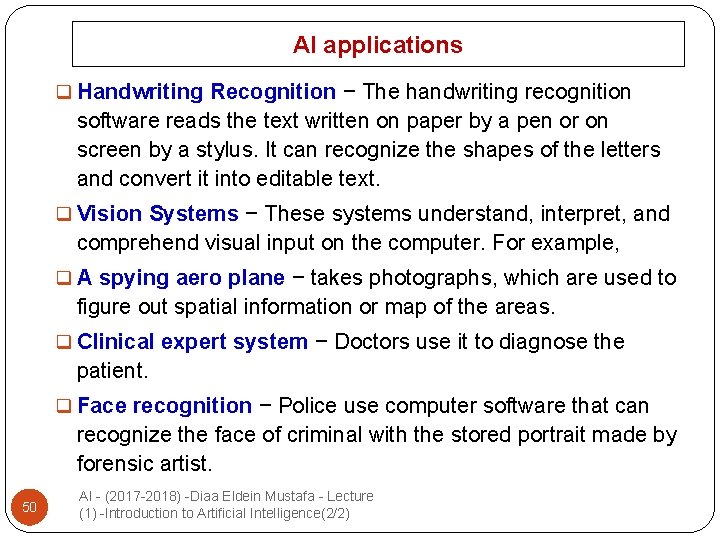
AI applications q Handwriting Recognition − The handwriting recognition software reads the text written on paper by a pen or on screen by a stylus. It can recognize the shapes of the letters and convert it into editable text. q Vision Systems − These systems understand, interpret, and comprehend visual input on the computer. For example, q A spying aero plane − takes photographs, which are used to figure out spatial information or map of the areas. q Clinical expert system − Doctors use it to diagnose the patient. q Face recognition − Police use computer software that can recognize the face of criminal with the stored portrait made by forensic artist. 50 AI - (2017 -2018) -Diaa Eldein Mustafa - Lecture (1) -Introduction to Artificial Intelligence(2/2)
51 AI - (2017 -2018) -Diaa Eldein Mustafa - Lecture (1) -Introduction to Artificial Intelligence(2/2)
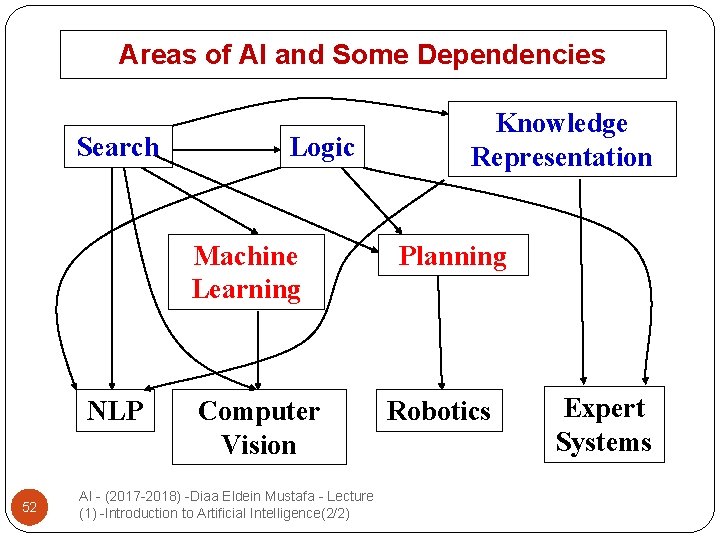
Areas of AI and Some Dependencies Search Logic Machine Learning NLP 52 Computer Vision AI - (2017 -2018) -Diaa Eldein Mustafa - Lecture (1) -Introduction to Artificial Intelligence(2/2) Knowledge Representation Planning Robotics Expert Systems
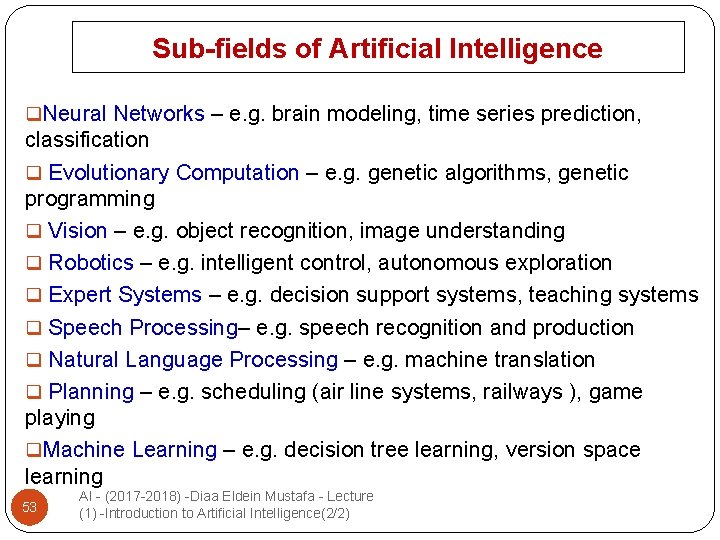
Sub-fields of Artificial Intelligence q. Neural Networks – e. g. brain modeling, time series prediction, classification q Evolutionary Computation – e. g. genetic algorithms, genetic programming q Vision – e. g. object recognition, image understanding q Robotics – e. g. intelligent control, autonomous exploration q Expert Systems – e. g. decision support systems, teaching systems q Speech Processing– e. g. speech recognition and production q Natural Language Processing – e. g. machine translation q Planning – e. g. scheduling (air line systems, railways ), game playing q. Machine Learning – e. g. decision tree learning, version space learning 53 AI - (2017 -2018) -Diaa Eldein Mustafa - Lecture (1) -Introduction to Artificial Intelligence(2/2)
Importance of AI q Game Playing q Speech Recognition q Understanding Natural Language q Computer Vision q Expert Systems q Heuristic Classification 54 AI - (2017 -2018) -Diaa Eldein Mustafa - Lecture (1) -Introduction to Artificial Intelligence(2/2)
Some Aspects of Artificial Intelligence Advantages q. More powerful and more useful computers q. New and improved interfaces q. Solving new problems q. Better handling of information q. Relieves information overload q. Conversion of information into knowledge Disadvantages q. Increased costs q. Difficulty with software development - slow and expensive q. Few experienced programmers q. Few practical products have reached the market as yet 55 AI - (2017 -2018) -Diaa Eldein Mustafa - Lecture (1) -Introduction to Artificial Intelligence(2/2)
Thank You End Questions ? 56 AI - (2017 -2018) -Diaa Eldein Mustafa - Lecture (0) -Introduction to Artificial Intelligence