
University of Pittsburgh Department of Biomedical Informatics Biomedical
University of Pittsburgh Department of Biomedical Informatics Biomedical Knowledge Navigation: Interactive tools for clinical and research insight Harry Hochheiser, Ph. D harryh@pitt. edu Assistant Professor Department of Biomedical Informatics Assistant Professor Intelligent Systems Program Director Biomedical Informatics Training Program Center for Causal Discovery (www. ccd. pitt. edu) University of Pittsburgh Buck Cash
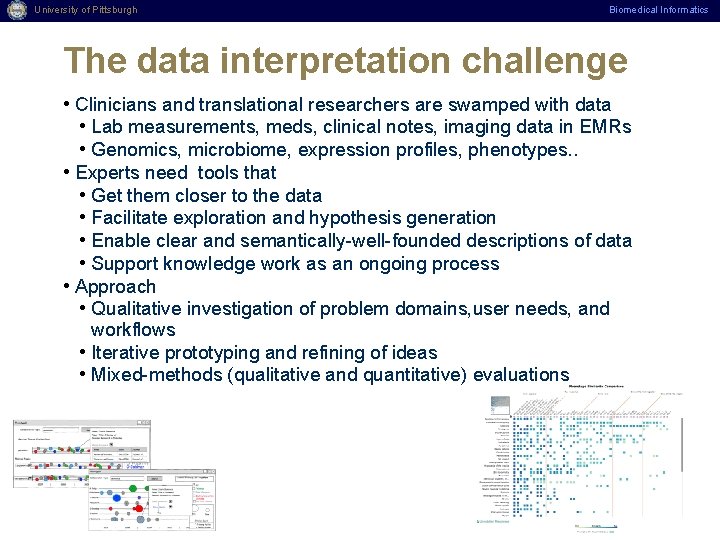
University of Pittsburgh Biomedical Informatics Department Name (Edit Master > Select Slide 1) The data interpretation challenge • Clinicians and translational researchers are swamped with data • Lab measurements, meds, clinical notes, imaging data in EMRs • Genomics, microbiome, expression profiles, phenotypes. . • Experts need tools that • Get them closer to the data • Facilitate exploration and hypothesis generation • Enable clear and semantically-well-founded descriptions of data • Support knowledge work as an ongoing process • Approach • Qualitative investigation of problem domains, user needs, and workflows • Iterative prototyping and refining of ideas • Mixed-methods (qualitative and quantitative) evaluations
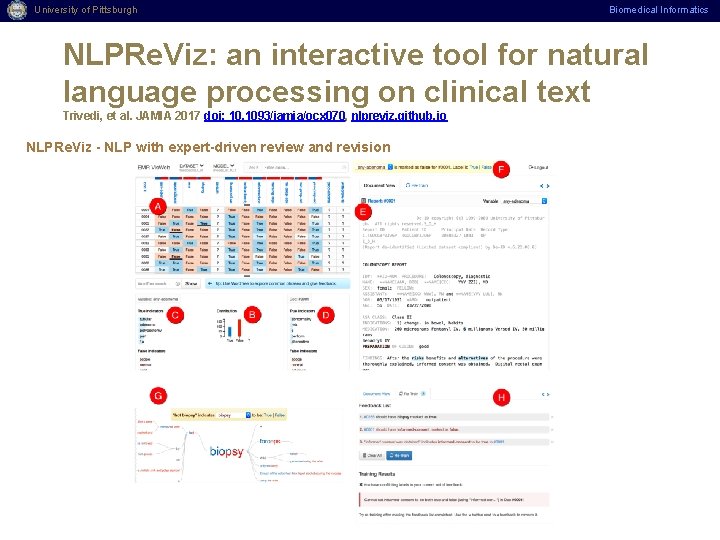
University of Pittsburgh Biomedical Informatics Department Name (Edit Master > Select Slide 1) NLPRe. Viz: an interactive tool for natural language processing on clinical text Trivedi, et al. JAMIA 2017 doi: 10. 1093/jamia/ocx 070, nlpreviz. github. io NLPRe. Viz - NLP with expert-driven review and revision
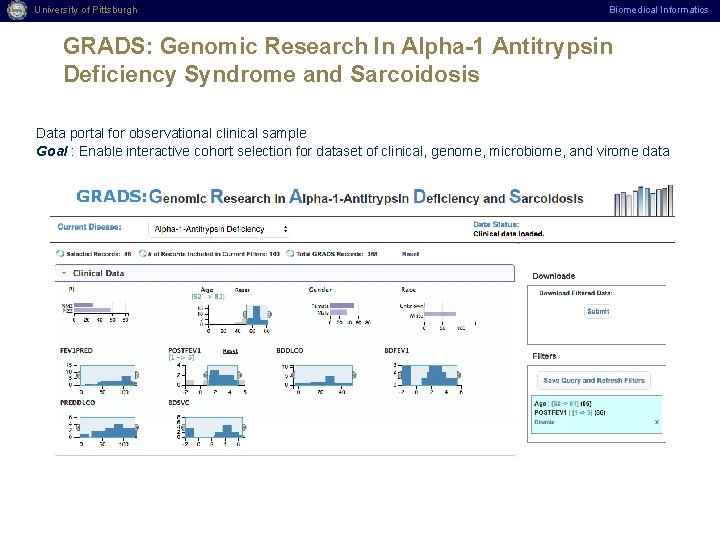
University of Pittsburgh Biomedical Informatics Department Name (Edit Master > Select Slide 1) GRADS: Genomic Research In Alpha-1 Antitrypsin Deficiency Syndrome and Sarcoidosis Data portal for observational clinical sample Goal : Enable interactive cohort selection for dataset of clinical, genome, microbiome, and virome data

University of Pittsburgh Biomedical Informatics Department Name (Edit Master > Select Slide 1) Clinical & Clinical Research Informatics Deep. Phe: Deep phenotyping of longitudinal cancer data extracted via NLP Goal : Develop multi-level data models for cancer progression and visual tools for cohort identification for retrospective studies Hochheiser, H, Castine M, Harris D, Savova G, Jacobson RS An Information Model for Cancer Phenotypes BMC Medical Informatics and Decision Making 2016 https: //doi. org/10. 1186/s 12911 -016 -0358 -4 Learning EMR: Use predictive models to identify and highlight items of interest to clinicians reviewing cases with EMRS, thus reducing cognitive load Goal : Explore and evaluate interface designs that will emphasize material predicted to be relevant without causing disorientation or blindness to relevant material King A, Cooper GF, Hochheiser H, Clermont G, Visweswaran S. Development and Preliminary Evaluation of a Prototype of a Learning Electronic Medical Record System. 2015 AMIA Annual Symposium; 2015 Nov 14 -18; San Francisco, California p. 1967 -1975. Best Student Paper King A, Hochheiser H, Visweswaran S, Clermont C, Cooper GF Eye-tracking for clinical decision support: A method to capture automatically what physicians are viewing in the EMR 2017 AMIA Joint Summits Best Student Paper, Clinical Research Informatics
University of Pittsburgh Biomedical Informatics Department Name (Edit Master > Select Slide 1) Other Current Projects Center for Causal Discovery: Advancing the application of causal discovery to biomedicine Goal : Tools and metadata support for reproducible causal analyses Addressing gaps in clinically useful evidence on drug-drug interactions: Developing improved tools for interpreting potential drug-drug interaction information Goal : Conduct inquiry into expert needs and workflows; design search engine over curated PDDI data. Quantifying Electronic Medical Record Usability to Improve Clinical Workflow: Using in-situ recording of clinician interactions with EMR during patient visits to understand factors influencing usability and perceived workflow Goal : Use understanding of EMR use in clinic to guide improved designs
University of Pittsburgh Biomedical Informatics Department Name (Edit Master > Select Slide 1) Grant Funding/Collaborations GRADS: 1 U 01 HL 112707, N. Kaminski (Yale, PI), S. Wiesnewski (Pitt), M. Becich (Pitt), A. Morris (Pitt), B. Methe (Pittt), E. Ghedin (NYU) Deep. Phe: 1 U 24 CA 184407, R. Jacobson (Pitt, co-PI), G. Savova (Boston Children’s Hospital, co-PI) Learning EMR: 1 R 01 LM 012095, S. Visweswaran (Pitt, PI), G. Cooper (Pitt), G. Clermont (Pitt), M. Hauskrecht (Pitt) Center for Causal Discovery: U 54 HG 008540, G. Cooper (Pitt, co-PI), I. Bahar (Pitt, co-PI), C. Glymour (CMU), R. Scheines (CMU), many others… Addressing gaps in clinically useful evidence on drug-drug interactions: 1 R 01 LM 011838 -01, R. Boyce (PI, Pitt) Quantifying Electronic Medical Record Usability to Improve Clinical Workflow: 5 R 01 HS 021290, Z. Agha (West Health Foundation & UCSD, PI), C. Weir (Utah), N. Weibel (UCSD), Y. Chen (UC Irvine). R Street (Texas A&M) Other Collaborators: W. Chapman (Utah), R. Hwa (Pitt), J. Wiebe (Pitt), P. Empey (Pitt)
- Slides: 7