
University of Pittsburgh Chemical Diversity Center The University
University of Pittsburgh Chemical Diversity Center The University of Pittsburgh Chemical Diversity Center: Using Chemistry to Discovery Novel Cancer Therapeutics Donna M. Huryn, Ph. D. CBC Kick-off Meeting August 10, 2009
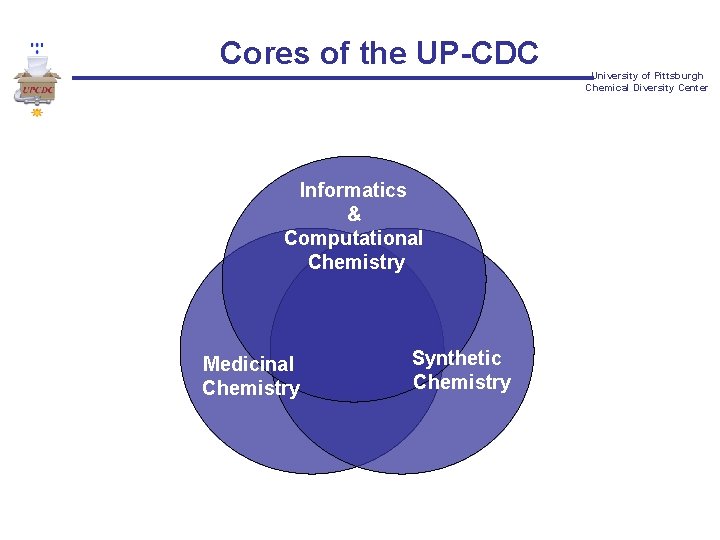
Cores of the UP-CDC Informatics & Computational Chemistry Medicinal Chemistry Synthetic Chemistry University of Pittsburgh Chemical Diversity Center

UP-CDC Structure and Capabilities University of Pittsburgh Chemical Diversity Center • Chem-informatics • Hit validation & triage • Virtual screening • Hit-to-lead activities • Pharmacophore modeling • Design & synthesis for SAR & • QSAR/ QPSR SPR development • In silico ADME/Tox modeling • Design to address ADME/Tox & predictions deficiencies • In silico library enumeration • Labeled probes/ analogs • Diversity analysis • Library design & docking • Structure-based drug design • Synthesis methodology & route development • Library synthesis • Natural products chemistry • Analytical chemistry support • Compound storage, handling & shipping • Scale-up synthesis
Ongoing UP-CDC Projects • Natural Products – Dictyostatin* – Tubulysin; Disorazoles – Wortmannin • • • Hsp 70 Modulators Protein Kinase D* Tubulin* Dusp 6* Protein-Protein Interactions – Myc-Max Antagonists* – Bcl-Bax Antagonists – P 53 -MDM 2/MDM 4 Antagonists* * posters University of Pittsburgh Chemical Diversity Center
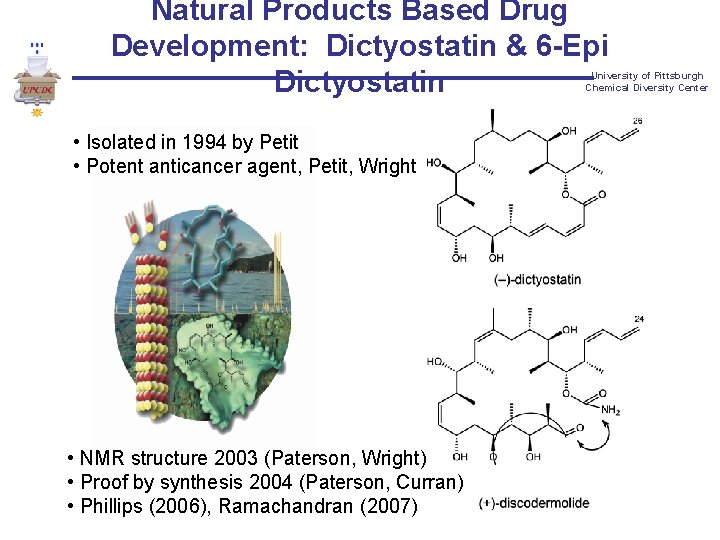
Natural Products Based Drug Development: Dictyostatin & 6 -Epi Dictyostatin University of Pittsburgh Chemical Diversity Center • Isolated in 1994 by Petit • Potent anticancer agent, Petit, Wright • NMR structure 2003 (Paterson, Wright) • Proof by synthesis 2004 (Paterson, Curran) • Phillips (2006), Ramachandran (2007)
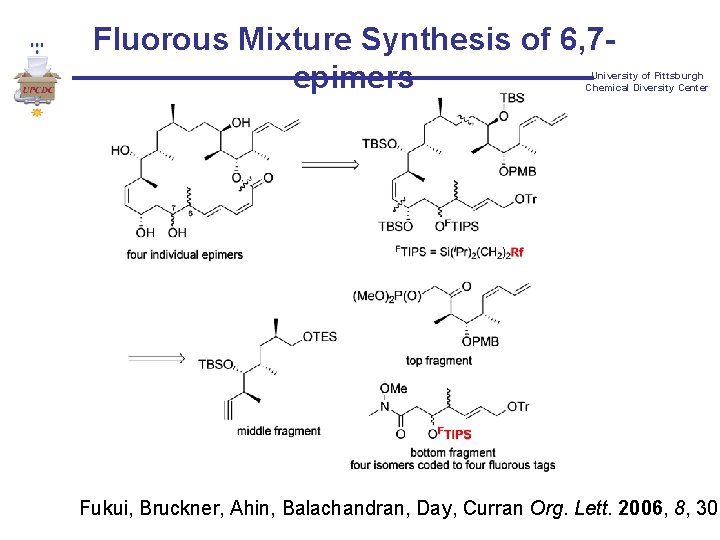
Fluorous Mixture Synthesis of 6, 7 epimers University of Pittsburgh Chemical Diversity Center Fukui, Bruckner, Ahin, Balachandran, Day, Curran Org. Lett. 2006, 8, 301
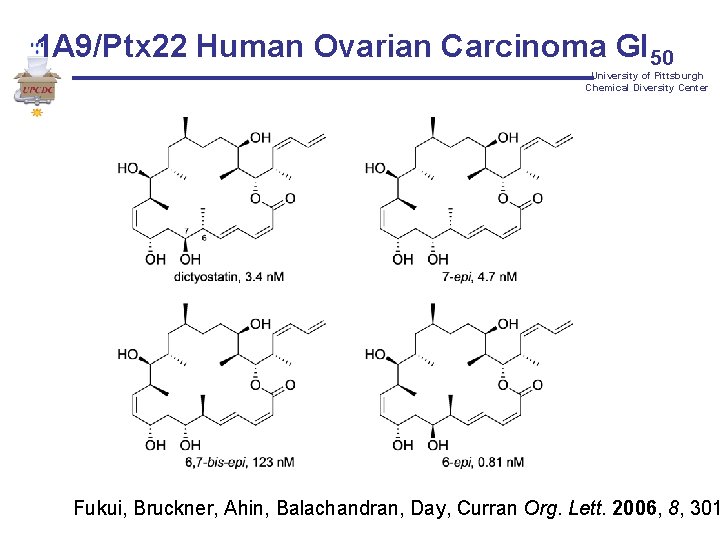
1 A 9/Ptx 22 Human Ovarian Carcinoma GI 50 University of Pittsburgh Chemical Diversity Center Fukui, Bruckner, Ahin, Balachandran, Day, Curran Org. Lett. 2006, 8, 301
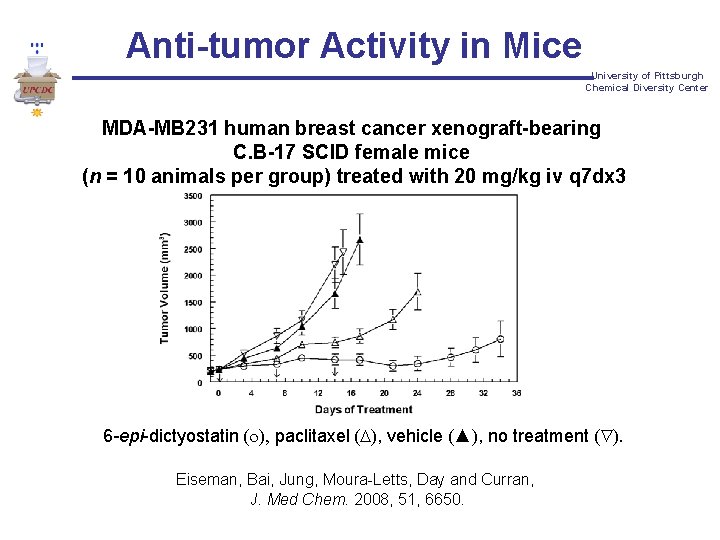
Anti-tumor Activity in Mice University of Pittsburgh Chemical Diversity Center MDA-MB 231 human breast cancer xenograft-bearing C. B-17 SCID female mice (n = 10 animals per group) treated with 20 mg/kg iv q 7 dx 3 6 -epi-dictyostatin ( ), paclitaxel ( ), vehicle (▲), no treatment ( ). Eiseman, Bai, Jung, Moura-Letts, Day and Curran, J. Med Chem. 2008, 51, 6650.
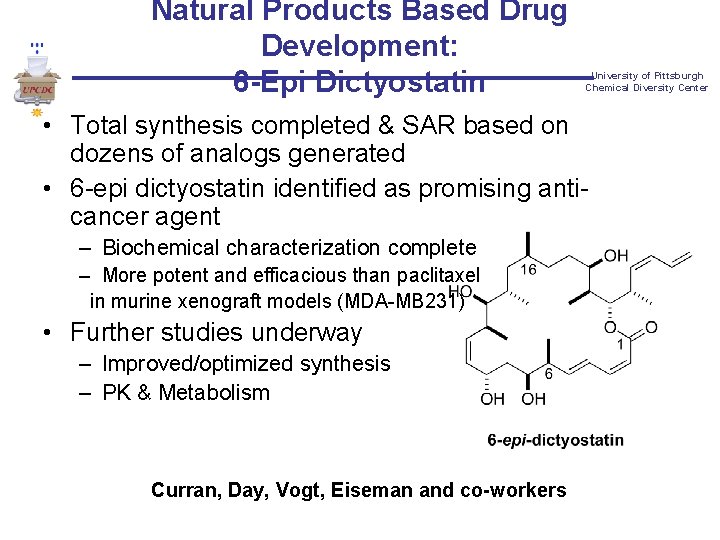
Natural Products Based Drug Development: 6 -Epi Dictyostatin University of Pittsburgh Chemical Diversity Center • Total synthesis completed & SAR based on dozens of analogs generated • 6 -epi dictyostatin identified as promising anticancer agent – Biochemical characterization complete – More potent and efficacious than paclitaxel in murine xenograft models (MDA-MB 231) • Further studies underway – Improved/optimized synthesis – PK & Metabolism Curran, Day, Vogt, Eiseman and co-workers
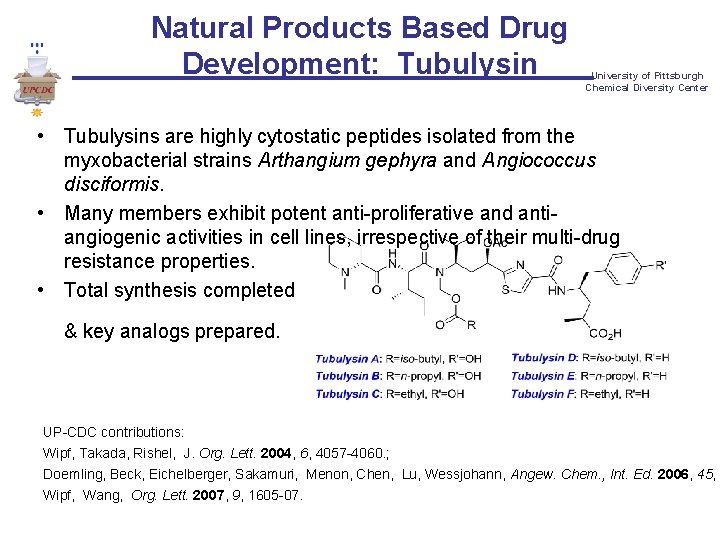
Natural Products Based Drug Development: Tubulysin University of Pittsburgh Chemical Diversity Center • Tubulysins are highly cytostatic peptides isolated from the myxobacterial strains Arthangium gephyra and Angiococcus disciformis. • Many members exhibit potent anti-proliferative and antiangiogenic activities in cell lines, irrespective of their multi-drug resistance properties. • Total synthesis completed & key analogs prepared. UP-CDC contributions: Wipf, Takada, Rishel, J. Org. Lett. 2004, 6, 4057 -4060. ; Doemling, Beck, Eichelberger, Sakamuri, Menon, Chen, Lu, Wessjohann, Angew. Chem. , Int. Ed. 2006, 45, Wipf, Wang, Org. Lett. 2007, 9, 1605 -07.
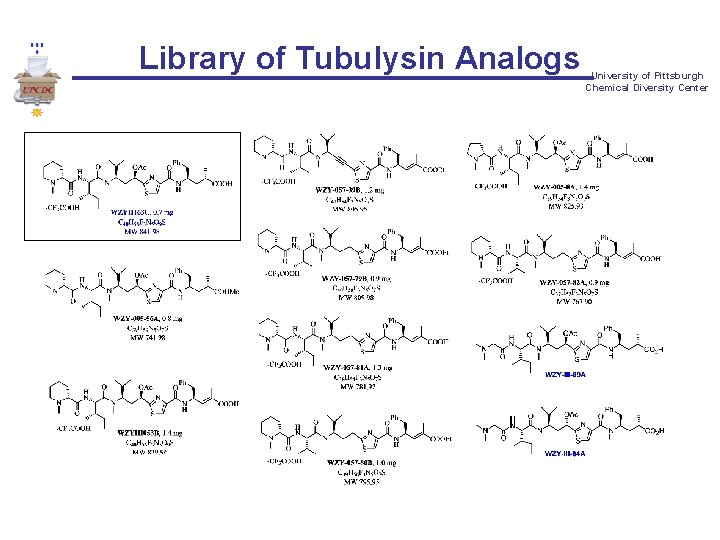
Library of Tubulysin Analogs University of Pittsburgh Chemical Diversity Center
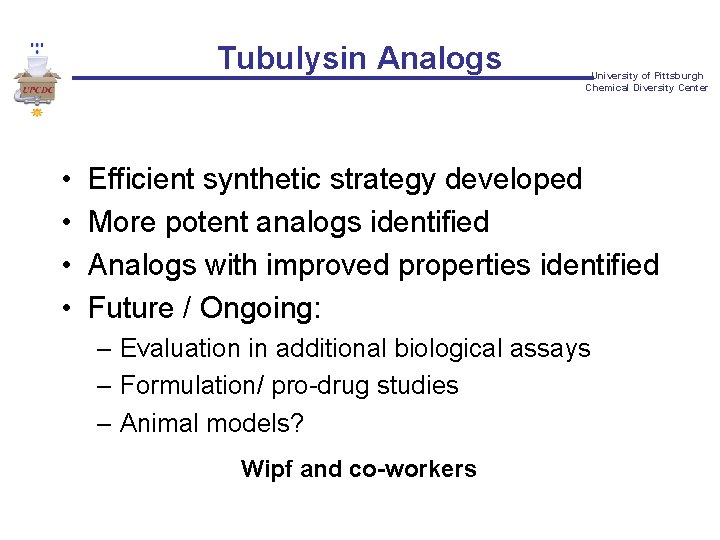
Tubulysin Analogs • • University of Pittsburgh Chemical Diversity Center Efficient synthetic strategy developed More potent analogs identified Analogs with improved properties identified Future / Ongoing: – Evaluation in additional biological assays – Formulation/ pro-drug studies – Animal models? Wipf and co-workers
Designing Chemical Probes: Heat Shock Protein (Hsp) 70 University of Pittsburgh Chemical Diversity Center §Hsp 70 s play essential roles during: §Protein Folding, Assembly, Targeting and Transport §Implicated in a variety of pathological conditions §Viruses: Hep B, Papillomavirus, HSV Polyoma Virus §Parasites: Trypanosoma, Plasmodium falciparum §Neurodegenerative & Protein-conformational diseases: §Huntington’s, Parkinson’s, Ataxias §Cancer §Gene expression & over-expression associated with various cancers §Hsp 70 inhibition triggers tumor-specific apoptosis §Hsp 70 over-expression in breast cancer tissues correlates with increased resistance and poor prognosis
Role of MAL 3 -101 & Hsp 70 in Apoptotic Pathway University of Pittsburgh Chemical Diversity Center Rodina, G; Vilenchik, M. ; Chiosis, G. et al, Nature Chem. Biol. 2007, 3, 498 -50
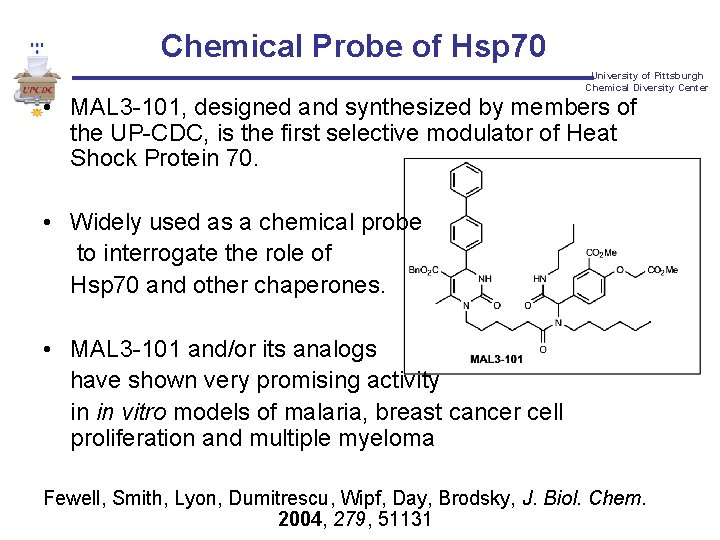
Chemical Probe of Hsp 70 University of Pittsburgh Chemical Diversity Center • MAL 3 -101, designed and synthesized by members of the UP-CDC, is the first selective modulator of Heat Shock Protein 70. • Widely used as a chemical probe to interrogate the role of Hsp 70 and other chaperones. • MAL 3 -101 and/or its analogs have shown very promising activity in in vitro models of malaria, breast cancer cell proliferation and multiple myeloma Fewell, Smith, Lyon, Dumitrescu, Wipf, Day, Brodsky, J. Biol. Chem. 2004, 279, 51131
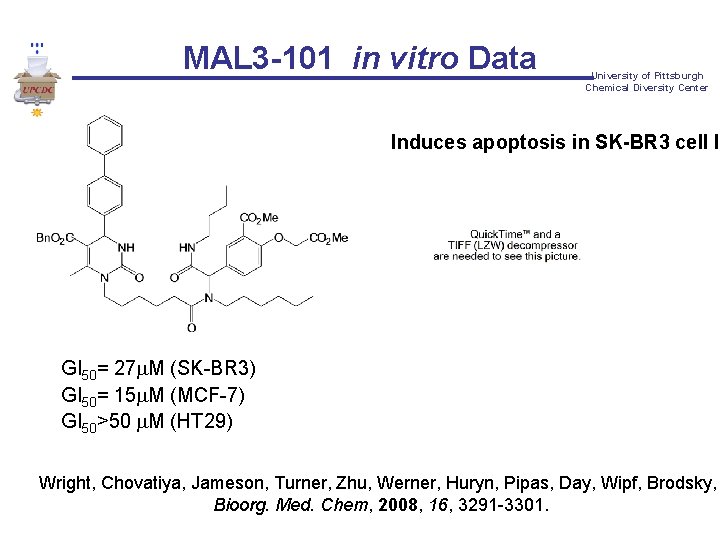
MAL 3 -101 in vitro Data University of Pittsburgh Chemical Diversity Center Induces apoptosis in SK-BR 3 cell li GI 50= 27 M (SK-BR 3) GI 50= 15 M (MCF-7) GI 50>50 M (HT 29) Wright, Chovatiya, Jameson, Turner, Zhu, Werner, Huryn, Pipas, Day, Wipf, Brodsky, Bioorg. Med. Chem, 2008, 16, 3291 -3301.
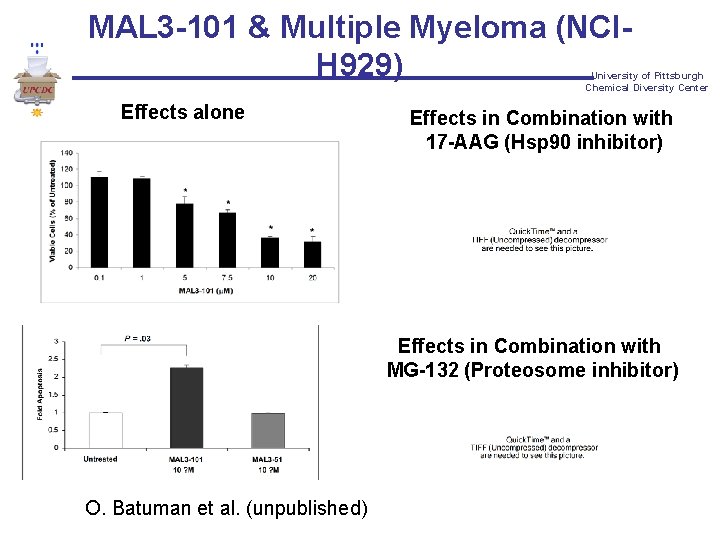
MAL 3 -101 & Multiple Myeloma (NCIH 929) University of Pittsburgh Chemical Diversity Center Effects alone Effects in Combination with 17 -AAG (Hsp 90 inhibitor) Effects in Combination with MG-132 (Proteosome inhibitor) O. Batuman et al. (unpublished)
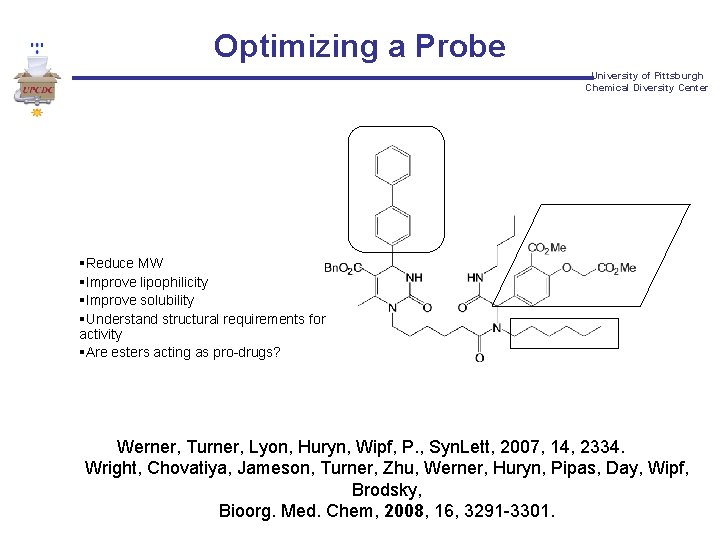
Optimizing a Probe University of Pittsburgh Chemical Diversity Center §Reduce MW §Improve lipophilicity §Improve solubility §Understand structural requirements for activity §Are esters acting as pro-drugs? Werner, Turner, Lyon, Huryn, Wipf, P. , Syn. Lett, 2007, 14, 2334. Wright, Chovatiya, Jameson, Turner, Zhu, Werner, Huryn, Pipas, Day, Wipf, Brodsky, Bioorg. Med. Chem, 2008, 16, 3291 -3301.

Library Design University of Pittsburgh Chemical Diversity Center
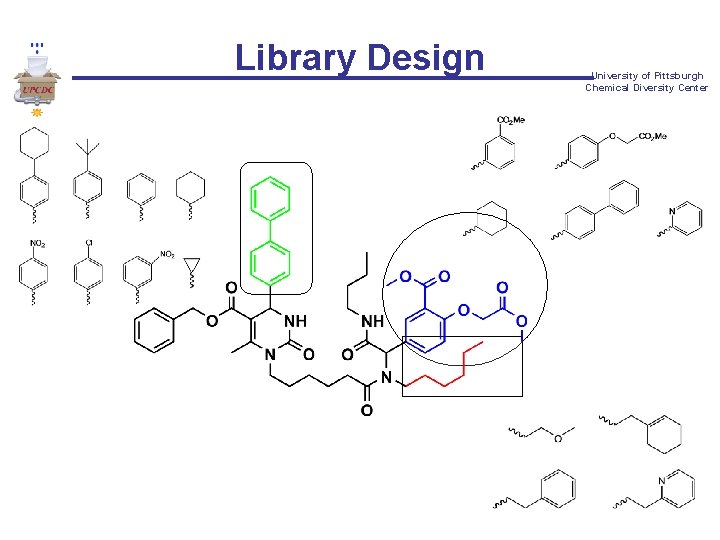
Library Design University of Pittsburgh Chemical Diversity Center
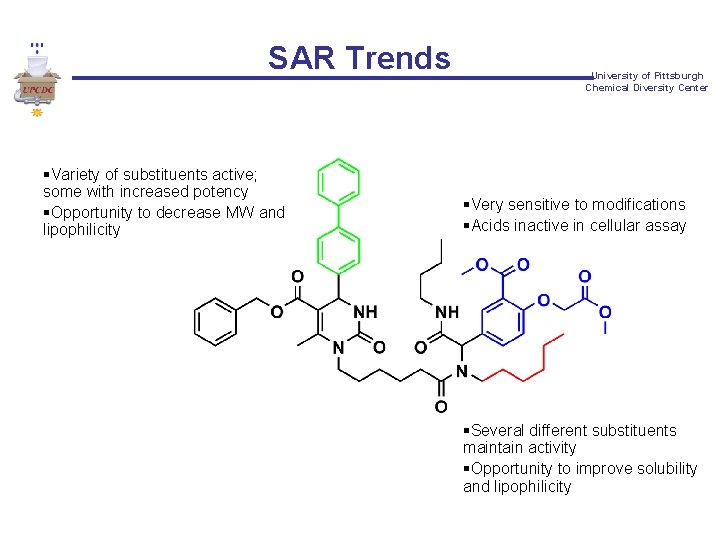
SAR Trends §Variety of substituents active; some with increased potency §Opportunity to decrease MW and lipophilicity University of Pittsburgh Chemical Diversity Center §Very sensitive to modifications §Acids inactive in cellular assay §Several different substituents maintain activity §Opportunity to improve solubility and lipophilicity
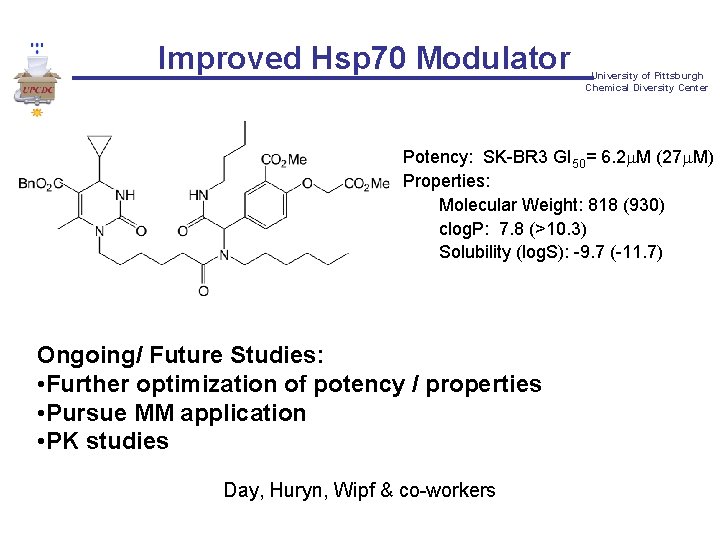
Improved Hsp 70 Modulator University of Pittsburgh Chemical Diversity Center Potency: SK-BR 3 GI 50= 6. 2 M (27 M) Properties: Molecular Weight: 818 (930) clog. P: 7. 8 (>10. 3) Solubility (log. S): -9. 7 (-11. 7) Ongoing/ Future Studies: • Further optimization of potency / properties • Pursue MM application • PK studies Day, Huryn, Wipf & co-workers
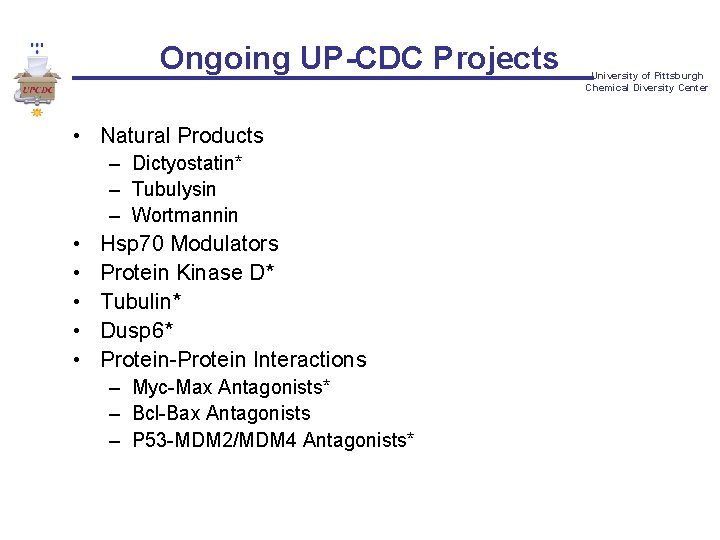
Ongoing UP-CDC Projects • Natural Products – Dictyostatin* – Tubulysin – Wortmannin • • • Hsp 70 Modulators Protein Kinase D* Tubulin* Dusp 6* Protein-Protein Interactions – Myc-Max Antagonists* – Bcl-Bax Antagonists – P 53 -MDM 2/MDM 4 Antagonists* University of Pittsburgh Chemical Diversity Center
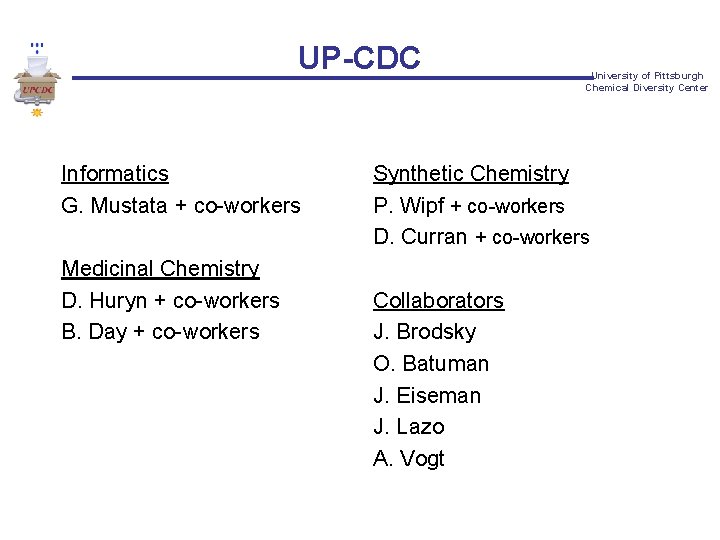
UP-CDC Informatics G. Mustata + co-workers Medicinal Chemistry D. Huryn + co-workers B. Day + co-workers University of Pittsburgh Chemical Diversity Center Synthetic Chemistry P. Wipf + co-workers D. Curran + co-workers Collaborators J. Brodsky O. Batuman J. Eiseman J. Lazo A. Vogt
- Slides: 24