
University of Pittsburgh Cathedral of Learning Americas Smartest

University of Pittsburgh Cathedral of Learning America’s Smartest City by Movoto Blog Rated Most Livable City by Places Rated Almanac and The Economist Named among Best in the World Places to Visit by National Geographic Traveler

Basic Introduction to Electrochemical Cells and Methods David H. Waldeck Department of Chemistry University of Pittsburgh

Chevron Science Center Chevron Annex Ashe Eberly Hall Website: http: //www. chem. pitt. edu/
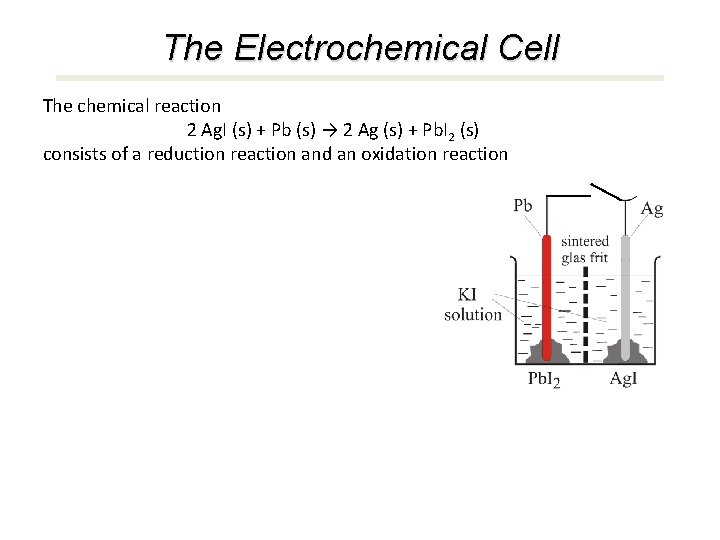
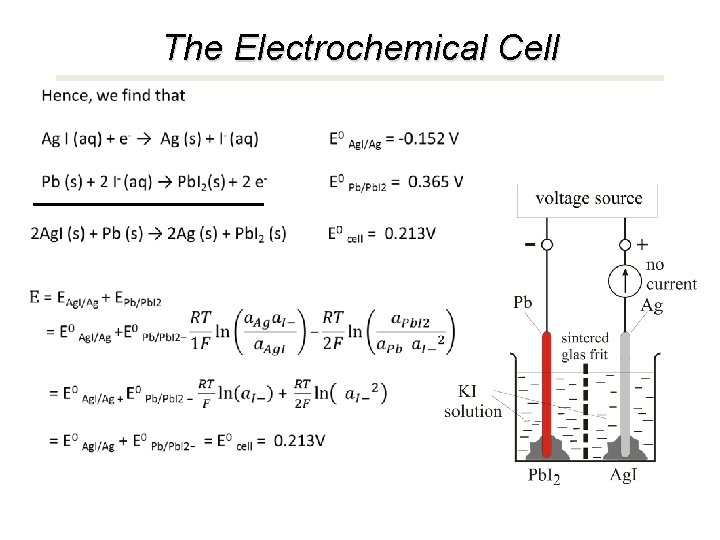
The Electrochemical Cell The chemical reaction An electrochemical cell is a device that transduces energy 2 Ag. I (s) + Pb (s) → 2 Ag (s) + Pb. I 2 (s) between chemical and electrical forms. consists of a reduction reaction and an oxidation reaction An electrochemical cell has at least two electrodes and an electrolyte, as such both ion and electron transport are important to consider.
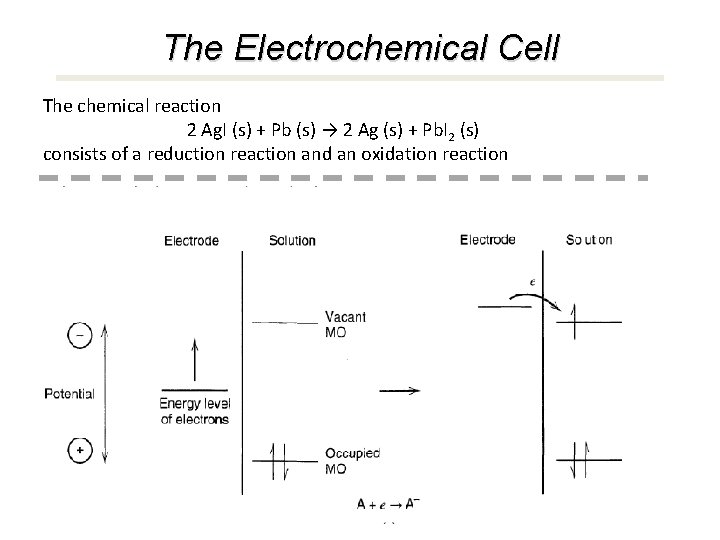
The Electrochemical Cell The chemical reaction 2 Ag. I (s) + Pb (s) → 2 Ag (s) + Pb. I 2 (s) consists of a reduction reaction and an oxidation reaction Absolute temperature Molar gas constant activity =1 standard potential Faraday’s constant # of electrons transferred in the reaction
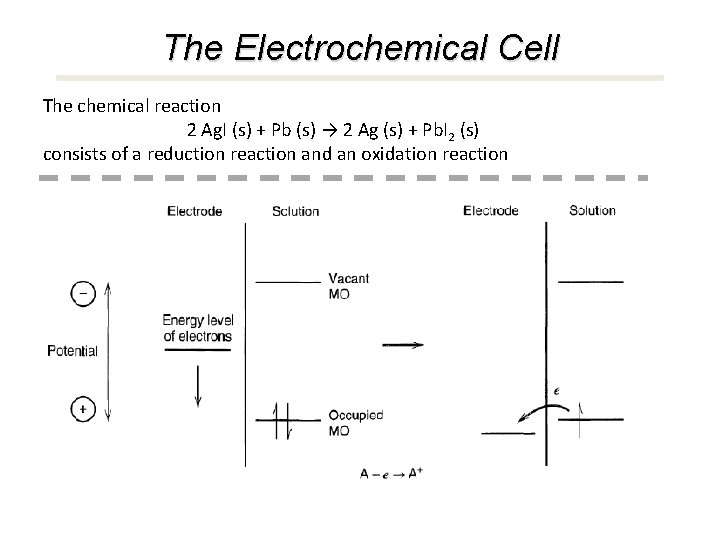
The Electrochemical Cell The chemical reaction 2 Ag. I (s) + Pb (s) → 2 Ag (s) + Pb. I 2 (s) consists of a reduction reaction and an oxidation reaction activity =1 standard potential # of electrons transferred in the reaction
The Electrochemical Cell
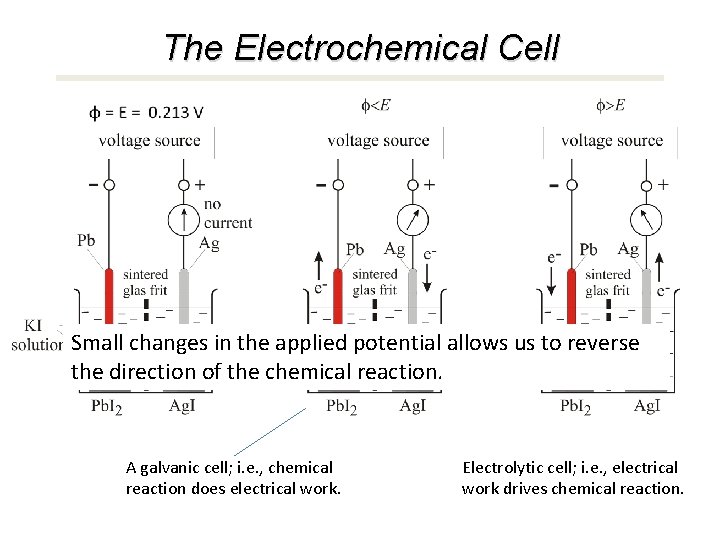
The Electrochemical Cell Small changes in the applied potential allows us to reverse the direction of the chemical reaction. A galvanic cell; i. e. , chemical reaction does electrical work. Electrolytic cell; i. e. , electrical work drives chemical reaction.
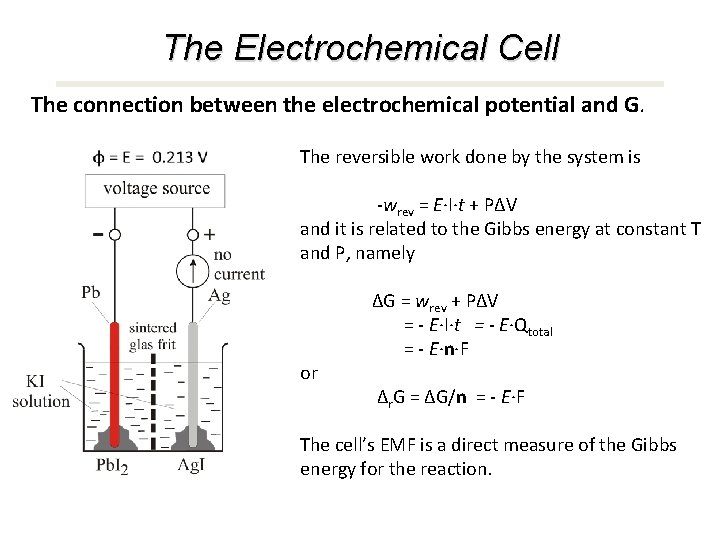
The Electrochemical Cell The connection between the electrochemical potential and G. The reversible work done by the system is -wrev = E∙I∙t + PΔV and it is related to the Gibbs energy at constant T and P, namely or ΔG = wrev + PΔV = - E∙I∙t = - E∙Qtotal = - E∙n∙F Δr. G = ΔG/n = - E∙F The cell’s EMF is a direct measure of the Gibbs energy for the reaction.
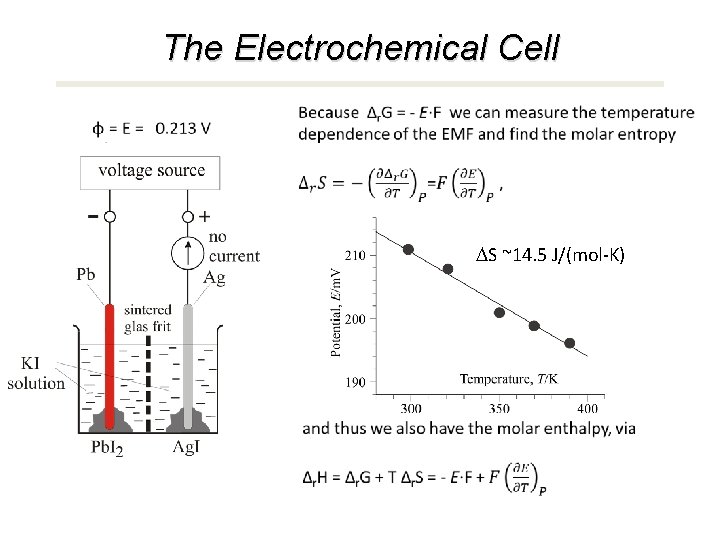
The Electrochemical Cell DS ~14. 5 J/(mol-K)
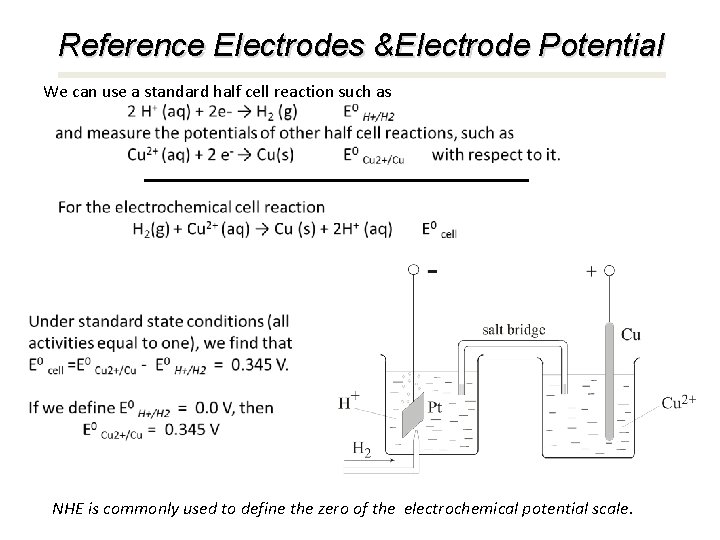
Reference Electrodes &Electrode Potential We can use a standard half cell reaction such as NHE is commonly used to define the zero of the electrochemical potential scale.
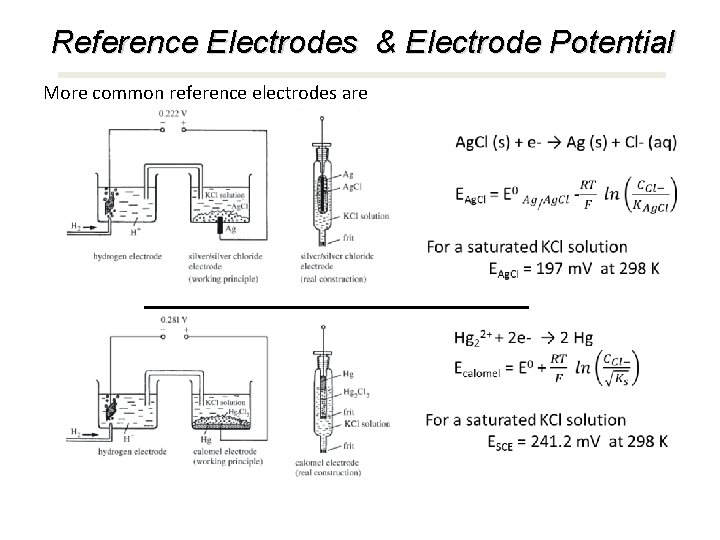
Reference Electrodes & Electrode Potential More common reference electrodes are
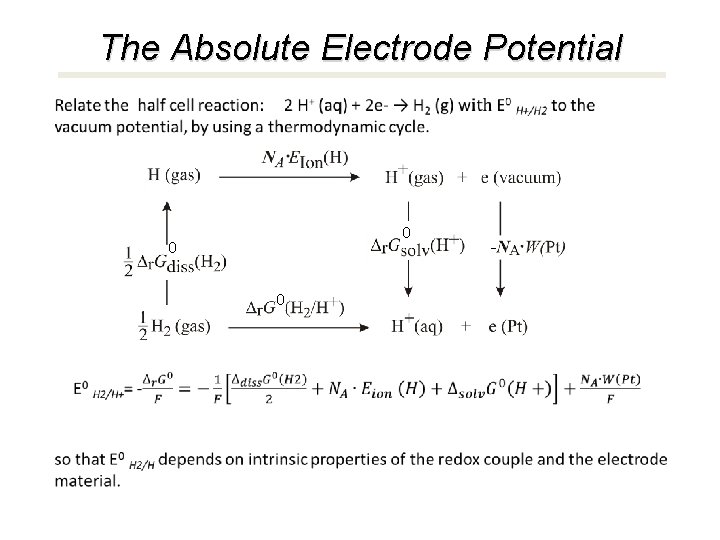
The Absolute Electrode Potential 0 0 0
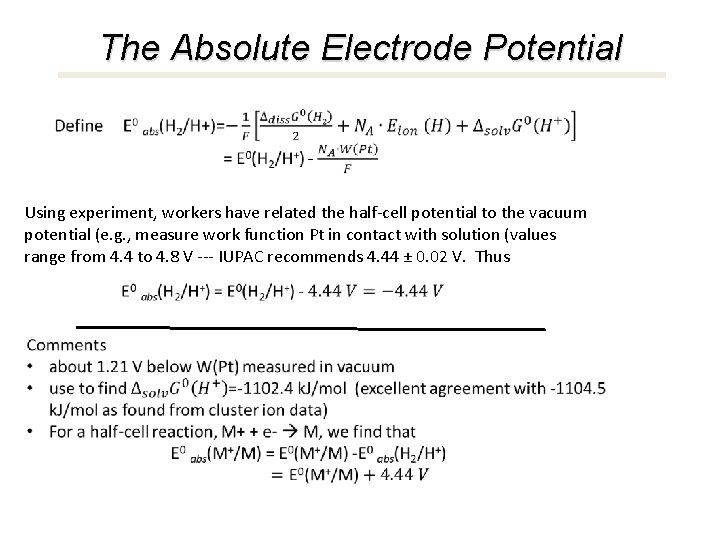
The Absolute Electrode Potential Using experiment, workers have related the half-cell potential to the vacuum potential (e. g. , measure work function Pt in contact with solution (values range from 4. 4 to 4. 8 V --- IUPAC recommends 4. 44 ± 0. 02 V. Thus

Potentiometry: Equilibrium Measurements No current flows and system at equilibrium. Potential provides information on • Gibbs energy, entropy, etc. • Nernst Equation • Activities of ions, such as p. H, etc. • Concentration cells • Activity coefficients and solution thermodynamics • Equilibrium constants • Titrations • Solubility products • Fuel cell and battery energetics
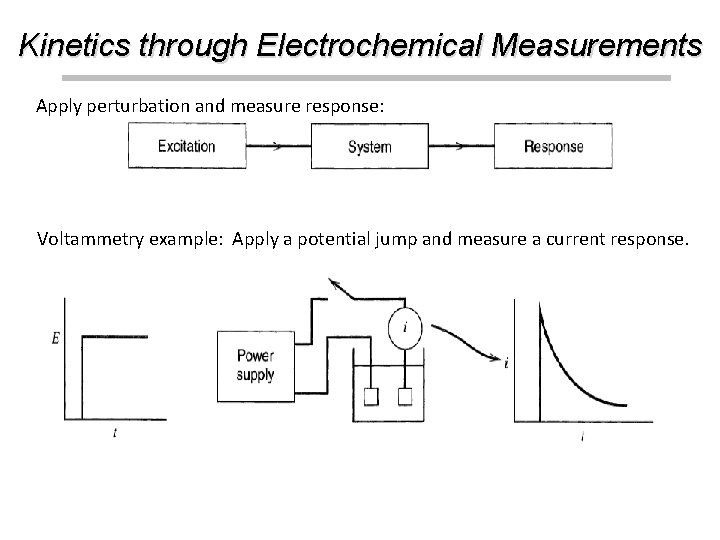
Kinetics through Electrochemical Measurements Apply perturbation and measure response: Voltammetry example: Apply a potential jump and measure a current response.
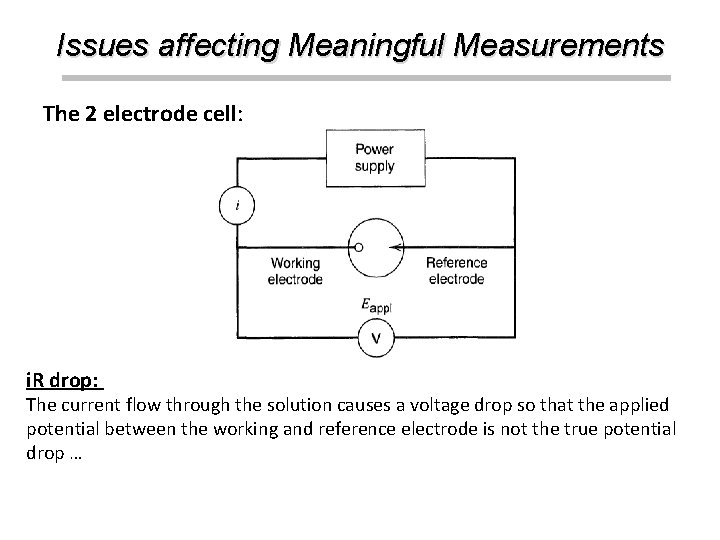
Issues affecting Meaningful Measurements The 2 electrode cell: i. RCurrent drop: can affect Reference Electrode Potential The current flow through the solution causes a voltage drop so that the applied potential between the working and reference electrode is not the true potential drop …
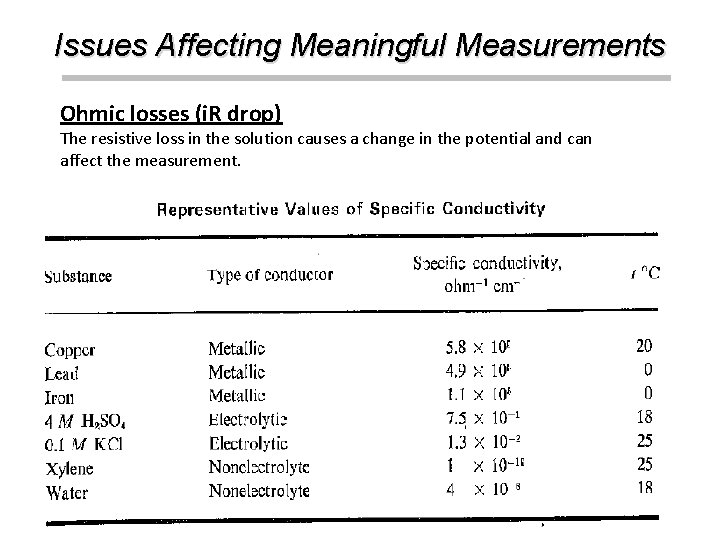
Issues Affecting Meaningful Measurements Ohmic losses (i. R drop) The resistive loss in the solution causes a change in the potential and can affect the measurement. current source Electron current, Ie, is flowing in the metal wires, while ion current, Iion, is flowing in the cell. In total Iion=Ie
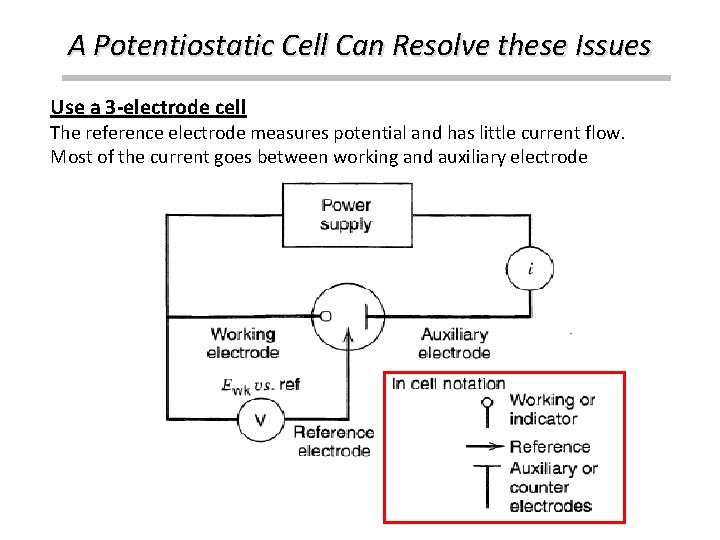
A Potentiostatic Cell Can Resolve these Issues Use a 3 -electrode cell The reference electrode measures potential and has little current flow. Most of the current goes between working and auxiliary electrode
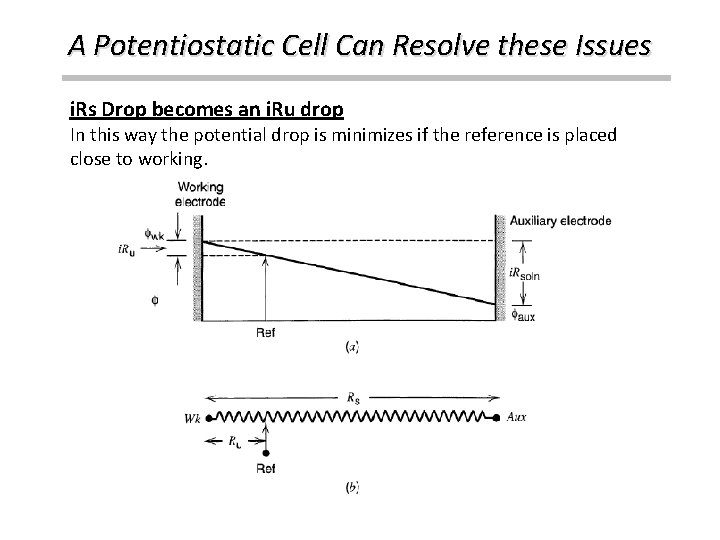
A Potentiostatic Cell Can Resolve these Issues i. Rs Drop becomes an i. Ru drop In this way the potential drop is minimizes if the reference is placed close to working.
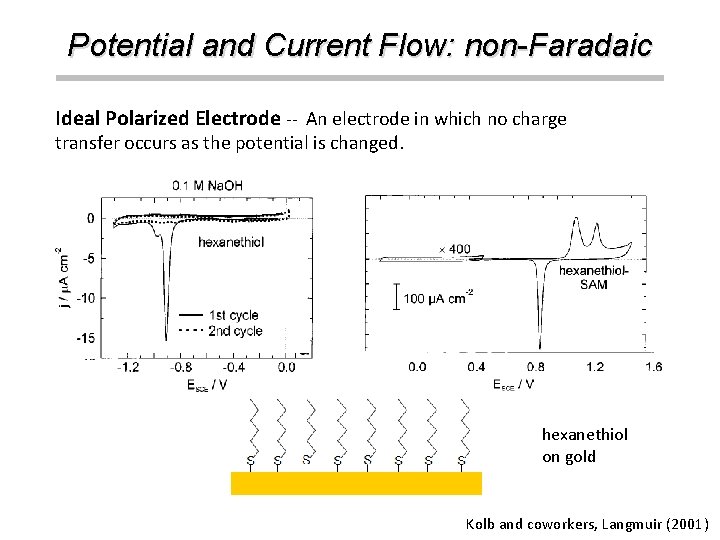
Potential and Current Flow: non-Faradaic Ideal Polarized Electrode -- An electrode in which no charge transfer occurs as the potential is changed. Some electrodes approximate over limited ranges: • Hg electrode over 2 V range in KCl solution • Hg oxidation at +0. 25 V versus NHE • K+ reduction at -2. 1 V versus NHE • Note that H 2 O reduction is kinetically slow and does not interfere • Gold • Pt • Gold SAMs hexanethiol on gold Kolb and coworkers, Langmuir (2001)
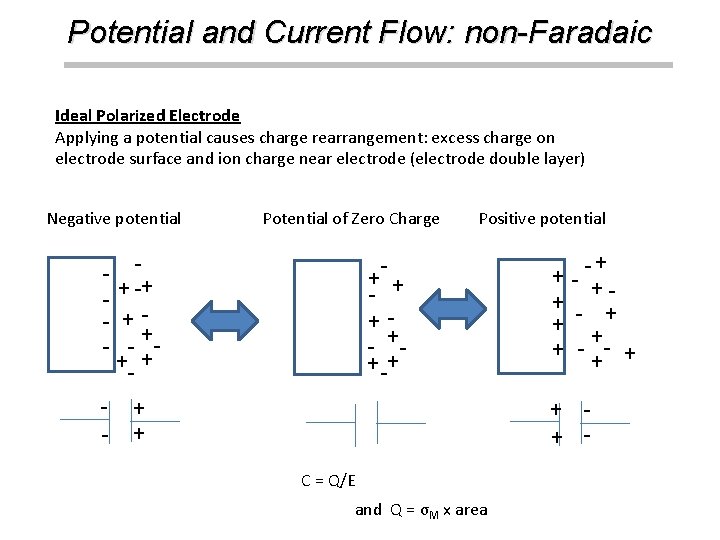
Potential and Current Flow: non-Faradaic Ideal Polarized Electrode Applying a potential causes charge rearrangement: excess charge on electrode surface and ion charge near electrode (electrode double layer) Negative potential Potential of Zero Charge - -+ - +- + +- - ++ - + Positive potential +- ++ -+ + + - ++ + - +- + + + - C = Q/E and Q = σM x area
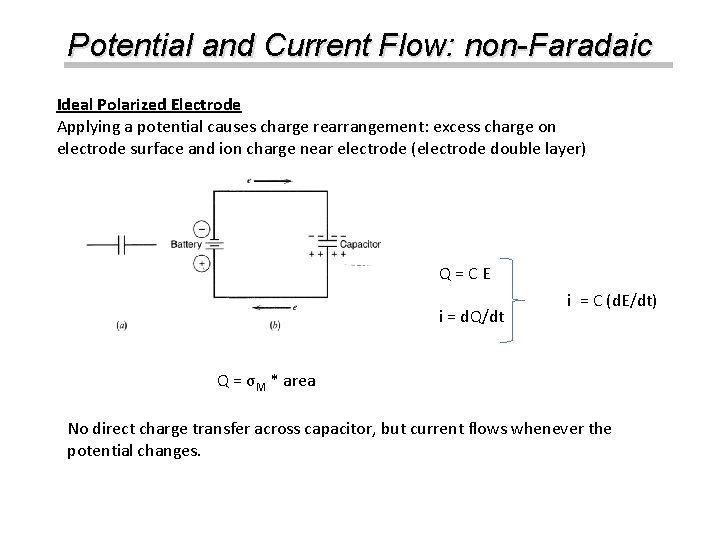
Potential and Current Flow: non-Faradaic Ideal Polarized Electrode Applying a potential causes charge rearrangement: excess charge on electrode surface and ion charge near electrode (electrode double layer) Q = C E i = d. Q/dt i = C (d. E/dt) Q = σM * area No direct charge transfer across capacitor, but current flows whenever the potential changes.
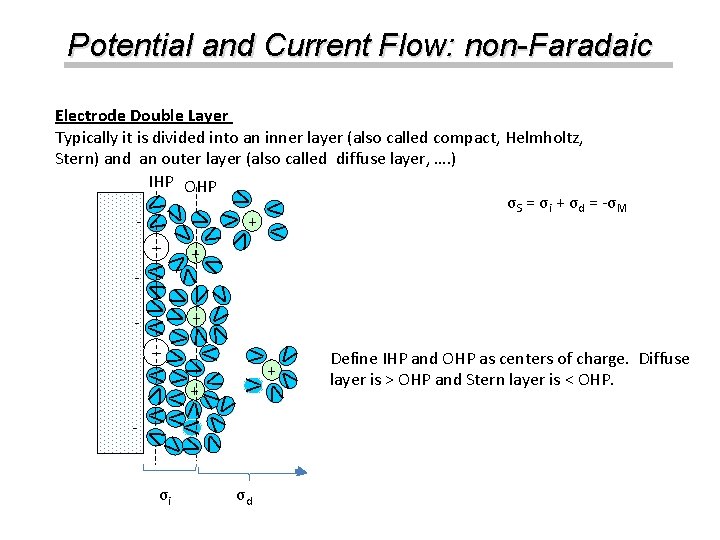
Potential and Current Flow: non-Faradaic VV V V + VV V V V + V V VV V σi V V V + V V VV VV – - V V VV Electrode Double Layer Typically it is divided into an inner layer (also called compact, Helmholtz, Stern) and an outer layer (also called diffuse layer, …. ) IHP OHP σS = σi + σd = -σM V + – V+ σd Define IHP and OHP as centers of charge. Diffuse layer is > OHP and Stern layer is < OHP.
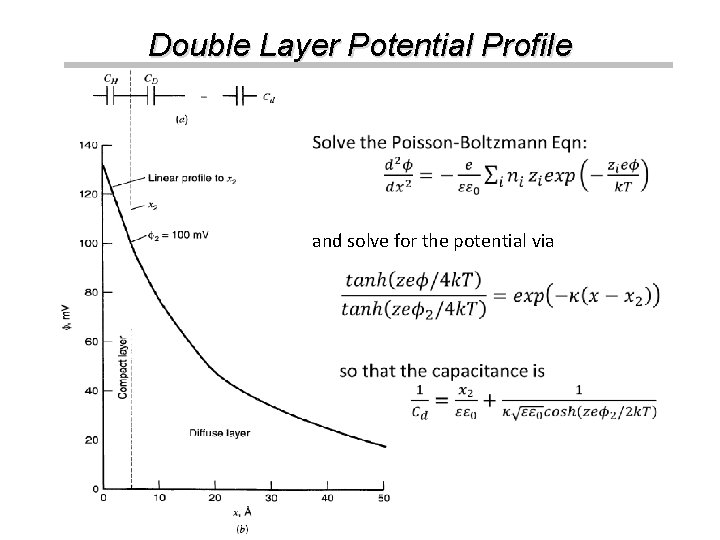
Double Layer Potential Profile and solve for the potential via
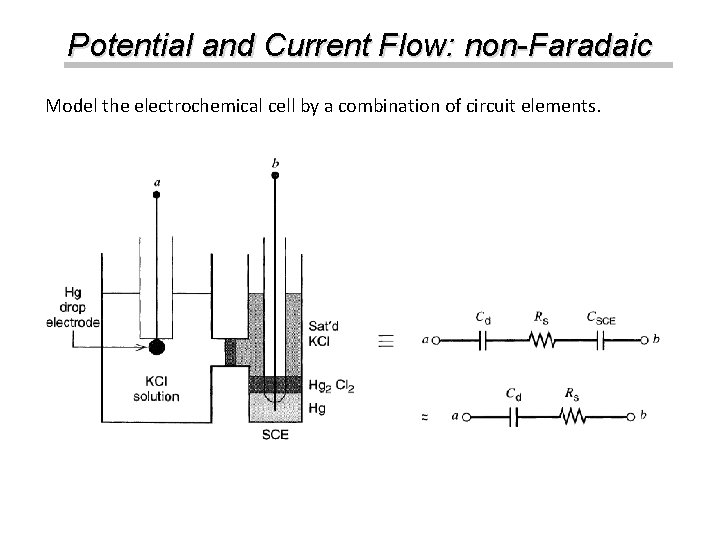
Potential and Current Flow: non-Faradaic Model the electrochemical cell by a combination of circuit elements.
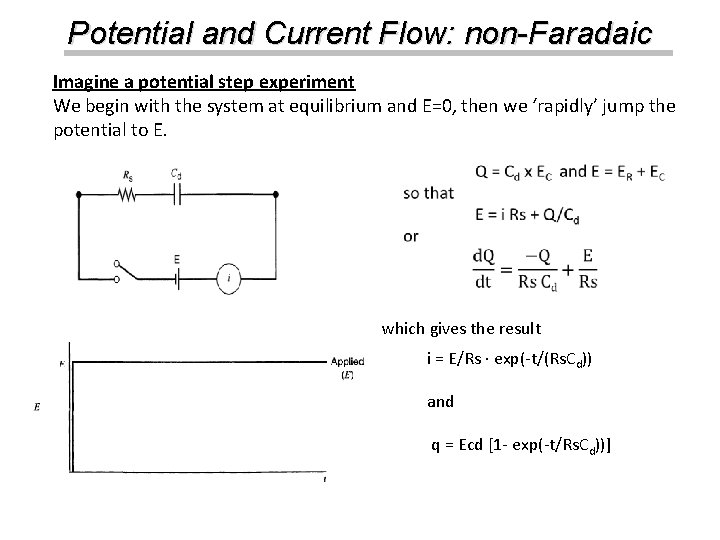
Potential and Current Flow: non-Faradaic Imagine a potential step experiment We begin with the system at equilibrium and E=0, then we ‘rapidly’ jump the potential to E. which gives the result i = E/Rs ∙ exp(-t/(Rs. Cd)) and q = Ecd [1 - exp(-t/Rs. Cd))]
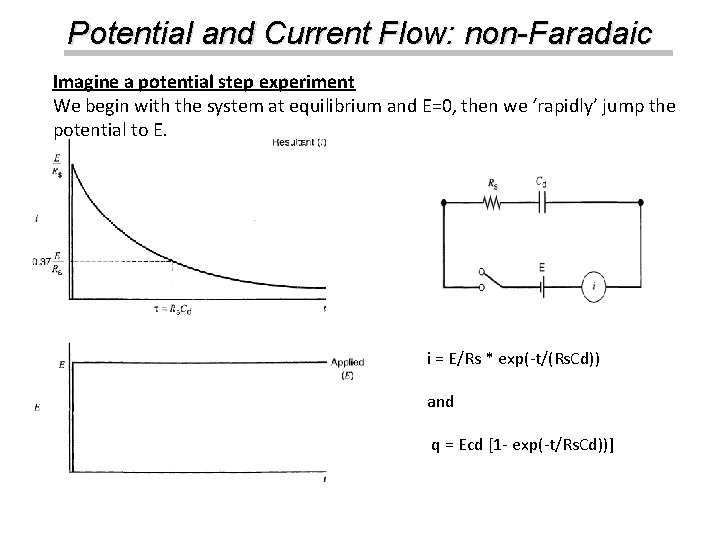
Potential and Current Flow: non-Faradaic Imagine a potential step experiment We begin with the system at equilibrium and E=0, then we ‘rapidly’ jump the potential to E. i = E/Rs * exp(-t/(Rs. Cd)) and q = Ecd [1 - exp(-t/Rs. Cd))]
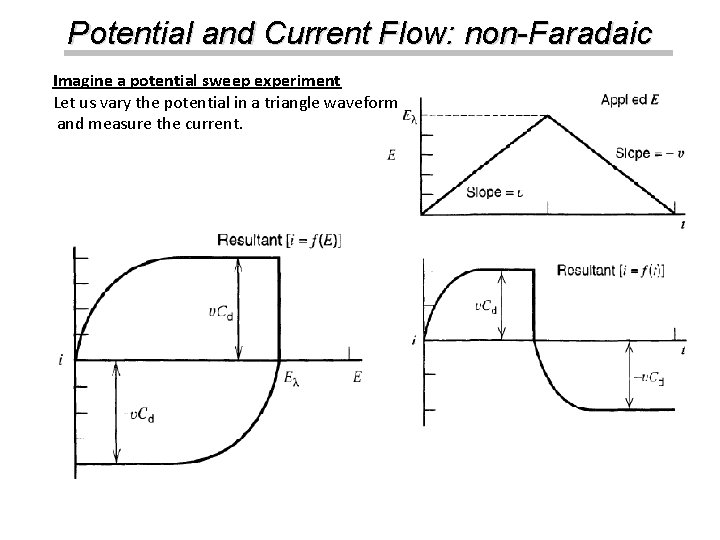
Potential and Current Flow: non-Faradaic Imagine a potential sweep experiment Let us vary the potential in a triangle waveform and measure the current.
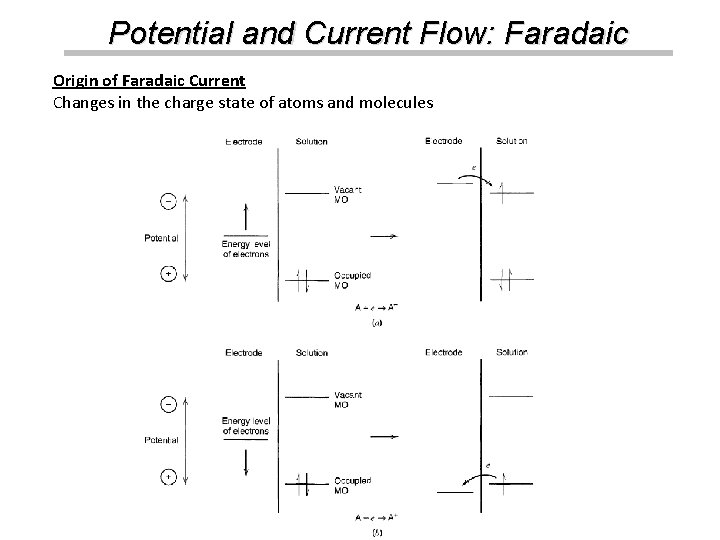
Potential and Current Flow: Faradaic Origin of Faradaic Current Changes in the charge state of atoms and molecules
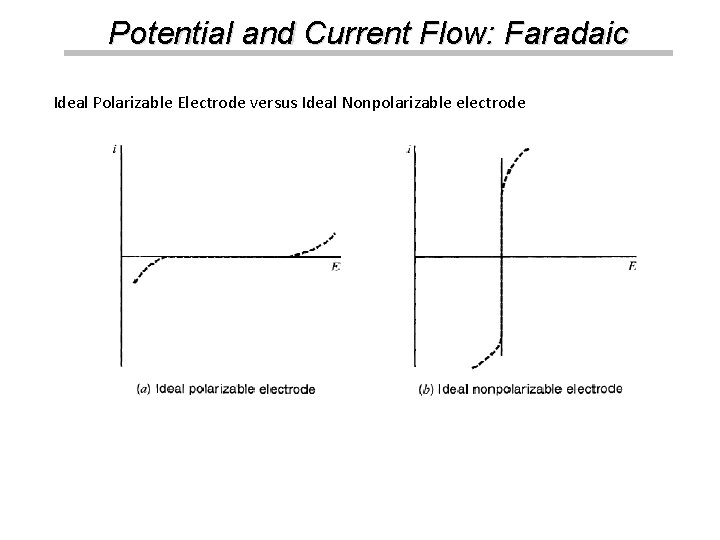
Potential and Current Flow: Faradaic Ideal Polarizable Electrode versus Ideal Nonpolarizable electrode
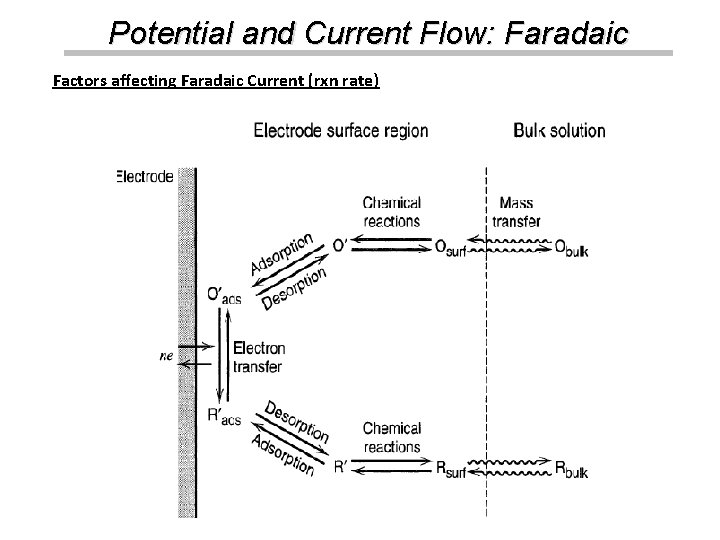
Potential and Current Flow: Faradaic Factors affecting Faradaic Current (rxn rate)
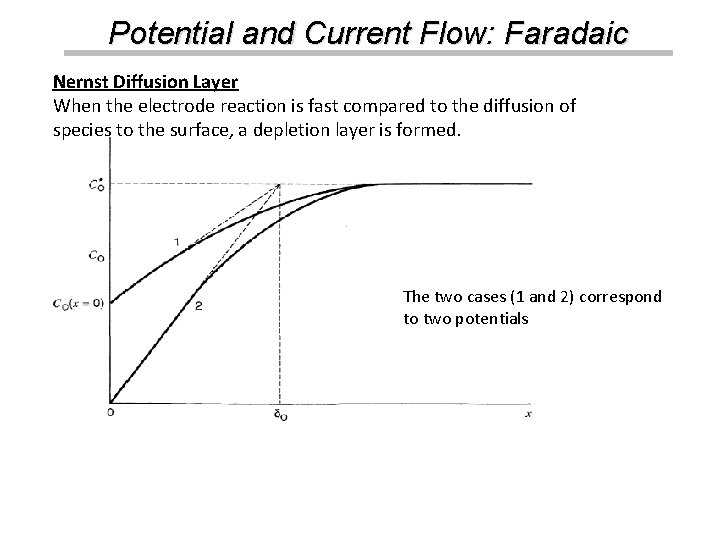
Potential and Current Flow: Faradaic Nernst Diffusion Layer When the electrode reaction is fast compared to the diffusion of species to the surface, a depletion layer is formed. The two cases (1 and 2) correspond to two potentials
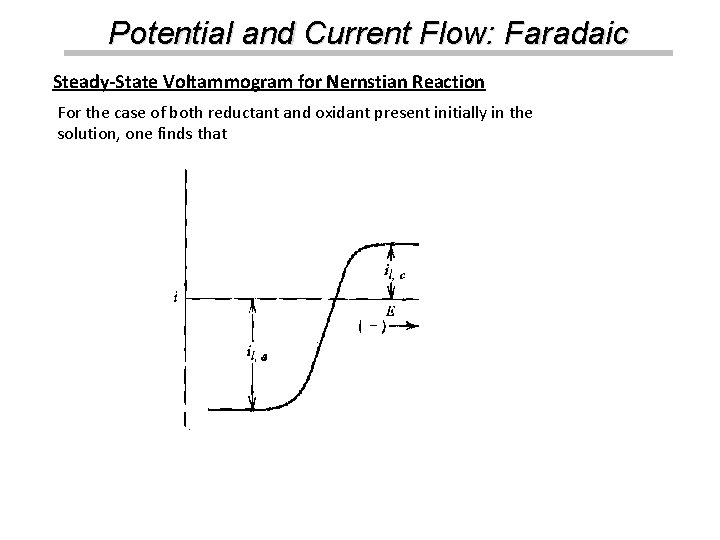
Potential and Current Flow: Faradaic Steady-State Voltammogram for Nernstian Reaction The case of only the oxidant being present initially. For the case of both reductant and oxidant present initially in the solution, one finds that E = E 1/2 +(RT/n. F) ln((il-i)/i) and the limiting current is il = n F A (DO/d 0) C*O At the half-wave potential (il = il/2), then E = E 1/2 =E 0’ - (RT/n. F) ln(m. O / m. R )
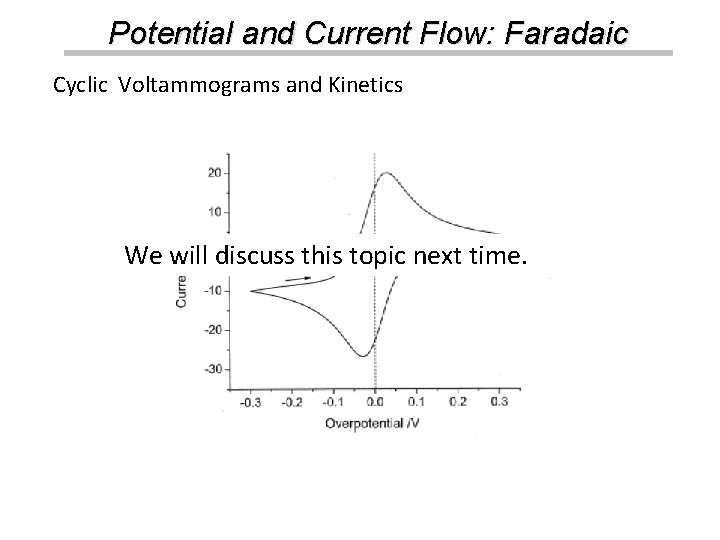
Potential and Current Flow: Faradaic Cyclic Voltammograms and Kinetics We will discuss this topic next time.
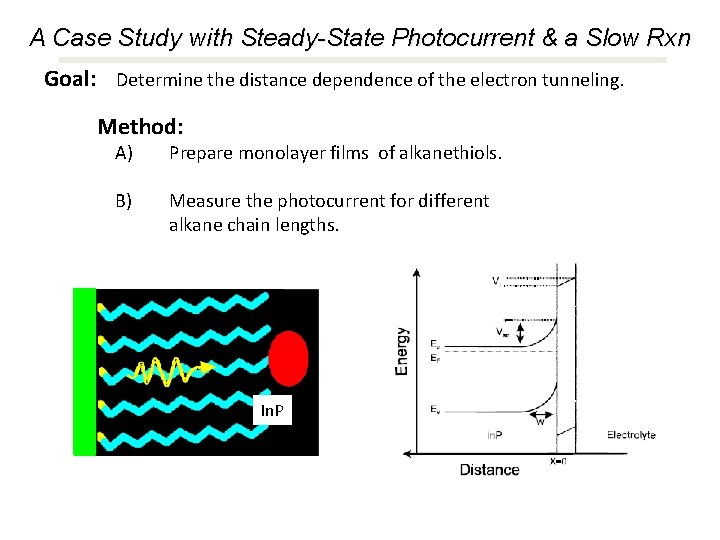
A Case Study with Steady-State Photocurrent & a Slow Rxn Goal: Determine the distance dependence of the electron tunneling. Method: A) Prepare monolayer films of alkanethiols. B) Measure the photocurrent for different alkane chain lengths. In. P
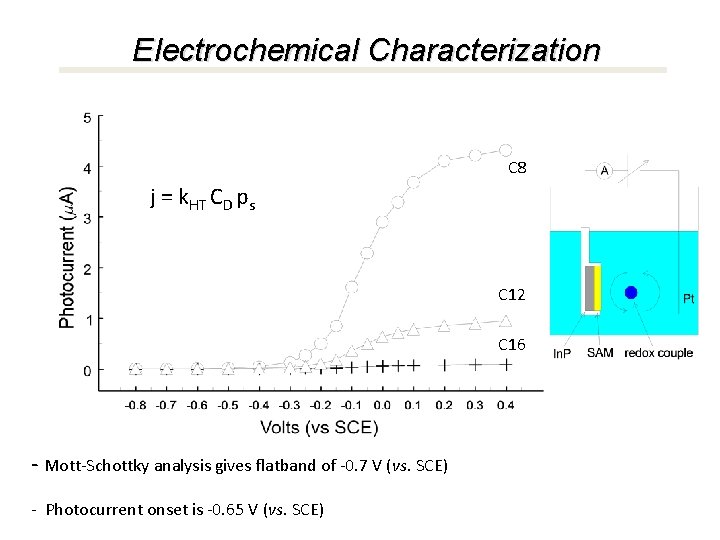
Electrochemical Characterization C 8 j = k. HT CD ps C 12 C 16 - Mott-Schottky analysis gives flatband of -0. 7 V (vs. SCE) - Photocurrent onset is -0. 65 V (vs. SCE)
Concentration Dependence of Photocurrent Bare Electrode Fe(CN)63 -/Fe(CN)64 - in 0. 5 M K 2 SO 4
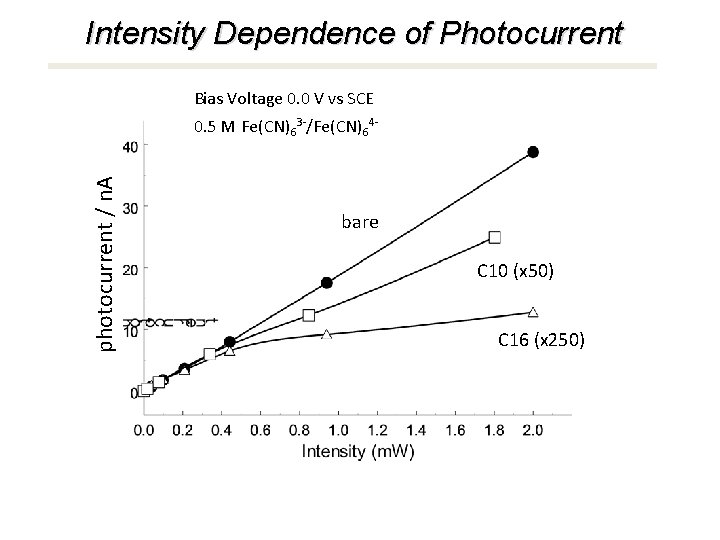
Intensity Dependence of Photocurrent Bias Voltage 0. 0 V vs SCE photocurrent / n. A 0. 5 M Fe(CN)63 -/Fe(CN)64 - bare C 10 (x 50) C 16 (x 250)
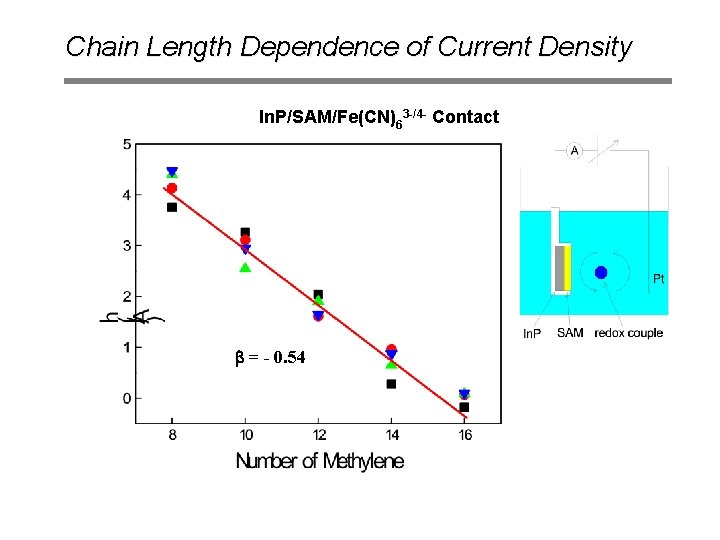
Chain Length Dependence of Current Density In. P/SAM/Fe(CN)63 -/4 - Contact = - 0. 54
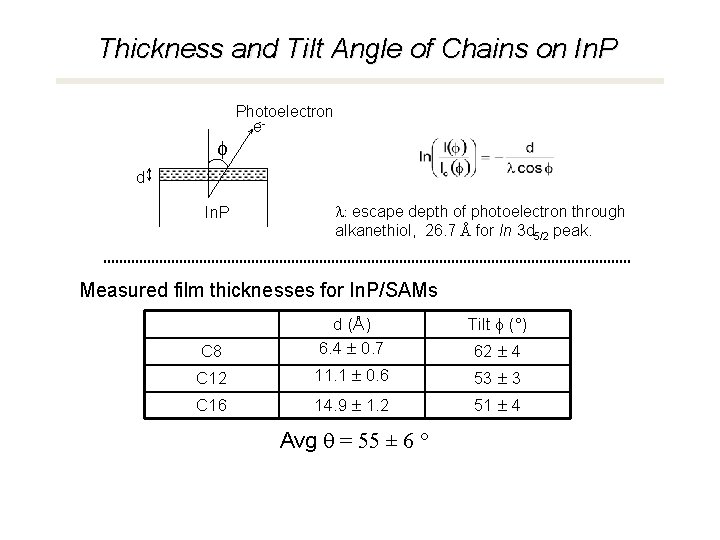
Thickness and Tilt Angle of Chains on In. P f Photoelectron e-- d In. P : escape depth of photoelectron through alkanethiol, 26. 7 Å for In 3 d 5/2 peak. Measured film thicknesses for In. P/SAMs Tilt f ( ) C 8 d (Å) 6. 4 0. 7 C 12 11. 1 0. 6 53 3 C 16 14. 9 1. 2 51 4 Avg = 55 ± 6 62 4
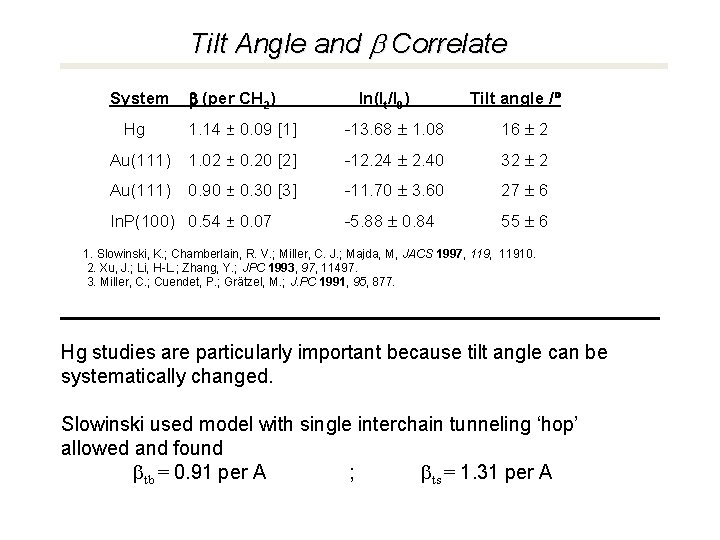
Tilt Angle and b Correlate System (per CH 2) Hg 1. 14 ± 0. 09 [1] -13. 68 1. 08 16 2 Au(111) 1. 02 ± 0. 20 [2] -12. 24 2. 40 32 2 Au(111) 0. 90 ± 0. 30 [3] -11. 70 3. 60 27 6 -5. 88 0. 84 55 6 In. P(100) 0. 54 ± 0. 07 ln(It/I 0) Tilt angle / 1. Slowinski, K. ; Chamberlain, R. V. ; Miller, C. J. ; Majda, M, JACS 1997, 119, 11910. 2. Xu, J. ; Li, H-L. ; Zhang, Y. ; JPC 1993, 97, 11497. 3. Miller, C. ; Cuendet, P. ; Grätzel, M. ; J. PC 1991, 95, 877. Hg studies are particularly important because tilt angle can be systematically changed. Slowinski used model with single interchain tunneling ‘hop’ allowed and found btb = 0. 91 per A ; bts = 1. 31 per A
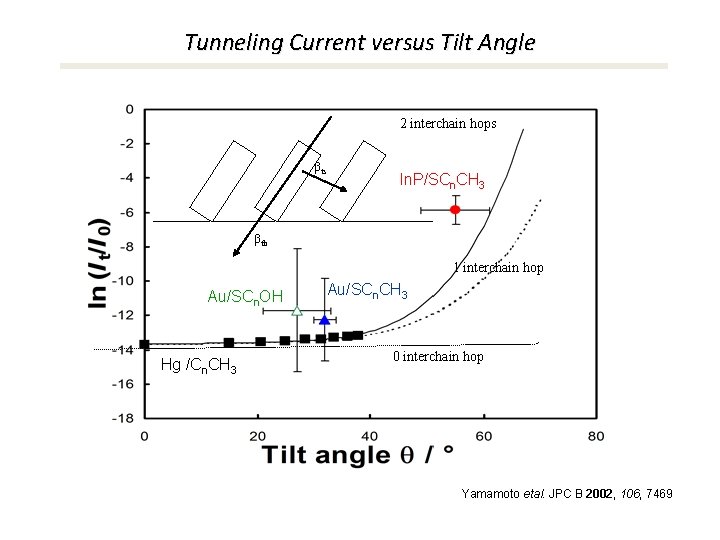
Tunneling Current versus Tilt Angle 2 interchain hops βts In. P/SCn. CH 3 βtb 1 interchain hop Au/SCn. OH Hg /Cn. CH 3 Au/SCn. CH 3 0 interchain hop Yamamoto etal. JPC B 2002, 106, 7469

Summary Electrochemical Cells – Definitions etc. Equilibrium properties of Echem cells – potentiometry etc. Some features of kinetic and transient measurements (more to come …. ) Citations Many of the figures used in the talk are taken from two textbooks. Electrochemical Methods by Bard and Faulkner Principles of Physical Chemistry by Kuhn, Waldeck, and Foersterling
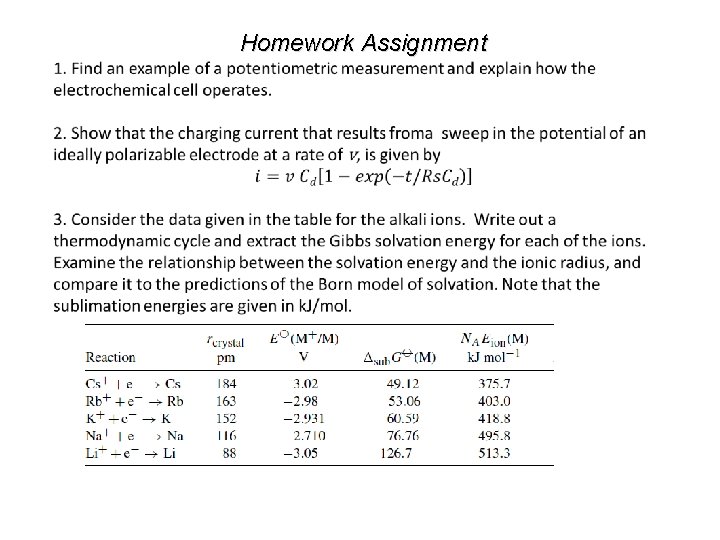
Homework Assignment
- Slides: 45