
University of Pennsylvania Interprocess Communication CSE 380 Lecture
- Slides: 10
University of Pennsylvania Interprocess Communication CSE 380 Lecture Note 8 Insup Lee 10/3/00 CSE 380
University of Pennsylvania Interprocess communication • Shared Memory • Message Passing – Signals 10/3/00 CSE 380
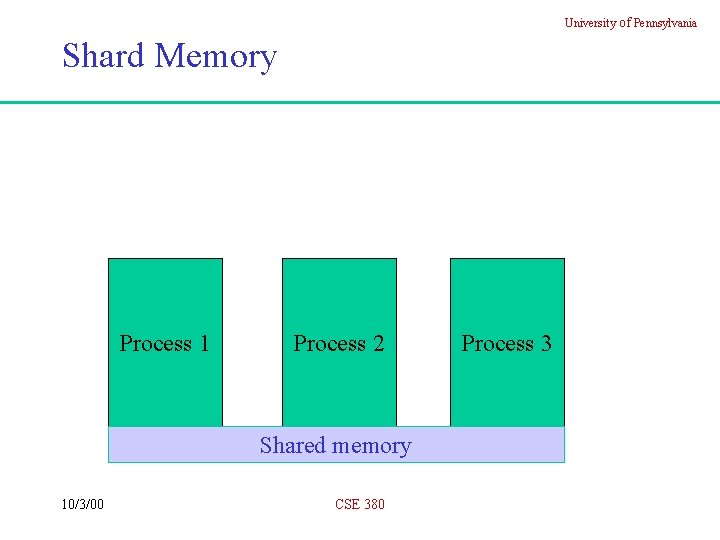
University of Pennsylvania Shard Memory Process 1 Process 2 Shared memory 10/3/00 CSE 380 Process 3
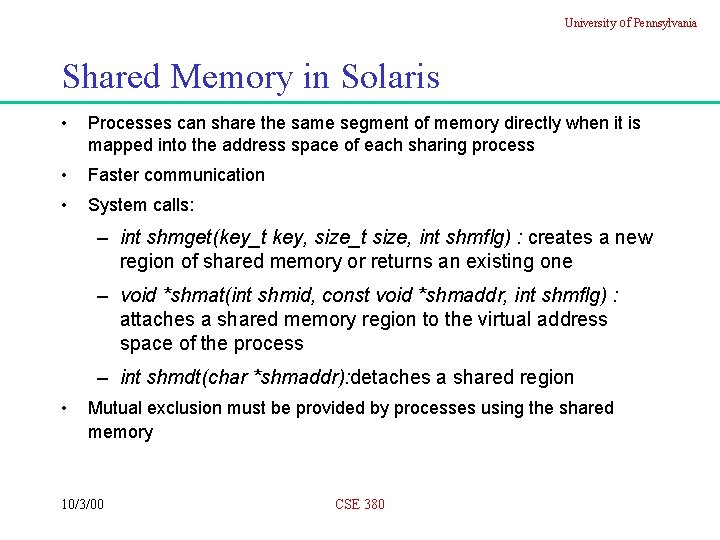
University of Pennsylvania Shared Memory in Solaris • Processes can share the same segment of memory directly when it is mapped into the address space of each sharing process • Faster communication • System calls: – int shmget(key_t key, size_t size, int shmflg) : creates a new region of shared memory or returns an existing one – void *shmat(int shmid, const void *shmaddr, int shmflg) : attaches a shared memory region to the virtual address space of the process – int shmdt(char *shmaddr): detaches a shared region • Mutual exclusion must be provided by processes using the shared memory 10/3/00 CSE 380
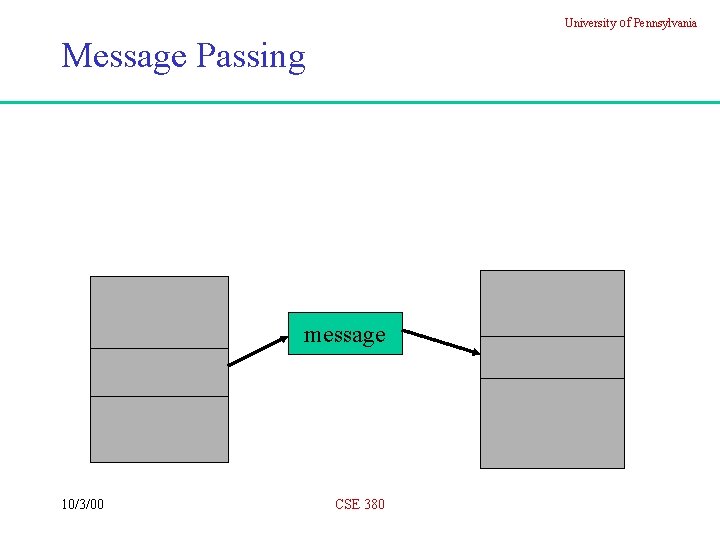
University of Pennsylvania Message Passing message 10/3/00 CSE 380
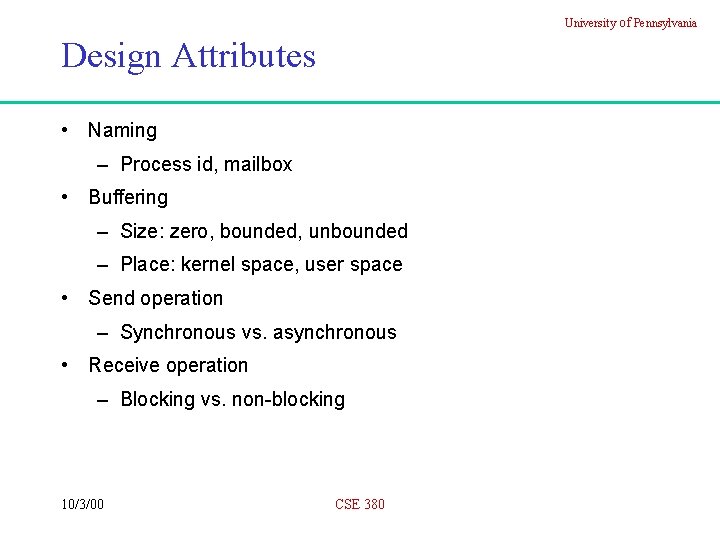
University of Pennsylvania Design Attributes • Naming – Process id, mailbox • Buffering – Size: zero, bounded, unbounded – Place: kernel space, user space • Send operation – Synchronous vs. asynchronous • Receive operation – Blocking vs. non-blocking 10/3/00 CSE 380
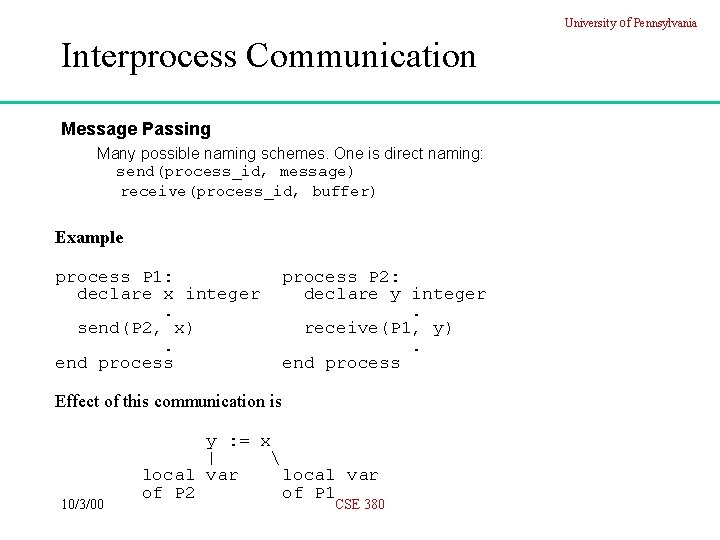
University of Pennsylvania Interprocess Communication Message Passing Many possible naming schemes. One is direct naming: send(process_id, message) receive(process_id, buffer) Example process P 1: declare x integer. send(P 2, x). end process P 2: declare y integer. receive(P 1, y). end process Effect of this communication is 10/3/00 y : = x | local var of P 2 of P 1 CSE 380
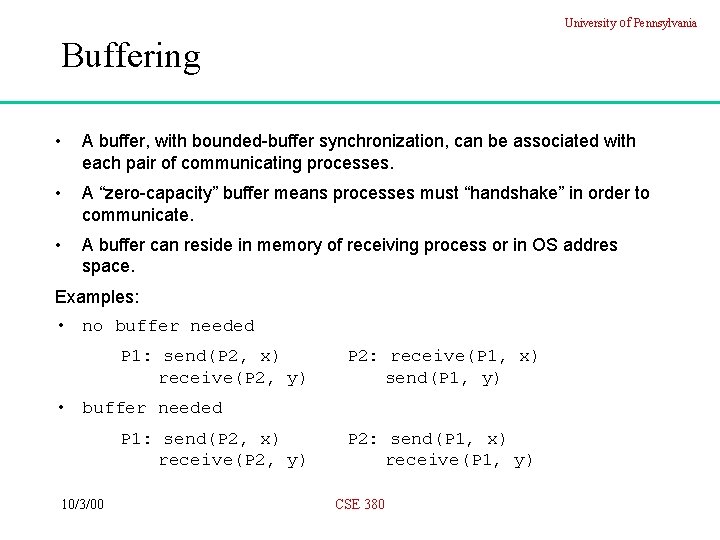
University of Pennsylvania Buffering • A buffer, with bounded-buffer synchronization, can be associated with each pair of communicating processes. • A “zero-capacity” buffer means processes must “handshake” in order to communicate. • A buffer can reside in memory of receiving process or in OS addres space. Examples: • no buffer needed P 1: send(P 2, x) receive(P 2, y) P 2: receive(P 1, x) send(P 1, y) • buffer needed P 1: send(P 2, x) receive(P 2, y) 10/3/00 P 2: send(P 1, x) receive(P 1, y) CSE 380
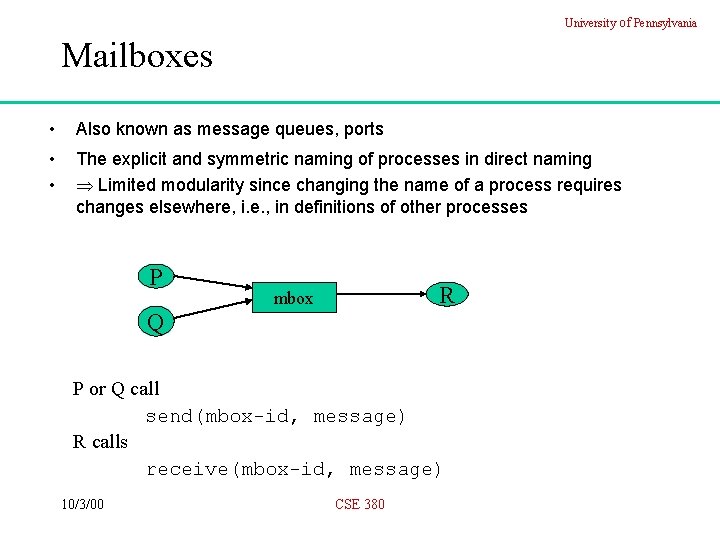
University of Pennsylvania Mailboxes • Also known as message queues, ports • • The explicit and symmetric naming of processes in direct naming Þ Limited modularity since changing the name of a process requires changes elsewhere, i. e. , in definitions of other processes P R mbox Q P or Q call send(mbox-id, message) R calls receive(mbox-id, message) 10/3/00 CSE 380
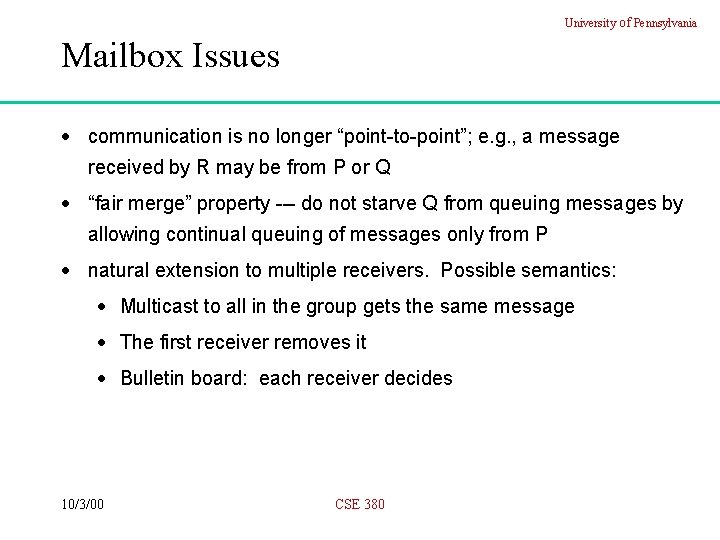
University of Pennsylvania Mailbox Issues · communication is no longer “point-to-point”; e. g. , a message received by R may be from P or Q · “fair merge” property --- do not starve Q from queuing messages by allowing continual queuing of messages only from P · natural extension to multiple receivers. Possible semantics: · Multicast to all in the group gets the same message · The first receiver removes it · Bulletin board: each receiver decides 10/3/00 CSE 380