
University of Ottawa Faculty of Law Public International
University of Ottawa Faculty of Law Public International Law 3231 A Part II: Subjects of International Law Craig Forcese
Public International Law University of Ottawa Faculty of Law 3231 A Subjects of International Law Key Subjects of International Law: The State • Craig Forcese State is a legally defined entity • Modern international law sets out four basic criteria for a state: 1. A permanent population 2. A defined territory 3. A government 4. A capacity to enter into relations with other states
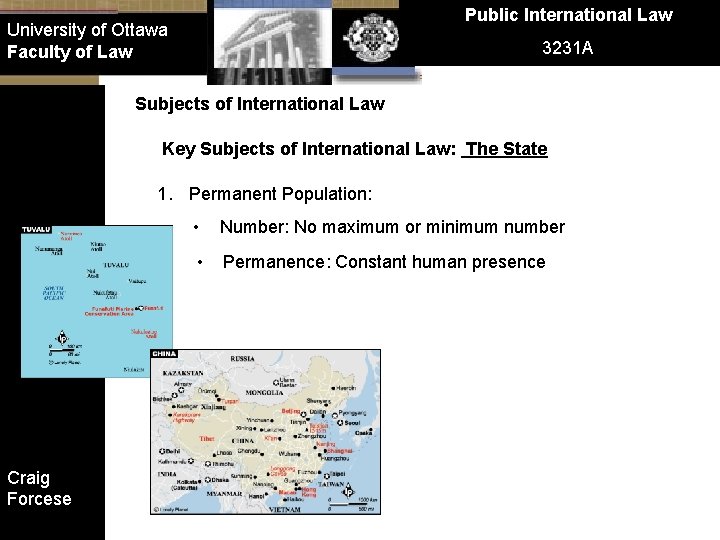
Public International Law University of Ottawa Faculty of Law 3231 A Subjects of International Law Key Subjects of International Law: The State 1. Permanent Population: • Number: No maximum or minimum number • Permanence: Constant human presence Craig Forcese
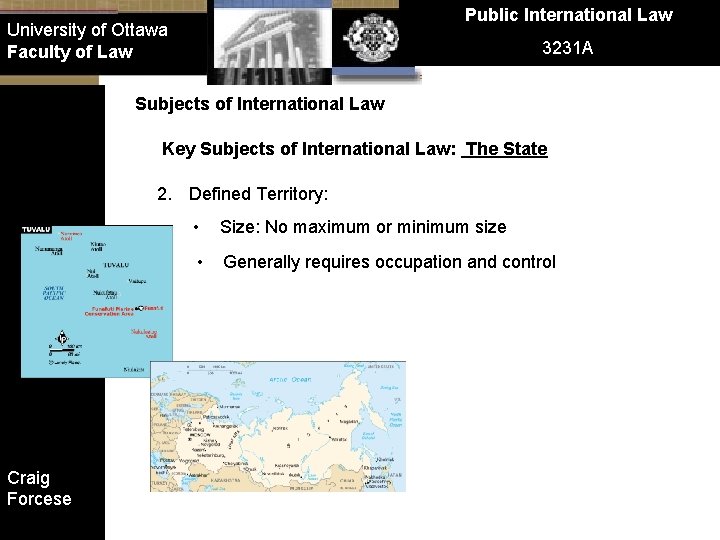
Public International Law University of Ottawa Faculty of Law 3231 A Subjects of International Law Key Subjects of International Law: The State 2. Defined Territory: • Size: No maximum or minimum size • Generally requires occupation and control Craig Forcese
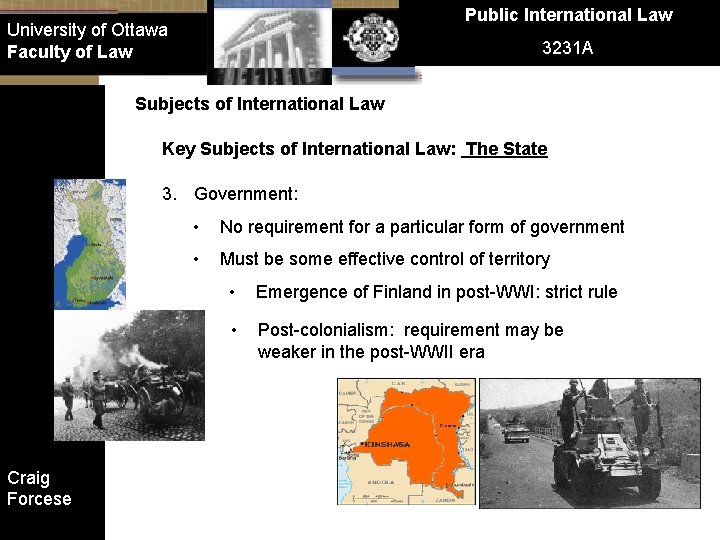
Public International Law University of Ottawa Faculty of Law 3231 A Subjects of International Law Key Subjects of International Law: The State 3. Government: Craig Forcese • No requirement for a particular form of government • Must be some effective control of territory • Emergence of Finland in post-WWI: strict rule • Post-colonialism: requirement may be weaker in the post-WWII era
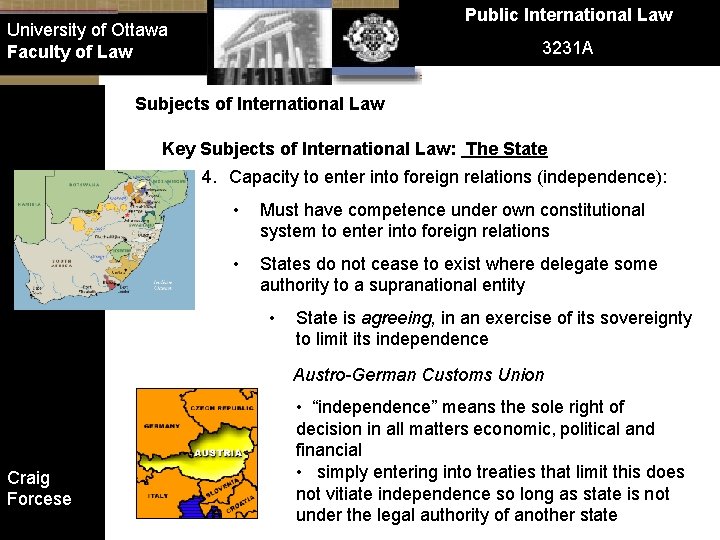
Public International Law University of Ottawa Faculty of Law 3231 A Subjects of International Law Key Subjects of International Law: The State 4. Capacity to enter into foreign relations (independence): • Must have competence under own constitutional system to enter into foreign relations • States do not cease to exist where delegate some authority to a supranational entity • State is agreeing, in an exercise of its sovereignty to limit its independence Austro-German Customs Union Craig Forcese • “independence” means the sole right of decision in all matters economic, political and financial • simply entering into treaties that limit this does not vitiate independence so long as state is not under the legal authority of another state
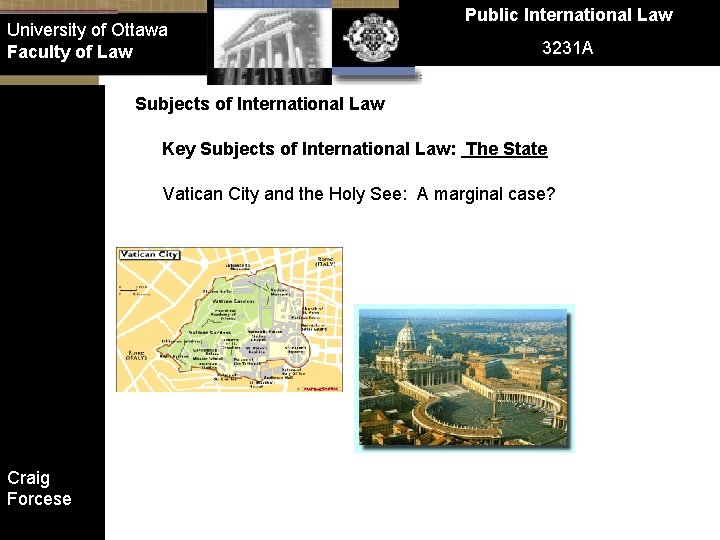
University of Ottawa Faculty of Law Public International Law 3231 A Subjects of International Law Key Subjects of International Law: The State Vatican City and the Holy See: A marginal case? Craig Forcese
Public International Law University of Ottawa Faculty of Law 3231 A Subjects of International Law Key Subjects of International Law: The State Recognition of States: • Complex definition: “…the free act by which one or more States acknowledge the existence on a definite territory of a human society politically organized, independent of any other existing State, and capable of observing the obligations of international law, and by which they manifest therefore their intention to consider it a member of the international Community. ” • Craig Forcese Simple definition: a formal acknowledgment by another state that an entity possesses the qualifications for statehood
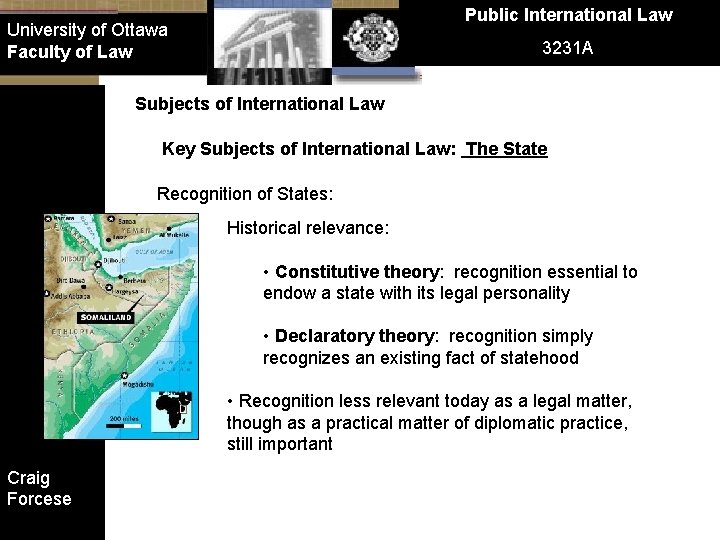
Public International Law University of Ottawa Faculty of Law 3231 A Subjects of International Law Key Subjects of International Law: The State Recognition of States: Historical relevance: • Constitutive theory: recognition essential to endow a state with its legal personality • Declaratory theory: recognition simply recognizes an existing fact of statehood • Recognition less relevant today as a legal matter, though as a practical matter of diplomatic practice, still important Craig Forcese
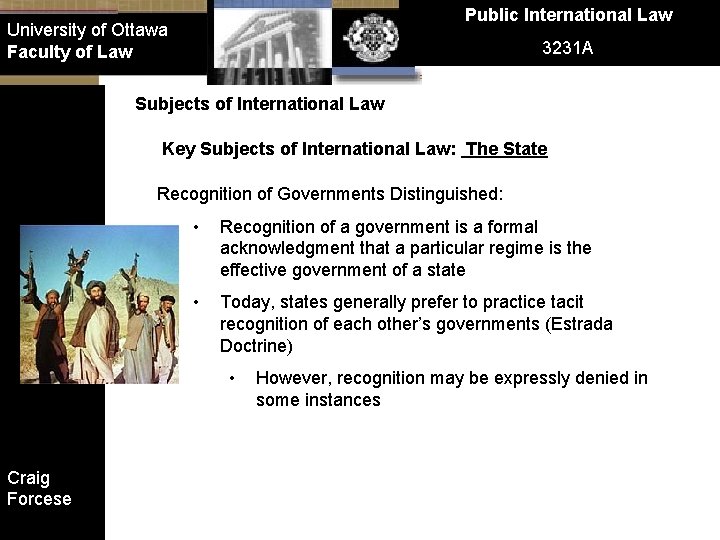
Public International Law University of Ottawa Faculty of Law 3231 A Subjects of International Law Key Subjects of International Law: The State Recognition of Governments Distinguished: • Recognition of a government is a formal acknowledgment that a particular regime is the effective government of a state • Today, states generally prefer to practice tacit recognition of each other’s governments (Estrada Doctrine) • Craig Forcese However, recognition may be expressly denied in some instances
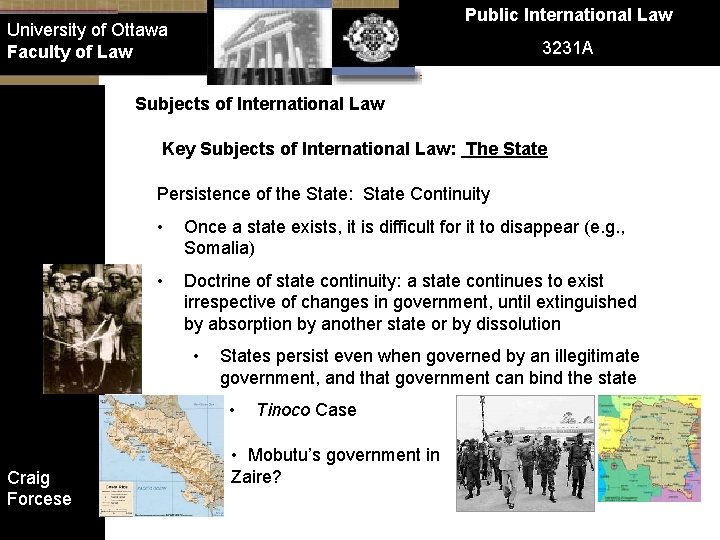
Public International Law University of Ottawa Faculty of Law 3231 A Subjects of International Law Key Subjects of International Law: The State Persistence of the State: State Continuity • Once a state exists, it is difficult for it to disappear (e. g. , Somalia) • Doctrine of state continuity: a state continues to exist irrespective of changes in government, until extinguished by absorption by another state or by dissolution • States persist even when governed by an illegitimate government, and that government can bind the state • Craig Forcese Tinoco Case • Mobutu’s government in Zaire?
Public International Law University of Ottawa Faculty of Law 3231 A Subjects of International Law Key Subjects of International Law: The State Changes in the State: State Succession • Craig Forcese State succession deals with the emergence of new states: what are the legal obligations of these new states? • Bound by customary international law • Treaties are more complicated: • One state merges into another, surviving state’s duties persist • A state acquires a piece of territory, the state’s obligations extend to this new territory
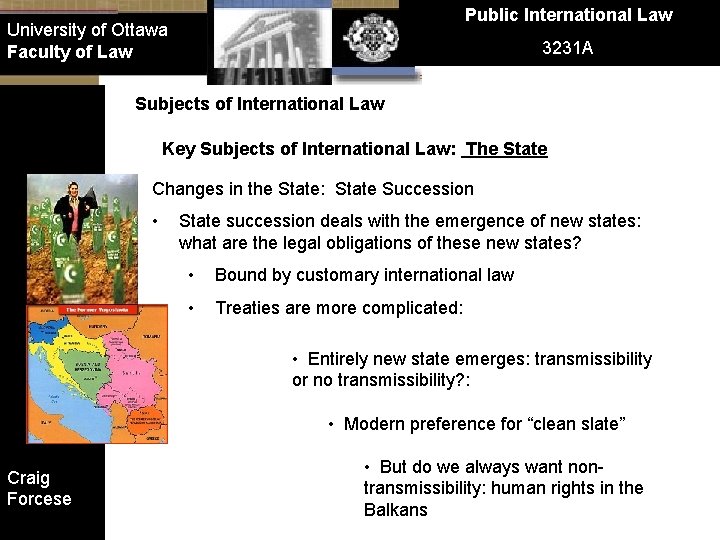
Public International Law University of Ottawa Faculty of Law 3231 A Subjects of International Law Key Subjects of International Law: The State Changes in the State: State Succession • State succession deals with the emergence of new states: what are the legal obligations of these new states? • Bound by customary international law • Treaties are more complicated: • Entirely new state emerges: transmissibility or no transmissibility? : • Modern preference for “clean slate” Craig Forcese • But do we always want nontransmissibility: human rights in the Balkans
Public International Law University of Ottawa Faculty of Law 3231 A Subjects of International Law Key Subjects of International Law: The State Sovereign Equality of States • Sovereignty: exclusive control over own affairs • • States are supposed to be equally sovereign • Craig Forcese • Sovereignty is taken to connote "independence" defined as the "right to exercise [within a set national territory], to the exclusion of any other State, the functions of a State" states "have equal rights and duties and are equal members of the international community, notwithstanding differences of an economic, social, political or other nature" Flip-side is obligation not to interfere in the sovereign affairs of other states
Public International Law University of Ottawa Faculty of Law 3231 A Subjects of International Law Key Subjects of International Law: Intergovernmental Organizations International Personality of Intergovernmental Organizations • Reparations Case • Craig Forcese in order to perform the functions assigned to it by the UN Charter, the UN was endowed with some international legal personality, separate and apart from that of its state members
Public International Law University of Ottawa Faculty of Law 3231 A Subjects of International Law Key Subjects of International Law: United Nations Established by the United Nations Charter (1945) 1. Purposes • Craig Forcese Article 1: • To maintain international peace and security • To develop friendly relations among nations based on respect for the principle of equal rights and selfdetermination of peoples • To achieve international co-operation in solving international problems of an economic, social, cultural, or humanitarian character, and in promoting and encouraging respect for human rights • To be a centre for harmonizing the actions of nations in the attainment of these common ends
Public International Law University of Ottawa Faculty of Law 3231 A Subjects of International Law Key Subjects of International Law: United Nations Established by the United Nations Charter (1945) 2. Principles • Craig Forcese Article 2 specifies, inter alia: • principle of the sovereign equality of all UN Members; • good faith obligation to act in fashion consistent with the Charter; • settlement of member international disputes by peaceful means in such a manner that international peace and security, and. justice, are not endangered; • members to refrain in their international relations from the threat or use of force against the territorial integrity or political independence of any state; • assistance to the UN
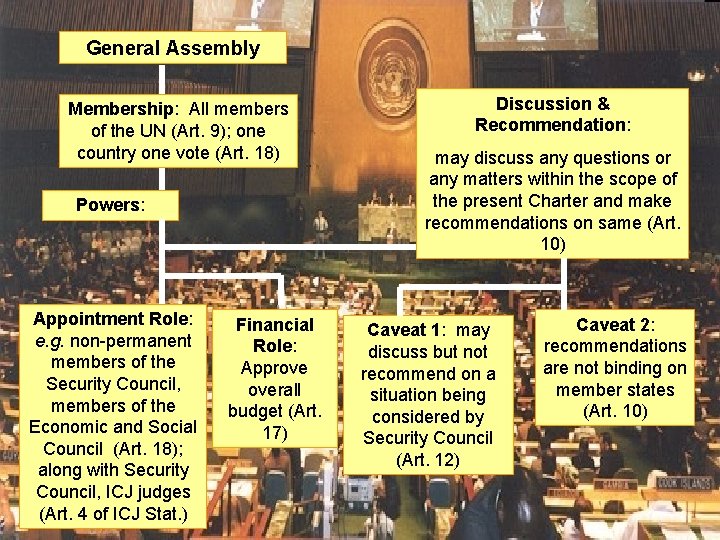
General Assembly Membership: All members of the UN (Art. 9); one country one vote (Art. 18) Powers: Appointment Role: e. g. non-permanent members of the Security Council, members of the Economic and Social Council (Art. 18); along with Security Council, ICJ judges (Art. 4 of ICJ Stat. ) Financial Role: Approve overall budget (Art. 17) Discussion & Recommendation: may discuss any questions or any matters within the scope of the present Charter and make recommendations on same (Art. 10) Caveat 1: may discuss but not recommend on a situation being considered by Security Council (Art. 12) Caveat 2: recommendations are not binding on member states (Art. 10)
Public International Law University of Ottawa Faculty of Law 3231 A Subjects of International Law Key Subjects of International Law: United Nations Relevance of the General Assembly: Craig Forcese • Political relevance: important to have a global “talkshop” • Legal relevance: • “progressive" school of resolution interpretation have sought to characterize the General Assembly's resolutions as the source of international law where the Assembly formulates the norms for the first time and adopts the resolution overwhelmingly and with the intent for it to be legally binding • However, truer to say that resolutions are hortatory
Public International Law University of Ottawa Faculty of Law 3231 A Subjects of International Law Key Subjects of International Law: United Nations Relevance of the General Assembly: • Political relevance: important to have a global “talkshop” • Legal relevance: • Craig Forcese Nevertheless, even if resolutions are not legally binding, they may have an impact on international law: • First, they can be evidence of customary international law • Second, sometimes they can catalyze or serve as the kernel around which new customary international law emerges
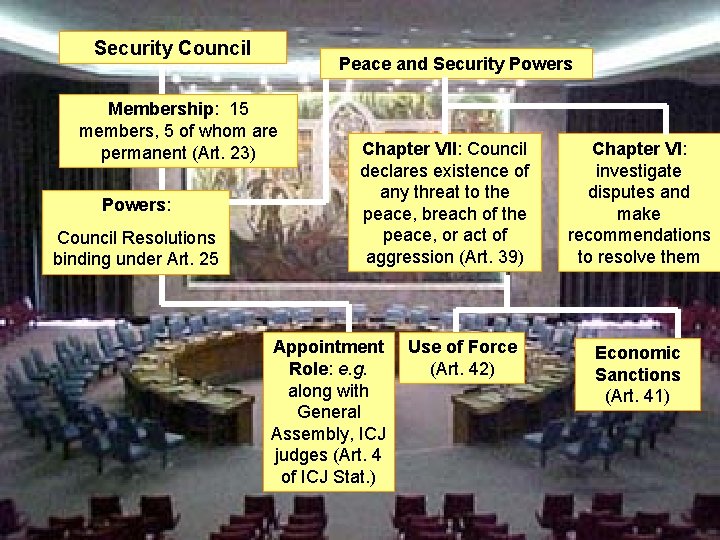
Security Council Peace and Security Powers Membership: 15 members, 5 of whom are permanent (Art. 23) Powers: Council Resolutions binding under Art. 25 Chapter VII: Council declares existence of any threat to the peace, breach of the peace, or act of aggression (Art. 39) Appointment Use of Force Role: e. g. (Art. 42) along with General Assembly, ICJ judges (Art. 4 of ICJ Stat. ) Chapter VI: investigate disputes and make recommendations to resolve them Economic Sanctions (Art. 41)
Public International Law University of Ottawa Faculty of Law 3231 A Subjects of International Law Key Subjects of International Law: United Nations The International Court of Justice: Craig Forcese • Inheritor of a long tradition of states arbitrating international disputes • Successor to the PCIJ, which had the following important qualities: • permanently constituted body with rules fixed beforehand binding on parties having recourse to the Court. • able to set about gradually developing a constant practice and maintaining a certain continuity in its decisions, • empowered to give advisory opinions upon any dispute or question referred to it by the League of Nations Council or Assembly.
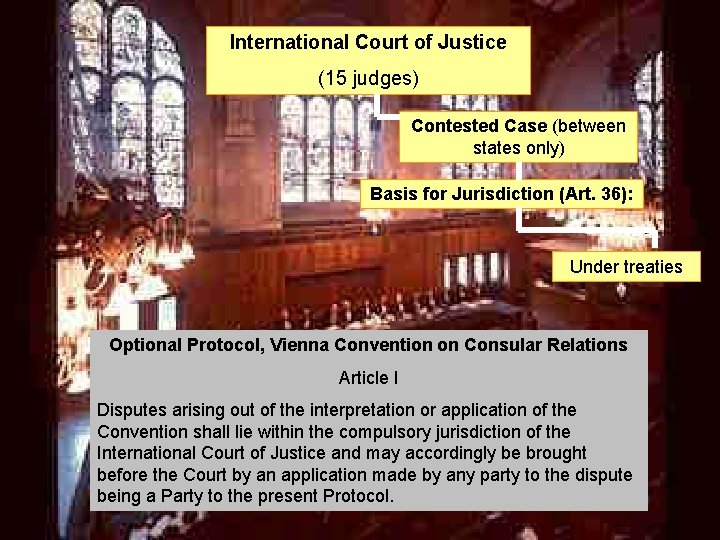
International Court of Justice (15 judges) Contested Case (between states only) Basis for Jurisdiction (Art. 36): Under treaties Optional Protocol, Vienna Convention on Consular Relations Article I Disputes arising out of the interpretation or application of the Convention shall lie within the compulsory jurisdiction of the International Court of Justice and may accordingly be brought before the Court by an application made by any party to the dispute being a Party to the present Protocol.
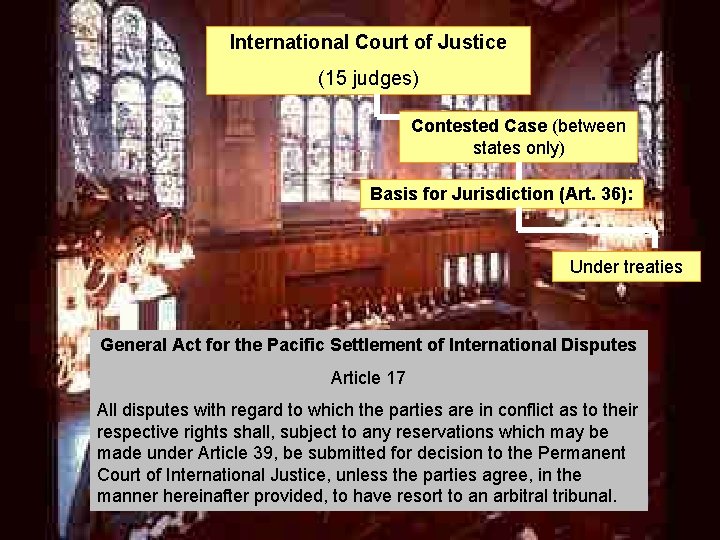
International Court of Justice (15 judges) Contested Case (between states only) Basis for Jurisdiction (Art. 36): Under treaties General Act for the Pacific Settlement of International Disputes Article 17 All disputes with regard to which the parties are in conflict as to their respective rights shall, subject to any reservations which may be made under Article 39, be submitted for decision to the Permanent Court of International Justice, unless the parties agree, in the manner hereinafter provided, to have resort to an arbitral tribunal.
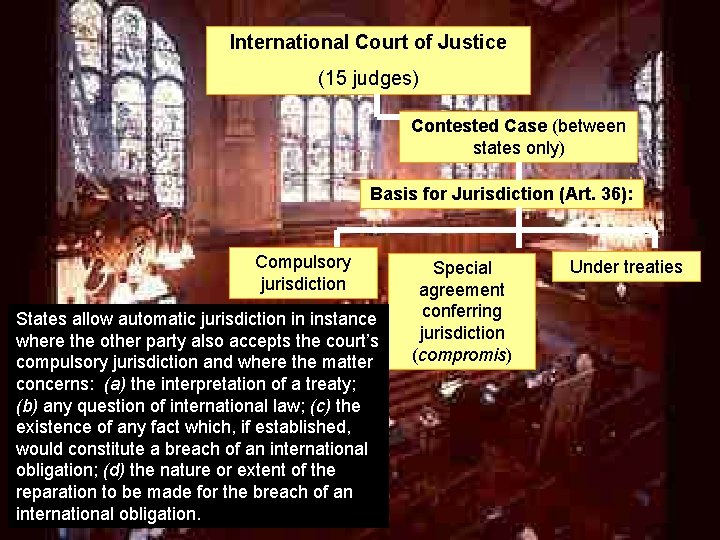
International Court of Justice (15 judges) Contested Case (between states only) Basis for Jurisdiction (Art. 36): Compulsory jurisdiction States allow automatic jurisdiction in instance where the other party also accepts the court’s compulsory jurisdiction and where the matter concerns: (a) the interpretation of a treaty; (b) any question of international law; (c) the existence of any fact which, if established, would constitute a breach of an international obligation; (d) the nature or extent of the reparation to be made for the breach of an international obligation. Special agreement conferring jurisdiction (compromis) Under treaties
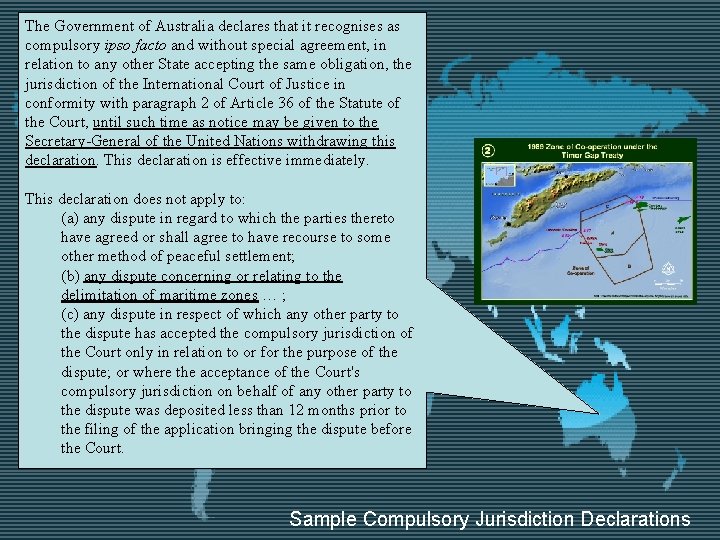
The Government of Australia declares that it recognises as compulsory ipso facto and without special agreement, in relation to any other State accepting the same obligation, the jurisdiction of the International Court of Justice in conformity with paragraph 2 of Article 36 of the Statute of the Court, until such time as notice may be given to the Secretary-General of the United Nations withdrawing this declaration. This declaration is effective immediately. This declaration does not apply to: (a) any dispute in regard to which the parties thereto have agreed or shall agree to have recourse to some other method of peaceful settlement; (b) any dispute concerning or relating to the delimitation of maritime zones … ; (c) any dispute in respect of which any other party to the dispute has accepted the compulsory jurisdiction of the Court only in relation to or for the purpose of the dispute; or where the acceptance of the Court's compulsory jurisdiction on behalf of any other party to the dispute was deposited less than 12 months prior to the filing of the application bringing the dispute before the Court. Sample Compulsory Jurisdiction Declarations
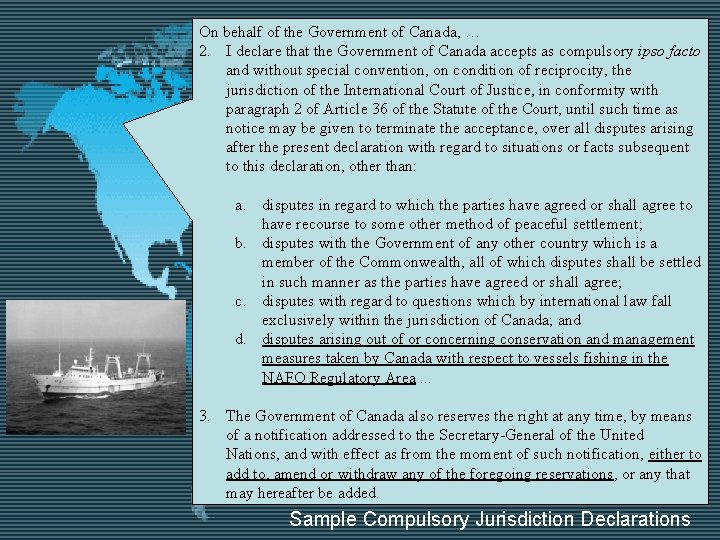
On behalf of the Government of Canada, … 2. I declare that the Government of Canada accepts as compulsory ipso facto and without special convention, on condition of reciprocity, the jurisdiction of the International Court of Justice, in conformity with paragraph 2 of Article 36 of the Statute of the Court, until such time as notice may be given to terminate the acceptance, over all disputes arising after the present declaration with regard to situations or facts subsequent to this declaration, other than: a. disputes in regard to which the parties have agreed or shall agree to have recourse to some other method of peaceful settlement; b. disputes with the Government of any other country which is a member of the Commonwealth, all of which disputes shall be settled in such manner as the parties have agreed or shall agree; c. disputes with regard to questions which by international law fall exclusively within the jurisdiction of Canada; and d. disputes arising out of or concerning conservation and management measures taken by Canada with respect to vessels fishing in the NAFO Regulatory Area. . . 3. The Government of Canada also reserves the right at any time, by means of a notification addressed to the Secretary-General of the United Nations, and with effect as from the moment of such notification, either to add to, amend or withdraw any of the foregoing reservations, or any that may hereafter be added. Sample Compulsory Jurisdiction Declarations
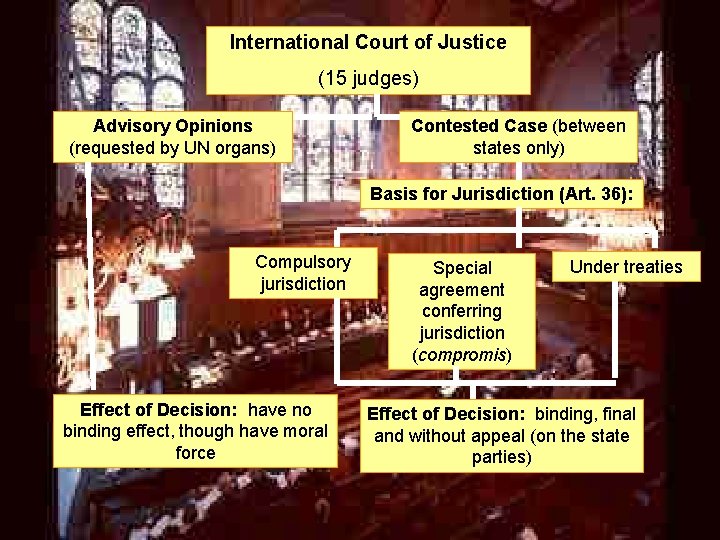
International Court of Justice (15 judges) Advisory Opinions (requested by UN organs) Contested Case (between states only) Basis for Jurisdiction (Art. 36): Compulsory jurisdiction Effect of Decision: have no binding effect, though have moral force Special agreement conferring jurisdiction (compromis) Under treaties Effect of Decision: binding, final and without appeal (on the state parties)
Public International Law University of Ottawa Faculty of Law 3231 A “Substantive Issues” in International Law State Jurisdiction Over Territory Craig Forcese • How does international law govern the acquisition of territory by existing states (land, sea, air, even space)? • How does international law regulate claims by peoples inhabiting territories controlled by states who wish to exert self-determination?
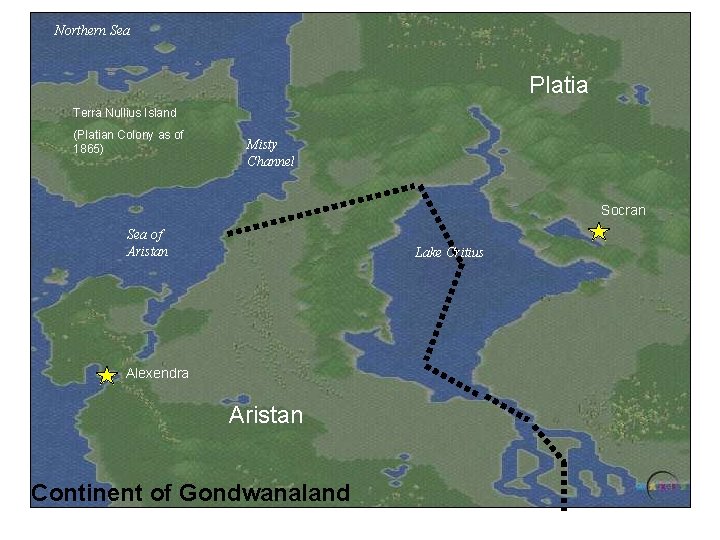
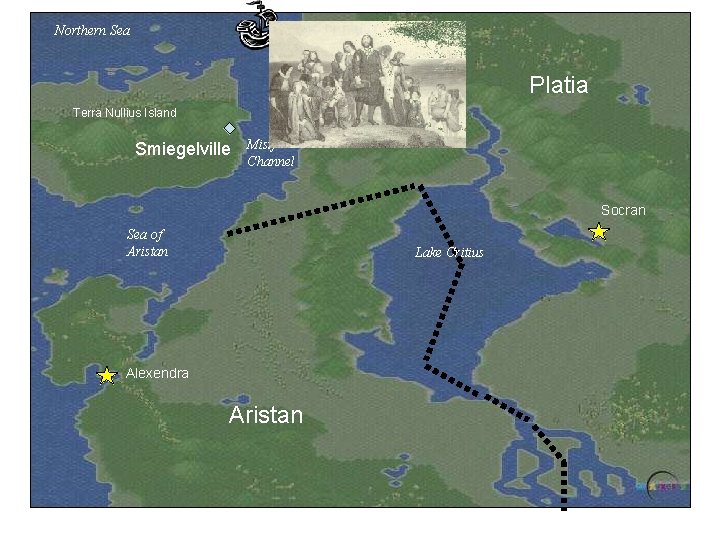
Northern Sea Platia Terra Nullius Island (Platian Colony as of 1865) Misty Channel Socran Sea of Aristan Lake Critius Alexendra Aristan Continent of Gondwanaland
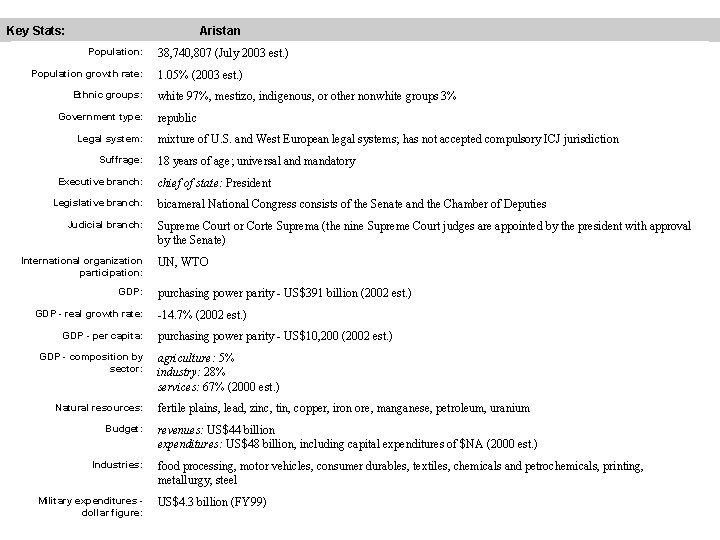
Key Stats: Aristan Population: Population growth rate: Ethnic groups: Government type: Legal system: Suffrage: Executive branch: Legislative branch: Judicial branch: International organization participation: GDP - real growth rate: GDP - per capita: GDP - composition by sector: Natural resources: Budget: Industries: Military expenditures - dollar figure: 38, 740, 807 (July 2003 est. ) 1. 05% (2003 est. ) white 97%, mestizo, indigenous, or other nonwhite groups 3% republic mixture of U. S. and West European legal systems; has not accepted compulsory ICJ jurisdiction 18 years of age; universal and mandatory chief of state: President bicameral National Congress consists of the Senate and the Chamber of Deputies Supreme Court or Corte Suprema (the nine Supreme Court judges are appointed by the president with approval by the Senate) UN, WTO purchasing power parity - US$391 billion (2002 est. ) -14. 7% (2002 est. ) purchasing power parity - US$10, 200 (2002 est. ) agriculture: 5% industry: 28% services: 67% (2000 est. ) fertile plains, lead, zinc, tin, copper, iron ore, manganese, petroleum, uranium revenues: US$44 billion expenditures: US$48 billion, including capital expenditures of $NA (2000 est. ) food processing, motor vehicles, consumer durables, textiles, chemicals and petrochemicals, printing, metallurgy, steel US$4. 3 billion (FY 99)
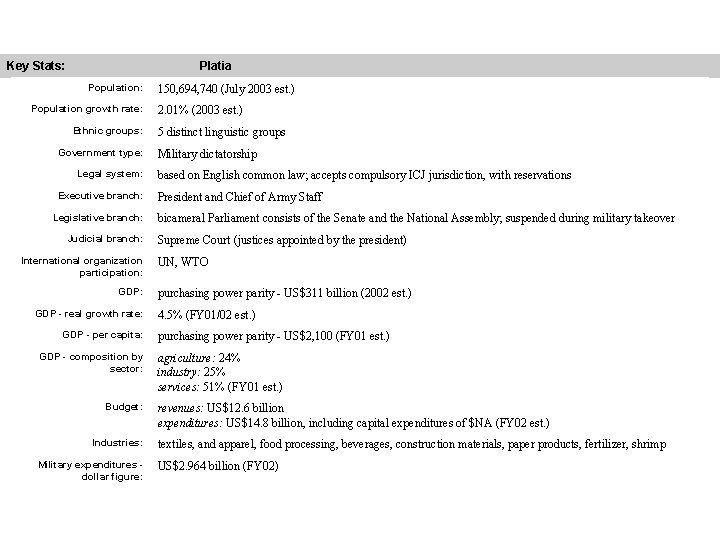
Key Stats: Platia Population: Population growth rate: Ethnic groups: Government type: Legal system: Executive branch: Legislative branch: Judicial branch: International organization participation: GDP - real growth rate: GDP - per capita: GDP - composition by sector: Budget: Industries: Military expenditures - dollar figure: 150, 694, 740 (July 2003 est. ) 2. 01% (2003 est. ) 5 distinct linguistic groups Military dictatorship based on English common law; accepts compulsory ICJ jurisdiction, with reservations President and Chief of Army Staff bicameral Parliament consists of the Senate and the National Assembly; suspended during military takeover Supreme Court (justices appointed by the president) UN, WTO purchasing power parity - US$311 billion (2002 est. ) 4. 5% (FY 01/02 est. ) purchasing power parity - US$2, 100 (FY 01 est. ) agriculture: 24% industry: 25% services: 51% (FY 01 est. ) revenues: US$12. 6 billion expenditures: US$14. 8 billion, including capital expenditures of $NA (FY 02 est. ) textiles, and apparel, food processing, beverages, construction materials, paper products, fertilizer, shrimp US$2. 964 billion (FY 02)
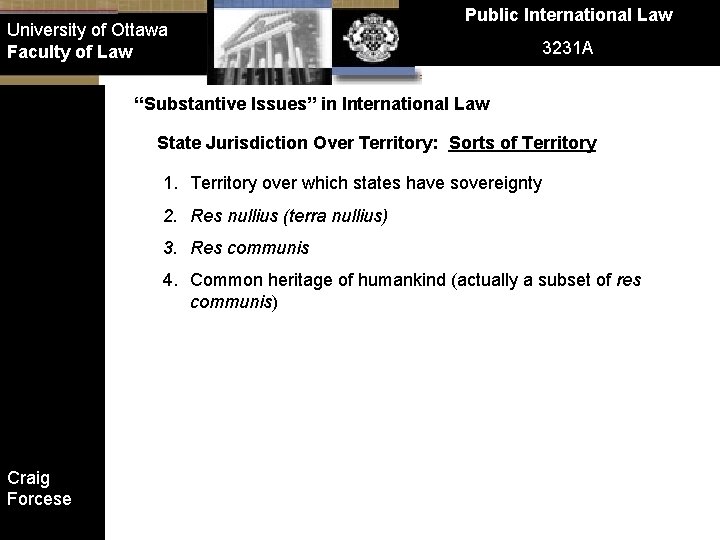
University of Ottawa Faculty of Law Public International Law 3231 A “Substantive Issues” in International Law State Jurisdiction Over Territory: Sorts of Territory 1. Territory over which states have sovereignty 2. Res nullius (terra nullius) 3. Res communis 4. Common heritage of humankind (actually a subset of res communis) Craig Forcese
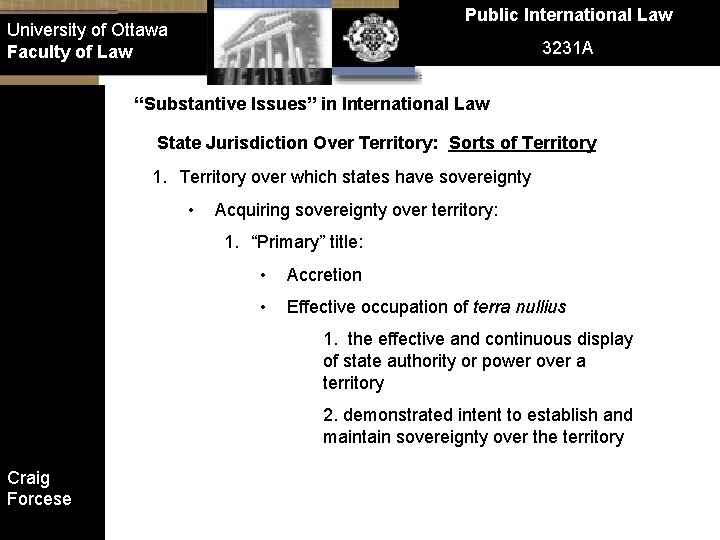
Public International Law University of Ottawa Faculty of Law 3231 A “Substantive Issues” in International Law State Jurisdiction Over Territory: Sorts of Territory 1. Territory over which states have sovereignty • Acquiring sovereignty over territory: 1. “Primary” title: • Accretion • Effective occupation of terra nullius 1. the effective and continuous display of state authority or power over a territory 2. demonstrated intent to establish and maintain sovereignty over the territory Craig Forcese
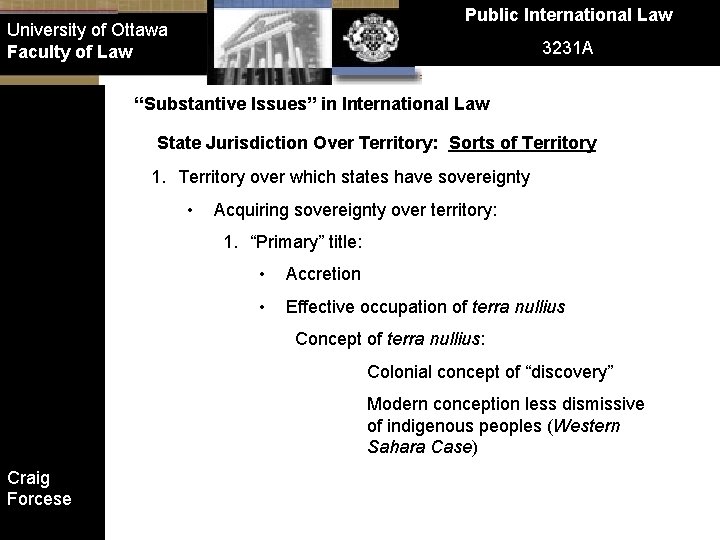
Public International Law University of Ottawa Faculty of Law 3231 A “Substantive Issues” in International Law State Jurisdiction Over Territory: Sorts of Territory 1. Territory over which states have sovereignty • Acquiring sovereignty over territory: 1. “Primary” title: • Accretion • Effective occupation of terra nullius Concept of terra nullius: Colonial concept of “discovery” Modern conception less dismissive of indigenous peoples (Western Sahara Case) Craig Forcese
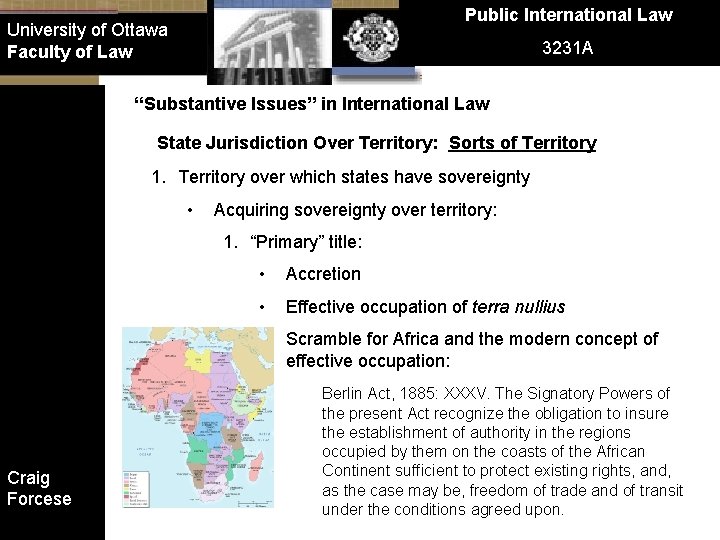
Public International Law University of Ottawa Faculty of Law 3231 A “Substantive Issues” in International Law State Jurisdiction Over Territory: Sorts of Territory 1. Territory over which states have sovereignty • Acquiring sovereignty over territory: 1. “Primary” title: • Accretion • Effective occupation of terra nullius Scramble for Africa and the modern concept of effective occupation: Craig Forcese Berlin Act, 1885: XXXV. The Signatory Powers of the present Act recognize the obligation to insure the establishment of authority in the regions occupied by them on the coasts of the African Continent sufficient to protect existing rights, and, as the case may be, freedom of trade and of transit under the conditions agreed upon.
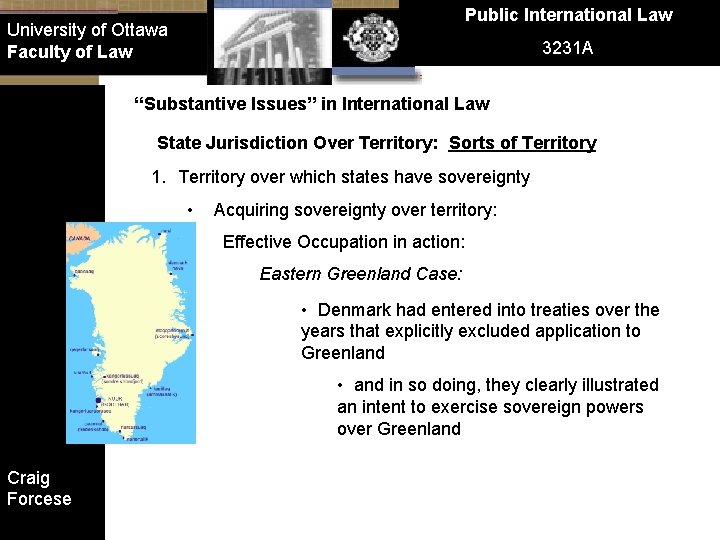
Public International Law University of Ottawa Faculty of Law 3231 A “Substantive Issues” in International Law State Jurisdiction Over Territory: Sorts of Territory 1. Territory over which states have sovereignty • Acquiring sovereignty over territory: Effective Occupation in action: Eastern Greenland Case: • Denmark had entered into treaties over the years that explicitly excluded application to Greenland • and in so doing, they clearly illustrated an intent to exercise sovereign powers over Greenland Craig Forcese
Public International Law University of Ottawa Faculty of Law 3231 A “Substantive Issues” in International Law State Jurisdiction Over Territory: Sorts of Territory 1. Territory over which states have sovereignty • Acquiring sovereignty over territory: 2. “Secondary” title: • Prescription: the first sovereign state can be displaced by the second through a peaceable occupation with sufficient intent of a second state Craig Forcese
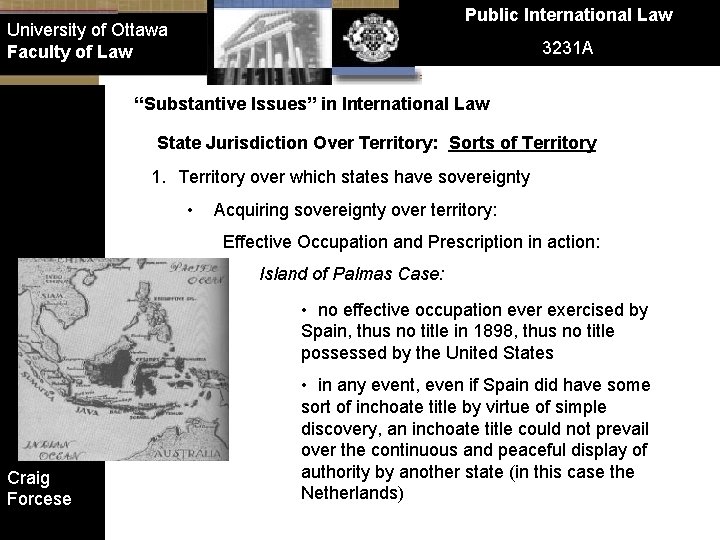
Public International Law University of Ottawa Faculty of Law 3231 A “Substantive Issues” in International Law State Jurisdiction Over Territory: Sorts of Territory 1. Territory over which states have sovereignty • Acquiring sovereignty over territory: Effective Occupation and Prescription in action: Island of Palmas Case: • no effective occupation ever exercised by Spain, thus no title in 1898, thus no title possessed by the United States Craig Forcese • in any event, even if Spain did have some sort of inchoate title by virtue of simple discovery, an inchoate title could not prevail over the continuous and peaceful display of authority by another state (in this case the Netherlands)
Public International Law University of Ottawa Faculty of Law 3231 A “Substantive Issues” in International Law State Jurisdiction Over Territory: Sorts of Territory 1. Territory over which states have sovereignty • Acquiring sovereignty over territory: 2. “Secondary” title continued: • Conquest: currently a violation of international law • past conquests legal when made likely benefit from the concept of inter-temporal law Craig Forcese
Public International Law University of Ottawa Faculty of Law 3231 A “Substantive Issues” in International Law State Jurisdiction Over Territory: Sorts of Territory 1. Territory over which states have sovereignty • Acquiring sovereignty over territory: 2. “Secondary” title continued: • Cession, Renunciation or Abandonment • Cession: given from one state to another under international agreement • Renunciation: renounced by one state, passing into the hands of another state which exercises sovereignty Craig Forcese • Abandonment: renounced by one state, and left as res nullius • Presumption against abandonment
Northern Sea Platia Terra Nullius Island Smiegelville Misty Channel Socran Sea of Aristan Lake Critius Alexendra Aristan
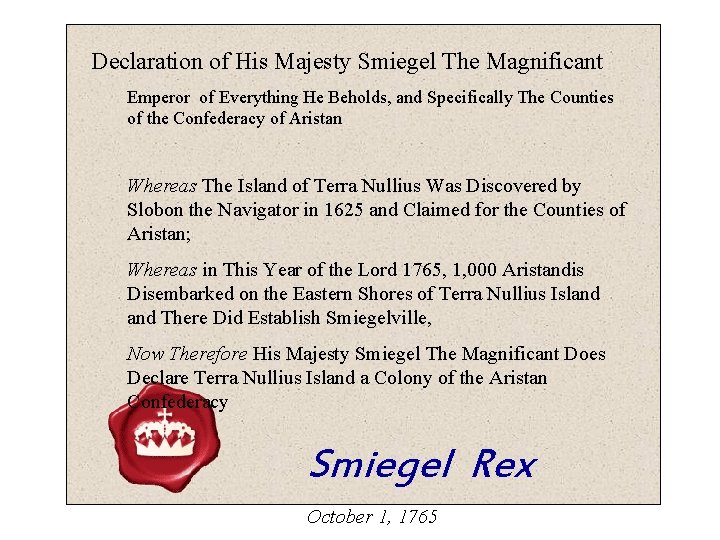
Declaration of His Majesty Smiegel The Magnificant Emperor of Everything He Beholds, and Specifically The Counties of the Confederacy of Aristan Whereas The Island of Terra Nullius Was Discovered by Slobon the Navigator in 1625 and Claimed for the Counties of Aristan; Whereas in This Year of the Lord 1765, 1, 000 Aristandis Disembarked on the Eastern Shores of Terra Nullius Island There Did Establish Smiegelville, Now Therefore His Majesty Smiegel The Magnificant Does Declare Terra Nullius Island a Colony of the Aristan Confederacy Smiegel Rex October 1, 1765
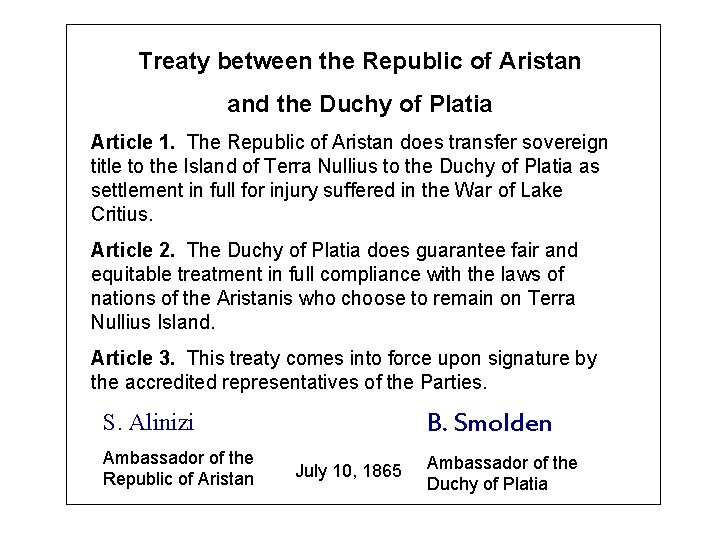
Treaty between the Republic of Aristan and the Duchy of Platia Article 1. The Republic of Aristan does transfer sovereign title to the Island of Terra Nullius to the Duchy of Platia as settlement in full for injury suffered in the War of Lake Critius. Article 2. The Duchy of Platia does guarantee fair and equitable treatment in full compliance with the laws of nations of the Aristanis who choose to remain on Terra Nullius Island. Article 3. This treaty comes into force upon signature by the accredited representatives of the Parties. B. Smolden S. Alinizi Ambassador of the Republic of Aristan July 10, 1865 Ambassador of the Duchy of Platia
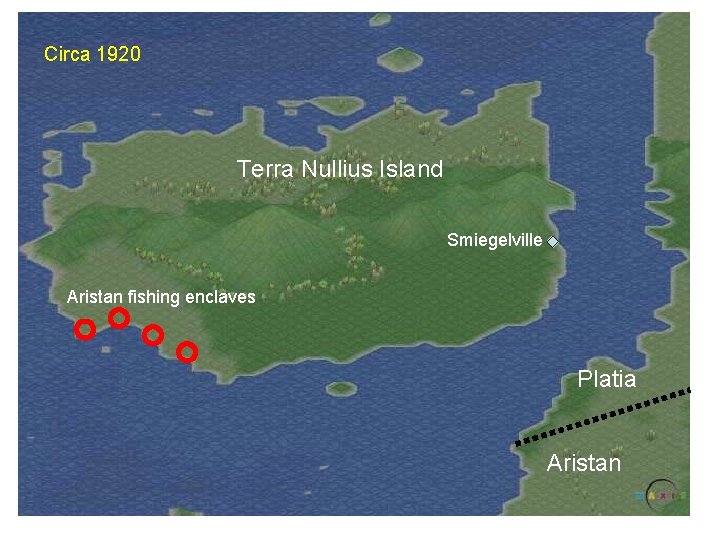
Circa 1920 Terra Nullius Island Smiegelville Aristan fishing enclaves Platia Aristan
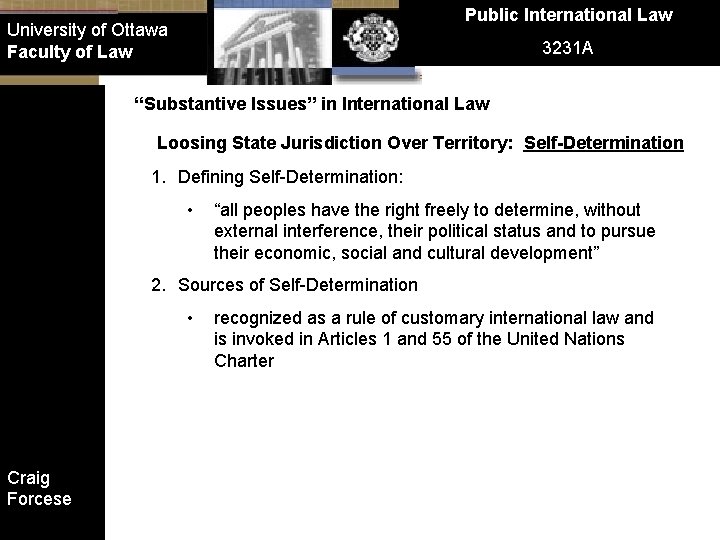
Public International Law University of Ottawa Faculty of Law 3231 A “Substantive Issues” in International Law Loosing State Jurisdiction Over Territory: Self-Determination 1. Defining Self-Determination: • “all peoples have the right freely to determine, without external interference, their political status and to pursue their economic, social and cultural development” 2. Sources of Self-Determination • Craig Forcese recognized as a rule of customary international law and is invoked in Articles 1 and 55 of the United Nations Charter
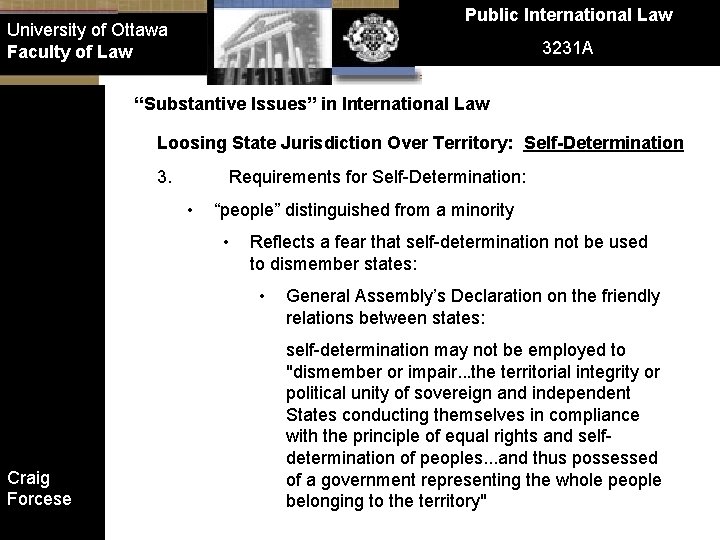
Public International Law University of Ottawa Faculty of Law 3231 A “Substantive Issues” in International Law Loosing State Jurisdiction Over Territory: Self-Determination 3. Requirements for Self-Determination: • “people” distinguished from a minority • Reflects a fear that self-determination not be used to dismember states: • Craig Forcese General Assembly’s Declaration on the friendly relations between states: self-determination may not be employed to "dismember or impair. . . the territorial integrity or political unity of sovereign and independent States conducting themselves in compliance with the principle of equal rights and selfdetermination of peoples. . . and thus possessed of a government representing the whole people belonging to the territory"
Public International Law University of Ottawa Faculty of Law 3231 A “Substantive Issues” in International Law Loosing State Jurisdiction Over Territory: Self-Determination 3. Requirements for Self-Determination: A. Who are peoples? • Sometimes refer to some level of ethnic homogeneity • • But note that many of the states that emerged after colonialism were not ethnically homogenous UN Special Rapporteur on the Sub-Commission on Prevention of Discrimination and Protection of Minorities: 1. The term "people" denotes a social entity possessing a clear identity and its own characteristics 2. Relationship with a territory Craig Forcese 3. A people should not be confused with ethnic, religious or linguistic minorities
Public International Law University of Ottawa Faculty of Law 3231 A “Substantive Issues” in International Law Loosing State Jurisdiction Over Territory: Self-Determination 3. Requirements for Self-Determination: B. Non-self-governing status • General Assembly friendly relations resolution: Self-determination may not be employed to "dismember or impair. . . the territorial integrity or political unity of sovereign and independent States conducting themselves in compliance with the principle of equal rights and selfdetermination of peoples. . . and thus possessed of a government representing the whole people belonging to the territory" • Craig Forcese self-determination, in international law, has been invoked in the context of colonial and non-self-governing peoples (as well as perhaps peoples struggling against severe repression)
Public International Law University of Ottawa Faculty of Law 3231 A “Substantive Issues” in International Law Loosing State Jurisdiction Over Territory: Self-Determination 4. Consequences of Self-Government: • The General Assembly has outlined three possible outcomes in its Resolutions 742 and 1541: 1. Emergence as a sovereign, independent state. 2. Free association with an independent state. • "should be the result of a free and voluntary choice by the peoples of the territory concerned, expressed through informed and democratic processes" 3. Integration with an independent state. • Craig Forcese should "be the result of the freely expressed wishes of the territory's peoples. . . their wishes having been expressed through informed and democratic processes, impartially conducted and based on universal adult suffrage. "
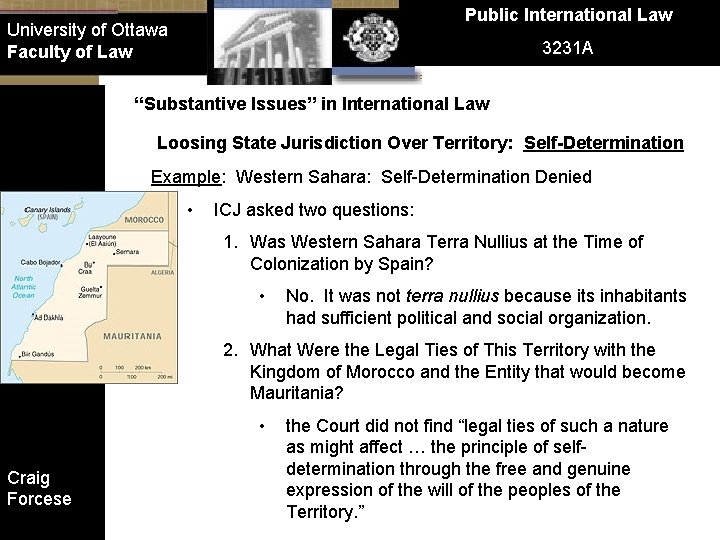
Public International Law University of Ottawa Faculty of Law 3231 A “Substantive Issues” in International Law Loosing State Jurisdiction Over Territory: Self-Determination Example: Western Sahara: Self-Determination Denied • ICJ asked two questions: 1. Was Western Sahara Terra Nullius at the Time of Colonization by Spain? • No. It was not terra nullius because its inhabitants had sufficient political and social organization. 2. What Were the Legal Ties of This Territory with the Kingdom of Morocco and the Entity that would become Mauritania? • Craig Forcese the Court did not find “legal ties of such a nature as might affect … the principle of selfdetermination through the free and genuine expression of the will of the peoples of the Territory. ”
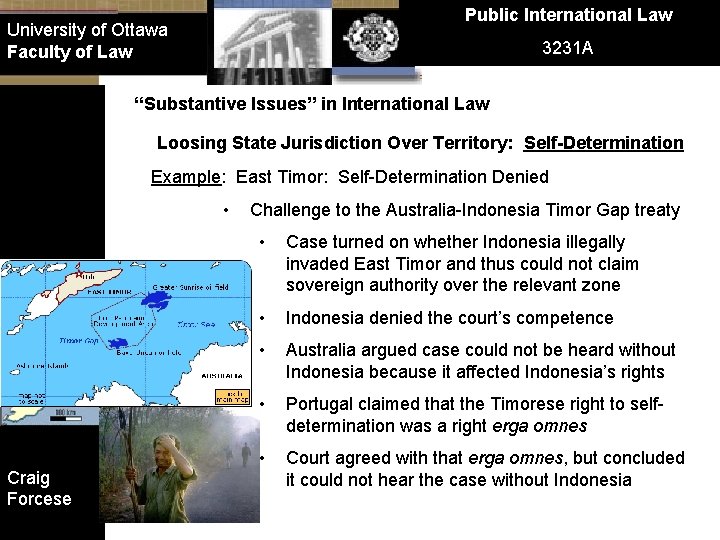
Public International Law University of Ottawa Faculty of Law 3231 A “Substantive Issues” in International Law Loosing State Jurisdiction Over Territory: Self-Determination Example: East Timor: Self-Determination Denied • Craig Forcese Challenge to the Australia-Indonesia Timor Gap treaty • Case turned on whether Indonesia illegally invaded East Timor and thus could not claim sovereign authority over the relevant zone • Indonesia denied the court’s competence • Australia argued case could not be heard without Indonesia because it affected Indonesia’s rights • Portugal claimed that the Timorese right to selfdetermination was a right erga omnes • Court agreed with that erga omnes, but concluded it could not hear the case without Indonesia
Public International Law University of Ottawa Faculty of Law 3231 A “Substantive Issues” in International Law Loosing State Jurisdiction Over Territory: Self-Determination Good or Bad? • The normative role of international law vs. the stabilizing role • Craig Forcese because the criteria for self-determination are so fuzzy, and the meaning of peoples so uncertain, does this mean that self-determination runs the risk of every little ethnic group claiming state status, dismembering states and fighting bloody civil wars?
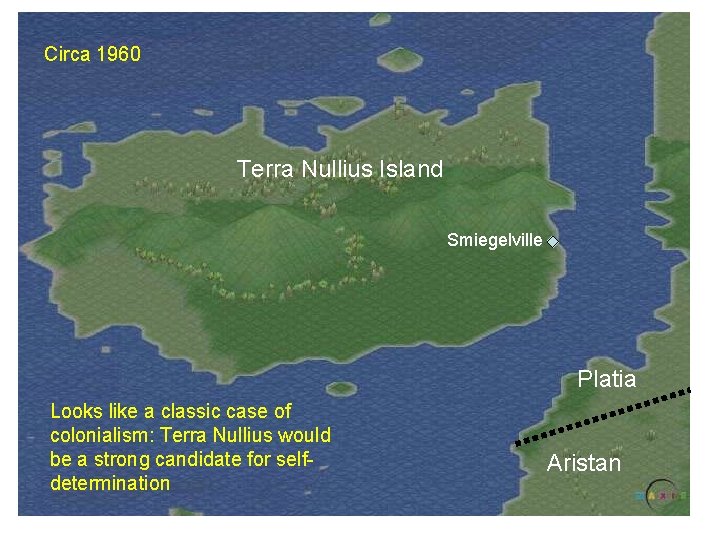
Circa 1960 Terra Nullius Island Smiegelville Platia Looks like a classic case of colonialism: Terra Nullius would be a strong candidate for selfdetermination Aristan
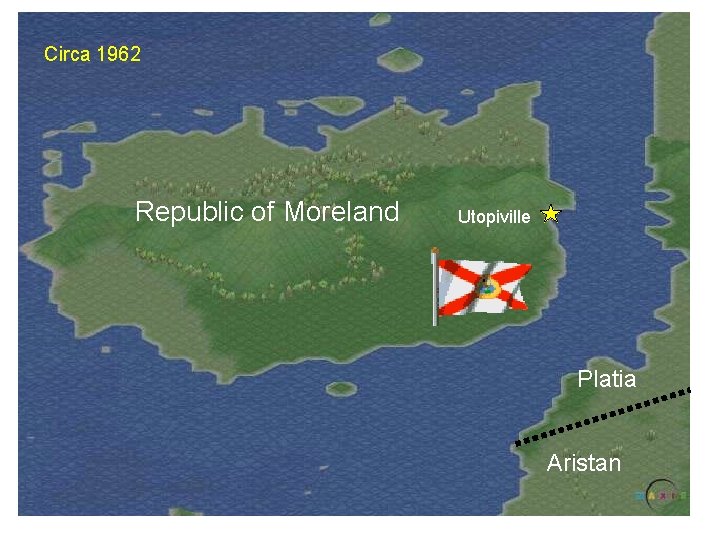
Circa 1962 Republic of Moreland Utopiville Platia Aristan
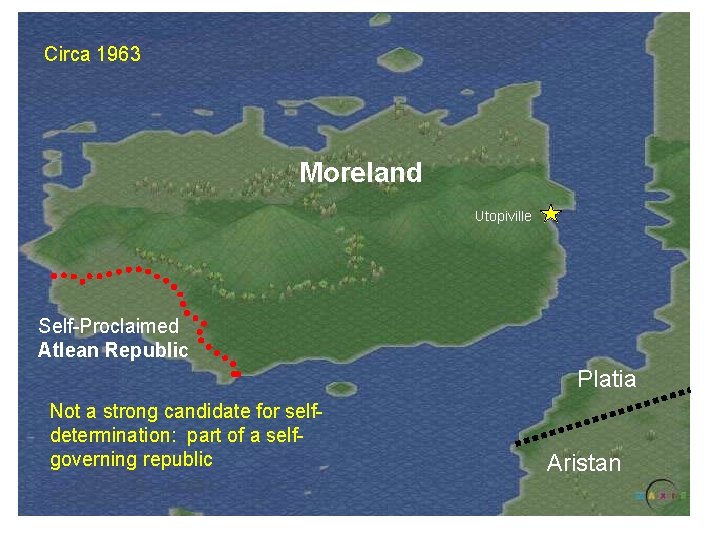
Circa 1963 Moreland Utopiville Self-Proclaimed Atlean Republic Platia Not a strong candidate for selfdetermination: part of a selfgoverning republic Aristan
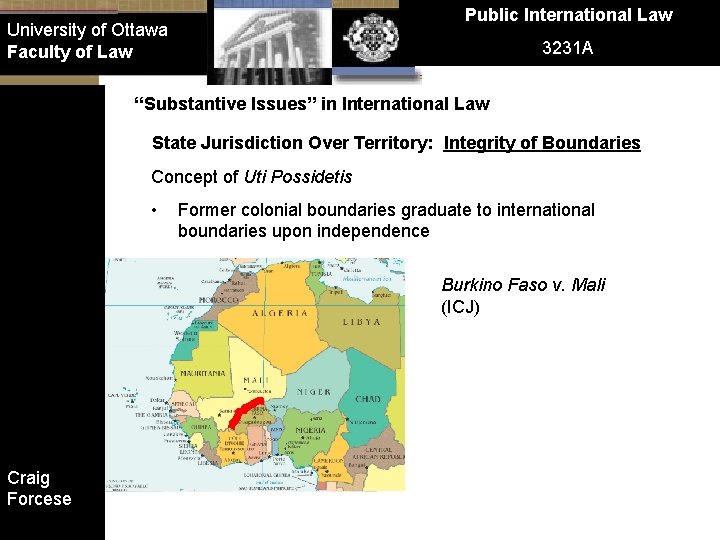
Public International Law University of Ottawa Faculty of Law 3231 A “Substantive Issues” in International Law State Jurisdiction Over Territory: Integrity of Boundaries Concept of Uti Possidetis • Former colonial boundaries graduate to international boundaries upon independence Burkino Faso v. Mali (ICJ) Craig Forcese
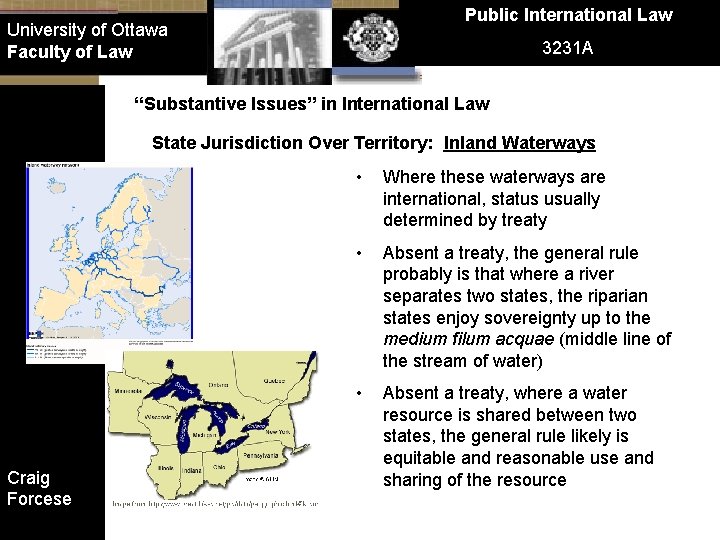
Public International Law University of Ottawa Faculty of Law 3231 A “Substantive Issues” in International Law State Jurisdiction Over Territory: Inland Waterways Craig Forcese • Where these waterways are international, status usually determined by treaty • Absent a treaty, the general rule probably is that where a river separates two states, the riparian states enjoy sovereignty up to the medium filum acquae (middle line of the stream of water) • Absent a treaty, where a water resource is shared between two states, the general rule likely is equitable and reasonable use and sharing of the resource
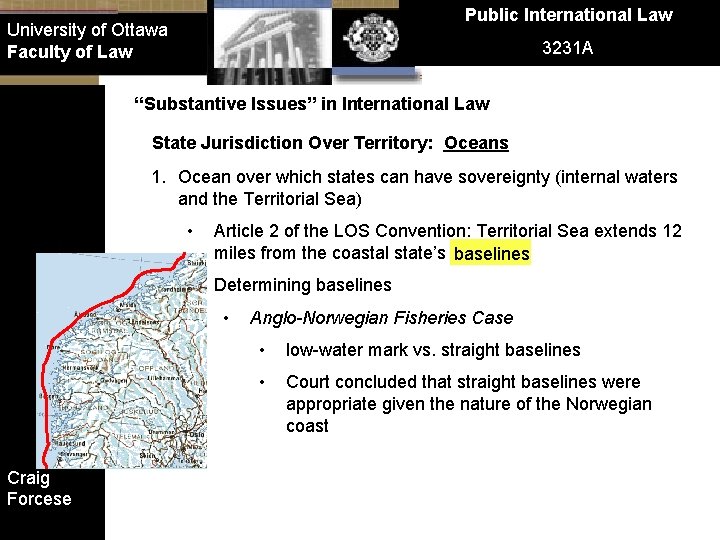
Public International Law University of Ottawa Faculty of Law 3231 A “Substantive Issues” in International Law State Jurisdiction Over Territory: Oceans 1. Ocean over which states can have sovereignty (internal waters and the Territorial Sea) • Article 2 of the LOS Convention: Territorial Sea extends 12 miles from the coastal state’s baselines • Determining baselines • Craig Forcese Anglo-Norwegian Fisheries Case • low-water mark vs. straight baselines • Court concluded that straight baselines were appropriate given the nature of the Norwegian coast
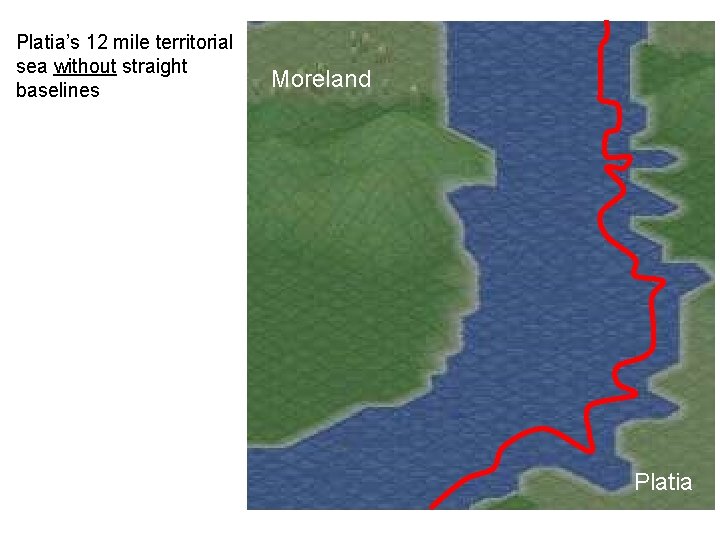
Platia’s 12 mile territorial sea without straight baselines Moreland Platia
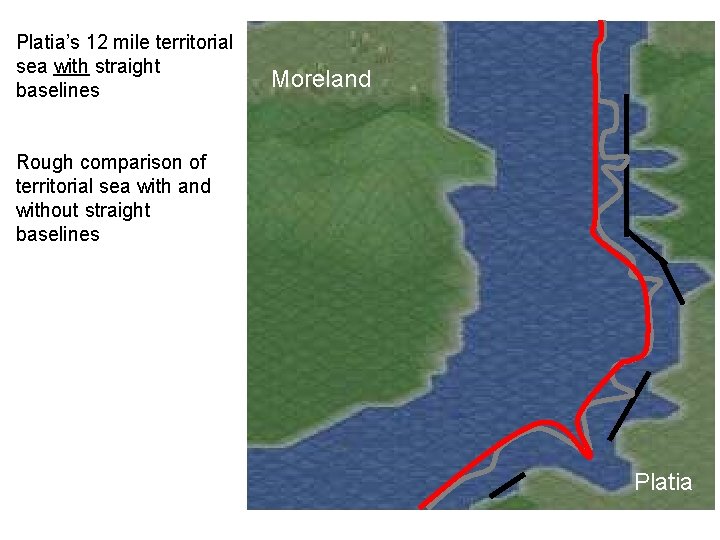
Platia’s 12 mile territorial sea with straight baselines Moreland Rough comparison of territorial sea with and without straight baselines Platia
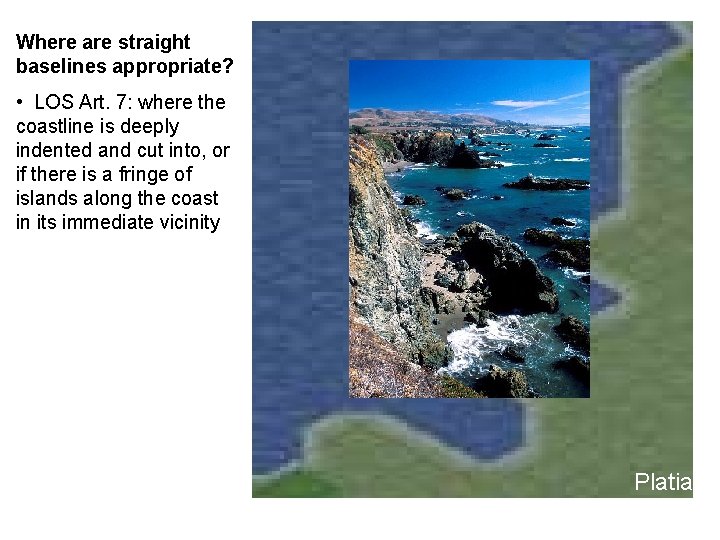
Where are straight baselines appropriate? • LOS Art. 7: where the coastline is deeply indented and cut into, or if there is a fringe of islands along the coast in its immediate vicinity Platia
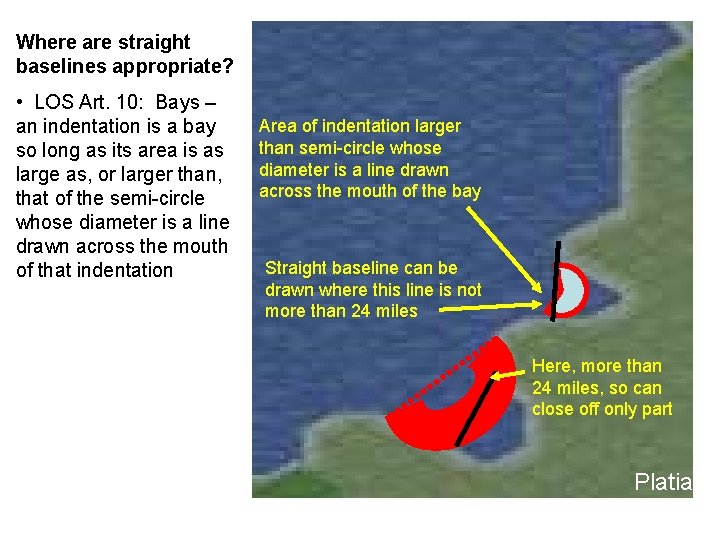
Where are straight baselines appropriate? • LOS Art. 10: Bays – an indentation is a bay so long as its area is as large as, or larger than, that of the semi-circle whose diameter is a line drawn across the mouth of that indentation Area of indentation larger than semi-circle whose diameter is a line drawn across the mouth of the bay Straight baseline can be drawn where this line is not more than 24 miles Here, more than 24 miles, so can close off only part Platia
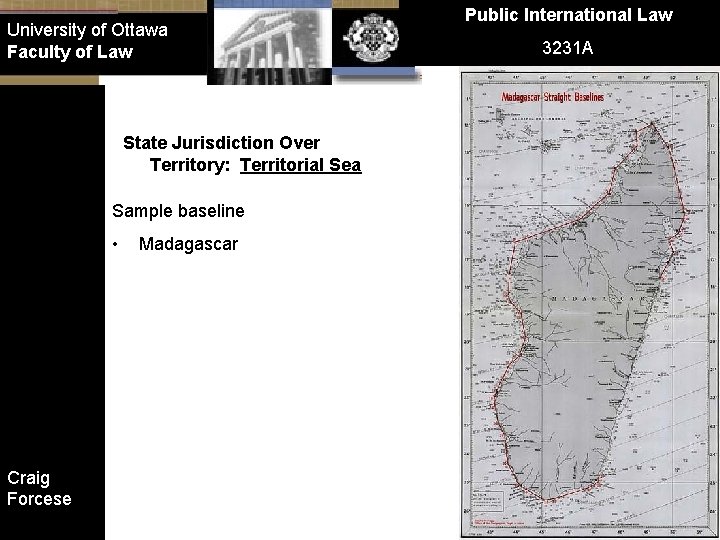
University of Ottawa Faculty of Law State Jurisdiction Over Territory: Territorial Sea Sample baseline • Craig Forcese Madagascar Public International Law 3231 A
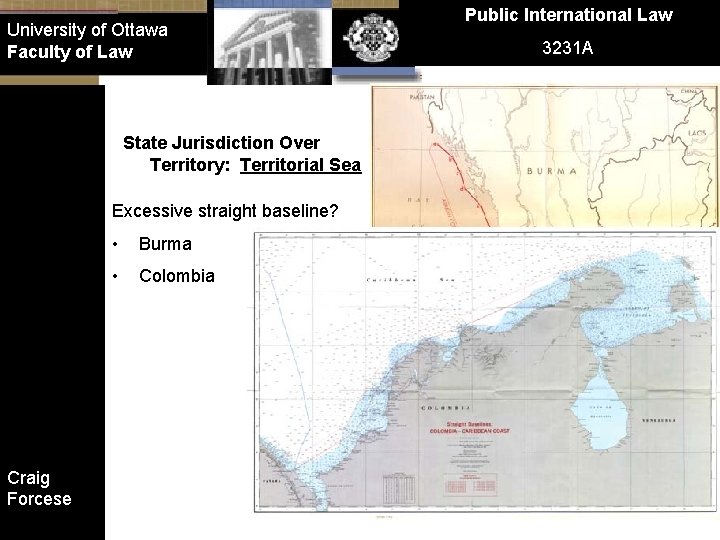
University of Ottawa Faculty of Law State Jurisdiction Over Territory: Territorial Sea Excessive straight baseline? Craig Forcese • Burma • Colombia Public International Law 3231 A
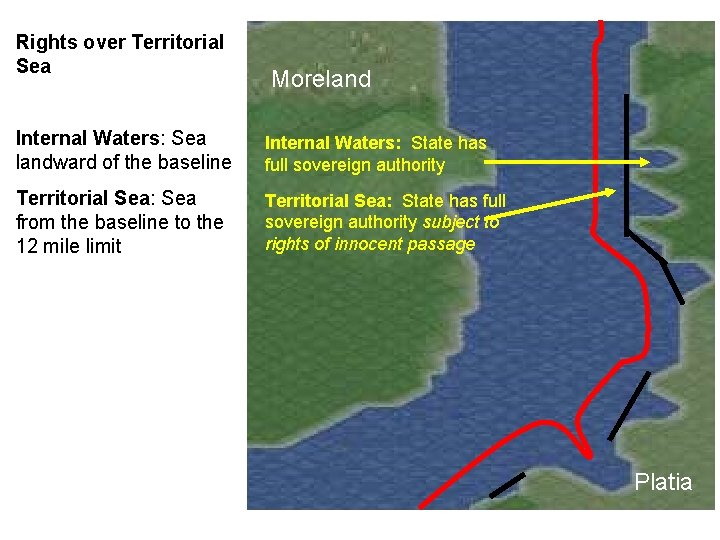
Rights over Territorial Sea Moreland Internal Waters: Sea landward of the baseline Internal Waters: State has full sovereign authority Territorial Sea: Sea from the baseline to the 12 mile limit Territorial Sea: State has full sovereign authority subject to rights of innocent passage Platia
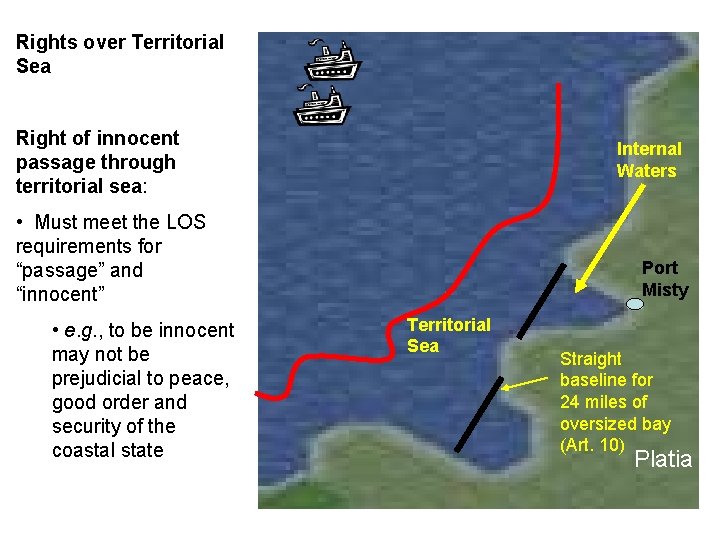
Rights over Territorial Sea Right of innocent passage through territorial sea: Internal Waters • Must meet the LOS requirements for “passage” and “innocent” • e. g. , to be innocent may not be prejudicial to peace, good order and security of the coastal state Port Misty Territorial Sea Straight baseline for 24 miles of oversized bay (Art. 10) Platia
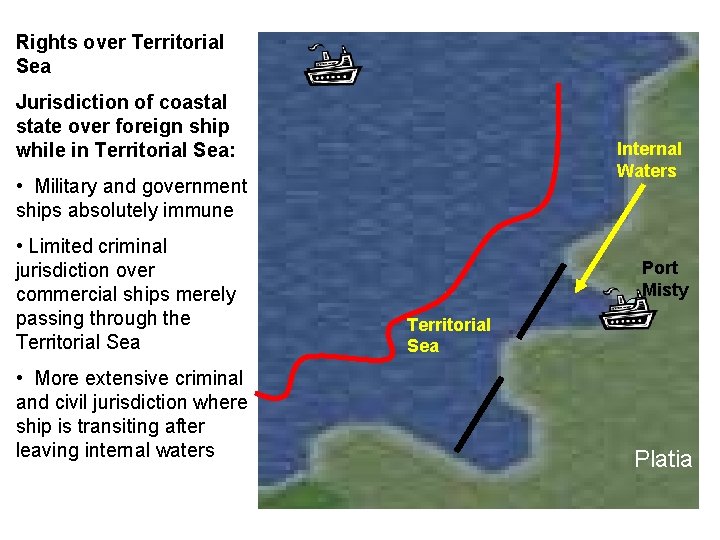
Rights over Territorial Sea Jurisdiction of coastal state over foreign ship while in Territorial Sea: Internal Waters • Military and government ships absolutely immune • Limited criminal jurisdiction over commercial ships merely passing through the Territorial Sea • More extensive criminal and civil jurisdiction where ship is transiting after leaving internal waters Port Misty Territorial Sea Platia
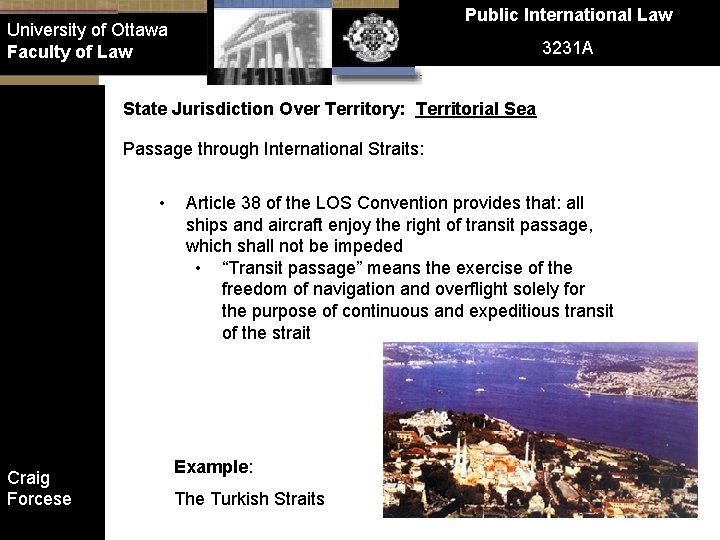
Public International Law University of Ottawa Faculty of Law 3231 A State Jurisdiction Over Territory: Territorial Sea Passage through International Straits: • Craig Forcese Article 38 of the LOS Convention provides that: all ships and aircraft enjoy the right of transit passage, which shall not be impeded • “Transit passage” means the exercise of the freedom of navigation and overflight solely for the purpose of continuous and expeditious transit of the strait Example: The Turkish Straits
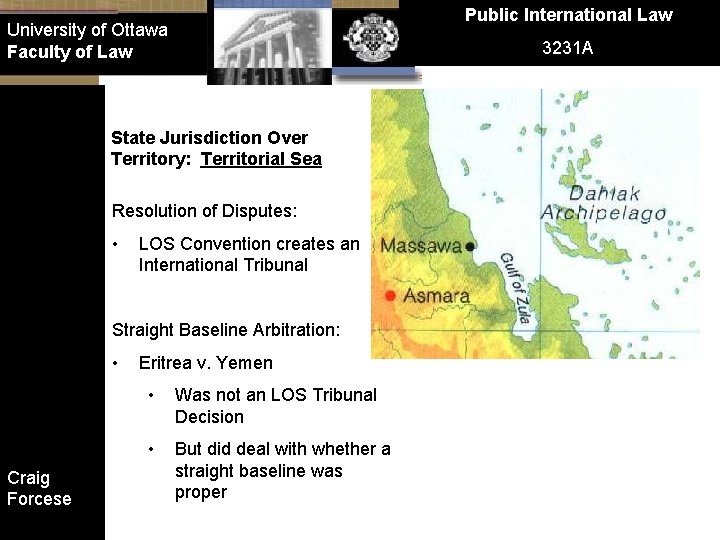
Public International Law University of Ottawa Faculty of Law 3231 A State Jurisdiction Over Territory: Territorial Sea Resolution of Disputes: • LOS Convention creates an International Tribunal Straight Baseline Arbitration: • Craig Forcese Eritrea v. Yemen • Was not an LOS Tribunal Decision • But did deal with whether a straight baseline was proper
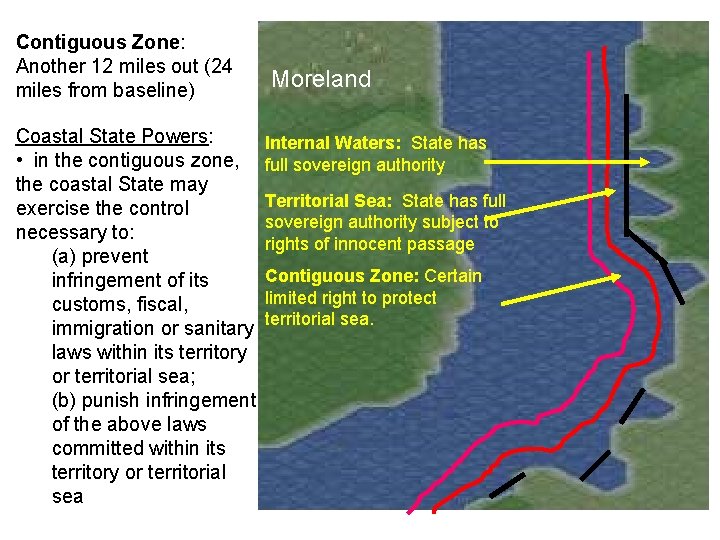
Contiguous Zone: Another 12 miles out (24 miles from baseline) Moreland Coastal State Powers: Internal Waters: State has • in the contiguous zone, full sovereign authority the coastal State may Territorial Sea: State has full exercise the control sovereign authority subject to necessary to: rights of innocent passage (a) prevent Contiguous Zone: Certain infringement of its limited right to protect customs, fiscal, immigration or sanitary territorial sea. laws within its territory or territorial sea; (b) punish infringement of the above laws committed within its territory or territorial sea Platia
Public International Law University of Ottawa Faculty of Law 3231 A State Jurisdiction Over Territory: Exclusive Economic Zone • states have important economic interests that extend beyond their territorial seas • Fisheries Jurisdiction Case – UK v. Iceland • • Craig Forcese customary law allowed a fishery zone, between the territorial sea and the high seas within which the coastal State could claim exclusive fisheries jurisdiction Approach to the “Exclusive Economic Zone” set out in the LOS Convention
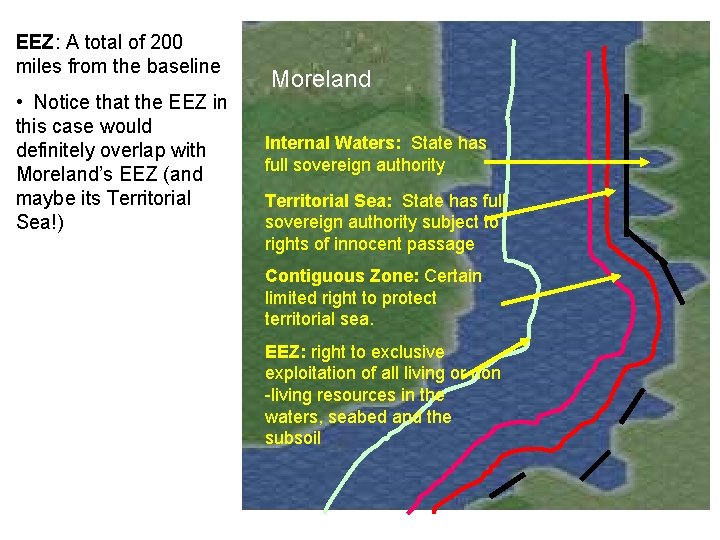
EEZ: A total of 200 miles from the baseline • Notice that the EEZ in this case would definitely overlap with Moreland’s EEZ (and maybe its Territorial Sea!) Moreland Internal Waters: State has full sovereign authority Territorial Sea: State has full sovereign authority subject to rights of innocent passage Contiguous Zone: Certain limited right to protect territorial sea. EEZ: right to exclusive exploitation of all living or non -living resources in the waters, seabed and the subsoil Platia
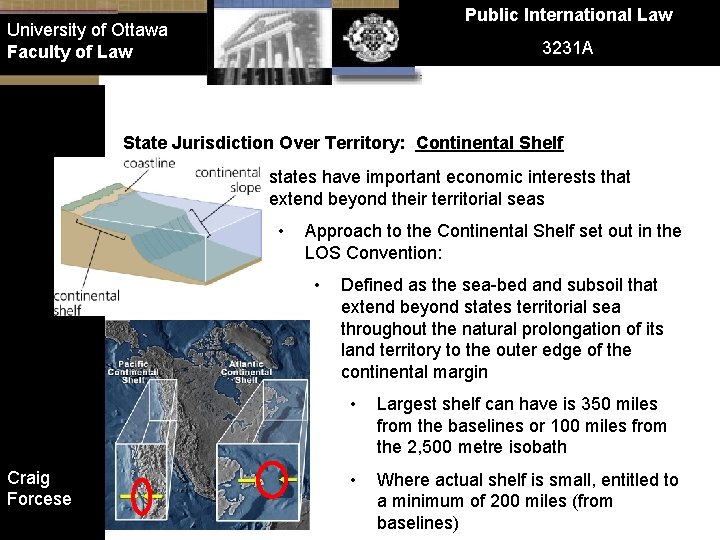
Public International Law University of Ottawa Faculty of Law 3231 A State Jurisdiction Over Territory: Continental Shelf • states have important economic interests that extend beyond their territorial seas • Approach to the Continental Shelf set out in the LOS Convention: • Craig Forcese Defined as the sea-bed and subsoil that extend beyond states territorial sea throughout the natural prolongation of its land territory to the outer edge of the continental margin • Largest shelf can have is 350 miles from the baselines or 100 miles from the 2, 500 metre isobath • Where actual shelf is small, entitled to a minimum of 200 miles (from baselines)
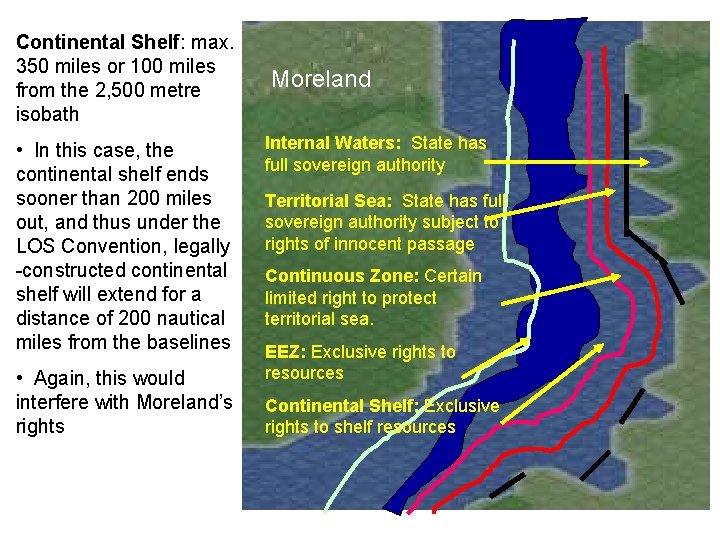
Continental Shelf: max. 350 miles or 100 miles from the 2, 500 metre isobath • In this case, the continental shelf ends sooner than 200 miles out, and thus under the LOS Convention, legally -constructed continental shelf will extend for a distance of 200 nautical miles from the baselines • Again, this would interfere with Moreland’s rights Moreland Internal Waters: State has full sovereign authority Territorial Sea: State has full sovereign authority subject to rights of innocent passage Continuous Zone: Certain limited right to protect territorial sea. EEZ: Exclusive rights to resources Continental Shelf: Exclusive rights to shelf resources Platia
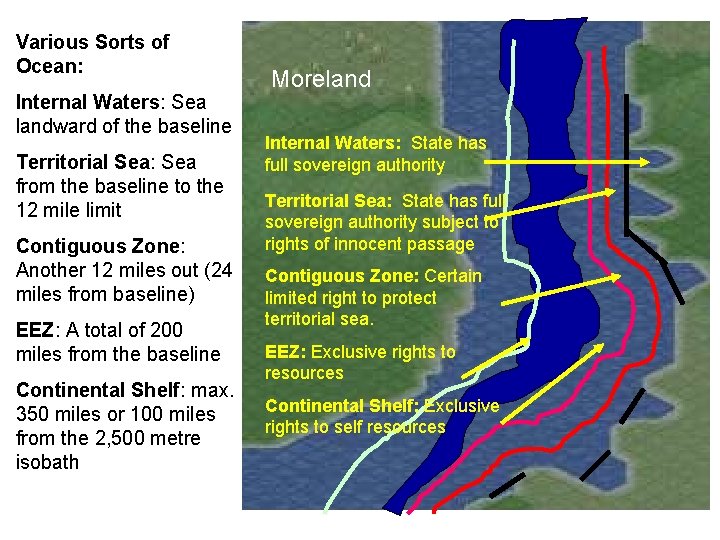
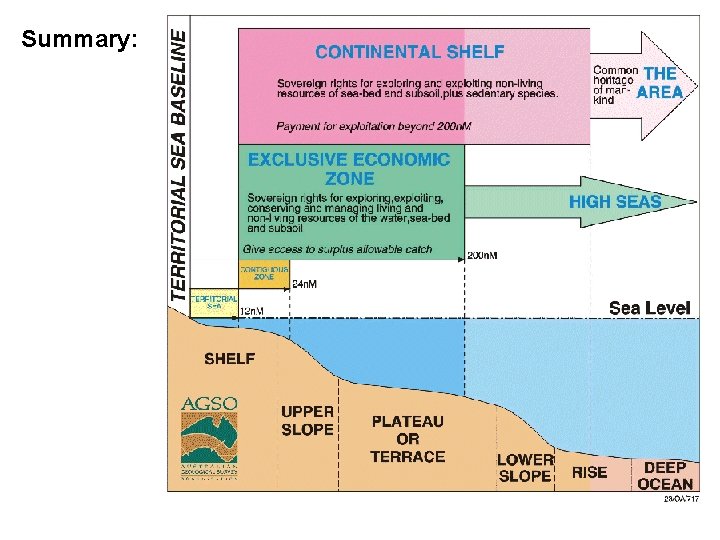
Various Sorts of Ocean: Internal Waters: Sea landward of the baseline Territorial Sea: Sea from the baseline to the 12 mile limit Contiguous Zone: Another 12 miles out (24 miles from baseline) EEZ: A total of 200 miles from the baseline Continental Shelf: max. 350 miles or 100 miles from the 2, 500 metre isobath Moreland Internal Waters: State has full sovereign authority Territorial Sea: State has full sovereign authority subject to rights of innocent passage Contiguous Zone: Certain limited right to protect territorial sea. EEZ: Exclusive rights to resources Continental Shelf: Exclusive rights to self resources Platia
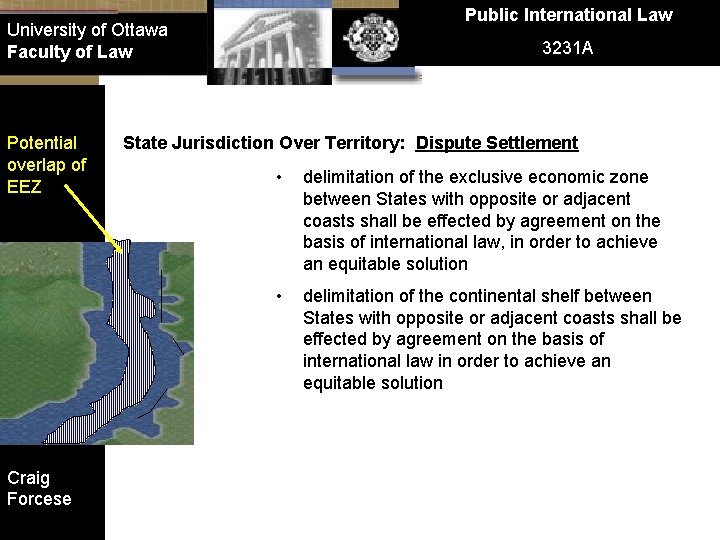
Public International Law University of Ottawa Faculty of Law Potential overlap of EEZ Craig Forcese 3231 A State Jurisdiction Over Territory: Dispute Settlement • delimitation of the exclusive economic zone between States with opposite or adjacent coasts shall be effected by agreement on the basis of international law, in order to achieve an equitable solution • delimitation of the continental shelf between States with opposite or adjacent coasts shall be effected by agreement on the basis of international law in order to achieve an equitable solution
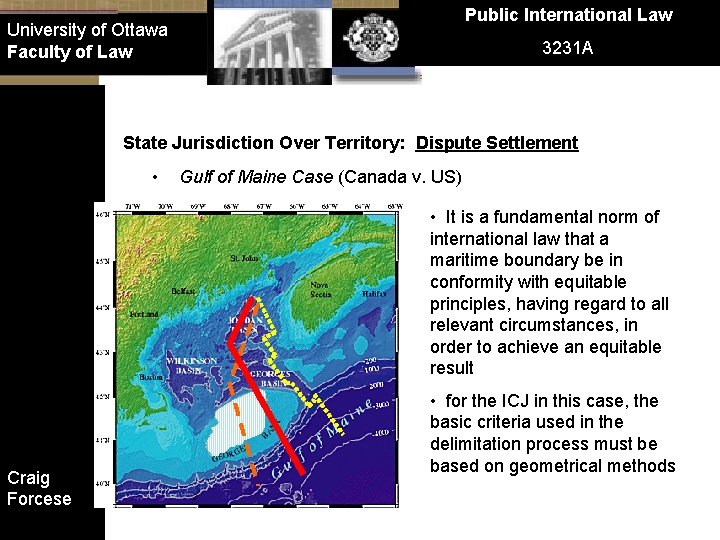
Public International Law University of Ottawa Faculty of Law 3231 A State Jurisdiction Over Territory: Dispute Settlement • Gulf of Maine Case (Canada v. US) • It is a fundamental norm of international law that a maritime boundary be in conformity with equitable principles, having regard to all relevant circumstances, in order to achieve an equitable result Craig Forcese • for the ICJ in this case, the basic criteria used in the delimitation process must be based on geometrical methods
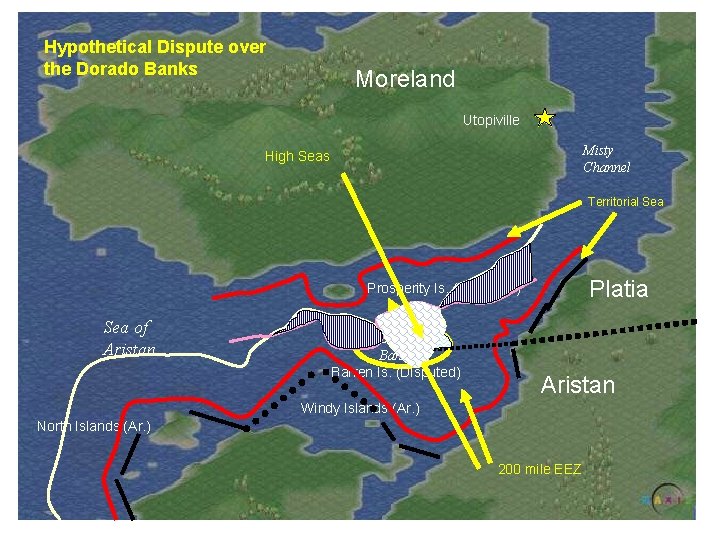
Hypothetical Dispute over the Dorado Banks Moreland Utopiville Misty Channel High Seas Territorial Sea Platia Prosperity Is. (Moreland) Sea of Aristan Dorado Banks Barren Is. (Disputed) Aristan Windy Islands (Ar. ) North Islands (Ar. ) 200 mile EEZ
Summary:
Public International Law University of Ottawa Faculty of Law 3231 A State Jurisdiction Over Territory: High Seas • Craig Forcese Pure res communis • on these commons all states have freedom of the high seas, such as freedom of navigation or freedom of overflight • No state may validly purport to subject any part of the high seas to its sovereignty
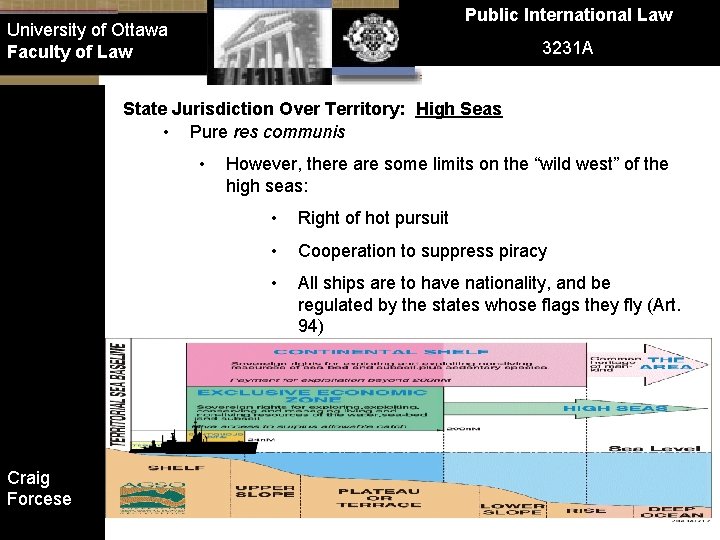
Public International Law University of Ottawa Faculty of Law 3231 A State Jurisdiction Over Territory: High Seas • Pure res communis • Craig Forcese However, there are some limits on the “wild west” of the high seas: • Right of hot pursuit • Cooperation to suppress piracy • All ships are to have nationality, and be regulated by the states whose flags they fly (Art. 94)
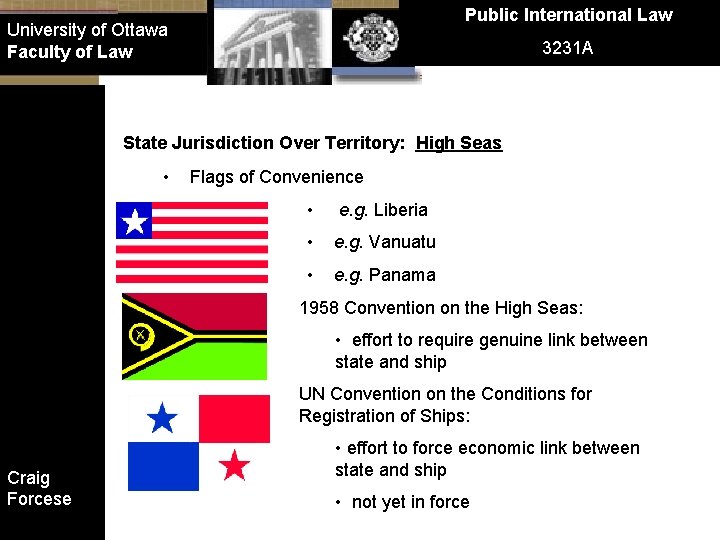
Public International Law University of Ottawa Faculty of Law 3231 A State Jurisdiction Over Territory: High Seas • Flags of Convenience • e. g. Liberia • e. g. Vanuatu • e. g. Panama 1958 Convention on the High Seas: • effort to require genuine link between state and ship UN Convention on the Conditions for Registration of Ships: Craig Forcese • effort to force economic link between state and ship • not yet in force
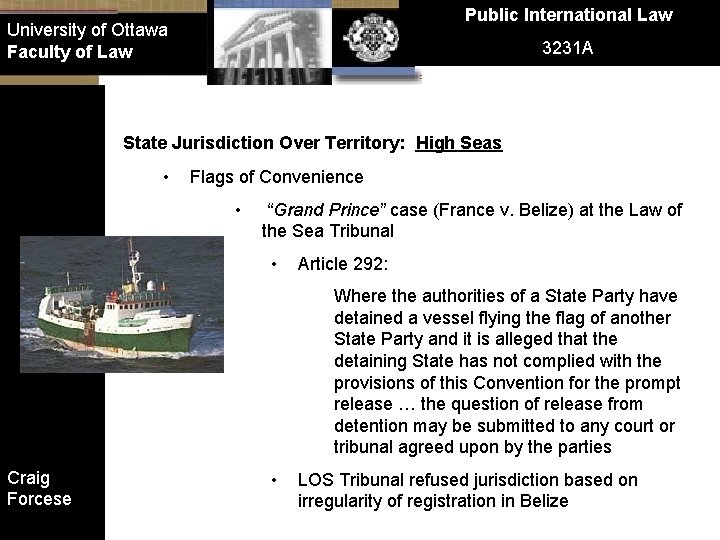
Public International Law University of Ottawa Faculty of Law 3231 A State Jurisdiction Over Territory: High Seas • Flags of Convenience • “Grand Prince” case (France v. Belize) at the Law of the Sea Tribunal • Article 292: Where the authorities of a State Party have detained a vessel flying the flag of another State Party and it is alleged that the detaining State has not complied with the provisions of this Convention for the prompt release … the question of release from detention may be submitted to any court or tribunal agreed upon by the parties Craig Forcese • LOS Tribunal refused jurisdiction based on irregularity of registration in Belize
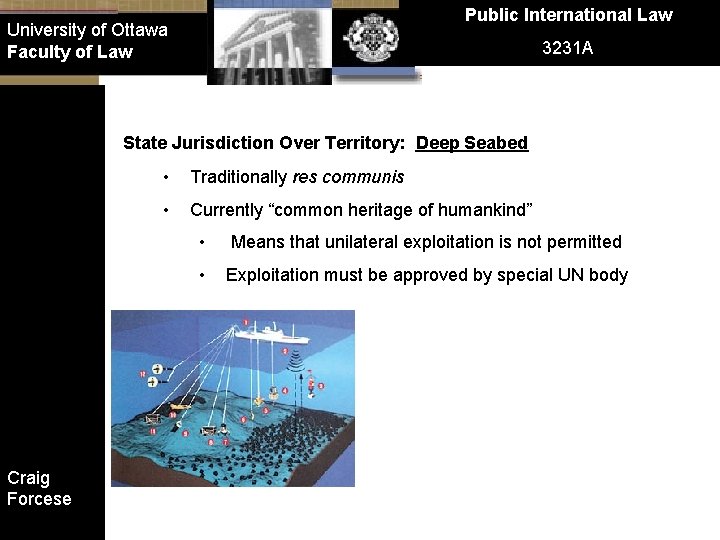
Public International Law University of Ottawa Faculty of Law 3231 A State Jurisdiction Over Territory: Deep Seabed Craig Forcese • Traditionally res communis • Currently “common heritage of humankind” • Means that unilateral exploitation is not permitted • Exploitation must be approved by special UN body
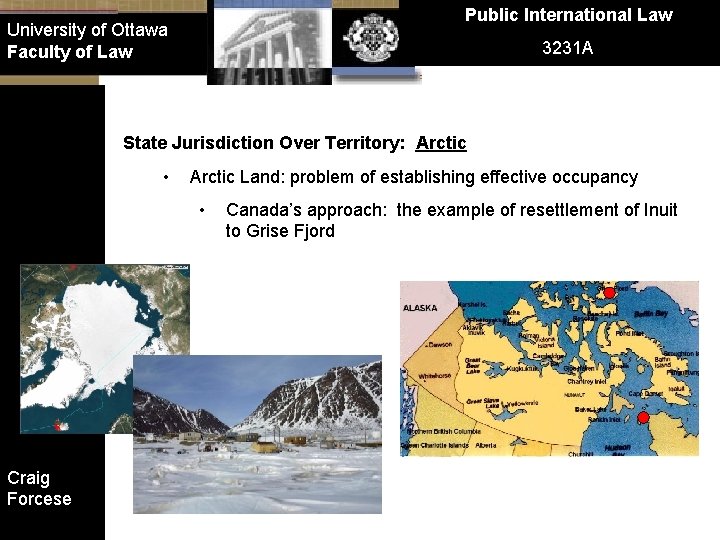
Public International Law University of Ottawa Faculty of Law 3231 A State Jurisdiction Over Territory: Arctic • Arctic Land: problem of establishing effective occupancy • Craig Forcese Canada’s approach: the example of resettlement of Inuit to Grise Fjord
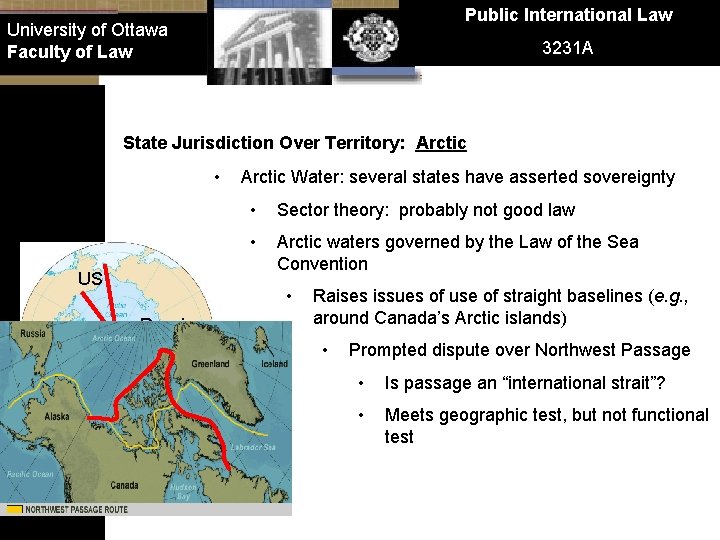
Public International Law University of Ottawa Faculty of Law 3231 A State Jurisdiction Over Territory: Arctic • US Canada Craig Forcese Arctic Water: several states have asserted sovereignty • Sector theory: probably not good law • Arctic waters governed by the Law of the Sea Convention • Russia Raises issues of use of straight baselines (e. g. , around Canada’s Arctic islands) • Prompted dispute over Northwest Passage • Is passage an “international strait”? • Meets geographic test, but not functional test
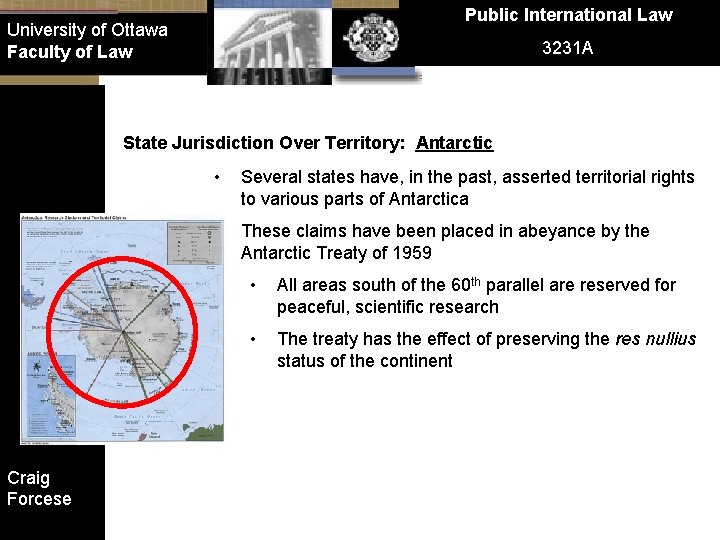
Public International Law University of Ottawa Faculty of Law 3231 A State Jurisdiction Over Territory: Antarctic US Craig Forcese • Several states have, in the past, asserted territorial rights to various parts of Antarctica • These claims have been placed in abeyance by the Antarctic Treaty of 1959 • All areas south of the 60 th parallel are reserved for peaceful, scientific research • The treaty has the effect of preserving the res nullius status of the continent
- Slides: 89