
University of Nottingham Discourse and Politics Conference Panel
- Slides: 31
University of Nottingham Discourse and Politics Conference: Panel on Political personalities A RHETORICAL ANALYSIS OF THE PERSUASIVE STRATEGIES IN POLITICAL DISCOURSE: THE CASE OF BARACK OBAMA’S 2012 ELECTORAL CAMPAIGN SPEECHES TITLE: 11 AM - 12. 30 PM ON 22 FEBRUARY, 2021 PRESENTED BY: RIMA MEDJEDOUB MILA UNIVERSITY CENTRE MEDJRIM@YAHOO. FR
Introduction �Persuasive strategies are the subject matter of rhetoric. �The most common use of the rhetorical theory is within political speeches.
Definitions of key terms �Political Speech: it is a genre of political discourse produced orally by politicians in front of an audience. Their purpose is primarily persuasion rather than information or entertainment. �Persuasion: Seiter and Gass (2004) view persuasion as a form of influence that achieves its goal by guiding people toward the adoption of an idea, attitude, belief, viewpoint, behavior, intention, feeling and/or action through appeals to reason, emotions, or some other means rather than force. �Rhetoric: The rhetorical theory offers a method for discovering the means of persuasion in discourse. The classical rhetorical theory has long focused on areas pertinent to persuasion since the Greek period (Sophists, Plato and Aristotle) and the Roman one (Cicero and Quintilian).
Research Question The present article has addressed the following question: What persuasive strategies are used in Barack Obama’s 2012 electoral campaign speeches?
Research Tool Cluster Analysis: a revised version � Existing methods permit the conduction of deductive analyses which means they risk imposing theoretical structures on texts that may resist them. �Cluster analysis (Burke, 1969): Top-down in orientation
Cluster Analysis: a revised version �Cluster analysis involves spotting the key symbols (or their synonyms) and the symbols that cluster around them in an artifact, then grouping the clusters into patterns from which the strategies are deduced
Cluster Analysis: a revised version �Example: �For instance, a cluster analysis of a speech encouraging people to get insurance on their houses may reveal that the speech is based on such terms as ‘whole life’, ‘family’, ‘best’ and ‘disaster’ and their associated clusters of terms. �Strategies as fear and desire (emotional appeals): instilling fear from sudden threats and tapping into one’s desire for protecting family and leading a decent life.
Criticism of Cluster Analysis �It might fail to account for the role of the aesthetic dimension of language, elegance of style, or organization of ideas which are crucial for persuasion.
Research Design � Descriptive, qualitative and interpretive. � The research was carried out inductively
Data �A transcript of a speech delivered by Barack Obama during the 2012 presidential elections campaign entitled “Remarks by the President at a Campaign Event in Columbus, Ohio” �The white house official website: http: //www. whitehouse. gov.
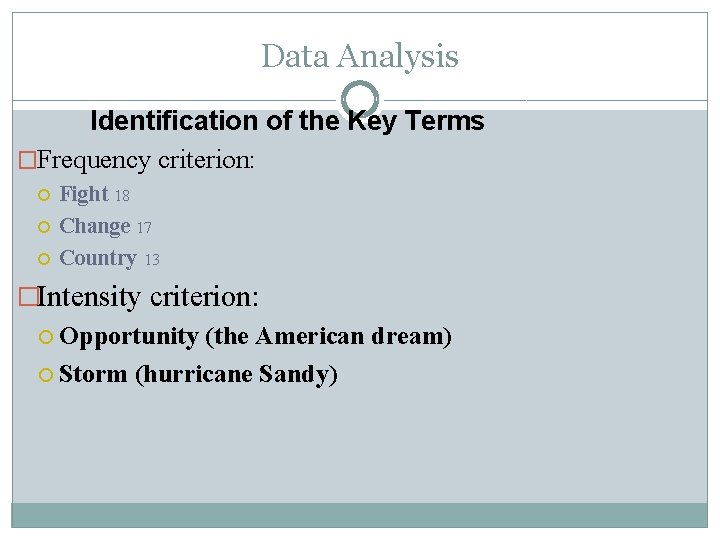
Data Analysis Identification of the Key Terms �Frequency criterion: Fight 18 Change 17 Country 13 �Intensity criterion: Opportunity (the American dream) Storm (hurricane Sandy)
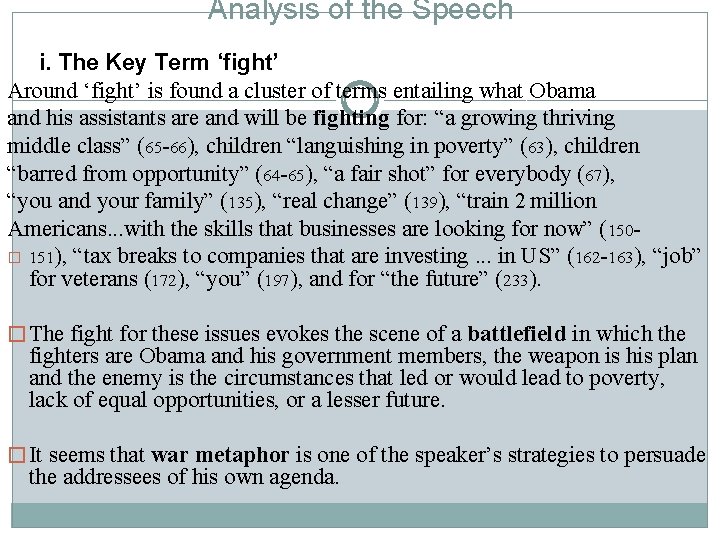
Analysis of the Speech i. The Key Term ‘fight’ Around ‘fight’ is found a cluster of terms entailing what Obama and his assistants are and will be fighting for: “a growing thriving middle class” (65 -66), children “languishing in poverty” (63), children “barred from opportunity” (64 -65), “a fair shot” for everybody (67), “you and your family” (135), “real change” (139), “train 2 million Americans. . . with the skills that businesses are looking for now” (150� 151), “tax breaks to companies that are investing. . . in US” (162 -163), “job” for veterans (172), “you” (197), and for “the future” (233). � The fight for these issues evokes the scene of a battlefield in which the fighters are Obama and his government members, the weapon is his plan and the enemy is the circumstances that led or would lead to poverty, lack of equal opportunities, or a lesser future. � It seems that war metaphor is one of the speaker’s strategies to persuade the addressees of his own agenda.
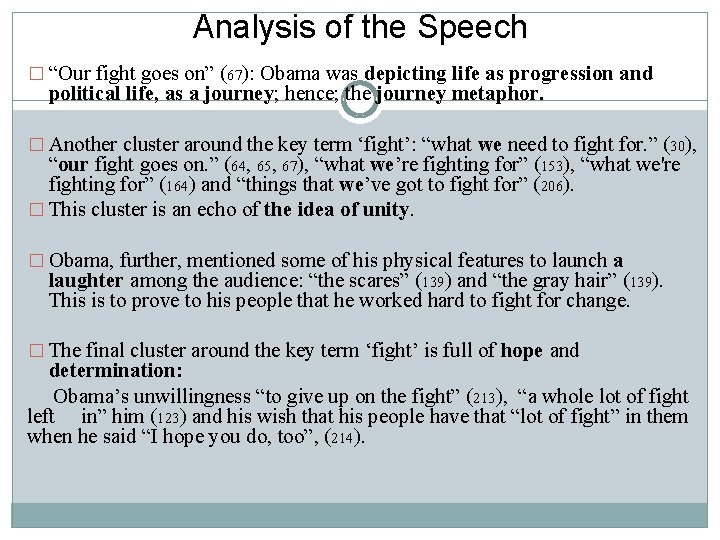
Analysis of the Speech � “Our fight goes on” (67): Obama was depicting life as progression and political life, as a journey; hence; the journey metaphor. � Another cluster around the key term ‘fight’: “what we need to fight for. ” (30), “our fight goes on. ” (64, 65, 67), “what we’re fighting for” (153), “what we're fighting for” (164) and “things that we’ve got to fight for” (206). � This cluster is an echo of the idea of unity. � Obama, further, mentioned some of his physical features to launch a laughter among the audience: “the scares” (139) and “the gray hair” (139). This is to prove to his people that he worked hard to fight for change. � The final cluster around the key term ‘fight’ is full of hope and determination: Obama’s unwillingness “to give up on the fight” (213), “a whole lot of fight left in” him (123) and his wish that his people have that “lot of fight” in them when he said “I hope you do, too”, (214).
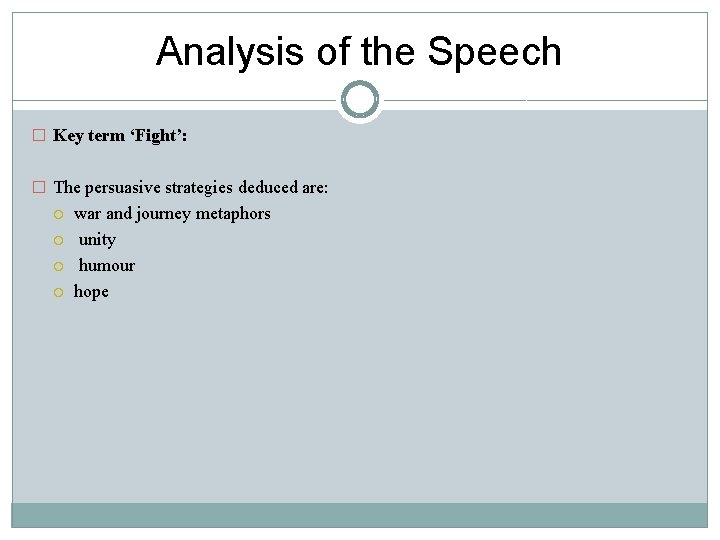
Analysis of the Speech � Key term ‘Fight’: � The persuasive strategies deduced are: war and journey metaphors unity humour hope
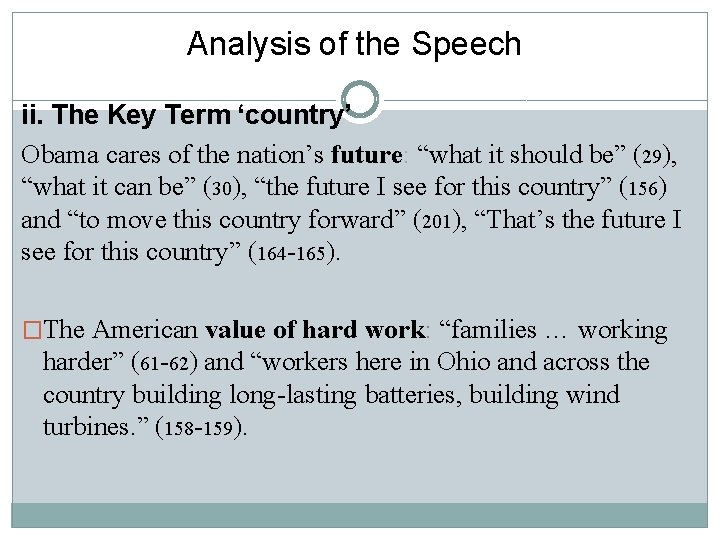
Analysis of the Speech ii. The Key Term ‘country’ Obama cares of the nation’s future: “what it should be” (29), “what it can be” (30), “the future I see for this country” (156) and “to move this country forward” (201), “That’s the future I see for this country” (164 -165). �The American value of hard work: “families … working harder” (61 -62) and “workers here in Ohio and across the country building long-lasting batteries, building wind turbines. ” (158 -159).
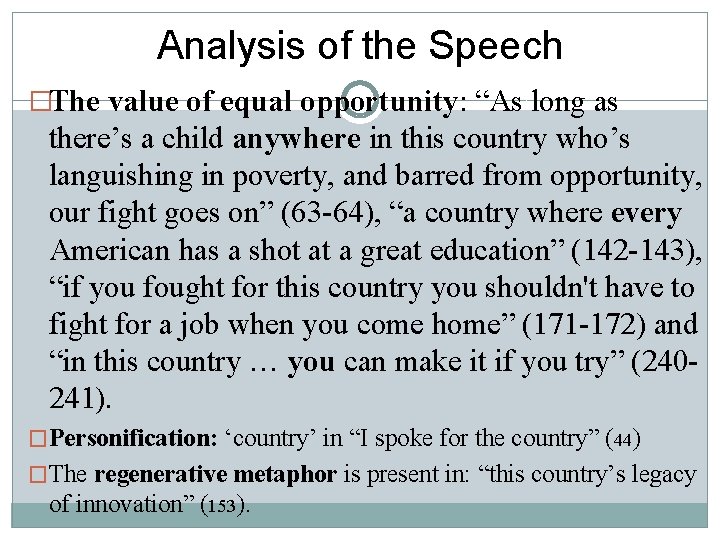
Analysis of the Speech �The value of equal opportunity: “As long as there’s a child anywhere in this country who’s languishing in poverty, and barred from opportunity, our fight goes on” (63 -64), “a country where every American has a shot at a great education” (142 -143), “if you fought for this country you shouldn't have to fight for a job when you come home” (171 -172) and “in this country … you can make it if you try” (240241). �Personification: ‘country’ in “I spoke for the country” (44) �The regenerative metaphor is present in: “this country’s legacy of innovation” (153).
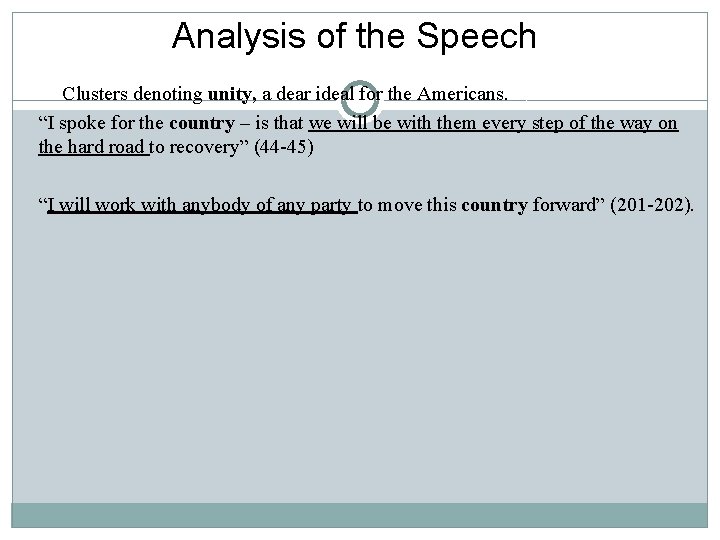
Analysis of the Speech Clusters denoting unity, a dear ideal for the Americans. “I spoke for the country – is that we will be with them every step of the way on the hard road to recovery” (44 -45) “I will work with anybody of any party to move this country forward” (201 -202).
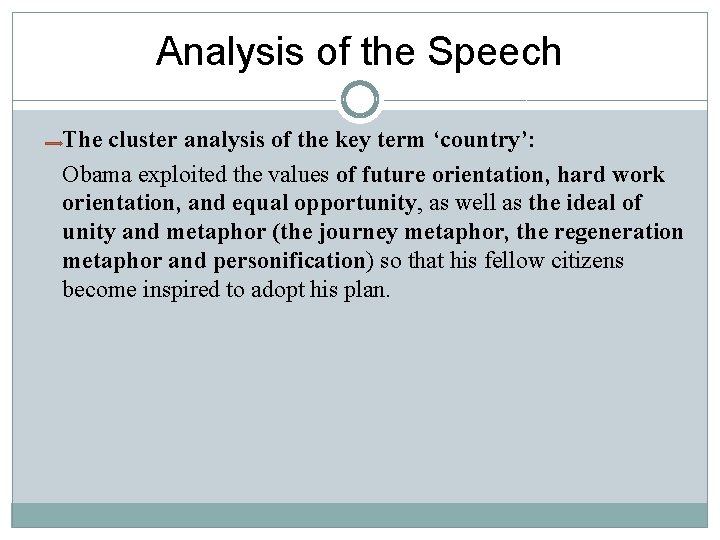
Analysis of the Speech The cluster analysis of the key term ‘country’: Obama exploited the values of future orientation, hard work orientation, and equal opportunity, as well as the ideal of unity and metaphor (the journey metaphor, the regeneration metaphor and personification) so that his fellow citizens become inspired to adopt his plan.
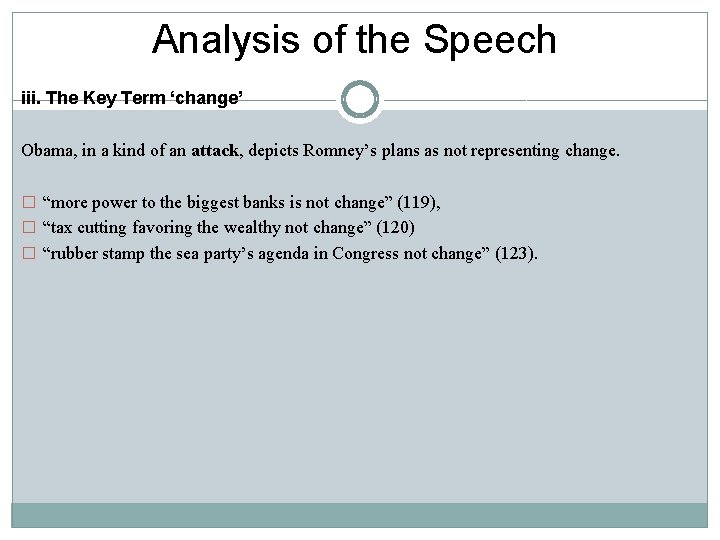
Analysis of the Speech iii. The Key Term ‘change’ Obama, in a kind of an attack, depicts Romney’s plans as not representing change. � “more power to the biggest banks is not change” (119), � “tax cutting favoring the wealthy not change” (120) � “rubber stamp the sea party’s agenda in Congress not change” (123).
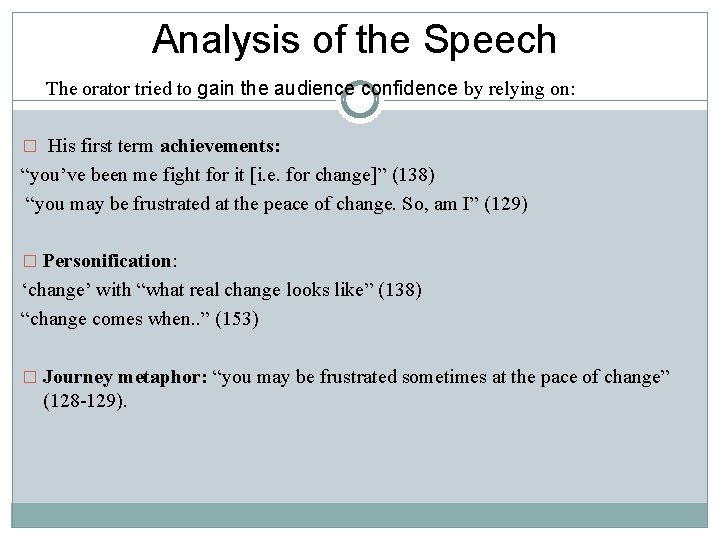
Analysis of the Speech The orator tried to gain the audience confidence by relying on: � His first term achievements: “you’ve been me fight for it [i. e. for change]” (138) “you may be frustrated at the peace of change. So, am I” (129) � Personification: ‘change’ with “what real change looks like” (138) “change comes when. . ” (153) � Journey metaphor: “you may be frustrated sometimes at the pace of change” (128 -129).
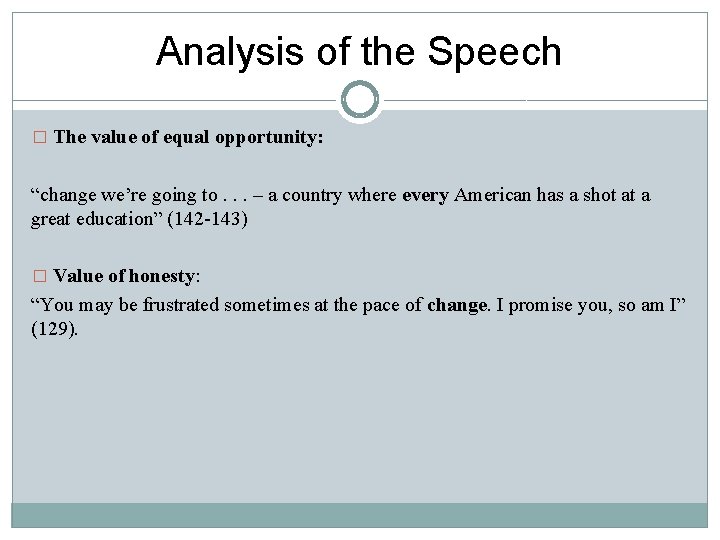
Analysis of the Speech � The value of equal opportunity: “change we’re going to. . . – a country where every American has a shot at a great education” (142 -143) � Value of honesty: “You may be frustrated sometimes at the pace of change. I promise you, so am I” (129).
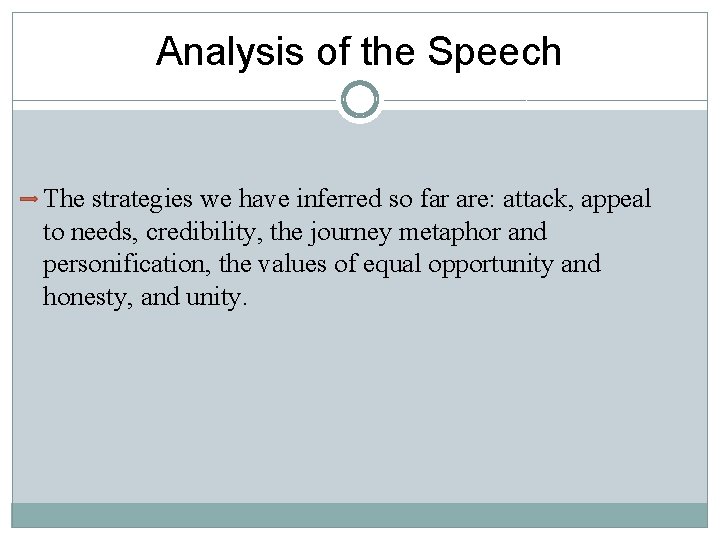
Analysis of the Speech The strategies we have inferred so far are: attack, appeal to needs, credibility, the journey metaphor and personification, the values of equal opportunity and honesty, and unity.
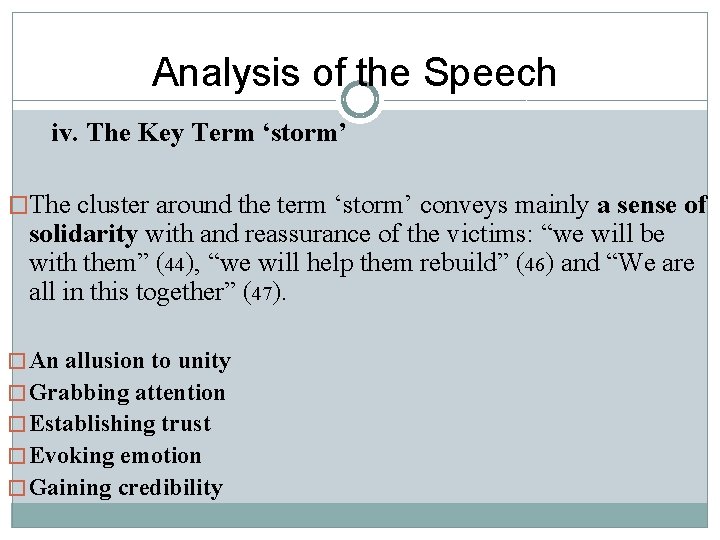
Analysis of the Speech iv. The Key Term ‘storm’ �The cluster around the term ‘storm’ conveys mainly a sense of solidarity with and reassurance of the victims: “we will be with them” (44), “we will help them rebuild” (46) and “We are all in this together” (47). � An allusion to unity � Grabbing attention � Establishing trust � Evoking emotion � Gaining credibility
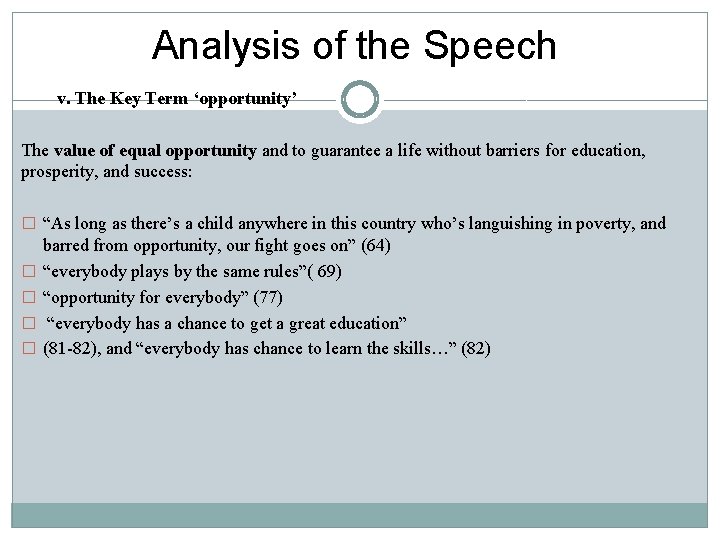
Analysis of the Speech v. The Key Term ‘opportunity’ The value of equal opportunity and to guarantee a life without barriers for education, prosperity, and success: � “As long as there’s a child anywhere in this country who’s languishing in poverty, and � � barred from opportunity, our fight goes on” (64) “everybody plays by the same rules”( 69) “opportunity for everybody” (77) “everybody has a chance to get a great education” (81 -82), and “everybody has chance to learn the skills…” (82)
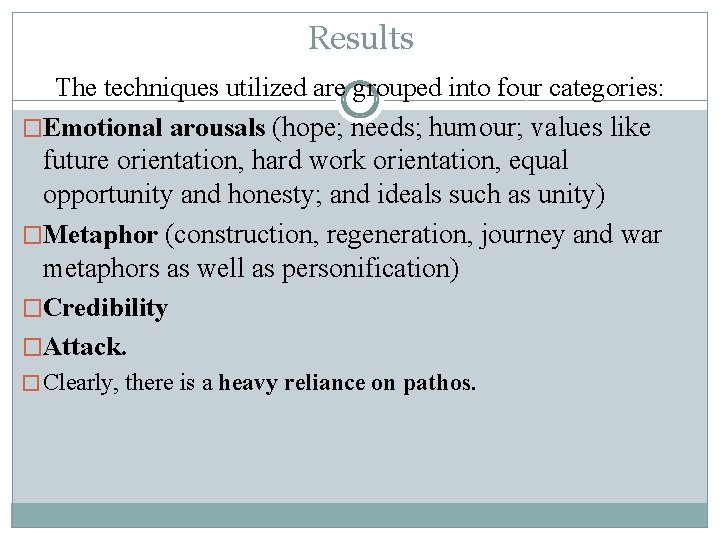
Results The techniques utilized are grouped into four categories: �Emotional arousals (hope; needs; humour; values like future orientation, hard work orientation, equal opportunity and honesty; and ideals such as unity) �Metaphor (construction, regeneration, journey and war metaphors as well as personification) �Credibility �Attack. � Clearly, there is a heavy reliance on pathos.
General Discussion �The full power of persuasion is derived from the successful combination of several tactics. �This interplay between the various appeals is also witnessed in metaphoric influence.
General Discussion �Metaphor is an efficient element to simplify concepts, relief tension, raise interest, intrigue hope and foster unity. � A purely logical speech would help gain agreement but will not be so interesting to a wide audience coming from various backgrounds; some pathos is needed.
General Discussion �Use of the values and ideals of the US society: Jowett and O’Donnel (1992, pp. 22 -23) that: “people are reluctant to change, thus, in order to convince them to do so, the persuader has to relate change to something in which the listener already believes. ”
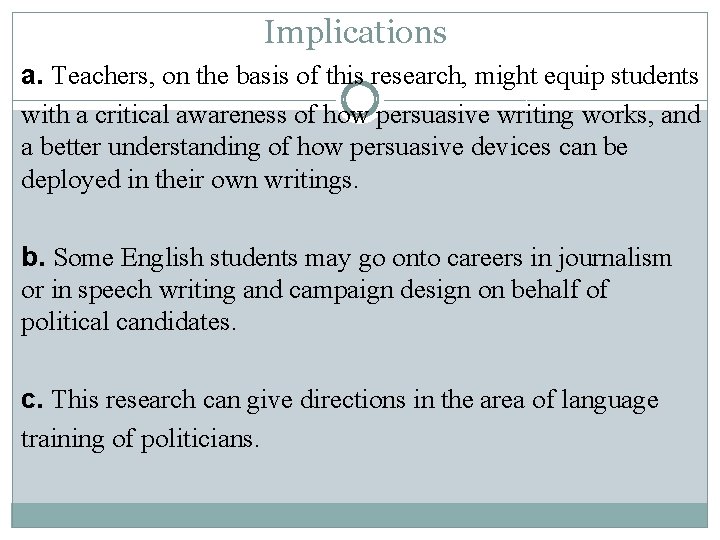
Implications a. Teachers, on the basis of this research, might equip students with a critical awareness of how persuasive writing works, and a better understanding of how persuasive devices can be deployed in their own writings. b. Some English students may go onto careers in journalism or in speech writing and campaign design on behalf of political candidates. c. This research can give directions in the area of language training of politicians.
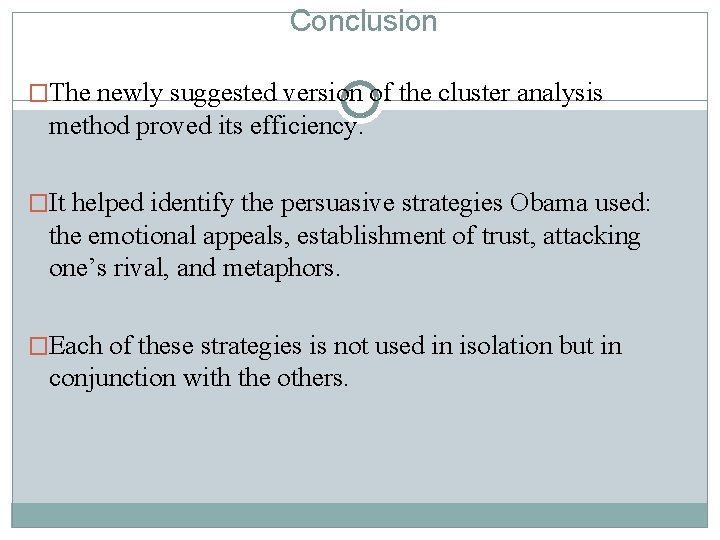
Conclusion �The newly suggested version of the cluster analysis method proved its efficiency. �It helped identify the persuasive strategies Obama used: the emotional appeals, establishment of trust, attacking one’s rival, and metaphors. �Each of these strategies is not used in isolation but in conjunction with the others.
References �Burke, K. (1969). A Rhetoric of Motives. California: University of California Press. �Jowett, G. S. , & O'Donnel, V. (1992). Propaganda and Persuasion. Londres: Sage publications. �Seiter, J. S. , & Gass, R. H. (2004). Perspectives on Persuasion, social influence, and compliance gaining (2 nd ed. ). Boston: Pearson Custom Publishing.