
UNIVERSITY OF NAIROBI DEPARTMENT OF MECHANICAL AND MANUFACTURING
UNIVERSITY OF NAIROBI DEPARTMENT OF MECHANICAL AND MANUFACTURING ENGINEERING DESIGN II FME 461 PART 8 -Summary GO NYANGASI November 2008 1
APPLICATION OF POWER SCREWS • FUNCTION OF A POWER SCREW IS • Provide a means for obtaining a large mechanical advantage • Transmit power by converting angular, into linear motion • Common applications include • Lifting jacks, presses, vices, and lead screws for lathe machines • Figure 1. 1 shows the application in a lifting jack, while Figure 1. 2 shows the same concept when used for a press. 2
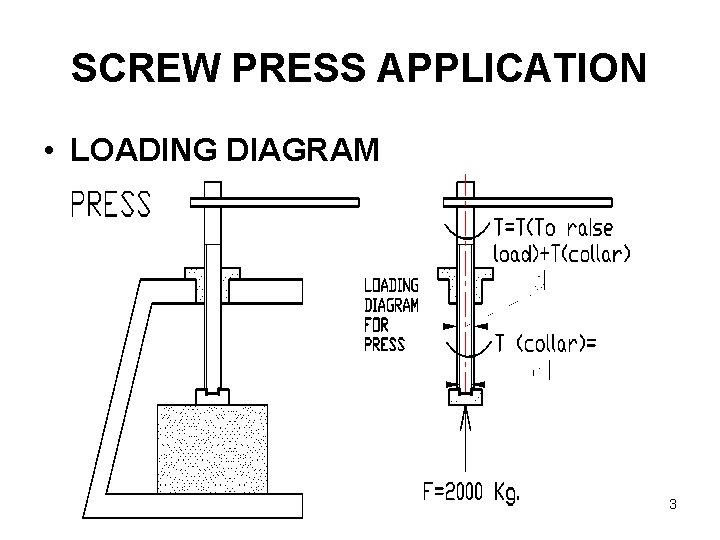
SCREW PRESS APPLICATION • LOADING DIAGRAM 3
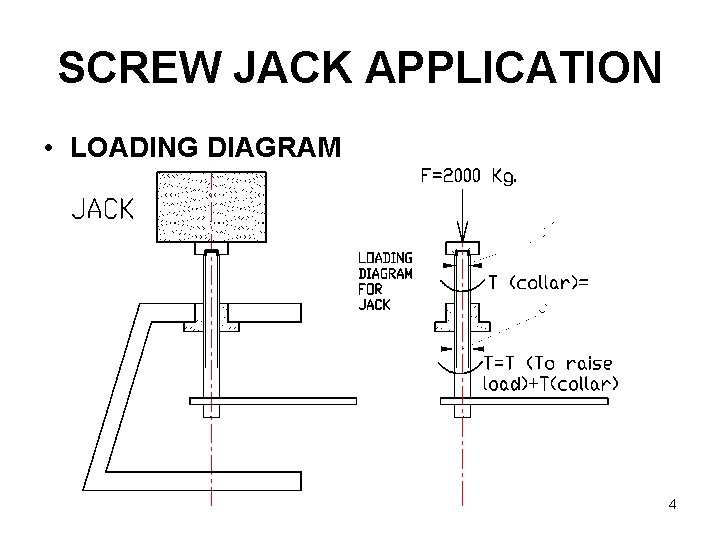
SCREW JACK APPLICATION • LOADING DIAGRAM 4

THREAD FORMS FOR POWER SCREWS • POWER SCREWS USE EITHER SQUARE, OR TRAPEZOIDAL THREAD FORMS • Two types of trapezoidal thread forms are • ACME thread standard, used widely in the English speaking countries, and based on the inches units, • Metric trapezoidal standard, originating in Europe, and now adopted by the International Standards Organisation (ISO). • Figure 1. 3 shows the three geometric profiles of the thread forms used for power screws. 5
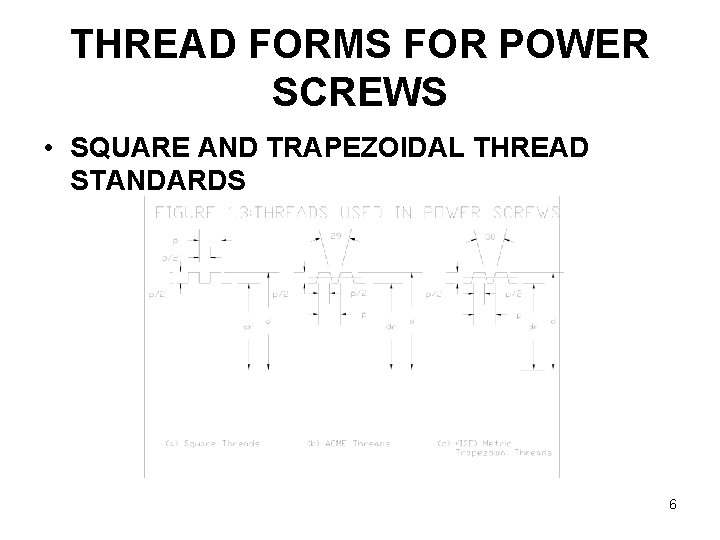
THREAD FORMS FOR POWER SCREWS • SQUARE AND TRAPEZOIDAL THREAD STANDARDS 6

(ISO) METRIC TRAPEZOIDAL SCREW THREAD STANDARDS • ISO Metric Trapezoidal Thread Standard 7

(ISO) METRIC TRAPEZOIDAL SCREW THREAD STANDARDS • DIAMETER, PITCH SPECIFICATIONS Nominal (Major Exernal) Diameter Pitch p Coarse Medium 8 1. 5 10 2 12 Fine Pitch Major Minor Diameter Internal External Internal Diameter d 2=D 2 d 1 D 7. 25 8. 30 6. 20 6. 50 1. 5 9. 00 10. 50 7. 50 8. 00 3 2 10. 50 12. 50 8. 50 9. 00 16 4 2 14. 00 16. 50 11. 50 12. 00 20 4 2 18. 00 20. 50 15. 50 16. 00 24 8 5 3 21. 50 24. 50 18. 50 19. 00 28 8 5 3 25. 50 28. 50 22. 50 23. 00 32 10 6 3 29. 00 33. 00 25. 00 26. 00 36 10 6 3 33. 00 37. 00 29. 00 30. 00 8
MECHANICS OF POWER SCREW (SQUARE THREADED) • GEOMETRY AND DIMENSIONS 1) Square threaded power screw 2) With a single start thread 3) Shown in next slide 9
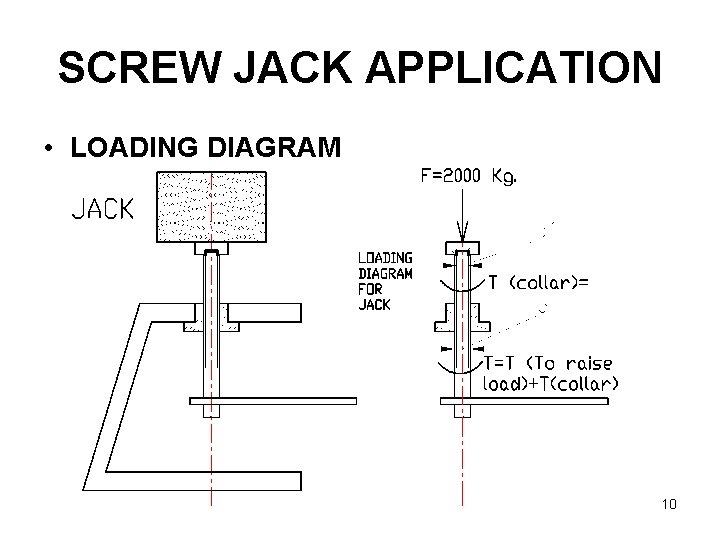
SCREW JACK APPLICATION • LOADING DIAGRAM 10
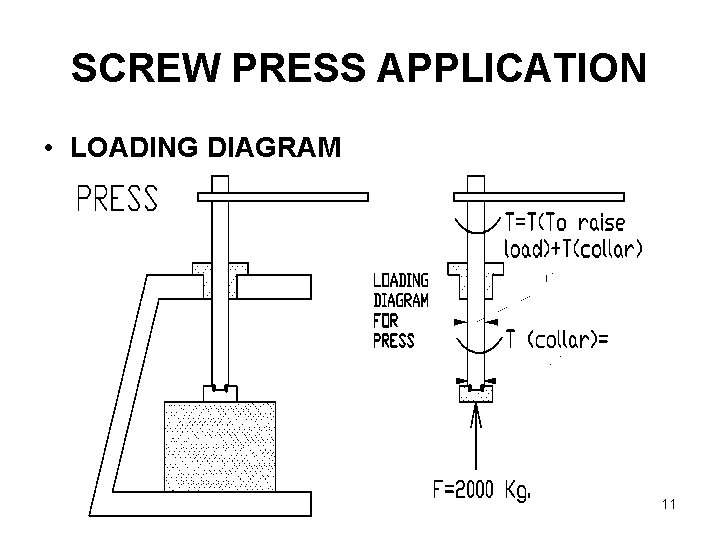
SCREW PRESS APPLICATION • LOADING DIAGRAM 11

MECHANICS OF POWER SCREW (SQUARE THREADED) • Geometry and dimensions 12
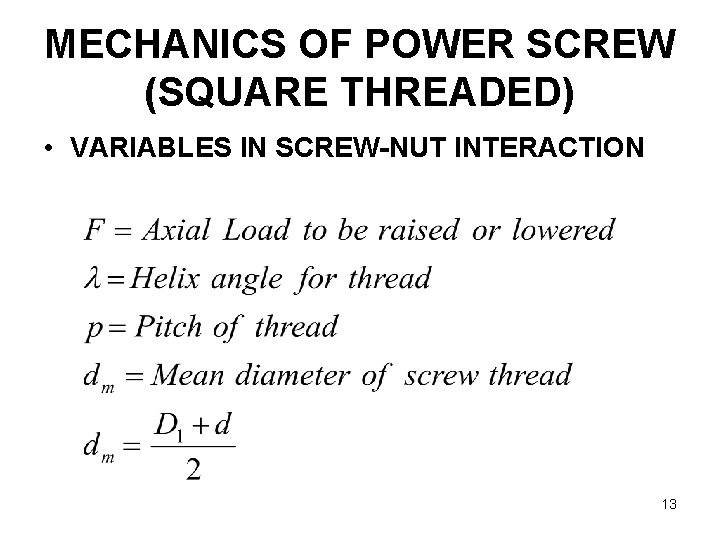
MECHANICS OF POWER SCREW (SQUARE THREADED) • VARIABLES IN SCREW-NUT INTERACTION 13
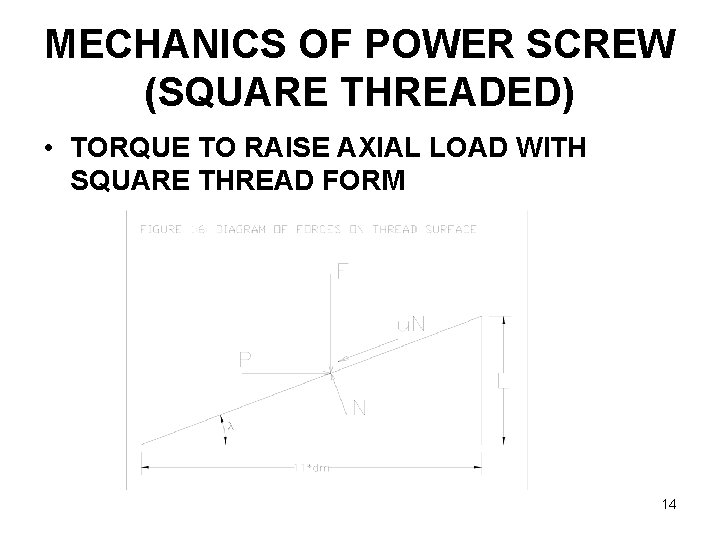
MECHANICS OF POWER SCREW (SQUARE THREADED) • TORQUE TO RAISE AXIAL LOAD WITH SQUARE THREAD FORM 14

MECHANICS OF POWER SCREW (SQUARE THREADED) • Geometry and dimensions 15

MECHANICS OF POWER SCREW (SQUARE THREADED) • TORQUE TO RAISE AXIAL LOAD WITH SQUARE THREAD FORM 16
MECHANICS OF POWER SCREW (SQUARE THREADED) • TORQUE TO RAISE AXIAL LOAD WITH SQUARE THREAD FORM 17
MECHANICS OF POWER SCREW (SQUARE THREADED) • TORQUE TO RAISE AXIAL LOAD WITH SQUARE THREAD FORM 18
MECHANICS OF POWER SCREW (OTHER THREAD FORMS) • THE CASE OF ANGULAR THREAD FORM • The equation for the torque required on the screw shaft to raise an axial load F, has been derived, and is therefore valid, for the square thread form, where 1) Normal thread loads are parallel to the axis of the screw shaft. • In the case of an angular thread form, such as ACME, (ISO) Metric Trapezoidal or other angular thread forms used in fasteners, • Thread angle for the various thread forms is as shown in the next slide: 19

MECHANICS OF POWER SCREW (OTHER THREAD FORMS) • TORQUE TO RAISE AXIAL LOAD WITH OTHER THREAD FORMS Thread Form Thread angle =2* ( in degrees) ACME 29 (ISO) Metric Trapezoidal 30 Metric Fasteners 30 20
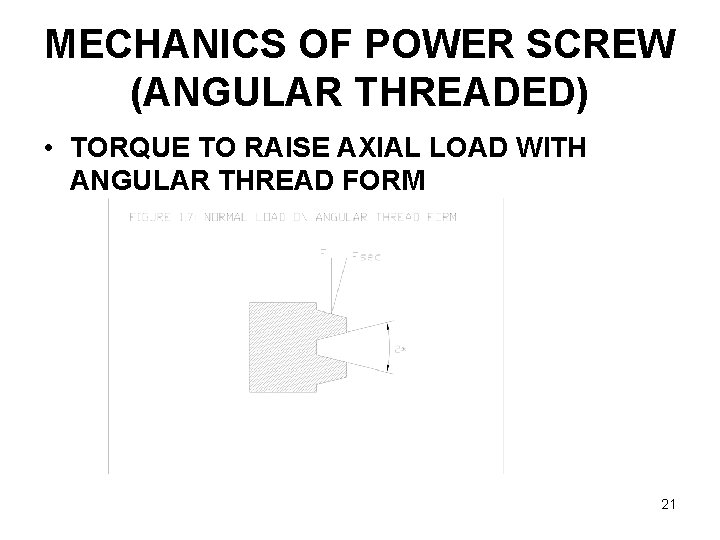
MECHANICS OF POWER SCREW (ANGULAR THREADED) • TORQUE TO RAISE AXIAL LOAD WITH ANGULAR THREAD FORM 21
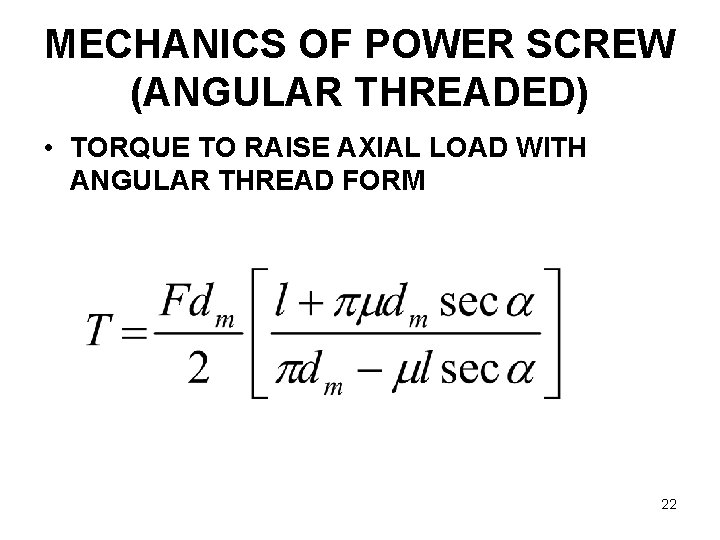
MECHANICS OF POWER SCREW (ANGULAR THREADED) • TORQUE TO RAISE AXIAL LOAD WITH ANGULAR THREAD FORM 22
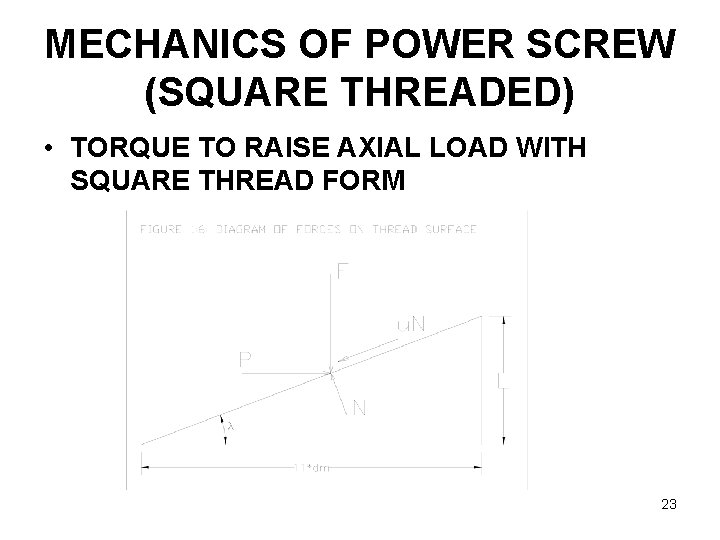
MECHANICS OF POWER SCREW (SQUARE THREADED) • TORQUE TO RAISE AXIAL LOAD WITH SQUARE THREAD FORM 23
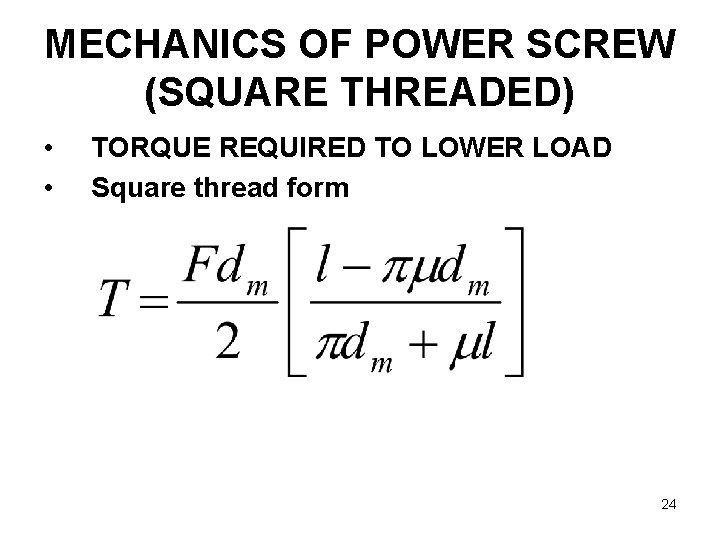
MECHANICS OF POWER SCREW (SQUARE THREADED) • • TORQUE REQUIRED TO LOWER LOAD Square thread form 24

MECHANICS OF POWER SCREW (ANGULAR THREADED) • • TORQUE REQUIRED TO LOWER LOAD Angular thread form 25

MECHANICS OF POWER SCREW COLLAR FRICTION • TORQUE TO OVERCOME COLLAR FRICTION • In most power screw applications, the axial load F must be transmitted through a thrust collar. • This is necessary so that while the screw shaft rotates, the collar (load application) pad may remain stationary as the load is lifted, or as the work is pressed, this is shown in the next slide 26

MECHANICS OF POWER SCREW COLLAR FRICTION • TORQUE TO OVERCOME COLLAR FRICTION 27
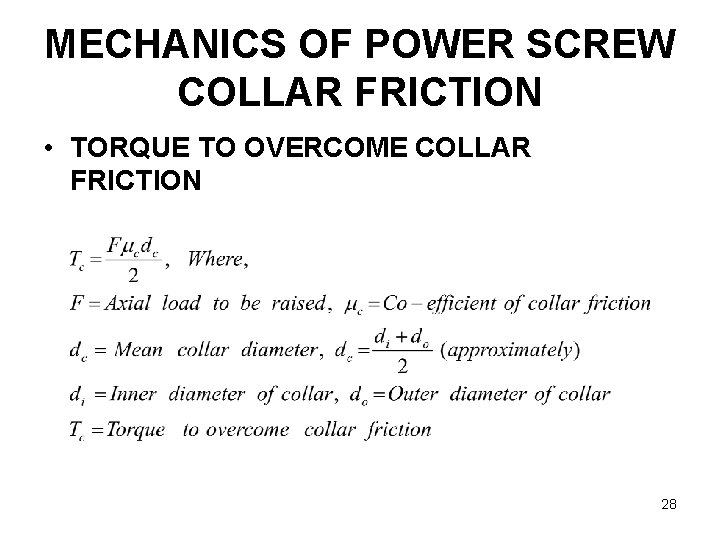
MECHANICS OF POWER SCREW COLLAR FRICTION • TORQUE TO OVERCOME COLLAR FRICTION 28
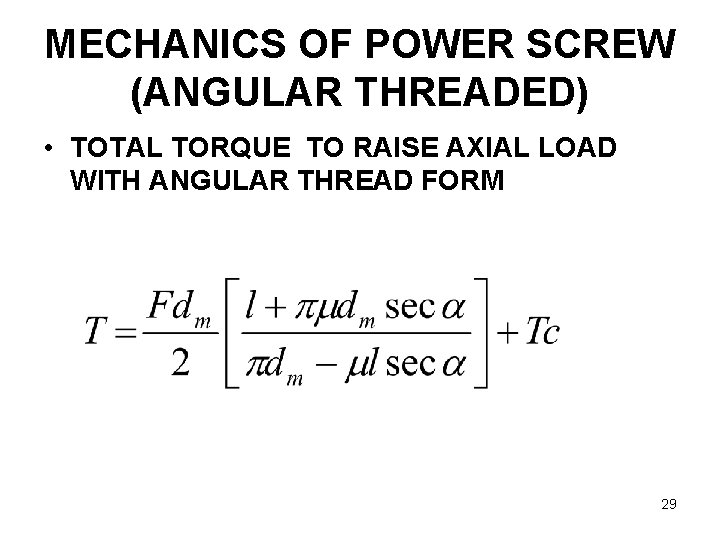
MECHANICS OF POWER SCREW (ANGULAR THREADED) • TOTAL TORQUE TO RAISE AXIAL LOAD WITH ANGULAR THREAD FORM 29
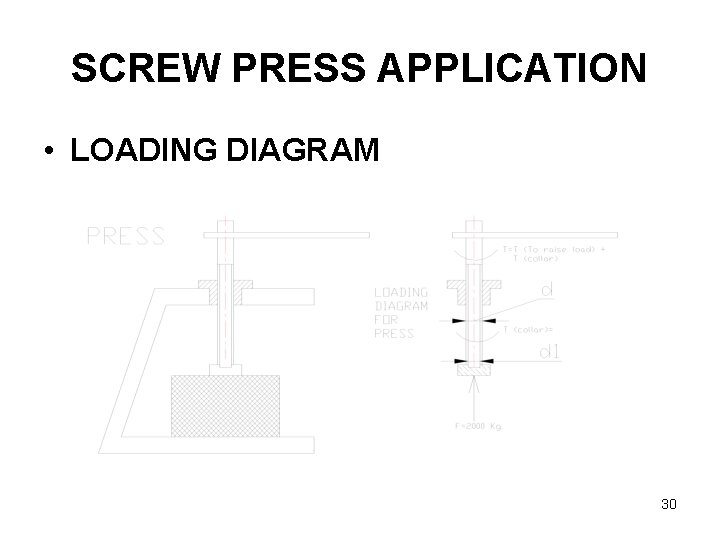
SCREW PRESS APPLICATION • LOADING DIAGRAM 30

MECHANICS OF POWER SCREW • COEFFICIENT OF FRICTION-THREADS Nut material Screw material Steel Bronze Brass Cast iron Steel, dry 0. 15 -0. 25 0. 15 -0. 23 0. 15 -0. 19 0. 15 -0. 25 Steel, machine oil 0. 11 -0. 17 0. 10 -0. 16 0. 10 -0. 15 0. 11 -0. 17 Bronze 0. 08 -0. 12 0. 04 -0. 06 - 0. 06 -0. 09 31
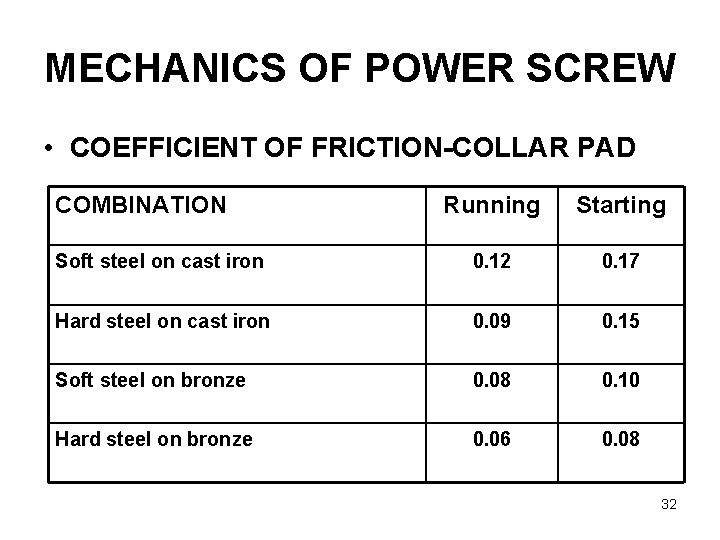
MECHANICS OF POWER SCREW • COEFFICIENT OF FRICTION-COLLAR PAD COMBINATION Running Starting Soft steel on cast iron 0. 12 0. 17 Hard steel on cast iron 0. 09 0. 15 Soft steel on bronze 0. 08 0. 10 Hard steel on bronze 0. 06 0. 08 32
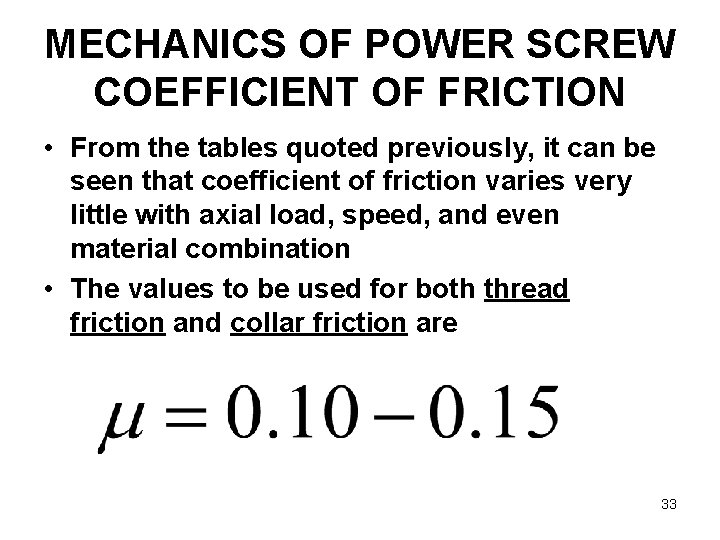
MECHANICS OF POWER SCREW COEFFICIENT OF FRICTION • From the tables quoted previously, it can be seen that coefficient of friction varies very little with axial load, speed, and even material combination • The values to be used for both thread friction and collar friction are 33
MECHANICS OF POWER SCREW COLLAR FRICTION • TORQUE TO OVERCOME COLLAR FRICTION • For large collars, the friction torque at collar bearing or pad will be more accurately computed as is done for a disc clutch. 34
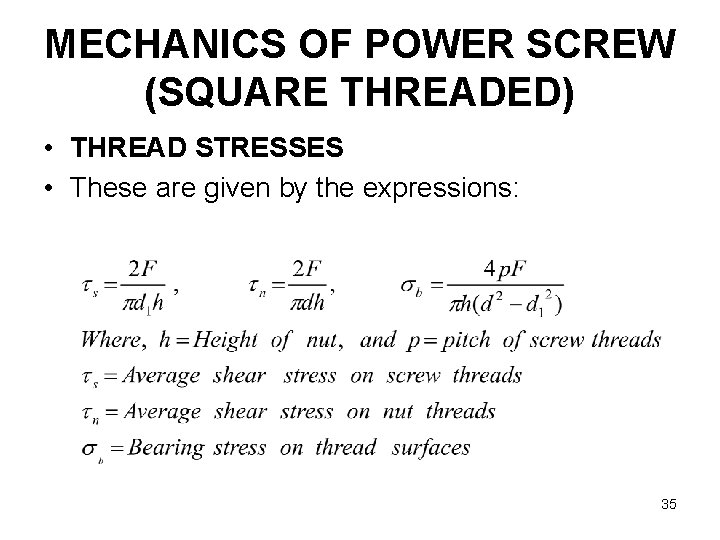
MECHANICS OF POWER SCREW (SQUARE THREADED) • THREAD STRESSES • These are given by the expressions: 35
MECHANICS OF POWER SCREW (SQUARE THREADED) • ALLOWABLE BEARING PRESSURES • Limiting values of bearing pressures on thread surfaces are given for various combination of screw and nut material • These have been determined empirically and are as shown in the next slide 36
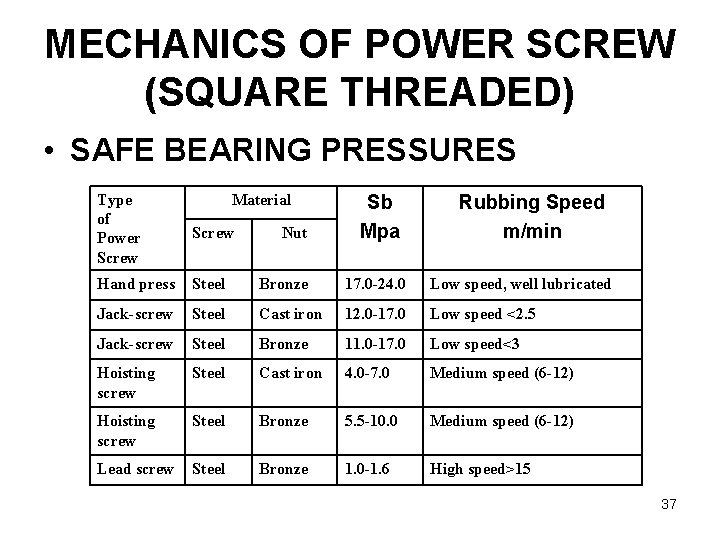
MECHANICS OF POWER SCREW (SQUARE THREADED) • SAFE BEARING PRESSURES Type of Power Screw Material Screw Hand press Steel Bronze 17. 0 -24. 0 Low speed, well lubricated Jack-screw Steel Cast iron 12. 0 -17. 0 Low speed <2. 5 Jack-screw Steel Bronze 11. 0 -17. 0 Low speed<3 Hoisting screw Steel Cast iron 4. 0 -7. 0 Medium speed (6 -12) Hoisting screw Steel Bronze 5. 5 -10. 0 Medium speed (6 -12) Lead screw Steel Bronze 1. 0 -1. 6 High speed>15 Nut Sb Mpa Rubbing Speed m/min 37
References • Shigley, Joseph; Mechanical Engineering Design, Seventh Edition, 2003, Mc. Graw Hil, pg 396 • VB Bandari; Design of Machine Elements, 1994, Tata Mc. Graw Hill, pg 175 38
- Slides: 38