
UNIVERSITY OF MONTENEGRO THE FACULTY OF POLITICAL SCIENCE


- Slides: 52
UNIVERSITY OF MONTENEGRO THE FACULTY OF POLITICAL SCIENCE ENGLISH COURSE – ENGLISH FOR SPECIFIC PURPOSES III
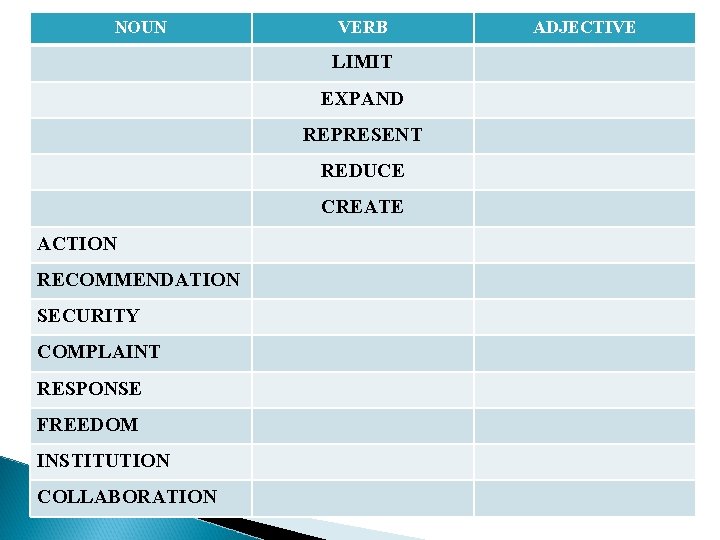
NOUN VERB LIMIT EXPAND REPRESENT REDUCE CREATE ACTION RECOMMENDATION SECURITY COMPLAINT RESPONSE FREEDOM INSTITUTION COLLABORATION ADJECTIVE
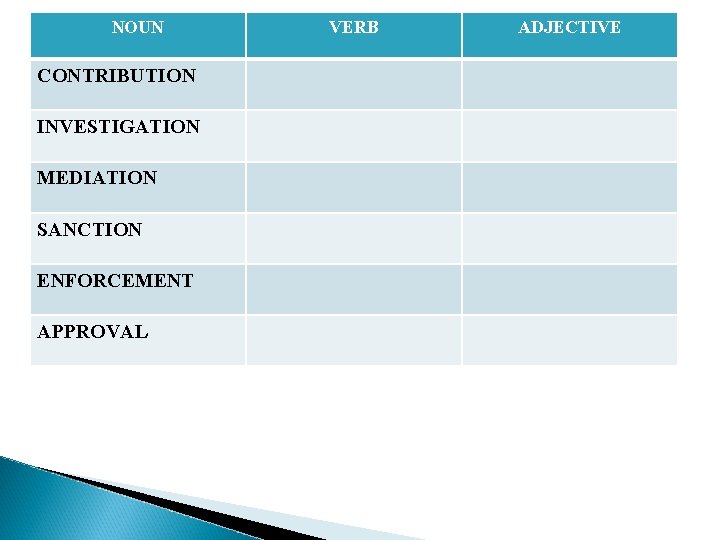
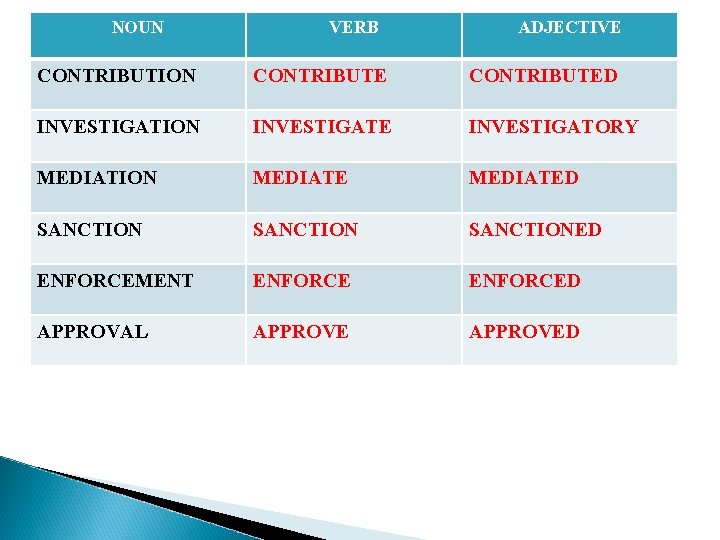
NOUN CONTRIBUTION INVESTIGATION MEDIATION SANCTION ENFORCEMENT APPROVAL VERB ADJECTIVE
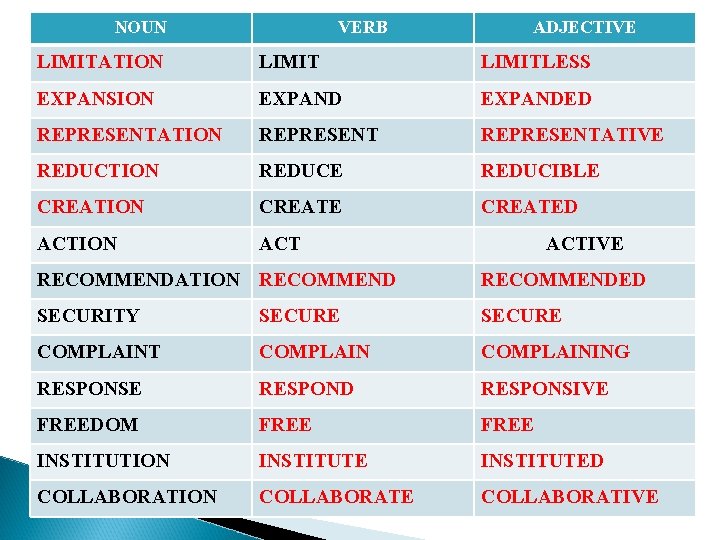
NOUN VERB ADJECTIVE LIMITATION LIMITLESS EXPANSION EXPANDED REPRESENTATION REPRESENTATIVE REDUCTION REDUCE REDUCIBLE CREATION CREATED ACTION ACTIVE RECOMMENDATION RECOMMENDED SECURITY SECURE COMPLAINT COMPLAINING RESPONSE RESPOND RESPONSIVE FREEDOM FREE INSTITUTION INSTITUTED COLLABORATION COLLABORATE COLLABORATIVE
NOUN VERB ADJECTIVE CONTRIBUTION CONTRIBUTED INVESTIGATION INVESTIGATE INVESTIGATORY MEDIATION MEDIATED SANCTIONED ENFORCEMENT ENFORCED APPROVAL APPROVED
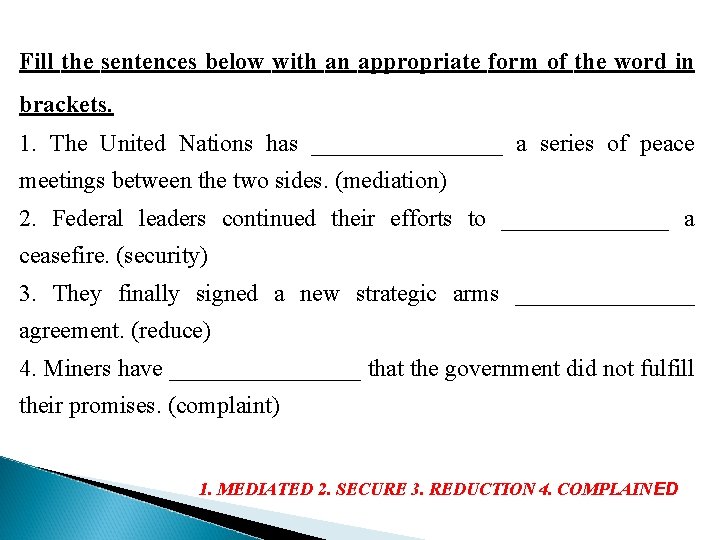
Fill the sentences below with an appropriate form of the word in brackets. 1. The United Nations has ________ a series of peace meetings between the two sides. (mediation) 2. Federal leaders continued their efforts to _______ a ceasefire. (security) 3. They finally signed a new strategic arms ________ agreement. (reduce) 4. Miners have ________ that the government did not fulfill their promises. (complaint) 1. MEDIATED 2. SECURE 3. REDUCTION 4. COMPLAINED
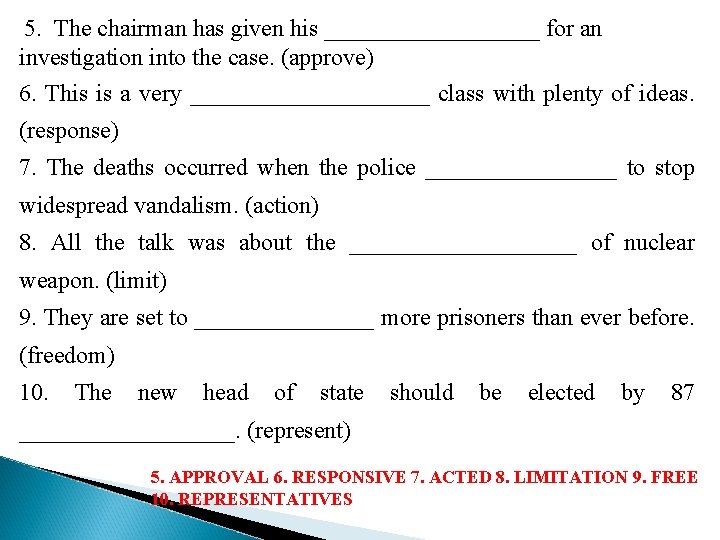
5. The chairman has given his _________ for an investigation into the case. (approve) 6. This is a very __________ class with plenty of ideas. (response) 7. The deaths occurred when the police ________ to stop widespread vandalism. (action) 8. All the talk was about the __________ of nuclear weapon. (limit) 9. They are set to ________ more prisoners than ever before. (freedom) 10. The new head of state should be elected by 87 _________. (represent) 5. APPROVAL 6. RESPONSIVE 7. ACTED 8. LIMITATION 9. FREE 10. REPRESENTATIVES
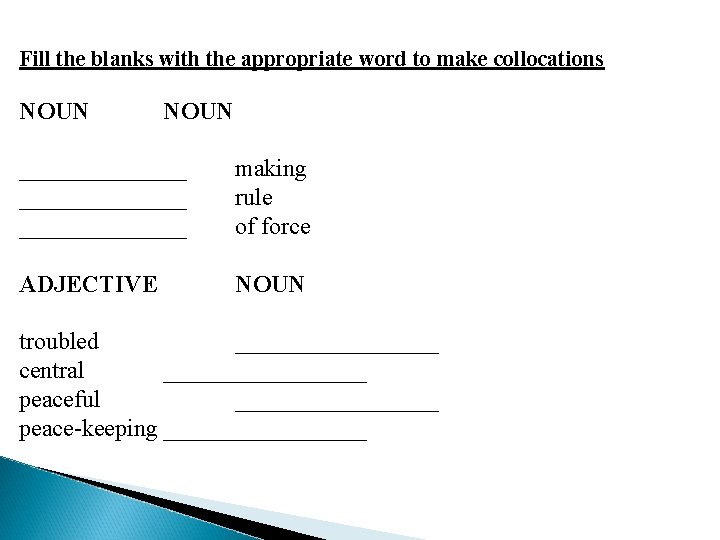
Fill the blanks with the appropriate word to make collocations NOUN ______________ making rule of force ADJECTIVE NOUN troubled _________ central _________ peaceful _________ peace-keeping _________
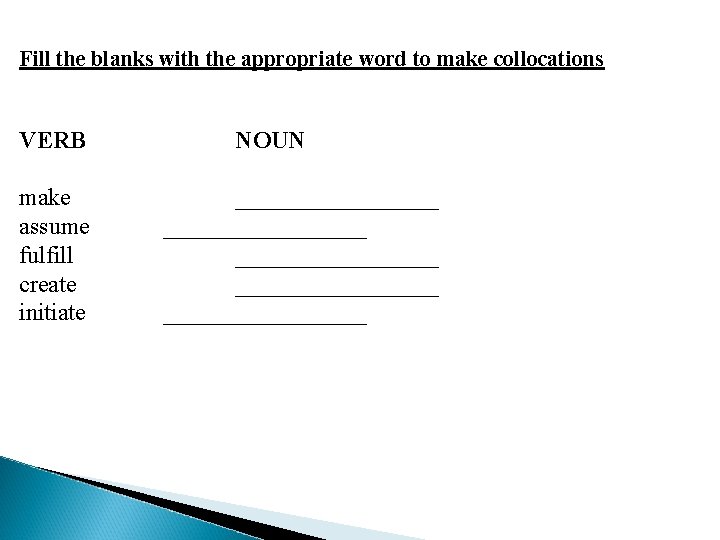
Fill the blanks with the appropriate word to make collocations VERB make assume fulfill create initiate NOUN _________________ _________
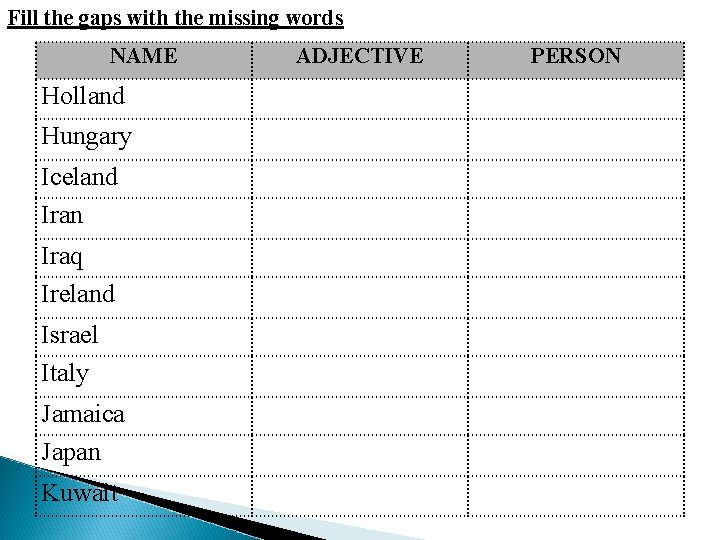
Fill the gaps with the missing words NAME Holland Hungary Iceland Iran Iraq Ireland Israel Italy Jamaica Japan Kuwait ADJECTIVE PERSON
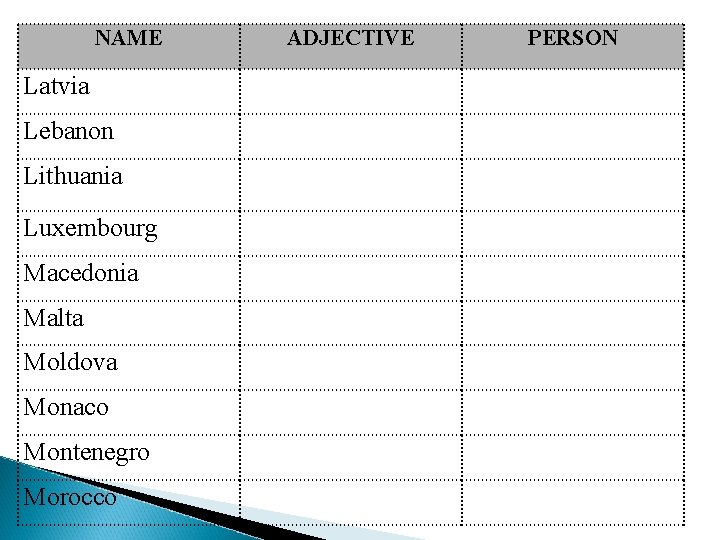
NAME Latvia Lebanon Lithuania Luxembourg Macedonia Malta Moldova Monaco Montenegro Morocco ADJECTIVE PERSON
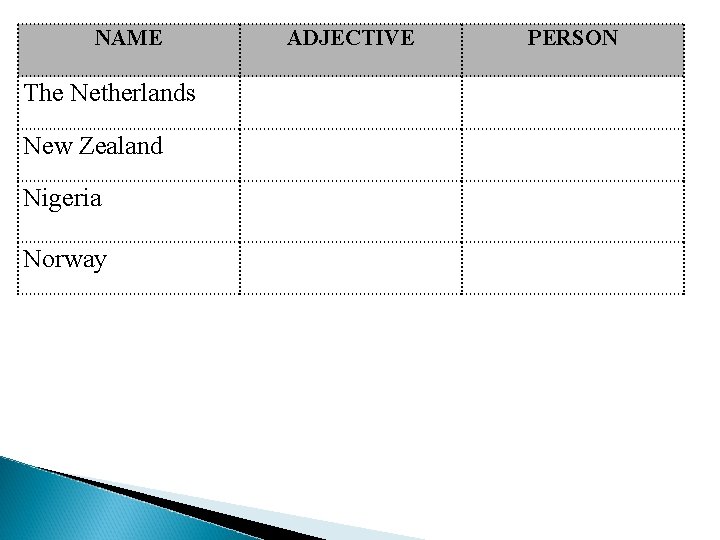
NAME The Netherlands New Zealand Nigeria Norway ADJECTIVE PERSON
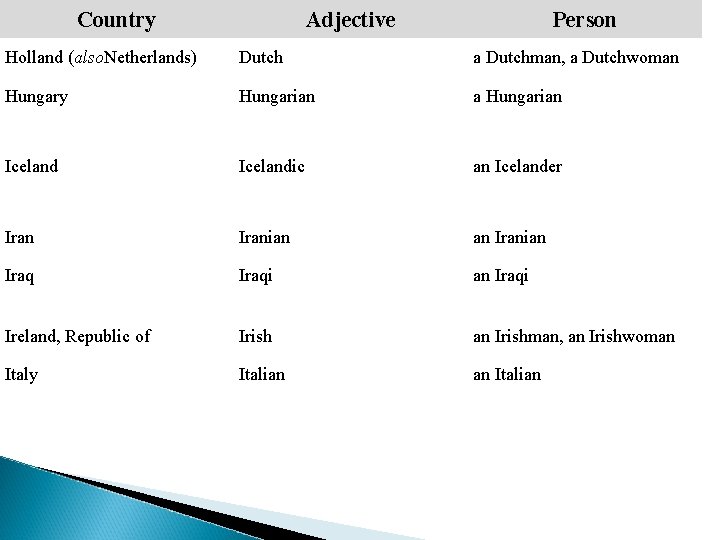
Country Adjective Person Holland (also. Netherlands) Dutch a Dutchman, a Dutchwoman Hungary Hungarian a Hungarian Icelandic an Icelander Iranian an Iranian Iraqi Ireland, Republic of Irish an Irishman, an Irishwoman Italy Italian an Italian
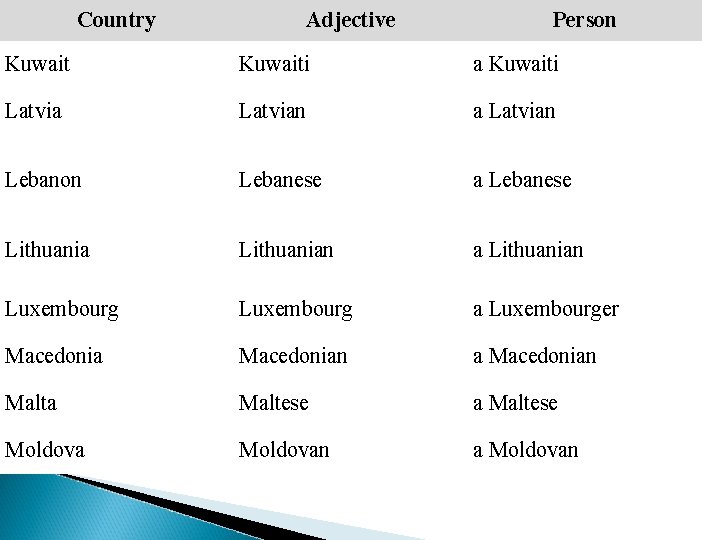
Country Adjective Person Kuwaiti a Kuwaiti Latvian a Latvian Lebanon Lebanese a Lebanese Lithuanian a Lithuanian Luxembourg a Luxembourger Macedonian a Macedonian Malta Maltese Moldovan
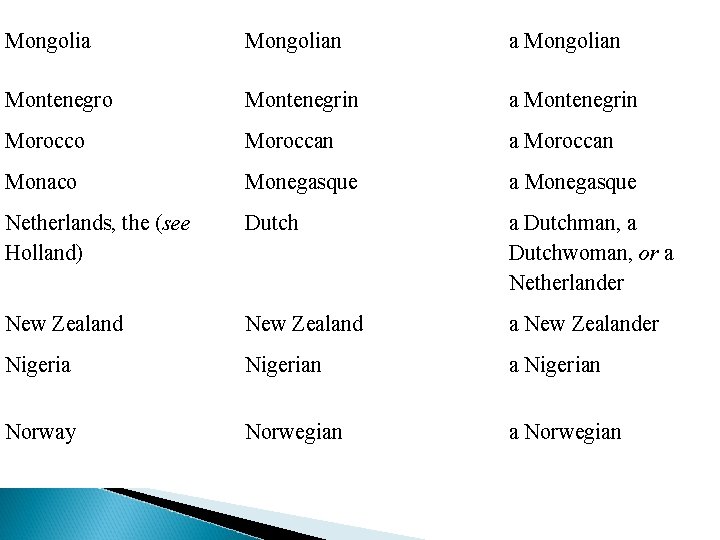
Mongolian Montenegro Montenegrin a Montenegrin Morocco Moroccan a Moroccan Monaco Monegasque a Monegasque Netherlands, the (see Holland) Dutch a Dutchman, a Dutchwoman, or a Netherlander New Zealand a New Zealander Nigerian a Nigerian Norway Norwegian a Norwegian
PRESENT PERFECT VS PRESENT PERFECT CONTINUOUS
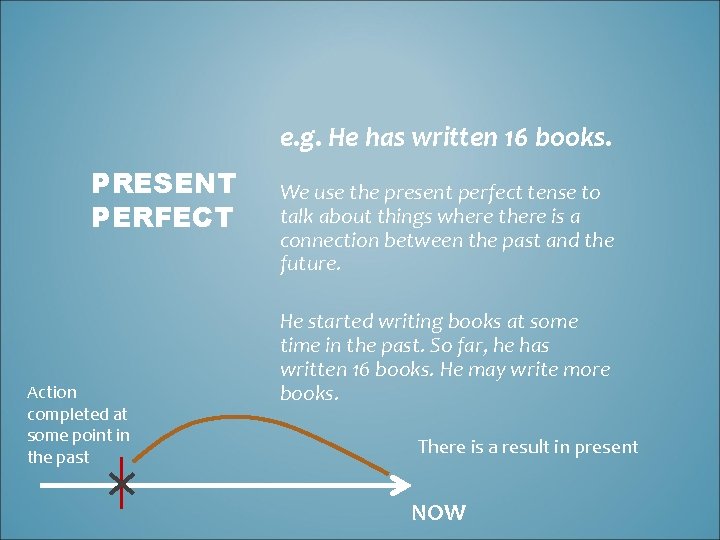
e. g. He has written 16 books. PRESENT PERFECT Action completed at some point in the past We use the present perfect tense to talk about things where there is a connection between the past and the future. He started writing books at some time in the past. So far, he has written 16 books. He may write more books. There is a result in present NOW
AS WELL AS THE PRESENT PERFECT SIMPLE, WE CAN USE THE PRESENT PERFECT CONTINUOUS TENSE TO TALK ABOUT EVENTS WITH A CONNECTION TO THE PRESENT. Study the following examples: I have painted the living room blue. I have been decorating the house this summer.
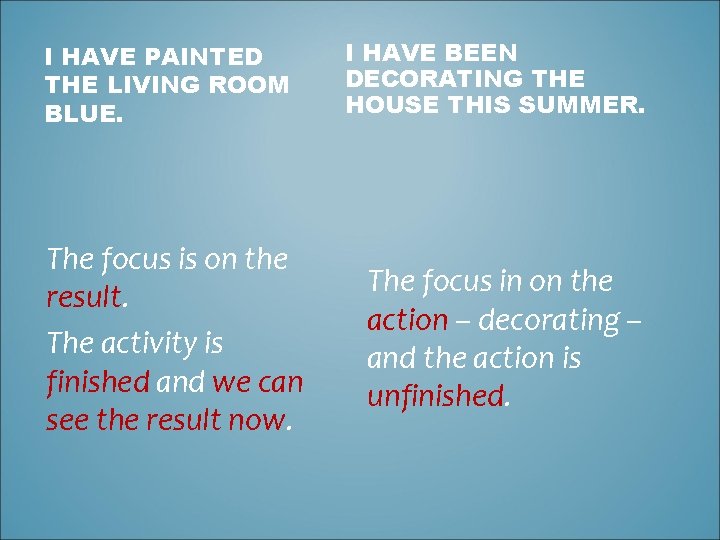
I HAVE PAINTED THE LIVING ROOM BLUE. The focus is on the result. The activity is finished and we can see the result now. I HAVE BEEN DECORATING THE HOUSE THIS SUMMER. The focus in on the action – decorating – and the action is unfinished.
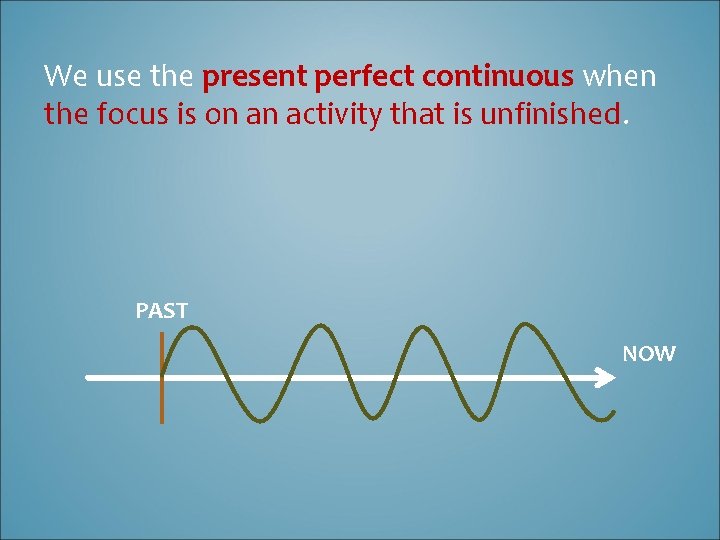
We use the present perfect continuous when the focus is on an activity that is unfinished. PAST NOW
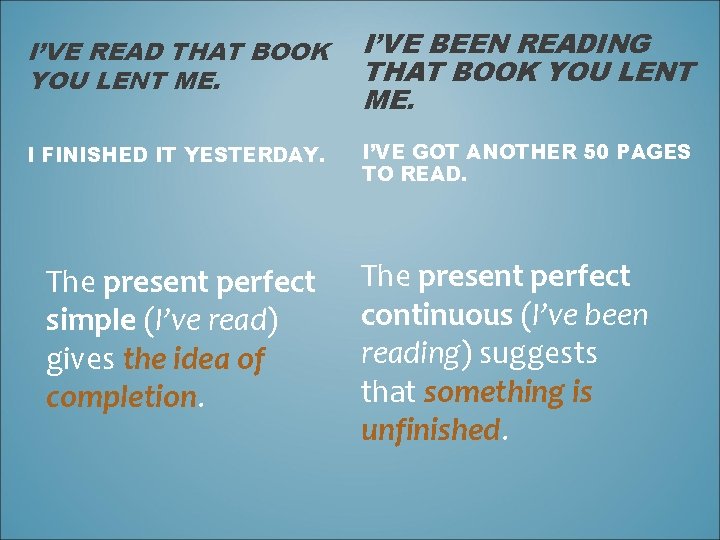
I’VE READ THAT BOOK YOU LENT ME. I’VE BEEN READING THAT BOOK YOU LENT ME. I FINISHED IT YESTERDAY. I’VE GOT ANOTHER 50 PAGES TO READ. The present perfect simple (I’ve read) gives the idea of completion. The present perfect continuous (I’ve been reading) suggests that something is unfinished.
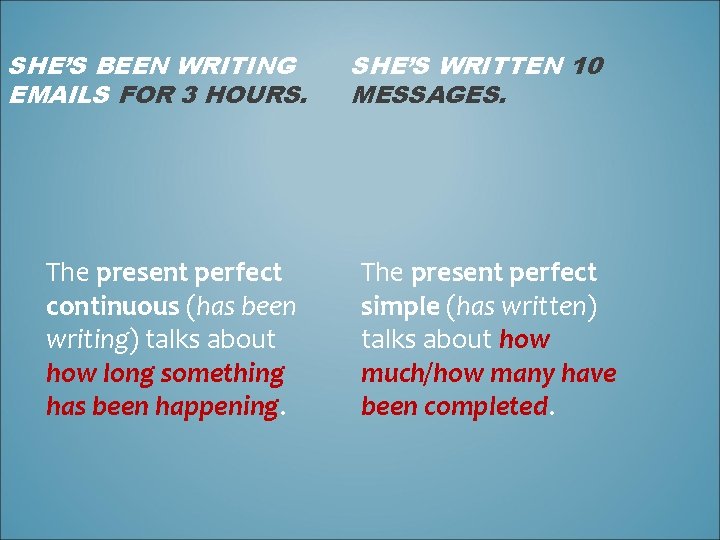
SHE’S BEEN WRITING EMAILS FOR 3 HOURS. The present perfect continuous (has been writing) talks about how long something has been happening. SHE’S WRITTEN 10 MESSAGES. The present perfect simple (has written) talks about how much/how many have been completed.
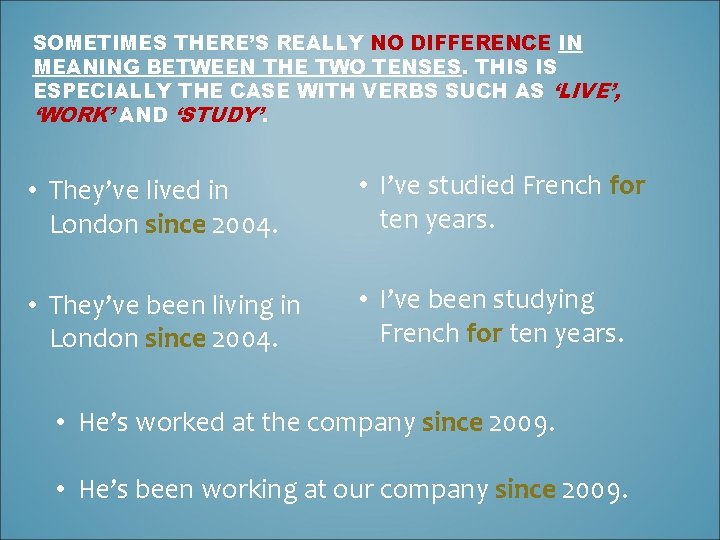
SOMETIMES THERE’S REALLY NO DIFFERENCE IN MEANING BETWEEN THE TWO TENSES. THIS IS ESPECIALLY THE CASE WITH VERBS SUCH AS ‘LIVE’, ‘WORK’ AND ‘STUDY’. • They’ve lived in London since 2004. • I’ve studied French for ten years. • They’ve been living in London since 2004. • I’ve been studying French for ten years. • He’s worked at the company since 2009. • He’s been working at our company since 2009.
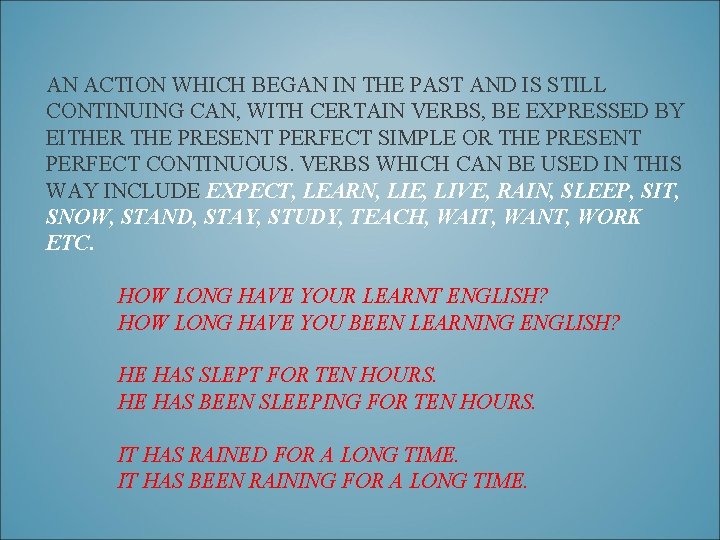
AN ACTION WHICH BEGAN IN THE PAST AND IS STILL CONTINUING CAN, WITH CERTAIN VERBS, BE EXPRESSED BY EITHER THE PRESENT PERFECT SIMPLE OR THE PRESENT PERFECT CONTINUOUS. VERBS WHICH CAN BE USED IN THIS WAY INCLUDE EXPECT, LEARN, LIE, LIVE, RAIN, SLEEP, SIT, SNOW, STAND, STAY, STUDY, TEACH, WAIT, WANT, WORK ETC. HOW LONG HAVE YOUR LEARNT ENGLISH? HOW LONG HAVE YOU BEEN LEARNING ENGLISH? HE HAS SLEPT FOR TEN HOURS. HE HAS BEEN SLEEPING FOR TEN HOURS. IT HAS RAINED FOR A LONG TIME. IT HAS BEEN RAINING FOR A LONG TIME.
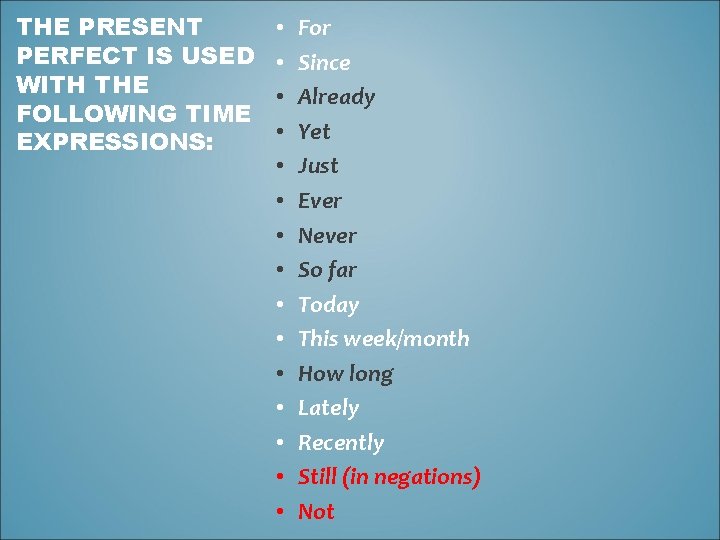
THE PRESENT PERFECT IS USED WITH THE FOLLOWING TIME EXPRESSIONS: • • • • For Since Already Yet Just Ever Never So far Today This week/month How long Lately Recently Still (in negations) Not
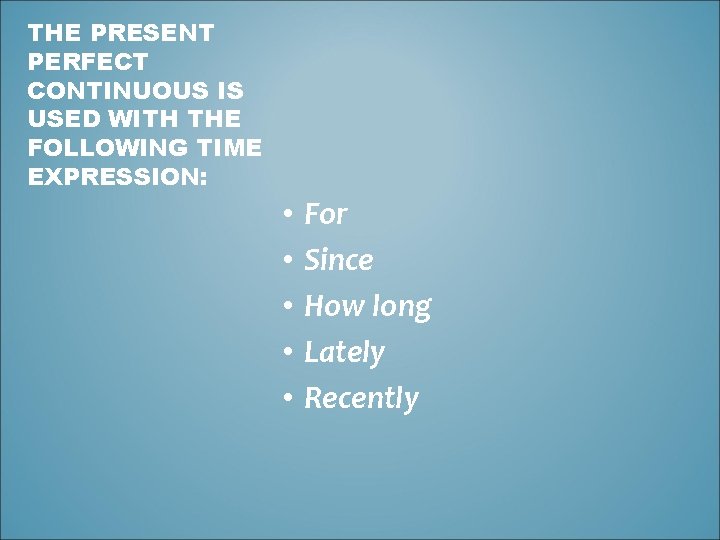
THE PRESENT PERFECT CONTINUOUS IS USED WITH THE FOLLOWING TIME EXPRESSION: • • • For Since How long Lately Recently
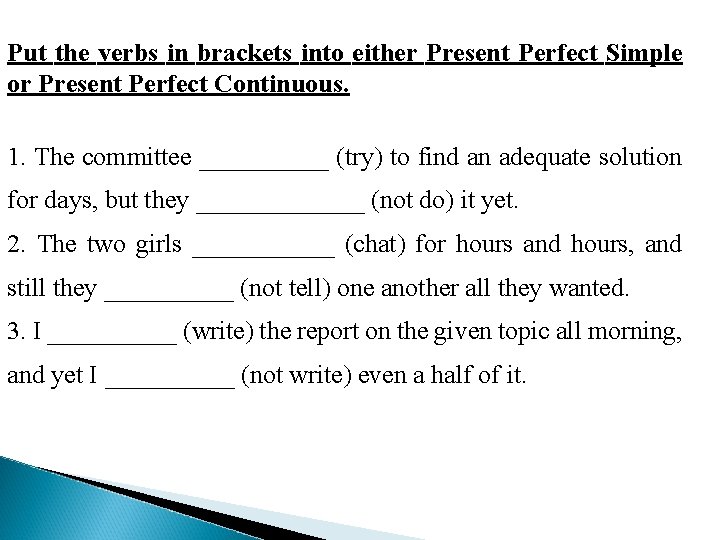
Put the verbs in brackets into either Present Perfect Simple or Present Perfect Continuous. 1. The committee _____ (try) to find an adequate solution for days, but they _______ (not do) it yet. 2. The two girls ______ (chat) for hours and hours, and still they _____ (not tell) one another all they wanted. 3. I _____ (write) the report on the given topic all morning, and yet I _____ (not write) even a half of it.
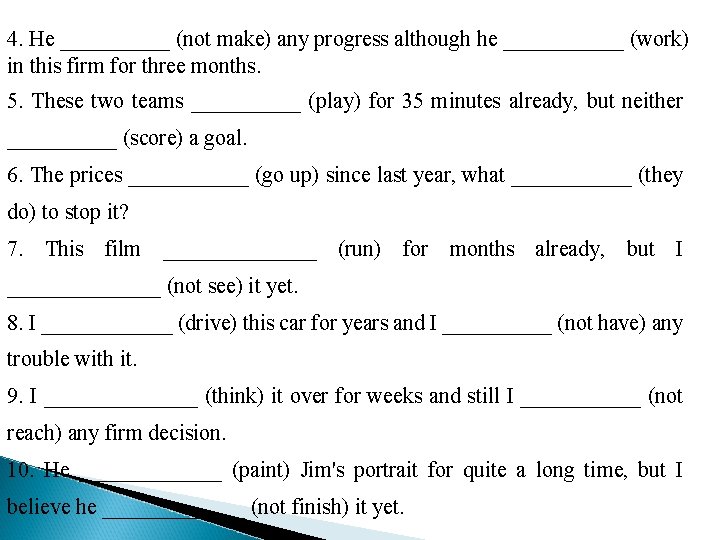
4. He _____ (not make) any progress although he ______ (work) in this firm for three months. 5. These two teams _____ (play) for 35 minutes already, but neither _____ (score) a goal. 6. The prices ______ (go up) since last year, what ______ (they do) to stop it? 7. This film _______ (run) for months already, but I _______ (not see) it yet. 8. I ______ (drive) this car for years and I _____ (not have) any trouble with it. 9. I _______ (think) it over for weeks and still I ______ (not reach) any firm decision. 10. He _______ (paint) Jim's portrait for quite a long time, but I believe he _______ (not finish) it yet.
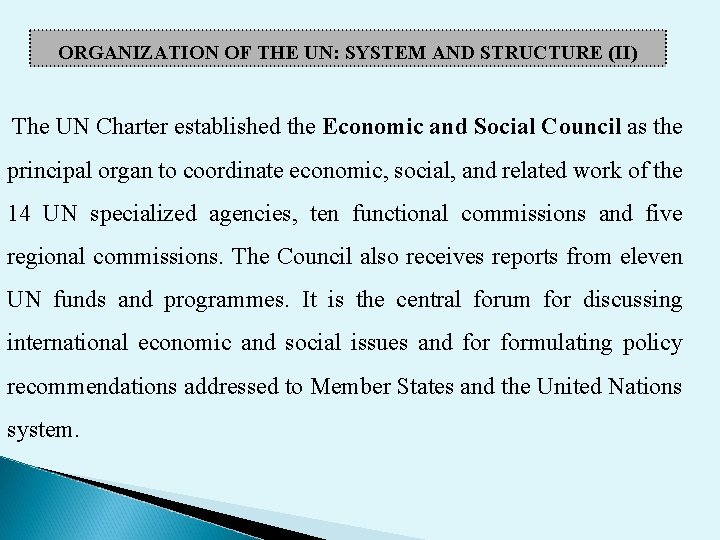
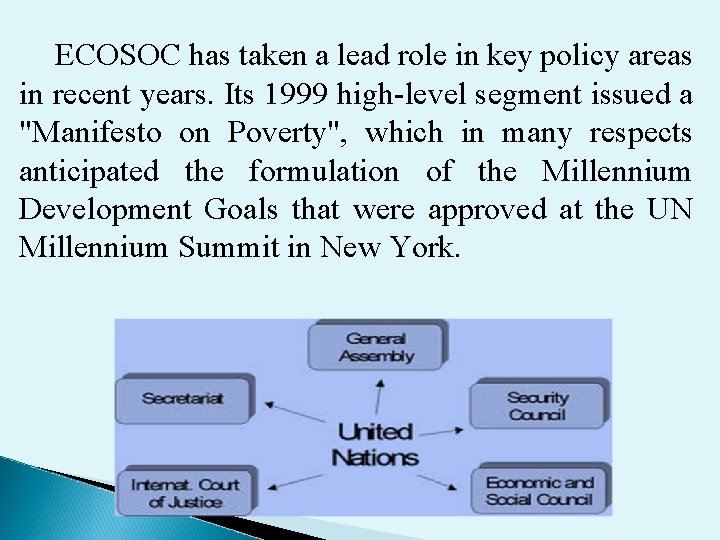
ORGANIZATION OF THE UN: SYSTEM AND STRUCTURE (II) The UN Charter established the Economic and Social Council as the principal organ to coordinate economic, social, and related work of the 14 UN specialized agencies, ten functional commissions and five regional commissions. The Council also receives reports from eleven UN funds and programmes. It is the central forum for discussing international economic and social issues and formulating policy recommendations addressed to Member States and the United Nations system.
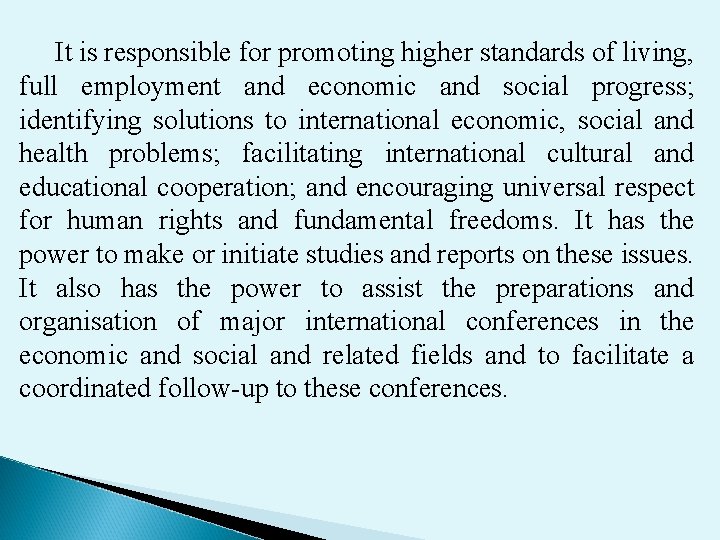
It is responsible for promoting higher standards of living, full employment and economic and social progress; identifying solutions to international economic, social and health problems; facilitating international cultural and educational cooperation; and encouraging universal respect for human rights and fundamental freedoms. It has the power to make or initiate studies and reports on these issues. It also has the power to assist the preparations and organisation of major international conferences in the economic and social and related fields and to facilitate a coordinated follow-up to these conferences.
ECOSOC has taken a lead role in key policy areas in recent years. Its 1999 high-level segment issued a "Manifesto on Poverty", which in many respects anticipated the formulation of the Millennium Development Goals that were approved at the UN Millennium Summit in New York.
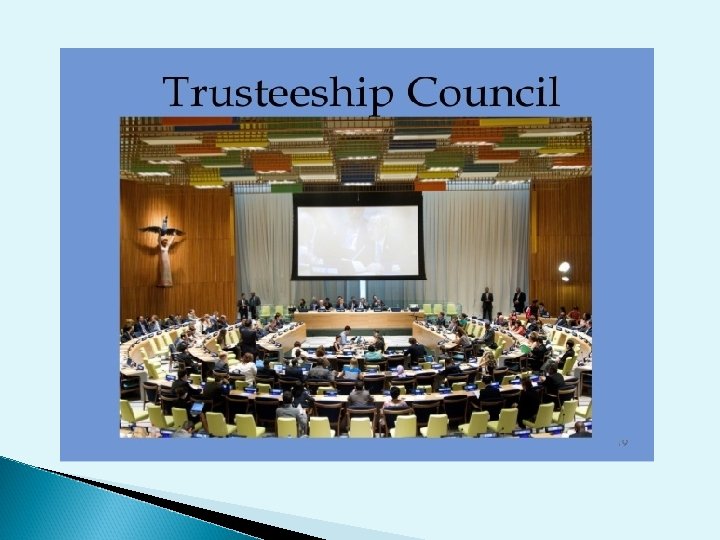
Trusteeship Council is one of the main organs of the United Nations and assigned to it the task of supervising the administration of Trust Territories placed under the Trusteeship System. Major goals of the System were to promote the advancement of the inhabitants of Trust Territories and their progressive development towards selfgovernment or independence. The Trusteeship Council is made up of the five permanent members of the Security Council - China, France, Russian Federation, United Kingdom and United States.
The aims of the Trusteeship System have been fulfilled to such an extent that all Trust Territories have attained self-government or independence, either as separate states or by joining neighbouring independent countries.
Under the Charter, the Trusteeship Council is authorized to examine and discuss reports from the Administering Authority on the political, economic, social and educational advancement of the peoples of Trust Territories and, in consultation with the Administering Authority, to examine petitions from and undertake periodic and other special missions to Trust Territories.
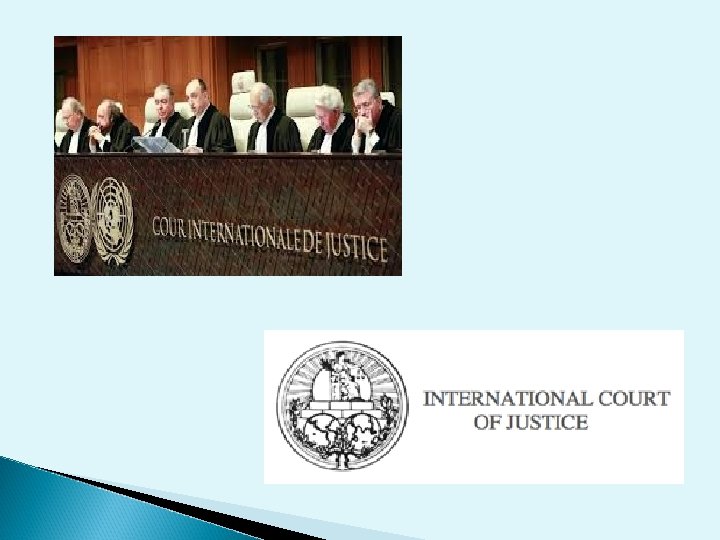
The International Court of Justice is the principal judicial organ of the United Nations. The Court has a dual role: to settle in accordance with international law the legal disputes submitted to it by states, and to give advisory opinions on legal questions referred to it by duly authorized international organs and agencies.
The Court is composed of 15 judges elected to nineyear terms of office by the United Nations General Assembly and Security Council sitting independently of each other. The judges must possess the qualifications required in their respective countries for appointment to the highest judicial offices, or be jurists of recognized competence in international law. The composition of the Court has also to reflect the main forms of civilization and the principal legal systems of the world.
The Court decides in accordance with international treaties and conventions in force, international custom, general principles of law and, as subsidiary means, judicial decisions and the teachings of the most highly qualified publicists.
The advisory procedure of the Court is open solely to international organizations. The only bodies at present authorized to request advisory opinions of the Court are five organs of the United Nations and 16 specialized agencies of the United Nations family.
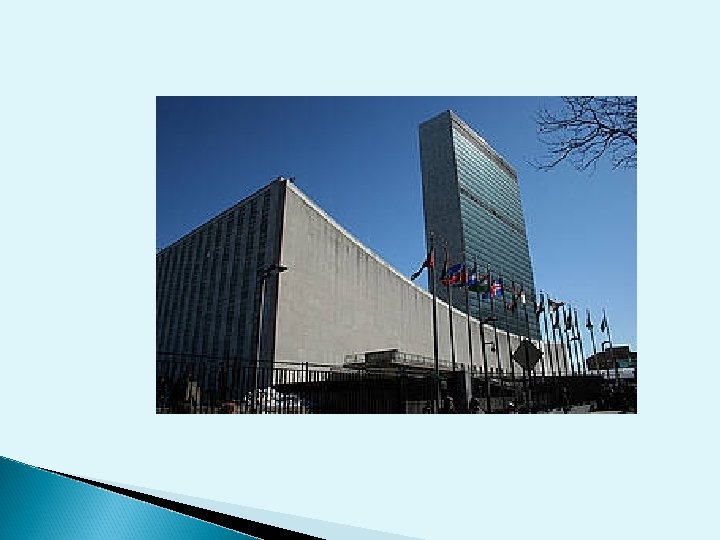
The Secretariat -- an international staff working in duty stations around the world -- carries out the diverse day-to-day work of the Organization. It services the other principal organs of the United Nations and administers the programmes and policies laid down by them. At its head is the Secretary General who is appointed by the General Assembly on the recommendation of the Security Council for a five-year, renewable term.
The duties carried out by the Secretariat are as varied as the problems dealt with by the United Nations. These range from administering peacekeeping operations to mediating international disputes, from surveying economic and social trends and problems to preparing studies on human rights and sustainable development. Secretariat staff also inform the world's communications media about the work of the United Nations; organize international conferences on issues of worldwide concern and interpret speeches and translate documents into the Organization's official languages.
In the twenty-first century, the UN is likely to continue to play an active role in the areas both of social and economic enhancement and of peace and security. However, the prospects for future UN peacekeeping are uncertain, and the capacity for the globe’s most powerful IGO to engineer progress in the social and economic realm is also likely to be severely tested. (From the official web site of the United Nations and C. W. Kegley Jr. and E. R. Wittkopf, World Politics)
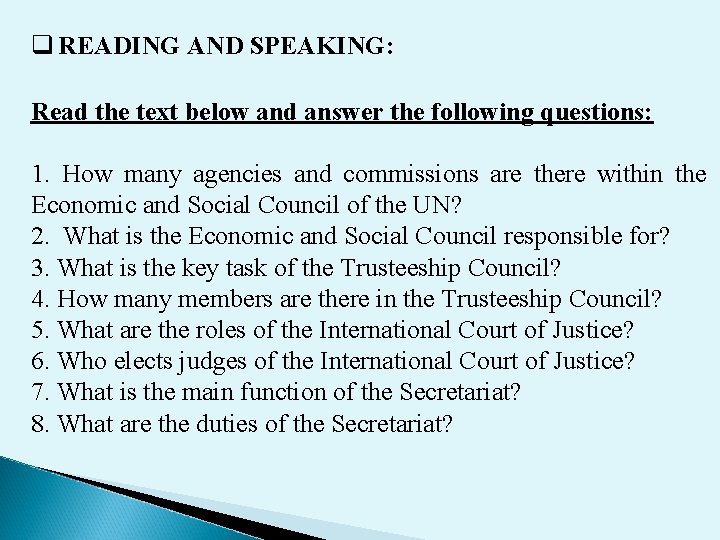
READING AND SPEAKING: Read the text below and answer the following questions: 1. How many agencies and commissions are there within the Economic and Social Council of the UN? 2. What is the Economic and Social Council responsible for? 3. What is the key task of the Trusteeship Council? 4. How many members are there in the Trusteeship Council? 5. What are the roles of the International Court of Justice? 6. Who elects judges of the International Court of Justice? 7. What is the main function of the Secretariat? 8. What are the duties of the Secretariat?
THANK YOU FOR COMING! SEE YOU NEXT WEEK AT 8: 45!