
University of Minnesota InternalExternal Sales Internal Sales Rate
- Slides: 22
University of Minnesota Internal/External Sales Internal Sales Rate Development Level I
Learning Objectives • Understand the rate development process • Determine what costs are allowed in the rate development • Walk through a rate development example • Questions at anytime during the presentation 2
Expected Outcome Revenue – Expenses = $0 at the end of the Fiscals Year • Revenue is the rate charged times the volume • Rate is estimated expense/volume • Expense is the cost to perform the activity Note: any allowable variance is included in next year’s rate 3
Internal Sales Rate Development Procedure and Website Internal Sales EFS website: http: //www. finsys. umn. edu/sales/iso. html – Policies – Procedures – Presentations – Job Aids – Training Modules 4
Internal Sales Rate Policy The purpose of the internal sales rate guidelines is to: • • Comply with Federal regulations Sold at rates that fully cover, but do not exceed costs Subsidies are documented in the rate development. All rates should be established to break even. 5
Principles for Internal Sales Rates • • • Reviewed and updated each year Set to break even Based on historical sales data Consistent for all internal customers Federal government receives the lowest rate Subsidies must be documented 6
Internal Sales Rate Development Steps to developing an Internal Sales rate: • Measurable unit • Expected level of activity • Annual estimated costs • Breakeven • Exclude unallowable costs • Direct vs. overhead costs • Activity per-unit rate • Reviewed and updated each year 7
Measurable Unit Measurable unit for goods and services • In terms of labor, machine time, or tangible product. Examples: per labor hour, per machine hour, per copy, per gallon, per test, etc. 8
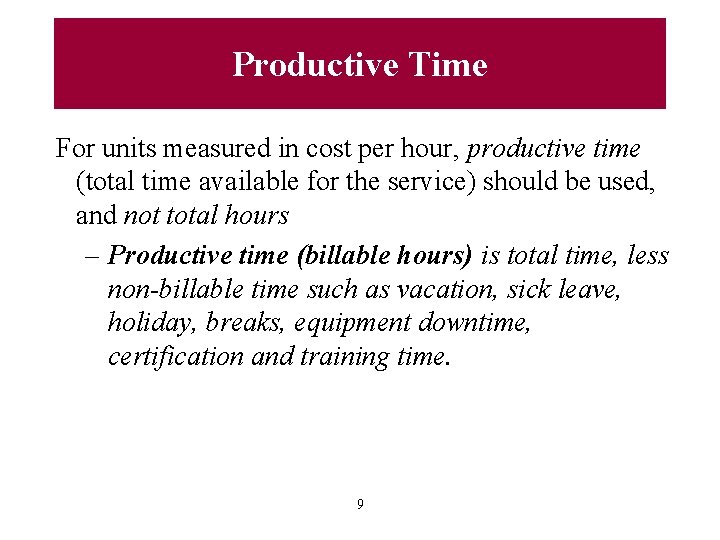
Productive Time For units measured in cost per hour, productive time (total time available for the service) should be used, and not total hours – Productive time (billable hours) is total time, less non-billable time such as vacation, sick leave, holiday, breaks, equipment downtime, certification and training time. 9
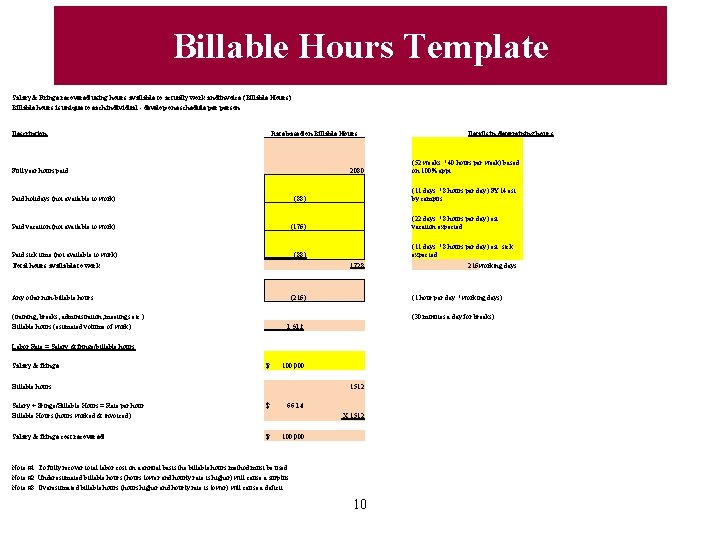
Billable Hours Template Salary& Fringe recovered using hours available to actually work and invoice (Billable Hours) Billable hours is unique to each individual - develop one schedule person Description Rate based on Billable Hours Full year hours paid 2080 Details in determining hours (52 weeks * 40 hours per week) based on 100% appt. Paid holidays (not available to work) (88) (11 days * 8 hours per day) FY 14 est. by campus Paid vacation (not available to work) (176) (22 days * 8 hours per day) est. vacation expected Paid sick time (not available to work) Total hours available to work (88) Any other non-billable hours (216) 1728 (training, breaks, administration, meetings etc. ) Billable hours (estimated volume of work) (1 hour per day * working days) (30 minutes a day for breaks) 1, 512 Labor Rate = Salary & fringe/billable hours Salary & fringe Billable hours $ 100, 000 Salary + Fringe/Billable Hours = Rate per hour $ 1512 66. 14 Billable Hours (hours worked & invoiced) Salary & fringe cost recovered (11 days * 8 hours per day) est. sick expected 216 working days X 1512 $ 100, 000 Note #1: To fully recover total labor cost on a annual basis the billable hours method must be used. Note #2: Underestimated billable hours (hours lower and hourly rate is higher) will cause a surplus. Note #3: Overestimated billable hours (hours higher and hourly rate is lower) will cause a deficit. 10
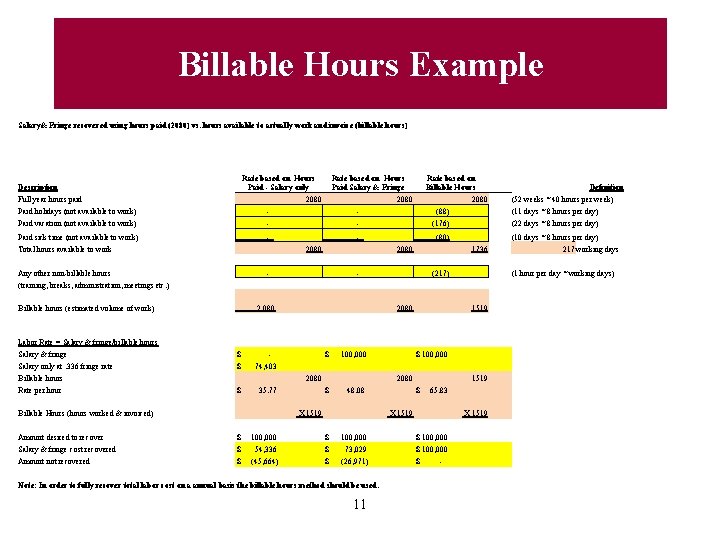
Billable Hours Example Salary& Fringe recovered using hours paid (2080) vs. hours available to actually work and invoice (billable hours) Description Full year hours paid Paid holidays (not available to work) Paid vacation (not available to work) Rate based on Hours Rate based on Paid - Salary only Paid Salary & Fringe Billable Hours 2080 - (88) - (176) Paid sick time (not available to work) Total hours available to work - Any other non-billable hours (training, breaks, administration, meetings etc. ) - Billable hours (estimated volume of work) 2, 080 - 2080 Definition (52 weeks * 40 hours per week) (11 days * 8 hours per day) (22 days * 8 hours per day) (80) 2080 - (10 days * 8 hours per day) 217 working days 1736 (217) 2080 (1 hour per day * working days) 1519 Labor Rate = Salary & fringe/billable hours Salary & fringe Salary only at. 336 fringe rate Billable hours Rate per hour $ - $ 74, 403 2080 $ 35. 77 Billable Hours (hours worked & invoiced) Amount desired to recover Salary & fringe cost recovered Amount not recovered $ 100, 000 2080 $ 48. 08 X 1519 $ 100, 000 $ 54, 336 $ (45, 664) $ 100, 000 $ 65. 83 X 1519 $ 100, 000 $ 73, 029 $ (26, 971) Note: In order to fully recover total labor cost on a annual basis the billable hours method should be used. 11 $ 100, 000 $ - 1519 X 1519
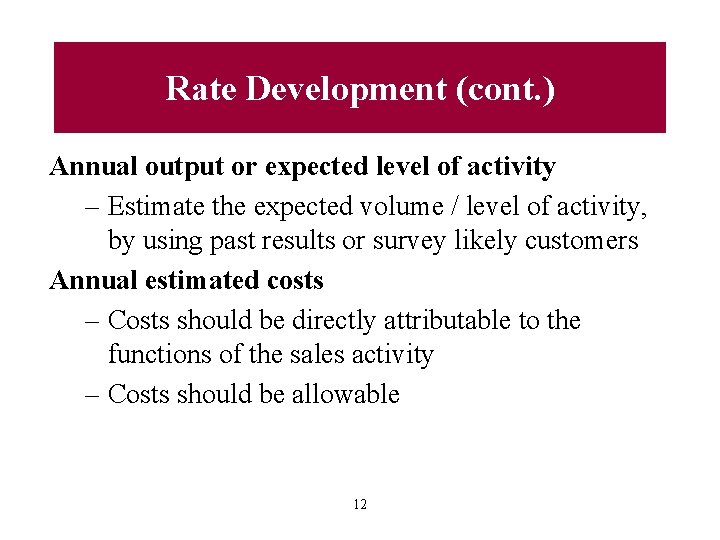
Rate Development (cont. ) Annual output or expected level of activity – Estimate the expected volume / level of activity, by using past results or survey likely customers Annual estimated costs – Costs should be directly attributable to the functions of the sales activity – Costs should be allowable 12
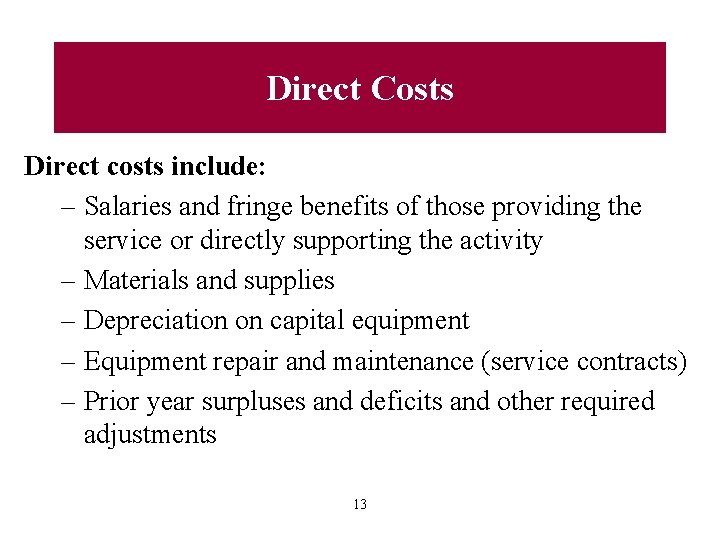
Direct Costs Direct costs include: – Salaries and fringe benefits of those providing the service or directly supporting the activity – Materials and supplies – Depreciation on capital equipment – Equipment repair and maintenance (service contracts) – Prior year surpluses and deficits and other required adjustments 13
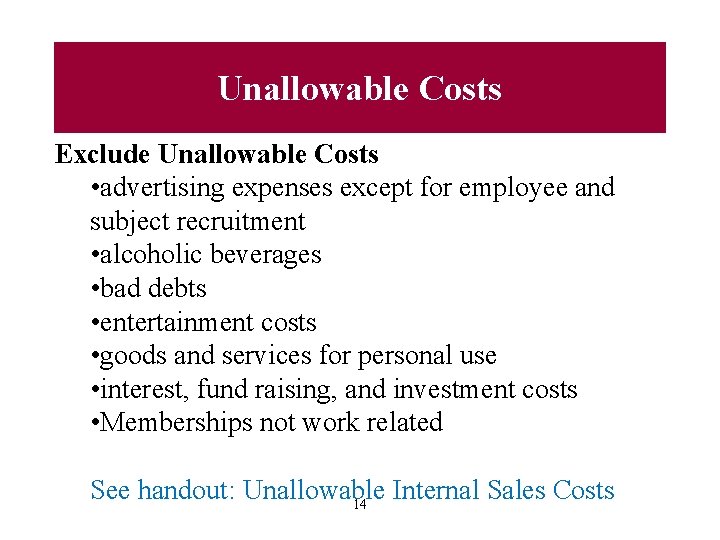
Unallowable Costs Exclude Unallowable Costs • advertising expenses except for employee and subject recruitment • alcoholic beverages • bad debts • entertainment costs • goods and services for personal use • interest, fund raising, and investment costs • Memberships not work related See handout: Unallowable Internal Sales Costs 14
Unallowable Costs Exclude Unallowable Costs The general premise for unallowable costs is that the federal government will not pay for certain costs that they believe are not directly related to the benefit of the research project. 15
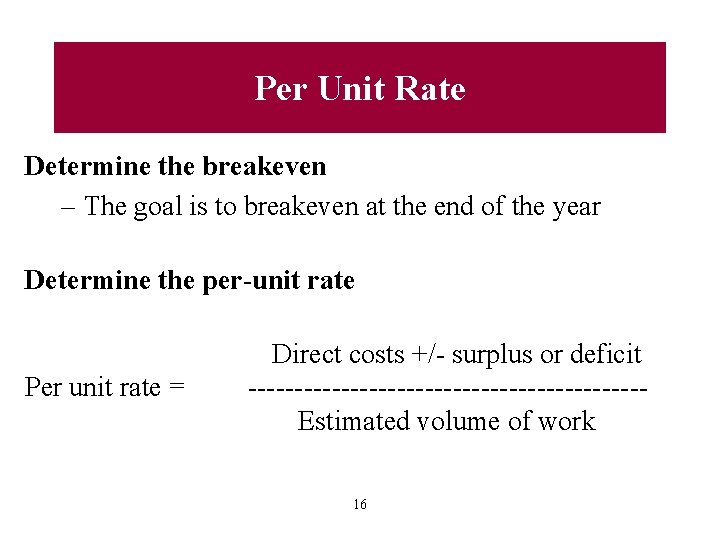
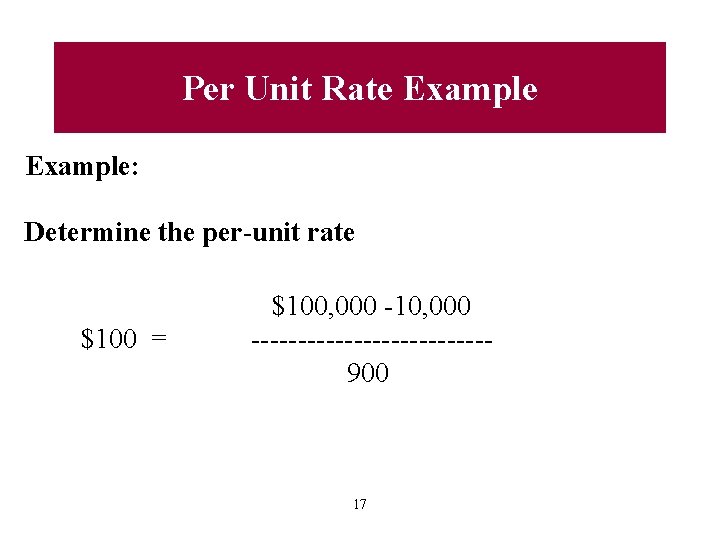
Per Unit Rate Determine the breakeven – The goal is to breakeven at the end of the year Determine the per-unit rate Direct costs +/- surplus or deficit Per unit rate = ---------------------- Estimated volume of work 16
Per Unit Rate Example: Determine the per-unit rate $100, 000 -10, 000 $100 = ------------- 900 17
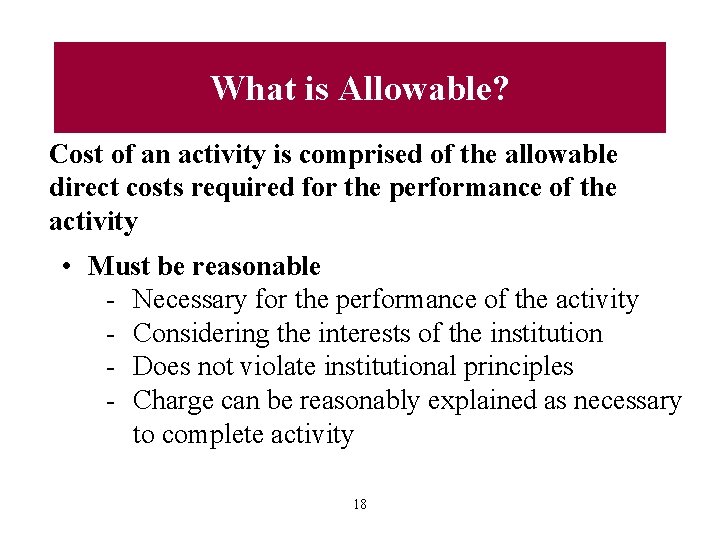
What is Allowable? Cost of an activity is comprised of the allowable direct costs required for the performance of the activity • Must be reasonable - Necessary for the performance of the activity - Considering the interests of the institution - Does not violate institutional principles - Charge can be reasonably explained as necessary to complete activity 18
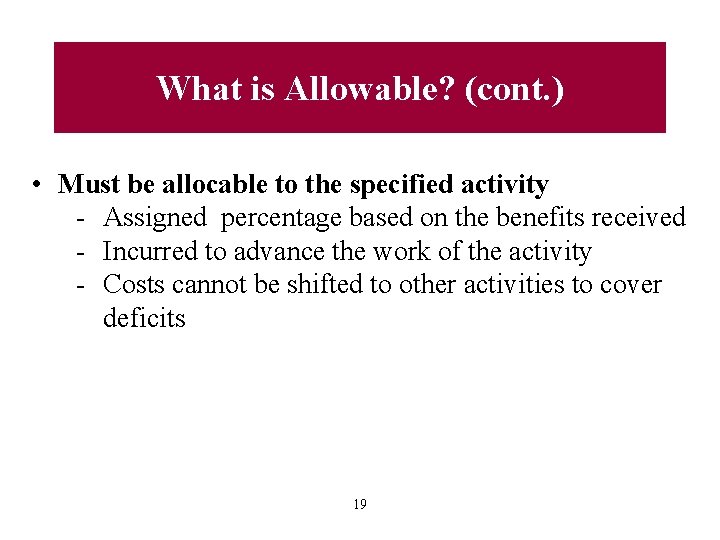
What is Allowable? (cont. ) • Must be allocable to the specified activity - Assigned percentage based on the benefits received - Incurred to advance the work of the activity - Costs cannot be shifted to other activities to cover deficits 19
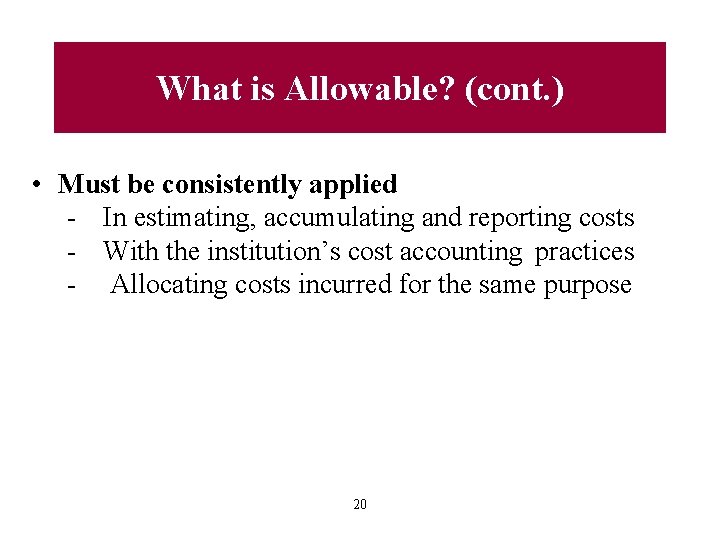
What is Allowable? (cont. ) • Must be consistently applied - In estimating, accumulating and reporting costs - With the institution’s cost accounting practices - Allocating costs incurred for the same purpose 20
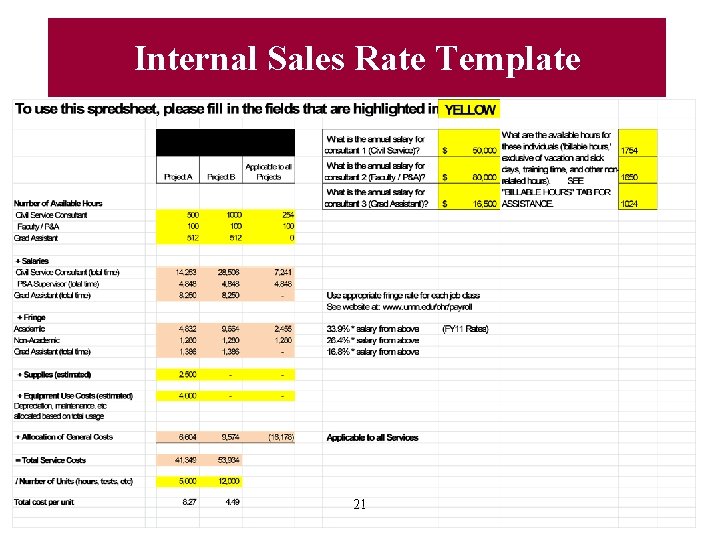
Internal Sales Rate Template 21
Questions? Office of Internal Sales website http: //finsys. umn. edu/sales/iso. html This presentation is posted on the site. 22