
University of Minnesota Computer Science Engineering An Overview

- Slides: 9
University of Minnesota Computer Science & Engineering An Overview for Smarter Planet Joint IBM/University Day Nov. 20, 2009 Vipin Kumar William Norris Professor and Head
Department Highlights • Outstanding faculty – One of the larger Computer Science dept with 38 tenure track faculty who provide critical mass and leadership in nearly all areas of computer science • Ranked third in the Faculty Scholarly Productivity Index. – (Chronicles of Higher Education, Jan. 2007) • Ranked 9 th for Citation Impact of Published Research Papers among the top 100 federally funded universities. – (Science Watch, Jan. 2007) • The only CSE department in the nation with three recipients of the Presidential Early Career Award for Scientists and Engineers (PECASE). • Extensive undergraduate and graduate program – Graduates about 125/yr with BS & BA in CS and BS in CE degrees, about 100/yr with MS(CS&SE) and about 18 -20/yr with Ph. D degrees – Our graduates are highly sought after by local, national, and international industry and academia
Books Authored & Co. Authored by CSE Faculty
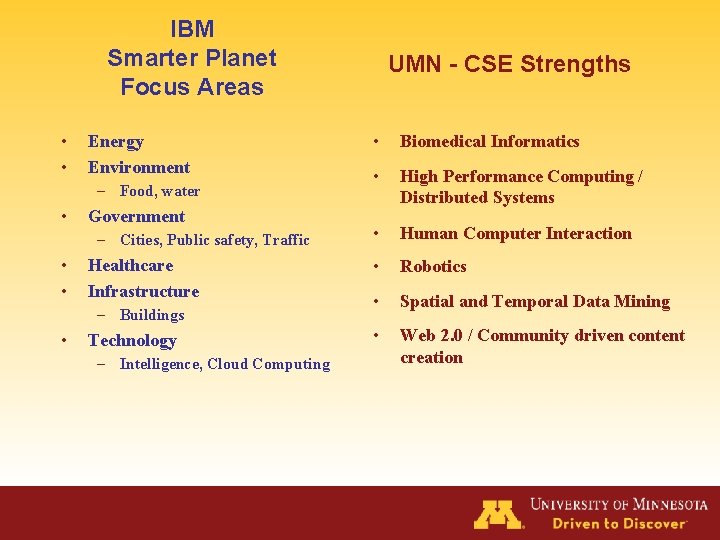
IBM Smarter Planet Focus Areas • • Energy Environment – Food, water • Government – Cities, Public safety, Traffic • • Healthcare Infrastructure – Buildings • Technology – Intelligence, Cloud Computing UMN - CSE Strengths • Biomedical Informatics • High Performance Computing / Distributed Systems • Human Computer Interaction • Robotics • Spatial and Temporal Data Mining • Web 2. 0 / Community driven content creation
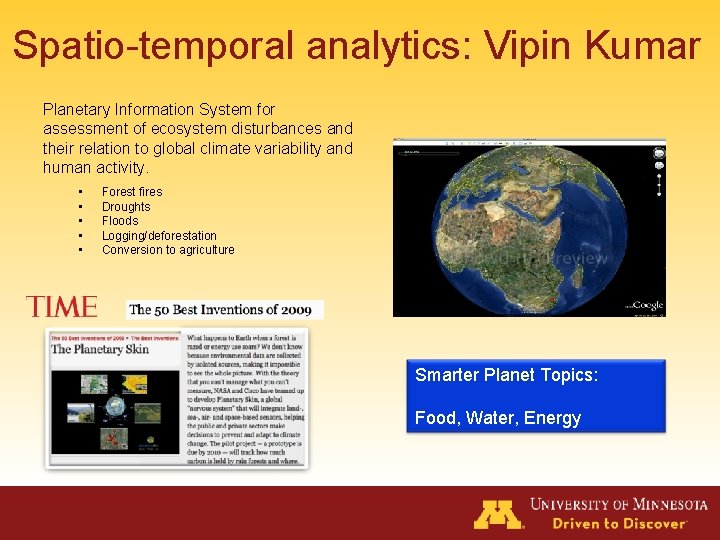
Spatio-temporal analytics: Vipin Kumar Planetary Information System for assessment of ecosystem disturbances and their relation to global climate variability and human activity. • • • Forest fires Droughts Floods Logging/deforestation Conversion to agriculture Smarter Planet Topics: Food, Water, Energy
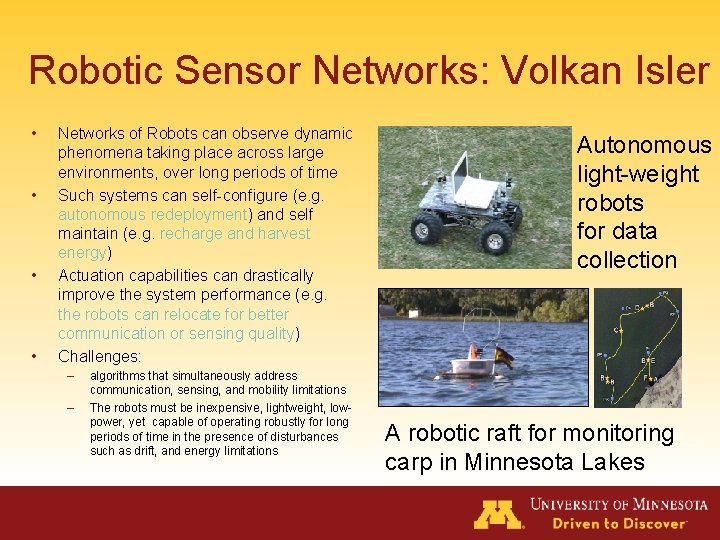
Robotic Sensor Networks: Volkan Isler • • Networks of Robots can observe dynamic phenomena taking place across large environments, over long periods of time Such systems can self-configure (e. g. autonomous redeployment) and self maintain (e. g. recharge and harvest energy) Actuation capabilities can drastically improve the system performance (e. g. the robots can relocate for better communication or sensing quality) Challenges: – – algorithms that simultaneously address communication, sensing, and mobility limitations The robots must be inexpensive, lightweight, lowpower, yet capable of operating robustly for long periods of time in the presence of disturbances such as drift, and energy limitations Autonomous light-weight robots for data collection A robotic raft for monitoring carp in Minnesota Lakes
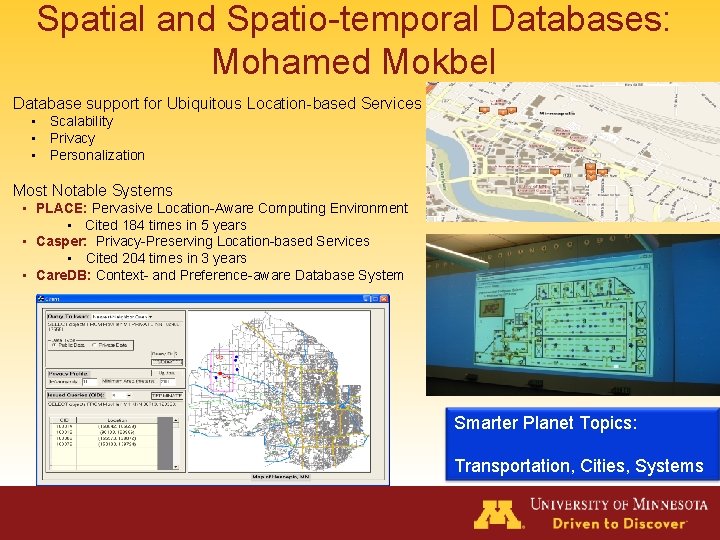
Spatial and Spatio-temporal Databases: Mohamed Mokbel Database support for Ubiquitous Location-based Services • Scalability • Privacy • Personalization Most Notable Systems • PLACE: Pervasive Location-Aware Computing Environment • Cited 184 times in 5 years • Casper: Privacy-Preserving Location-based Services • Cited 204 times in 3 years • Care. DB: Context- and Preference-aware Database System Smarter Planet Topics: Transportation, Cities, Systems
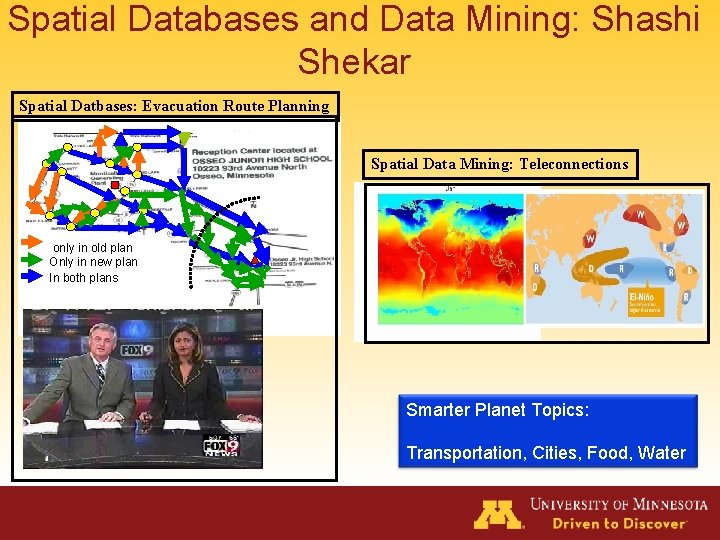
Spatial Databases and Data Mining: Shashi Shekar Spatial Datbases: Evacuation Route Planning Spatial Data Mining: Teleconnections only in old plan Only in new plan In both plans Smarter Planet Topics: Transportation, Cities, Food, Water
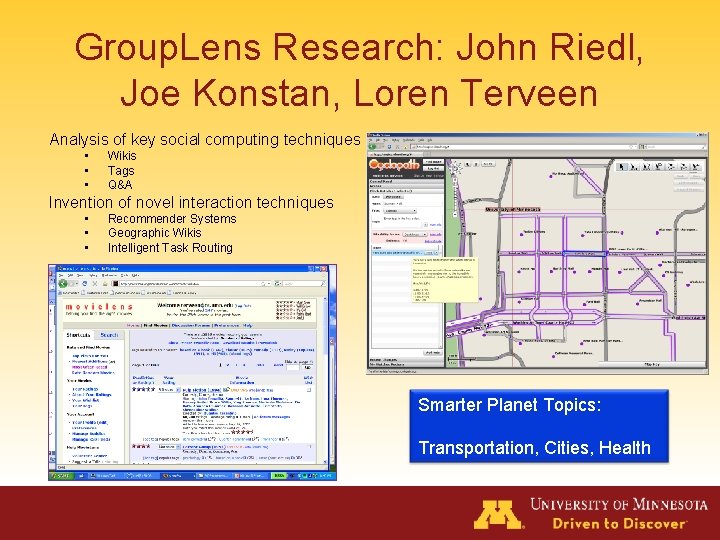
Group. Lens Research: John Riedl, Joe Konstan, Loren Terveen Analysis of key social computing techniques • • • Wikis Tags Q&A Invention of novel interaction techniques • • • Recommender Systems Geographic Wikis Intelligent Task Routing Smarter Planet Topics: Transportation, Cities, Health