
University of Hawaii SOEST n Department of Oceanography
- Slides: 12
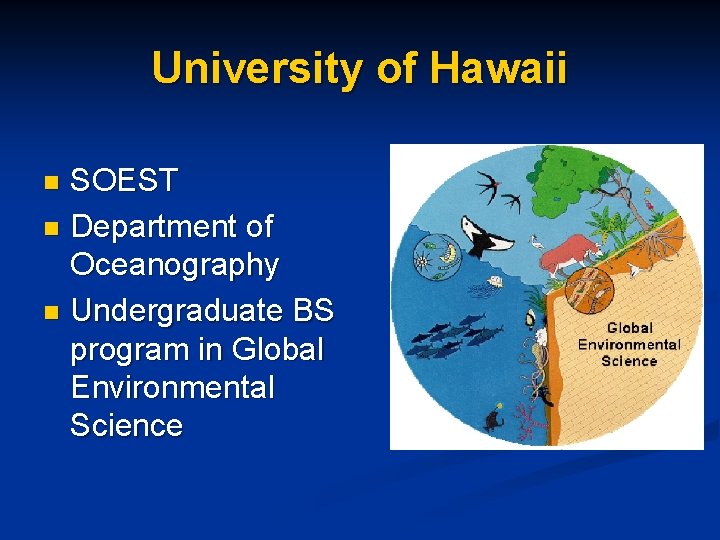
University of Hawaii SOEST n Department of Oceanography n Undergraduate BS program in Global Environmental Science n
GES Degree Interdisciplinary study of Earth’s physical, chemical, and biological (including human) systems n Rigorous BS degree n Coordination with other schools at UH provides expertise for training in intersections with economic, policy, and social systems n
GES Degree n Coursework: • Solid background in science and math Ø Includes Introductory Oceanography • GES courses Ø Skills courses: problem solving, computer skills, modeling, oral and written communication Ø Content courses: environmental change, biogeochemical cycles, etc. Ø Many incorporate oceanographic information/data. • Electives – students choose area of focus Ø Many choose oceanography courses
GES Degree n Senior Research Thesis • Required, one-year project with individual • • • mentor Experience in scientific method; field and experimental work; data collection, analysis, reduction, and interpretation; literature review and analysis. Oral presentation and written thesis >50% of students work on oceanographic projects
GES Graduates Roughly 50% go on to graduate school, many in oceanography or marine-related fields n Remainder in environmental consulting jobs, teaching, government positions n
OCN 201: Science of the Sea Lecture class – large (100 -200 students) n Team taught – 3 faculty (1 geo, 1 bio, 1 phys-chem) n Field trips, some self-guided n Optional Lab n Class website: http: //www. soest. hawaii. edu/oceanograph y/courses_html/OCN 201/ n
OCN 201 Labs Combination of computer-based, demonstration, and hands-on labs n Examples: n • Computer – nutrient lab based on Java Ocean • • Atlas: http: //odf. ucsd. edu/joa/jsindex. html Demonstration – salinity and thermohaline circulation Hands-on – plankton tow; count copepods and calculate concentration; ID organisms
Upper Division Courses – Incorporation of Oceanographic Concepts/Data Global Environmental Change § Aquatic Pollution § Atmospheric Pollution § Biogeochemical Cycles § Interpretation of Earth-system Computer Databases n
OCN 363 § Interpretation of Earth-system Computer Databases • • • Computer skills (Matlab, web page design/use, data reduction, plotting) Introduction to satellite-derived and other remotely sensed data and instrumentation used Ocean data sets used for assignments Class website: http: //www. satlab. hawaii. edu/ges/ocn 363 -2005/
Senior Research Projects n Environmental Assessment of Offshore Aquaculture – Romain Mauriac • Used pigment analyses to assess effects on phytoplankton populations § Enumeration of Microbial Cells in Hydrothermal Plumes – Carolyn Berger • Compared epifluorescence microscopy to flow cytometry § Coral Bleaching in the Northwest Hawaiian Islands – Yves Veillerobe • Evaluated spatial and temporal variability of SST from in situ and satellite-derived data
Things we’d like to do Shipboard experience for all n Integrate certain concepts and skills throughout curriculum, e. g. modeling n More hands-on experiences in courses n
Problems we’ve encountered n Ship availability for student cruises • Time and $ § Computer availability, maintenance, and upgrades § Student computer skills