
University of Glasgow School of Education Mathematics Enhancing


- Slides: 34
University of Glasgow School of Education - Mathematics Enhancing Students’ Mathematical Experiences in ITE Programmes Dr Ismail O. Zembat Dr Cristina Mio
Overview of the Key ITE programmes at University of Glasgow in Mathematics Education • PGDE Primary • MEduc • PGDE Secondary
1. What goals do we want to achieve? Evaluation of Mathematics Programmes. . . 2. What do we do to achieve these goals? 3. How do we monitor progress towards these goals?
1. What goals do we want to achieve? Evaluation of Mathematics Programmes. . . What do we do to achieve this? How do we monitor progress towards these goals?
Our main goal in mathematics education programmes is to prepare: Teachers as designers through theory-driven experiences
What do we want to achieve? Evaluation of Mathematics Programmes. . . What do we do to achieve this? How do we monitor progress towards these goals?
Our students experience what it means to be designers through theory-driven practice
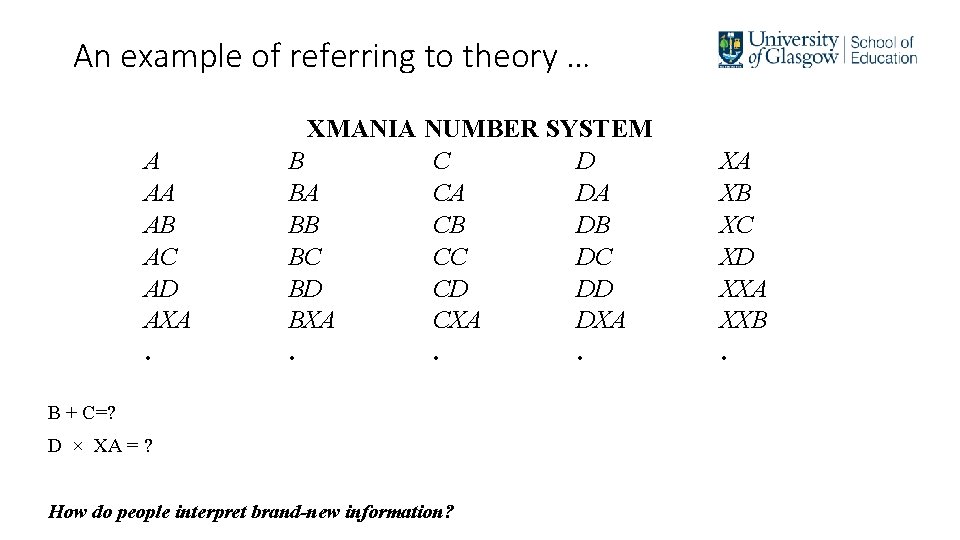
An example of referring to theory … A AA AB AC AD AXA. XMANIA NUMBER SYSTEM B C D BA CA DA BB CB DB BC CC DC BD CD DD BXA CXA DXA. . . B + C=? D × XA = ? How do people interpret brand-new information? XA XB XC XD XXA XXB.
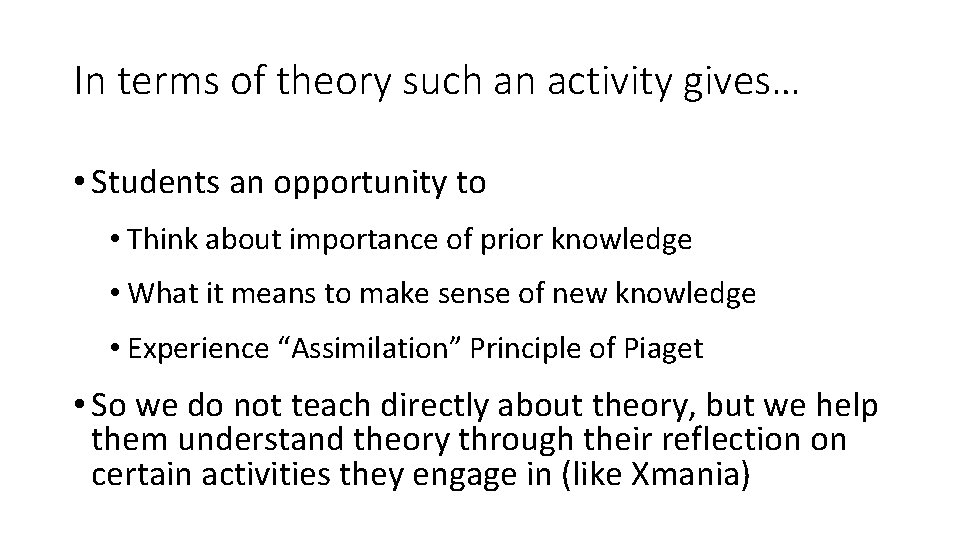
In terms of theory such an activity gives… • Students an opportunity to • Think about importance of prior knowledge • What it means to make sense of new knowledge • Experience “Assimilation” Principle of Piaget • So we do not teach directly about theory, but we help them understand theory through their reflection on certain activities they engage in (like Xmania)
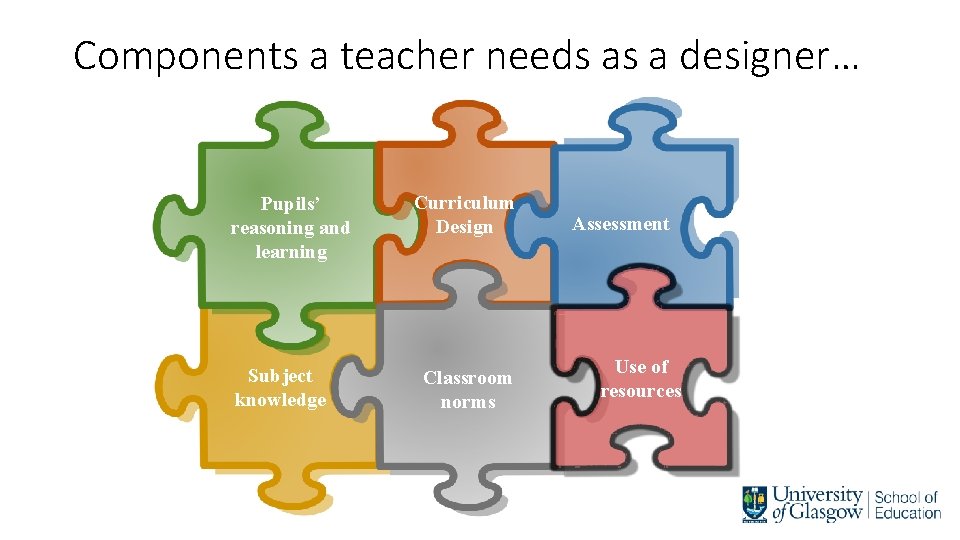
Components a teacher needs as a designer… Pupils’ reasoning and learning Subject knowledge Curriculum Design Classroom norms Assessment Use of resources
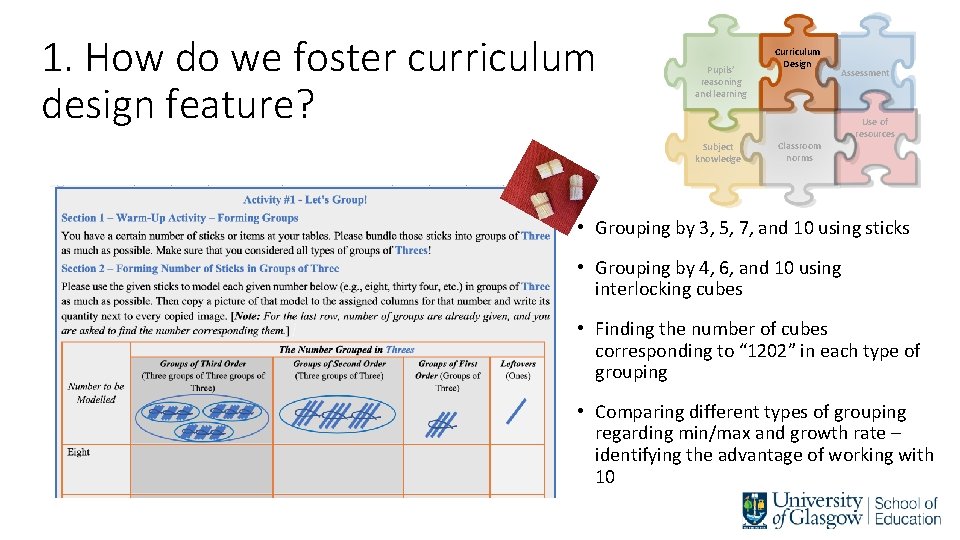
1. How do we foster curriculum design feature? Pupils’ reasoning and learning Subject knowledge Curriculum Design Assessment Classroom norms Use of resources • Grouping by 3, 5, 7, and 10 using sticks • Grouping by 4, 6, and 10 using interlocking cubes • Finding the number of cubes corresponding to “ 1202” in each type of grouping • Comparing different types of grouping regarding min/max and growth rate – identifying the advantage of working with 10
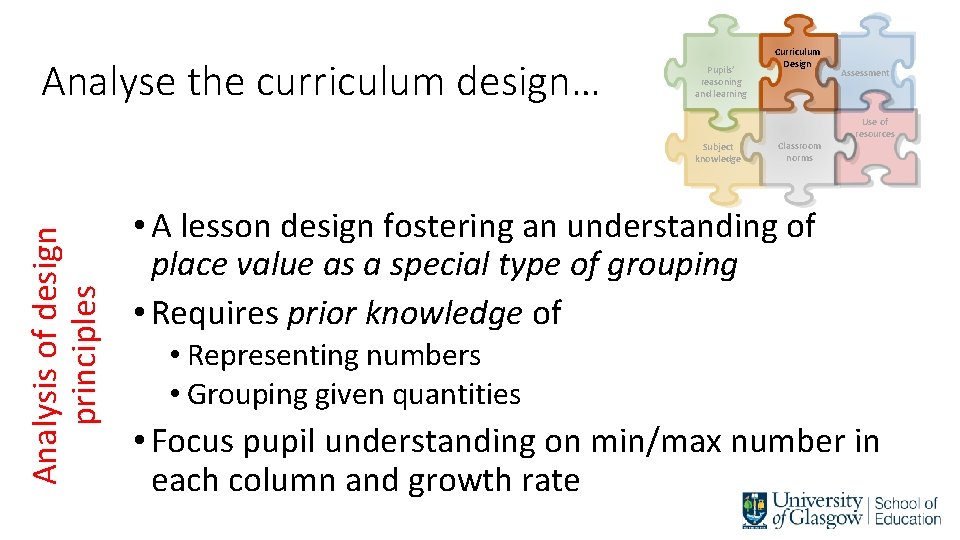
Analyse the curriculum design… Pupils’ reasoning and learning Analysis of design principles Subject knowledge Curriculum Design Classroom norms Assessment Use of resources • A lesson design fostering an understanding of place value as a special type of grouping • Requires prior knowledge of • Representing numbers • Grouping given quantities • Focus pupil understanding on min/max number in each column and growth rate
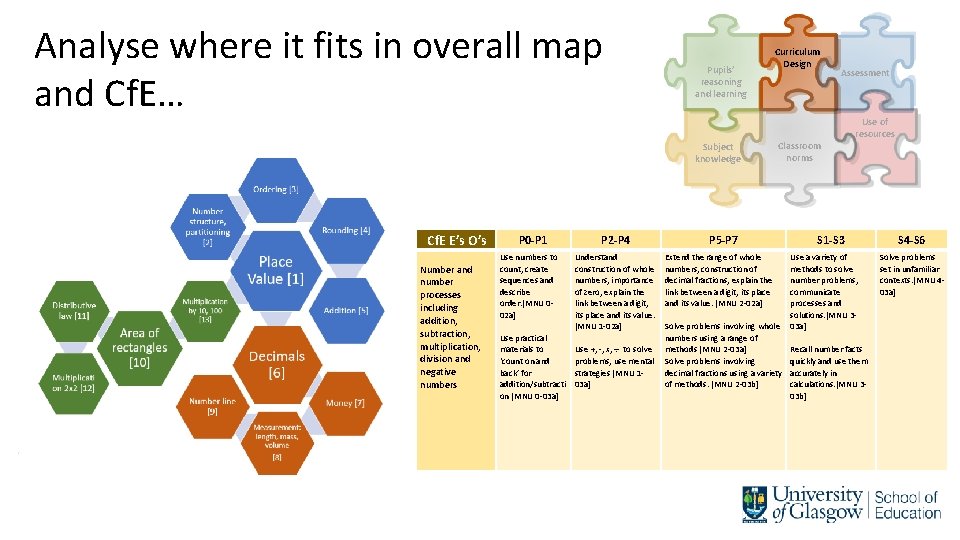
Analyse where it fits in overall map and Cf. E… Pupils’ reasoning and learning Subject knowledge Cf. E E’s O’s Number and number processes including addition, subtraction, multiplication, division and negative numbers P 0 -P 1 Use numbers to count, create sequences and describe order. [MNU 002 a] Use practical materials to ‘count on and back’ for addition/subtracti on [MNU 0 -03 a] P 2 -P 4 Understand construction of whole numbers, importance of zero, explain the link between a digit, its place and its value. [MNU 1 -02 a] Use +, -, x, to solve problems, use mental strategies [MNU 103 a] Curriculum Design Assessment Classroom norms P 5 -P 7 Extend the range of whole numbers, construction of decimal fractions, explain the link between a digit, its place and its value. [MNU 2 -02 a] Solve problems involving whole numbers using a range of methods [MNU 2 -03 a] Solve problems involving decimal fractions using a variety of methods. [MNU 2 -03 b] Use of resources S 1 -S 3 Use a variety of methods to solve number problems, communicate processes and solutions. [MNU 303 a] Recall number facts quickly and use them accurately in calculations. [MNU 303 b] S 4 -S 6 Solve problems set in unfamiliar contexts. [MNU 403 a]
2. How do we foster an understanding of pupil’s learning? This also gives them a chance to experience pupil lens…
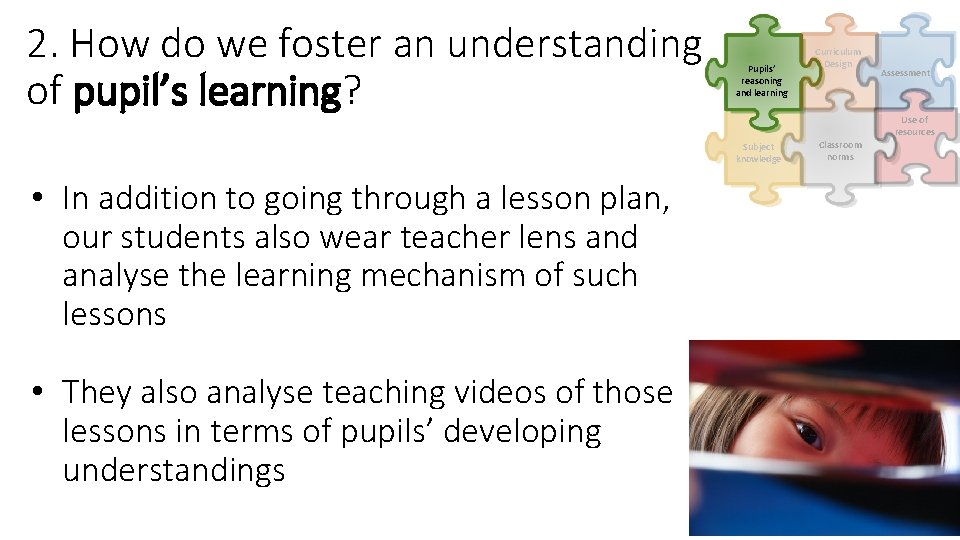
2. How do we foster an understanding of pupil’s learning? Pupils’ reasoning and learning • They also analyse teaching videos of those lessons in terms of pupils’ developing understandings Assessment Use of resources Subject knowledge • In addition to going through a lesson plan, our students also wear teacher lens and analyse the learning mechanism of such lessons Curriculum Design Classroom norms
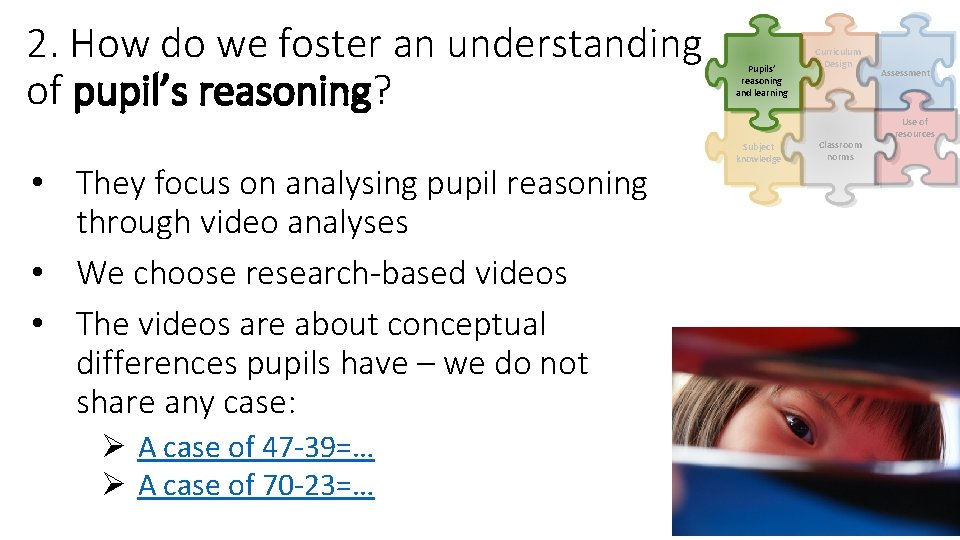
2. How do we foster an understanding of pupil’s reasoning? • They focus on analysing pupil reasoning through video analyses • We choose research-based videos • The videos are about conceptual differences pupils have – we do not share any case: Ø A case of 47 -39=… Ø A case of 70 -23=… Pupils’ reasoning and learning Subject knowledge Curriculum Design Classroom norms Assessment Use of resources
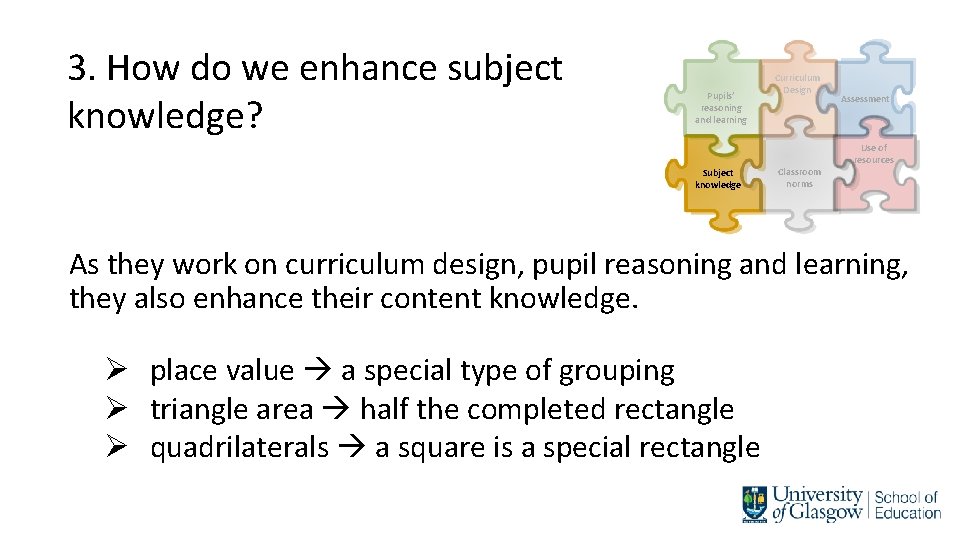
3. How do we enhance subject knowledge? Pupils’ reasoning and learning Subject knowledge Curriculum Design Classroom norms Assessment Use of resources As they work on curriculum design, pupil reasoning and learning, they also enhance their content knowledge. Ø place value a special type of grouping Ø triangle area half the completed rectangle Ø quadrilaterals a square is a special rectangle
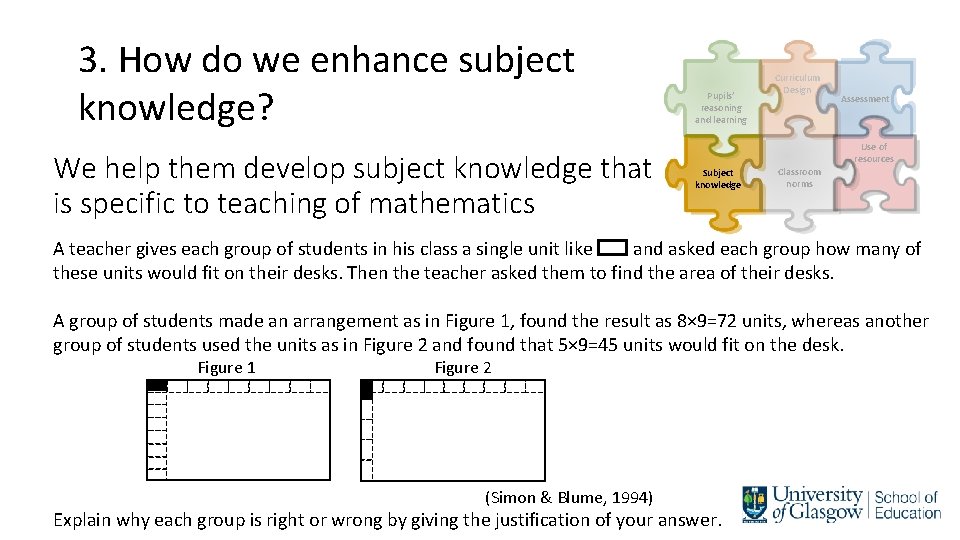
3. How do we enhance subject knowledge? We help them develop subject knowledge that is specific to teaching of mathematics Pupils’ reasoning and learning Curriculum Design Assessment Use of resources Subject knowledge Classroom norms A teacher gives each group of students in his class a single unit like and asked each group how many of these units would fit on their desks. Then the teacher asked them to find the area of their desks. A group of students made an arrangement as in Figure 1, found the result as 8× 9=72 units, whereas another group of students used the units as in Figure 2 and found that 5× 9=45 units would fit on the desk. Figure 1 Figure 2 (Simon & Blume, 1994) Explain why each group is right or wrong by giving the justification of your answer.
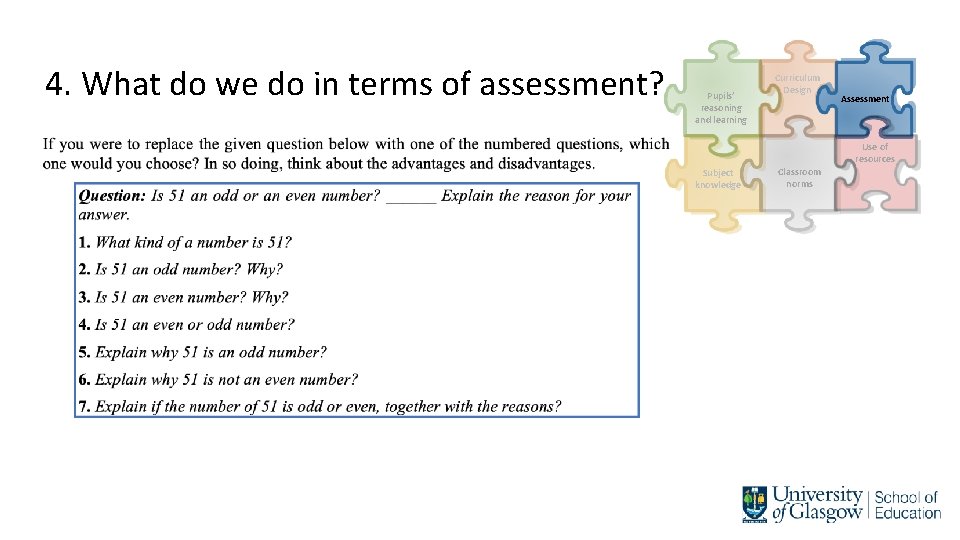
4. What do we do in terms of assessment? Pupils’ reasoning and learning Curriculum Design Assessment Use of resources Subject knowledge Classroom norms
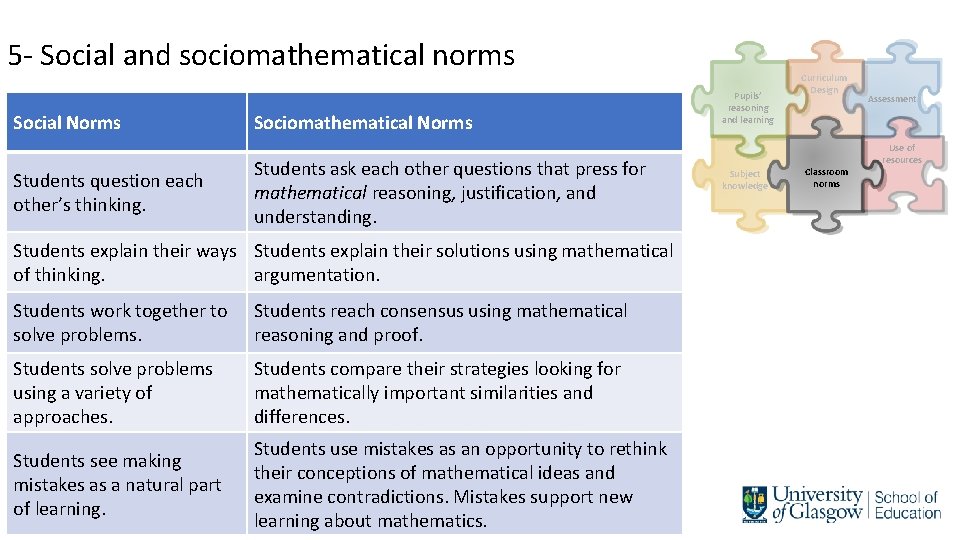
5 - Social and sociomathematical norms Social Norms Students question each other’s thinking. Sociomathematical Norms Students ask each other questions that press for mathematical reasoning, justification, and understanding. Students explain their ways Students explain their solutions using mathematical of thinking. argumentation. Students work together to solve problems. Students reach consensus using mathematical reasoning and proof. Students solve problems using a variety of approaches. Students compare their strategies looking for mathematically important similarities and differences. Students see making mistakes as a natural part of learning. Students use mistakes as an opportunity to rethink their conceptions of mathematical ideas and examine contradictions. Mistakes support new learning about mathematics. Pupils’ reasoning and learning Subject knowledge Curriculum Design Classroom norms Assessment Use of resources
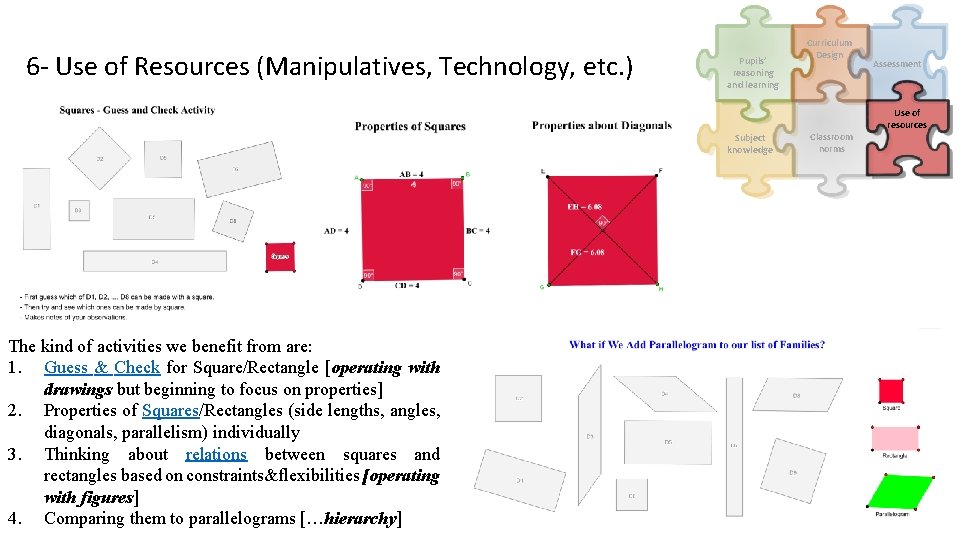
6 - Use of Resources (Manipulatives, Technology, etc. ) Pupils’ reasoning and learning Subject knowledge The kind of activities we benefit from are: 1. Guess & Check for Square/Rectangle [operating with drawings but beginning to focus on properties] 2. Properties of Squares/Rectangles (side lengths, angles, diagonals, parallelism) individually 3. Thinking about relations between squares and rectangles based on constraints&flexibilities [operating with figures] 4. Comparing them to parallelograms […hierarchy] Curriculum Design Classroom norms Assessment Use of resources
All of this is guided by our partnership with schools… • These lessons have been tested in real classrooms • They are currently being used in a Scottish Primary School (video) • Positive pupil/teacher feedback about our partnership • We share these experiences with our PGDE students
What do we want to achieve? Evaluation of Mathematics Programmes. . . What do we do to achieve this? How do we monitor progress towards these goals?
Community of Practice • We have a strong maths lecturer team with variety of schooling and academic experiences • We share our experiences in biweekly meetings and decide on further steps • Changes to the content of future seminars are made in a timely manner if any issues emerge • We consider student feedback seriously This Photo by Unknown Author is licensed under CC BY-NC
Thi s Speaking of student feedback … • Ongoing dialogue and interaction with our students • Getting feedback at specific points throughout the year Pho to by Un kno wn Au tho r is li cen sed und er CC B Y-S A -NC
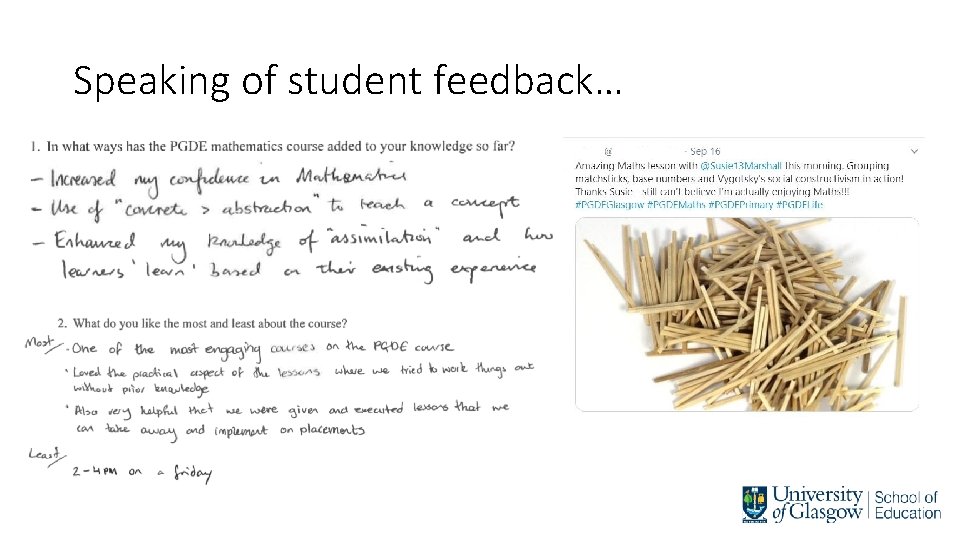
Speaking of student feedback…
Speaking of student feedback… What do PGDE Primary students say?
Other measures to evaluate the Maths programmes • We use a feedback system called PTES for our PGDE Secondary Mathematics students • We also use a formal feedback system for every course (called EVASYS) that asks students about their experience in each course once the grades are revealed
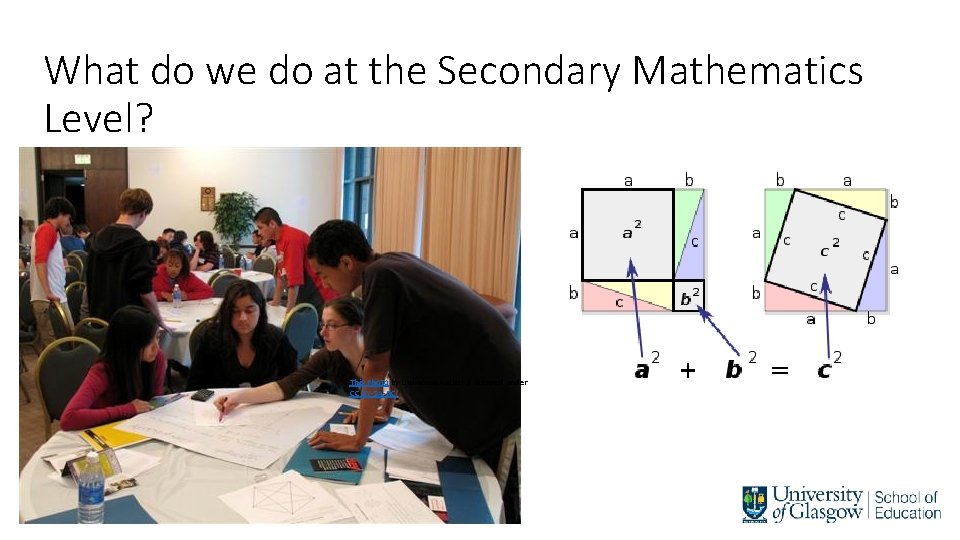
What do we do at the Secondary Mathematics Level? This Photo by Unknown Author is licensed under CC BY-SA-NC
What do we do at the Secondary Mathematics Level? Building a knowledge base through active participation by focusing on: • Developing a different mindset for Maths and its beauty and learning • Teaching Mathematics for Understanding • Tasks on lesson development through exchanging ideas in group • Benefitting from Neuroscience/Psychology with respect to Maths learning • Socio-cultural aspects of constructing mathematical knowledge (norms) • Assessment for Learning and questioning
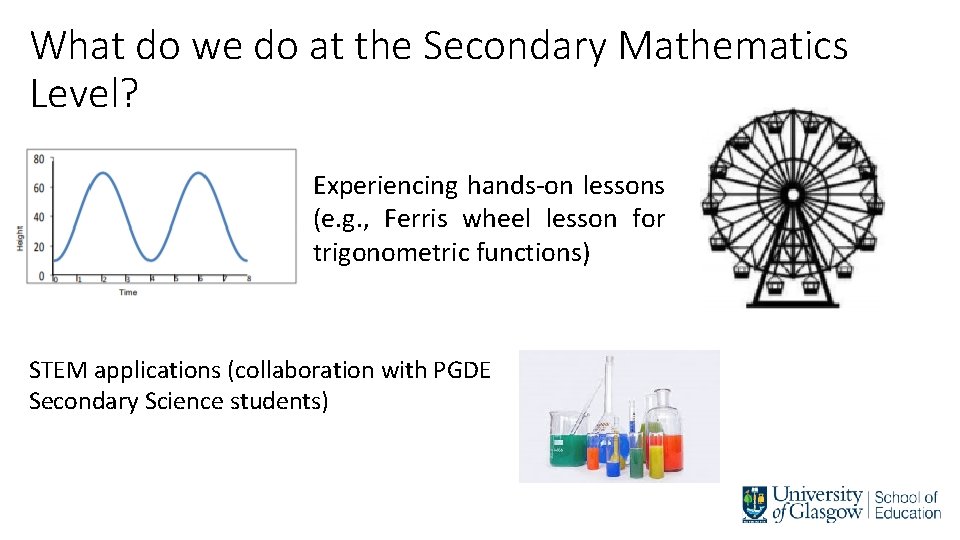
What do we do at the Secondary Mathematics Level? Experiencing hands-on lessons (e. g. , Ferris wheel lesson for trigonometric functions) STEM applications (collaboration with PGDE Secondary Science students)
What feedback do we get from our Secondary PGDE students? Video 1 Video 2 Video 3
Challenges & Priorities • Students need to be convinced - different from how they were taught/different mindset • Different mindsets in primary and secondary PGDE students: o Primary - feel insecure since they are not confident in their mathematics knowledge o Secondary - know mathematics but are disconnected from school mathematics
Thanks… Any Questions? Ismail. Zembat@Glasgow. ac. uk Cristina. Mio@Glasgow. ac. uk