
University of Cincinnatis SUCCESS CHALLENGE Placing Student Success



- Slides: 32
University of Cincinnati’s SUCCESS CHALLENGE: Placing Student Success at the Center Consortium for Student Retention Data Exchange For Early Intervention Committee Meeting – October 16, 2008 Caroline Miller, Ph. D Sr. AVP Enrollment caroline. miller@uc. edu Maria Palmieri, Ph. D Sr. Research Assoc, IR maria. palmieri@uc. edu
UC status in 2000 • Almost 30% baccalaureate Freshmen gone by the start of the second year • Fewer than half graduated within 6 years • That’s a tragedy for students & tax payers • That’s a tough track record to market for a research extensive campus
What Contributes to Retention? • Profile – largely a function of institutional & student profile (academic, financial & demographic) • Progress – prevailing model is around persistence, but if the goal is graduation we must focus on progress – the distance to the finish line, not the distance from the start line
What Contributes to Retention? • Process – If the goal is to raise the overall retention and grad rates, it’s important to focus on the “all” not just those most at risk • Promise – Experiences are consistent with the “Promise of the Brand” – break the promise, we will lose students
Access Without Success National Trends: • Retention rates up, then stable – now reported to be dropping • Graduation rates now reported to be dropping • The disparity is greater for students from low socio-economic backgrounds
Pell Eligibility • UC’s Uptown campus enrolls the third highest percentage of Pell-eligible students among research extensive institutions nationwide – about 30%. • 50% of UC students are 1 st-generation (40% of Uptown students are 1 stgeneration)
So how does UC compare – particularly for High Risk Students? ENTER SUCCESS CHALLENGE
Success Challenge Ohio Board of Regents Initiative (1999) Challenges university main campuses: 1. To increase the baccalaureate graduation rates of in-state at-risk students 2. To shorten the length of time to degree Note: Not U College, Not CAT, Not Branches
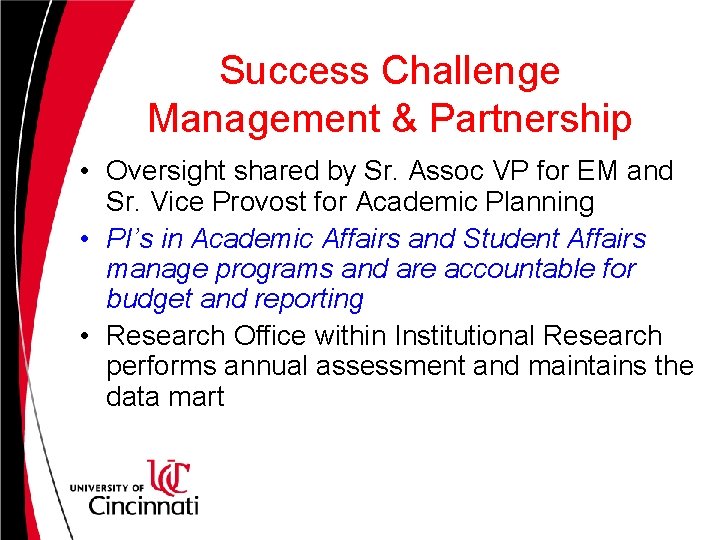
Success Challenge Management & Partnership • Oversight shared by Sr. Assoc VP for EM and Sr. Vice Provost for Academic Planning • PI’s in Academic Affairs and Student Affairs manage programs and are accountable for budget and reporting • Research Office within Institutional Research performs annual assessment and maintains the data mart
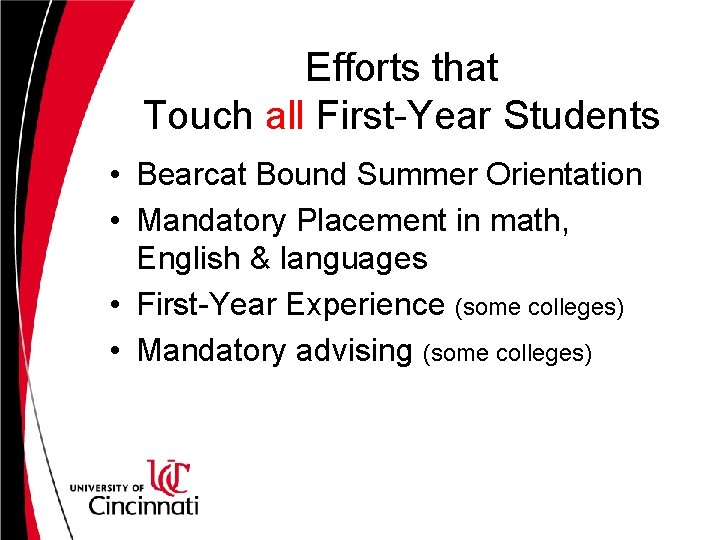
Efforts that Touch all First-Year Students • Bearcat Bound Summer Orientation • Mandatory Placement in math, English & languages • First-Year Experience (some colleges) • Mandatory advising (some colleges)
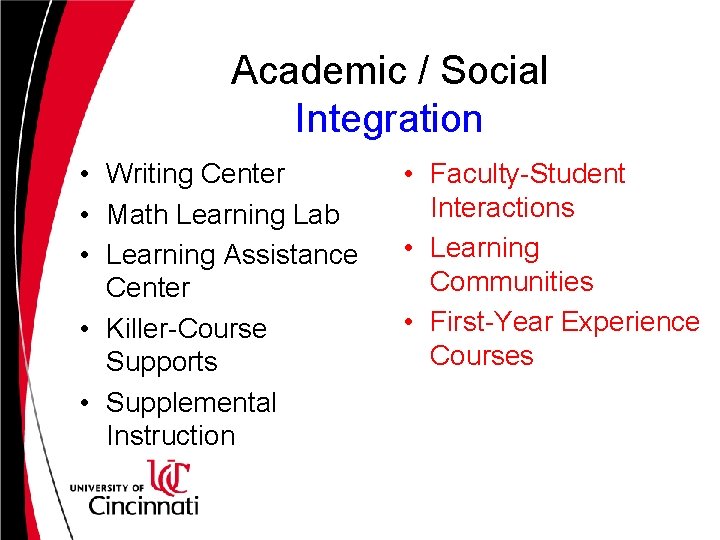
Academic / Social Integration • Writing Center • Math Learning Lab • Learning Assistance Center • Killer-Course Supports • Supplemental Instruction • Faculty-Student Interactions • Learning Communities • First-Year Experience Courses
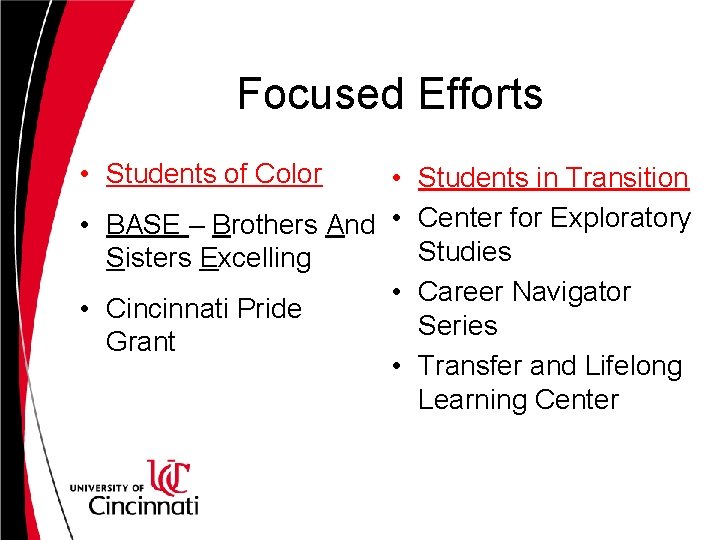
Focused Efforts • Students of Color • Students in Transition • BASE – Brothers And • Center for Exploratory Studies Sisters Excelling • Career Navigator • Cincinnati Pride Series Grant • Transfer and Lifelong Learning Center
Research Goal: Determine if Success Challenge is achieving its goals 1. Are in-state at-risk baccalaureate students graduating at higher rates? 2. Are they graduating in a more timely manner?
Methodology • 2000 and 2001 First-Time, Full-Time Baccalaureate Degree-Seeking Cohorts • Compared Success Challenge Participants to SC Non-Participants – Graduation Rates – Time to Degree – Grouped by Pell-Eligibility Status
Methodology – Defined 2000, 2001 Cohorts – Collected Data: • Degree Sought • Ethnicity • Pell-Eligibility Status • ACT/SAT Scores • Residency Status • Graduation Status • Credit Load Level • SC Participation • Gender • 1 st Year GPA
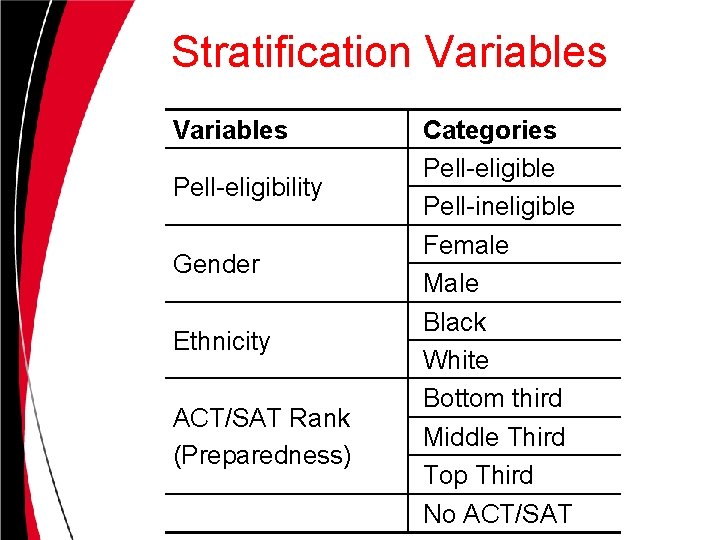
Control Group • Chosen from pool of Success Challenge participants • Match the proportion of Success Challenge non-participants • Based on stratification variables
Stratification Variables Pell-eligibility Gender Ethnicity ACT/SAT Rank (Preparedness) Categories Pell-eligible Pell-ineligible Female Male Black White Bottom third Middle Third Top Third No ACT/SAT
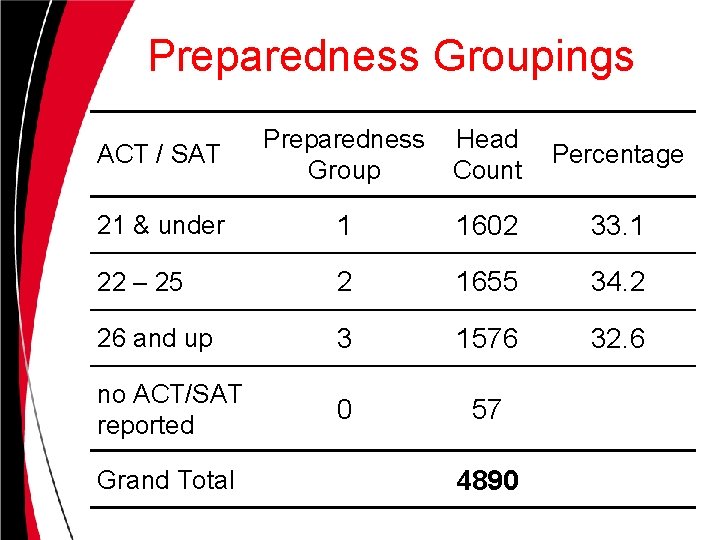
Preparedness Groupings ACT / SAT Preparedness Group Head Count Percentage 21 & under 1 1602 33. 1 22 – 25 2 1655 34. 2 26 and up 3 1576 32. 6 no ACT/SAT reported 0 57 Grand Total 4890
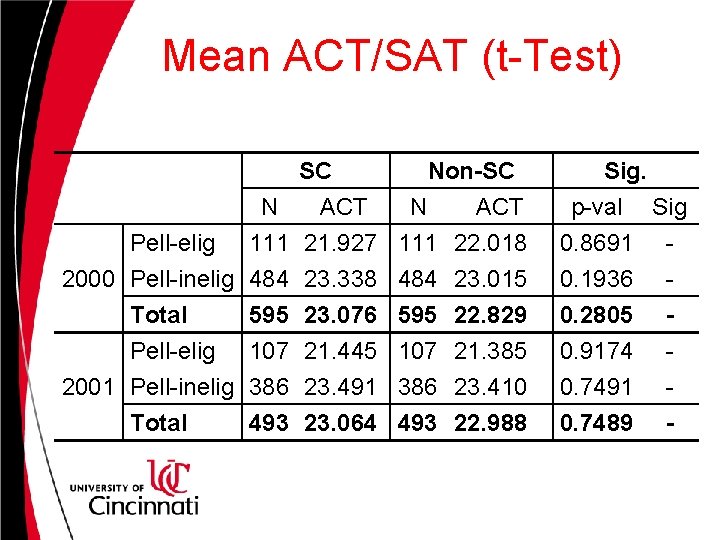
Mean ACT/SAT (t-Test) SC Non-SC N ACT Pell-elig 111 21. 927 111 22. 018 2000 Pell-inelig 484 23. 338 484 23. 015 Sig. p-val Sig 0. 8691 0. 1936 - Total Pell-elig 2001 Pell-inelig Total 0. 2805 0. 9174 0. 7491 0. 7489 595 107 386 493 23. 076 21. 445 23. 491 23. 064 595 107 386 493 22. 829 21. 385 23. 410 22. 988 -
RESULTS
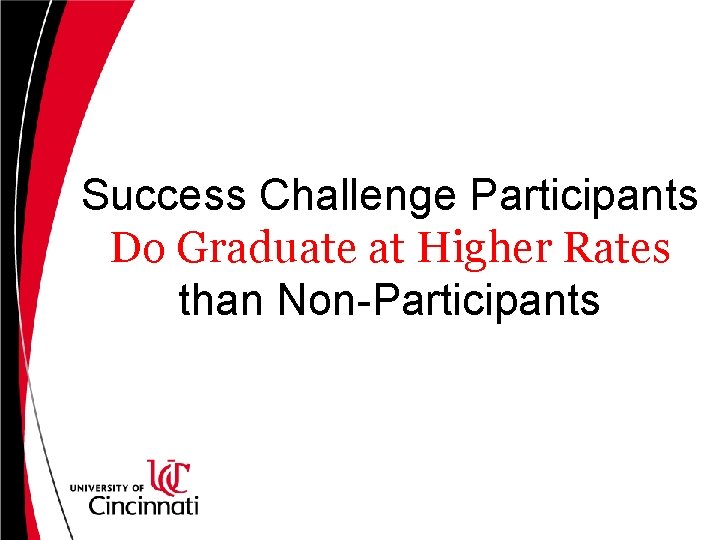
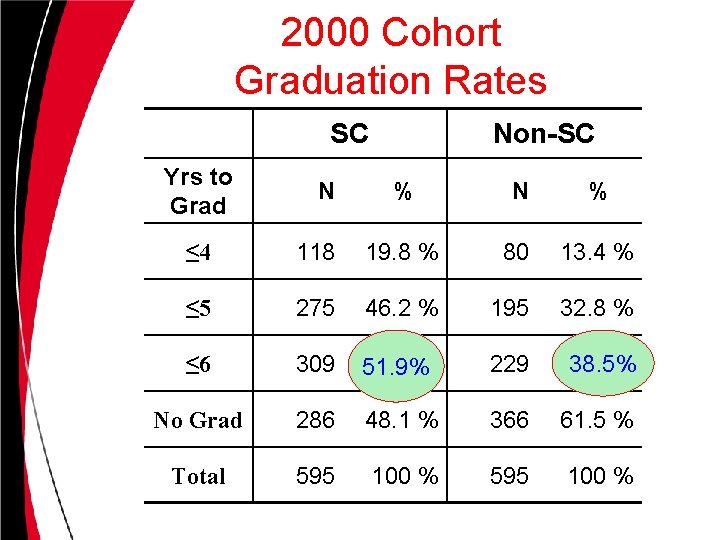
Success Challenge Participants Do Graduate at Higher Rates than Non-Participants
2000 Cohort Graduation Rates SC Yrs to Grad N Non-SC % N % ≤ 4 118 19. 8 % 80 13. 4 % ≤ 5 275 46. 2 % 195 32. 8 % ≤ 6 309 51. 9% 229 38. 5% No Grad 286 48. 1 % 366 61. 5 % Total 595 100 %
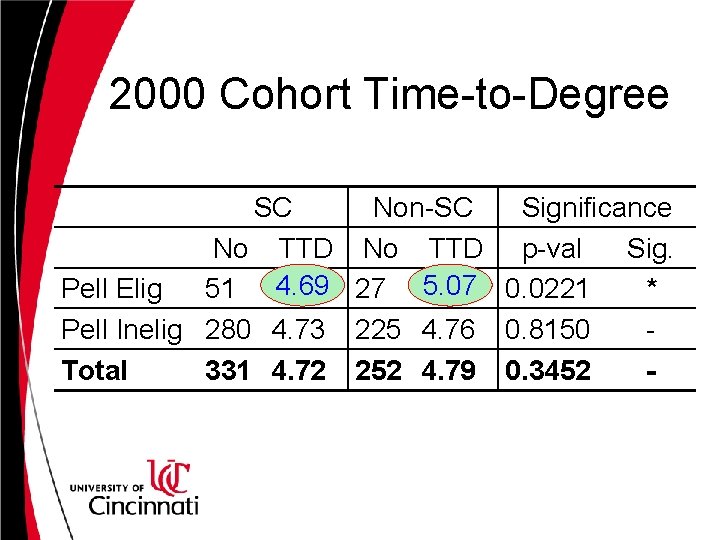
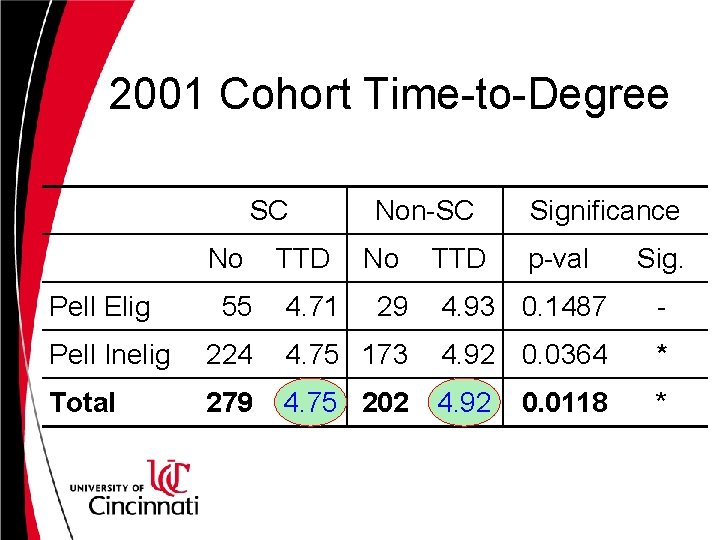
Success Challenge Participants Do Graduate in a More Timely Manner than Non-Participants
2000 Cohort Time-to-Degree SC Non-SC Significance No TTD p-val Sig. Pell Elig 51 4. 69 27 5. 07 0. 0221 * Pell Inelig 280 4. 73 225 4. 76 0. 8150 Total 331 4. 72 252 4. 79 0. 3452 -
2001 Cohort Time-to-Degree SC No Pell Elig 55 TTD 4. 71 Non-SC No TTD Significance p-val Sig. 29 4. 93 0. 1487 - Pell Inelig 224 4. 75 173 4. 92 0. 0364 * Total 279 4. 75 202 4. 92 * 0. 0118
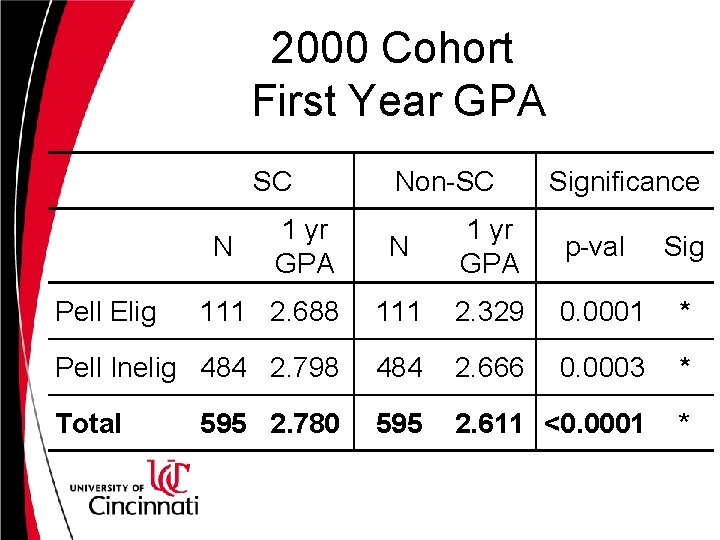
Success Challenge Participants Have Better First-Year Academic Performance than Non-Participants
2000 Cohort First Year GPA SC Significance N 1 yr GPA p-val Sig 111 2. 688 111 2. 329 0. 0001 * Pell Inelig 484 2. 798 484 2. 666 0. 0003 * Total 595 2. 611 <0. 0001 * N Pell Elig 1 yr GPA Non-SC 595 2. 780
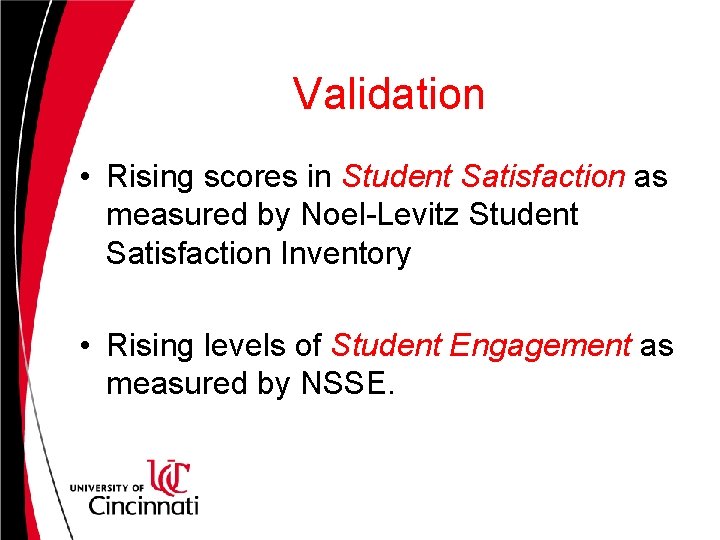
Validation • Rising scores in Student Satisfaction as measured by Noel-Levitz Student Satisfaction Inventory • Rising levels of Student Engagement as measured by NSSE.
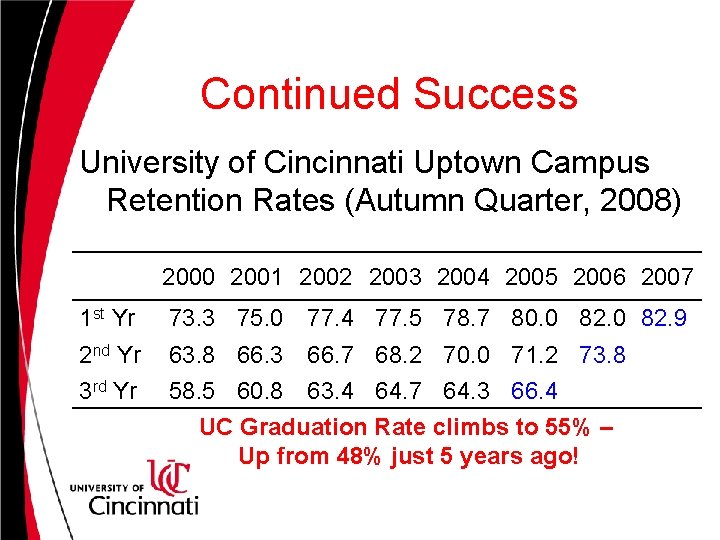
Continued Success University of Cincinnati Uptown Campus Retention Rates (Autumn Quarter, 2008) 2000 2001 2002 2003 2004 2005 2006 2007 1 st Yr 73. 3 75. 0 77. 4 77. 5 78. 7 80. 0 82. 9 2 nd Yr 63. 8 66. 3 66. 7 68. 2 70. 0 71. 2 73. 8 3 rd Yr 58. 5 60. 8 63. 4 64. 7 64. 3 66. 4 UC Graduation Rate climbs to 55% – Up from 48% just 5 years ago!
UC|Recognition Awarded National Best Practice Recipient for the institutionalization of enhanced retention and graduation rates By Consortium for Student Retention Data Exchange at the National Symposium on Student Retention