
UNIVERSITY OF CAPE COAST Cape Coast Ghana ECO







- Slides: 96
UNIVERSITY OF CAPE COAST Cape Coast, Ghana ECO 301: INTERMEDIATE MICROECONOMICS Kwabena Nkansah Darfor UCC
UNIVERSITY OF CAPE COAST Cape Coast, Ghana OVERVIEW OF CONSUMER BEHAVIOUR THEORY 2
UNIVERSITY OF CAPE COAST Cape Coast, Ghana Consumer Preferences and the Concept of Utility
UNIVERSITY OF CAPE COAST - GHANA Overview 1. Motivation 2. Consumer Preferences and the Concept of Utility 3. The Utility Function • Marginal Utility and Diminishing Marginal Utility 4. Indifference Curves 5. The Marginal Rate of Substitution 6. Some Special Functional Forms 4
UNIVERSITY OF CAPE COAST - GHANA Motivation • Why study consumer choice? • Study of how consumers with limited resources choose goods and services • Helps derive the demand curve for any good or service • Businesses care about consumer demand curves • Government can use this to determine how to help and whom to help buy certain goods and services 5
UNIVERSITY OF CAPE COAST - GHANA Consumer Preferences tell us how the consumer would rank (that is, compare the desirability of) any two combinations or allotments of goods, assuming these allotments were available to the consumer at no cost. These allotments of goods are referred to as baskets or bundles. These baskets are assumed to be available for consumption at a particular time, place and under particular physical circumstances. 6
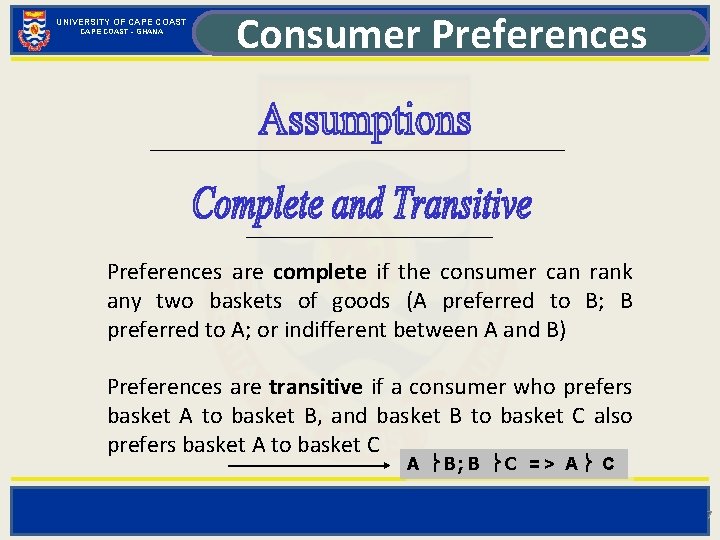
UNIVERSITY OF CAPE COAST - GHANA Consumer Preferences are complete if the consumer can rank any two baskets of goods (A preferred to B; B preferred to A; or indifferent between A and B) Preferences are transitive if a consumer who prefers basket A to basket B, and basket B to basket C also prefers basket A to basket C A B; B C = > A C 7
UNIVERSITY OF CAPE COAST - GHANA Consumer Preferences are monotonic if a basket with more of at least one good and no less of any good is preferred to the original basket. 8
UNIVERSITY OF CAPE COAST - GHANA Types of Ranking Students take an exam. After the exam, the students are ranked according to their performance. An ordinal ranking lists the students in order of their performance (i. e. , Kweku did best, Kojo did second best, Akua did third best, and so on). A cardinal ranking gives the mark of the exam, based on an absolute marking standard (i. e. , Kweku got 80, Kojo got 75, Akua got 74 and so on). Alternatively, if the exam were graded on a curve, the marks would be an ordinal ranking. 9
UNIVERSITY OF CAPE COAST - GHANA The Utility Function The three assumptions about preferences allow us to represent preferences with a utility function. Utility function – a function that measures the level of satisfaction a consumer receives from any basket of goods and services. – assigns a number to each basket so that more preferred baskets get a higher number than less preferred baskets. U = u(y) 10
UNIVERSITY OF CAPE COAST - GHANA The Utility Function • An ordinal concept: the precise magnitude of the number that the function assigns has no significance. • Utility not comparable across individuals. • Any transformation of a utility function that preserves the original ranking of bundles is an equally good representation of preferences. e. g. U = vs. U = + 2 represent the same preferences. 11
UNIVERSITY OF CAPE COAST - GHANA Marginal Utility of a good y • additional utility that the consumer gets from consuming a little more of y • i. e. the rate at which total utility changes as the level of consumption of good y rises • MUy = U/ y • slope of the utility function with respect to y 12
UNIVERSITY OF CAPE COAST - GHANA Diminishing Marginal Utility The principle of diminishing marginal utility states that the marginal utility falls as the consumer consumes more of a good. 13
UNIVERSITY OF CAPE COAST - GHANA Diminishing Marginal Utility 14
UNIVERSITY OF CAPE COAST - GHANA Marginal Utility The marginal utility of a good, x, is the additional utility that the consumer gets from consuming a little more of x when the consumption of all the other goods in the consumer’s basket remain constant. • U(x, y) = x + y • U/ x (y held constant) = MUx • U/ y (x held constant) = MUy 15
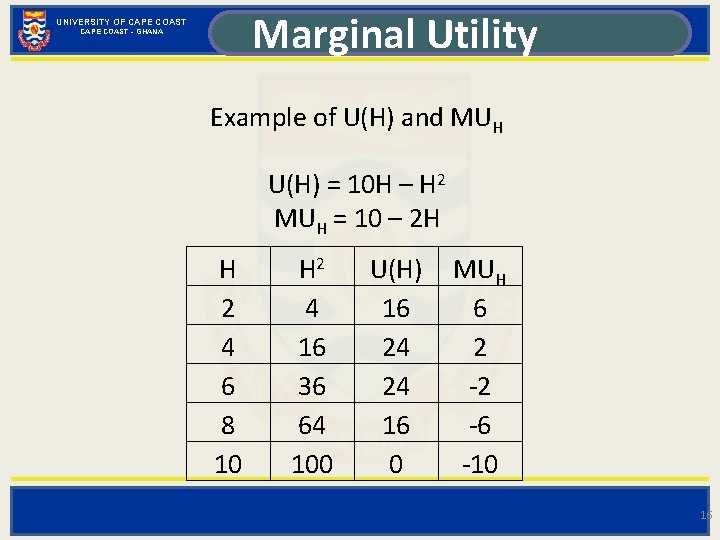
Marginal Utility UNIVERSITY OF CAPE COAST - GHANA Example of U(H) and MUH U(H) = 10 H – H 2 MUH = 10 – 2 H H 2 4 6 8 10 H 2 4 16 36 64 100 U(H) 16 24 24 16 0 MUH 6 2 -2 -6 -10 16
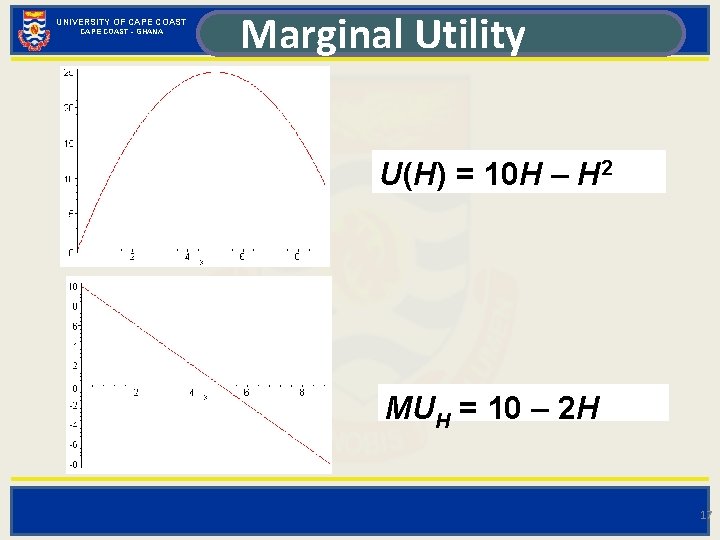
UNIVERSITY OF CAPE COAST - GHANA Marginal Utility U(H) = 10 H – H 2 MUH = 10 – 2 H 17
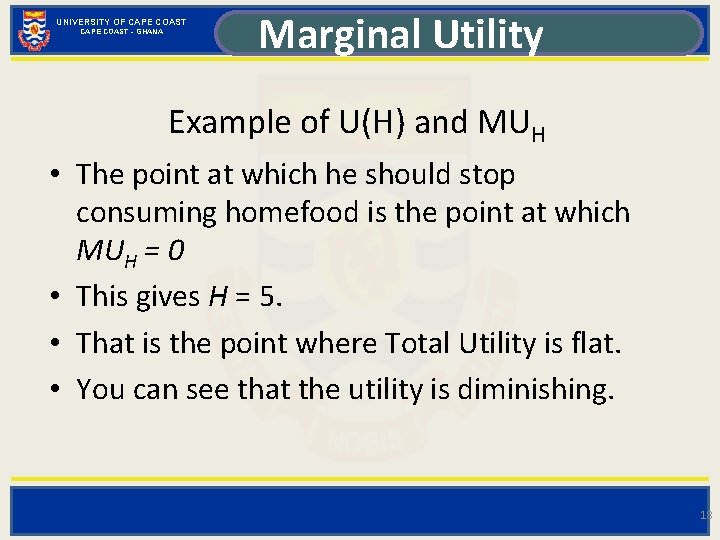
UNIVERSITY OF CAPE COAST - GHANA Marginal Utility Example of U(H) and MUH • The point at which he should stop consuming homefood is the point at which MUH = 0 • This gives H = 5. • That is the point where Total Utility is flat. • You can see that the utility is diminishing. 18
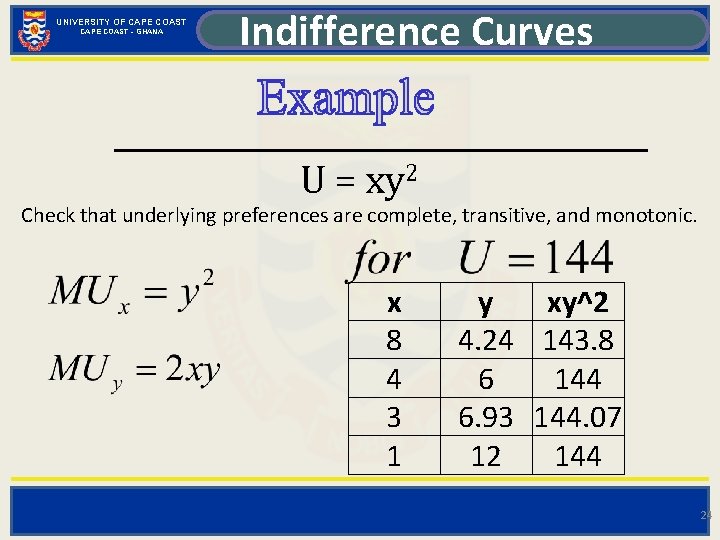
UNIVERSITY OF CAPE COAST - GHANA Marginal Utility – multiple goods U = xy 2 MUx = y 2 MUy = 2 xy • More is better? More y more and more x indicates more U so yes it is monotonic • Diminishing marginal utility? • MU of x is not dependent of x. So the marginal utility of x (movies) does not decrease as the number of movies increases. • MU of y increases with increase in number of operas (y) so neither exhibits diminishing returns. 19
UNIVERSITY OF CAPE COAST - GHANA Indifference Curves An Indifference Curve or Indifference Set: is the set of all baskets for which the consumer is indifferent An Indifference Map : Illustrates a set of indifference curves for a consumer 20
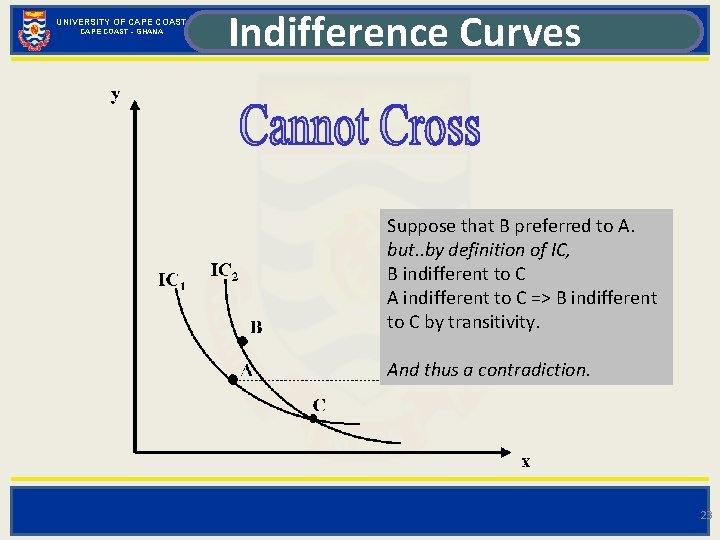
UNIVERSITY OF CAPE COAST - GHANA Indifference Curves 1) Monotonicity => indifference curves have negative slope – and indifference curves are not “thick” 2) Transitivity => indifference curves do not cross 3) Completeness => each basket lies on only one indifference curve 21
UNIVERSITY OF CAPE COAST - GHANA Indifference Curves 22
UNIVERSITY OF CAPE COAST - GHANA Indifference Curves Suppose that B preferred to A. but. . by definition of IC, B indifferent to C A indifferent to C => B indifferent to C by transitivity. And thus a contradiction. 23
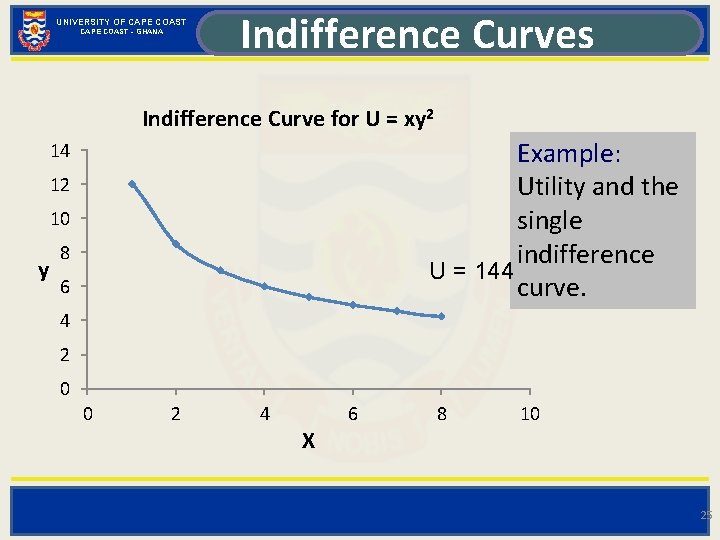
UNIVERSITY OF CAPE COAST - GHANA Indifference Curves U = xy 2 Check that underlying preferences are complete, transitive, and monotonic. x 8 4 3 1 y xy^2 4. 24 143. 8 6 144 6. 93 144. 07 12 144 24
UNIVERSITY OF CAPE COAST - GHANA Indifference Curves Indifference Curve for U = xy 2 Example: Utility and the single indifference U = 144 curve. 14 12 10 y 8 6 4 2 0 0 2 4 X 6 8 10 25
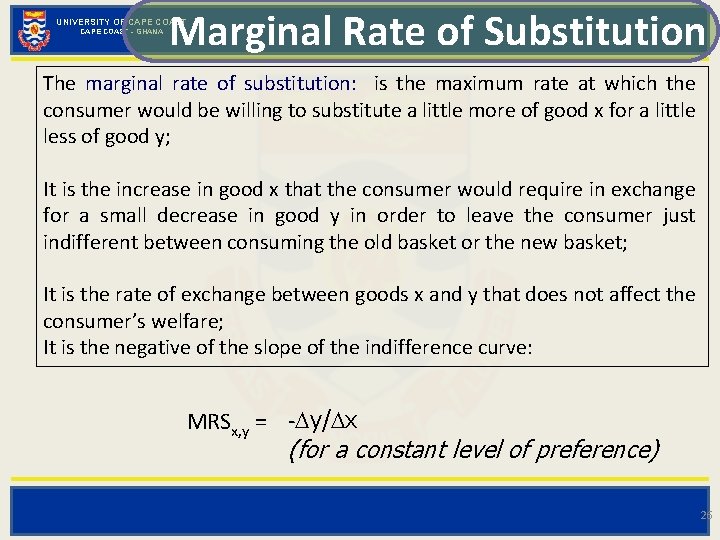
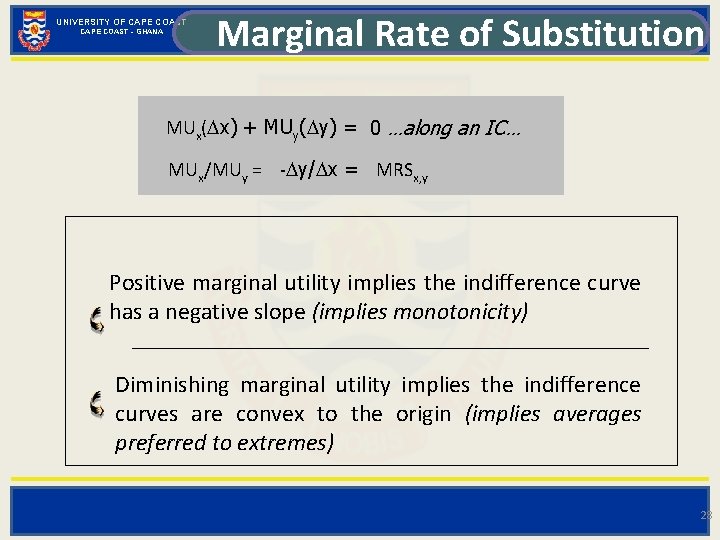
Marginal Rate of Substitution UNIVERSITY OF CAPE COAST - GHANA The marginal rate of substitution: is the maximum rate at which the consumer would be willing to substitute a little more of good x for a little less of good y; It is the increase in good x that the consumer would require in exchange for a small decrease in good y in order to leave the consumer just indifferent between consuming the old basket or the new basket; It is the rate of exchange between goods x and y that does not affect the consumer’s welfare; It is the negative of the slope of the indifference curve: MRSx, y = - y/ x (for a constant level of preference) 26
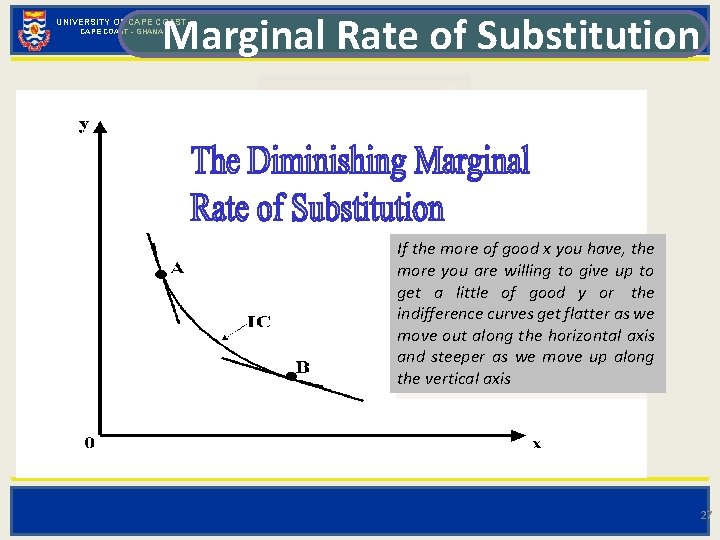
Marginal Rate of Substitution UNIVERSITY OF CAPE COAST - GHANA If the more of good x you have, the more you are willing to give up to get a little of good y or the indifference curves get flatter as we move out along the horizontal axis and steeper as we move up along the vertical axis 27
UNIVERSITY OF CAPE COAST - GHANA Marginal Rate of Substitution MUx( x) + MUy( y) = 0 …along an IC… MUx/MUy = - y/ x = MRSx, y Positive marginal utility implies the indifference curve has a negative slope (implies monotonicity) Diminishing marginal utility implies the indifference curves are convex to the origin (implies averages preferred to extremes) 28
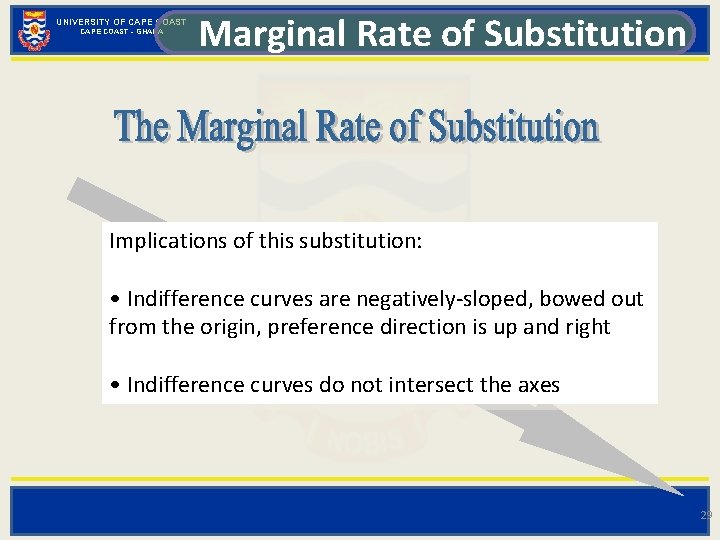
UNIVERSITY OF CAPE COAST - GHANA Marginal Rate of Substitution Implications of this substitution: • Indifference curves are negatively-sloped, bowed out from the origin, preference direction is up and right • Indifference curves do not intersect the axes 29
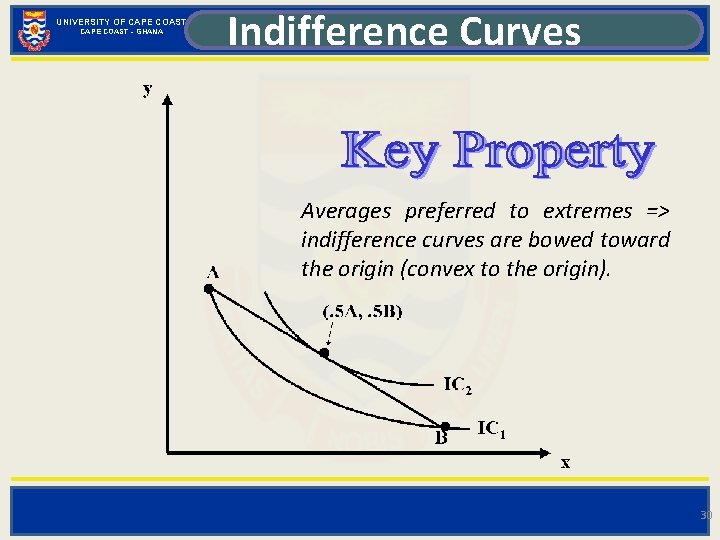
UNIVERSITY OF CAPE COAST - GHANA Indifference Curves Averages preferred to extremes => indifference curves are bowed toward the origin (convex to the origin). 30
UNIVERSITY OF CAPE COAST - GHANA Indifference Curves Do the indifference curves intersect the axes? A value of x = 0 or y = 0 is inconsistent with any positive level of utility. 31
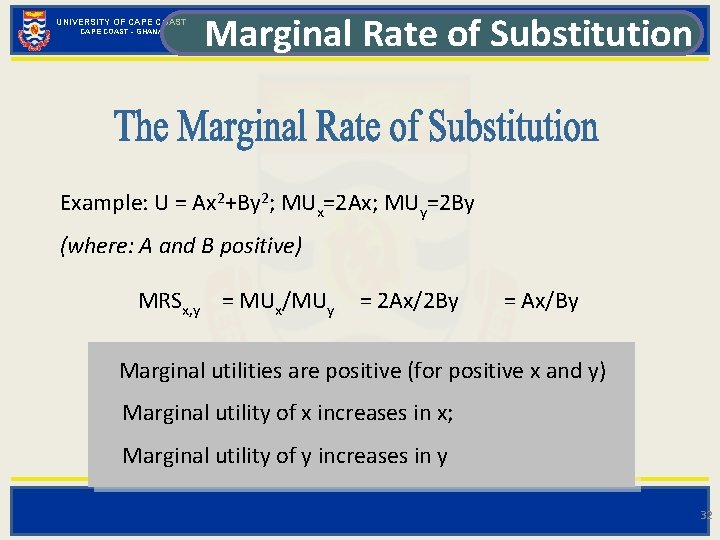
UNIVERSITY OF CAPE COAST - GHANA Marginal Rate of Substitution Example: U = Ax 2+By 2; MUx=2 Ax; MUy=2 By (where: A and B positive) MRSx, y = MUx/MUy = 2 Ax/2 By = Ax/By Marginal utilities are positive (for positive x and y) Marginal utility of x increases in x; Marginal utility of y increases in y 32
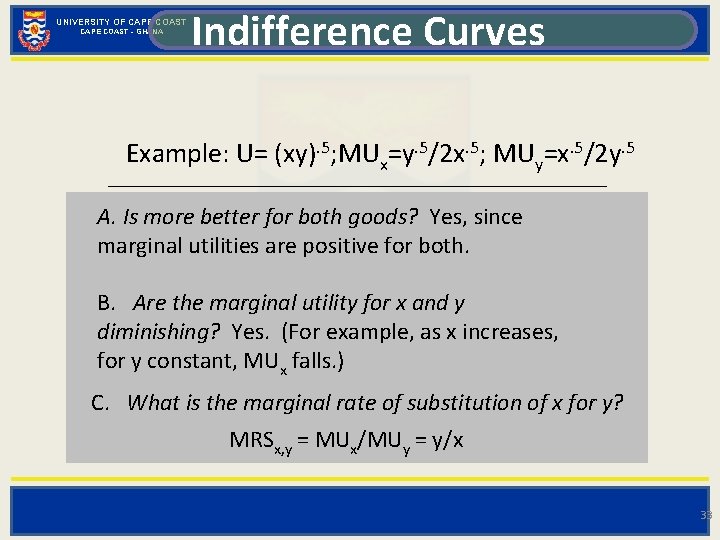
UNIVERSITY OF CAPE COAST - GHANA Indifference Curves Example: U= (xy). 5; MUx=y. 5/2 x. 5; MUy=x. 5/2 y. 5 A. Is more better for both goods? Yes, since marginal utilities are positive for both. B. Are the marginal utility for x and y diminishing? Yes. (For example, as x increases, for y constant, MUx falls. ) C. What is the marginal rate of substitution of x for y? MRSx, y = MUx/MUy = y/x 33
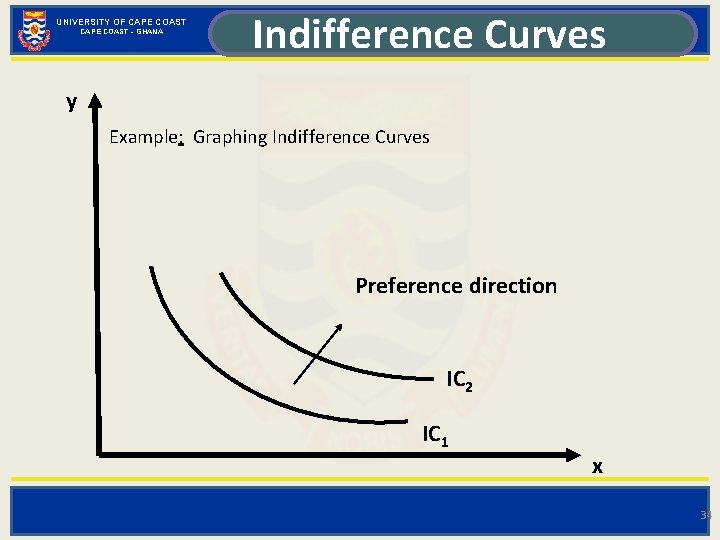
UNIVERSITY OF CAPE COAST - GHANA Indifference Curves y Example: Graphing Indifference Curves Preference direction IC 2 IC 1 x 34
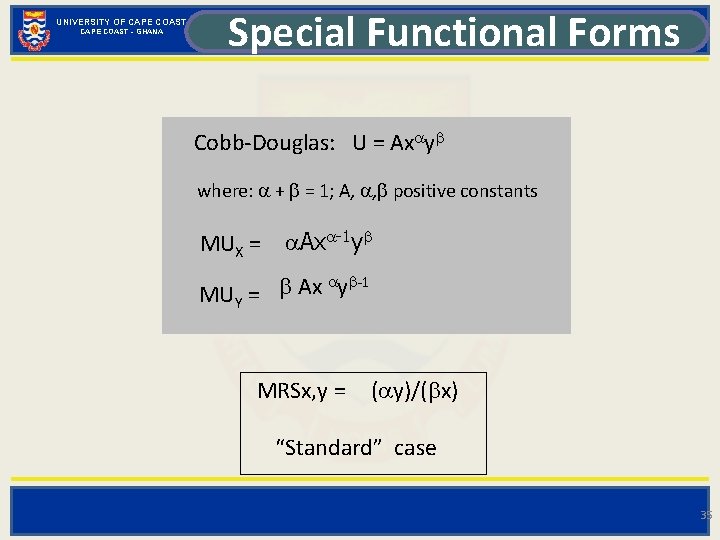
UNIVERSITY OF CAPE COAST - GHANA Special Functional Forms Cobb-Douglas: U = Ax y where: + = 1; A, , positive constants MUX = Ax -1 y y -1 Ax MUY = MRSx, y = ( y)/( x) “Standard” case 35
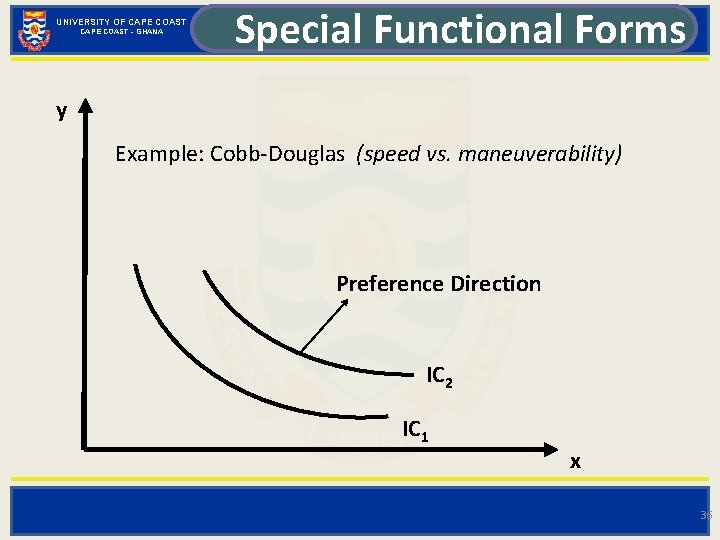
UNIVERSITY OF CAPE COAST - GHANA Special Functional Forms y Example: Cobb-Douglas (speed vs. maneuverability) Preference Direction IC 2 IC 1 x 36
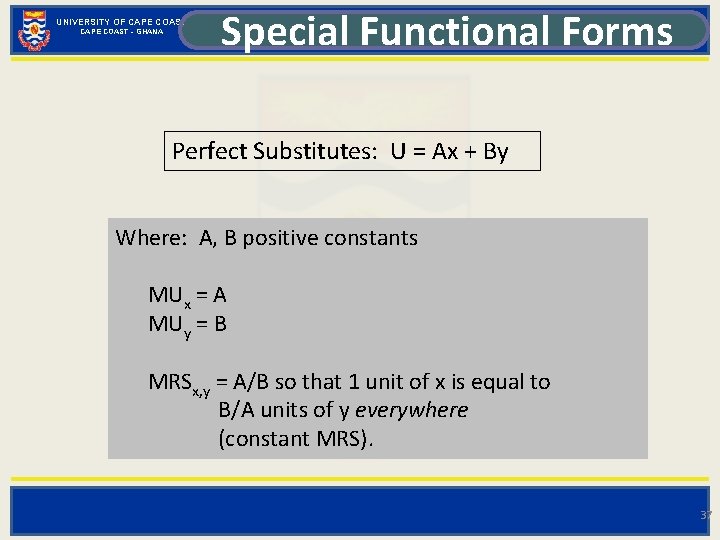
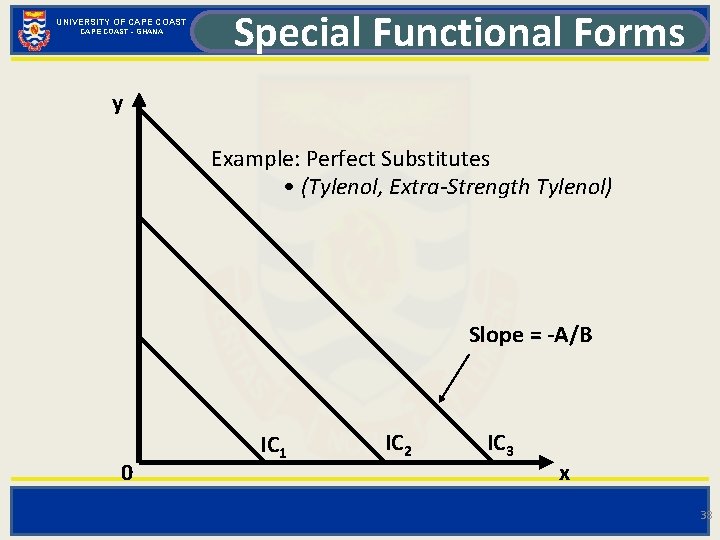
UNIVERSITY OF CAPE COAST - GHANA Special Functional Forms Perfect Substitutes: U = Ax + By Where: A, B positive constants MUx = A MUy = B MRSx, y = A/B so that 1 unit of x is equal to B/A units of y everywhere (constant MRS). 37
UNIVERSITY OF CAPE COAST - GHANA Special Functional Forms y Example: Perfect Substitutes • (Tylenol, Extra-Strength Tylenol) Slope = -A/B 0 IC 1 IC 2 IC 3 x 38
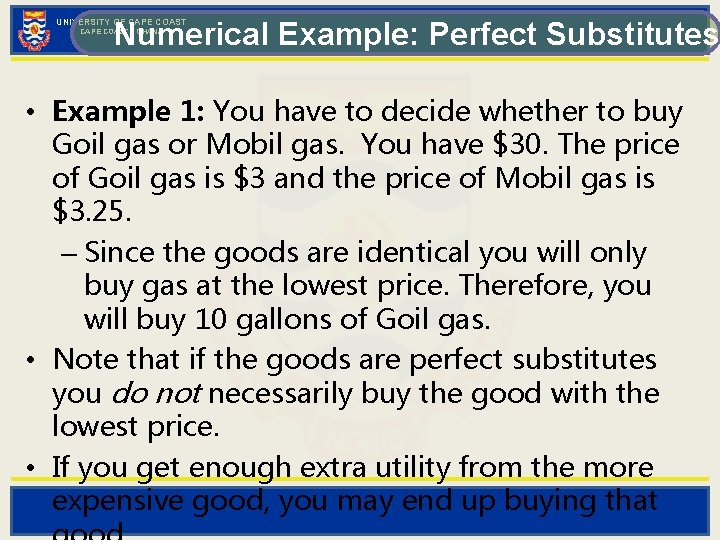
Numerical Example: Perfect Substitutes UNIVERSITY OF CAPE COAST - GHANA • Example 1: You have to decide whether to buy Goil gas or Mobil gas. You have $30. The price of Goil gas is $3 and the price of Mobil gas is $3. 25. – Since the goods are identical you will only buy gas at the lowest price. Therefore, you will buy 10 gallons of Goil gas. • Note that if the goods are perfect substitutes you do not necessarily buy the good with the lowest price. • If you get enough extra utility from the more expensive good, you may end up buying that
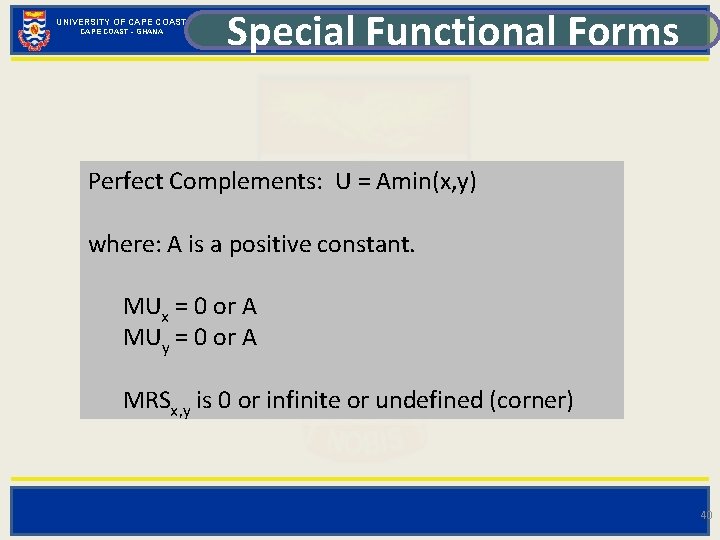
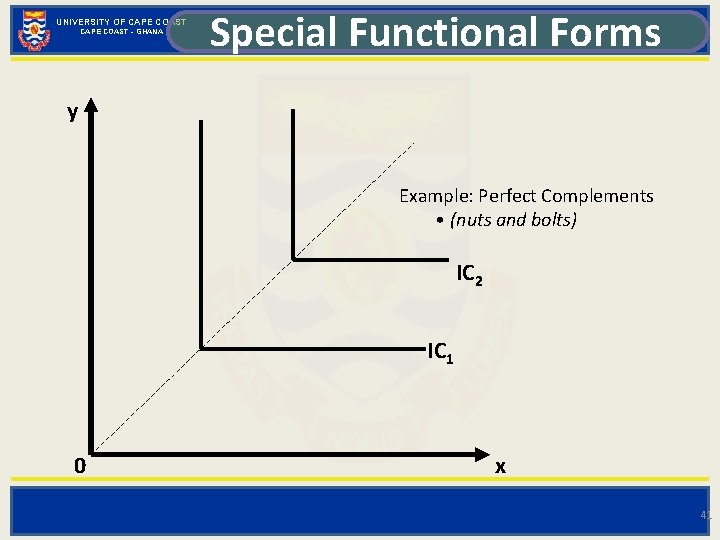
UNIVERSITY OF CAPE COAST - GHANA Special Functional Forms Perfect Complements: U = Amin(x, y) where: A is a positive constant. MUx = 0 or A MUy = 0 or A MRSx, y is 0 or infinite or undefined (corner) 40
UNIVERSITY OF CAPE COAST - GHANA Special Functional Forms y Example: Perfect Complements • (nuts and bolts) IC 2 IC 1 0 x 41
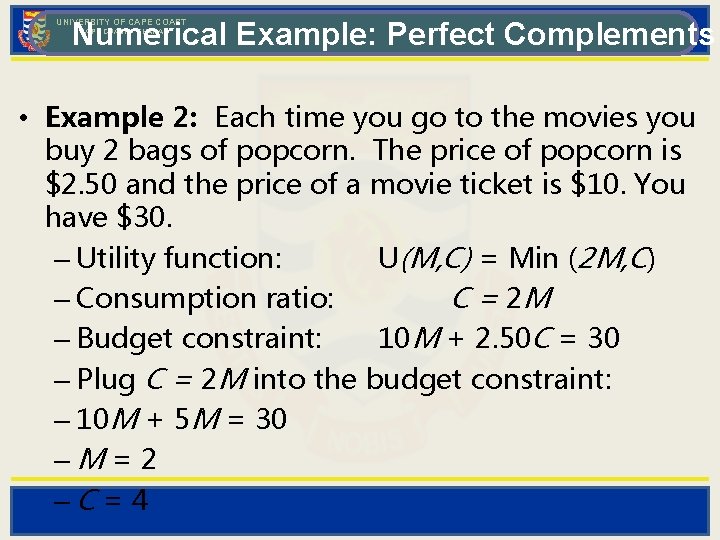
Numerical Example: Perfect Complements UNIVERSITY OF CAPE COAST - GHANA • Example 2: Each time you go to the movies you buy 2 bags of popcorn. The price of popcorn is $2. 50 and the price of a movie ticket is $10. You have $30. – Utility function: U(M, C) = Min (2 M, C) – Consumption ratio: C = 2 M – Budget constraint: 10 M + 2. 50 C = 30 – Plug C = 2 M into the budget constraint: – 10 M + 5 M = 30 –M=2 –C=4
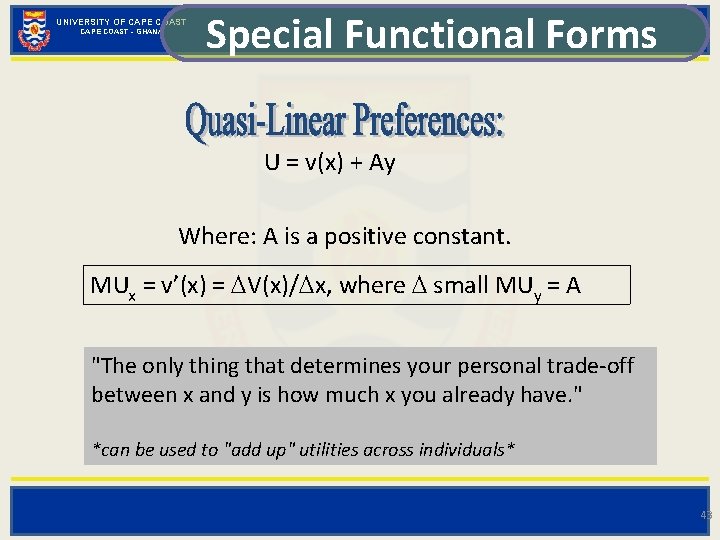
UNIVERSITY OF CAPE COAST - GHANA Special Functional Forms U = v(x) + Ay Where: A is a positive constant. MUx = v’(x) = V(x)/ x, where small MUy = A "The only thing that determines your personal trade-off between x and y is how much x you already have. " *can be used to "add up" utilities across individuals* 43
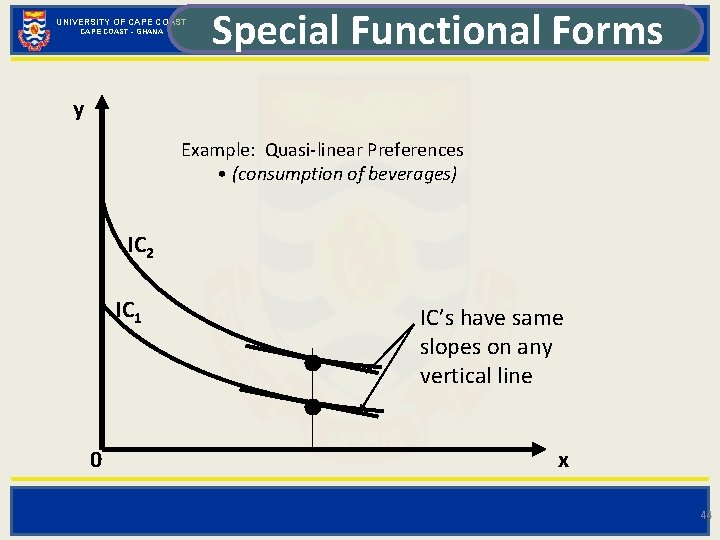
UNIVERSITY OF CAPE COAST - GHANA Special Functional Forms y Example: Quasi-linear Preferences • (consumption of beverages) IC 2 IC 1 • • 0 IC’s have same slopes on any vertical line x 44
UNIVERSITY OF CAPE COAST Cape Coast, Ghana CONSUMER CHOICE 45
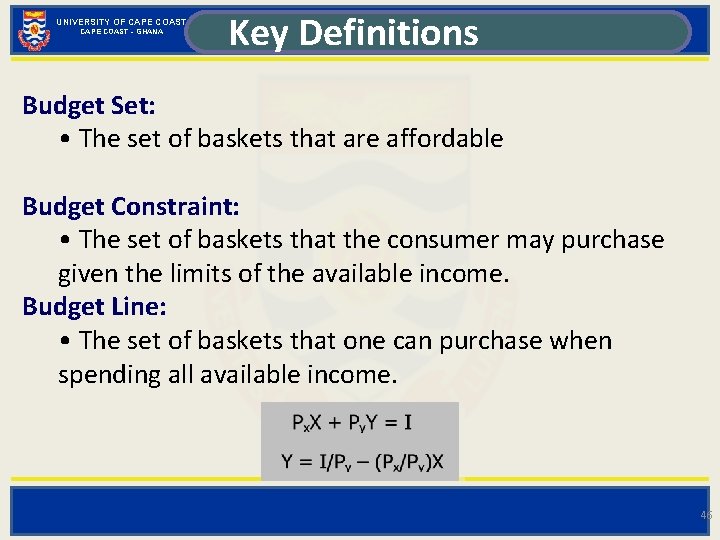
UNIVERSITY OF CAPE COAST - GHANA Key Definitions Budget Set: • The set of baskets that are affordable Budget Constraint: • The set of baskets that the consumer may purchase given the limits of the available income. Budget Line: • The set of baskets that one can purchase when spending all available income. 46
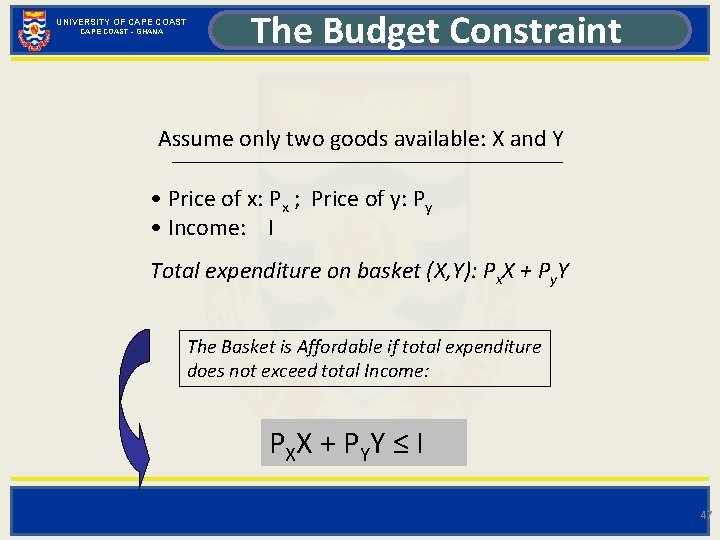
UNIVERSITY OF CAPE COAST - GHANA The Budget Constraint Assume only two goods available: X and Y • Price of x: Px ; Price of y: Py • Income: I Total expenditure on basket (X, Y): Px. X + Py. Y The Basket is Affordable if total expenditure does not exceed total Income: PXX + PYY ≤ I 47
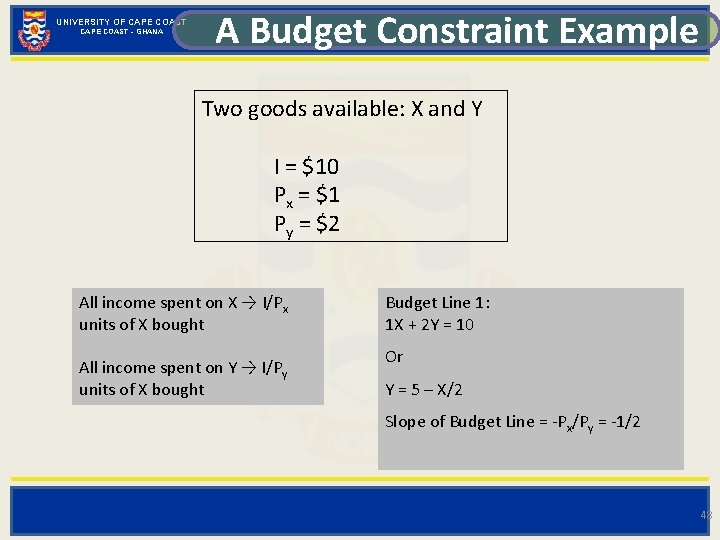
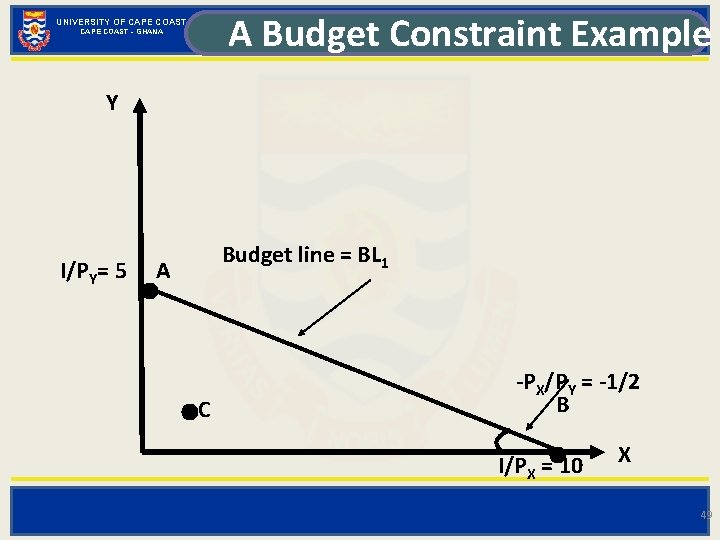
UNIVERSITY OF CAPE COAST - GHANA A Budget Constraint Example Two goods available: X and Y I = $10 Px = $1 Py = $2 All income spent on X → I/Px units of X bought All income spent on Y → I/Py units of X bought Budget Line 1: 1 X + 2 Y = 10 Or Y = 5 – X/2 Slope of Budget Line = -Px/Py = -1/2 48
UNIVERSITY OF CAPE COAST - GHANA A Budget Constraint Example Y I/PY= 5 Budget line = BL 1 A • • C -PX/PY = -1/2 B • I/PX = 10 X 49
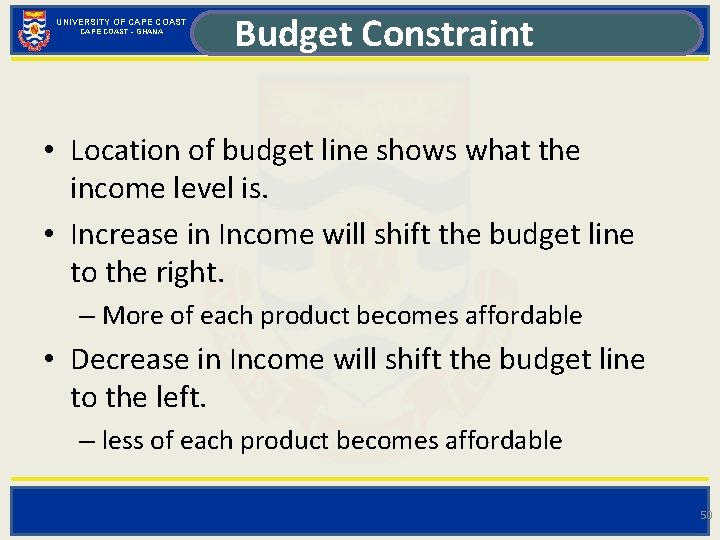
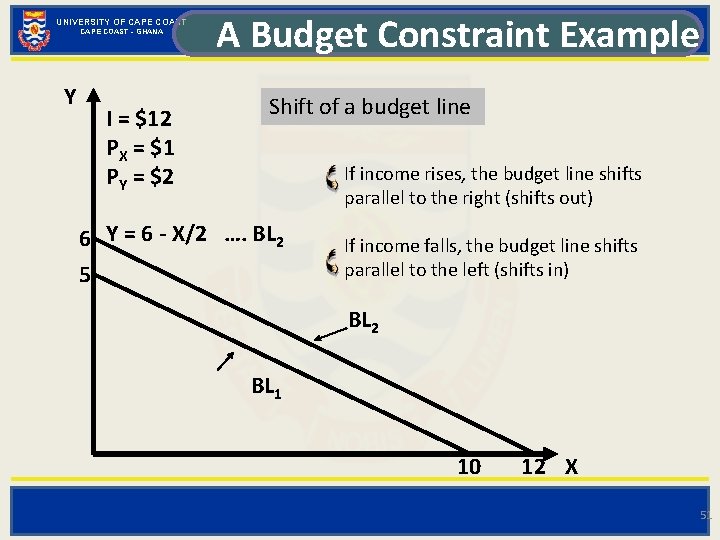
UNIVERSITY OF CAPE COAST - GHANA Budget Constraint • Location of budget line shows what the income level is. • Increase in Income will shift the budget line to the right. – More of each product becomes affordable • Decrease in Income will shift the budget line to the left. – less of each product becomes affordable 50
UNIVERSITY OF CAPE COAST - GHANA Y I = $12 PX = $1 PY = $2 A Budget Constraint Example Shift of a budget line If income rises, the budget line shifts parallel to the right (shifts out) 6 Y = 6 - X/2 …. BL 2 5 If income falls, the budget line shifts parallel to the left (shifts in) BL 2 BL 1 10 12 X 51
UNIVERSITY OF CAPE COAST - GHANA Budget Constraint • Location of budget line shows what the income level is. • Increase in Income will shift the budget line to the right. – More of each product becomes affordable • Decrease in Income will shift the budget line to the left. – less of each product becomes affordable 52
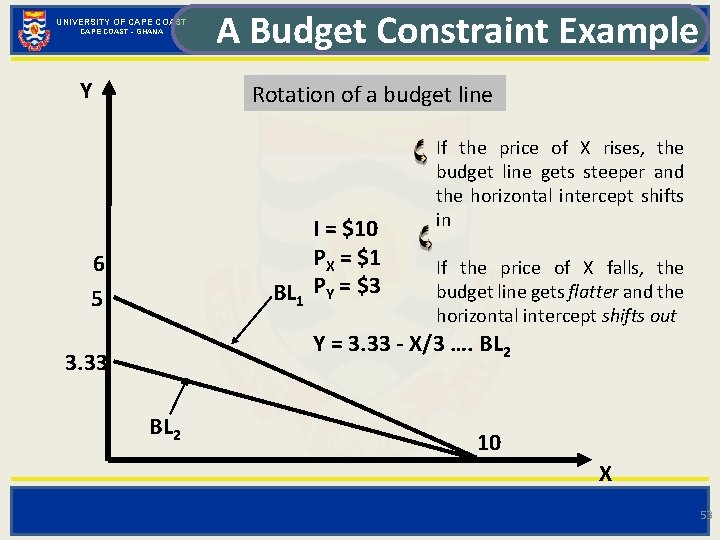
UNIVERSITY OF CAPE COAST - GHANA Y A Budget Constraint Example Rotation of a budget line I = $10 PX = $1 BL 1 PY = $3 6 5 If the price of X rises, the budget line gets steeper and the horizontal intercept shifts in If the price of X falls, the budget line gets flatter and the horizontal intercept shifts out Y = 3. 33 - X/3 …. BL 2 3. 33 BL 2 10 X 53
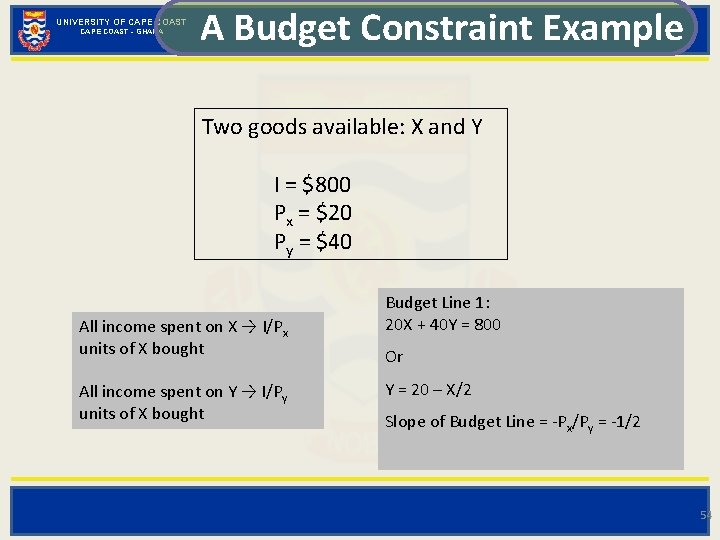
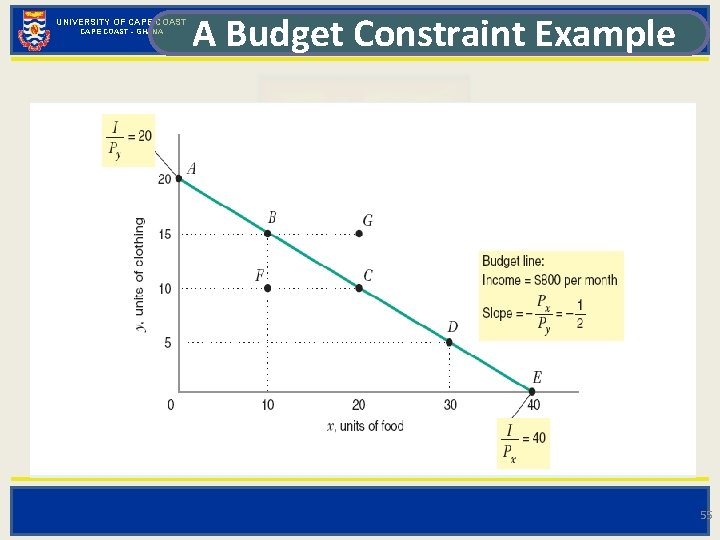
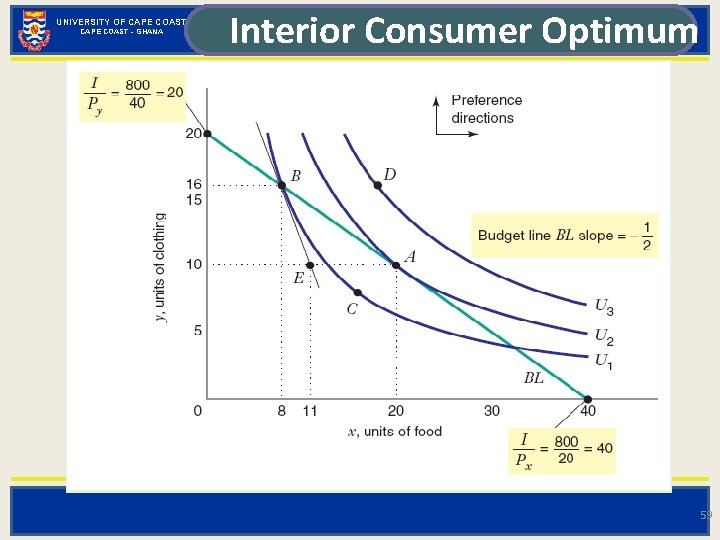
UNIVERSITY OF CAPE COAST - GHANA A Budget Constraint Example Two goods available: X and Y I = $800 Px = $20 Py = $40 All income spent on X → I/Px units of X bought All income spent on Y → I/Py units of X bought Budget Line 1: 20 X + 40 Y = 800 Or Y = 20 – X/2 Slope of Budget Line = -Px/Py = -1/2 54
UNIVERSITY OF CAPE COAST - GHANA A Budget Constraint Example 55
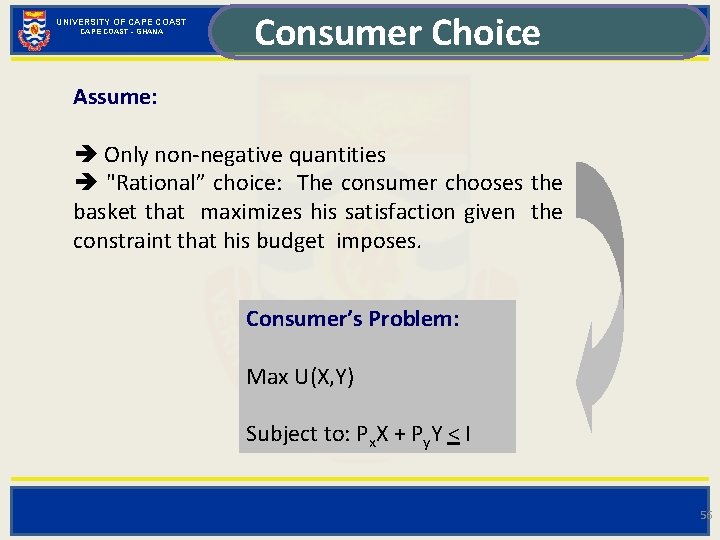
UNIVERSITY OF CAPE COAST - GHANA Consumer Choice Assume: Only non-negative quantities "Rational” choice: The consumer chooses the basket that maximizes his satisfaction given the constraint that his budget imposes. Consumer’s Problem: Max U(X, Y) Subject to: Px. X + Py. Y < I 56
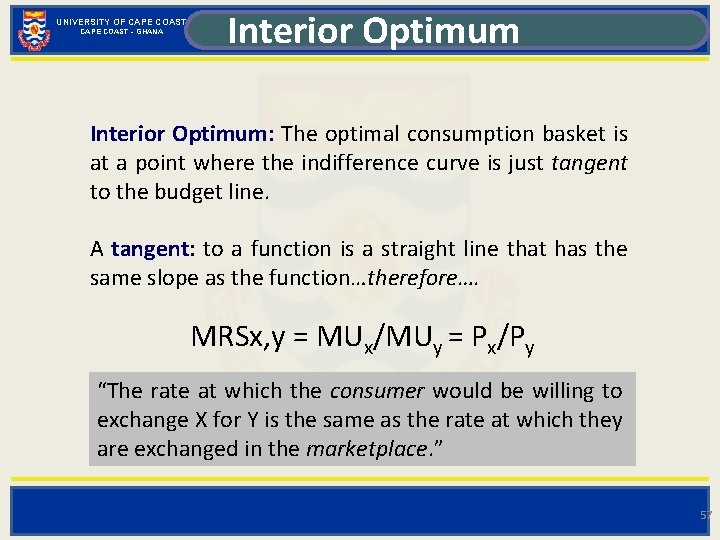
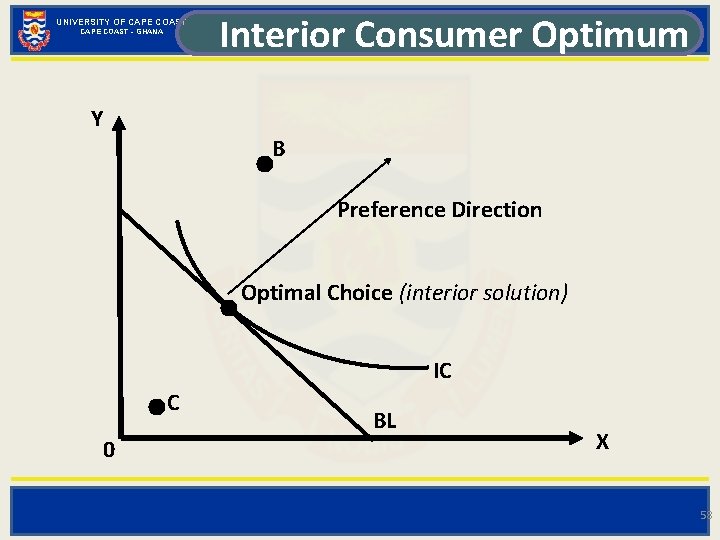
UNIVERSITY OF CAPE COAST - GHANA Interior Optimum: The optimal consumption basket is at a point where the indifference curve is just tangent to the budget line. A tangent: to a function is a straight line that has the same slope as the function…therefore…. MRSx, y = MUx/MUy = Px/Py “The rate at which the consumer would be willing to exchange X for Y is the same as the rate at which they are exchanged in the marketplace. ” 57
UNIVERSITY OF CAPE COAST - GHANA Interior Consumer Optimum Y B • Preference Direction • 0 • C Optimal Choice (interior solution) IC BL X 58
UNIVERSITY OF CAPE COAST - GHANA Interior Consumer Optimum 59
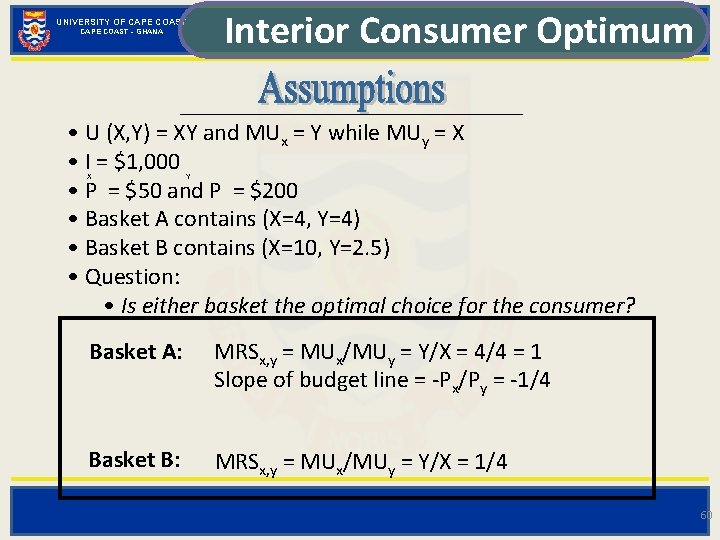
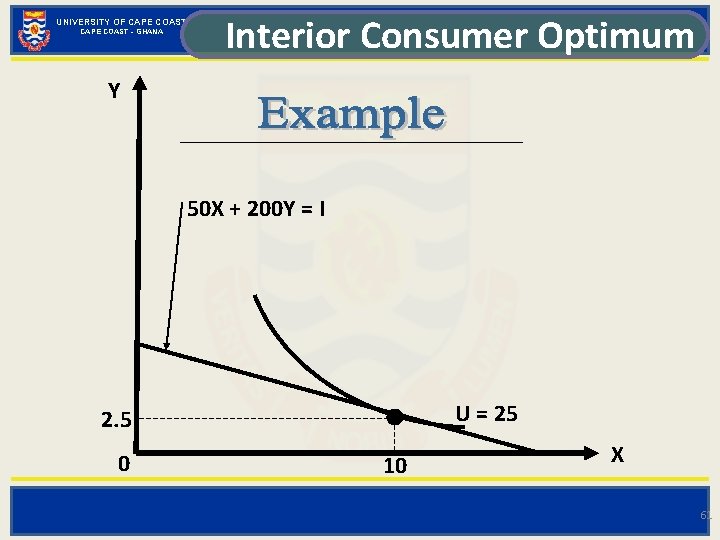
UNIVERSITY OF CAPE COAST - GHANA Interior Consumer Optimum • U (X, Y) = XY and MUx = Y while MUy = X • I = $1, 000 • P = $50 and P = $200 • Basket A contains (X=4, Y=4) • Basket B contains (X=10, Y=2. 5) • Question: • Is either basket the optimal choice for the consumer? X Y Basket A: MRSx, y = MUx/MUy = Y/X = 4/4 = 1 Slope of budget line = -Px/Py = -1/4 Basket B: MRSx, y = MUx/MUy = Y/X = 1/4 60
UNIVERSITY OF CAPE COAST - GHANA Interior Consumer Optimum Y 50 X + 200 Y = I 2. 5 • 0 10 U = 25 X 61
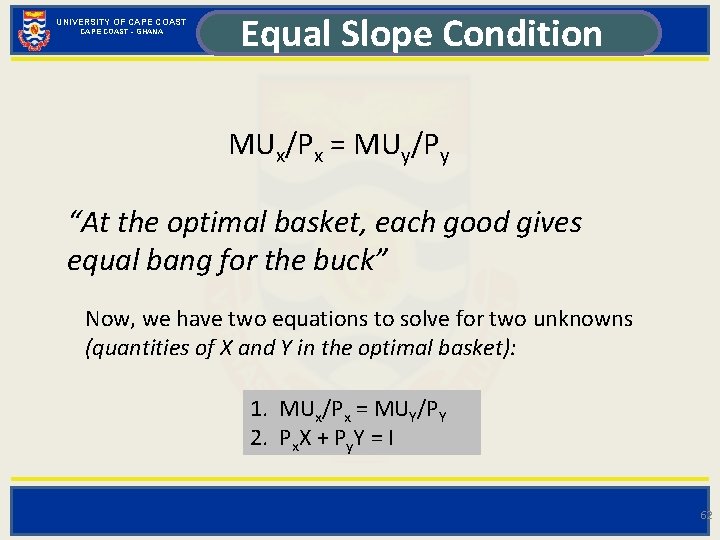
UNIVERSITY OF CAPE COAST - GHANA Equal Slope Condition MUx/Px = MUy/Py “At the optimal basket, each good gives equal bang for the buck” Now, we have two equations to solve for two unknowns (quantities of X and Y in the optimal basket): 1. MUx/Px = MUY/PY 2. Px. X + Py. Y = I 62
UNIVERSITY OF CAPE COAST - GHANA Constrained Optimization What are the equations that the optimal consumption basket must fulfill if we want to represent the consumer’s choice among three goods? • MU / P = MU / P is an example of “marginal reasoning” to maximize X Y Y X • P X + P Y = I reflects the “constraint” Y X 63
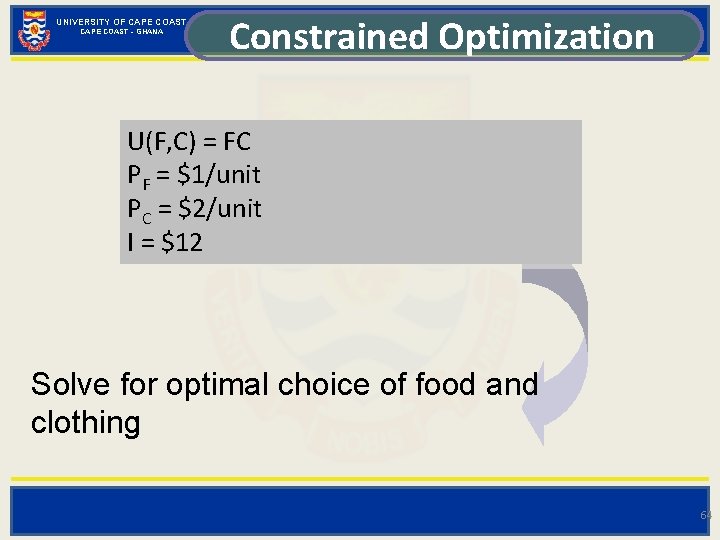
UNIVERSITY OF CAPE COAST - GHANA Constrained Optimization U(F, C) = FC PF = $1/unit PC = $2/unit I = $12 Solve for optimal choice of food and clothing 64
UNIVERSITY OF CAPE COAST Cape Coast, Ghana Theory of Demand 65
UNIVERSITY OF CAPE COAST - GHANA Overview 1. Individual Demand Curves 2. Income and Substitution Effects & the Slope of Demand • Applications: Ø The Work-Leisure Trade-off Ø Consumer Surplus 3. Constructing Market Demand The Effects of a Change in Price • Optimal Choice • Demand Curve 66
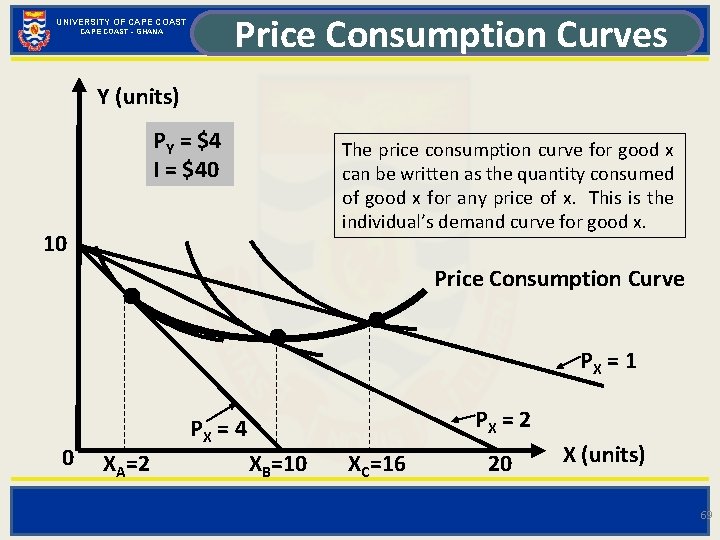
UNIVERSITY OF CAPE COAST - GHANA Individual Demand Curves The Price Consumption Curve of Good X: Is the set of optimal baskets for every possible price of good x, holding all other prices and income constant. 68
Price Consumption Curves UNIVERSITY OF CAPE COAST - GHANA Y (units) PY = $4 I = $40 The price consumption curve for good x can be written as the quantity consumed of good x for any price of x. This is the individual’s demand curve for good x. 10 • • PX = 1 PX = 2 PX = 4 XA=2 Price Consumption Curve XB=10 XC=16 20 X (units) 69
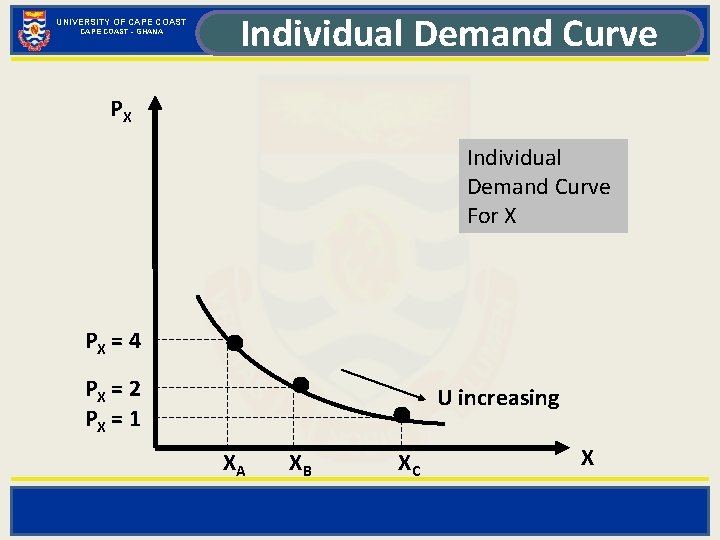
UNIVERSITY OF CAPE COAST - GHANA Individual Demand Curve PX Individual Demand Curve For X PX = 4 • PX = 2 PX = 1 XA • XB • XC U increasing X
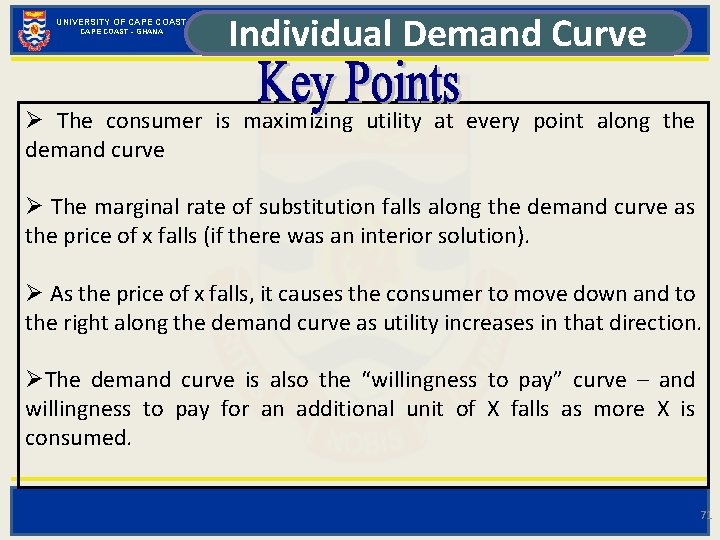
UNIVERSITY OF CAPE COAST - GHANA Individual Demand Curve Ø The consumer is maximizing utility at every point along the demand curve Ø The marginal rate of substitution falls along the demand curve as the price of x falls (if there was an interior solution). Ø As the price of x falls, it causes the consumer to move down and to the right along the demand curve as utility increases in that direction. ØThe demand curve is also the “willingness to pay” curve – and willingness to pay for an additional unit of X falls as more X is consumed. 71
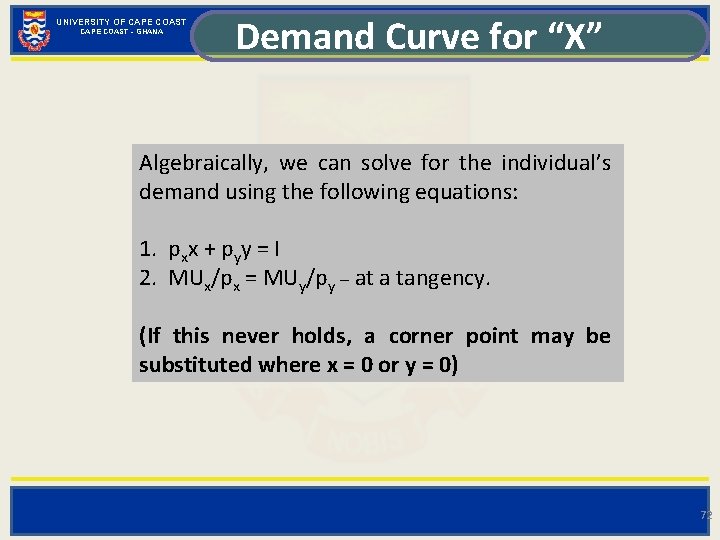
UNIVERSITY OF CAPE COAST - GHANA Demand Curve for “X” Algebraically, we can solve for the individual’s demand using the following equations: 1. pxx + pyy = I 2. MUx/px = MUy/py – at a tangency. (If this never holds, a corner point may be substituted where x = 0 or y = 0) 72
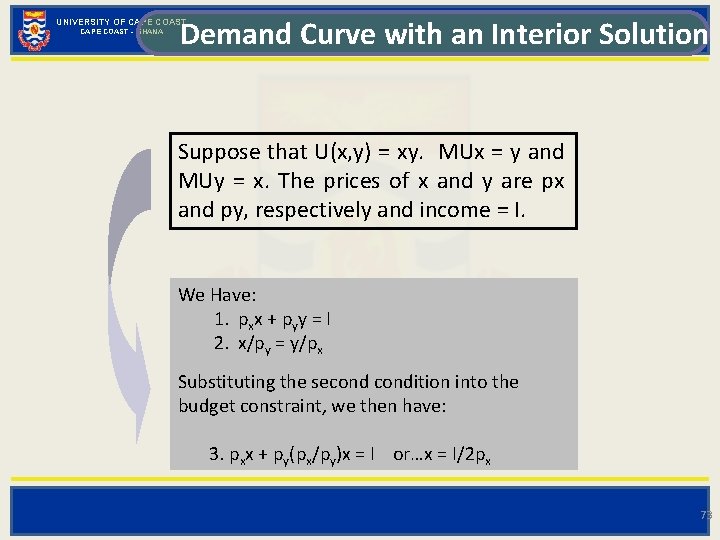
Demand Curve with an Interior Solution UNIVERSITY OF CAPE COAST - GHANA Suppose that U(x, y) = xy. MUx = y and MUy = x. The prices of x and y are px and py, respectively and income = I. We Have: 1. pxx + pyy = I 2. x/py = y/px Substituting the secondition into the budget constraint, we then have: 3. pxx + py(px/py)x = I or…x = I/2 px 73
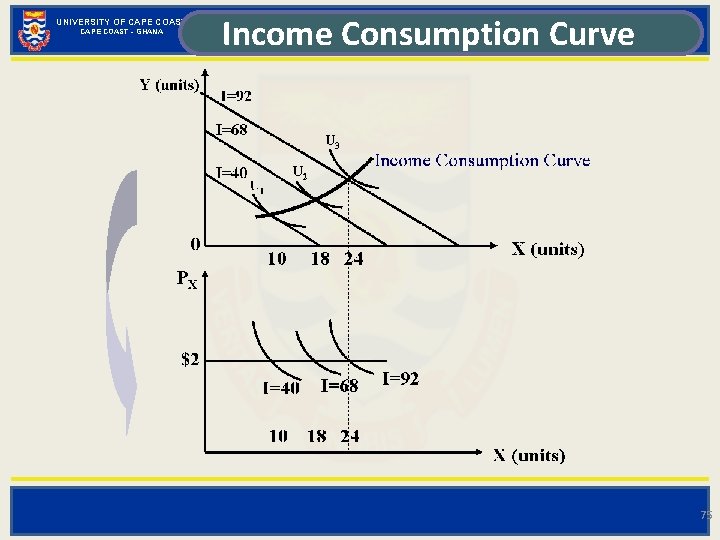
UNIVERSITY OF CAPE COAST - GHANA Change in Income & Demand The income consumption curve of good x is the set of optimal baskets for every possible level of income. We can graph the points on the income consumption curve as points on a shifting demand curve. 74
UNIVERSITY OF CAPE COAST - GHANA Income Consumption Curve 75
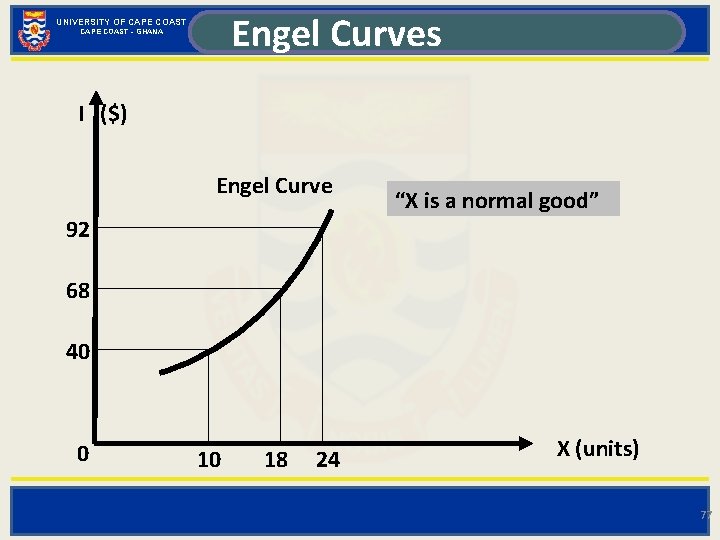
UNIVERSITY OF CAPE COAST - GHANA Engel Curves The income consumption curve for good x also can be written as the quantity consumed of good x for any income level. This is the individual’s Engel Curve for good x. When the income consumption curve is positively sloped, the slope of the Engel Curve is positive. 76
Engel Curves UNIVERSITY OF CAPE COAST - GHANA I ($) Engel Curve 92 “X is a normal good” 68 40 0 10 18 24 X (units) 77
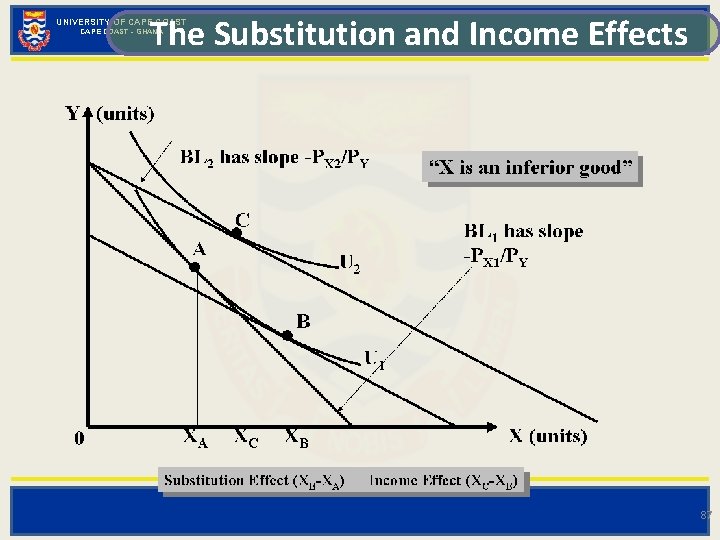
UNIVERSITY OF CAPE COAST - GHANA Definitions of Goods • If the income consumption curve shows that the consumer purchases more of good x as her income rises, good x is a normal good. • Equivalently, if the slope of the Engel curve is positive, the good is a normal good. • If the income consumption curve shows that the consumer purchases less of good x as her income rises, good x is an inferior good. • Equivalently, if the slope of the Engel curve is negative, the good is an inferior good. 78
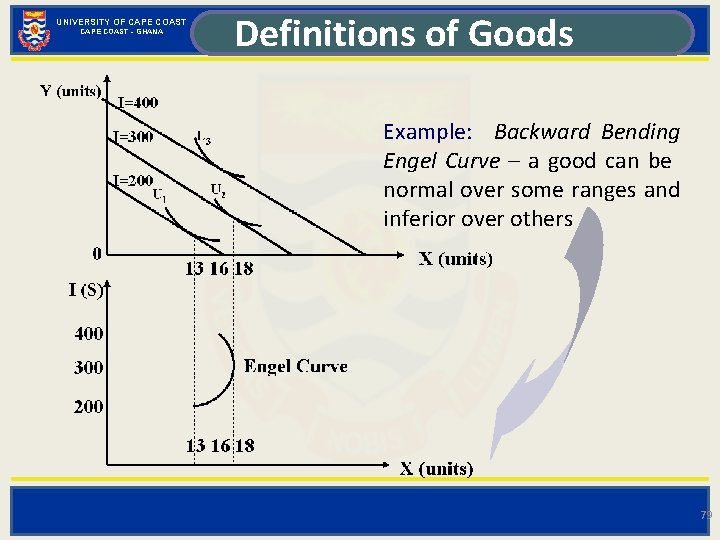
UNIVERSITY OF CAPE COAST - GHANA Definitions of Goods Example: Backward Bending Engel Curve – a good can be normal over some ranges and inferior over others 79
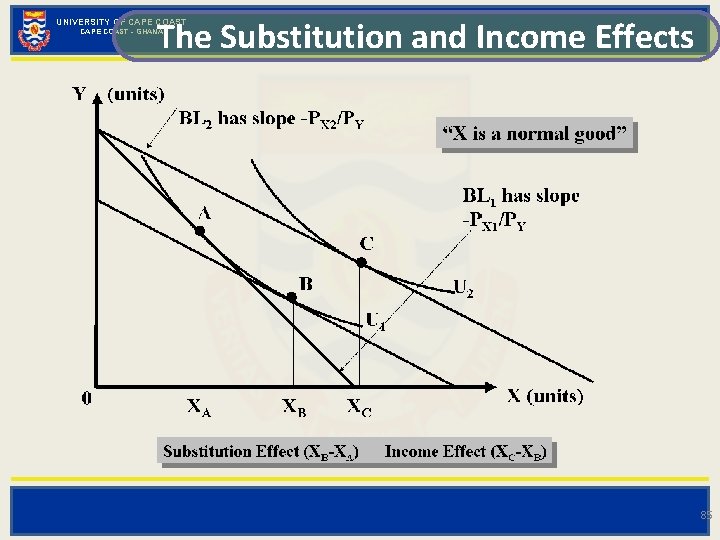
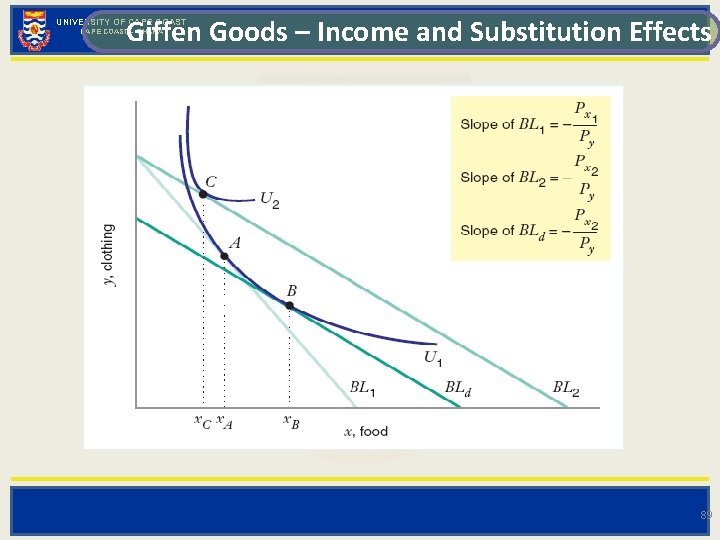
Impact of Change in the Price of a Good UNIVERSITY OF CAPE COAST - GHANA • Substitution Effect: Relative change in price affects the amount of good that is bought as consumer tries to achieve the same level of utility • Income Effect: Consumer’s purchasing power changes and affects the consumer in a way similar to effect of a change in income 80
UNIVERSITY OF CAPE COAST - GHANA The Substitution Effect • As the price of x falls, all else constant, good x becomes cheaper relative to good y. • This change in relative prices alone causes the consumer to adjust his/ her consumption basket. • This effect is called the substitution effect. • The substitution effect always is negative. • Usually, a move along a demand curve will be composed of both effects. 81
Impact of Change in the Price of a Good UNIVERSITY OF CAPE COAST - GHANA Definition: As the price of x falls, all else constant, purchasing power rises. As the price of x rises, all else constant, purchasing power falls. This is called the income effect of a change in price. The income effect may be positive (normal good) or negative (inferior good). 82
Impact of Change in the Price of a Good UNIVERSITY OF CAPE COAST - GHANA • If price of a good falls – consumer substitutes into the good to achieve the same level of utility • When price falls – purchasing power increases the consumer can buy the same amount and still have money left 83
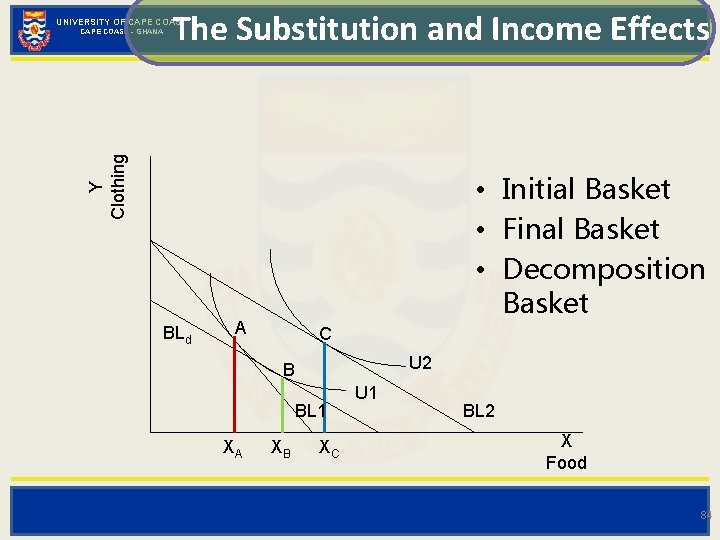
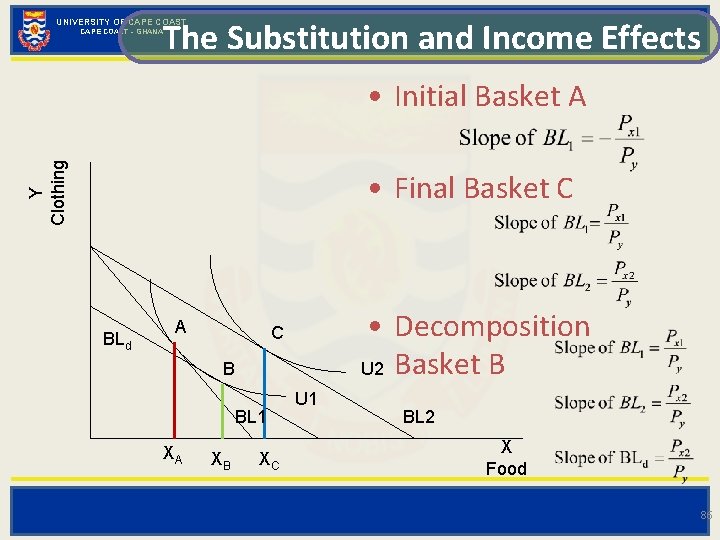
The Substitution and Income Effects UNIVERSITY OF CAPE COAST Y Clothing CAPE COAST - GHANA BLd • Initial Basket • Final Basket • Decomposition Basket A C U 2 B BL 1 XA XB XC U 1 BL 2 X Food 84
The Substitution and Income Effects UNIVERSITY OF CAPE COAST - GHANA 85
The Substitution and Income Effects UNIVERSITY OF CAPE COAST - GHANA Y Clothing • Initial Basket A • Final Basket C BLd A • Decomposition U 2 Basket B C B BL 1 XA XB XC U 1 BL 2 X Food 86
The Substitution and Income Effects UNIVERSITY OF CAPE COAST - GHANA 87
UNIVERSITY OF CAPE COAST - GHANA Giffen Goods If a good is so inferior that the net effect of a price decrease of good x, all else constant, is a decrease in consumption of good x, good x is a Giffen good. For Giffen goods, demand does not slope down. When might an income effect be large enough to offset the substitution effect? The good would have to represent a very large proportion of the budget. 88
Giffen Goods – Income and Substitution Effects UNIVERSITY OF CAPE COAST - GHANA 89
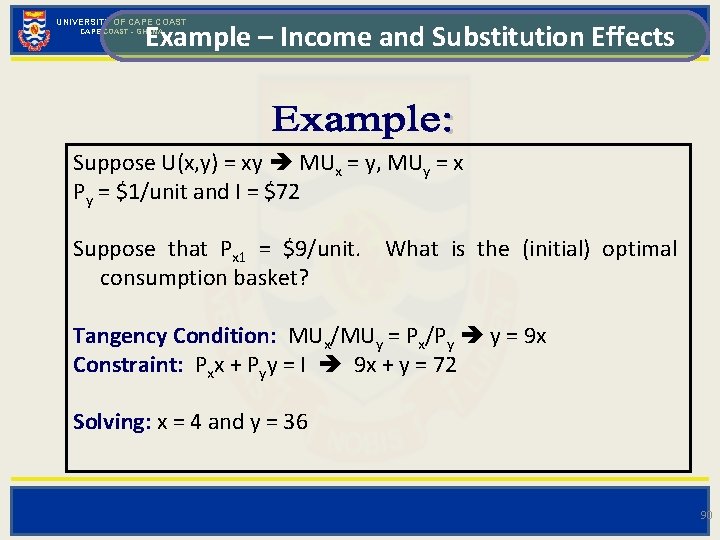
UNIVERSITY OF CAPE COAST Example – Income and Substitution Effects CAPE COAST - GHANA Suppose U(x, y) = xy MUx = y, MUy = x Py = $1/unit and I = $72 Suppose that Px 1 = $9/unit. What is the (initial) optimal consumption basket? Tangency Condition: MUx/MUy = Px/Py y = 9 x Constraint: Pxx + Pyy = I 9 x + y = 72 Solving: x = 4 and y = 36 90
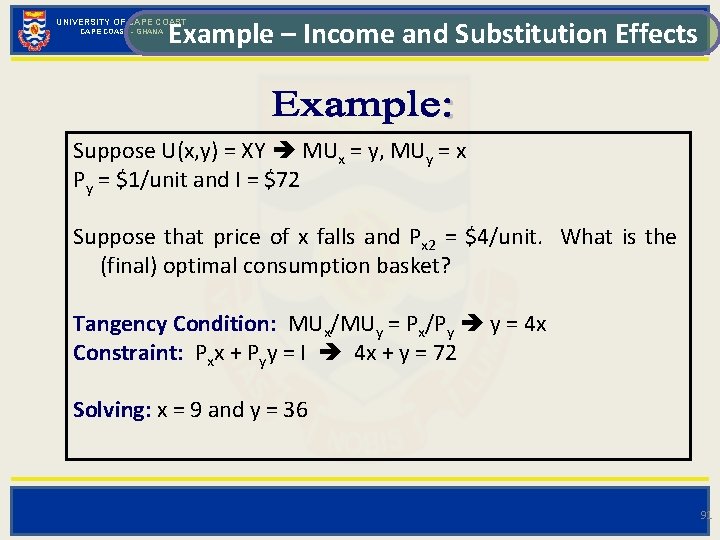
Example – Income and Substitution Effects UNIVERSITY OF CAPE COAST - GHANA Suppose U(x, y) = XY MUx = y, MUy = x Py = $1/unit and I = $72 Suppose that price of x falls and Px 2 = $4/unit. What is the (final) optimal consumption basket? Tangency Condition: MUx/MUy = Px/Py y = 4 x Constraint: Pxx + Pyy = I 4 x + y = 72 Solving: x = 9 and y = 36 91
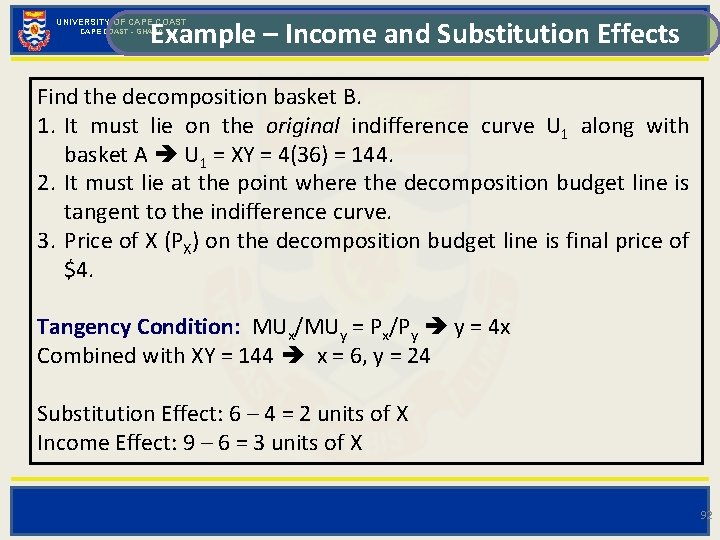
Example – Income and Substitution Effects UNIVERSITY OF CAPE COAST - GHANA Find the decomposition basket B. 1. It must lie on the original indifference curve U 1 along with basket A U 1 = XY = 4(36) = 144. 2. It must lie at the point where the decomposition budget line is tangent to the indifference curve. 3. Price of X (PX) on the decomposition budget line is final price of $4. Tangency Condition: MUx/MUy = Px/Py y = 4 x Combined with XY = 144 x = 6, y = 24 Substitution Effect: 6 – 4 = 2 units of X Income Effect: 9 – 6 = 3 units of X 92
UNIVERSITY OF CAPE COAST - GHANA Consumer Surplus • The individual’s demand curve can be seen as the individual’s willingness to pay curve. • On the other hand, the individual must only actually pay the market price for (all) the units consumed. • Consumer Surplus is the difference between what the consumer is willing to pay and what the consumer actually pays. 93
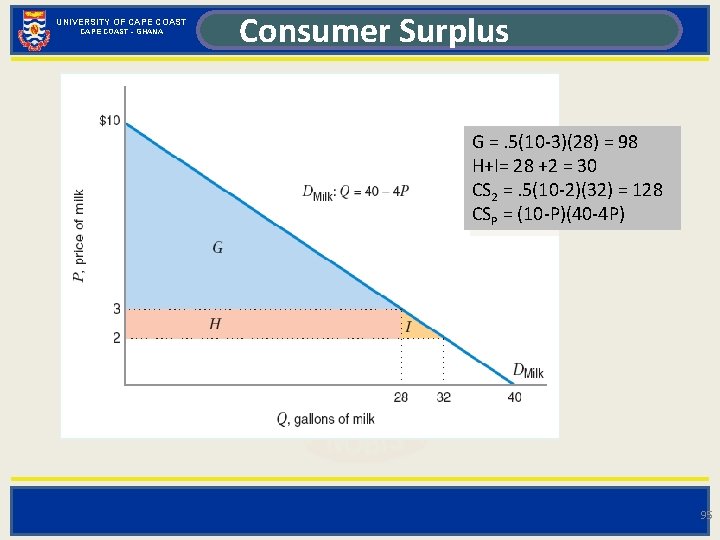
UNIVERSITY OF CAPE COAST - GHANA Consumer Surplus Definition: The net economic benefit to the consumer due to a purchase (i. e. the willingness to pay of the consumer net of the actual expenditure on the good) is called consumer surplus. The area under an ordinary demand curve and above the market price provides a measure of consumer surplus 94
UNIVERSITY OF CAPE COAST - GHANA Consumer Surplus G =. 5(10 -3)(28) = 98 H+I= 28 +2 = 30 CS 2 =. 5(10 -2)(32) = 128 CSP = (10 -P)(40 -4 P) 95
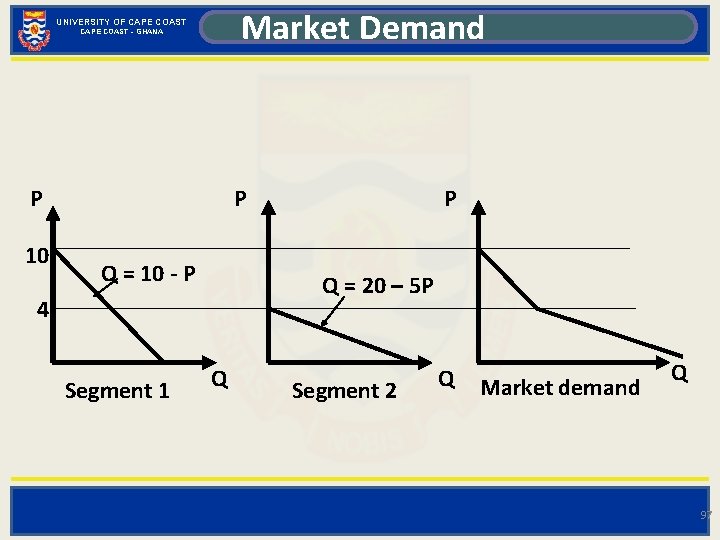
UNIVERSITY OF CAPE COAST - GHANA Market Demand The market demand function is the horizontal sum of the individual (or segment) demands. In other words, market demand is obtained by adding the quantities demanded by the individuals (or segments) at each price and plotting this total quantity for all possible prices. 96
Market Demand UNIVERSITY OF CAPE COAST - GHANA P 10 P Q = 10 - P Q = 20 – 5 P 4 Segment 1 P Q Segment 2 Q Market demand Q 97