
UNIVERSITY OF buda Dr Ferenc Szlivka Professor Dr
UNIVERSITY OF Óbuda Dr. Ferenc Szlivka Professor Dr. Szlivka: Thermo Dynamics 10. chapter 1
Technical Thermo dynamics • Basic elements The first law of thermo dynamics • Reversible state changes Cyclic Processes The secound law of thermo dynamics The basic form of thermal expansion Easier thermal computations 2
Basic elements • The subject of thermodynamics Thermotechnics, thermodynamics, heat transmission The method of thermodynamics System, environment, wall The zero law of thermo dynamics Status, status indicators Changes in the state. Work and heat Internal Energy, enthalpy, Entropia Material and System Features 3
The subject of thermodynamics • The energy transformation The relationship between mass and energy Empirical funds areas Classic thermotechnics Irreversible Thermodynamics Macroscopic thermodynamics Statistical mechanics Technical Thermodynamics 4
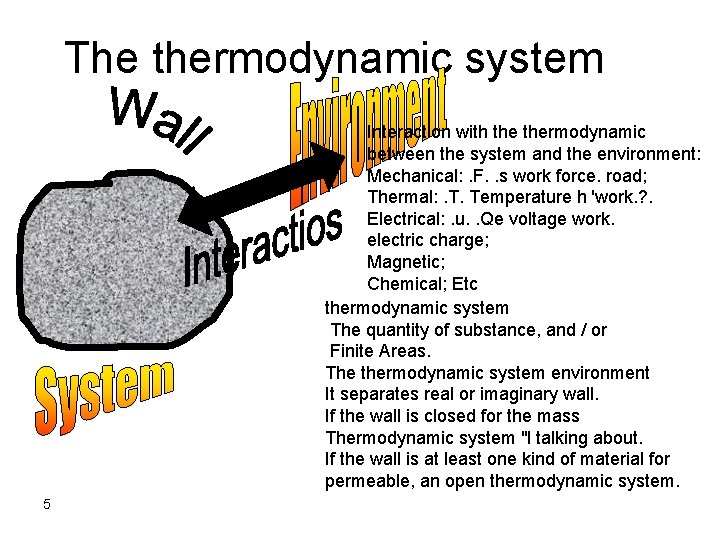
The thermodynamic system Interaction with thermodynamic between the system and the environment: Mechanical: . F. . s work force. road; Thermal: . T. Temperature h 'work. ? . Electrical: . u. . Qe voltage work. electric charge; Magnetic; Chemical; Etc thermodynamic system The quantity of substance, and / or Finite Areas. The thermodynamic system environment It separates real or imaginary wall. If the wall is closed for the mass Thermodynamic system "l talking about. If the wall is at least one kind of material for permeable, an open thermodynamic system. 5
The thermodynamic system Interaction between thermodynamic system and the environment: Mechanical "F" work force "s" means; Thermal: "T" temperature „ work” Electric "U" work stress "Qe" electric charge; Magnetic; Chemical; Etc 6
The thermodynamic system Status indicators and their role Thermodynamic properties of the essential aspects of the system: Their role is the description of thermodynamic system (to defin the state), these quantities, ie status indicators, are defined for balanced systems. (Termostatic!) Measurable quantities. 7
The main indicators the pressure (p), temperature (T), the volume (V), the internal energy (U), the enthalpy (H = U + p. V), the entropy (S), the mass (m), the specific volume (v = V / m) a specific internal energy (u = U / m), specific enthalpy (h = H / m), the specific entropy (s = S / m). The material constituting thermodynamic system i-th component The concentration of component (yi), the Ingredients thermodynamic system i-th The chemical potential of the components (i) 8
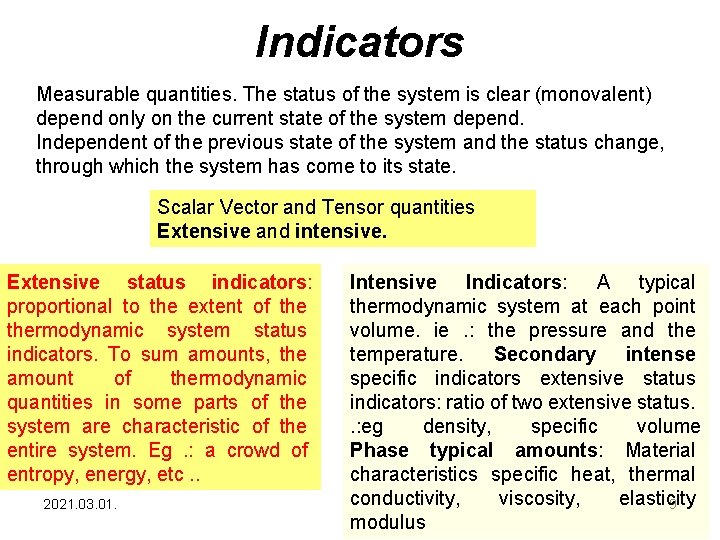
Indicators Measurable quantities. The status of the system is clear (monovalent) depend only on the current state of the system depend. Independent of the previous state of the system and the status change, through which the system has come to its state. Scalar Vector and Tensor quantities Extensive and intensive. Extensive status indicators: proportional to the extent of thermodynamic system status indicators. To sum amounts, the amount of thermodynamic quantities in some parts of the system are characteristic of the entire system. Eg . : a crowd of entropy, energy, etc. . 2021. 03. 01. Intensive Indicators: A typical thermodynamic system at each point volume. ie . : the pressure and the temperature. Secondary intense specific indicators extensive status indicators: ratio of two extensive status. . : eg density, specific volume Phase typical amounts: Material characteristics specific heat, thermal conductivity, viscosity, elasticity 9 modulus
Indicators Groups: 1 st Extensive status indicator is proportional to the mass of thermodynamic system. The amount of figures relating to the number of total system value for sub-systems. These include the volume (V) and internal energy (U), the enthalpy (H = U + p. V) entropy (S), the mass (m). Some of them satisfies conservation laws, but for example. The entropy is not. 2021. 03. 01. 10
Indicators Groups: 2 nd intensive indicators are independent to the mass of thermodynamic system. In case of any balance of the system the same value. Examples of the pressure (p), temperature (T), the material constituting thermodynamic i-th component of the chemical potential (s). 2021. 03. 01. 11
Indicators Groups: Specific indicators extensive mass per unit extensive status indicators. Examples are the specific volume (v = V / m), the specific internal energy (u = U / m), the specific enthalpy (h = H / m) and the specific entropy (s = S / m). The system is in equilibrium with a specific phase of the extensive state index value the same everywhere, but a variety of different phases. Specific extensive status indicators for each phase of properties as intense. 2021. 03. 01. 12
Thermodynamic equilibrium The condition in which it is terminated, any changes within the system. Then, the intensity parameters (T, p etc) homogeneously distributed in the system. Which detailing: 1. Thermal equilibrium: the temperature of the system is the same for all. 2. Mechanical equilibrium: the pressure of the system is the same for all. 3 Phase balance. The amount and composition of the phases constant in the system: 4. Chemical equilibrium means the number of the components is constant, the chemical potentials are the same value within the system. 2021. 03. 01. 13
The zeroth low of thermodynamics Two systems are said to be in the relation of thermal equilibrium if they are linked by a wall permeable only to heat and they do not change over time. [1] As a convenience of language, systems are sometimes also said to be in a relation of thermal equilibrium if they are not linked so as to be able to transfer heat to each other, but would not do so if they were connected by a wall permeable only to heat. Thermal equilibrium between two systems is a transitive relation. 2021. 03. 01.
Internal energy (U) In relation to the centre of gravity, the microscopic elements of the system move at a wide variety of speeds and have potential energy from interactions between them. This movement does not cease in the evening of the calm of the macroscopic system. This energy, which is derived as the sum of the kinetic and potential energy of the microscopic building blocks of the system, is called internal energy. – the speed of unorganized movement of molecules (movement), of molecules, – the vibration (movement), the attractive/repulsive forces between molecules (potential), – bindings between atoms (potential) and – the bindings (potential) between the atoms. The internal energy status indicator. The internal energy is a status indicator. 2021. 03. 01. 15
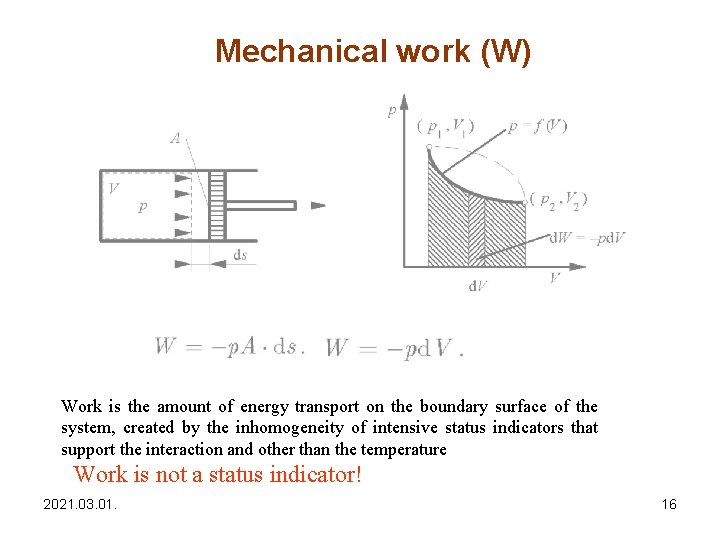
Mechanical work (W) Work is the amount of energy transport on the boundary surface of the system, created by the inhomogeneity of intensive status indicators that support the interaction and other than the temperature Work is not a status indicator! 2021. 03. 01. 16
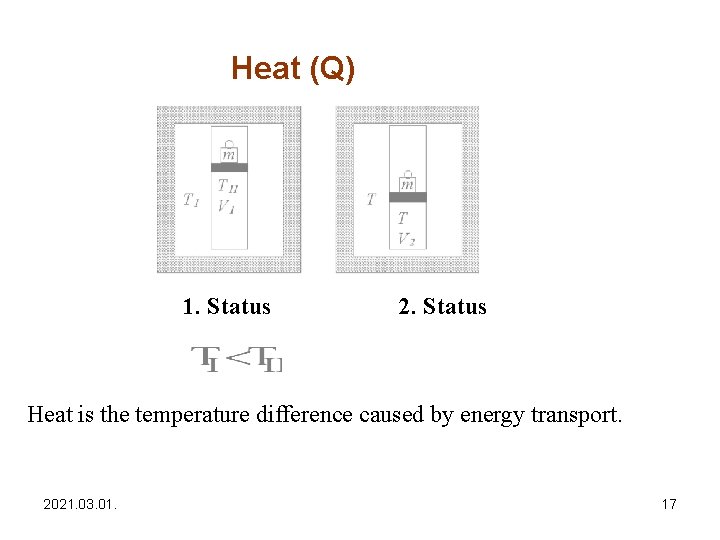
Heat (Q) 1. Status 2. Status Heat is the temperature difference caused by energy transport. 2021. 03. 01. 17
Heat and work relationship 1. Both work and heat are related to the interaction between the system and its environment on the boundary surface of the system. 2. Both describe the transition (transient) between the two states of thermodynamic system and not the system. 3. Both are typical of the transition process, i. e. process characteristics and non-status indicators of the system. 4. Both depend on the state change mode, i. e. road dependents, and consequently do not state indicators of the system. 2021. 03. 01. 18
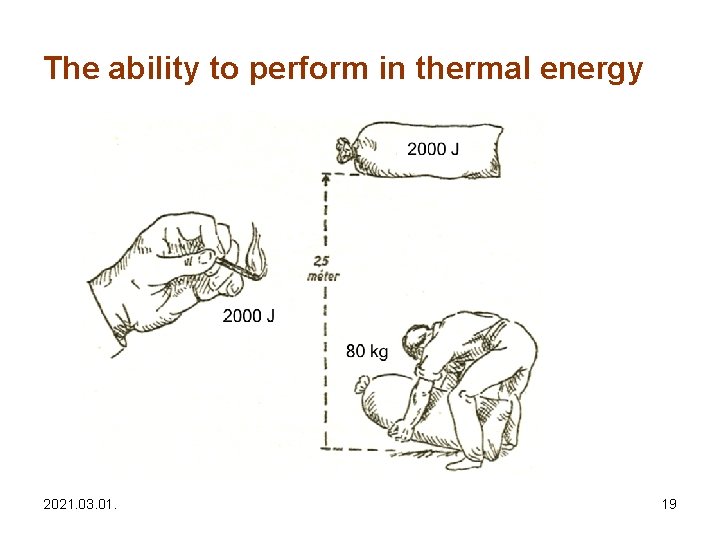
The ability to perform in thermal energy 2021. 03. 01. 19
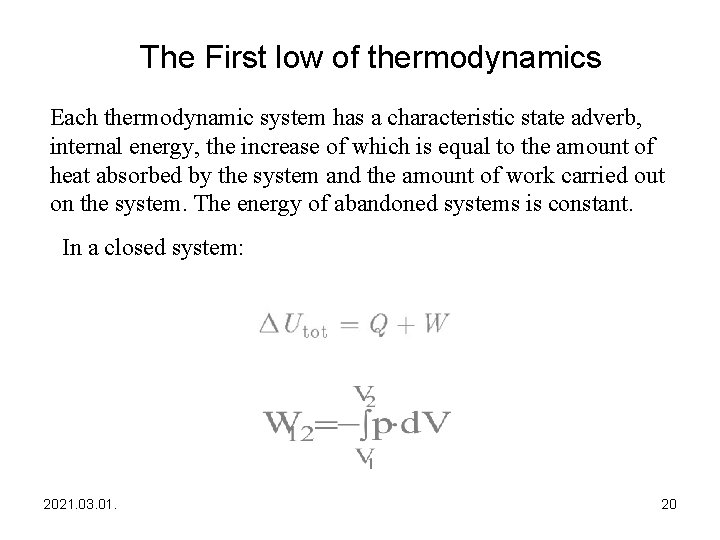
The First low of thermodynamics Each thermodynamic system has a characteristic state adverb, internal energy, the increase of which is equal to the amount of heat absorbed by the system and the amount of work carried out on the system. The energy of abandoned systems is constant. In a closed system: 2021. 03. 01. 20
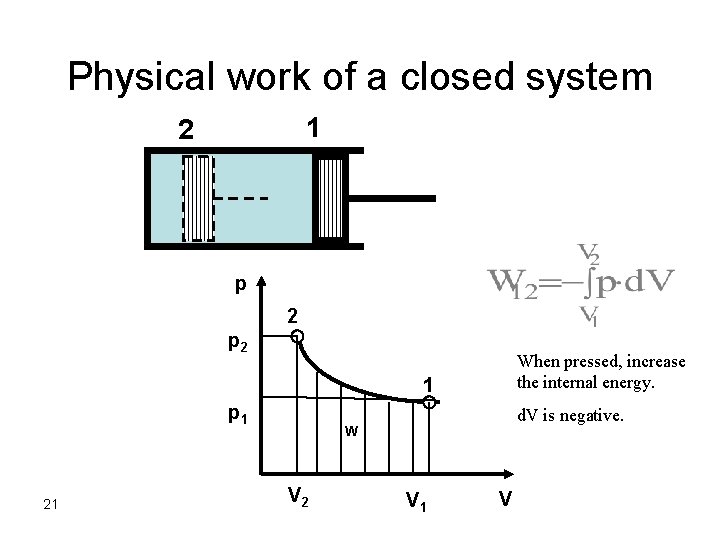
Physical work of a closed system 1 2 L 12=- p* V p 2 1 p 1 21 W V 2 V 1 When pressed, increase the internal energy. L 12=- p*d. V is negative. V
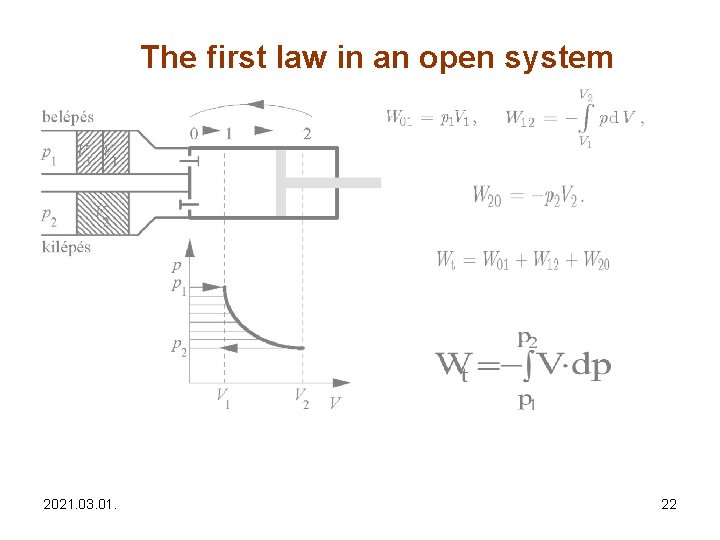
The first law in an open system 2021. 03. 01. 22
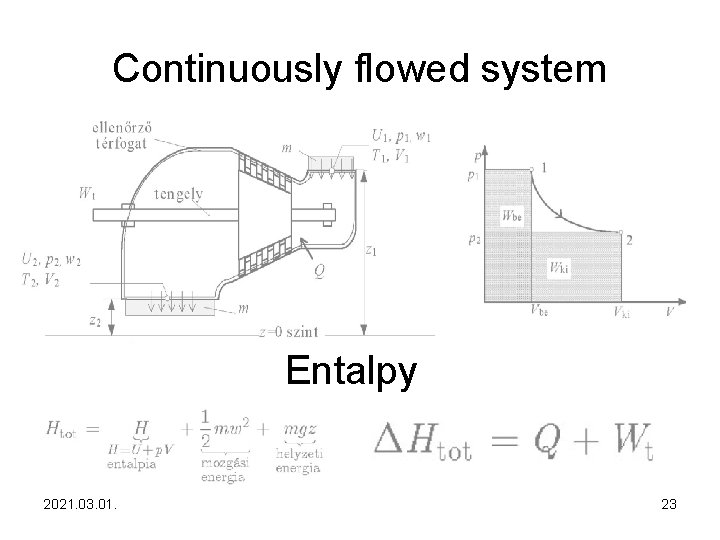
Continuously flowed system Entalpy 2021. 03. 01. 23
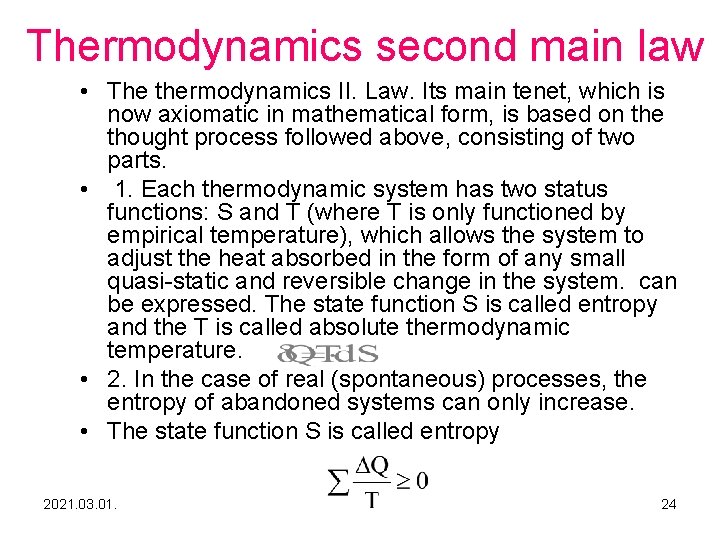
Thermodynamics second main law • The thermodynamics II. Law. Its main tenet, which is now axiomatic in mathematical form, is based on the thought process followed above, consisting of two parts. • 1. Each thermodynamic system has two status functions: S and T (where T is only functioned by empirical temperature), which allows the system to adjust the heat absorbed in the form of any small quasi-static and reversible change in the system. can be expressed. The state function S is called entropy and the T is called absolute thermodynamic temperature. • 2. In the case of real (spontaneous) processes, the entropy of abandoned systems can only increase. • The state function S is called entropy 2021. 03. 01. 24
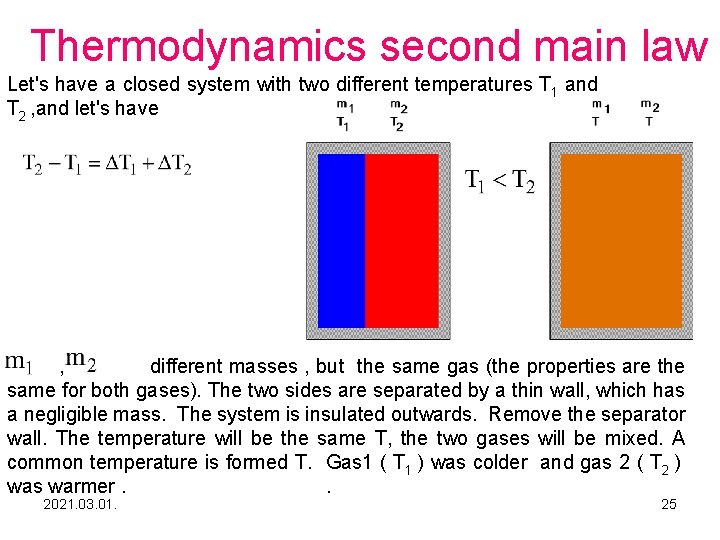
Thermodynamics second main law Let's have a closed system with two different temperatures T 1 and T 2 , and let's have , different masses , but the same gas (the properties are the same for both gases). The two sides are separated by a thin wall, which has a negligible mass. The system is insulated outwards. Remove the separator wall. The temperature will be the same T, the two gases will be mixed. A common temperature is formed T. Gas 1 ( T 1 ) was colder and gas 2 ( T 2 ) was warmer. . 2021. 03. 01. 25
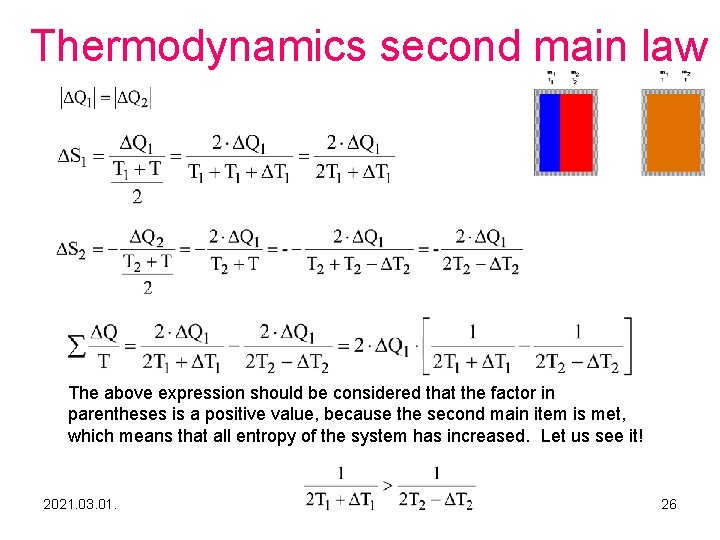
Thermodynamics second main law The above expression should be considered that the factor in parentheses is a positive value, because the second main item is met, which means that all entropy of the system has increased. Let us see it! 2021. 03. 01. 26
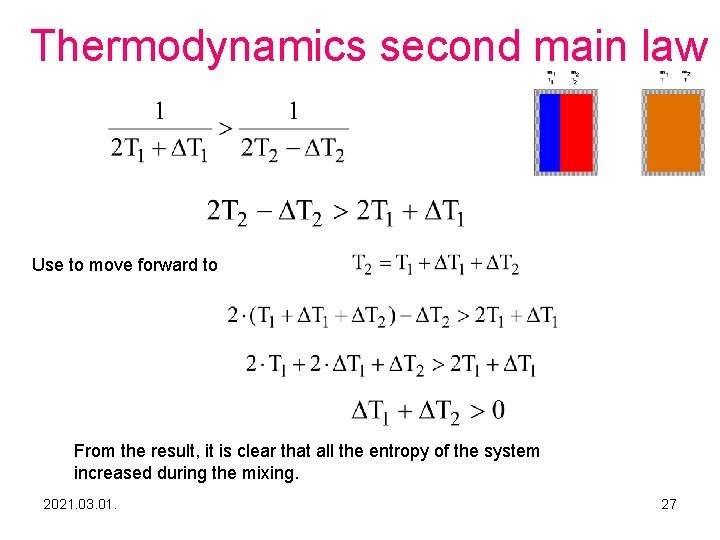
Thermodynamics second main law Use to move forward to From the result, it is clear that all the entropy of the system increased during the mixing. 2021. 03. 01. 27
The ideal gas equation of state 2021. 03. 01. 28
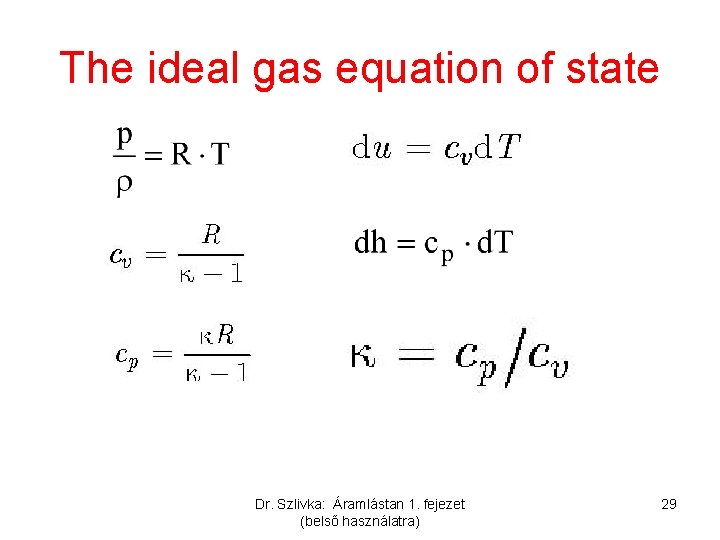
The ideal gas equation of state Dr. Szlivka: Áramlástan 1. fejezet (belső használatra) 29
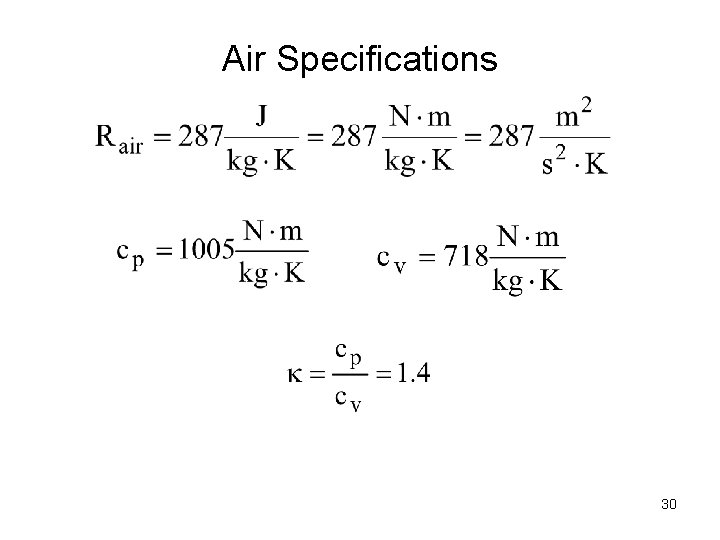
Air Specifications 30
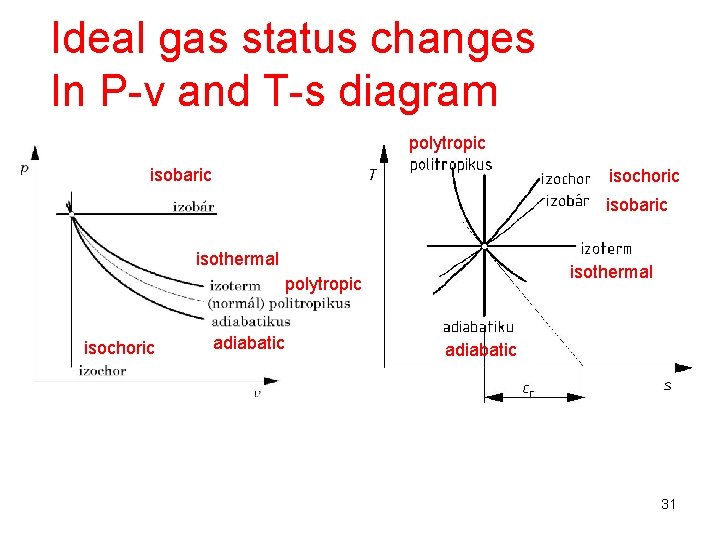
Ideal gas status changes In P-v and T-s diagram polytropic isobaric isochoric isobaric isothermal polytropic isochoric adiabatic 31
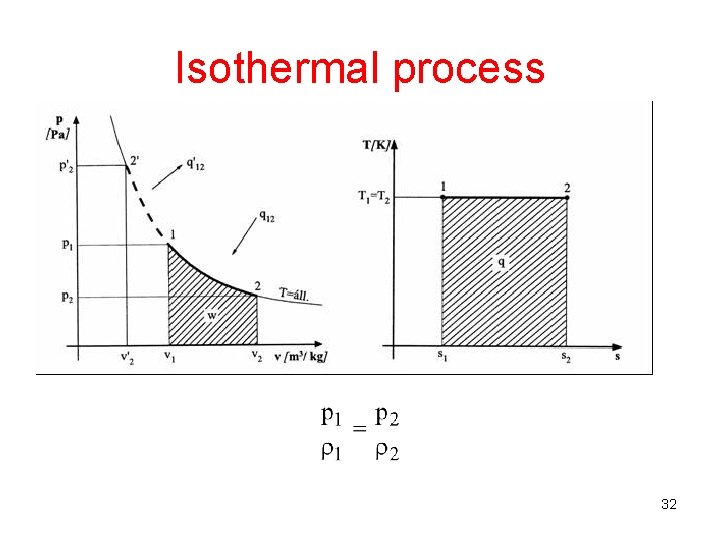
Isothermal process 32
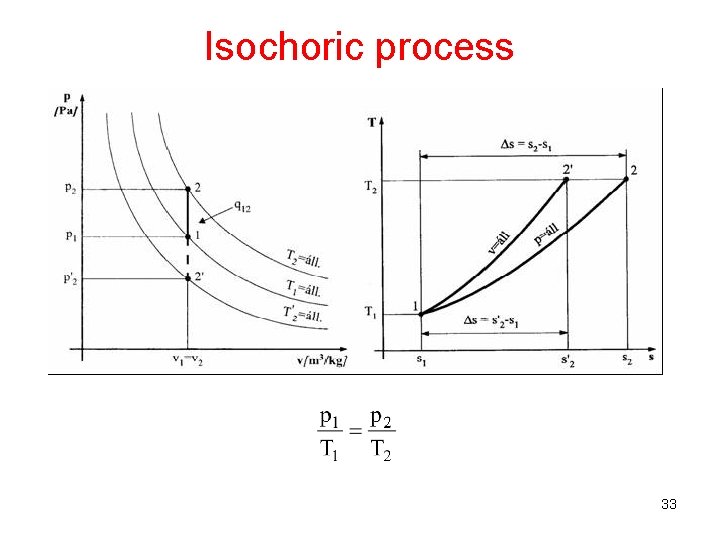
Isochoric process 33
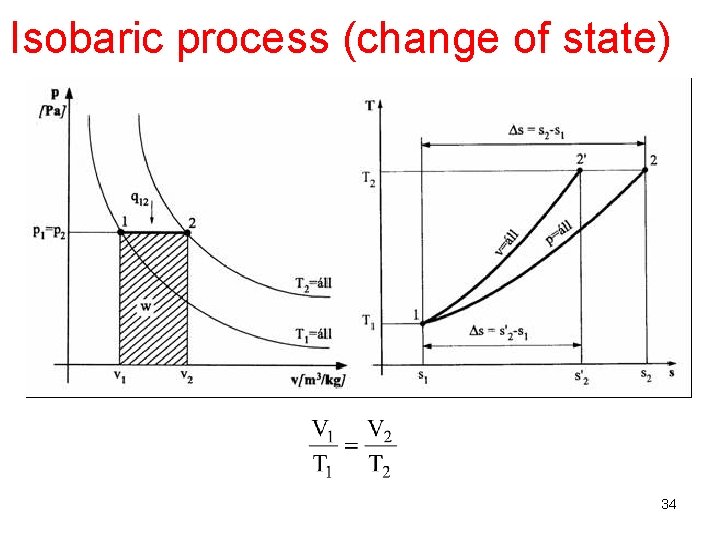
Isobaric process (change of state) 34
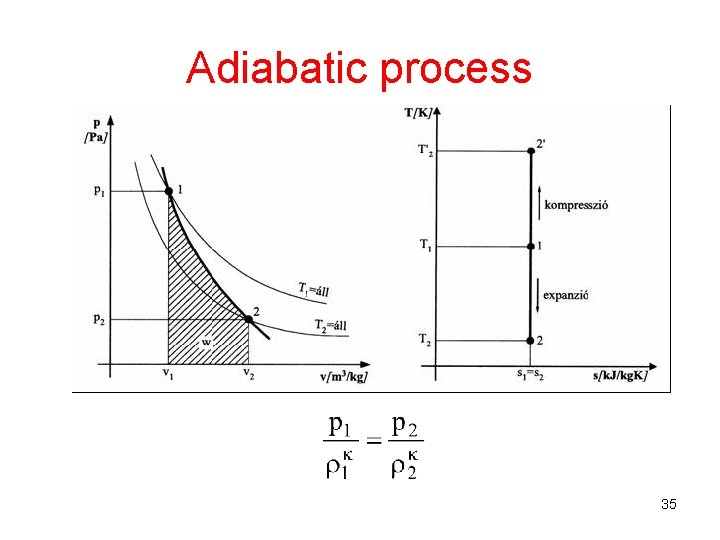
Adiabatic process 35
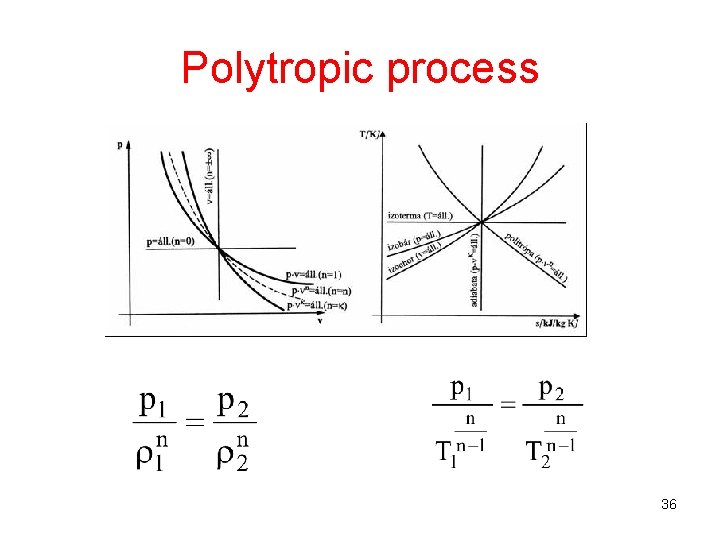
Polytropic process 36
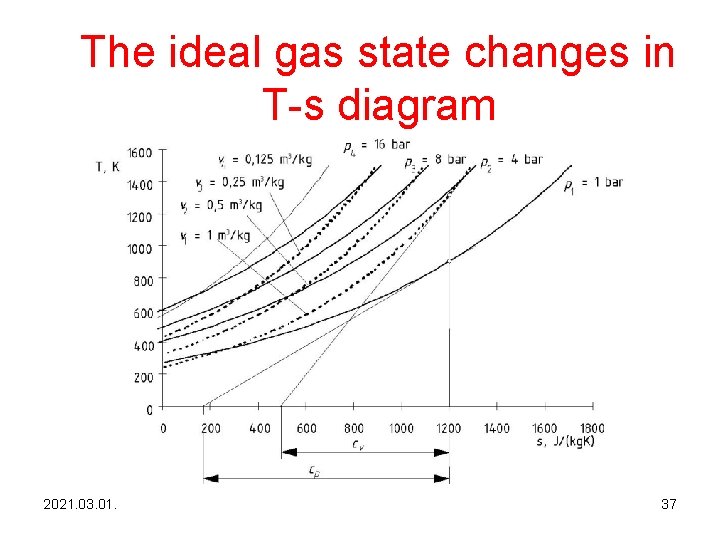
The ideal gas state changes in T-s diagram 2021. 03. 01. 37
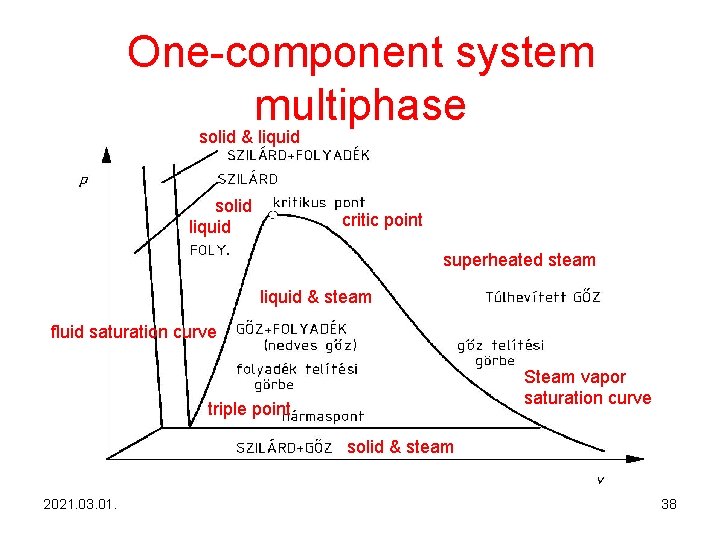
One-component system multiphase solid & liquid solid liquid critic point superheated steam liquid & steam fluid saturation curve Steam vapor saturation curve triple point solid & steam 2021. 03. 01. 38
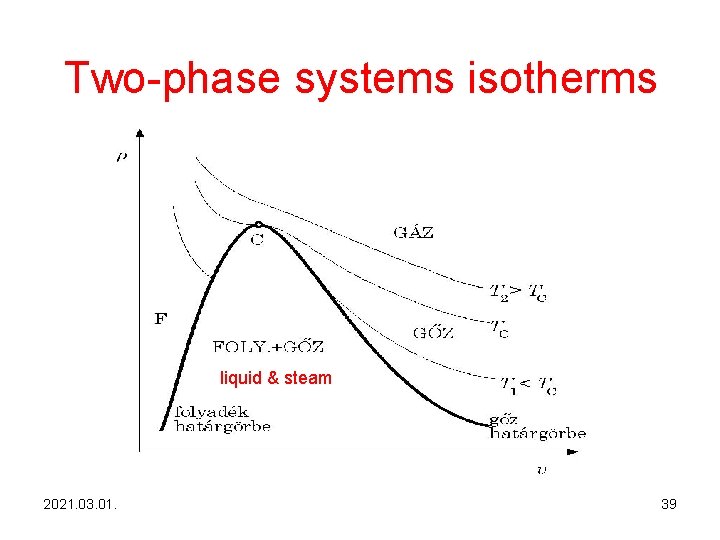
Two-phase systems isotherms liquid & steam 2021. 03. 01. 39
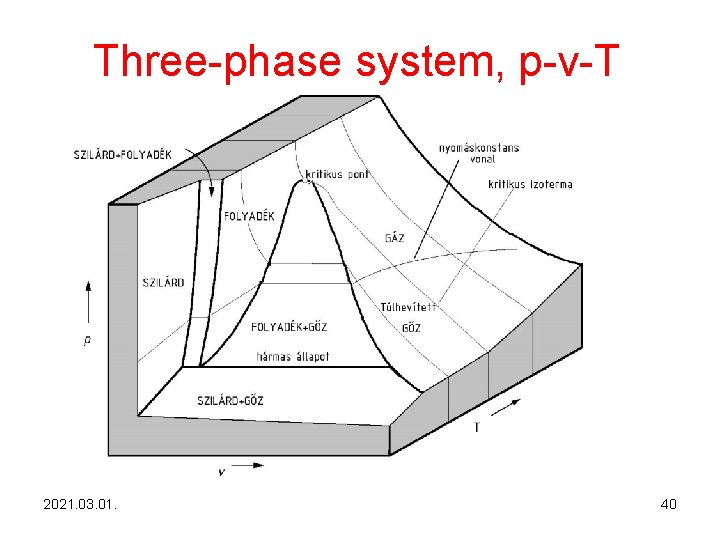
Three-phase system, p-v-T 2021. 03. 01. 40
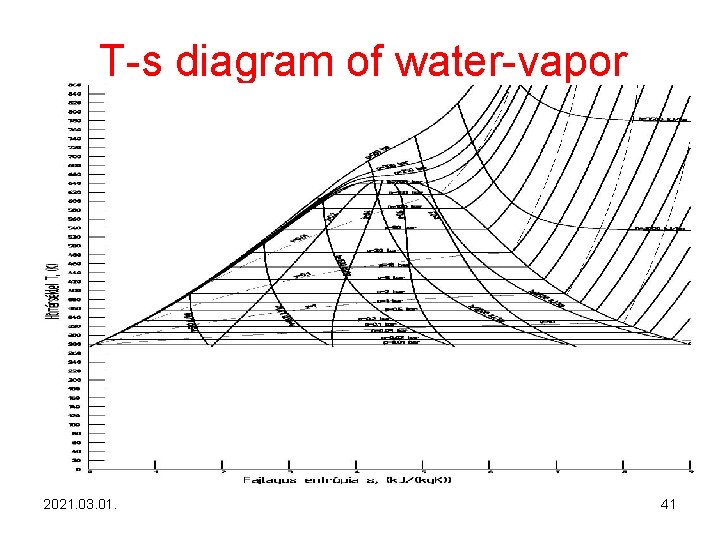
T-s diagram of water-vapor 2021. 03. 01. 41
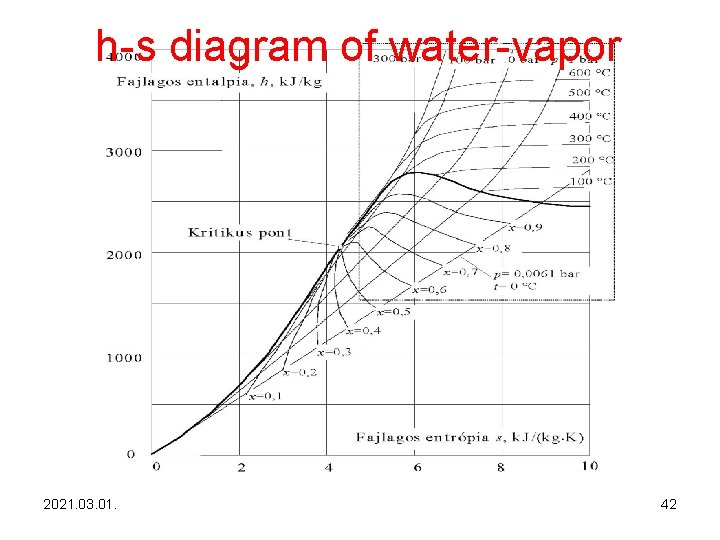
h-s diagram of water-vapor 2021. 03. 01. 42
- Slides: 42