
University of British Columbia CPSC 414 Computer Graphics
University of British Columbia CPSC 414 Computer Graphics Rotations and Quaternions Week 9, Wed 29 Oct 2003 © Tamara Munzner 1
University of British Columbia CPSC 414 Computer Graphics Clipping recap © Tamara Munzner 2
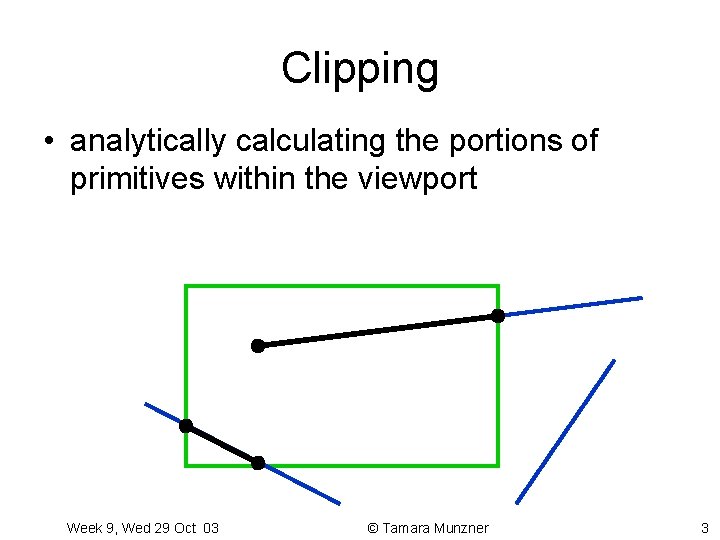
Clipping • analytically calculating the portions of primitives within the viewport Week 9, Wed 29 Oct 03 © Tamara Munzner 3
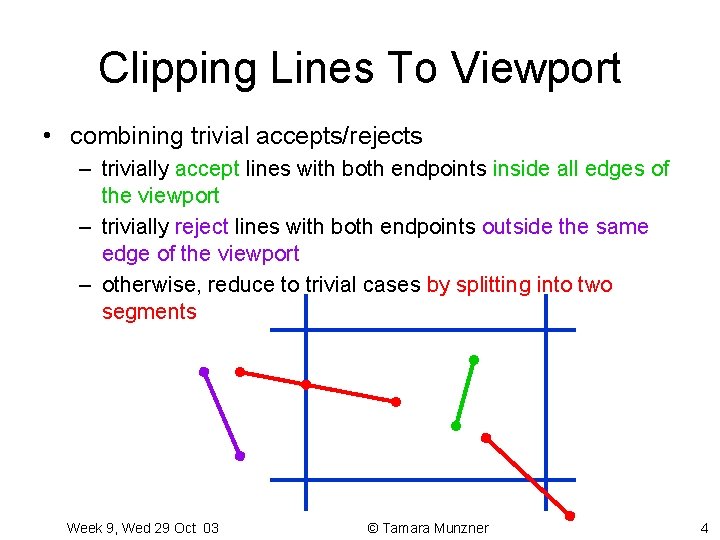
Clipping Lines To Viewport • combining trivial accepts/rejects – trivially accept lines with both endpoints inside all edges of the viewport – trivially reject lines with both endpoints outside the same edge of the viewport – otherwise, reduce to trivial cases by splitting into two segments Week 9, Wed 29 Oct 03 © Tamara Munzner 4
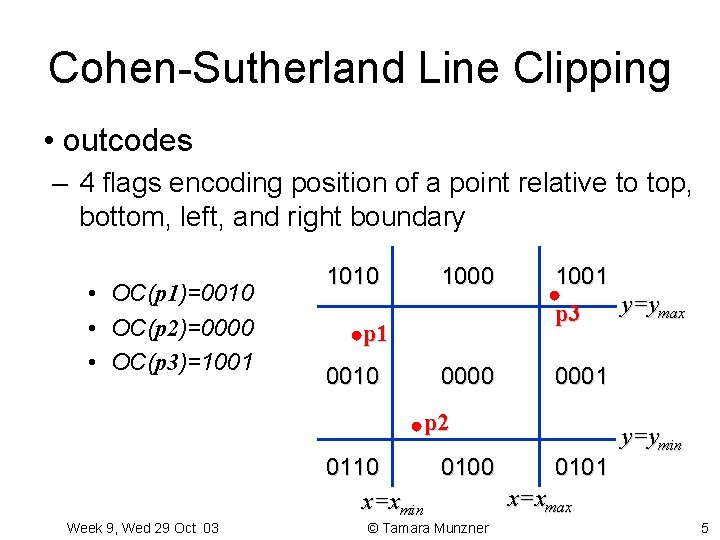
Cohen-Sutherland Line Clipping • outcodes – 4 flags encoding position of a point relative to top, bottom, left, and right boundary • OC(p 1)=0010 • OC(p 2)=0000 • OC(p 3)=1001 1010 1000 p 3 p 1 0010 1001 0000 0001 p 2 0110 0101 x=xmax x=xmin Week 9, Wed 29 Oct 03 © Tamara Munzner y=ymax y=ymin 5
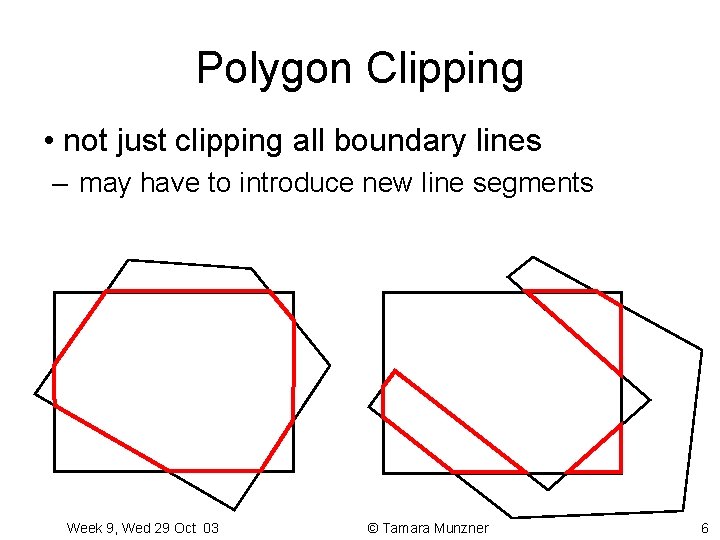
Polygon Clipping • not just clipping all boundary lines – may have to introduce new line segments Week 9, Wed 29 Oct 03 © Tamara Munzner 6
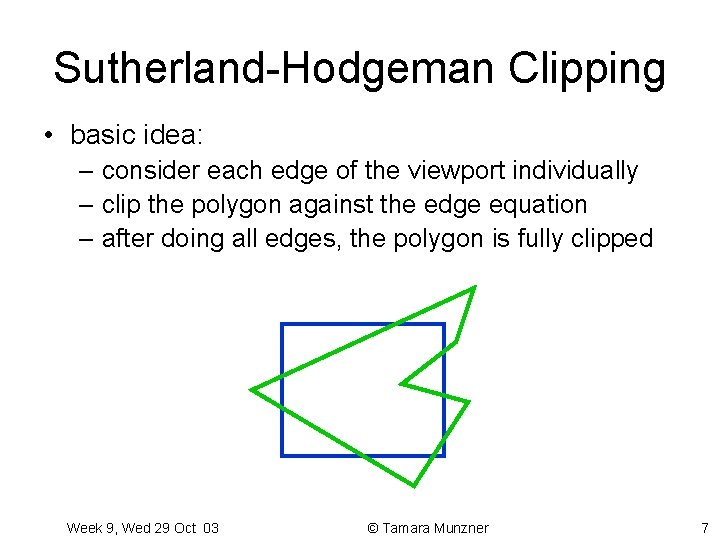
Sutherland-Hodgeman Clipping • basic idea: – consider each edge of the viewport individually – clip the polygon against the edge equation – after doing all edges, the polygon is fully clipped Week 9, Wed 29 Oct 03 © Tamara Munzner 7
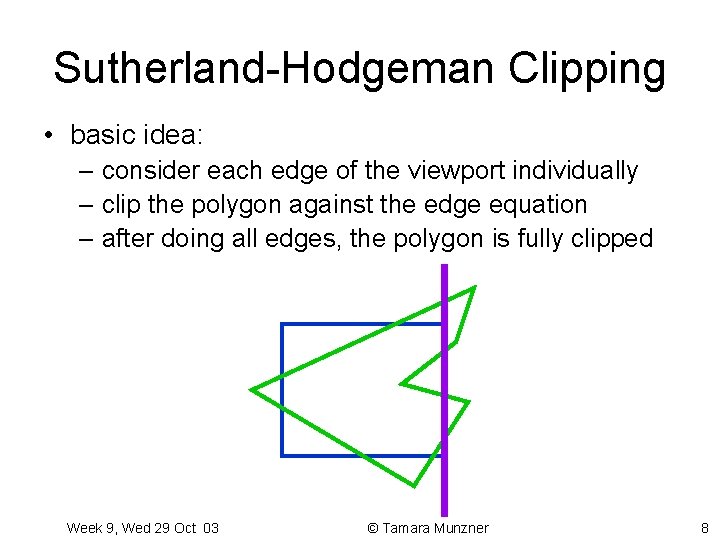
Sutherland-Hodgeman Clipping • basic idea: – consider each edge of the viewport individually – clip the polygon against the edge equation – after doing all edges, the polygon is fully clipped Week 9, Wed 29 Oct 03 © Tamara Munzner 8
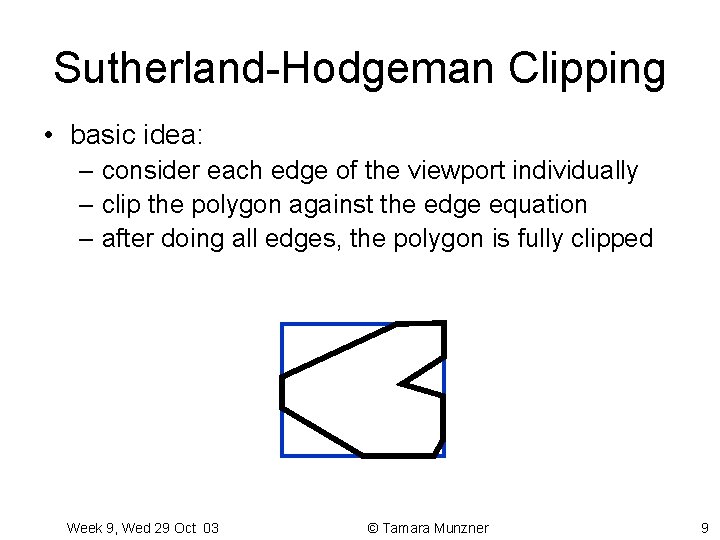
Sutherland-Hodgeman Clipping • basic idea: – consider each edge of the viewport individually – clip the polygon against the edge equation – after doing all edges, the polygon is fully clipped Week 9, Wed 29 Oct 03 © Tamara Munzner 9
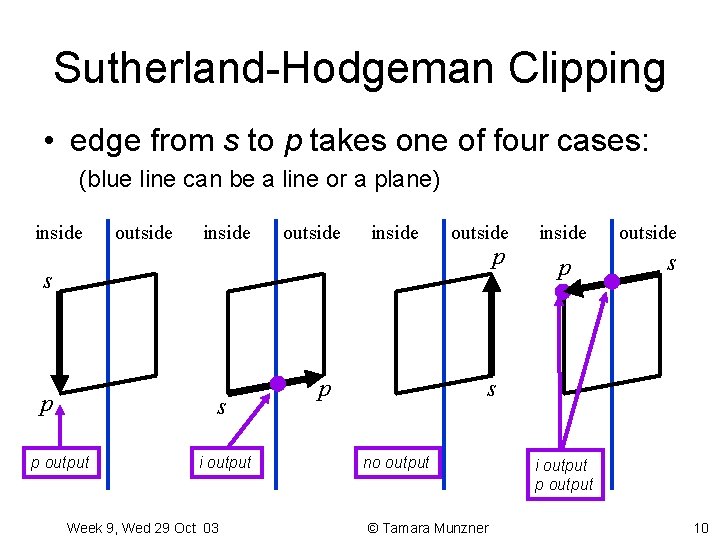
Sutherland-Hodgeman Clipping • edge from s to p takes one of four cases: (blue line can be a line or a plane) inside outside p s p output i output Week 9, Wed 29 Oct 03 p inside p outside s s no output © Tamara Munzner i output p output 10
University of British Columbia CPSC 414 Computer Graphics Rotations and Quaternions © Tamara Munzner 11
Camera Movement Hints • change viewing transformation – don’t try doing this with perspective xform! • methods – glu. Look. At – direct camera control using rotate/translate • camera motion opposite of object motion – rotate world by a = orbit camera by -a Week 9, Wed 29 Oct 03 © Tamara Munzner 12
Parameterizing Rotations • Straightforward in 2 D – A scalar, , represents rotation in plane • More complicated in 3 D – Three scalars are required to define orientation – Note that three scalars are also required to define position – Objects free to translate and tumble in 3 D have 6 degrees of freedom (DOF) Week 9, Wed 29 Oct 03 © Tamara Munzner 13
Representing 3 Rotational DOFs • 3 x 3 Matrix (9 DOFs) – Rows of matrix define orthogonal axes • Euler Angles (3 DOFs) – Rot x + Rot y + Rot z • Axis-angle (4 DOFs) – Axis of rotation + Rotation amount • Quaternion (4 DOFs) – 4 dimensional complex numbers Week 9, Wed 29 Oct 03 © Tamara Munzner 14
3 x 3 Rotation Matrix • • 9 DOFs must reduce to 3 Rows must be unit length (-3 DOFs) Rows must be orthogonal (-3 DOFs) Drifting matrices is very bad – Numerical errors results when trying to gradually rotate matrix by adding derivatives – Resulting matrix may scale / shear – Gram-Schmidt algorithm will re-orthogonalize • Difficult to interpolate between matrices – How would you do it? Week 9, Wed 29 Oct 03 © Tamara Munzner 15
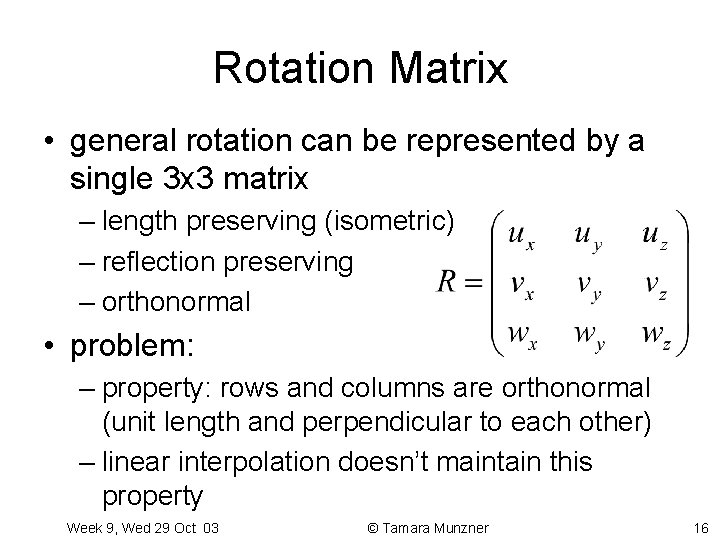
Rotation Matrix • general rotation can be represented by a single 3 x 3 matrix – length preserving (isometric) – reflection preserving – orthonormal • problem: – property: rows and columns are orthonormal (unit length and perpendicular to each other) – linear interpolation doesn’t maintain this property Week 9, Wed 29 Oct 03 © Tamara Munzner 16
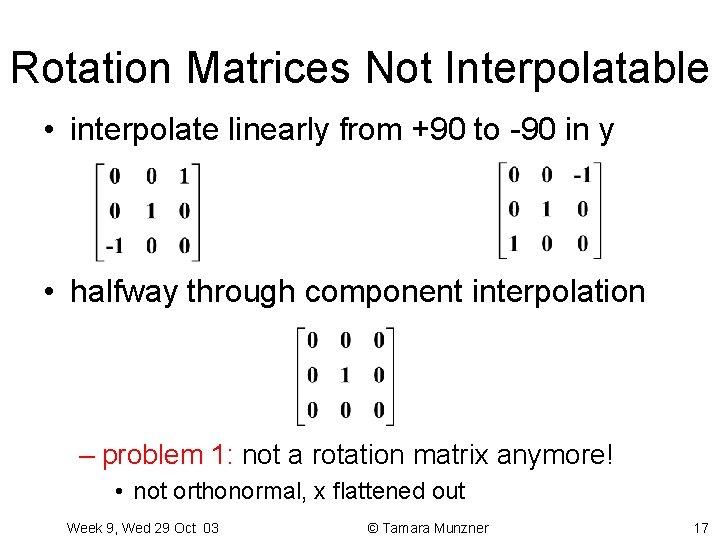
Rotation Matrices Not Interpolatable • interpolate linearly from +90 to -90 in y • halfway through component interpolation – problem 1: not a rotation matrix anymore! • not orthonormal, x flattened out Week 9, Wed 29 Oct 03 © Tamara Munzner 17
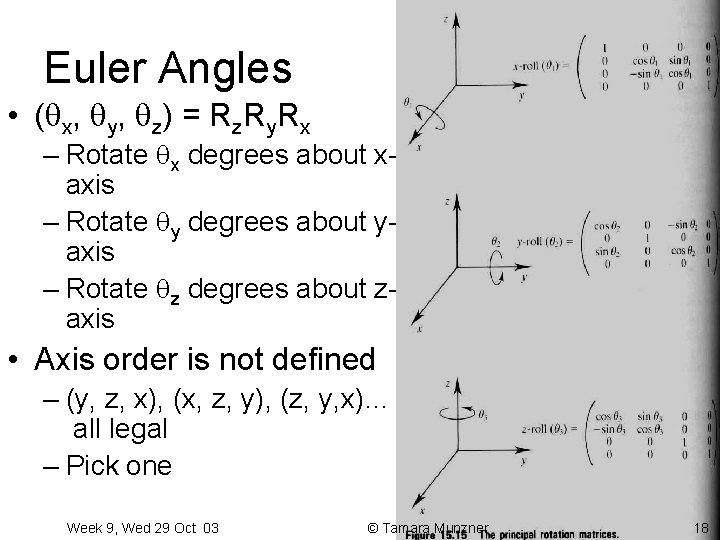
Euler Angles • ( x, y, z) = Rz. Ry. Rx – Rotate x degrees about xaxis – Rotate y degrees about yaxis – Rotate z degrees about zaxis • Axis order is not defined – (y, z, x), (x, z, y), (z, y, x)… all legal – Pick one Week 9, Wed 29 Oct 03 © Tamara Munzner 18
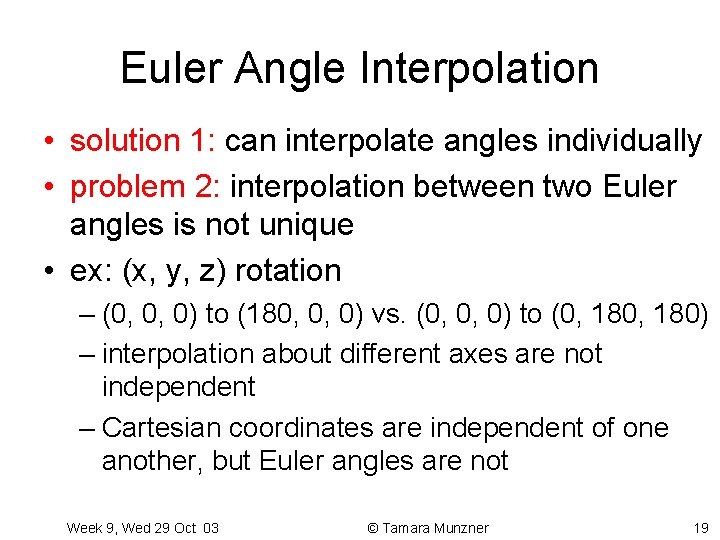
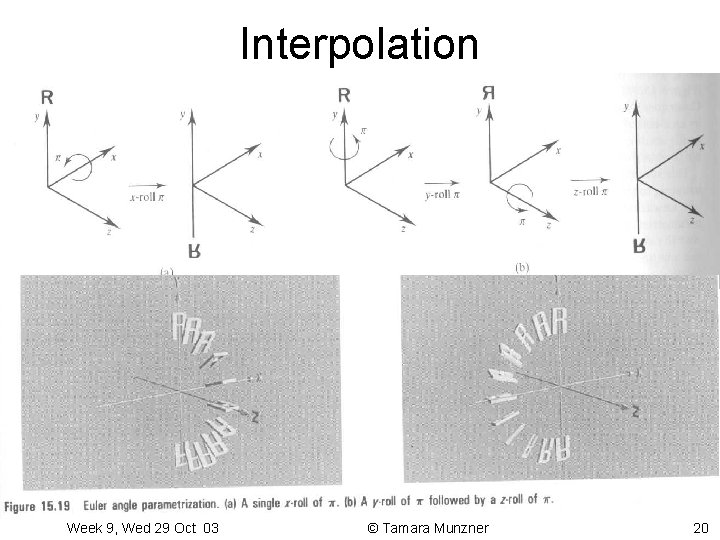
Euler Angle Interpolation • solution 1: can interpolate angles individually • problem 2: interpolation between two Euler angles is not unique • ex: (x, y, z) rotation – (0, 0, 0) to (180, 0, 0) vs. (0, 0, 0) to (0, 180) – interpolation about different axes are not independent – Cartesian coordinates are independent of one another, but Euler angles are not Week 9, Wed 29 Oct 03 © Tamara Munzner 19
Interpolation Week 9, Wed 29 Oct 03 © Tamara Munzner 20
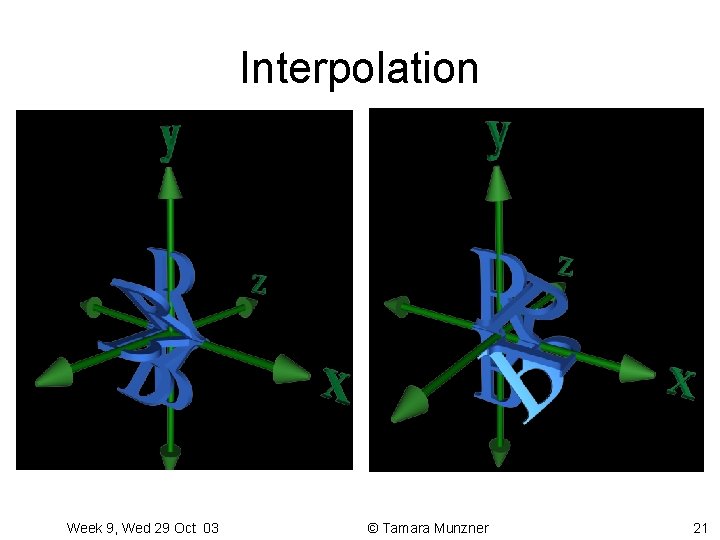
Interpolation Week 9, Wed 29 Oct 03 © Tamara Munzner 21
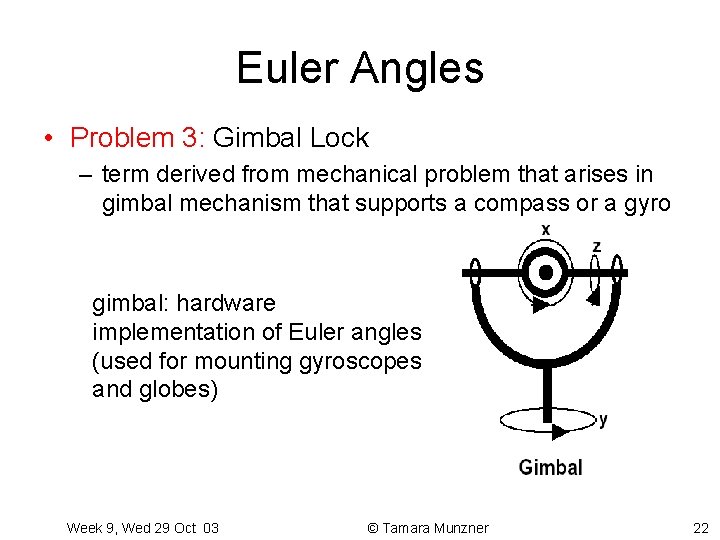
Euler Angles • Problem 3: Gimbal Lock – term derived from mechanical problem that arises in gimbal mechanism that supports a compass or a gyro gimbal: hardware implementation of Euler angles (used for mounting gyroscopes and globes) Week 9, Wed 29 Oct 03 © Tamara Munzner 22
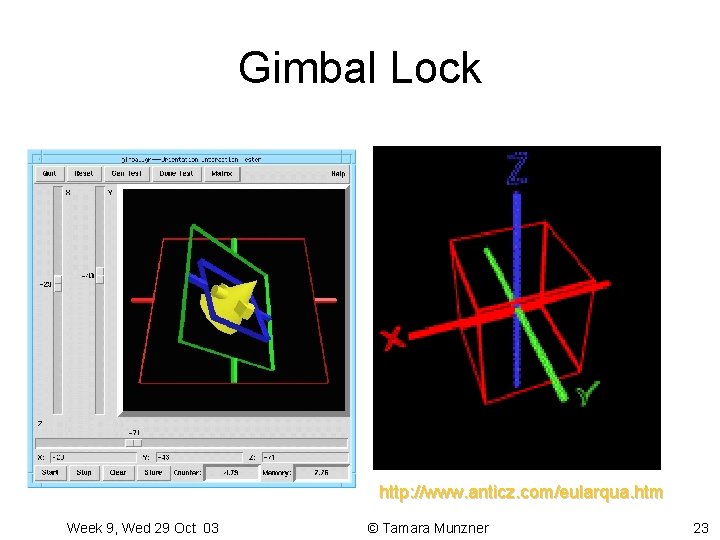
Gimbal Lock http: //www. anticz. com/eularqua. htm Week 9, Wed 29 Oct 03 © Tamara Munzner 23
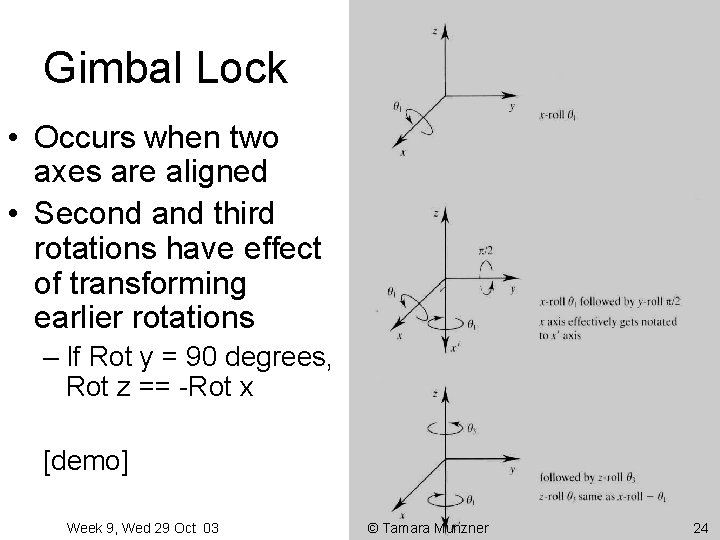
Gimbal Lock • Occurs when two axes are aligned • Second and third rotations have effect of transforming earlier rotations – If Rot y = 90 degrees, Rot z == -Rot x [demo] Week 9, Wed 29 Oct 03 © Tamara Munzner 24
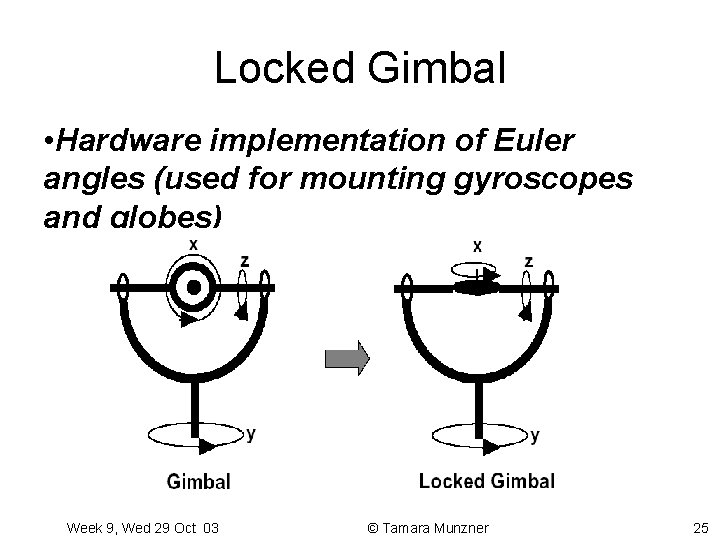
Locked Gimbal • Hardware implementation of Euler angles (used for mounting gyroscopes and globes) Week 9, Wed 29 Oct 03 © Tamara Munzner 25
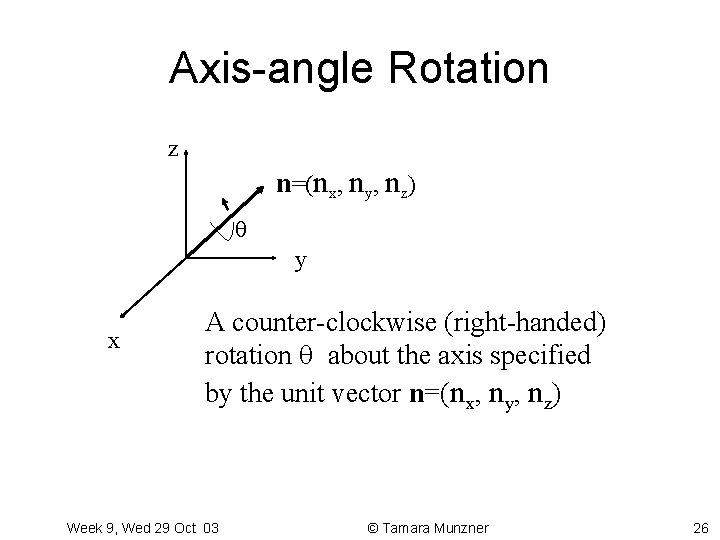
Axis-angle Rotation z n=(nx, ny, nz) y x A counter-clockwise (right-handed) rotation about the axis specified by the unit vector n=(nx, ny, nz) Week 9, Wed 29 Oct 03 © Tamara Munzner 26
Axis-angle Notation • Define an axis of rotation (x, y, z) and a rotation about that axis, : R( , n) • 4 degrees of freedom specify 3 rotational degrees of freedom because axis of rotation is constrained to be a unit vector Week 9, Wed 29 Oct 03 © Tamara Munzner 27
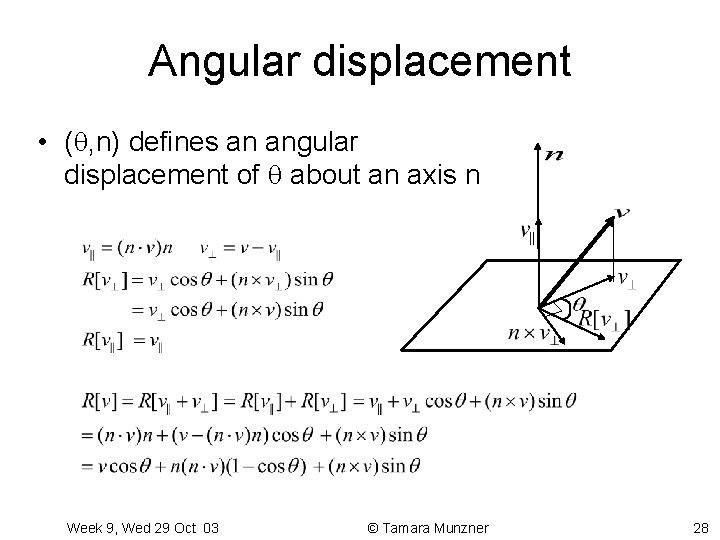
Angular displacement • ( , n) defines an angular displacement of about an axis n Week 9, Wed 29 Oct 03 © Tamara Munzner 28
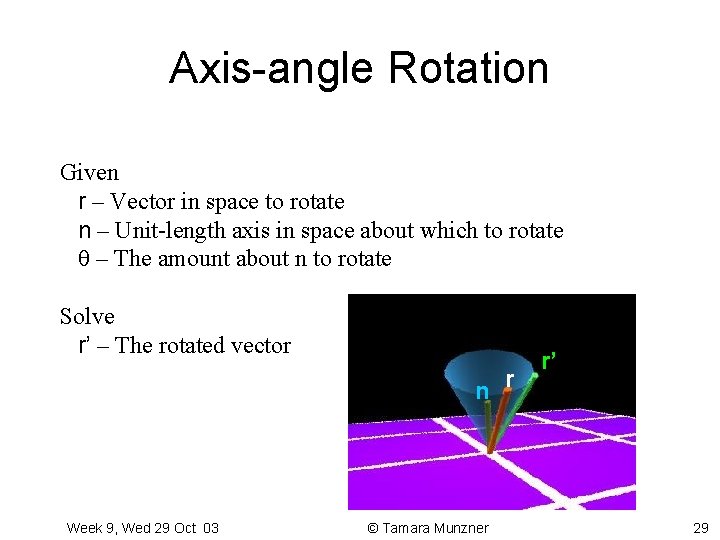
Axis-angle Rotation Given r – Vector in space to rotate n – Unit-length axis in space about which to rotate – The amount about n to rotate Solve r’ – The rotated vector n r Week 9, Wed 29 Oct 03 © Tamara Munzner r’ 29
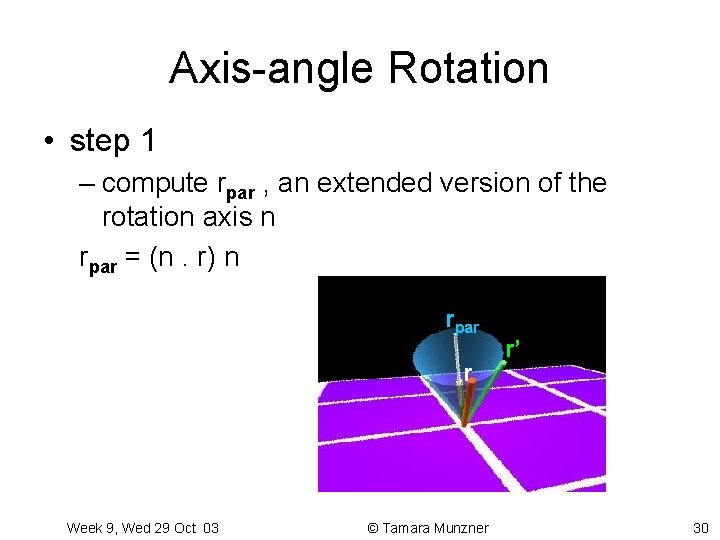
Axis-angle Rotation • step 1 – compute rpar , an extended version of the rotation axis n rpar = (n. r) n rpar r Week 9, Wed 29 Oct 03 © Tamara Munzner r’ 30
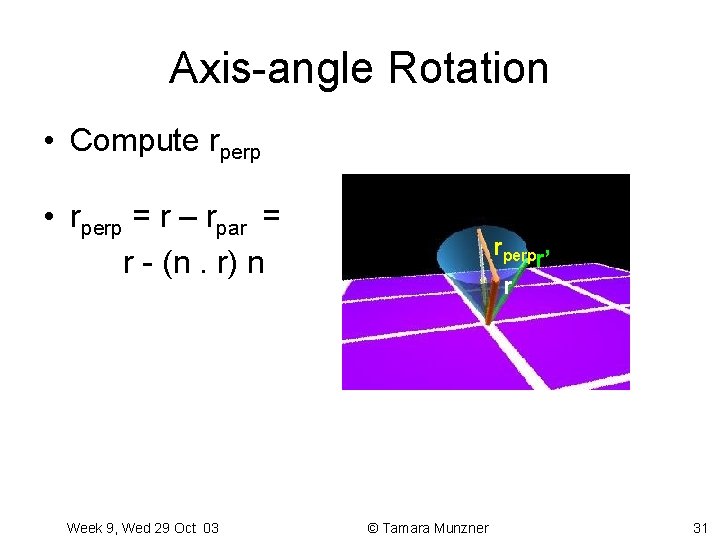
Axis-angle Rotation • Compute rperp • rperp = r – rpar = r - (n. r) n Week 9, Wed 29 Oct 03 rperpr’ r © Tamara Munzner 31
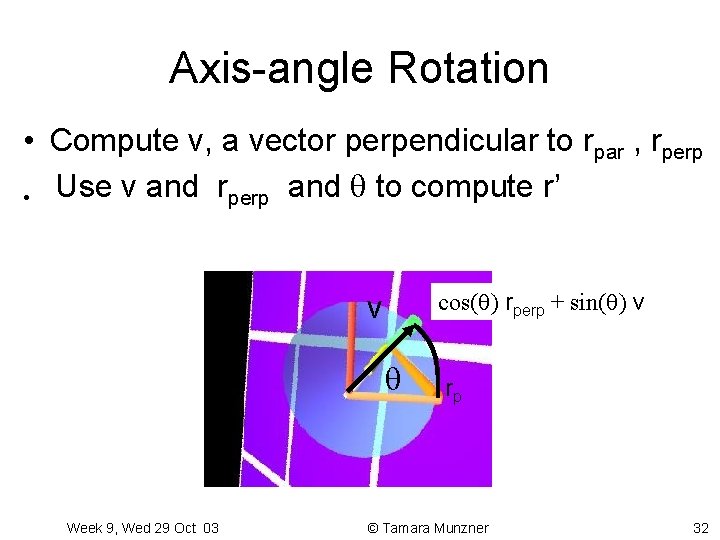
Axis-angle Rotation • Compute v, a vector perpendicular to rpar , rperp • Use v and rperp and to compute r’ cos( ) rperp + sin( ) v v Week 9, Wed 29 Oct 03 rp © Tamara Munzner 32
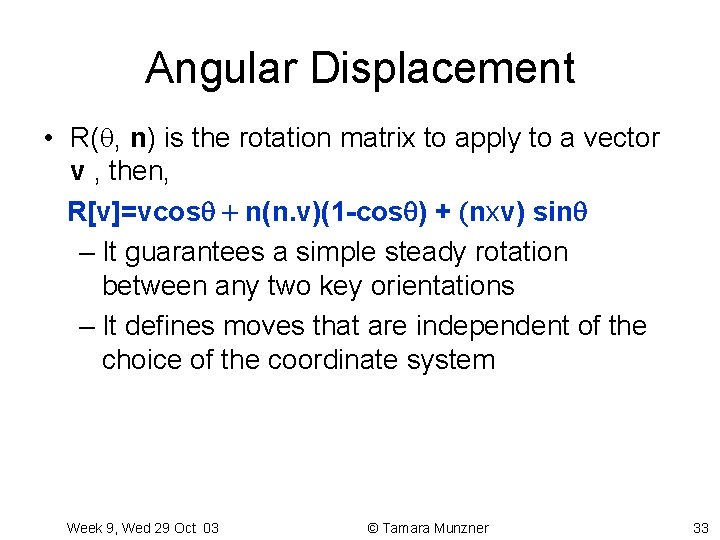
Angular Displacement • R( , n) is the rotation matrix to apply to a vector v , then, R[v]=vcosq + n(n. v)(1 -cosq) + (nxv) sinq – It guarantees a simple steady rotation between any two key orientations – It defines moves that are independent of the choice of the coordinate system Week 9, Wed 29 Oct 03 © Tamara Munzner 33
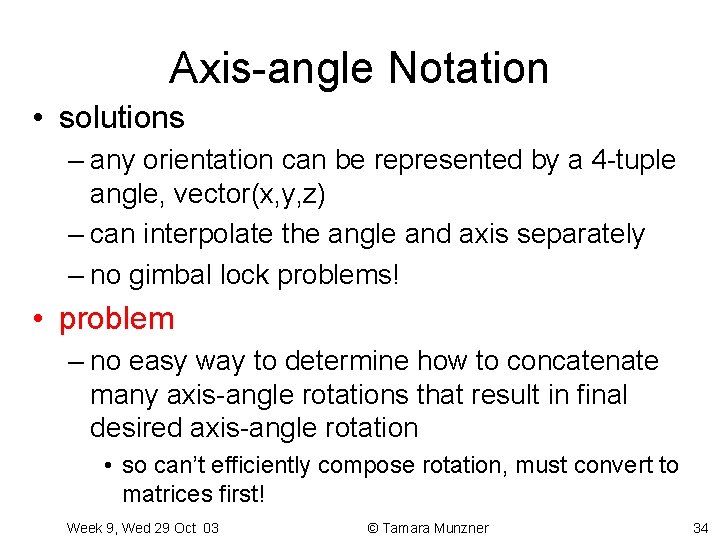
Axis-angle Notation • solutions – any orientation can be represented by a 4 -tuple angle, vector(x, y, z) – can interpolate the angle and axis separately – no gimbal lock problems! • problem – no easy way to determine how to concatenate many axis-angle rotations that result in final desired axis-angle rotation • so can’t efficiently compose rotation, must convert to matrices first! Week 9, Wed 29 Oct 03 © Tamara Munzner 34
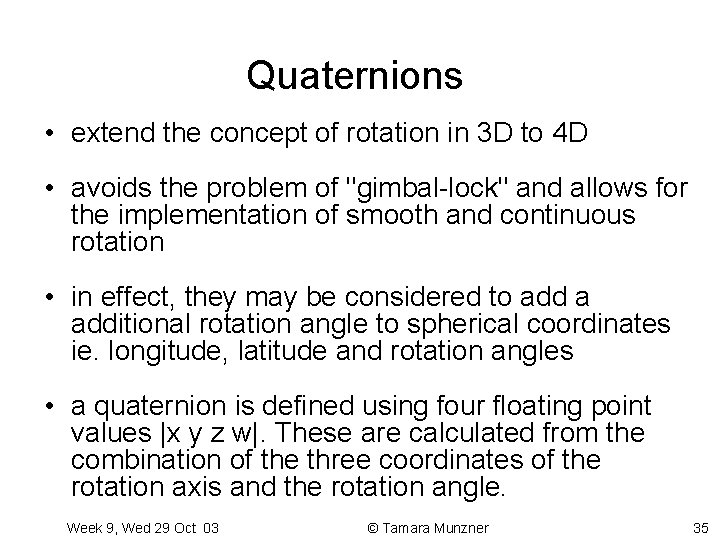
Quaternions • extend the concept of rotation in 3 D to 4 D • avoids the problem of "gimbal-lock" and allows for the implementation of smooth and continuous rotation • in effect, they may be considered to add a additional rotation angle to spherical coordinates ie. longitude, latitude and rotation angles • a quaternion is defined using four floating point values |x y z w|. These are calculated from the combination of the three coordinates of the rotation axis and the rotation angle. Week 9, Wed 29 Oct 03 © Tamara Munzner 35

Quaternions Definition • Extension of complex numbers • 4 -tuple of real numbers – s, x, y, z or [s, v] – s is a scalar – v is a vector • Same information as axis/angle but in a different form • Can be viewed as an original orientation or a rotation to apply to an object Week 9, Wed 29 Oct 03 © Tamara Munzner 36
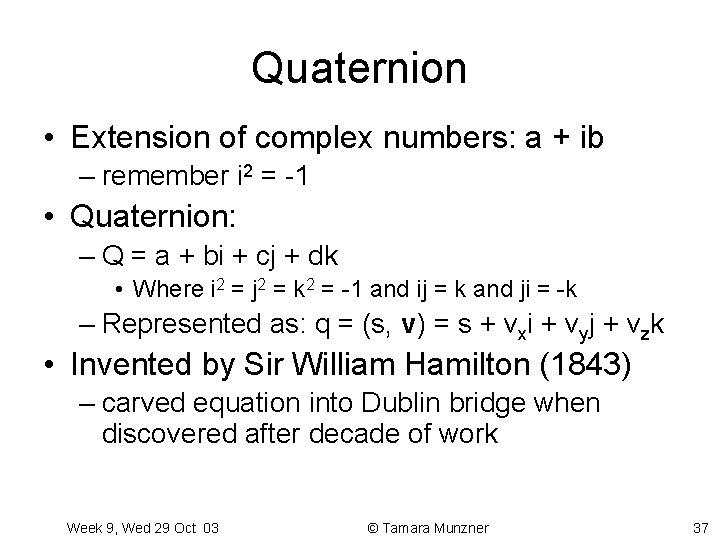
Quaternion • Extension of complex numbers: a + ib – remember i 2 = -1 • Quaternion: – Q = a + bi + cj + dk • Where i 2 = j 2 = k 2 = -1 and ij = k and ji = -k – Represented as: q = (s, v) = s + vxi + vyj + vzk • Invented by Sir William Hamilton (1843) – carved equation into Dublin bridge when discovered after decade of work Week 9, Wed 29 Oct 03 © Tamara Munzner 37
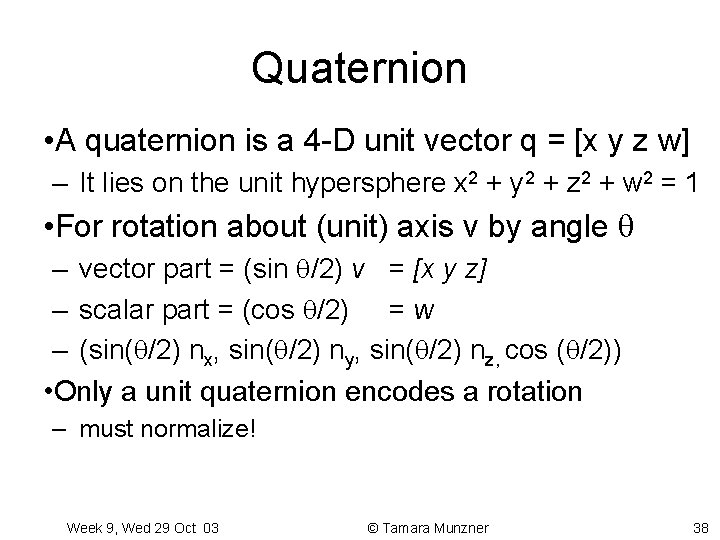
Quaternion • A quaternion is a 4 -D unit vector q = [x y z w] – It lies on the unit hypersphere x 2 + y 2 + z 2 + w 2 = 1 • For rotation about (unit) axis v by angle – vector part = (sin /2) v = [x y z] – scalar part = (cos /2) = w – (sin( /2) nx, sin( /2) ny, sin( /2) nz, cos ( /2)) • Only a unit quaternion encodes a rotation – must normalize! Week 9, Wed 29 Oct 03 © Tamara Munzner 38

Quaternion • Rotation matrix corresponding to a quaternion: – [x y z w] = • Quaternion Multiplication – q 1 * q 2 = [v 1, w 1] * [v 2, w 2] = [(w 1 v 2+w 2 v 1+ (v 1 x v 2)), w 1 w 2 -v 1. v 2] – quaternion * quaternion = quaternion – this satisfies requirements for mathematical group – Rotating object twice according to two different quaternions is equivalent to one rotation according to product of two quaternions Week 9, Wed 29 Oct 03 © Tamara Munzner 39
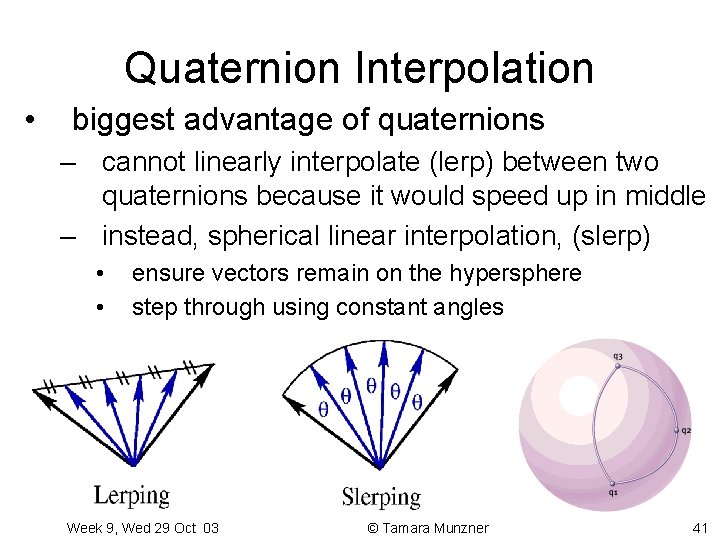
Quaternion Interpolation • biggest advantage of quaternions – cannot linearly interpolate (lerp) between two quaternions because it would speed up in middle – instead, spherical linear interpolation, (slerp) • • ensure vectors remain on the hypersphere step through using constant angles Week 9, Wed 29 Oct 03 © Tamara Munzner 41
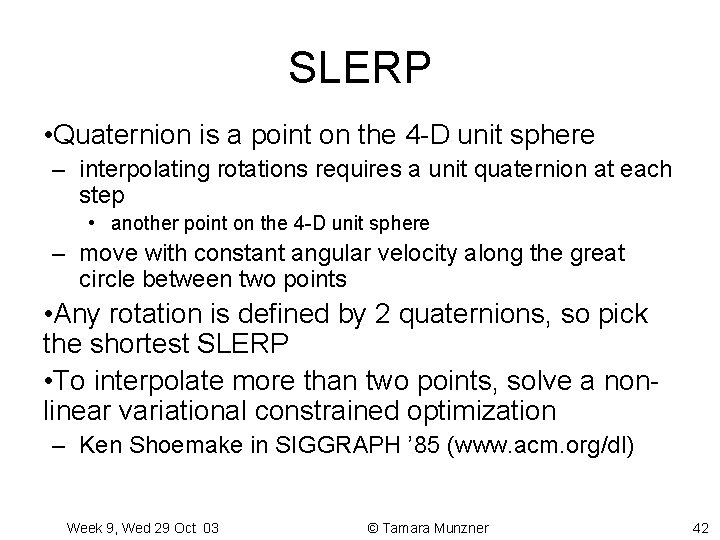
SLERP • Quaternion is a point on the 4 -D unit sphere – interpolating rotations requires a unit quaternion at each step • another point on the 4 -D unit sphere – move with constant angular velocity along the great circle between two points • Any rotation is defined by 2 quaternions, so pick the shortest SLERP • To interpolate more than two points, solve a nonlinear variational constrained optimization – Ken Shoemake in SIGGRAPH ’ 85 (www. acm. org/dl) Week 9, Wed 29 Oct 03 © Tamara Munzner 42
Quaternion Libraries • Gamasutra – Code, explanatory article – Registration required http: //www. gamasutra. com/features/19980703/quaternions_01. htm Week 9, Wed 29 Oct 03 © Tamara Munzner 43
Evaluating Quaternions • Advantages: – Flexible. – No parametrization singularities (gimbal lock) – Smooth consistent interpolation of orientations. – Simple and efficient composition of rotations. • Disadvantages: – Each orientation is represented by two quaternions. – Complex! Week 9, Wed 29 Oct 03 © Tamara Munzner 44
Summary • 3 x 3 matrices – drifting, can’t interpolate • Euler angles – gimbal lock • axis-angle – can’t concatenate • quaternions – solve all problems, but complex Week 9, Wed 29 Oct 03 © Tamara Munzner 45
Project Strategy Suggestion • debug basics with simple euler angles – with single drag, does view change the right way? • then can add quaternions Week 9, Wed 29 Oct 03 © Tamara Munzner 46
- Slides: 45