
University of British Columbia CPSC 414 Computer Graphics
University of British Columbia CPSC 414 Computer Graphics Shading Week 5, Wed 1 Oct 2003 • recap: lighting • shading © Tamara Munzner 1
News • final signup for project 1 demo slots • extra lab coverage – Wed 10 -1, 4 -5: 30, Thu 11 -1 • • normal lab hours: Wed 1 -3 newsgroup working externally door code handin from remote. ugrad. cs. ubc. ca Week 5, Wed 1 Oct 03 © Tamara Munzner 2
Readings • Chapter 6 Week 5, Wed 1 Oct 03 © Tamara Munzner 3
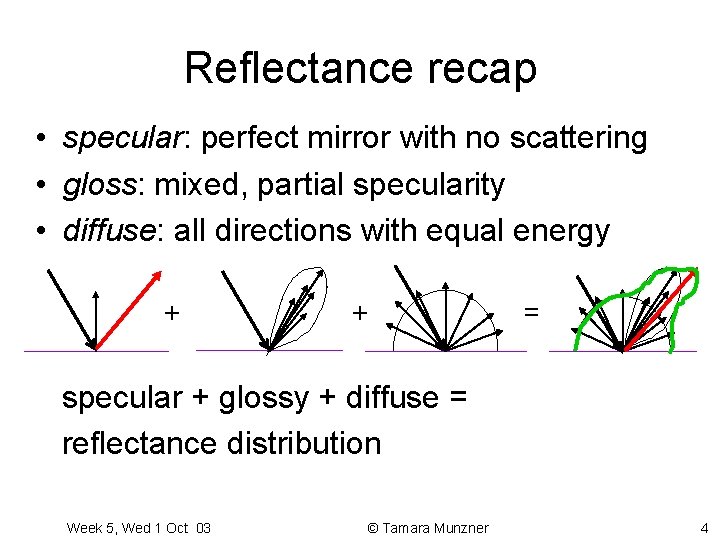
Reflectance recap • specular: perfect mirror with no scattering • gloss: mixed, partial specularity • diffuse: all directions with equal energy + + = specular + glossy + diffuse = reflectance distribution Week 5, Wed 1 Oct 03 © Tamara Munzner 4
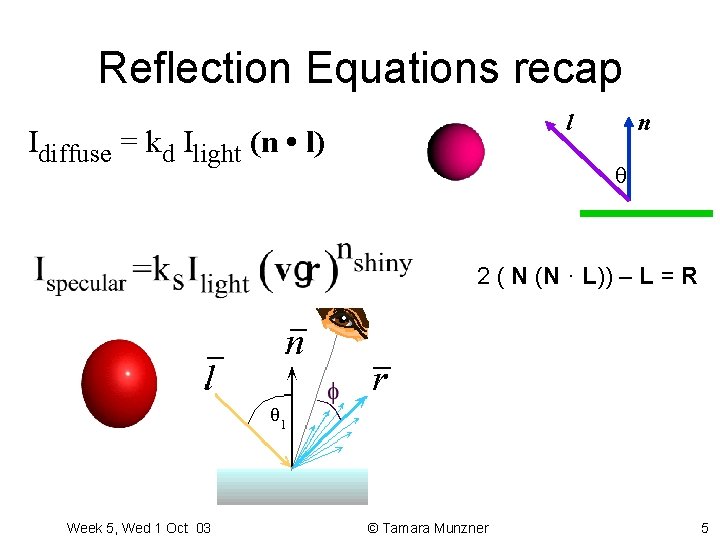
Reflection Equations recap l Idiffuse = kd Ilight (n • l) n 2 ( N (N · L)) – L = R Week 5, Wed 1 Oct 03 © Tamara Munzner 5

Reflection Equations 2 recap h • Blinn improvement n v l • full Phong lighting model – combine ambient, diffuse, specular components Week 5, Wed 1 Oct 03 © Tamara Munzner 6
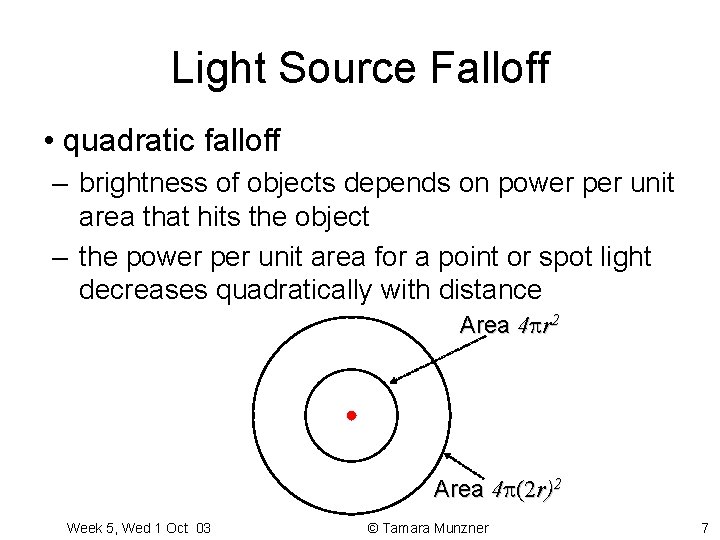
Light Source Falloff • quadratic falloff – brightness of objects depends on power per unit area that hits the object – the power per unit area for a point or spot light decreases quadratically with distance Area 4 r 2 Area 4 (2 r)2 Week 5, Wed 1 Oct 03 © Tamara Munzner 7
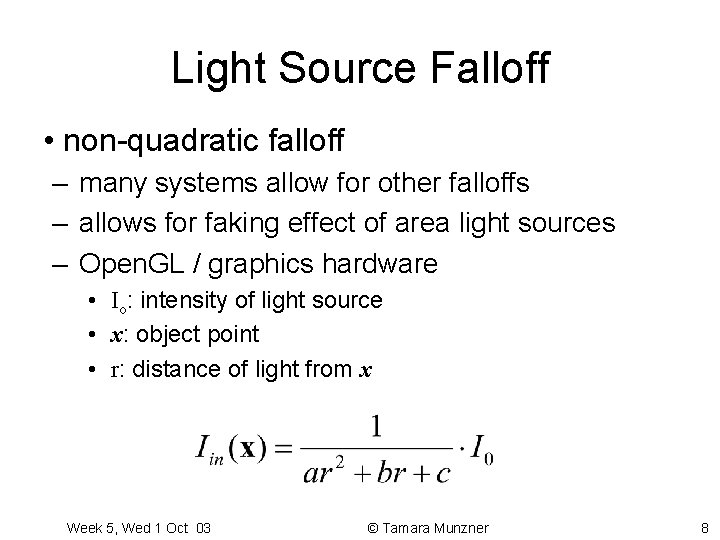
Light Source Falloff • non-quadratic falloff – many systems allow for other falloffs – allows for faking effect of area light sources – Open. GL / graphics hardware • Io: intensity of light source • x: object point • r: distance of light from x Week 5, Wed 1 Oct 03 © Tamara Munzner 8
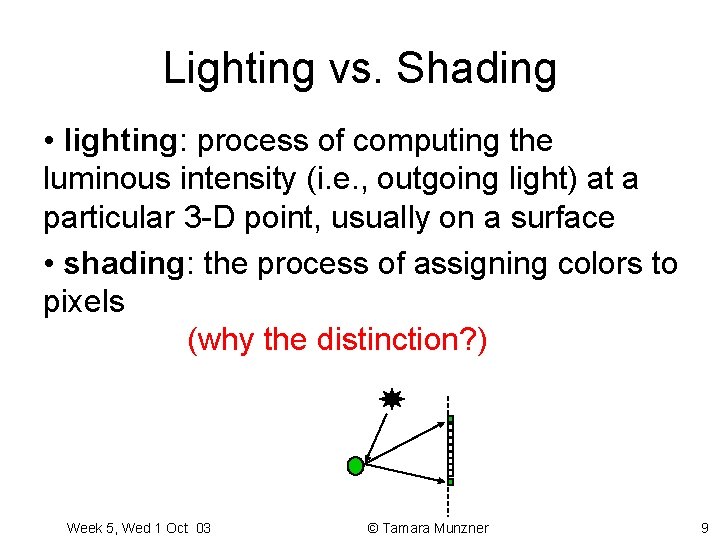
Lighting vs. Shading • lighting: process of computing the luminous intensity (i. e. , outgoing light) at a particular 3 -D point, usually on a surface • shading: the process of assigning colors to pixels (why the distinction? ) Week 5, Wed 1 Oct 03 © Tamara Munzner 9
Applying Illumination • we now have an illumination model for a point on a surface • if surface defined as mesh of polygonal facets, which points should we use? – fairly expensive calculation – several possible answers, each with different implications for visual quality of result Week 5, Wed 1 Oct 03 © Tamara Munzner 10
Applying Illumination • polygonal/triangular models – each facet has a constant surface normal – if light is directional, diffuse reflectance is constant across the facet. – why? Week 5, Wed 1 Oct 03 © Tamara Munzner 11
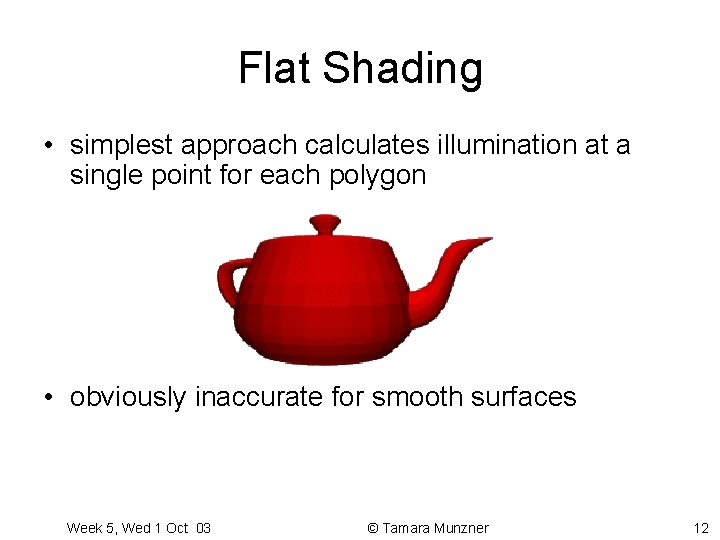
Flat Shading • simplest approach calculates illumination at a single point for each polygon • obviously inaccurate for smooth surfaces Week 5, Wed 1 Oct 03 © Tamara Munzner 12
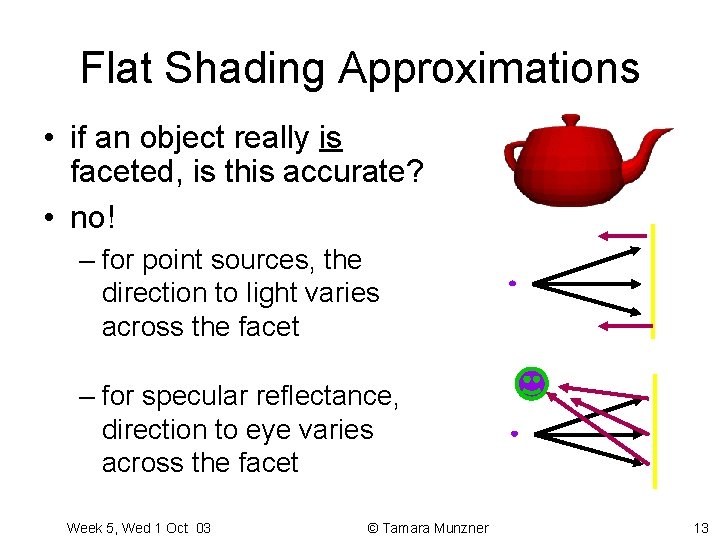
Flat Shading Approximations • if an object really is faceted, is this accurate? • no! – for point sources, the direction to light varies across the facet – for specular reflectance, direction to eye varies across the facet Week 5, Wed 1 Oct 03 © Tamara Munzner 13
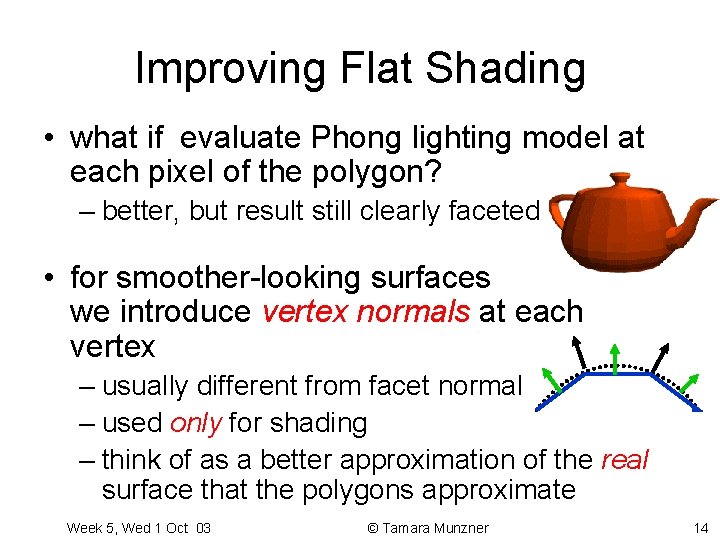
Improving Flat Shading • what if evaluate Phong lighting model at each pixel of the polygon? – better, but result still clearly faceted • for smoother-looking surfaces we introduce vertex normals at each vertex – usually different from facet normal – used only for shading – think of as a better approximation of the real surface that the polygons approximate Week 5, Wed 1 Oct 03 © Tamara Munzner 14
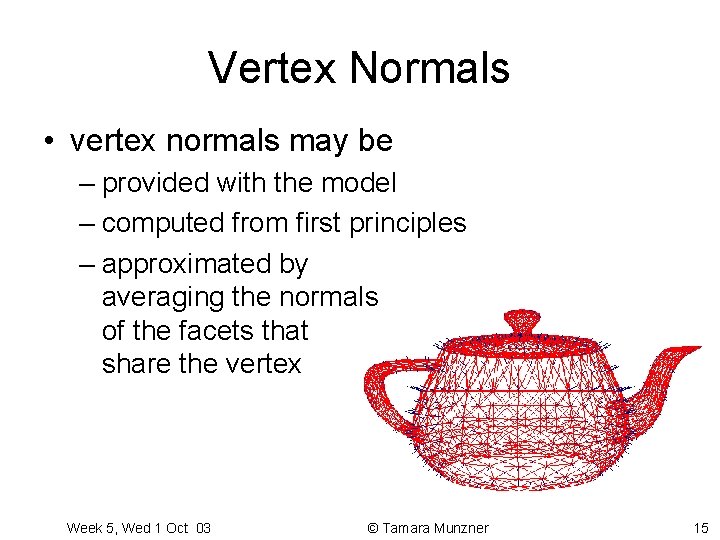
Vertex Normals • vertex normals may be – provided with the model – computed from first principles – approximated by averaging the normals of the facets that share the vertex Week 5, Wed 1 Oct 03 © Tamara Munzner 15
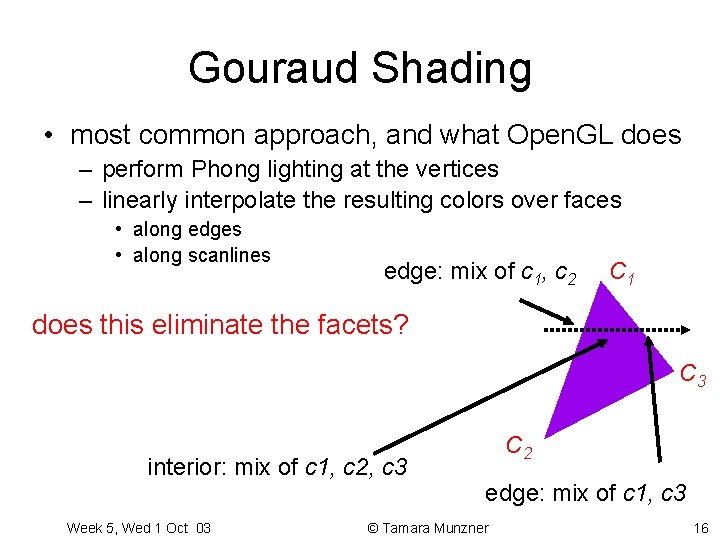
Gouraud Shading • most common approach, and what Open. GL does – perform Phong lighting at the vertices – linearly interpolate the resulting colors over faces • along edges • along scanlines edge: mix of c 1, c 2 C 1 does this eliminate the facets? C 3 interior: mix of c 1, c 2, c 3 Week 5, Wed 1 Oct 03 C 2 edge: mix of c 1, c 3 © Tamara Munzner 16
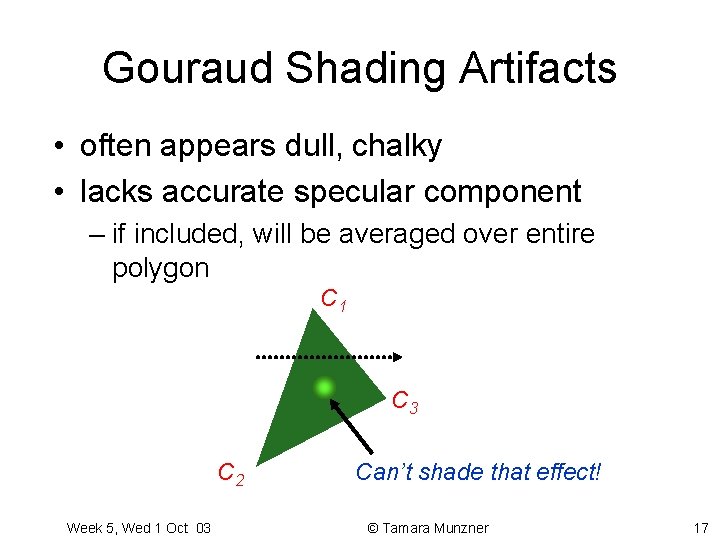
Gouraud Shading Artifacts • often appears dull, chalky • lacks accurate specular component – if included, will be averaged over entire polygon C 1 C 3 C 2 Week 5, Wed 1 Oct 03 Can’t shade that effect! © Tamara Munzner 17
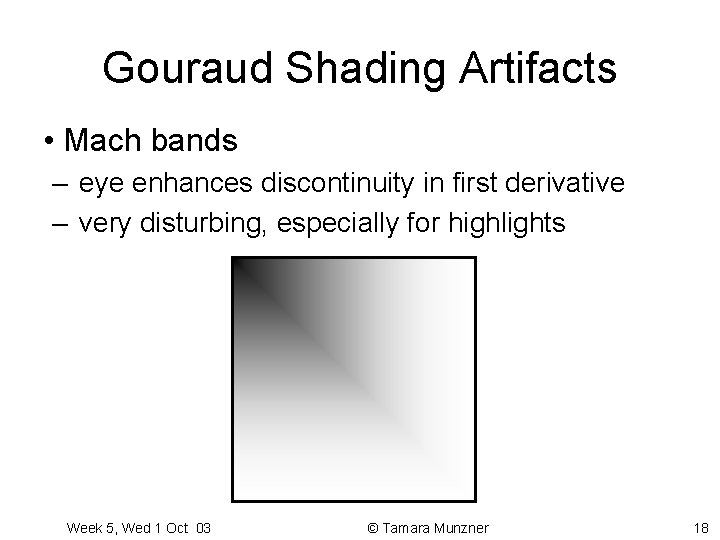
Gouraud Shading Artifacts • Mach bands – eye enhances discontinuity in first derivative – very disturbing, especially for highlights Week 5, Wed 1 Oct 03 © Tamara Munzner 18
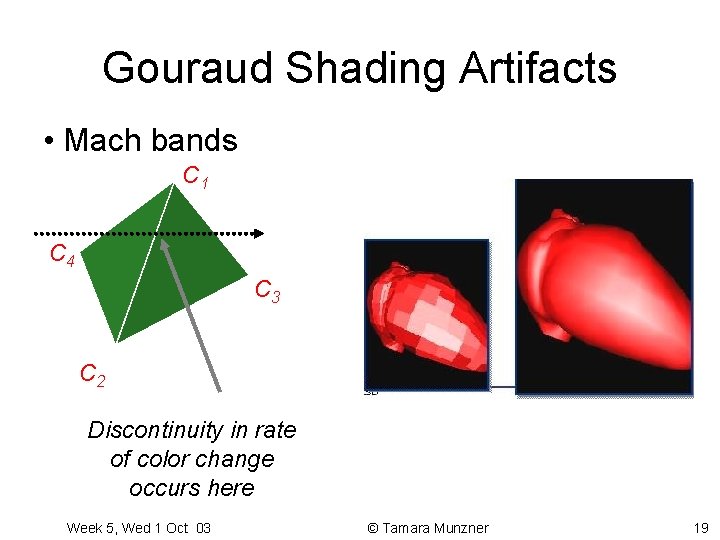
Gouraud Shading Artifacts • Mach bands C 1 C 4 C 3 C 2 Discontinuity in rate of color change occurs here Week 5, Wed 1 Oct 03 © Tamara Munzner 19
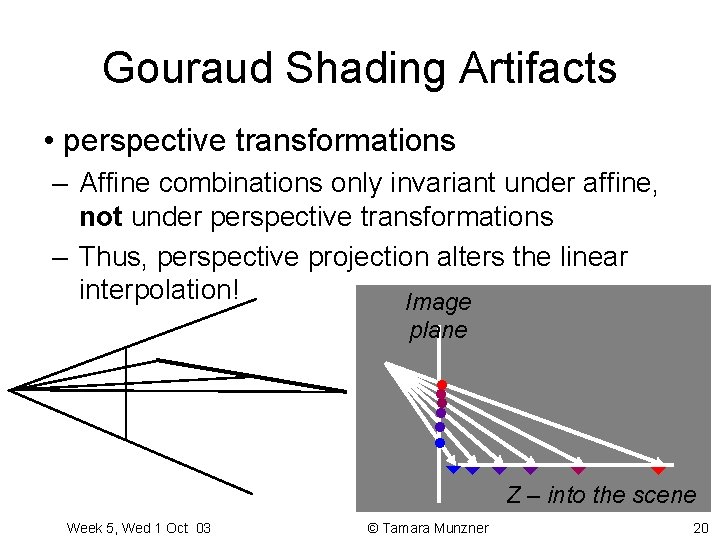
Gouraud Shading Artifacts • perspective transformations – Affine combinations only invariant under affine, not under perspective transformations – Thus, perspective projection alters the linear interpolation! Image plane i i i uuu u Z – into the scene Week 5, Wed 1 Oct 03 © Tamara Munzner 20
Gouraud Shading Artifacts • perspective transformation problem – colors slightly “swim” on the surface as objects move relative to the camera – usually ignored since often only small difference • usually smaller than changes from lighting variations – to do it right • either shading in object space • or correction for perspective foreshortening • expensive – thus hardly ever done for colors Week 5, Wed 1 Oct 03 © Tamara Munzner 21
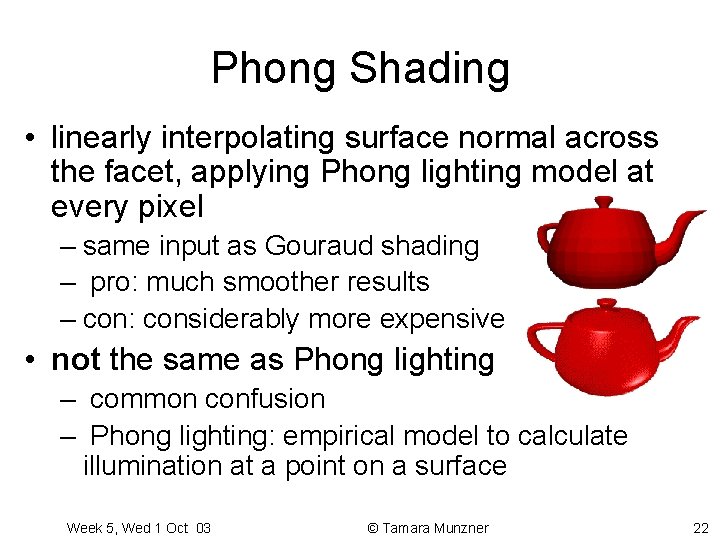
Phong Shading • linearly interpolating surface normal across the facet, applying Phong lighting model at every pixel – same input as Gouraud shading – pro: much smoother results – con: considerably more expensive • not the same as Phong lighting – common confusion – Phong lighting: empirical model to calculate illumination at a point on a surface Week 5, Wed 1 Oct 03 © Tamara Munzner 22
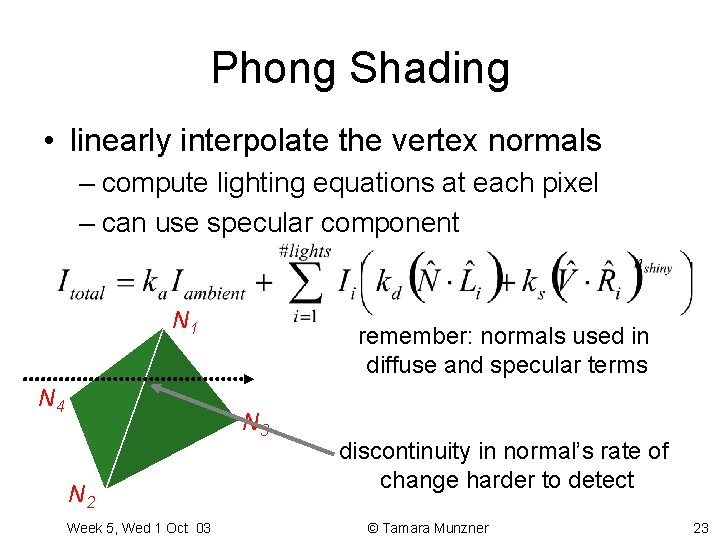
Phong Shading • linearly interpolate the vertex normals – compute lighting equations at each pixel – can use specular component N 1 N 4 remember: normals used in diffuse and specular terms N 3 N 2 Week 5, Wed 1 Oct 03 discontinuity in normal’s rate of change harder to detect © Tamara Munzner 23
Phong Shading Difficulties • computationally expensive – per-pixel vector normalization and lighting computation! – floating point operations required • lighting after perspective projection – messes up the angles between vectors – have to keep eye-space vectors around • no direct support in hardware – but can be simulated with texture mapping Week 5, Wed 1 Oct 03 © Tamara Munzner 24
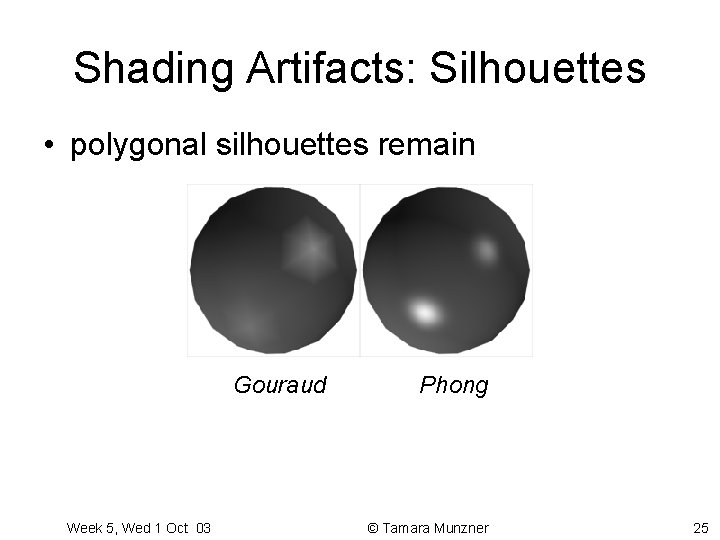
Shading Artifacts: Silhouettes • polygonal silhouettes remain Gouraud Week 5, Wed 1 Oct 03 Phong © Tamara Munzner 25
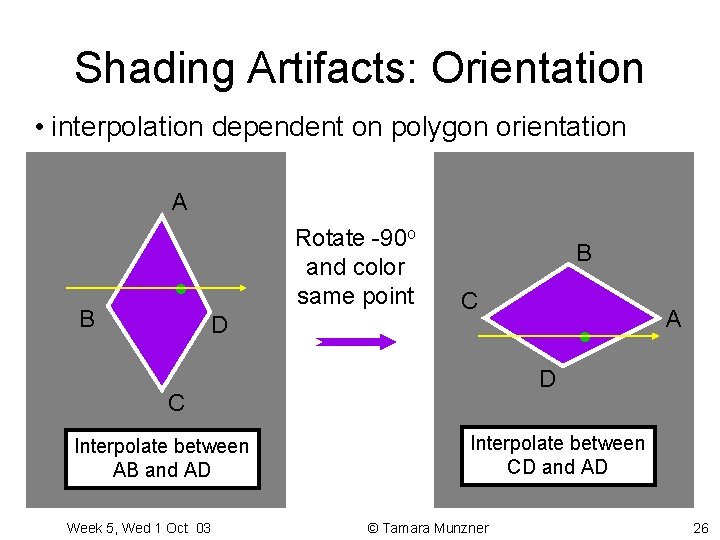
Shading Artifacts: Orientation • interpolation dependent on polygon orientation A i D B C i B Rotate -90 o and color same point D C Interpolate between AB and AD Week 5, Wed 1 Oct 03 A Interpolate between CD and AD © Tamara Munzner 26
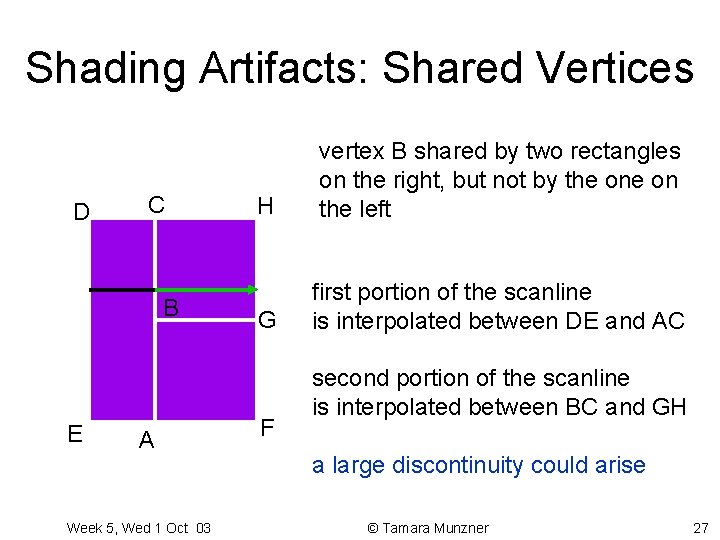
Shading Artifacts: Shared Vertices D C B E A Week 5, Wed 1 Oct 03 H vertex B shared by two rectangles on the right, but not by the on the left G first portion of the scanline is interpolated between DE and AC F second portion of the scanline is interpolated between BC and GH a large discontinuity could arise © Tamara Munzner 27
Shading Models Summary • flat shading – compute Phong lighting once for entire polygon • Gouraud shading – compute Phong lighting at the vertices and interpolate lighting values across polygon • Phong shading – compute averaged vertex normals – interpolate normals across polygon and perform Phong lighting across polygon Week 5, Wed 1 Oct 03 © Tamara Munzner 28
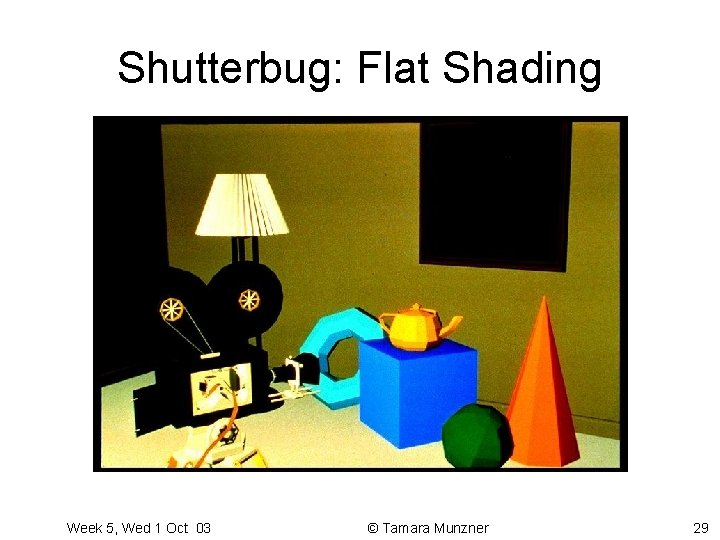
Shutterbug: Flat Shading Week 5, Wed 1 Oct 03 © Tamara Munzner 29
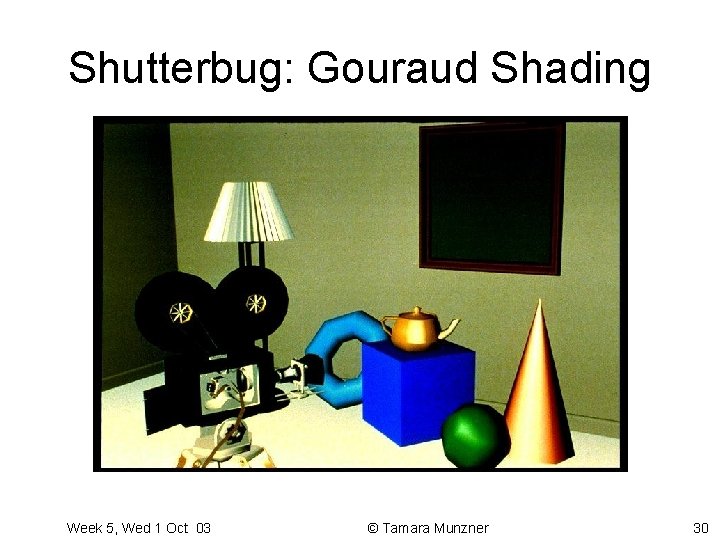
Shutterbug: Gouraud Shading Week 5, Wed 1 Oct 03 © Tamara Munzner 30
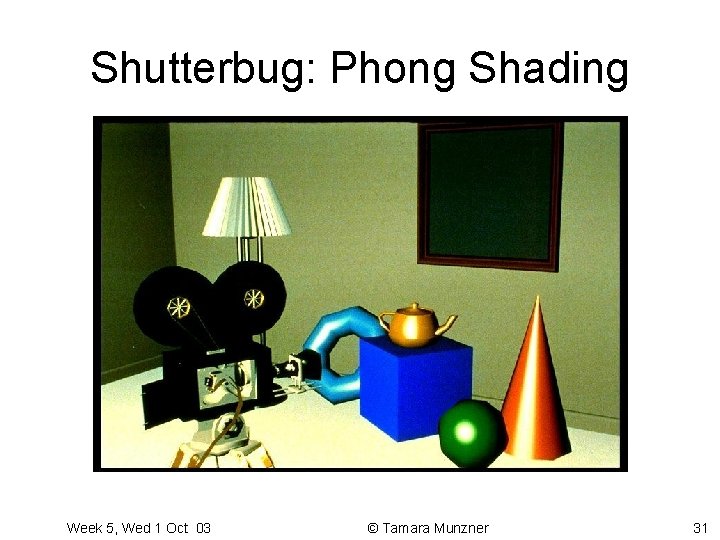
Shutterbug: Phong Shading Week 5, Wed 1 Oct 03 © Tamara Munzner 31
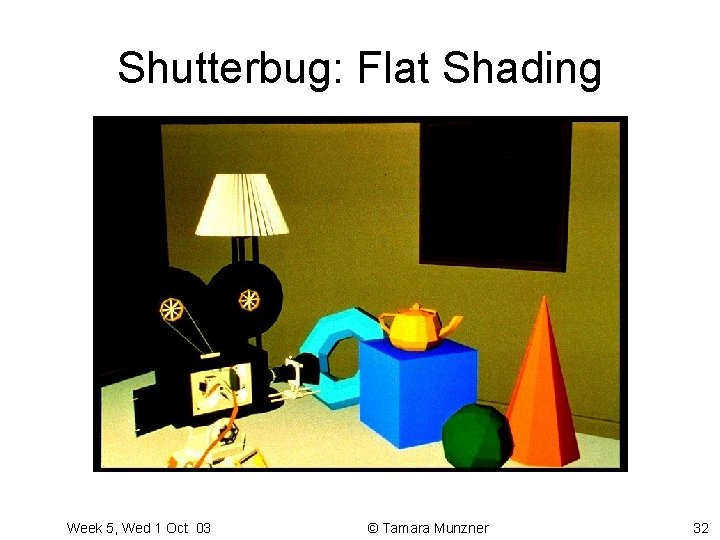
Shutterbug: Flat Shading Week 5, Wed 1 Oct 03 © Tamara Munzner 32
- Slides: 32