
University of British Columbia CPSC 314 Computer Graphics
University of British Columbia CPSC 314 Computer Graphics Jan-Apr 2007 Tamara Munzner Advanced Rendering II Week 7, Fri Mar 2 • http: //www. ugrad. cs. ubc. ca/~cs 314/Vjan 2007
Reading for Last and This Time • FCG Chap 10 Ray Tracing • only 10. 1 -10. 7 • FCG Chap 25 Image-Based Rendering 2

News • signup sheet for P 2 grading • Mon 11 -12, 2 -3, 5 -5: 30 • Tue 11 -1 • Wed 11 -12, 2 -3, 5 -5: 30 3
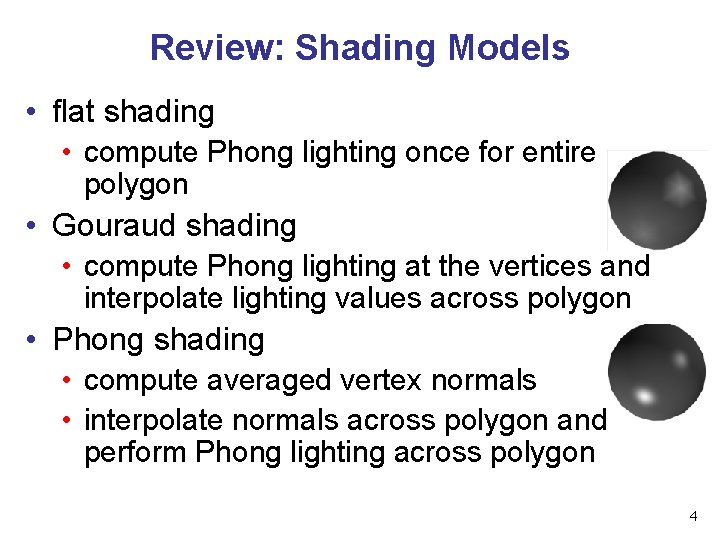
Review: Shading Models • flat shading • compute Phong lighting once for entire polygon • Gouraud shading • compute Phong lighting at the vertices and interpolate lighting values across polygon • Phong shading • compute averaged vertex normals • interpolate normals across polygon and perform Phong lighting across polygon 4
Review/Clarification: Specifying Normals • Open. GL state machine • uses last normal specified • if no normals specified, assumes all identical • per-vertex normals gl. Normal 3 f(1, 1, 1); gl. Vertex 3 f(3, 4, 5); gl. Normal 3 f(1, 1, 0); gl. Vertex 3 f(10, 5, 2); • per-face normals gl. Normal 3 f(1, 1, 1); gl. Vertex 3 f(3, 4, 5); gl. Vertex 3 f(10, 5, 2); • normal interpreted as direction from vertex location • can automatically normalize (computational cost) gl. Enable(GL_NORMALIZE); 5
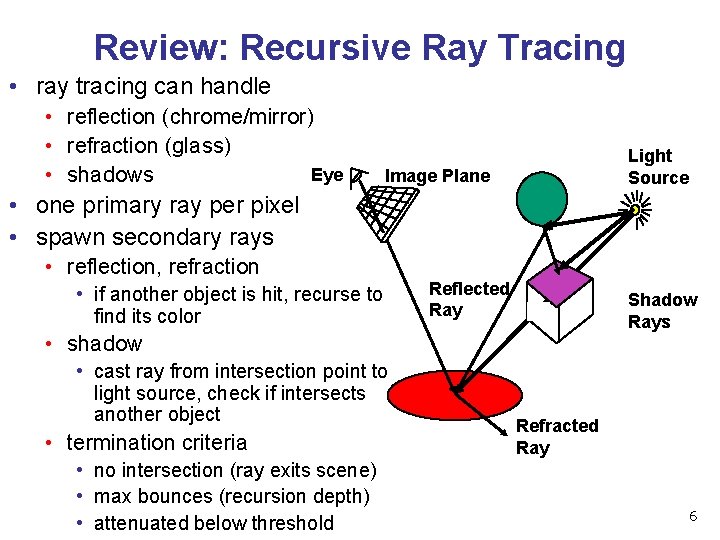
Review: Recursive Ray Tracing • ray tracing can handle • reflection (chrome/mirror) • refraction (glass) Eye • shadows Light Source Image Plane • one primary ray per pixel • spawn secondary rays • reflection, refraction • if another object is hit, recurse to find its color Reflected Ray Shadow Rays • shadow • cast ray from intersection point to light source, check if intersects another object • termination criteria • no intersection (ray exits scene) • max bounces (recursion depth) • attenuated below threshold Refracted Ray 6
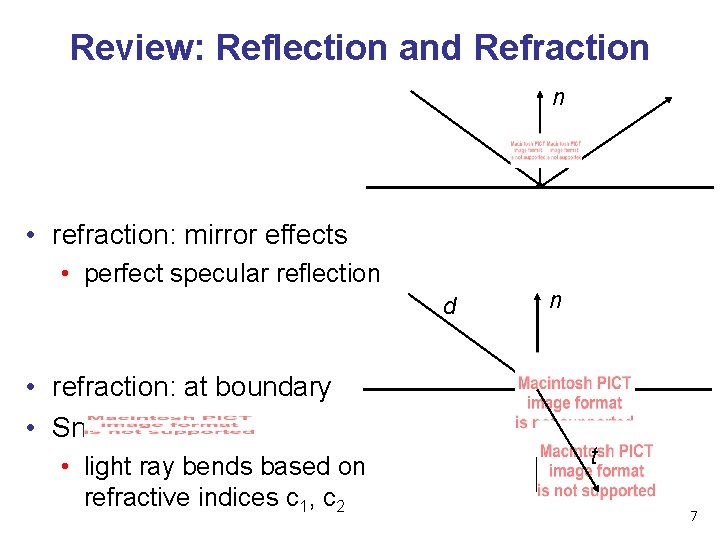
Review: Reflection and Refraction n • refraction: mirror effects • perfect specular reflection d • refraction: at boundary • Snell’s Law • light ray bends based on refractive indices c 1, c 2 n t 7
Advanced Rendering II 8
Ray Trees • all rays directly or indirectly spawned off by a single primary ray w. cs. virginia. edu/~gfx/Courses/2003/Intro. fall. 03/slides/lighting_web/lighting. pdf 9
Ray Tracing • issues: • • • generation of rays intersection of rays with geometric primitives geometric transformations lighting and shading efficient data structures so we don’t have to test intersection with every object 10
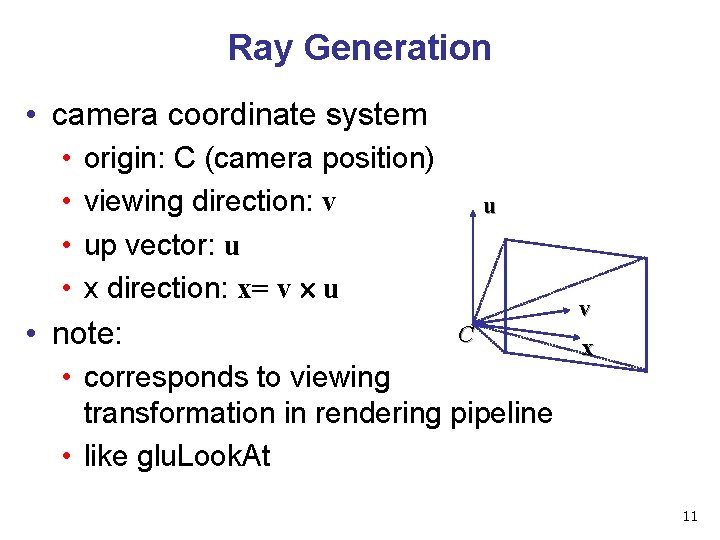
Ray Generation • camera coordinate system • • origin: C (camera position) viewing direction: v up vector: u x direction: x= v u • note: u C • corresponds to viewing transformation in rendering pipeline • like glu. Look. At v x 11
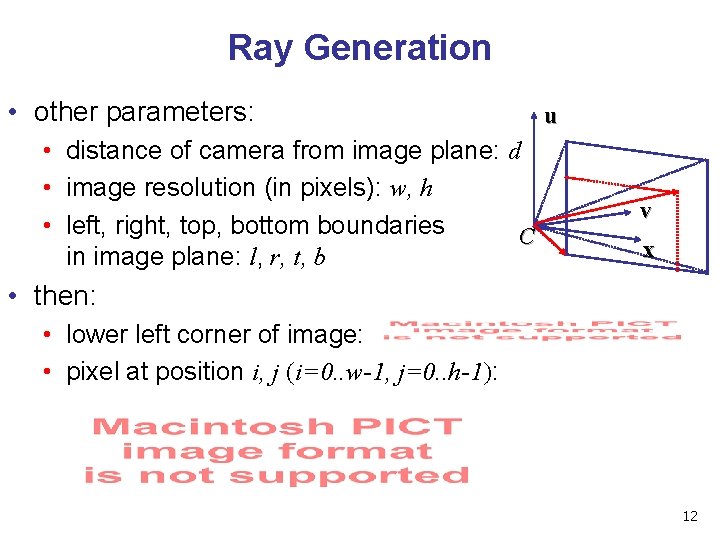
Ray Generation • other parameters: • distance of camera from image plane: d • image resolution (in pixels): w, h • left, right, top, bottom boundaries C in image plane: l, r, t, b u v x • then: • lower left corner of image: • pixel at position i, j (i=0. . w-1, j=0. . h-1): 12
Ray Generation • ray in 3 D space: where t= 0… 13
Ray Tracing • issues: • • • generation of rays intersection of rays with geometric primitives geometric transformations lighting and shading efficient data structures so we don’t have to test intersection with every object 14
Ray - Object Intersections • inner loop of ray-tracing • must be extremely efficient • task: given an object o, find ray parameter t, such that Ri, j(t) is a point on the object • such a value for t may not exist • solve a set of equations • intersection test depends on geometric primitive • ray-sphere • ray-triangle • ray-polygon 15
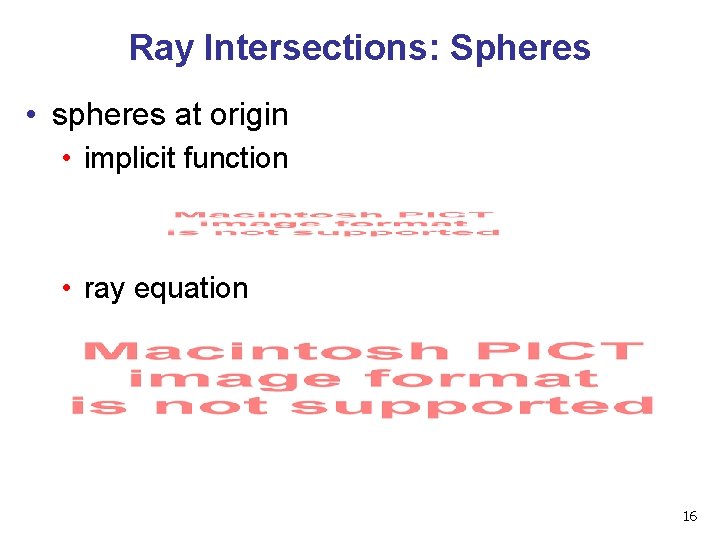
Ray Intersections: Spheres • spheres at origin • implicit function • ray equation 16
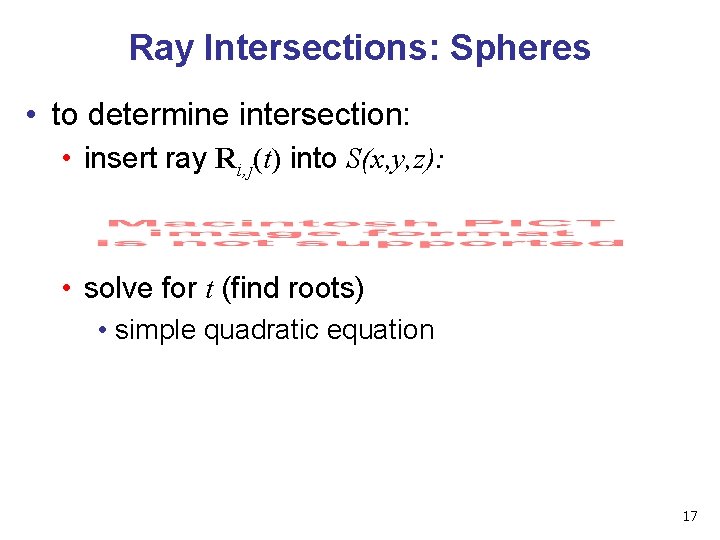
Ray Intersections: Spheres • to determine intersection: • insert ray Ri, j(t) into S(x, y, z): • solve for t (find roots) • simple quadratic equation 17
Ray Intersections: Other Primitives • implicit functions • spheres at arbitrary positions • same thing • conic sections (hyperboloids, ellipsoids, paraboloids, cones, cylinders) • same thing (all are quadratic functions!) • polygons • first intersect ray with plane • linear implicit function • then test whether point is inside or outside of polygon (2 D test) • for convex polygons • suffices to test whether point in on the correct side of every boundary edge • similar to computation of outcodes in line clipping (upcoming) 18
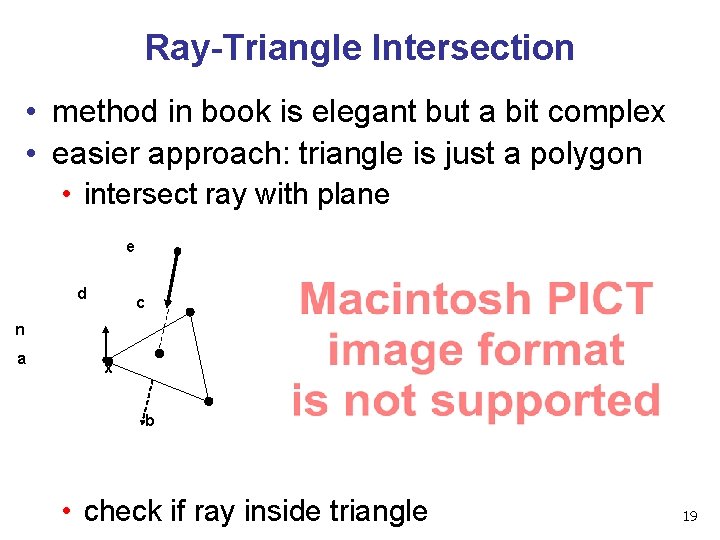
Ray-Triangle Intersection • method in book is elegant but a bit complex • easier approach: triangle is just a polygon • intersect ray with plane e d c n a x b • check if ray inside triangle 19
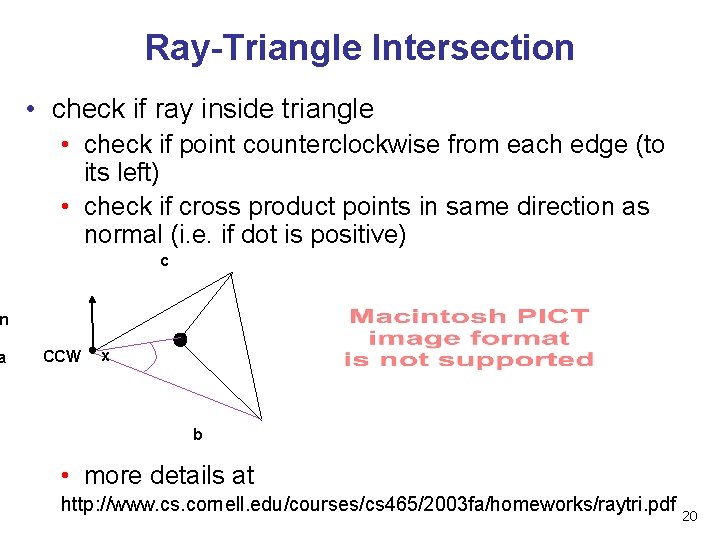
Ray-Triangle Intersection • check if ray inside triangle • check if point counterclockwise from each edge (to its left) • check if cross product points in same direction as normal (i. e. if dot is positive) c n a CCW x b • more details at http: //www. cs. cornell. edu/courses/cs 465/2003 fa/homeworks/raytri. pdf 20
Ray Tracing • issues: • • • generation of rays intersection of rays with geometric primitives geometric transformations lighting and shading efficient data structures so we don’t have to test intersection with every object 21
Geometric Transformations • similar goal as in rendering pipeline: • modeling scenes more convenient using different coordinate systems for individual objects • problem • not all object representations are easy to transform • problem is fixed in rendering pipeline by restriction to polygons, which are affine invariant • ray tracing has different solution • ray itself is always affine invariant • thus: transform ray into object coordinates! 22
Geometric Transformations • ray transformation • for intersection test, it is only important that ray is in same coordinate system as object representation • transform all rays into object coordinates • transform camera point and ray direction by inverse of model/view matrix • shading has to be done in world coordinates (where light sources are given) • transform object space intersection point to world coordinates • thus have to keep both world and object-space ray 23
Ray Tracing • issues: • • • generation of rays intersection of rays with geometric primitives geometric transformations lighting and shading efficient data structures so we don’t have to test intersection with every object 24
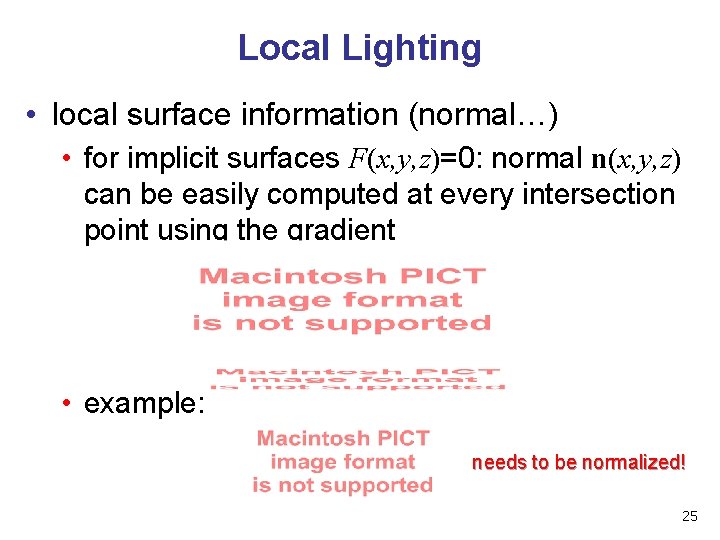
Local Lighting • local surface information (normal…) • for implicit surfaces F(x, y, z)=0: normal n(x, y, z) can be easily computed at every intersection point using the gradient • example: needs to be normalized! 25
Local Lighting • local surface information • alternatively: can interpolate per-vertex information for triangles/meshes as in rendering pipeline • now easy to use Phong shading! • as discussed for rendering pipeline • difference with rendering pipeline: • interpolation cannot be done incrementally • have to compute barycentric coordinates for every intersection point (e. g plane equation for triangles) 26
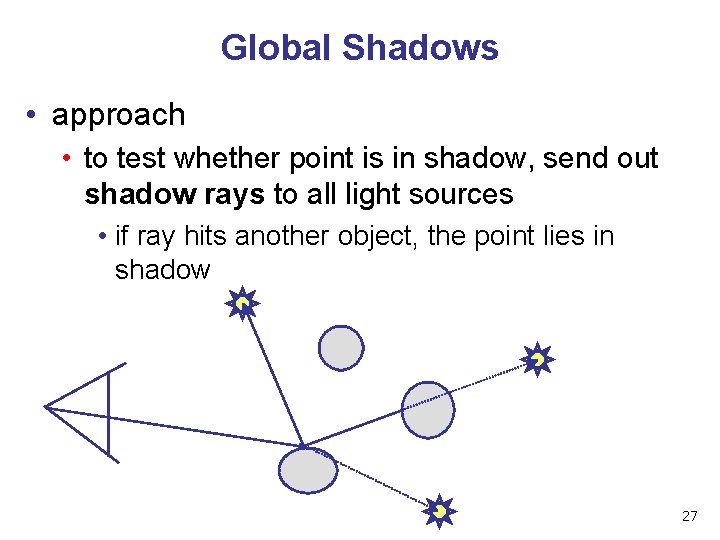
Global Shadows • approach • to test whether point is in shadow, send out shadow rays to all light sources • if ray hits another object, the point lies in shadow 27
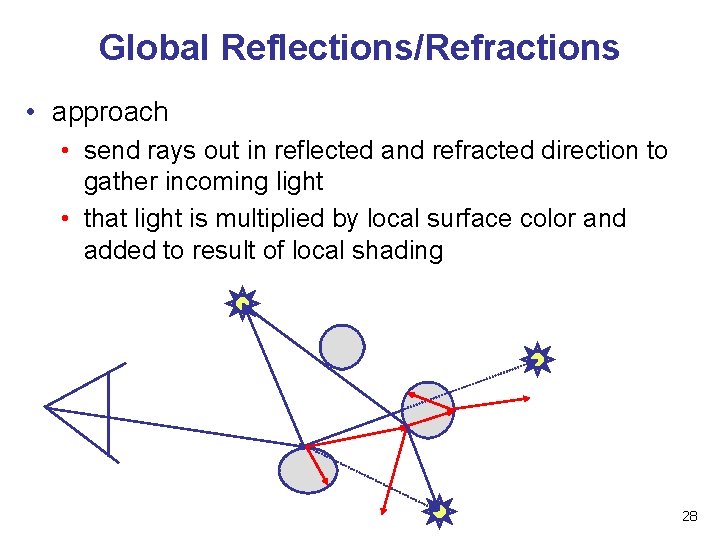
Global Reflections/Refractions • approach • send rays out in reflected and refracted direction to gather incoming light • that light is multiplied by local surface color and added to result of local shading 28
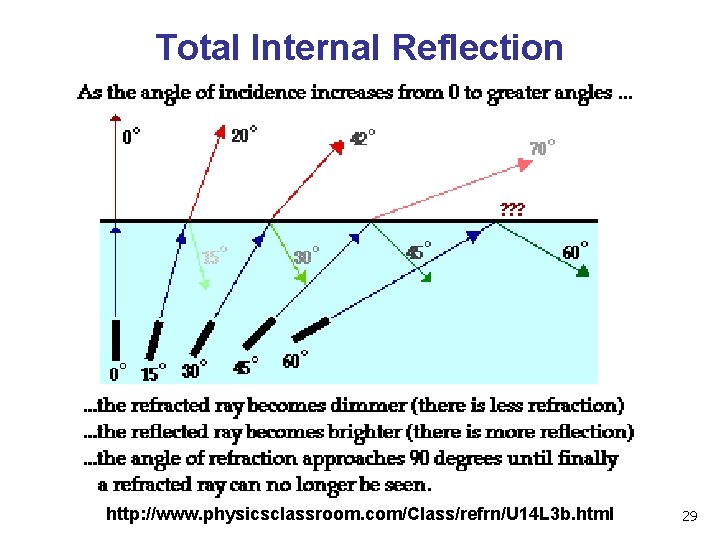
Total Internal Reflection http: //www. physicsclassroom. com/Class/refrn/U 14 L 3 b. html 29
Ray Tracing • issues: • • • generation of rays intersection of rays with geometric primitives geometric transformations lighting and shading efficient data structures so we don’t have to test intersection with every object 30
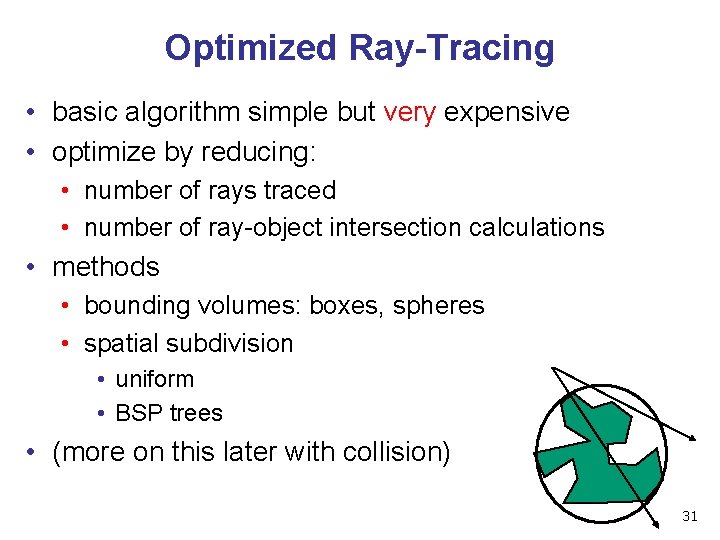
Optimized Ray-Tracing • basic algorithm simple but very expensive • optimize by reducing: • number of rays traced • number of ray-object intersection calculations • methods • bounding volumes: boxes, spheres • spatial subdivision • uniform • BSP trees • (more on this later with collision) 31
Example Images 32
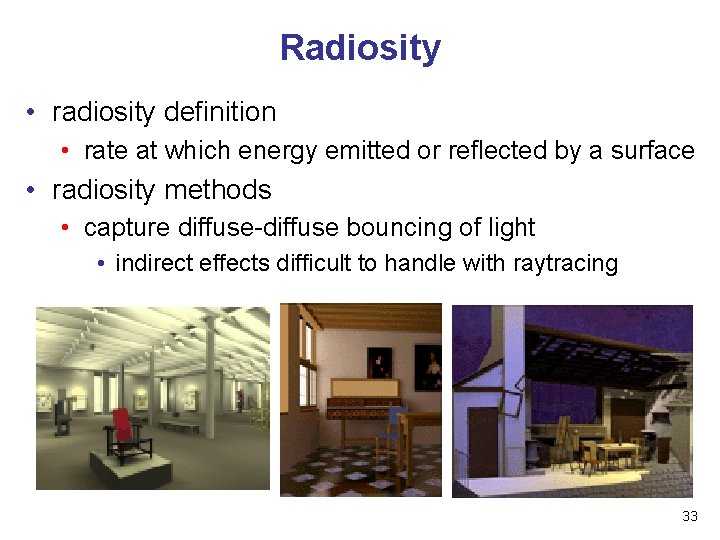
Radiosity • radiosity definition • rate at which energy emitted or reflected by a surface • radiosity methods • capture diffuse-diffuse bouncing of light • indirect effects difficult to handle with raytracing 33
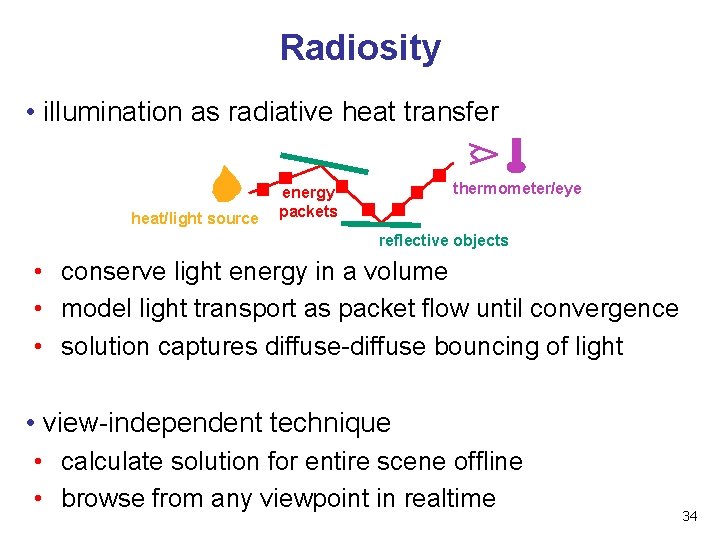
Radiosity • illumination as radiative heat transfer heat/light source thermometer/eye energy packets reflective objects • conserve light energy in a volume • model light transport as packet flow until convergence • solution captures diffuse-diffuse bouncing of light • view-independent technique • calculate solution for entire scene offline • browse from any viewpoint in realtime 34
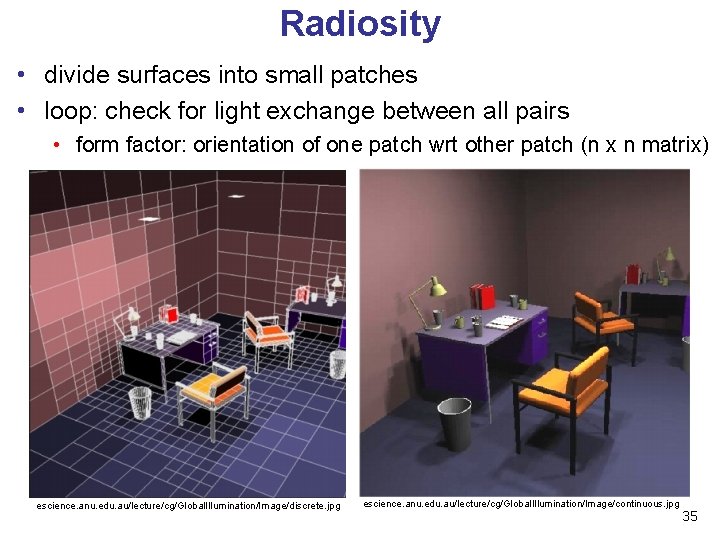
Radiosity • divide surfaces into small patches • loop: check for light exchange between all pairs • form factor: orientation of one patch wrt other patch (n x n matrix) [IBM] escience. anu. edu. au/lecture/cg/Global. Illumination/Image/discrete. jpg escience. anu. edu. au/lecture/cg/Global. Illumination/Image/continuous. jpg 35
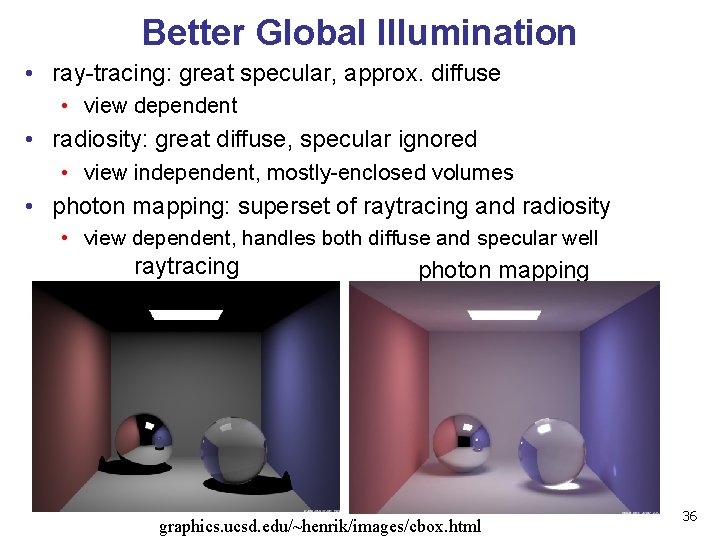
Better Global Illumination • ray-tracing: great specular, approx. diffuse • view dependent • radiosity: great diffuse, specular ignored • view independent, mostly-enclosed volumes • photon mapping: superset of raytracing and radiosity • view dependent, handles both diffuse and specular well raytracing photon mapping graphics. ucsd. edu/~henrik/images/cbox. html 36
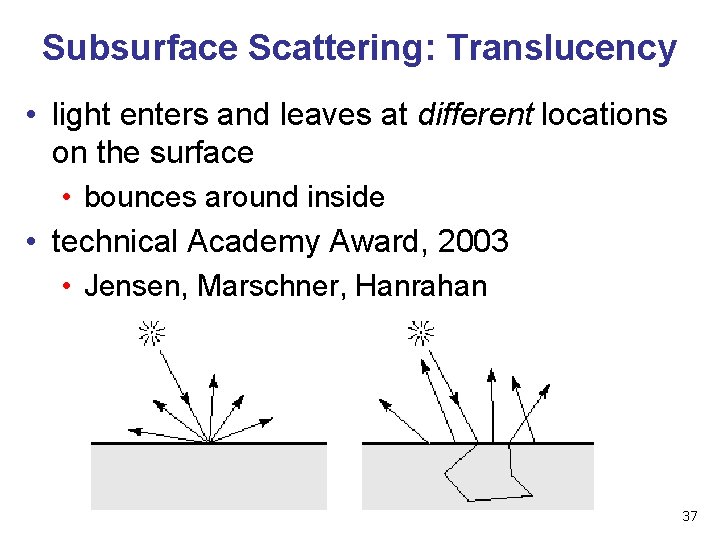
Subsurface Scattering: Translucency • light enters and leaves at different locations on the surface • bounces around inside • technical Academy Award, 2003 • Jensen, Marschner, Hanrahan 37
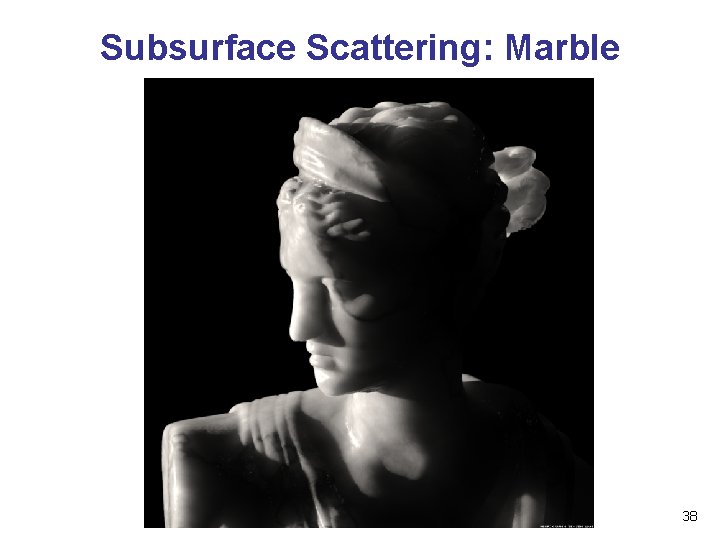
Subsurface Scattering: Marble 38
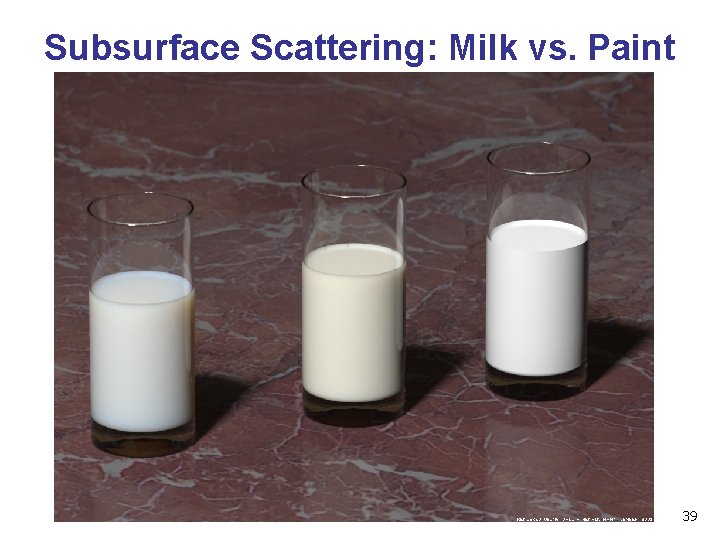
Subsurface Scattering: Milk vs. Paint 39
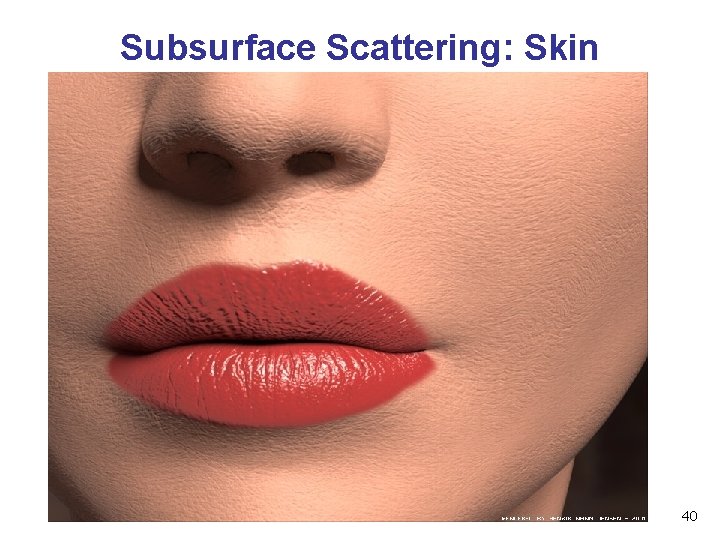
Subsurface Scattering: Skin 40
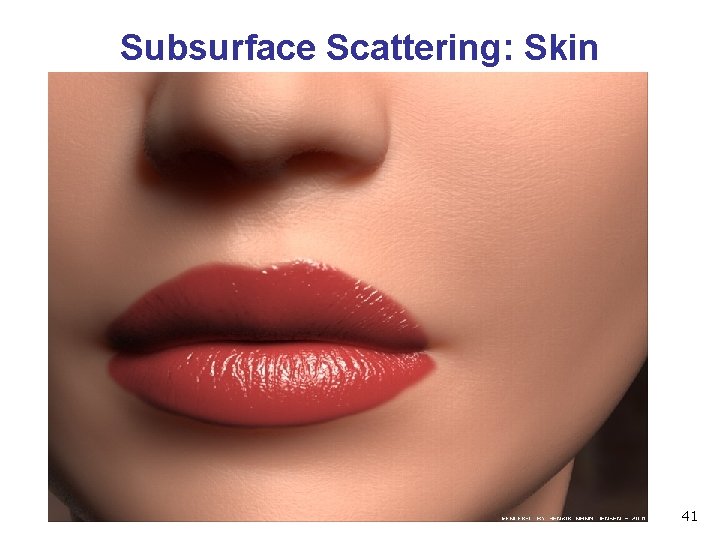
Subsurface Scattering: Skin 41
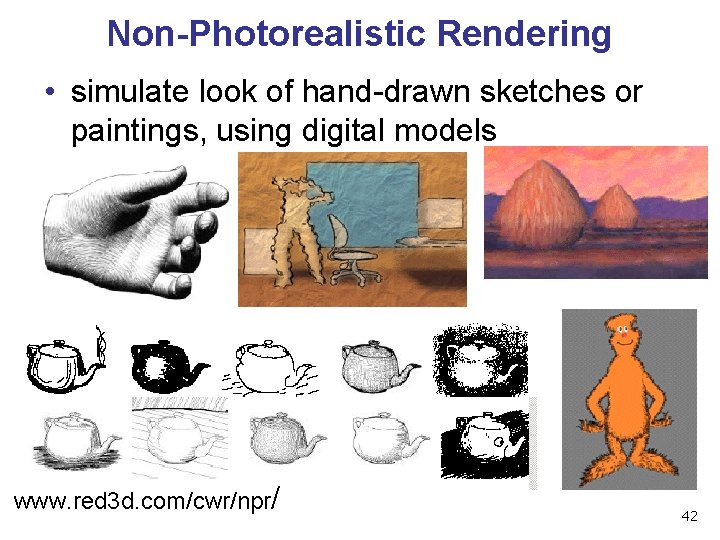
Non-Photorealistic Rendering • simulate look of hand-drawn sketches or paintings, using digital models www. red 3 d. com/cwr/npr/ 42
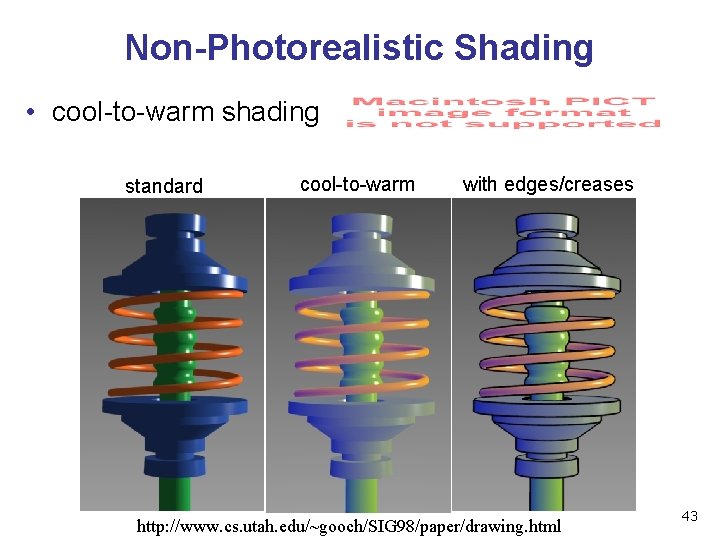
Non-Photorealistic Shading • cool-to-warm shading standard cool-to-warm with edges/creases http: //www. cs. utah. edu/~gooch/SIG 98/paper/drawing. html 43
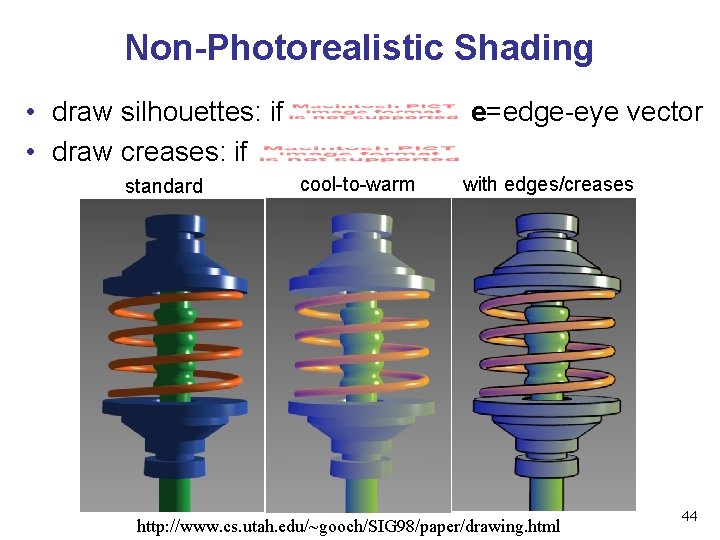
Non-Photorealistic Shading • draw silhouettes: if • draw creases: if standard , e=edge-eye vector cool-to-warm with edges/creases http: //www. cs. utah. edu/~gooch/SIG 98/paper/drawing. html 44
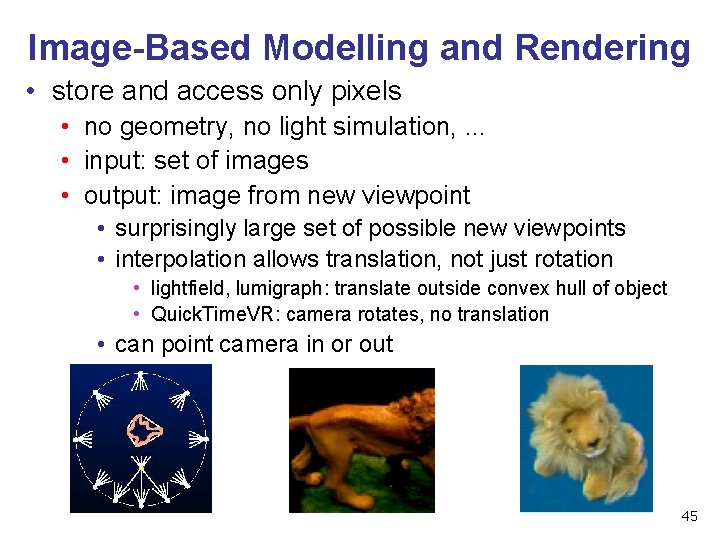
Image-Based Modelling and Rendering • store and access only pixels • no geometry, no light simulation, . . . • input: set of images • output: image from new viewpoint • surprisingly large set of possible new viewpoints • interpolation allows translation, not just rotation • lightfield, lumigraph: translate outside convex hull of object • Quick. Time. VR: camera rotates, no translation • can point camera in or out 45
Image-Based Rendering • display time not tied to scene complexity • expensive rendering or real photographs • example: Matrix bullet-time scene • array of many cameras allows virtual camera to "freeze time" • convergence of graphics, vision, photography • computational photography 46
- Slides: 46