
University of British Columbia CPSC 111 Intro to
University of British Columbia CPSC 111, Intro to Computation Jan-Apr 2006 Tamara Munzner Class Design III Lecture 8, Tue Jan 31 2006 based on slides by Paul Carter http: //www. cs. ubc. ca/~tmm/courses/cpsc 111 -06 -spr
Reading This Week n n n Chap 3 (today) Re-read Chapter 4. 3 -4. 5 (Thursday) reminder - code examples created in class posted by slides and assigned reading
News n n Assignment 1 due today 5 pm Wed office hours 11: 30 -12: 30 not 11 -12 n n n reminder: in X 661 Windows home setup guide posted to Web. CT Reminders n n CSLC is available if you need help Check ugrad email account regularly (or forward to active account) n grade info sent there
Exam n Midterm reminder: Tue Feb 7, 18: 30 - 20: 00 n Geography 100 & 200 n Exam conflict: email me today n DRC: Disability Resource Center n n n academic accomodation for disabilities forms due one week before exam (today!) http: //students. ubc. ca/access/drc. cfm

Correction: UML n UML diagram representing class design Classname + field: type - field: type fields + Classname() + method(): return type + method(param 1 type, param 2 type): return type - method(): return type methods
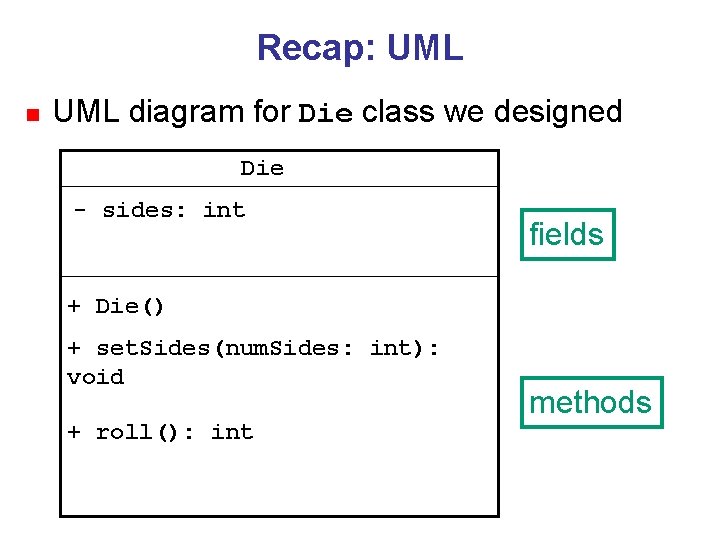
Recap: UML n UML diagram for Die class we designed Die - sides: int fields + Die() + set. Sides(num. Sides: int): void + roll(): int methods
Objectives n n n understand how to design new classes using abstraction and encapsulation understand how to implement new classes in Java understand how to comment classes using javadoc conventions understand how to create documentation using javadoc understand how to finish refining code
Recap: Separation and Modularity n Design possibilities n Die and Roll. Die as separate classes n one single class that does it all n Separation allows code re-use through modularity n another software design principle One module for modeling a die: Die class n Other modules can use die or dice n n n we wrote one, the Roll. Dice class Modularization also occurs at file level n n modules stored in different files also makes re-use easier
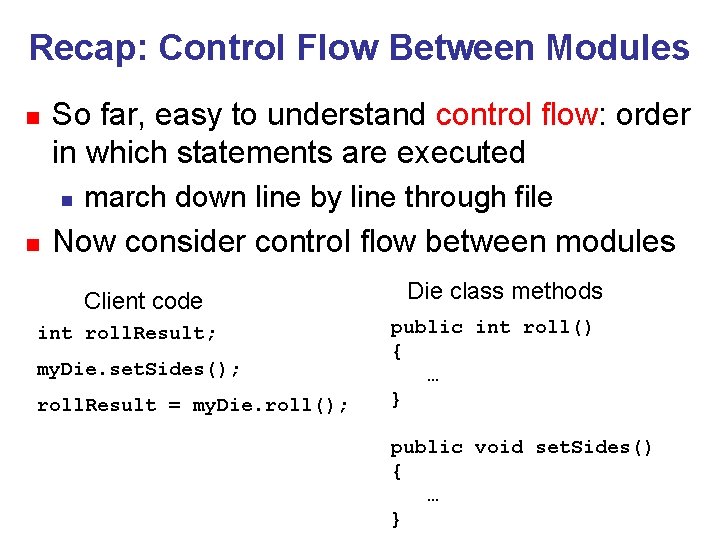
Recap: Control Flow Between Modules n So far, easy to understand control flow: order in which statements are executed n n march down line by line through file Now consider control flow between modules Client code int roll. Result; my. Die. set. Sides(); roll. Result = my. Die. roll(); Die class methods public int roll() { … } public void set. Sides() { … }
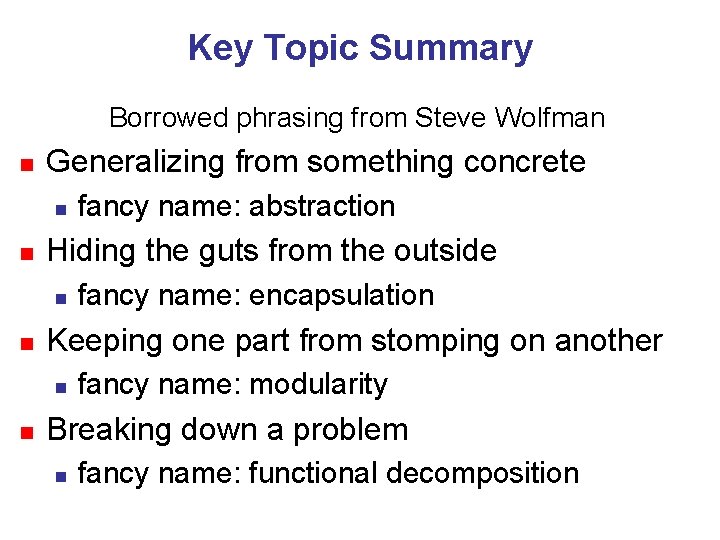
Key Topic Summary Borrowed phrasing from Steve Wolfman n Generalizing from something concrete n n Hiding the guts from the outside n n fancy name: encapsulation Keeping one part from stomping on another n n fancy name: abstraction fancy name: modularity Breaking down a problem n fancy name: functional decomposition
Implementing Point and Point. Test public class Point { }
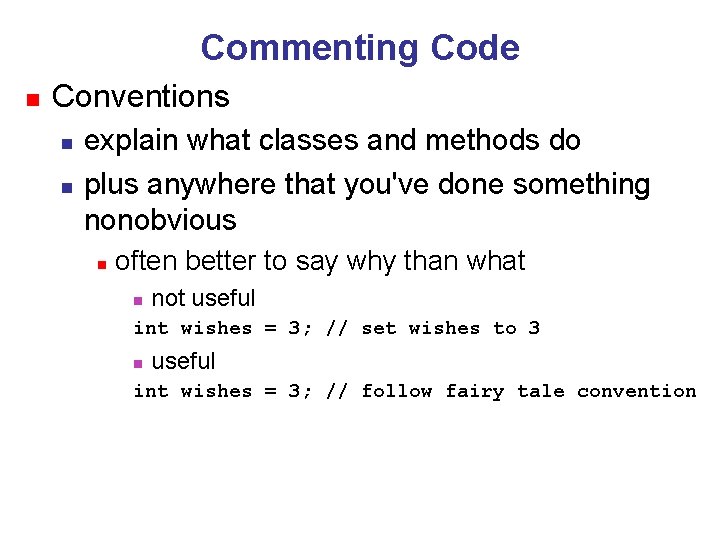
Commenting Code n Conventions n n explain what classes and methods do plus anywhere that you've done something nonobvious n often better to say why than what n not useful int wishes = 3; // set wishes to 3 n useful int wishes = 3; // follow fairy tale convention
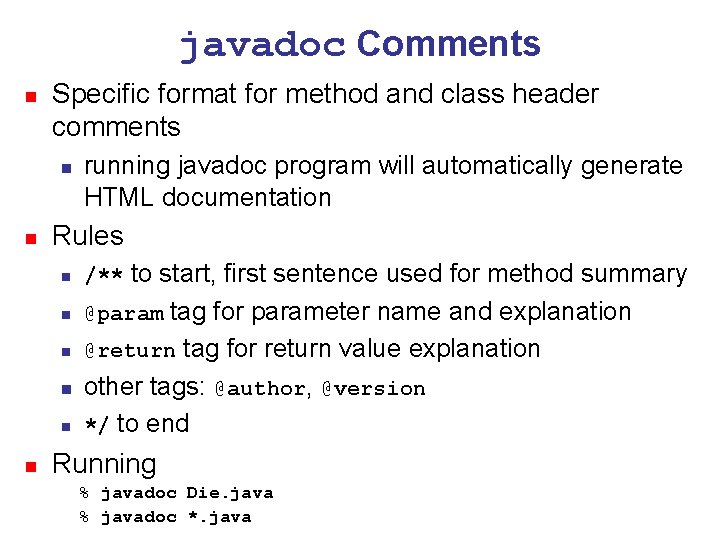
javadoc Comments n Specific format for method and class header comments n n Rules n /** to start, first sentence used for method summary n @param tag for parameter name and explanation n @return tag for return value explanation n running javadoc program will automatically generate HTML documentation other tags: @author, @version */ to end Running % javadoc Die. java % javadoc *. java

javadoc Method Comment Example /** Sets the die shape, thus the range of values it can roll. @param num. Sides the number of sides of the die */ public void set. Sides(int num. Sides) { sides = num. Sides; } /** Gets the number of sides of the die. @return the number of sides of the die */ public int get. Sides() { return sides; }
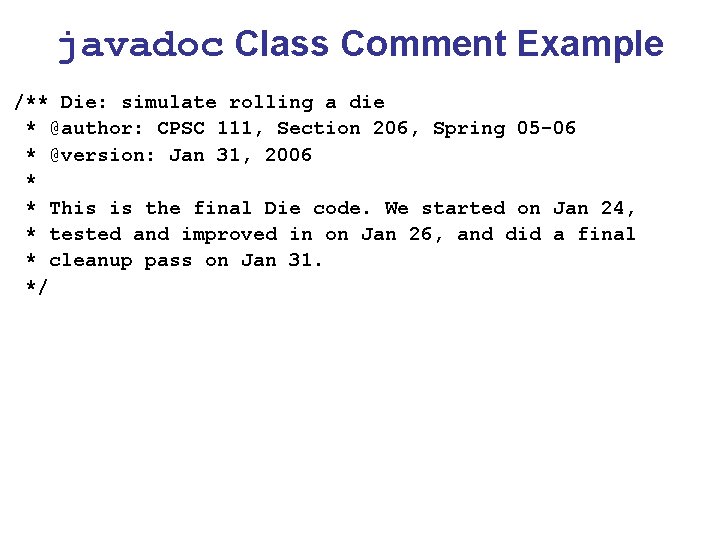
javadoc Class Comment Example /** Die: simulate rolling a die * @author: CPSC 111, Section 206, Spring 05 -06 * @version: Jan 31, 2006 * * This is the final Die code. We started on Jan 24, * tested and improved in on Jan 26, and did a final * cleanup pass on Jan 31. */
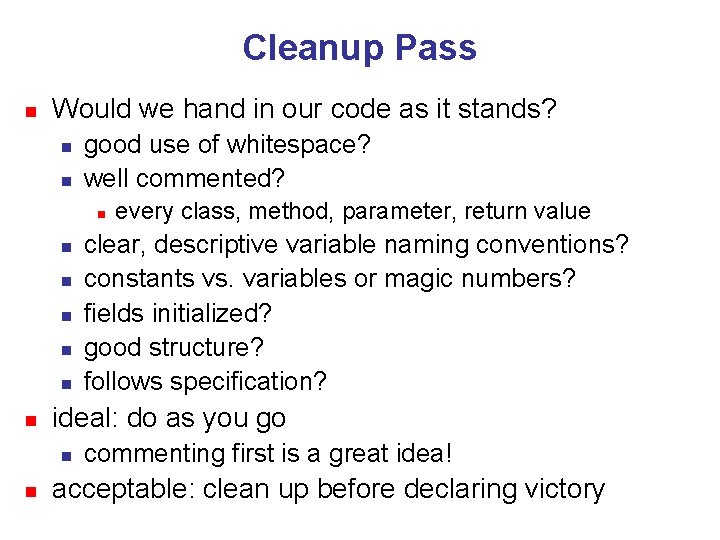
Cleanup Pass n Would we hand in our code as it stands? n n good use of whitespace? well commented? n n n n clear, descriptive variable naming conventions? constants vs. variables or magic numbers? fields initialized? good structure? follows specification? ideal: do as you go n n every class, method, parameter, return value commenting first is a great idea! acceptable: clean up before declaring victory

Formal vs. Actual Parameters n n formal parameter: in declaration of class actual parameter: passed in when method is called n n if parameter is primitive type n n n variable names may or may not match call by value: value of actual parameter copied into formal parameter when method is called changes made to formal parameter inside method body will not be reflected in actual parameter value outside of method if parameter is object: covered later
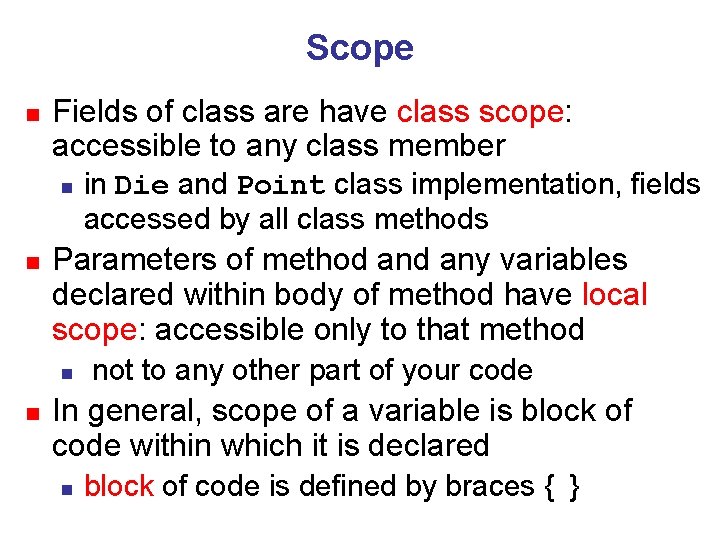
Scope n Fields of class are have class scope: accessible to any class member n n Parameters of method any variables declared within body of method have local scope: accessible only to that method n n in Die and Point class implementation, fields accessed by all class methods not to any other part of your code In general, scope of a variable is block of code within which it is declared n block of code is defined by braces { }
- Slides: 18