
University Of Brighton Lily Colgan Product Design with
University Of Brighton Lily Colgan Product Design with professional practice Visual Research report Module Leader: Eddy Elton LIVING WITH DIABETES
Contents 1 Introduction 2 Market Assessment 3 How well Is Diabetes Controlled 4 Competitor Analysis 5 Methodology 6 Observations 7 Interviews 8 Persona 9 Image Board 10 User Specification
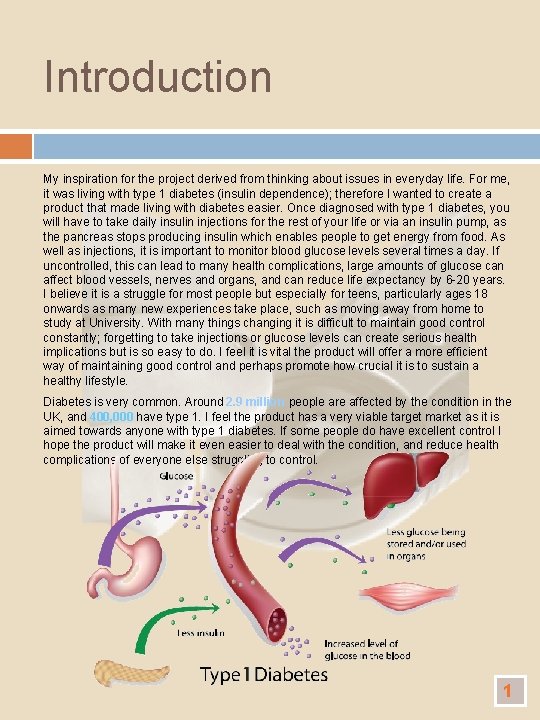
Introduction My inspiration for the project derived from thinking about issues in everyday life. For me, it was living with type 1 diabetes (insulin dependence); therefore I wanted to create a product that made living with diabetes easier. Once diagnosed with type 1 diabetes, you will have to take daily insulin injections for the rest of your life or via an insulin pump, as the pancreas stops producing insulin which enables people to get energy from food. As well as injections, it is important to monitor blood glucose levels several times a day. If uncontrolled, this can lead to many health complications, large amounts of glucose can affect blood vessels, nerves and organs, and can reduce life expectancy by 6 -20 years. I believe it is a struggle for most people but especially for teens, particularly ages 18 onwards as many new experiences take place, such as moving away from home to study at University. With many things changing it is difficult to maintain good control constantly; forgetting to take injections or glucose levels can create serious health implications but is so easy to do. I feel it is vital the product will offer a more efficient way of maintaining good control and perhaps promote how crucial it is to sustain a healthy lifestyle. Diabetes is very common. Around 2. 9 million people are affected by the condition in the UK, and 400, 000 have type 1. I feel the product has a very viable target market as it is aimed towards anyone with type 1 diabetes. If some people do have excellent control I hope the product will make it even easier to deal with the condition, and reduce health complications of everyone else struggling to control. 1
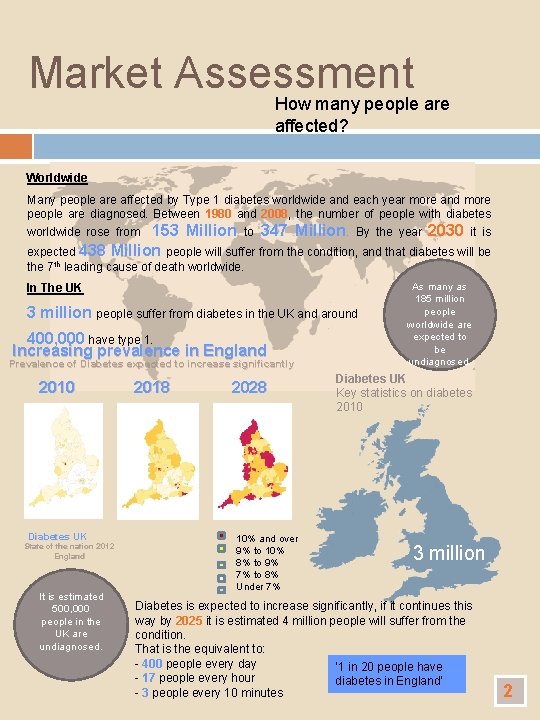
Market Assessment How many people are affected? Worldwide Many people are affected by Type 1 diabetes worldwide and each year more and more people are diagnosed. Between 1980 and 2008, the number of people with diabetes 153 Million to 347 Million. By the year 2030 it is expected 438 Million people will suffer from the condition, and that diabetes will be worldwide rose from the 7 th leading cause of death worldwide. In The UK 3 million people suffer from diabetes in the UK and around 400, 000 have type 1. Increasing prevalence in England Prevalence of Diabetes expected to increase significantly 2010 Diabetes UK State of the nation 2012 England It is estimated 500, 000 people in the UK are undiagnosed. 2018 2028 10% and over 9% to 10% 8% to 9% 7% to 8% Under 7% As many as 185 million people worldwide are expected to be undiagnosed. Diabetes UK Key statistics on diabetes 2010 3 million Diabetes is expected to increase significantly, if it continues this way by 2025 it is estimated 4 million people will suffer from the condition. That is the equivalent to: - 400 people every day ‘ 1 in 20 people have - 17 people every hour diabetes in England’ - 3 people every 10 minutes 2
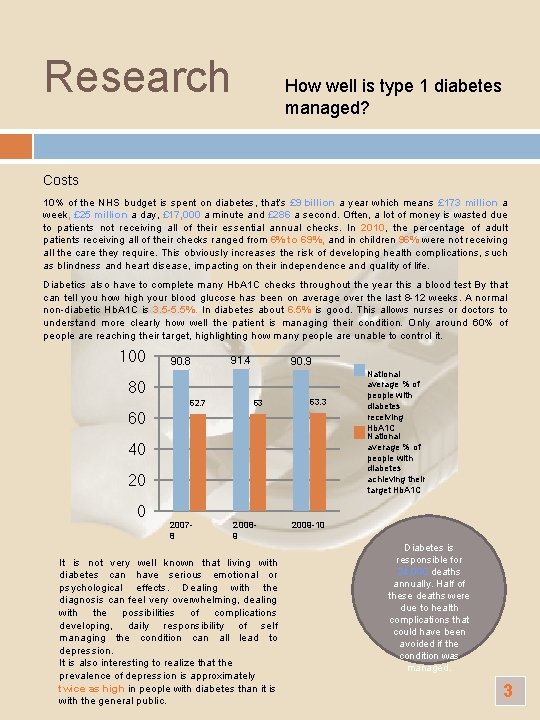
Research How well is type 1 diabetes managed? Costs 10% of the NHS budget is spent on diabetes, that’s £ 9 billion a year which means £ 173 million a week, £ 25 million a day, £ 17, 000 a minute and £ 286 a second. Often, a lot of money is wasted due to patients not receiving all of their essential annual checks. In 2010, the percentage of adult patients receiving all of their checks ranged from 6% to 69%, and in children 96% were not receiving all the care they require. This obviously increases the risk of developing health complications, such as blindness and heart disease, impacting on their independence and quality of life. Diabetics also have to complete many Hb. A 1 C checks throughout the year this a blood test By that can tell you how high your blood glucose has been on average over the last 8 -12 weeks. A normal non-diabetic Hb. A 1 C is 3. 5 -5. 5%. In diabetes about 6. 5% is good. This allows nurses or doctors to understand more clearly how well the patient is managing their condition. Only around 60% of people are reaching their target, highlighting how many people are unable to control it. 100 90. 8 91. 4 90. 9 80 62. 7 63 63. 3 60 40 20078 20089 It is not very well known that living with diabetes can have serious emotional or psychological effects. Dealing with the diagnosis can feel very overwhelming, dealing with the possibilities of complications developing, daily responsibility of self managing the condition can all lead to depression. It is also interesting to realize that the prevalence of depression is approximately twice as high in people with diabetes than it is with the general public. National average % of people with diabetes receiving Hb. A 1 C National average % of people with diabetes achieving their target Hb. A 1 C 2009 -10 Diabetes is responsible for 24, 000 deaths annually. Half of these deaths were due to health complications that could have been avoided if the condition was managed. 3
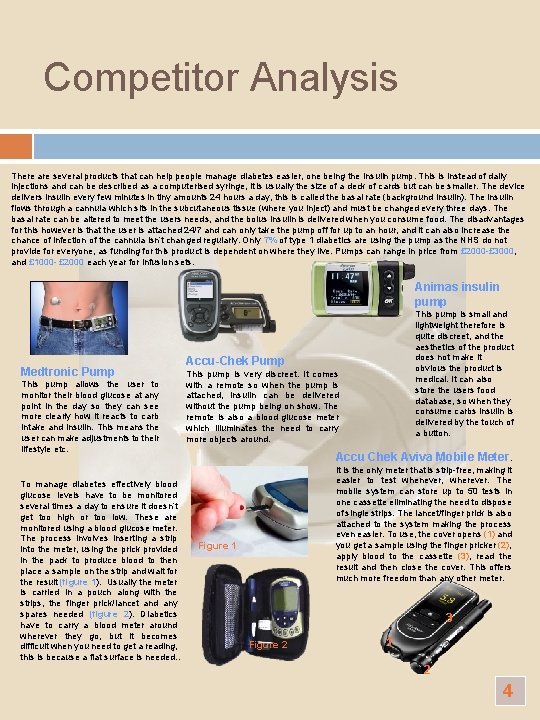
Competitor Analysis There are several products that can help people manage diabetes easier, one being the Insulin pump. This is instead of daily injections and can be described as a computerised syringe, it is usually the size of a deck of cards but can be smaller. The device delivers insulin every few minutes in tiny amounts 24 hours a day, this is called the basal rate (background insulin). The insulin flows through a cannula which sits in the subcutaneous tissue (where you inject) and must be changed every three days. The basal rate can be altered to meet the users needs, and the bolus insulin is delivered when you consume food. The disadvantages for this however is that the user is attached 24/7 and can only take the pump off for up to an hour, and it can also increase the chance of infection of the cannula isn’t changed regularly. Only 7% of type 1 diabetics are using the pump as the NHS do not provide for everyone, as funding for this product is dependent on where they live. Pumps can range in price from £ 2000 -£ 3000, and £ 1000 - £ 2000 each year for infusion sets. Animas insulin pump Medtronic Pump This pump allows the user to monitor their blood glucose at any point in the day so they can see more clearly how it reacts to carb intake and insulin. This means the user can make adjustments to their lifestyle etc. To manage diabetes effectively blood glucose levels have to be monitored several times a day to ensure it doesn’t get too high or too low. These are monitored using a blood glucose meter. The process involves inserting a strip into the meter, using the prick provided in the pack to produce blood to then place a sample on the strip and wait for the result (figure 1). Usually the meter is carried in a pouch along with the strips, the finger prick/lancet and any spares needed (figure 2). Diabetics have to carry a blood meter around wherever they go, but it becomes difficult when you need to get a reading, this is because a flat surface is needed. . This pump is small and lightweight therefore is quite discreet, and the aesthetics of the product does not make it obvious the product is medical. It can also store the users food database, so when they consume carbs insulin is delivered by the touch of a button. Accu-Chek Pump This pump is very discreet. It comes with a remote so when the pump is attached, insulin can be delivered without the pump being on show. The remote is also a blood glucose meter which illuminates the need to carry more objects around. Accu Chek Aviva Mobile Meter. It is the only meter that is strip-free, making it easier to test whenever, wherever. The mobile system can store up to 50 tests in one cassette eliminating the need to dispose of single strips. The lancet/finger prick is also attached to the system making the process even easier. To use, the cover opens (1) and you get a sample using the finger pricker (2), apply blood to the cassette (3), read the result and then close the cover. This offers much more freedom than any other meter. Figure 1 3 Figure 2 1 2 4
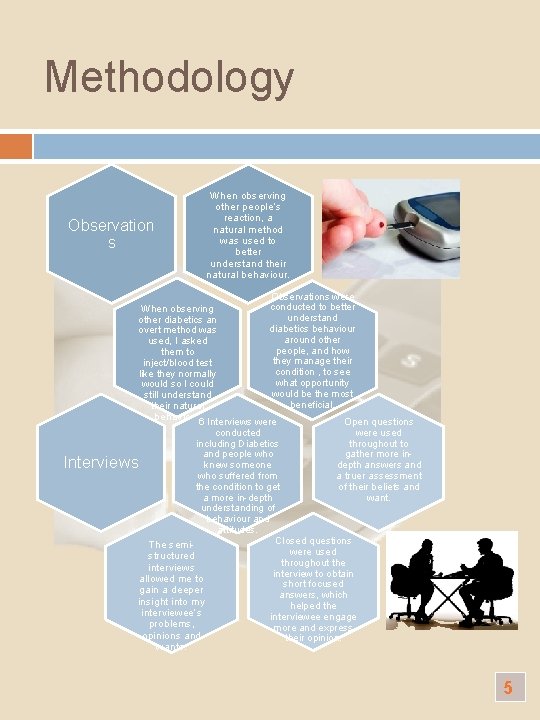
Methodology Observation s When observing other people’s reaction, a natural method was used to better understand their natural behaviour. When observing other diabetics an overt method was used, I asked them to inject/blood test like they normally would so I could still understand their natural Observations were conducted to better understand diabetics behaviour around other people, and how they manage their condition , to see what opportunity would be the most beneficial. behaviour 6 Interviews were Open questions were used conducted throughout to including Diabetics gather more inand people who depth answers and knew someone a truer assessment who suffered from of their beliefs and the condition to get want. a more in-depth understanding of behaviour and attitudes. Closed questions The semiwere used structured throughout the interviews interview to obtain allowed me to short focused gain a deeper answers, which insight into my helped the interviewee’s interviewee engage problems, more and express opinions and their opinion. wants. Interviews 5
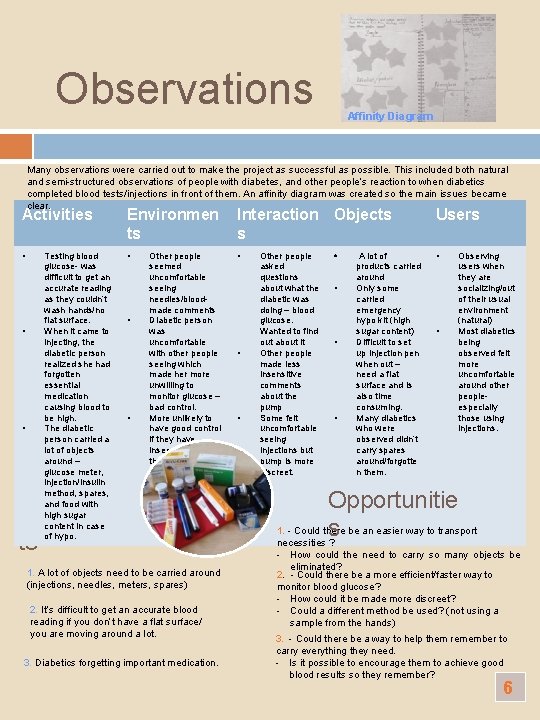
Observations Affinity Diagram Many observations were carried out to make the project as successful as possible. This included both natural and semi-structured observations of people with diabetes, and other people’s reaction to when diabetics completed blood tests/injections in front of them. An affinity diagram was created so the main issues became clear. Activities Environmen ts Interaction Objects s Users • • • Testing blood glucose- was difficult to get an accurate reading as they couldn’t wash hands/no flat surface. When it came to injecting, the diabetic person realized she had forgotten essential medication causing blood to be high. The diabetic person carried a lot of objects around – glucose meter, injection/insulin method, spares, and food with high sugar content in case of hypo. • • Other people seemed uncomfortable seeing needles/bloodmade comments Diabetic person was uncomfortable with other people seeing which made her more unwilling to monitor glucose – bad control. More unlikely to have good control if they have insecurities about their condition. Insigh ts 1. A lot of objects need to be carried around (injections, needles, meters, spares) 2. It’s difficult to get an accurate blood reading if you don’t have a flat surface/ you are moving around a lot. 3. Diabetics forgetting important medication. • • Other people asked questions about what the diabetic was doing – blood glucose. Wanted to find out about it Other people made less insensitive comments about the pump Some felt uncomfortable seeing injections but pump is more discreet. • • A lot of products carried around Only some carried emergency hypo kit (high sugar content) Difficult to set up injection pen when out – need a flat surface and is also time consuming. Many diabetics who were observed didn’t carry spares around/forgotte n them. • Observing users when they are socializing/out of their usual environment (natural) Most diabetics being observed felt more uncomfortable around other peopleespecially those using injections. Opportunitie 1. - Could there s be an easier way to transport necessities ? - How could the need to carry so many objects be eliminated? 2. - Could there be a more efficient/faster way to monitor blood glucose? - How could it be made more discreet? - Could a different method be used? (not using a sample from the hands) 3. - Could there be a way to help them remember to carry everything they need. - Is it possible to encourage them to achieve good blood results so they remember? 6
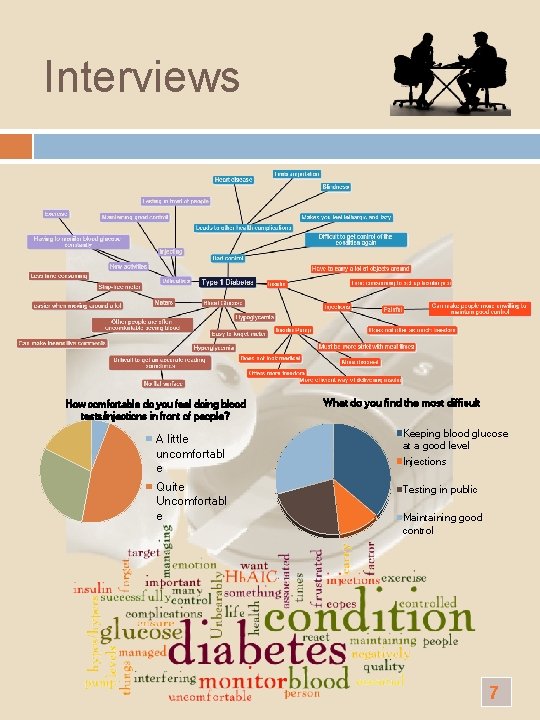
Interviews How comfortable do you feel doing blood tests/injections in front of people? What do you find the most difficult A little uncomfortabl e Keeping blood glucose at a good level Injections Quite Uncomfortabl e Testing in public Maintaining good control 7
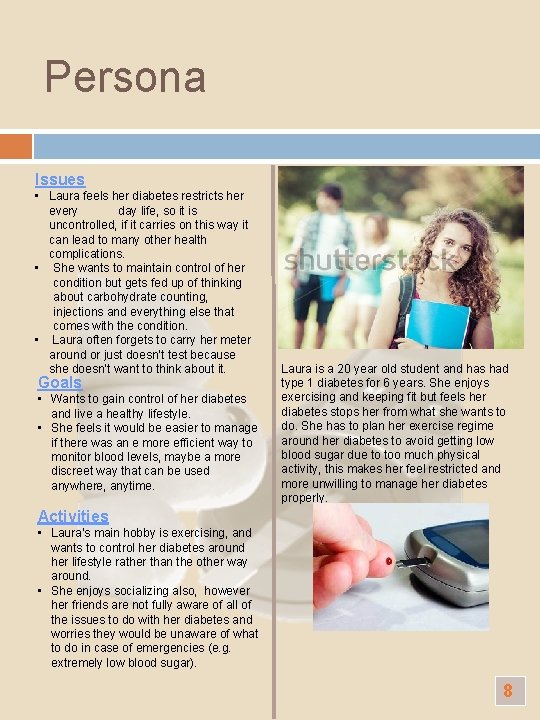
Persona Issues • Laura feels her diabetes restricts her every day life, so it is uncontrolled, if it carries on this way it can lead to many other health complications. • She wants to maintain control of her condition but gets fed up of thinking about carbohydrate counting, injections and everything else that comes with the condition. • Laura often forgets to carry her meter around or just doesn’t test because she doesn’t want to think about it. Goals • Wants to gain control of her diabetes and live a healthy lifestyle. • She feels it would be easier to manage if there was an e more efficient way to monitor blood levels, maybe a more discreet way that can be used anywhere, anytime. Laura is a 20 year old student and has had type 1 diabetes for 6 years. She enjoys exercising and keeping fit but feels her diabetes stops her from what she wants to do. She has to plan her exercise regime around her diabetes to avoid getting low blood sugar due to too much physical activity, this makes her feel restricted and more unwilling to manage her diabetes properly. Activities • Laura’s main hobby is exercising, and wants to control her diabetes around her lifestyle rather than the other way around. • She enjoys socializing also, however her friends are not fully aware of all of the issues to do with her diabetes and worries they would be unaware of what to do in case of emergencies (e. g. extremely low blood sugar). 8
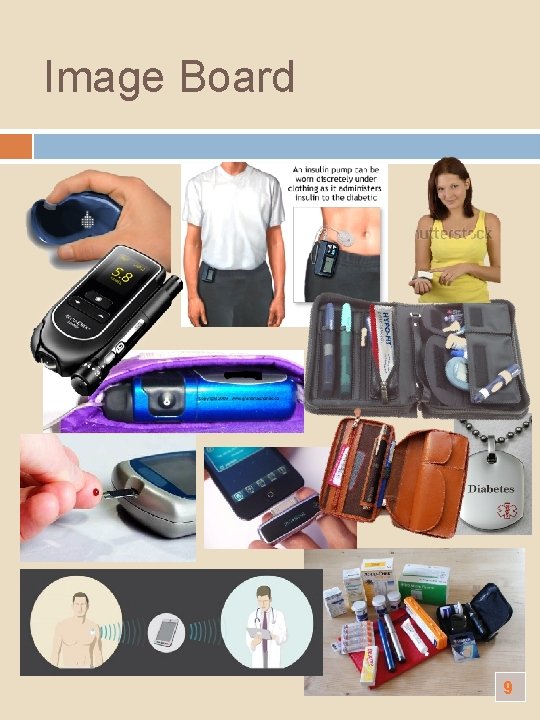
Image Board 9
User Requirement Specification A 1: Product must be durable to A 1: Whilst doing observations I last several years with frequent everyday use. noticed some meters were worn and damaged from frequent use. A 2: Product must not be clearly visible to others when in use. A 2: During observations, many users felt uncomfortable with other people seeing them check blood glucose/deliver insulin. A 3: Product must be an appropriate size to transport around for every day activities (to fit in handbag etc. ) A 4: The product must help the user to reduce the amount of high blood glucose levels they get – no higher than 12. 9 mmol/L A 5: The product must help the user to control the condition better – reducing hypos/hypers. A 6: The product must make blood glucose testing more efficient – don’t need a flat surface A 3: During the interview stage, many of the interviewees said they had many objects to carry around. A 4: If a diabetic person has frequent high blood sugar this can lead to many other health complications, I discovered this during market assessment. A 5: Frequent hypos/hypers can contribute to depression and make you feel lethargic and weak, so I want the product to reduce this, this was found during market assessment and interviews A 6: It is difficult to get an accurate reading if you can’t wash hands or there’s no flat surface, so the product must make this easier. I found this during observations and intervierws. 10
Appendix References: http: //www 3. imperial. ac. uk/newsandeventspggrp/imperialcollege/newssummary/news_2 7 -6 -2011 -9 -59 -55 http: //www. who. int/mediacentre/factsheets/fs 236/en/ http: //medweb. bham. ac. uk/easdec/prevention/what_is_the_hba 1 c. htm http: //www. jdrf. org. uk/life-with-type-1 -diabetes/managing-type-1/treatments/insulinpumps http: //www. diabetes. co. uk/insulin/Getting-an-insulin-pump. html http: //www 3. imperial. ac. uk/newsandeventspggrp/imperialcollege/newssummary/news_2 7 -6 -2011 -9 -59 -55 http: //www. google. co. uk/url? sa=t&rct=j&q=&esrc=s&frm=1&source=web&cd=3&ved=0 C Dw. QFj. AC&url=http%3 A%2 F%2 Fwww. diabetes. org. uk%2 FDocuments%2 FReports%2 F Diabetes-in-the-UK-201112. pdf&ei=yty. EUvlik. YCEB 6 Kjg. IAL&usg=AFQj. CNEh. Ll. K 7 Jxtt. Wv. YRix_GPsl 0 u 6 a 0 DQ&bv m=bv. 56343320, d. ZG 4 http: //www. diabetes. org. uk/Guide-to-diabetes/What-is-Type-1 diabetes/ https: //www. accu-chek. co. uk/gb/products/metersystems/index. html http: //www. medtronic-diabetes. co. uk/ https: //www. accu-chek. co. uk/gb/products/insulinpumps/index. html http: //www. animas. com/ http: //www. nhs. uk/conditions/Diabetes-type 1/Pages/Introduction. aspx
- Slides: 13