
University of Anbar College of Dentistry Oral Medicine

University of Anbar College of Dentistry Oral Medicine Dr. Shaimaa Hamid Ph. D of Oral Medicine

Pain; An unpleasant sensory and emotional experience associated with actual or potential tissue damage. Pain is always subjective.
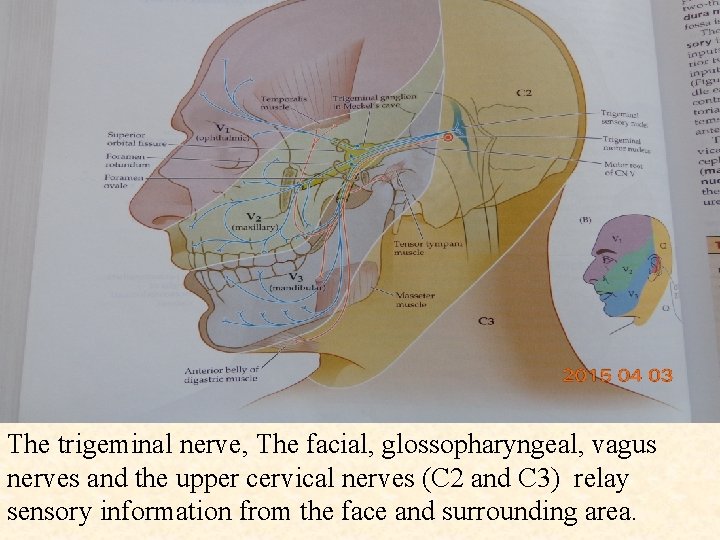
The trigeminal nerve, The facial, glossopharyngeal, vagus nerves and the upper cervical nerves (C 2 and C 3) relay sensory information from the face and surrounding area.
Primary sensory neurons associated with pain (nocicepters) are characterized by small-diameter axons with slow conduction velocities (ie, finely myelinated A delta fibers and unmyelinated C fibers). Nociceptors are the sensory receptors specialized for detecting noxious stimuli. Some are unimodal and respond only to thermal or mechanical stimuli; others are polymodal and respond to mechanical, thermal, and chemical stimuli.
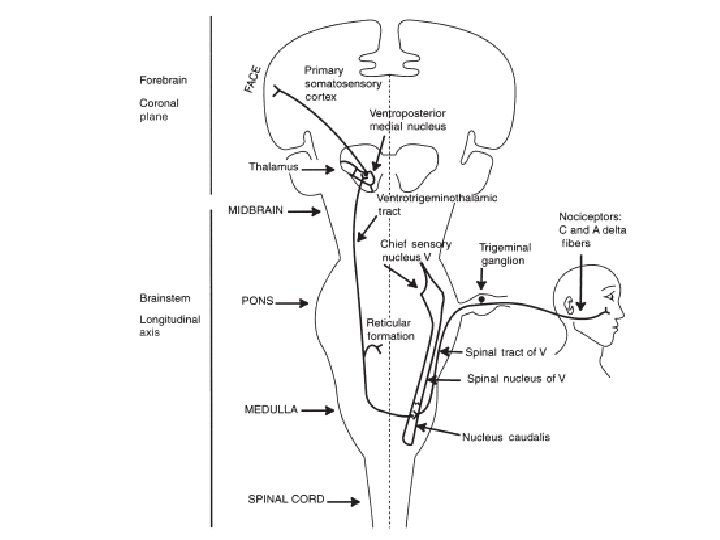
- Information associated with pain is carried in the three divisions of the trigeminal nerve to the trigeminal sensory ganglion. - The central processes of these neurons enter the pons, where they descend in the brainstem as the spinal trigeminal tract. - Fibers from the spinal trigeminal tract synapse in the adjacent trigeminal nucleus that extends parallel to the tract in the brainstem.
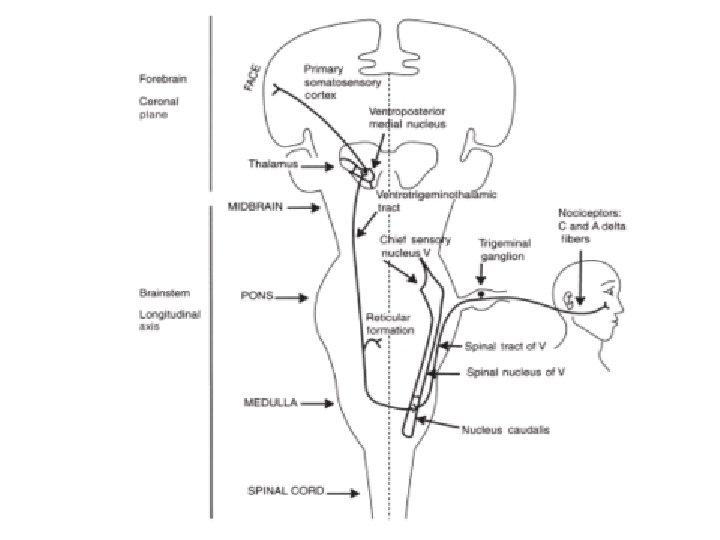
- The spinal nucleus is divided into three nuclei; the most caudal, the nucleus caudalis, which is the principal site in the brainstem for nociceptive information. - Axons from the spinal nucleus of trigeminal nerve cross to the opposite side and ascend to the thalamus. - From the thalamus, neurons course and end at the somatosensory cortex. - In the spinal cord, other pathways from the dorsal horn pass to the ventral horn and activate flexor motor neurons, generating the withdrawal flexion reflex.
Chronic pain: Following peripheral tissue or nerve injury, a pathologic state may develop; resulting in persistent pain long after the injured tissue has healed. In this state, pain no longer represents a warning signal of potential or actual tissue damage; pain itself becomes the disorder.
The proposed explanation for the persistence of pain after healing relates to changes in the central nervous system. The clinical manifestations of these changes include hyperalgesia (an increased response to a stimulus that is normally painful); allodynia (pain due to a stimulus that does not normally provoke pain); and spontaneous, radiating, and referred pain.
Drug therapy: ü Non-opioid Analgesics: This group consists primarily of acetaminophen and the large group of nonsteroidal anti-inflammatory drugs (NSAIDs).
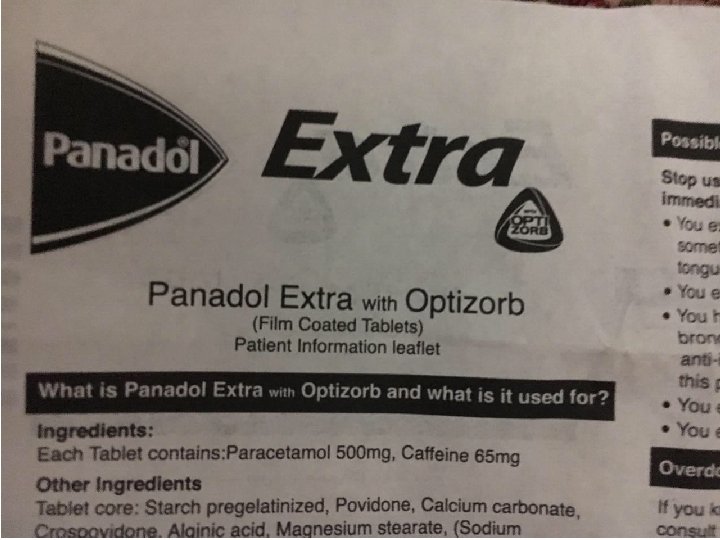
Acetaminophen generally has fewer adverse effects when compared to NSAIDs. It does not affect platelet function, rarely causes gastrointestinal (GI) disturbances, and can be given to patients who are allergic to aspirin or other NSAIDs. Caffeine has been shown to enhance the effectiveness of nonopioid drugs and is often added to the analgesic. The mechanism of action of acetaminophen is different from that of the NSAIDs but remains unknown; there is some evidence that suggests a central action.
NSAIDs are thought to work primarily at the site of injury by inhibiting the enzyme cyclo-oxygenase (COX), which is required for the synthesis of prostaglandins, substances that sensitize peripheral sensory nerves and contribute to the experience of pain.
ü Opioids: These drugs bind to m-opioid receptors, resulting in actions that lead to the analgesic effects. Effects at the membrane level leading to a decrease in neuronal excitability. Opioids increase activity in some neuronal pathways such as the descending inhibitory pathways. The use of opioid therapy in moderate to severe acute pain and cancer pain is well established.
ü Adjuvant Drugs: This group of drugs has been approved for use in conditions other than pain. they have been found to be of value in pain management. Amitriptyline (a tricyclic antidepressant), the antidepressant that has been most frequently studied in clinical trials, has been proven to be effective in chronic orofacial pain treatment.
The neurotransmitters serotonin and norepinephrine are thought to play a role in the descending inhibitory transmissions from the brain to the dorsal horn, modulating nociceptive impulses. Tricyclic antidepressants (TCAs) block the reuptake of serotonin and norepinephrine (NE), and this is thought to enhance the central inhibitory system in pain processing. These effects occur at doses that are lower than those required for an antidepressant effect.
Anticonvulsant drugs are effective in the treatment of trigeminal neuralgia and diabetic neuropathy and for migraine prophylaxis. These drugs frequently produce side effects (including sedation, dizziness, ataxia, and mood changes) that can limit their usefulness.
ü Topical Medications: Topical analgesic therapy on the skin or oral mucosa has the advantage of reduced systemic absorption and thus a reduced risk of side effects. Capsaicin used as a topical cream. It is effective in treating postherpetic neuralgia. Topical application blocks C-fiber conduction, inactivates the release of neuropeptides from peripheral nerve endings.
Facial Neuralgias: Group of neurologic disorders involving the cranial nerves and are characterized by: (a) Brief episodes of shooting, often electric shock– like pain along the course of the affected nerve branch. (b) Trigger zones on the skin or mucosa that precipitate painful attacks when touched. (c) Pain-free periods between attacks and refractory periods immediately after an attack, during which a new episode cannot be triggered.
These clinical characteristics neuropathic pain, which tends to be; 1 - Constant. 2 - Burning quality. 3 - Absent of trigger zones. differ from
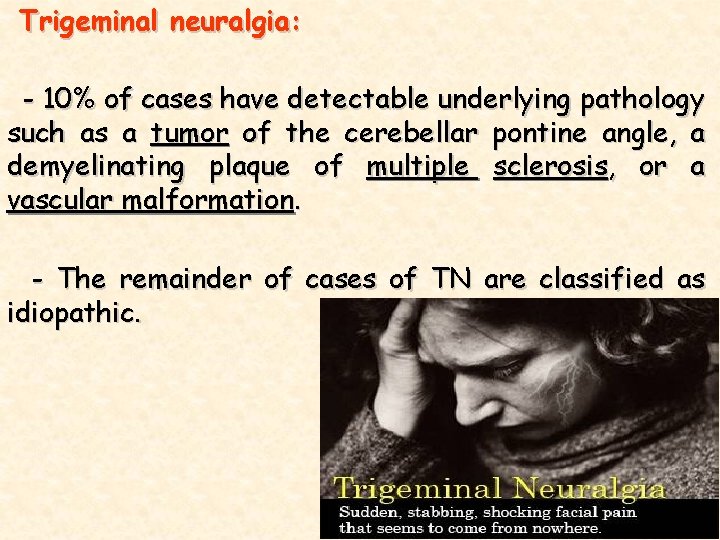
Trigeminal neuralgia: - 10% of cases have detectable underlying pathology such as a tumor of the cerebellar pontine angle, a demyelinating plaque of multiple sclerosis, or a vascular malformation. - The remainder of cases of TN are classified as idiopathic.
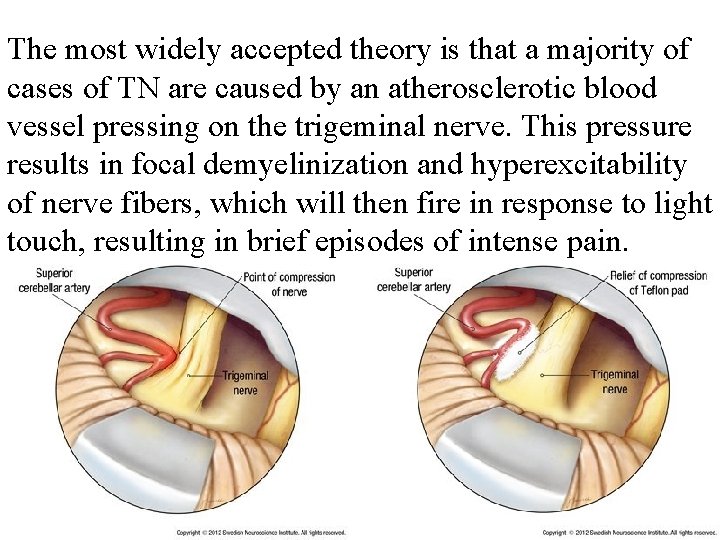
The most widely accepted theory is that a majority of cases of TN are caused by an atherosclerotic blood vessel pressing on the trigeminal nerve. This pressure results in focal demyelinization and hyperexcitability of nerve fibers, which will then fire in response to light touch, resulting in brief episodes of intense pain.
- Episodes of intense shooting stabbing pain that lasts for a few seconds and then completely disappears. The pain characteristically has an electric shock–like quality and is unilateral. - The maxillary branch is the branch that is most commonly affected. - Pain in TN is precipitated by light touch on a “trigger zone” present on the skin or mucosa within the distribution of the involved nerve branch. - Just after an attack, there is a refractory period when touching the trigger zone will not precipitate pain.
- Anticonvulsant drugs are most frequently used and are most effective. Carbamazepine (Tegretol) is the most commonly used drug. - Gabapentin, a newer anticonvulsant that has fewer serious side effects than carbamazepine.
Glossopharyngeal neuralgia: - It is a rare condition that is associated with paroxysmal pain that is similar to, but less intense than, the pain of TN. - The location of the trigger zone and pain sensation follows the distribution of the glossopharyngeal nerve (the pharynx, posterior tongue and ear). - Pain is triggered by stimulating the pharyngeal mucosa during chewing, talking, and swallowing.
- Glossopharyngeal neuralgia may occur with TN, and when this occurs, a search for a common central lesion is essential. - Glossopharyngeal neuralgia also may be associated with vagal symptoms, such as syncope and arrhythmia, owing to the close anatomic proximity of the two nerves.
Geniculate neuralgia: - It is an uncommon paroxysmal neuralgia of facial nerve, characterized by pain in the ear and (less frequently) the anterior tongue or soft palate. - There is often some degree of facial paralysis, indicating the involvement of the motor root.
- Geniculate neuralgia commonly results from herpes zoster of the geniculate ganglion, a condition referred to as Ramsay Hunt syndrome. Viral vesicles may be observed in the ear canal or on the tympanic membrane. - The symptoms result from inflammatory neural degeneration, and a short course (2 to 3 weeks) of high-dose steroid therapy is beneficial. Acyclovir significantly reduces the duration of the pain. Patients with geniculate neuralgia are also treated with carbamazepine and antidepressants.
Occipital neuralgia: - It is a rare neuralgia in the distribution of the sensory branches of the cervical plexus. - The most common causes are trauma, neoplasms, infections, and aneurysms involving the affected nerve.
postherpetic neuralgia: - Herpes zoster (shingles) is caused by the reactivation of latent varicella-zoster virus infection that results in both pain and vesicular lesions along the course of the affected nerve. - Persistent pain, paresthesia, hyperesthesia, and allodynia months to years after the zoster lesions have healed. - Approximately 15 to 20% of cases of herpes zoster involve the trigeminal nerve although the majority of these cases affect the ophthalmic division of the fifth nerve, resulting in pain and lesions in the region of the eyes and forehead.
- In a majority of cases, the pain of herpes zoster resolves within a month after the lesions heal. Pain that persists longer than a month is classified as postherpetic neuralgia (PHN) although some authors do not make the diagnosis of PHN until the pain has persisted for longer than 3 or even 6 months. - The combination of peripheral and central injury by varicella-zoster virus results in the spontaneous discharge of neurons and an exaggerated painful response to nonpainful stimuli.
- antiviral drugs, particularly famciclovir, along with a short course of systemic corticosteroids during the acute phase of the disease - topical anesthetic agents, such as lidocaine, or analgesics, particularly capsaicin. - tricyclic antidepressants such as amitriptyline and nortriptyline. - Gabapentin, carbamazepine or phenytoin.
Post-traumatic neuropathic pain: A neuroma is an incomplete or failed attempt at nerve repair following injury to a peripheral nerve, resulting in a disorganized nerve fiber that is focally electrically excitable. The pathologic sensitization of the injured peripheral nerve or CNS results in both peripheral and CNS hyperexcitability, which are manifest as allodynia (pain caused by a stimulus that is normally not painful), or hyperalgesia (an exaggerated response to a mildly painful stimulus).
- Systemic corticosteroids are considered helpful in decreasing the incidence and severity of traumatic neuropathies when administered within the first week after a nerve injury. - The tricyclic antidepressants (TCAs) such as amitriptyline and nortriptyline can be used alone; in severe intractable cases, they potentiate the effect of narcotic analgesics. - Gabapentin, an anticonvulsant drug. - Topical capsaicin may also be effective in controlling pain
Atypical Facial Pain: - One theory considers atypical facial pain to be a form of de-afferentation or phantom tooth pain. Neuropathic pain may result from tissue injury that affects peripheral nerves, resulting in CNS changes, causing persistent pain. - the effectiveness of tricycle antidepressant medication have been used to support a psychological explanation.
- Others consider that atypical facial pain is a form of sympathetically maintained pain. The pain is worsened during periods of stress. It is proposed that following injury, sympatheticsensory coupling occurs in which nociceptors upregulate α-adrenergic receptors and respond to norepinephrine released from sympathetic terminals in the injured region.
- Most frequently in women in the fourth and fifth decades of life. - Constant dull aching pain without an apparent cause that can be detected by examination or laboratory studies. - The patient frequently reports that the onset of pain coincided with a dental procedure such as oral surgery or an endodontic or restorative procedure. - Patients will give a history of receiving trials of multiple medications, including antibiotics, corticosteroids, decongestants, or anticonvulsant drugs.
- Patients should be reassured - TCAs such as amitriptyline and nortriptyline - Gabapentin and clonazepam. - Topical desensitization with capsaicin.

- Slides: 41