
University Ethics How Colleges Can Build and Benefit
University Ethics How Colleges Can Build and Benefit from a Culture of Ethics James F. Keenan, SJ
Absences of Ethics at American Universities Athletics- Sexual abuse and multiply cover-ups at Penn State University Academics- Cheating scandal that caused a government course to be canceled at Harvard University Faculty and student plagiarism Admissions- Favoritism given to students with political connections and weak academic credentials at University of Illinois Student Affairs/Academic Advising- UW System has nearly 100 cases involving teaching, supervisory, and advising staff
Systemic Issues? Strong correlation between lack of professional ethics in Higher Ed and lack of consciousness in American culture Who is subjected to professional ethic standards Lack of evidence showing commitment to ethics in Higher Ed
Other Fields That Focus on Ethics Medical profession Found, articulate, and institutionalize right conduct among competing, but overlapping relationships Religious and church ministries Focus on teaching ethics to others To teach, govern, and make members of the congregation morally accountable Priest, clergy, and bishops lacked ethical reasoning No horizontal responsibility
Burning Questions What does ethics look like at major universities? Does the cultural landscape help explain obstacles to professional ethics in Higher Ed? How do you shift from the vertical to horizontal accountability in Higher Ed?
Ethical Reasoning is reasoning about right and wrong human conduct. It requires practitioners to be able to assess their own ethical values and the social context of problems, recognize ethical issues in a variety of settings, think about how different ethical perspectives might be applied to ethical dilemmas, while considering the ramifications of alternative actions. From https: //www. aacu. org/sites/default/files/VALUE/Ethical. Reasoning. pdf
Group Activity Build a horizontal accountability rubric (3 Groups) for different departments in a university, while thinking of components that directly affect our profession This rubric is intended to help us as practitioners evaluate work samples and collections of work that demonstrate learning about ethics in our profession. The rubric will focus on Ethical Self Awareness, Public Critique of Ethics, and Professional Conduct Modified from https: //www. aacu. org/sites/default/files/VALUE/Ethical. Reasoning. pdf
Groups Group 1 Advising – Jason, Dolores, Kristine, and Liliana Group 2 Teaching – Katy, Eric, Lorena, and Kevin Group 3 Financial Aid – Greg, John, Mai, Tracey
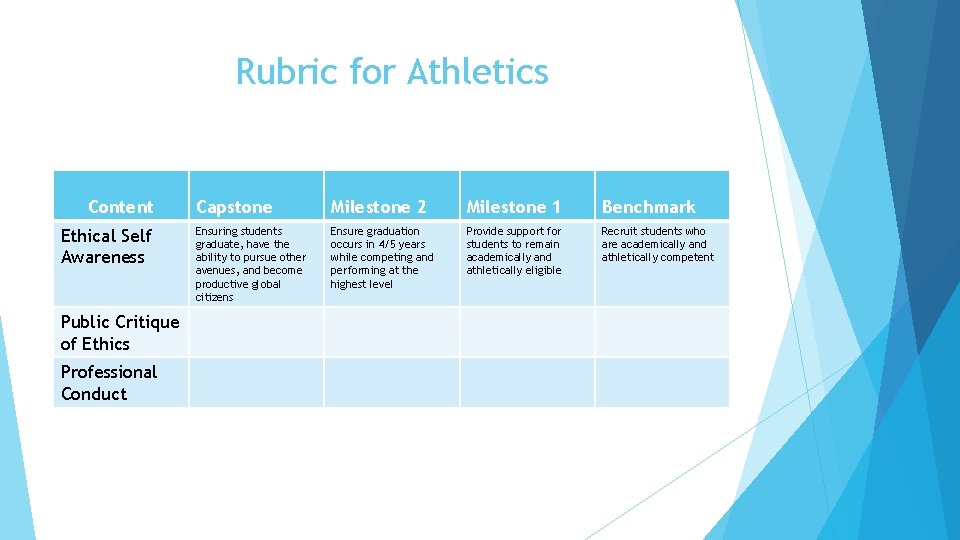
Rubric for Athletics Content Ethical Self Awareness Public Critique of Ethics Professional Conduct Capstone Milestone 2 Milestone 1 Benchmark Ensuring students graduate, have the ability to pursue other avenues, and become productive global citizens Ensure graduation occurs in 4/5 years while competing and performing at the highest level Provide support for students to remain academically and athletically eligible Recruit students who are academically and athletically competent
- Slides: 9