
UNIVERSITI MALAYSIA PERLIS CENTRE FOR DIPLOMA STUDIES MANUFACTURING

- Slides: 21
UNIVERSITI MALAYSIA PERLIS CENTRE FOR DIPLOMA STUDIES MANUFACTURING PROCESS II DPT 213
Chapter 1 : Introduction to CNC Ø Ø Evolution of CNC Numerical Control basic component system Advantages and disadvantages Application of NC
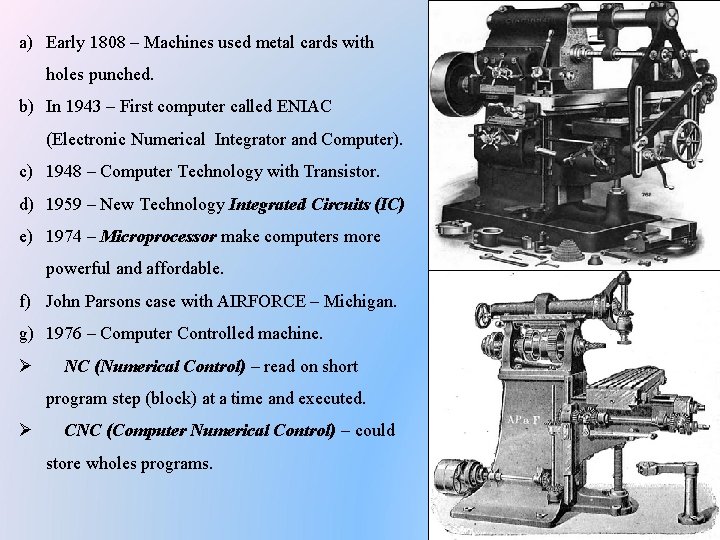
a) Early 1808 – Machines used metal cards with holes punched. b) In 1943 – First computer called ENIAC (Electronic Numerical Integrator and Computer). c) 1948 – Computer Technology with Transistor. d) 1959 – New Technology Integrated Circuits (IC) e) 1974 – Microprocessor make computers more powerful and affordable. f) John Parsons case with AIRFORCE – Michigan. g) 1976 – Computer Controlled machine. Ø NC (Numerical Control) – read on short program step (block) at a time and executed. Ø CNC (Computer Numerical Control) – could store wholes programs.
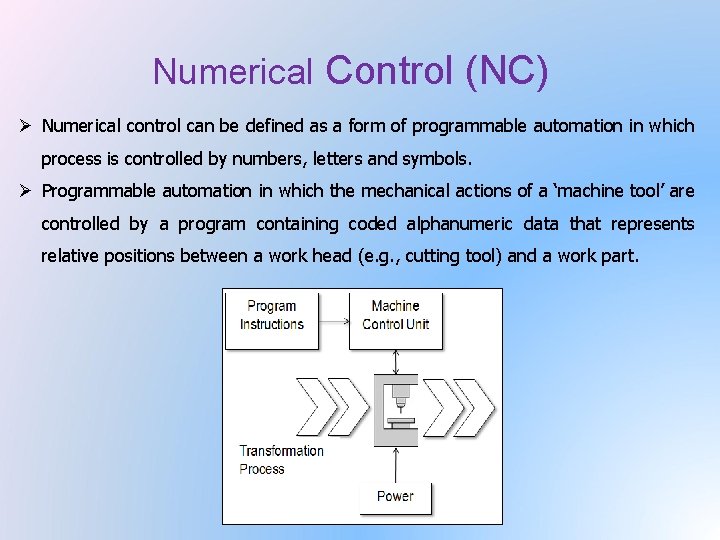
Numerical Control (NC) Ø Numerical control can be defined as a form of programmable automation in which process is controlled by numbers, letters and symbols. Ø Programmable automation in which the mechanical actions of a ‘machine tool’ are controlled by a program containing coded alphanumeric data that represents relative positions between a work head (e. g. , cutting tool) and a work part.
Numerical Control Method To utilize numerical control in manufacturing, the following steps must be accomplished : 1) The engineering drawing of the workout must be interpreted in terms of manufacturing processes to be used. 2) The part programmer plans the process for the portion of the job to be done on NC. 3) A punched tape is prepared from the part programmer's process plan. 4) The tape is checked or verified. 5) The job is produced on an NC machine under tape control.
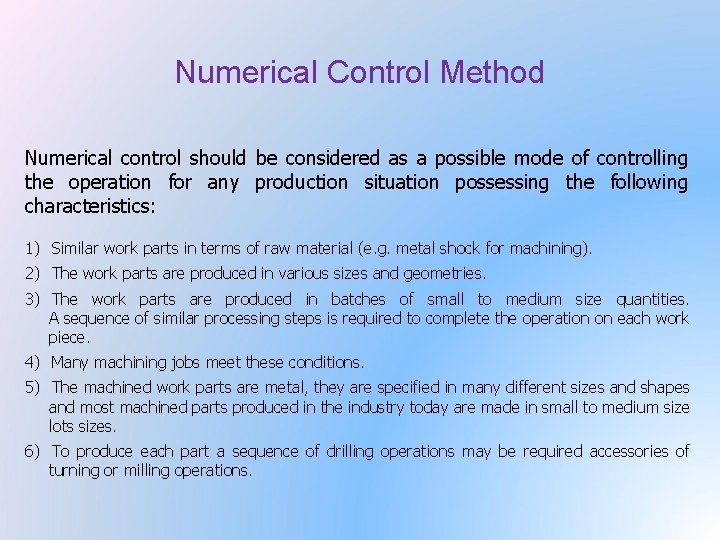
Numerical Control Method Numerical control should be considered as a possible mode of controlling the operation for any production situation possessing the following characteristics: 1) Similar work parts in terms of raw material (e. g. metal shock for machining). 2) The work parts are produced in various sizes and geometries. 3) The work parts are produced in batches of small to medium size quantities. A sequence of similar processing steps is required to complete the operation on each work piece. 4) Many machining jobs meet these conditions. 5) The machined work parts are metal, they are specified in many different sizes and shapes and most machined parts produced in the industry today are made in small to medium size lots sizes. 6) To produce each part a sequence of drilling operations may be required accessories of turning or milling operations.
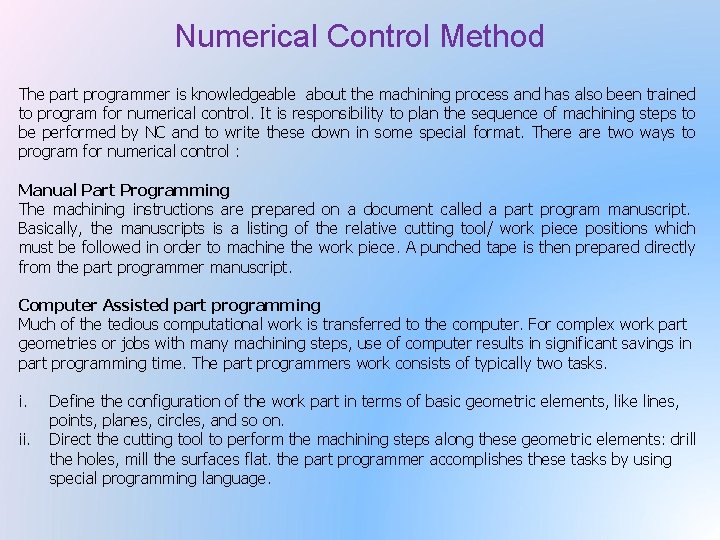
Numerical Control Method The part programmer is knowledgeable about the machining process and has also been trained to program for numerical control. It is responsibility to plan the sequence of machining steps to be performed by NC and to write these down in some special format. There are two ways to program for numerical control : Manual Part Programming The machining instructions are prepared on a document called a part program manuscript. Basically, the manuscripts is a listing of the relative cutting tool/ work piece positions which must be followed in order to machine the work piece. A punched tape is then prepared directly from the part programmer manuscript. Computer Assisted part programming Much of the tedious computational work is transferred to the computer. For complex work part geometries or jobs with many machining steps, use of computer results in significant savings in part programming time. The part programmers work consists of typically two tasks. i. ii. Define the configuration of the work part in terms of basic geometric elements, like lines, points, planes, circles, and so on. Direct the cutting tool to perform the machining steps along these geometric elements: drill the holes, mill the surfaces flat. the part programmer accomplishes these tasks by using special programming language.
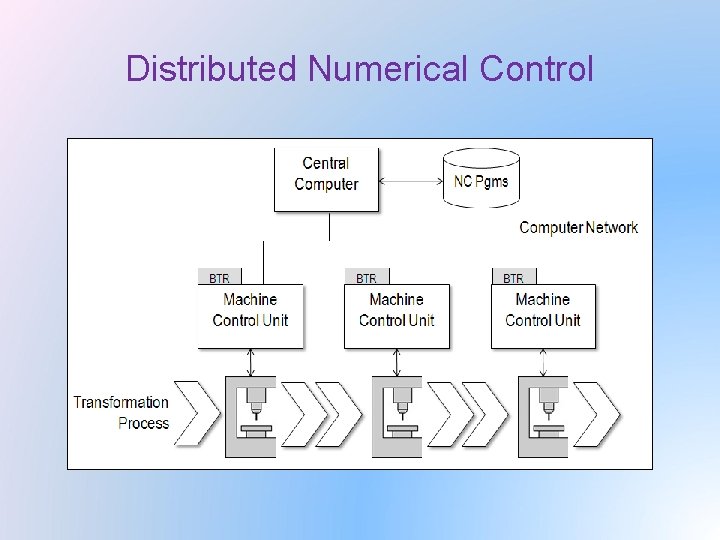
Distributed Numerical Control
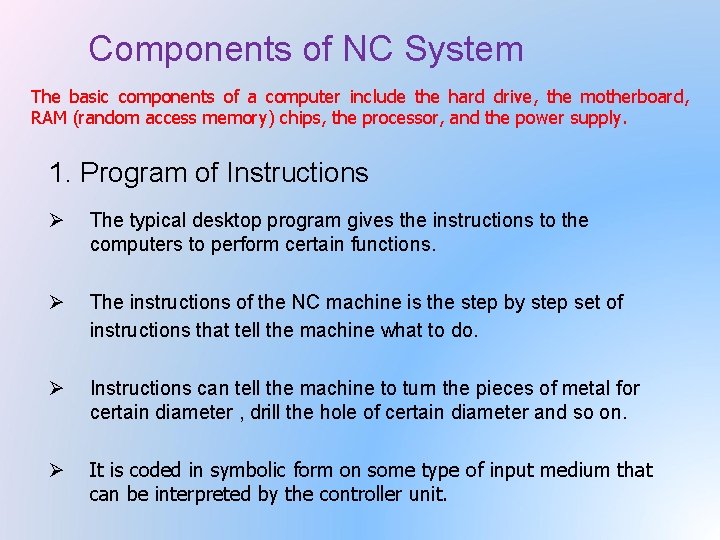
Components of NC System The basic components of a computer include the hard drive, the motherboard, RAM (random access memory) chips, the processor, and the power supply. 1. Program of Instructions Ø The typical desktop program gives the instructions to the computers to perform certain functions. Ø The instructions of the NC machine is the step by step set of instructions that tell the machine what to do. Ø Instructions can tell the machine to turn the pieces of metal for certain diameter , drill the hole of certain diameter and so on. Ø It is coded in symbolic form on some type of input medium that can be interpreted by the controller unit.
Components of NC System 2. Controller unit @ machine control unit (MCU) Ø The controller unit is most vital parts of the NC and CNC machines. Ø The controller unit made of the electronics components, it reads and interprets the program of instructions and converts them in the mechanical actions of the machine tool. Ø The typical control unit comprises of tape reader, date buffer, signal output channels to the machine tools. Ø Controller send the instructions to the machine tool via signal output channel that are connect to the servomotors and other control of the machines.
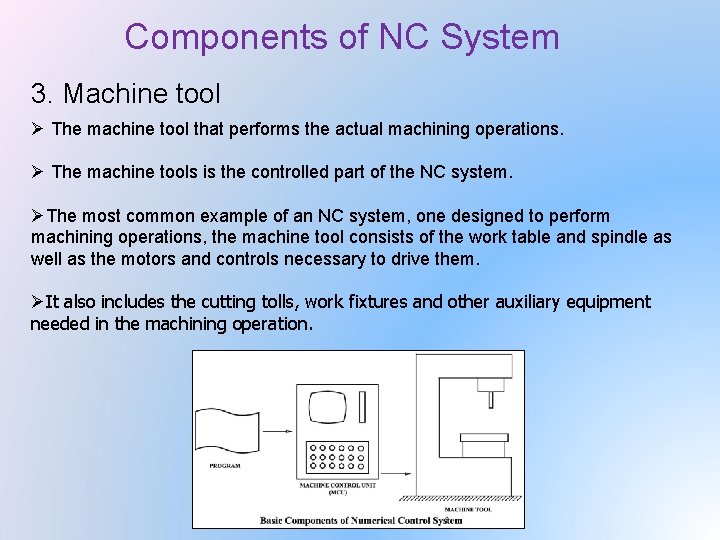
Components of NC System 3. Machine tool Ø The machine tool that performs the actual machining operations. Ø The machine tools is the controlled part of the NC system. ØThe most common example of an NC system, one designed to perform machining operations, the machine tool consists of the work table and spindle as well as the motors and controls necessary to drive them. ØIt also includes the cutting tolls, work fixtures and other auxiliary equipment needed in the machining operation.
Types of NC System 1. Point-to-Point NC Ø Called a positioning system. In PTP the objective of the machine tool control system is to move the cutting tool to predefined location. Ø Once the tool reaches the desired location, the machining operation is performed at that position. Ø The drilling of the holes is performed at that location, the tool is moved to the next hole location, and so forth. Ø Positioning systems are the simplest machine tool control systems.
Types of NC System 2. Straight Cut NC Ø As a control systems are capable of moving the cutting tool parallel to one of the major axes at a controlled rate suitable for machining. Ø It is therefore appropriate for performing milling operations to fabricate work-pieces of rectangular configurations. Ø With this type of NC systems it is there for appropriate for performing milling operations to fabricate work-pieces of rectangular configurations. Ø Therefore angular cuts on the work-piece would not be possible. An NC machine tool capable of performing straight cut movements is also capable of point to point movements.
Types of NC System 2. Contouring NC Ø Is the most complex flexible and the most expensive type of machine tool control. Ø It is therefore appropriate for performing milling operations to fabricate work-pieces of rectangular configurations. Ø In addition the distinguishing feature of the of contouring NC system is their capacity for simultaneously control of more than one axis movement of machine tool Figures below illustrate the versatility of continuous path NC. Ø Milling and Turning are the common examples of the use of contouring control.
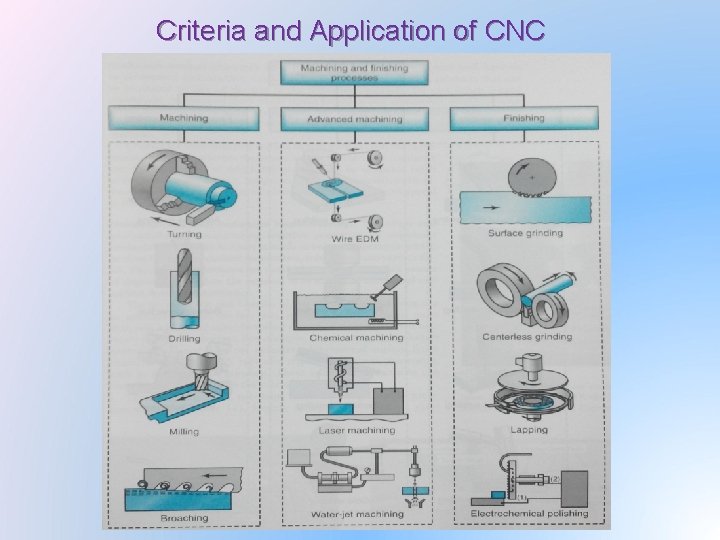
NC Application Characteristics (Machining) NC has been used in a variety of applications. A complete list of application is probably not possible but such a list would have to include the following: 1) Metal cutting machine tools 2) Press working machine tools 3) Welding machines 4) Inspection machines 5) Automatics drafting 6) Assembly machines 7) Tube bending 8) Flame cutting 9) Industrial Robots 10) Automated knitted machines 11) Cloth cutting 12) Automatics riveting By far the most common application of the numerical control is for metal cutting machine tools. Within the category alone, NC equipment has been built to perform virtually the entire range of material removal processes including: 1) Milling 2) Drilling and related operation 3) Boring 4) Turning 5) Grinding
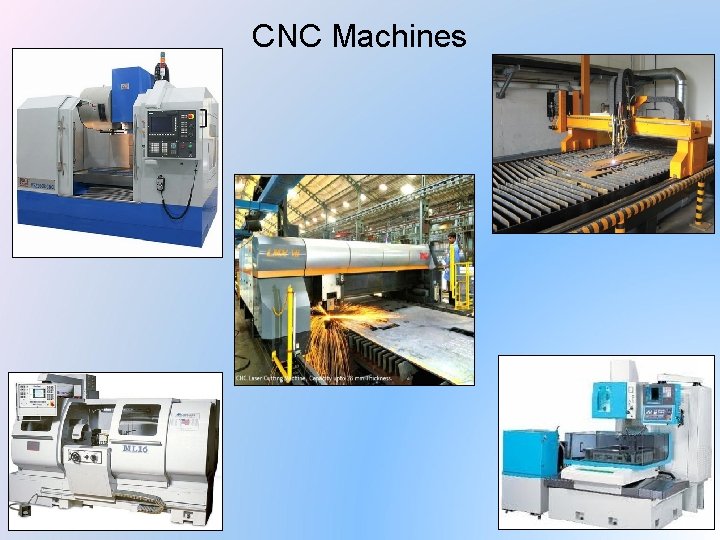
Computer Numerical Control (CNC) Machine CNC Machining is a process used in the manufacturing sector that involves the use of computers to control machine tools. Tools that can be controlled in this manner include lathes, mills, routers and grinders. The machine can be a milling machine, lathe, router, welder, grinder, laser or waterjet cutter, sheet metal stamping machine, robot, or many other types of machines. The CNC controller works together with a series of motors and drive components to move and control the machine axes, executing the programmed motions.
Advantages and Disadvantages Advantages 1. 2. 3. 4. 5. 6. 7. Parts can be produced in less time and reduce the non productive time (setup time, number of setups, tool changing time and work piece handling time). Reduce non-production time and Cycle time reduction Achieve manufacturing flexibility. Repeatability and increase in production rate. Produce parts with complex shapes. Improve quality and Lower scrap rates Achieve good surface finish and accuracy.
Advantages and Disadvantages 1. 2. 3. 4. 5. 6. The cost of CNC machine tool is much high. Cost and skill of the people required to operate a CNC machine is generally high. Special training needed to the personnel manning the CNC machine tools. Requires higher investments for maintenance. The automatic operation of CNC machines implies relatively higher running cost. High utilization required.
Criteria and Application of CNC
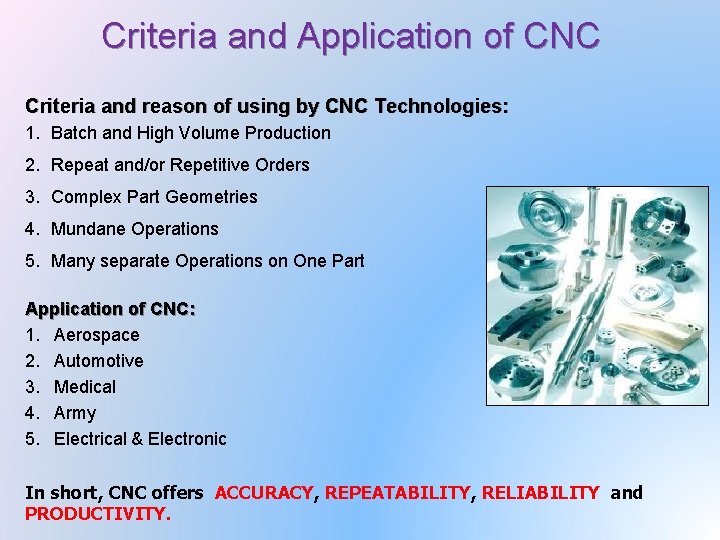
Criteria and Application of CNC Criteria and reason of using by CNC Technologies: 1. Batch and High Volume Production 2. Repeat and/or Repetitive Orders 3. Complex Part Geometries 4. Mundane Operations 5. Many separate Operations on One Part Application of CNC: 1. Aerospace 2. Automotive 3. Medical 4. Army 5. Electrical & Electronic In short, CNC offers ACCURACY, REPEATABILITY, RELIABILITY and PRODUCTIVITY.
CNC Machines