
Universit di Pisa Convolutional Neural Networks for NLP





- Slides: 19
Università di Pisa Convolutional Neural Networks for NLP Human Language Technologies Giuseppe Attardi Slides from Christopher Manning
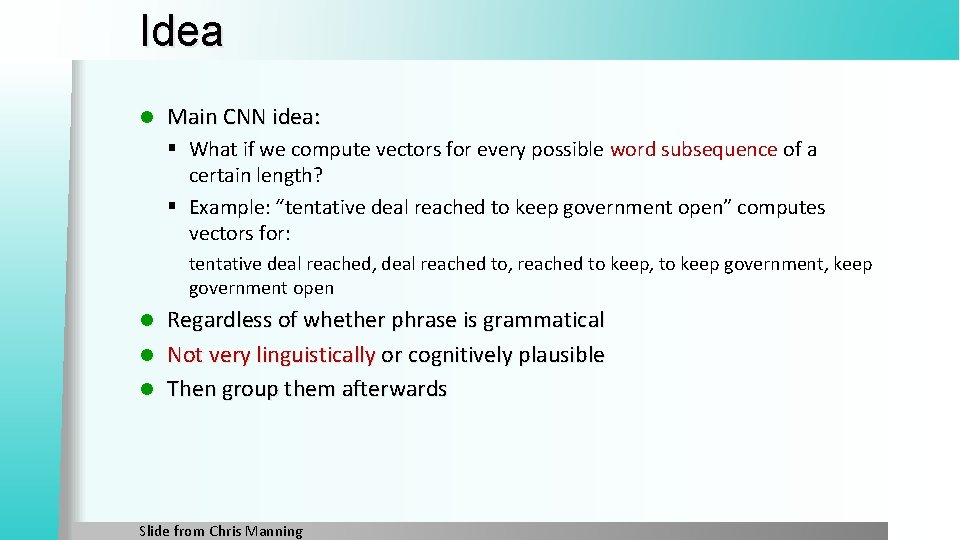
Idea l Main CNN idea: § What if we compute vectors for every possible word subsequence of a certain length? § Example: “tentative deal reached to keep government open” computes vectors for: tentative deal reached, deal reached to, reached to keep, to keep government, keep government open Regardless of whether phrase is grammatical l Not very linguistically or cognitively plausible l Then group them afterwards l Slide from Chris Manning
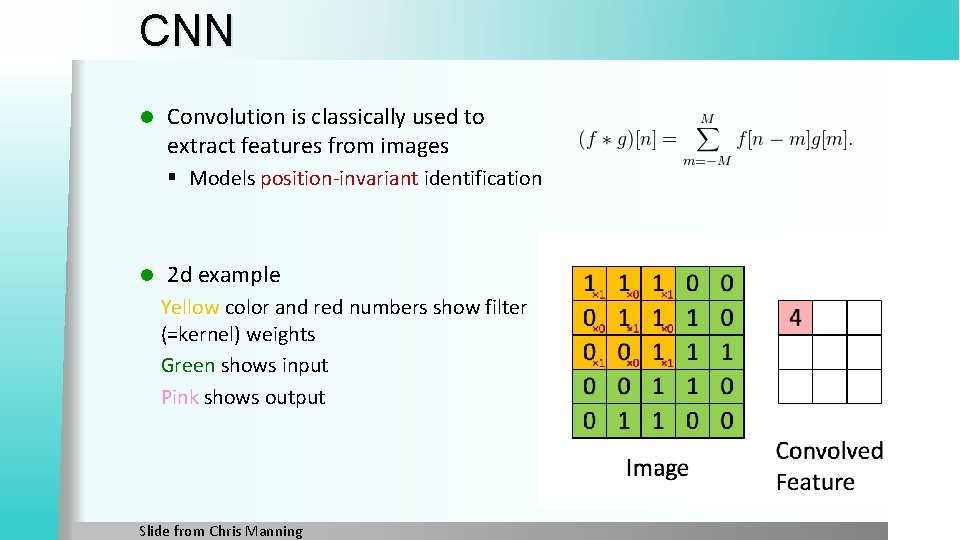
CNN l Convolution is classically used to extract features from images § Models position-invariant identification l 2 d example Yellow color and red numbers show filter (=kernel) weights Green shows input Pink shows output Slide from Chris Manning
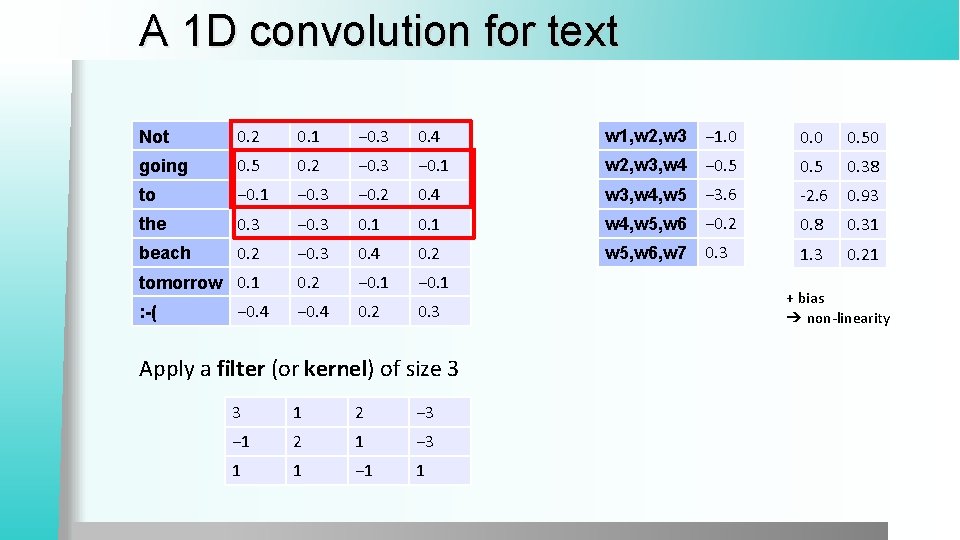
A 1 D convolution for text Not 0. 2 0. 1 − 0. 3 0. 4 w 1, w 2, w 3 − 1. 0 0. 50 going 0. 5 0. 2 − 0. 3 − 0. 1 w 2, w 3, w 4 − 0. 5 0. 38 to − 0. 1 − 0. 3 − 0. 2 0. 4 w 3, w 4, w 5 − 3. 6 -2. 6 0. 93 the 0. 3 − 0. 3 0. 1 w 4, w 5, w 6 − 0. 2 0. 8 0. 31 beach 0. 2 − 0. 3 0. 4 0. 2 w 5, w 6, w 7 0. 3 1. 3 0. 21 0. 2 − 0. 1 − 0. 4 0. 2 0. 3 tomorrow 0. 1 : -( − 0. 4 Apply a filter (or kernel) of size 3 3 1 2 − 3 − 1 2 1 − 3 1 1 − 1 1 + bias ➔ non-linearity
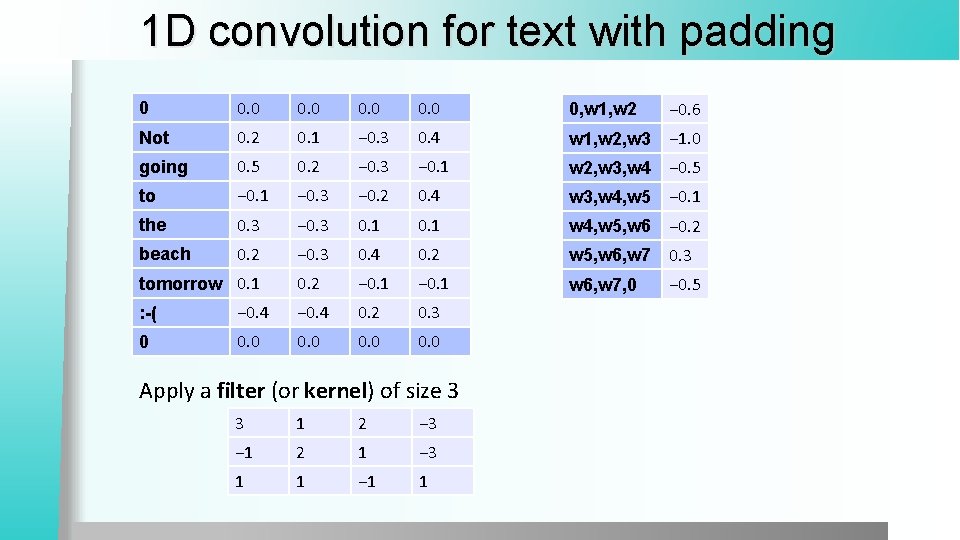
1 D convolution for text with padding 0 0, w 1, w 2 Not 0. 2 0. 1 − 0. 3 0. 4 w 1, w 2, w 3 − 1. 0 going 0. 5 0. 2 − 0. 3 − 0. 1 w 2, w 3, w 4 − 0. 5 to − 0. 1 − 0. 3 − 0. 2 0. 4 w 3, w 4, w 5 − 0. 1 the 0. 3 − 0. 3 0. 1 w 4, w 5, w 6 − 0. 2 beach 0. 2 − 0. 3 0. 4 0. 2 w 5, w 6, w 7 0. 3 0. 2 − 0. 1 w 6, w 7, 0 tomorrow 0. 1 : -( − 0. 4 0. 2 0. 3 0 0. 0 Apply a filter (or kernel) of size 3 3 1 2 − 3 − 1 2 1 − 3 1 1 − 0. 6 − 0. 5
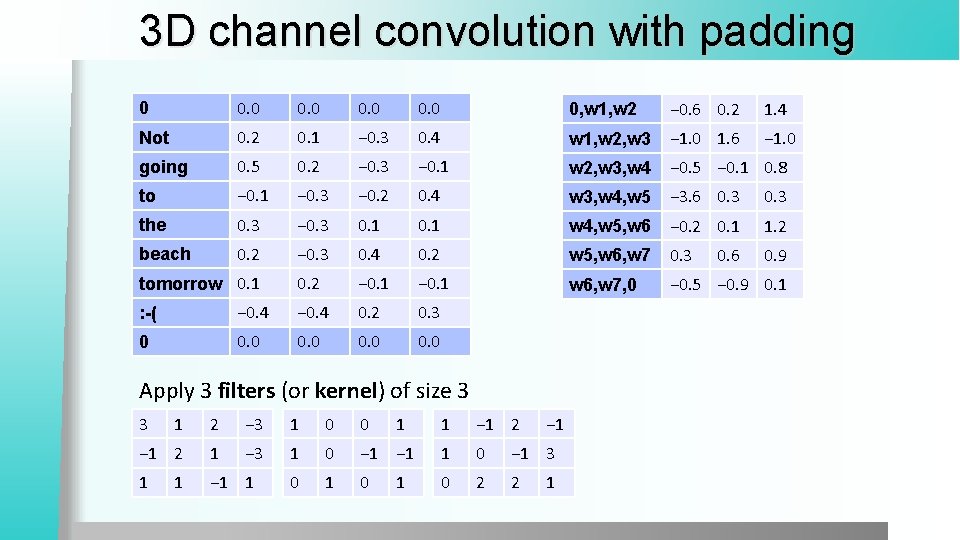
3 D channel convolution with padding 0 0, w 1, w 2 − 0. 6 0. 2 1. 4 Not 0. 2 0. 1 − 0. 3 0. 4 w 1, w 2, w 3 − 1. 0 1. 6 − 1. 0 going 0. 5 0. 2 − 0. 3 − 0. 1 w 2, w 3, w 4 − 0. 5 − 0. 1 0. 8 to − 0. 1 − 0. 3 − 0. 2 0. 4 w 3, w 4, w 5 − 3. 6 0. 3 the 0. 3 − 0. 3 0. 1 w 4, w 5, w 6 − 0. 2 0. 1 1. 2 beach 0. 2 − 0. 3 0. 4 0. 2 w 5, w 6, w 7 0. 3 0. 9 0. 2 − 0. 1 w 6, w 7, 0 − 0. 5 − 0. 9 0. 1 tomorrow 0. 1 : -( − 0. 4 0. 2 0. 3 0 0. 0 Apply 3 filters (or kernel) of size 3 3 1 2 − 3 1 0 0 − 1 2 1 − 3 1 0 1 − 1 1 0 1 1 1 − 1 2 − 1 1 0 − 1 3 0 0 2 2 1 1 − 1 1 0. 6
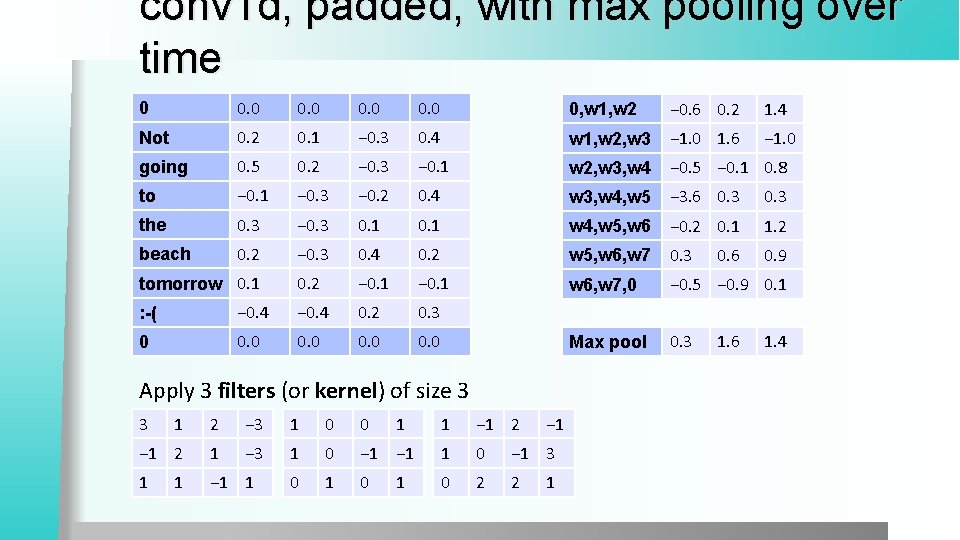
conv 1 d, padded, with max pooling over time 0 0, w 1, w 2 − 0. 6 0. 2 1. 4 Not 0. 2 0. 1 − 0. 3 0. 4 w 1, w 2, w 3 − 1. 0 1. 6 − 1. 0 going 0. 5 0. 2 − 0. 3 − 0. 1 w 2, w 3, w 4 − 0. 5 − 0. 1 0. 8 to − 0. 1 − 0. 3 − 0. 2 0. 4 w 3, w 4, w 5 − 3. 6 0. 3 the 0. 3 − 0. 3 0. 1 w 4, w 5, w 6 − 0. 2 0. 1 1. 2 beach 0. 2 − 0. 3 0. 4 0. 2 w 5, w 6, w 7 0. 3 0. 9 0. 2 − 0. 1 w 6, w 7, 0 − 0. 5 − 0. 9 0. 1 Max pool 0. 3 tomorrow 0. 1 : -( − 0. 4 0. 2 0. 3 0 0. 0 Apply 3 filters (or kernel) of size 3 3 1 2 − 3 1 0 0 − 1 2 1 − 3 1 0 1 − 1 1 0 1 1 1 − 1 2 − 1 1 0 − 1 3 0 0 2 2 1 1 − 1 1 0. 6 1. 4
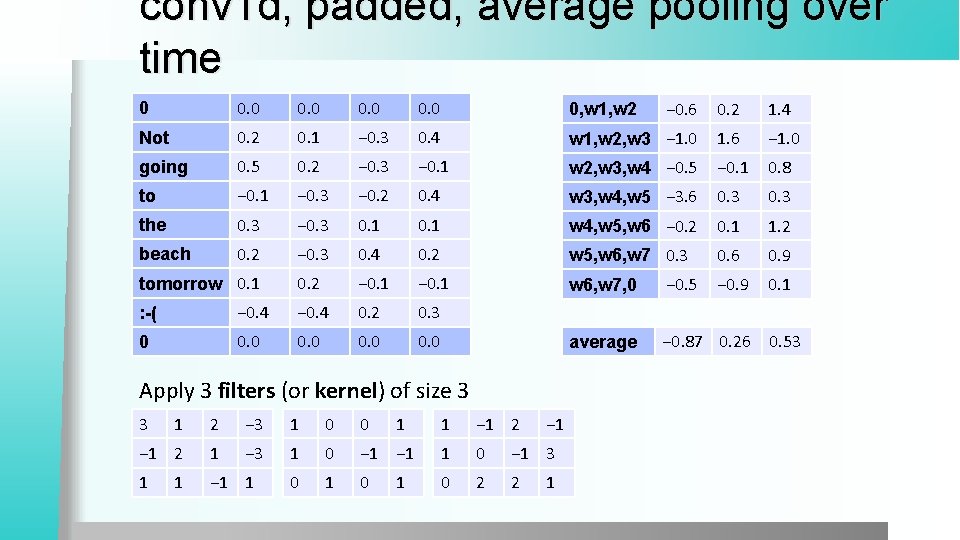
conv 1 d, padded, average pooling over time 0 0, w 1, w 2 − 0. 6 0. 2 1. 4 Not 0. 2 0. 1 − 0. 3 0. 4 w 1, w 2, w 3 − 1. 0 1. 6 − 1. 0 going 0. 5 0. 2 − 0. 3 − 0. 1 w 2, w 3, w 4 − 0. 5 − 0. 1 0. 8 to − 0. 1 − 0. 3 − 0. 2 0. 4 w 3, w 4, w 5 − 3. 6 0. 3 the 0. 3 − 0. 3 0. 1 w 4, w 5, w 6 − 0. 2 0. 1 1. 2 beach 0. 2 − 0. 3 0. 4 0. 2 w 5, w 6, w 7 0. 3 0. 6 0. 9 0. 2 − 0. 1 w 6, w 7, 0 − 0. 5 − 0. 9 0. 1 average − 0. 87 0. 26 tomorrow 0. 1 : -( − 0. 4 0. 2 0. 3 0 0. 0 Apply 3 filters (or kernel) of size 3 3 1 2 − 3 1 0 0 − 1 2 1 − 3 1 0 1 − 1 1 0 1 1 1 − 1 2 − 1 1 0 − 1 3 0 0 2 2 1 1 − 1 1 0. 53
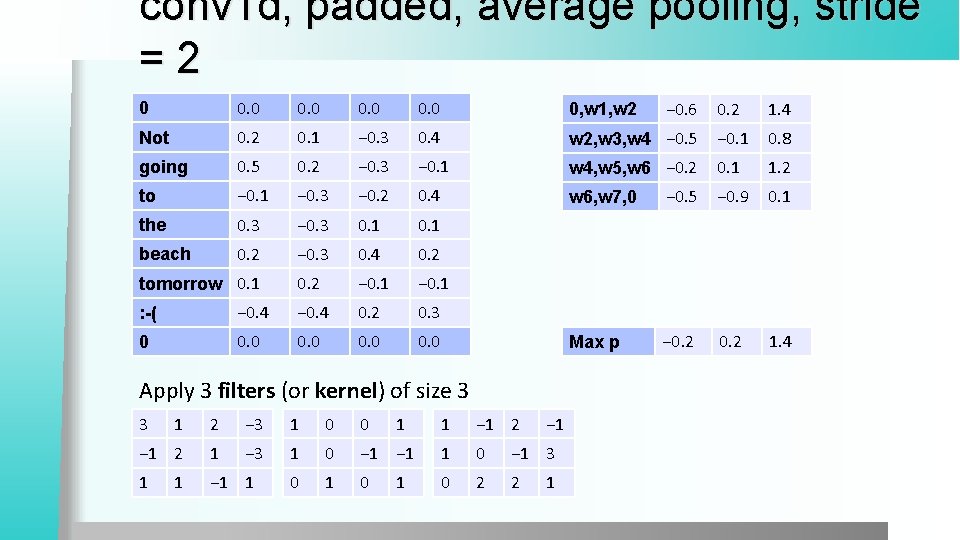
conv 1 d, padded, average pooling, stride =2 0 0, w 1, w 2 Not 0. 2 0. 1 − 0. 3 0. 4 going 0. 5 0. 2 − 0. 3 to − 0. 1 − 0. 3 the 0. 3 beach 0. 2 tomorrow 0. 1 0. 2 1. 4 w 2, w 3, w 4 − 0. 5 − 0. 1 0. 8 − 0. 1 w 4, w 5, w 6 − 0. 2 0. 1 1. 2 − 0. 2 0. 4 w 6, w 7, 0 − 0. 5 − 0. 9 0. 1 − 0. 3 0. 4 0. 2 − 0. 1 Max p − 0. 2 1. 4 : -( − 0. 4 0. 2 0. 3 0 0. 0 Apply 3 filters (or kernel) of size 3 3 1 2 − 3 1 0 0 − 1 2 1 − 3 1 0 1 − 1 1 0 1 1 1 − 1 2 − 1 1 0 − 1 3 0 0 2 2 1 1 − 0. 6
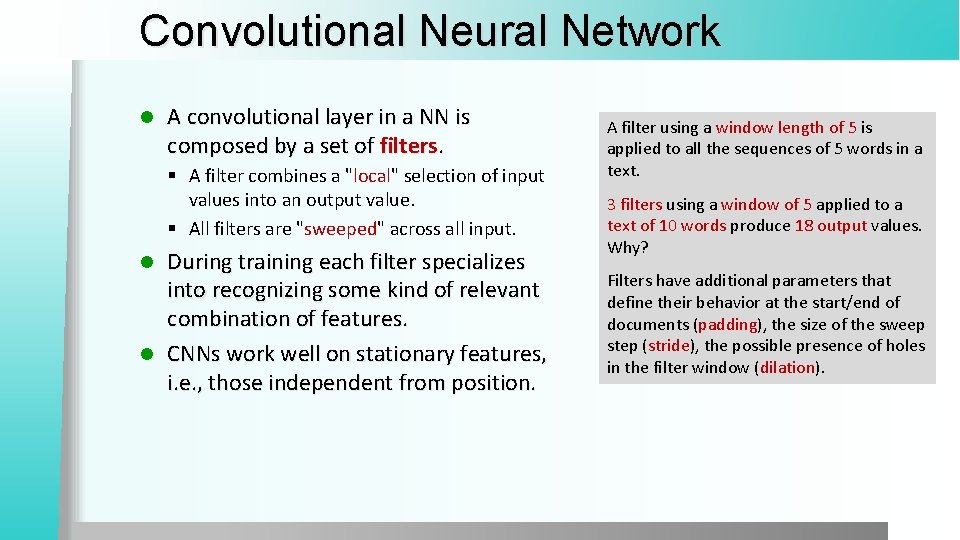
Convolutional Neural Network l A convolutional layer in a NN is composed by a set of filters. § A filter combines a "local" selection of input values into an output value. § All filters are "sweeped" across all input. During training each filter specializes into recognizing some kind of relevant combination of features. l CNNs work well on stationary features, i. e. , those independent from position. l A filter using a window length of 5 is applied to all the sequences of 5 words in a text. 3 filters using a window of 5 applied to a text of 10 words produce 18 output values. Why? Filters have additional parameters that define their behavior at the start/end of documents (padding), the size of the sweep step (stride), the possible presence of holes in the filter window (dilation).
Convolutiona Neural Network
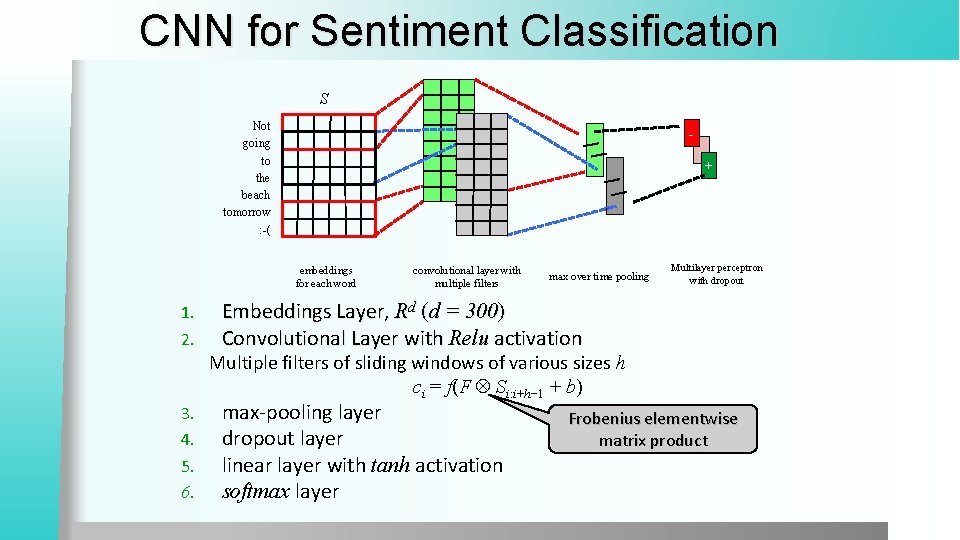
Single Layer CNN for Sentence Classification Yoon Kim (2014): Convolutional Neural Networks for Sentence Classification. EMNLP 2014. https: //arxiv. org/pdf/1408. 5882. pdf l A variant of convolutional NNs of Collobert, Weston et al. (2011) Natural Language Processing (almost) from Scratch. l Goal: Sentence classification: l § Mainly positive or negative sentiment of a sentence l Other tasks like: § Subjective or objective language sentence § Question classification: about person, location, number, . . .
CNN for Sentiment Classification S Not going to the beach tomorrow : -( - embeddings for each word 1. 2. 3. 4. 5. 6. convolutional layer with multiple filters max over time pooling + Multilayer perceptron with dropout Embeddings Layer, Rd (d = 300) Convolutional Layer with Relu activation Multiple filters of sliding windows of various sizes h ci = f(F Si: i+h− 1 + b) max-pooling layer dropout layer linear layer with tanh activation softmax layer Frobenius elementwise matrix product
Code l See notebook: § http: //attardi-4. di. unipi. it: 8000/hub/userredirect/lab/tree/HLT/Cnn. NLP. ipynb
Follow up Zhang and Wallace (2015) A Sensitivity Analysis of (and Practitioners’ Guide to) Convolutional Neural Networks for Sentence Classification https: //arxiv. org/pdf/1510. 03820. pdf
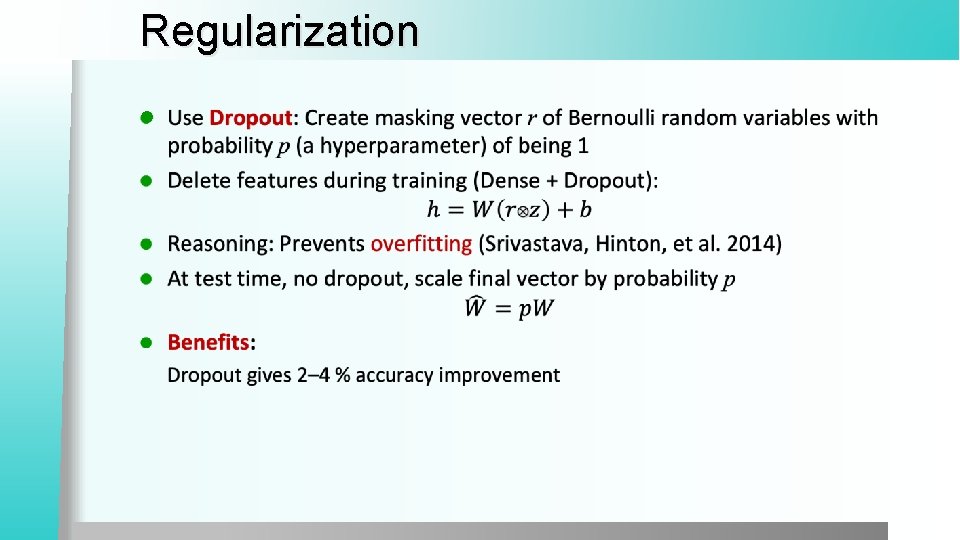
Regularization l
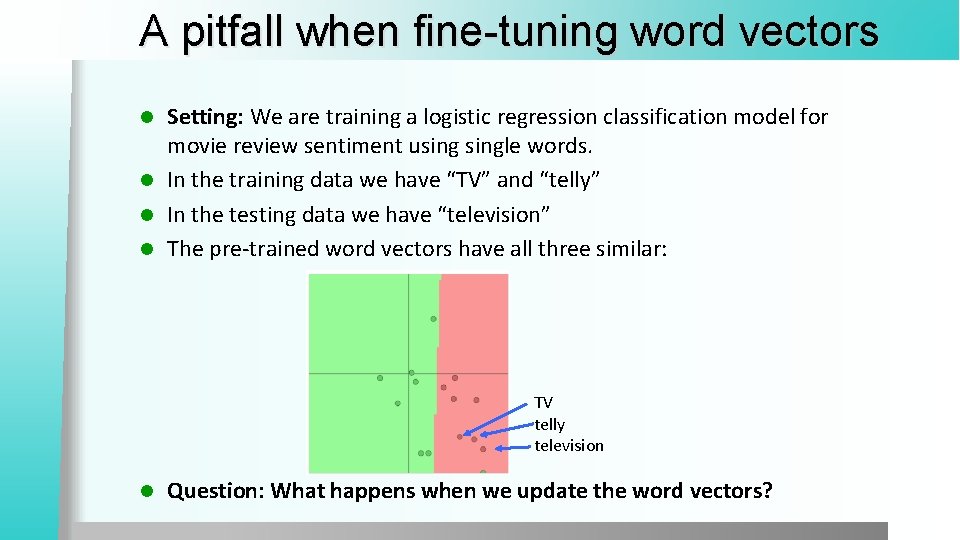
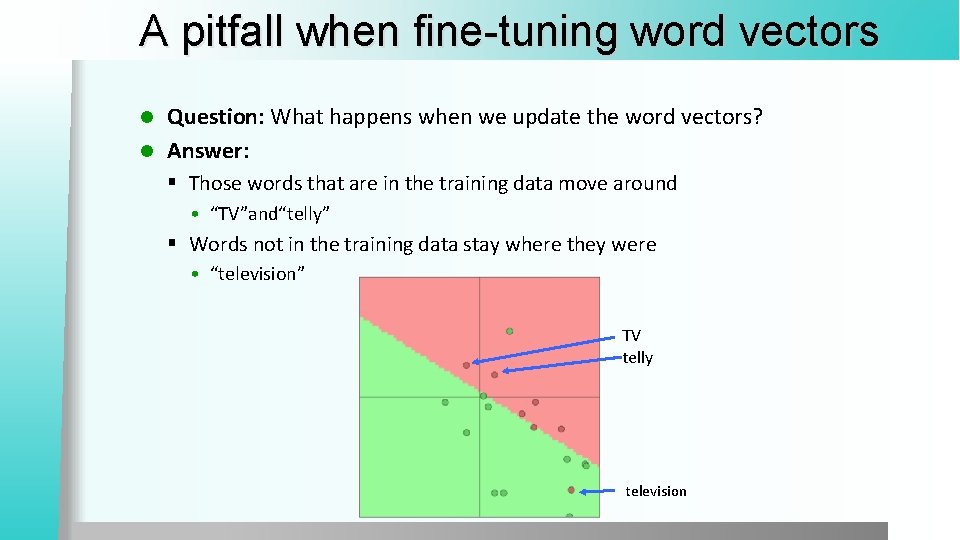
A pitfall when fine-tuning word vectors Setting: We are training a logistic regression classification model for movie review sentiment usingle words. l In the training data we have “TV” and “telly” l In the testing data we have “television” l The pre-trained word vectors have all three similar: l TV telly television l Question: What happens when we update the word vectors?
A pitfall when fine-tuning word vectors Question: What happens when we update the word vectors? l Answer: l § Those words that are in the training data move around • “TV”and“telly” § Words not in the training data stay where they were • “television” TV telly television
What to do l Question: Should I use available “pre-trained” word vectors Answer: § Almost always, yes! § They are trained on a huge amount of data, and so they will know about words not in your training data and will know more about words that are in your training data § Have 100 s of millions of words of data? Okay to start random Question: Should I update (“fine tune”) my own word vectors? l • Answer: l § § If you only have a small training data set, don’t train the word vectors If you have a large dataset, it probably will work better to train = update = fine-tune word vectors to the task