
Universit de Sherbrooke Surface nanometric sulphur and carbon
Université de Sherbrooke Surface nanometric sulphur and carbon moieties in Ni-catalyzed steam reforming of hydrocarbons N. Abatzoglou, Kandaiyan Shanmuga Priya S. Rakass, H. Oudghiri-Hassani and P. Rowntree Department of Chemical & Biotechnological Engineering 1 May 17, 2011: NTUA
Université de Sherbrooke Outline Ø Introduction § Rationale § Actual knowledge Ø Materials and methods Ø Results Ø Conclusions Ø Acknowledgments 2 May 17, 2011: NTUA
Introduction Université de Sherbrooke Rationale Ø Previous published work by the authors proved the efficiency of pristine micrometric Ni powders as steam reforming catalysts Ø Sulfur contamination of the Ni surface is known to cause catalyst partial or total deactivation Ø Commercial natural gas is artificially contaminated with alkanethiols and sulfides (i. e tert-butyl-mercaptan and di-methyl-sulfide) This work tries to elucidate the role of the sulfur at the surface of Ni-based catalysts 3 May 17, 2011: NTUA
Introduction Université de Sherbrooke Scientific background (1) Conventional supported Ni catalysts are known to deactivate by sintering, sulfur passivation and carbon deposition Ø The sulfur compounds in gasoline and H 2 S produced from these sulfur compounds in the hydrocarbon reforming process are poisonous to the Reforming and WGS catalysts Ø Deactivation of supported metal catalysts by carbon formation is another serious problem in steam reforming due to: q fouling of the metal surface q blockage of catalyst pores q loss of the structural integrity of the catalyst support material 4 May 17, 2011: NTUA
Université de Sherbrooke Scientific background (2) v Sulfur passivated reforming process (SPARG) : Trace amount (2 ppm) of H 2 S with the feed gas. Ø S selectively poisons active sites of Ni catalyst - Small loss in the reforming activity. Rationale: Trace amounts of S affect the deactivation rate much more than the reforming rate. Ø Adsorbed S deactivate the occupied Ni site, thus changing the “Number/Surface unit” of the catalytically active ensembles. Ø Size of these ensembles is critical in allowing SR with minimal formation of coke. Ø SR is thought to involve ensembles of 3 -4 Ni atoms, while C formation requires 6 -7 Ni atoms. Ø Complete coverage of catalyst with S results in total deactivation; however, at S coverage of around 70% of saturation, C deposition could effectively be eliminated while SR still proceeds. 5 J. R. Rostrup-Nielsen, J. Catal. 85 (1984) 31 May 17, 2011: NTUA
6 Université de Sherbrooke Scientific background (3) v Interfacial reactions between H 2 S and Ni surface leads to rapid adsorption of monolayer of S atoms on Ni surface. v These observations are consistent with predictions from first-principles calculations : H 2 S dissociation on transition -metal surfaces has small dissociation barriers (weak H-S bonds), and high exothermicities (strong S-metal bonds). v Self-assembled monolayers (SAM) are formed from adsorption of organothiols on metal surfaces such as Au and Ni. • G. A. Sargent, G. B. Freeman, J. L. Chao, Surf. Sci 100 (1980) 342. • B. Mc. Allister, P. Hu, J. Chem. Phys. 122 (2005) 84709. • S. Rakass, H. Oudghiri-Hassani, N. Abatzoglou & P. Rowntree, J. Power Sources 162 (2006) 579. May 17, 2011: NTUA
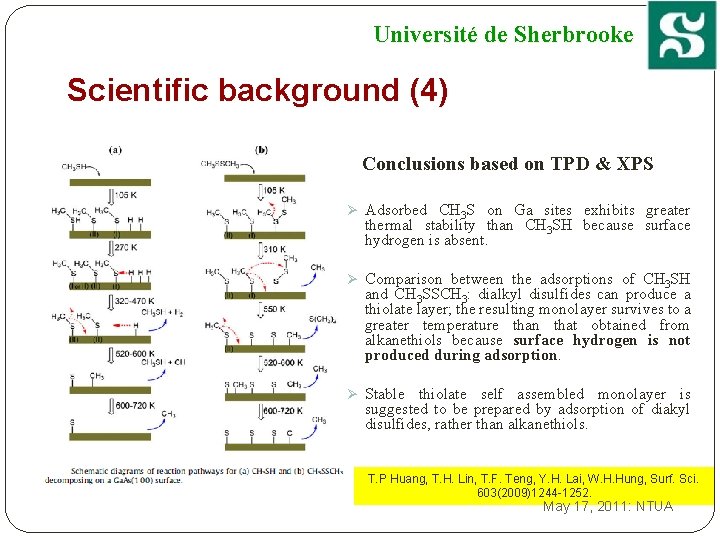
Université de Sherbrooke Scientific background (4) Conclusions based on TPD & XPS Ø Adsorbed CH 3 S on Ga sites exhibits greater thermal stability than CH 3 SH because surface hydrogen is absent. Ø Comparison between the adsorptions of CH 3 SH and CH 3 SSCH 3: dialkyl disulfides can produce a thiolate layer; the resulting monolayer survives to a greater temperature than that obtained from alkanethiols because surface hydrogen is not produced during adsorption. Ø Stable thiolate self assembled monolayer is suggested to be prepared by adsorption of diakyl disulfides, rather than alkanethiols. 7 T. P Huang, T. H. Lin, T. F. Teng, Y. H. Lai, W. H. Hung, Surf. Sci. 603(2009)1244 -1252. May 17, 2011: NTUA
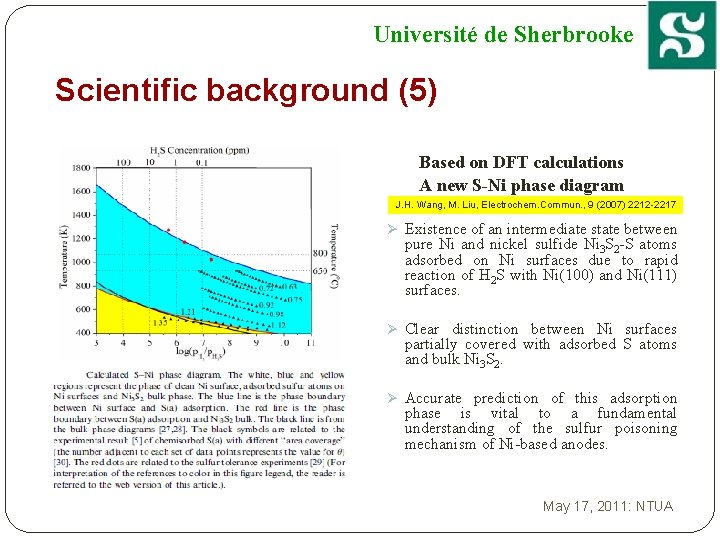
Université de Sherbrooke Scientific background (5) Based on DFT calculations A new S-Ni phase diagram J. H. Wang, M. Liu, Electrochem. Commun. , 9 (2007) 2212 -2217 Ø Existence of an intermediate state between pure Ni and nickel sulfide Ni 3 S 2 -S atoms adsorbed on Ni surfaces due to rapid reaction of H 2 S with Ni(100) and Ni(111) surfaces. Ø Clear distinction between Ni surfaces partially covered with adsorbed S atoms and bulk Ni 3 S 2. Ø Accurate prediction of this adsorption phase is vital to a fundamental understanding of the sulfur poisoning mechanism of Ni-based anodes. 8 May 17, 2011: NTUA
Materials and methods Université de Sherbrooke The unsupported Ni powder Ø Ø Ø 9 Inco Ni 255 BET Surface = 0. 44 m 2/g Particle size distribution: 1 -20µm Open filamentary structure and irregular spiky surface Produced by thermal decomposition of Ni(CO)4 May 17, 2011: NTUA
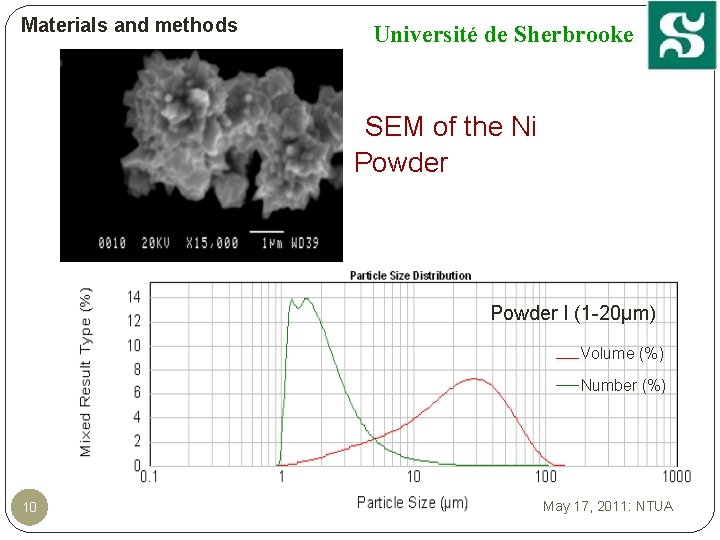
Materials and methods Université de Sherbrooke SEM of the Ni Powder I (1 -20µm) Volume (%) Number (%) 10 May 17, 2011: NTUA
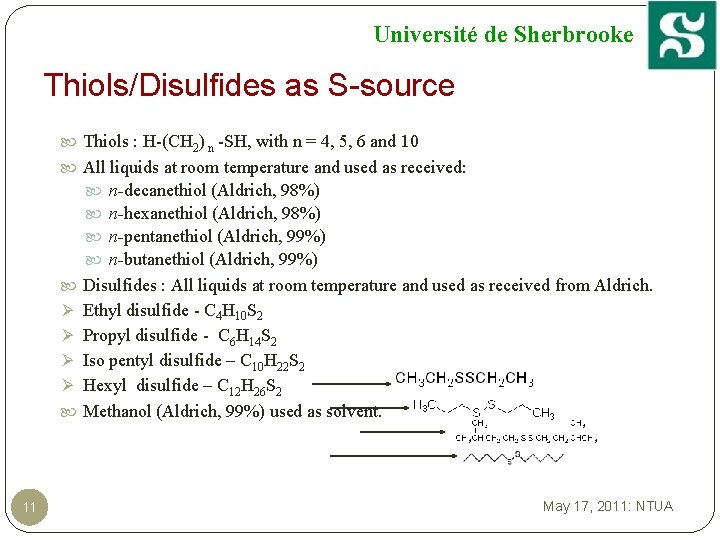
Université de Sherbrooke Thiols/Disulfides as S-source Thiols : H-(CH 2) n -SH, with n = 4, 5, 6 and 10 All liquids at room temperature and used as received: n-decanethiol (Aldrich, 98%) n-hexanethiol (Aldrich, 98%) n-pentanethiol (Aldrich, 99%) n-butanethiol (Aldrich, 99%) Disulfides : All liquids at room temperature and used as received from Aldrich. Ø Ethyl disulfide - C 4 H 10 S 2 Ø Propyl disulfide - C 6 H 14 S 2 Ø Iso pentyl disulfide – C 10 H 22 S 2 Ø Hexyl disulfide – C 12 H 26 S 2 Methanol (Aldrich, 99%) used as solvent. 11 May 17, 2011: NTUA
Materials and methods Université de Sherbrooke Ni Impregnation Ø Pristine Ni powder in 10 -3 M sol. of alkanethiols/methanol Ø 5 g of Ni in 100 ml of solution: several orders of magnitude excess thiol as compared to the monolayer quantities Ø Immersion time under stirring: 20 h Ø Rinsed thoroughly with fresh methanol Ø Samples dried for 12 hours at ambient temperature 12 May 17, 2011: NTUA
Materials and methods Université de Sherbrooke Experimental set-up A multi-differential isothermal reactor set-up equipped with a gas humidification system, a programmable furnace and coupled to a Quadrupole Mass Spectrometer 13 May 17, 2011: NTUA
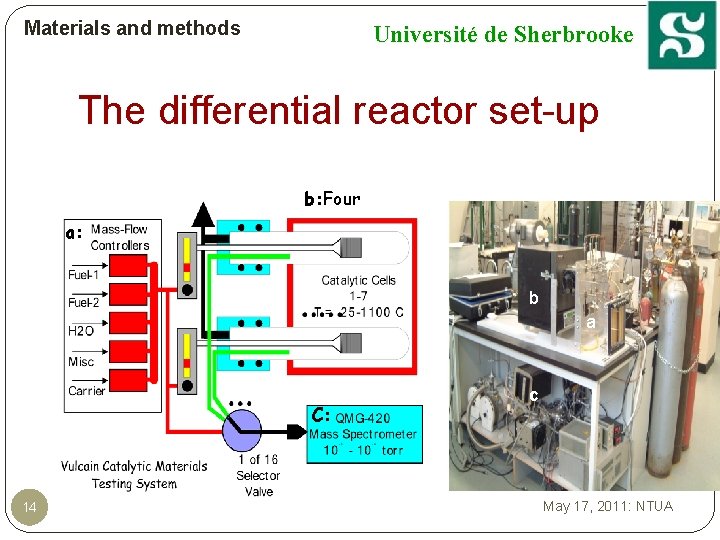
Materials and methods Université de Sherbrooke The differential reactor set-up b: Four a: b a C: 14 c May 17, 2011: NTUA
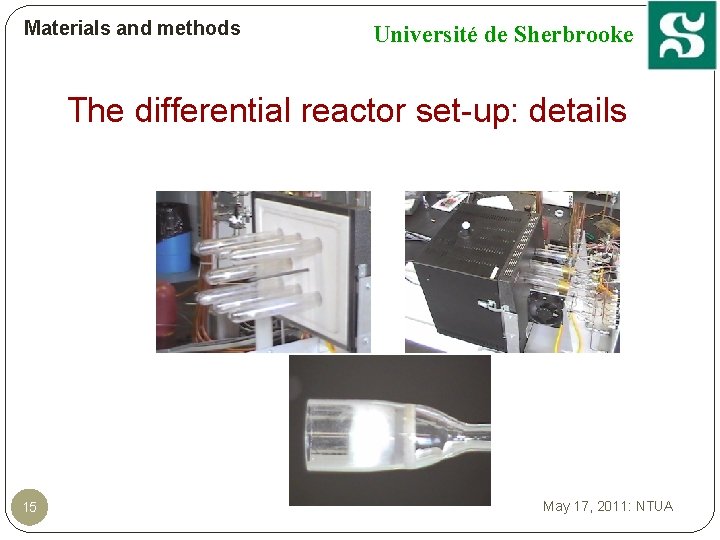
Materials and methods Université de Sherbrooke The differential reactor set-up: details 15 May 17, 2011: NTUA
Materials and methods Université de Sherbrooke Basic experimental protocol The reactant gas is composed of Ultra high purity CH 4 and steam Ar was used as inert diluent The partial pressure of water in the gas is used to regulate the CH 4/H 2 O The gas compositions and flow rates are controlled by rotameters The flow rate used was 25 ml/min per tube 0. 25 g of catalyst packed into the quartz tubes and retained by quartz wool The inner tubes include porous fused quartz disks (coarse porosity of 40 -90 mm, 1. 5 cm diameter) supporting the Ni catalyst bed No entrainment of catalyst particles occurs downstream The reforming tests were conducted at a CH 4/H 2 O molar ratio of 1: 2 and at sufficiently low GHSV 16 May 17, 2011: NTUA
Materials and methods Université de Sherbrooke Experimental campaigns Q 1: What happens to the Ni ? Steam Reforming with pristine and alkanethiols- impregnated Ni Q 2: What if the surfaces are thermally pretreated? Steam reforming with thermally pretreated pristine and alkanethiols impregnated Ni Q 3: Which is the source of the aromatic carbon? CH 4 vs Alkanethiols 17 May 17, 2011: NTUA
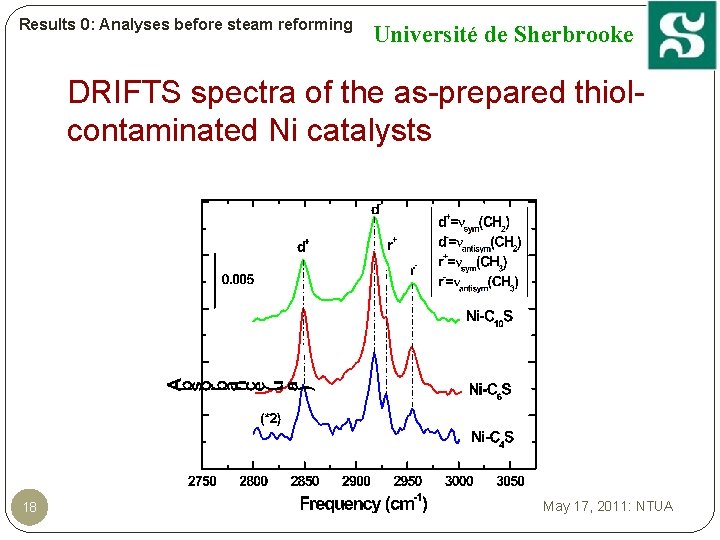
Results 0: Analyses before steam reforming Université de Sherbrooke DRIFTS spectra of the as-prepared thiolcontaminated Ni catalysts 18 May 17, 2011: NTUA
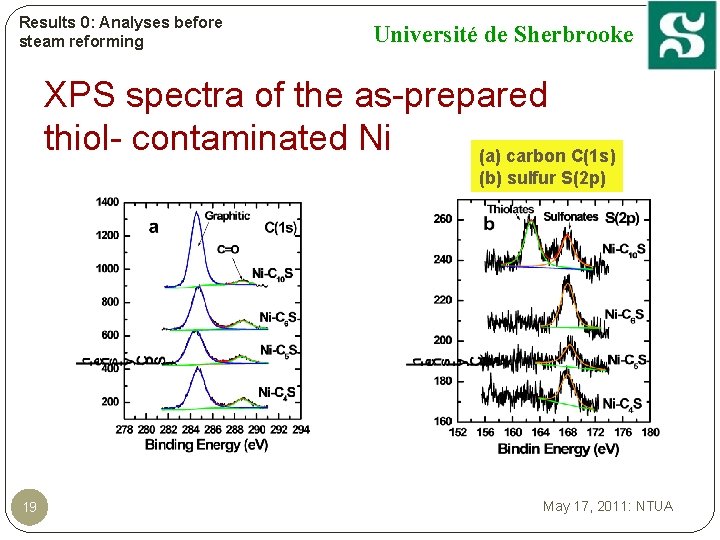
Results 0: Analyses before steam reforming Université de Sherbrooke XPS spectra of the as-prepared thiol- contaminated Ni (a) carbon C(1 s) (b) sulfur S(2 p) 19 May 17, 2011: NTUA
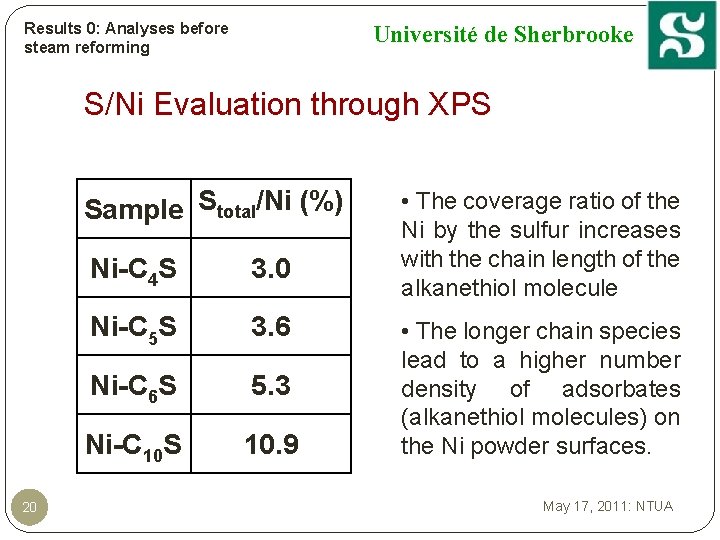
Results 0: Analyses before steam reforming Université de Sherbrooke S/Ni Evaluation through XPS Sample Stotal/Ni (%) 20 Ni-C 4 S 3. 0 Ni-C 5 S 3. 6 Ni-C 6 S 5. 3 Ni-C 10 S 10. 9 • The coverage ratio of the Ni by the sulfur increases with the chain length of the alkanethiol molecule • The longer chain species lead to a higher number density of adsorbates (alkanethiol molecules) on the Ni powder surfaces. May 17, 2011: NTUA
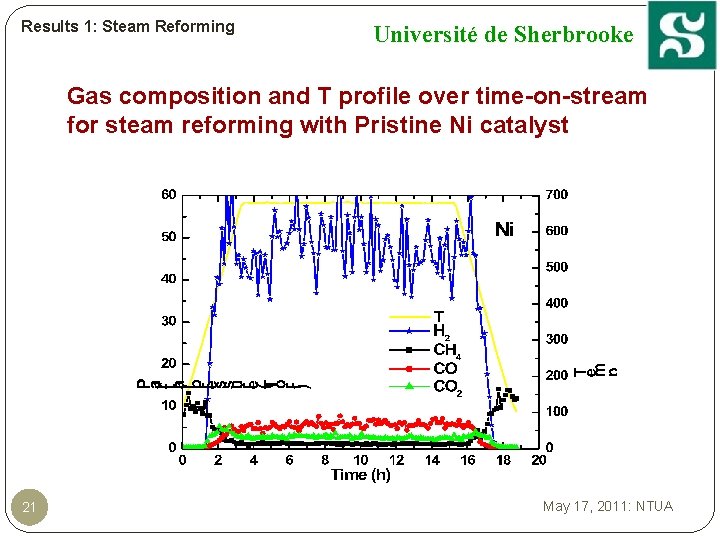
Results 1: Steam Reforming Université de Sherbrooke Gas composition and T profile over time-on-stream for steam reforming with Pristine Ni catalyst 21 May 17, 2011: NTUA
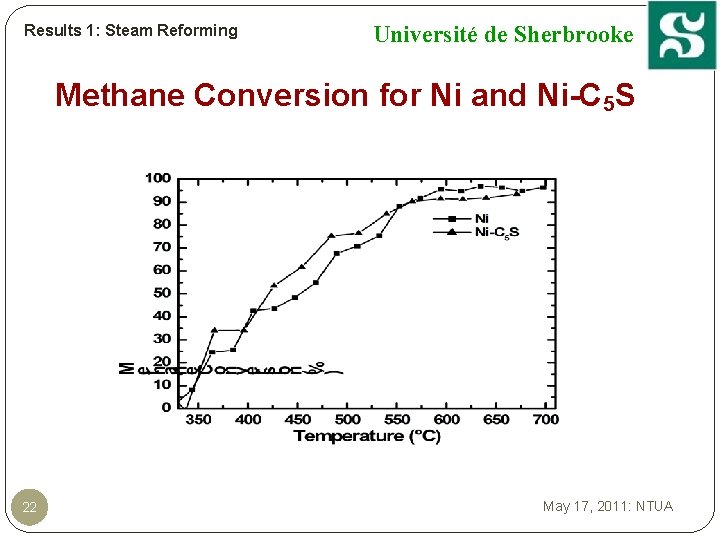
Results 1: Steam Reforming Université de Sherbrooke Methane Conversion for Ni and Ni-C 5 S 22 May 17, 2011: NTUA
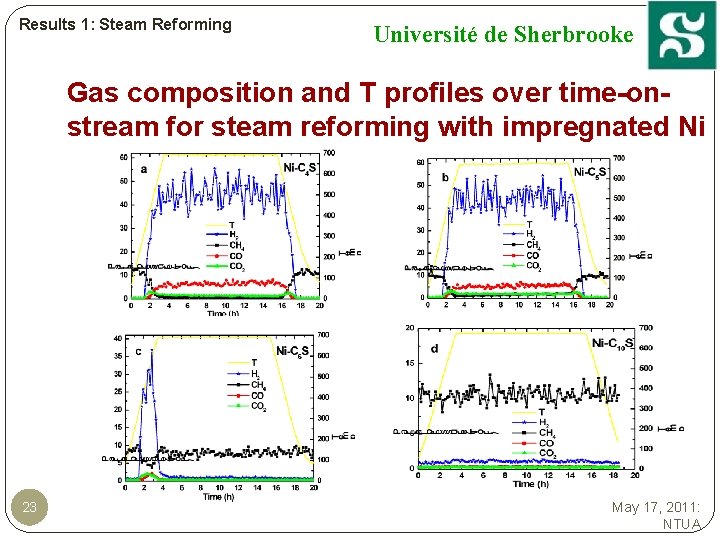
Results 1: Steam Reforming Université de Sherbrooke Gas composition and T profiles over time-onstream for steam reforming with impregnated Ni 23 May 17, 2011: NTUA
Results 1: Steam Reforming Université de Sherbrooke Observations (1) Ø The high catalytic activity and stability of Ni-C 4 S and Ni-C 5 S catalysts were similar to that of pristine Ni catalysts Ø The activity of Ni-C 6 S catalysts decreased for temperatures above 580 o. C Ø No activity was obtained over the Ni-C 10 S at any temperature 24 May 17, 2011: NTUA
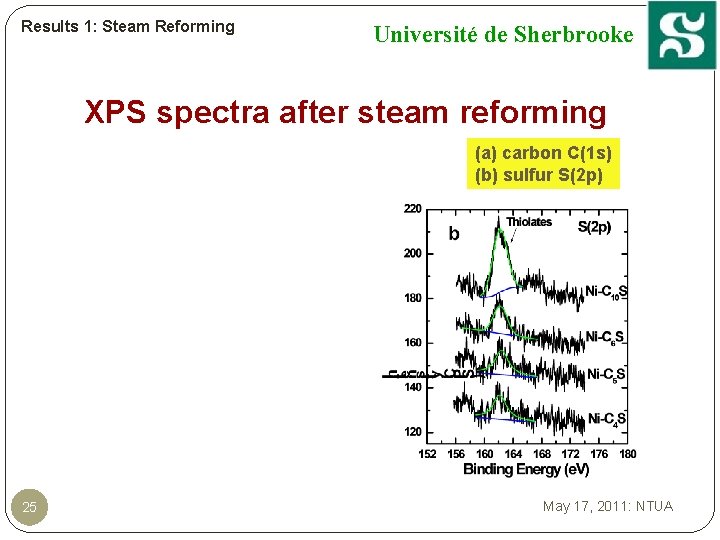
Results 1: Steam Reforming Université de Sherbrooke XPS spectra after steam reforming (a) carbon C(1 s) (b) sulfur S(2 p) 25 May 17, 2011: NTUA
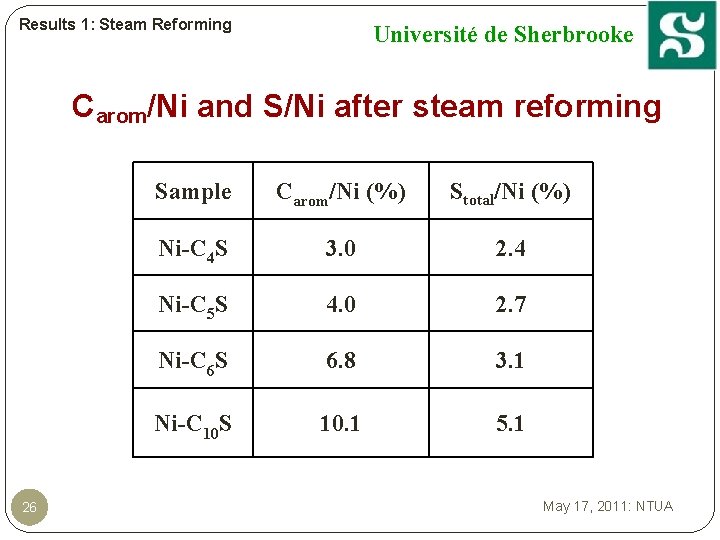
Results 1: Steam Reforming Université de Sherbrooke Carom/Ni and S/Ni after steam reforming 26 Sample Carom/Ni (%) Stotal/Ni (%) Ni-C 4 S 3. 0 2. 4 Ni-C 5 S 4. 0 2. 7 Ni-C 6 S 6. 8 3. 1 Ni-C 10 S 10. 1 5. 1 May 17, 2011: NTUA
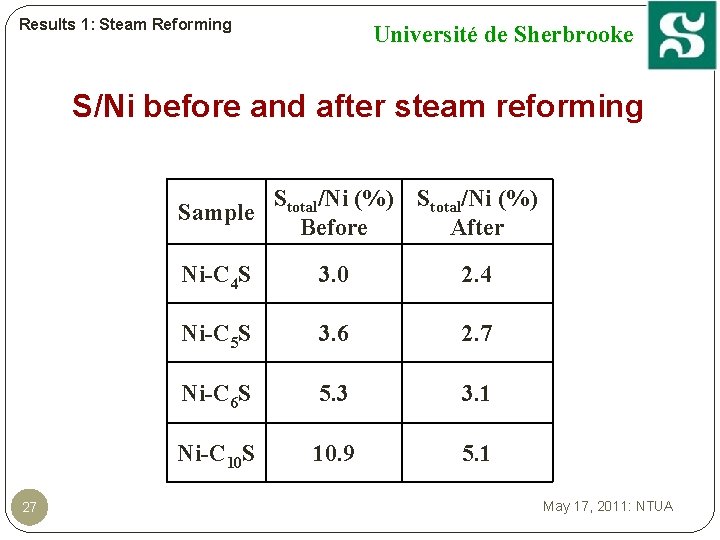
Results 1: Steam Reforming Université de Sherbrooke S/Ni before and after steam reforming Stotal/Ni (%) Sample Before After 27 Ni-C 4 S 3. 0 2. 4 Ni-C 5 S 3. 6 2. 7 Ni-C 6 S 5. 3 3. 1 Ni-C 10 S 10. 9 5. 1 May 17, 2011: NTUA
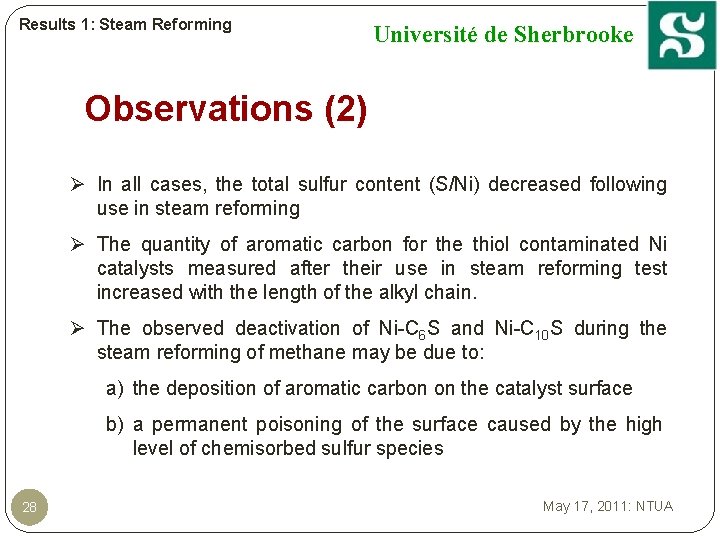
Results 1: Steam Reforming Université de Sherbrooke Observations (2) Ø In all cases, the total sulfur content (S/Ni) decreased following use in steam reforming Ø The quantity of aromatic carbon for the thiol contaminated Ni catalysts measured after their use in steam reforming test increased with the length of the alkyl chain. Ø The observed deactivation of Ni-C 6 S and Ni-C 10 S during the steam reforming of methane may be due to: a) the deposition of aromatic carbon on the catalyst surface b) a permanent poisoning of the surface caused by the high level of chemisorbed sulfur species 28 May 17, 2011: NTUA
Results 2: Thermal Pretreatment and Steam Reforming Université de Sherbrooke Gas composition and T profile over time-on-stream for steam reforming with thermally pretreated Ni at 700°C 29 May 17, 2011: NTUA
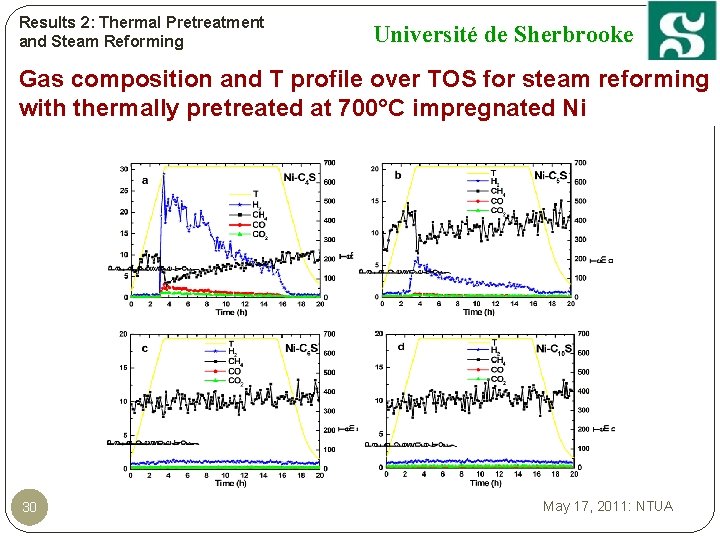
Results 2: Thermal Pretreatment and Steam Reforming Université de Sherbrooke Gas composition and T profile over TOS for steam reforming with thermally pretreated at 700°C impregnated Ni 30 May 17, 2011: NTUA
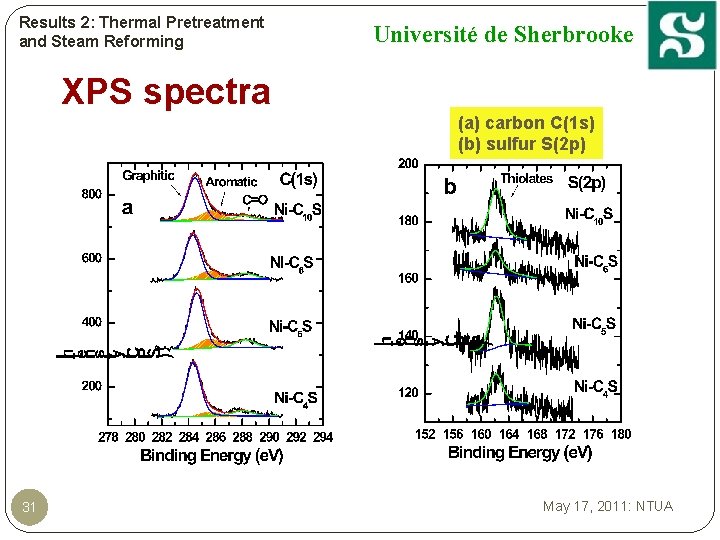
Results 2: Thermal Pretreatment and Steam Reforming Université de Sherbrooke XPS spectra (a) carbon C(1 s) (b) sulfur S(2 p) 31 May 17, 2011: NTUA
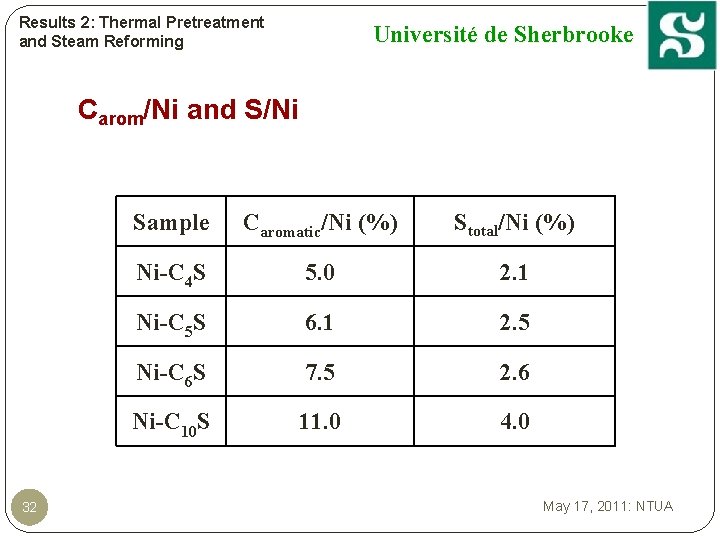
Results 2: Thermal Pretreatment and Steam Reforming Université de Sherbrooke Carom/Ni and S/Ni 32 Sample Caromatic/Ni (%) Stotal/Ni (%) Ni-C 4 S 5. 0 2. 1 Ni-C 5 S 6. 1 2. 5 Ni-C 6 S 7. 5 2. 6 Ni-C 10 S 11. 0 4. 0 May 17, 2011: NTUA
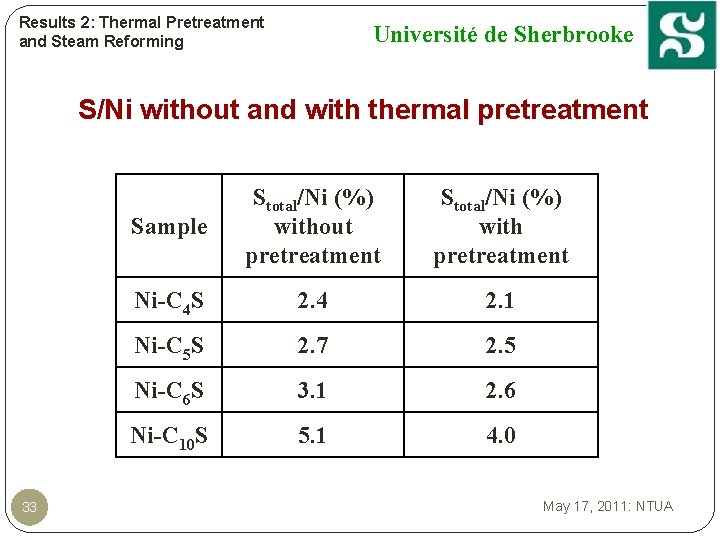
Results 2: Thermal Pretreatment and Steam Reforming Université de Sherbrooke S/Ni without and with thermal pretreatment 33 Sample Stotal/Ni (%) without pretreatment Stotal/Ni (%) with pretreatment Ni-C 4 S 2. 4 2. 1 Ni-C 5 S 2. 7 2. 5 Ni-C 6 S 3. 1 2. 6 Ni-C 10 S 5. 1 4. 0 May 17, 2011: NTUA
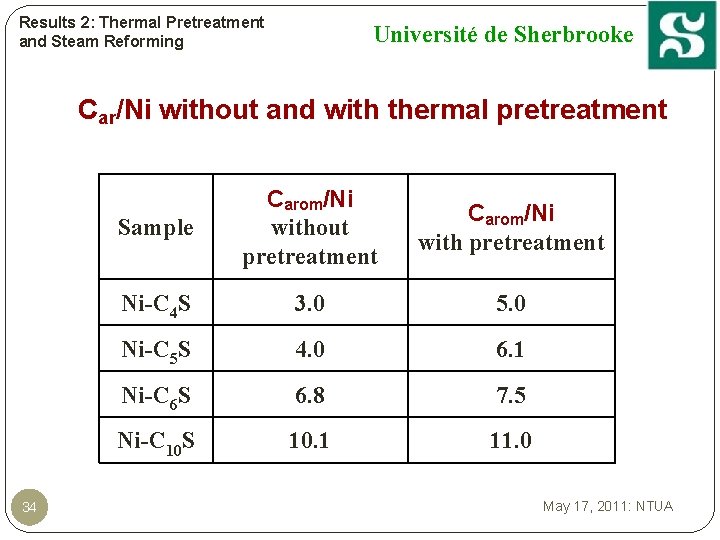
Results 2: Thermal Pretreatment and Steam Reforming Université de Sherbrooke Car/Ni without and with thermal pretreatment 34 Sample Carom/Ni without pretreatment Carom/Ni with pretreatment Ni-C 4 S 3. 0 5. 0 Ni-C 5 S 4. 0 6. 1 Ni-C 6 S 6. 8 7. 5 Ni-C 10 S 10. 1 11. 0 May 17, 2011: NTUA
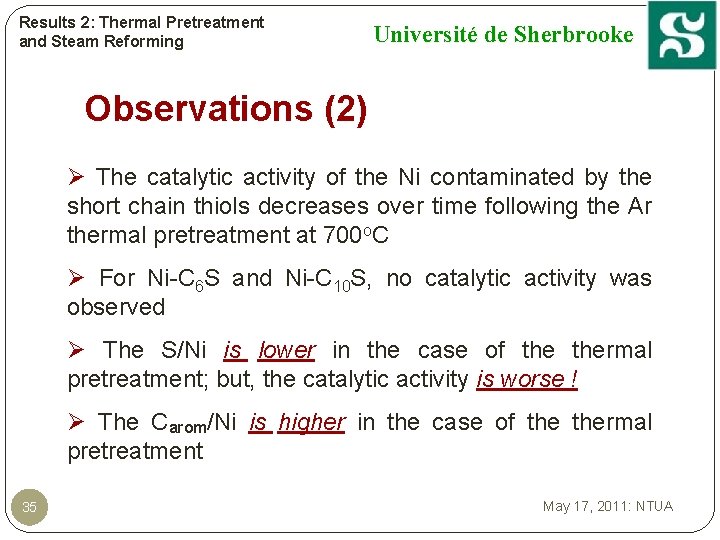
Results 2: Thermal Pretreatment and Steam Reforming Université de Sherbrooke Observations (2) Ø The catalytic activity of the Ni contaminated by the short chain thiols decreases over time following the Ar thermal pretreatment at 700 o. C Ø For Ni-C 6 S and Ni-C 10 S, no catalytic activity was observed Ø The S/Ni is lower in the case of thermal pretreatment; but, the catalytic activity is worse ! Ø The Carom/Ni is higher in the case of thermal pretreatment 35 May 17, 2011: NTUA
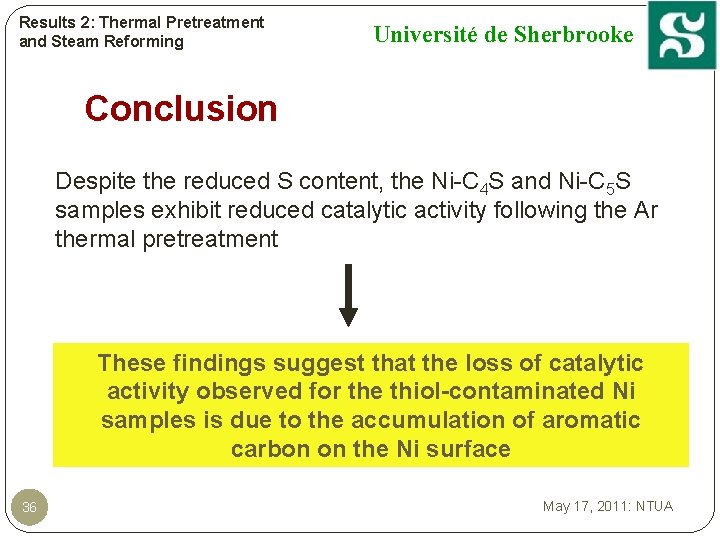
Results 2: Thermal Pretreatment and Steam Reforming Université de Sherbrooke Conclusion Despite the reduced S content, the Ni-C 4 S and Ni-C 5 S samples exhibit reduced catalytic activity following the Ar thermal pretreatment These findings suggest that the loss of catalytic activity observed for the thiol-contaminated Ni samples is due to the accumulation of aromatic carbon on the Ni surface 36 May 17, 2011: NTUA
Results 3: CH 4 vs Alkanethiols Université de Sherbrooke Which molecule is responsible for the formation of aromatic carbon ? Are the pre-adsorbed alkanethiols or feed-gas CH 4? 37 May 17, 2011: NTUA
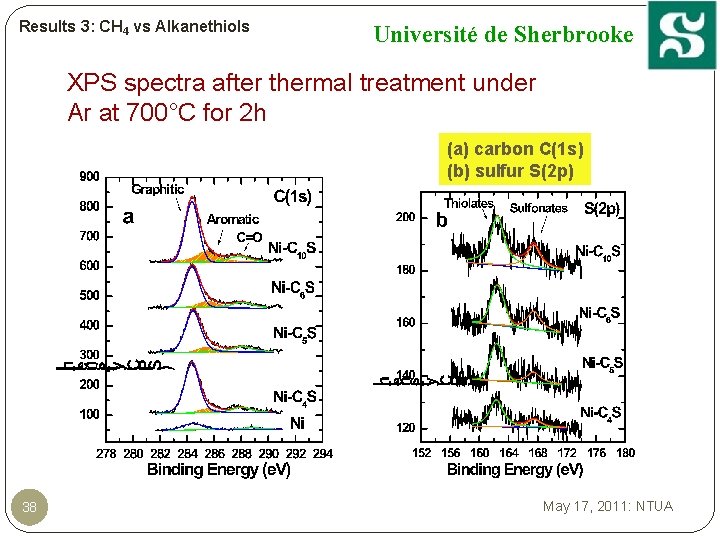
Results 3: CH 4 vs Alkanethiols Université de Sherbrooke XPS spectra after thermal treatment under Ar at 700°C for 2 h (a) carbon C(1 s) (b) sulfur S(2 p) 38 May 17, 2011: NTUA
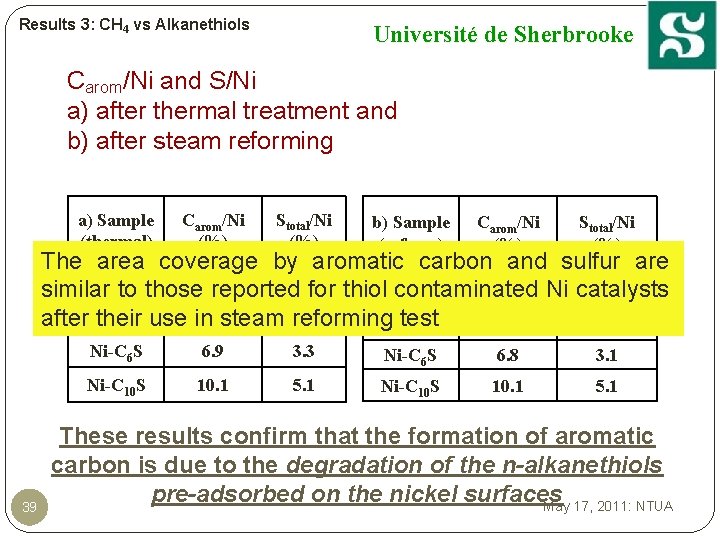
Results 3: CH 4 vs Alkanethiols Université de Sherbrooke Carom/Ni and S/Ni a) after thermal treatment and b) after steam reforming a) Sample (thermal) Carom/Ni (%) Stotal/Ni (%) b) Sample (reform) Carom/Ni (%) Stotal/Ni (%) Ni-C 6 S 6. 9 3. 3 Ni-C 6 S 6. 8 3. 1 Ni-C 10 S 10. 1 5. 1 The area coverage by aromatic carbon and sulfur are Ni-Cto 3. 0 Ni catalysts 2. 4 4 S those 3. 0 similar reported 2. 4 for thiol. Ni-C contaminated 4 S 4. 1 steam reforming 2. 6 after. Ni-C their test Ni-C 4. 0 2. 7 5 S use in 5 S 39 These results confirm that the formation of aromatic carbon is due to the degradation of the n-alkanethiols pre-adsorbed on the nickel surfaces May 17, 2011: NTUA
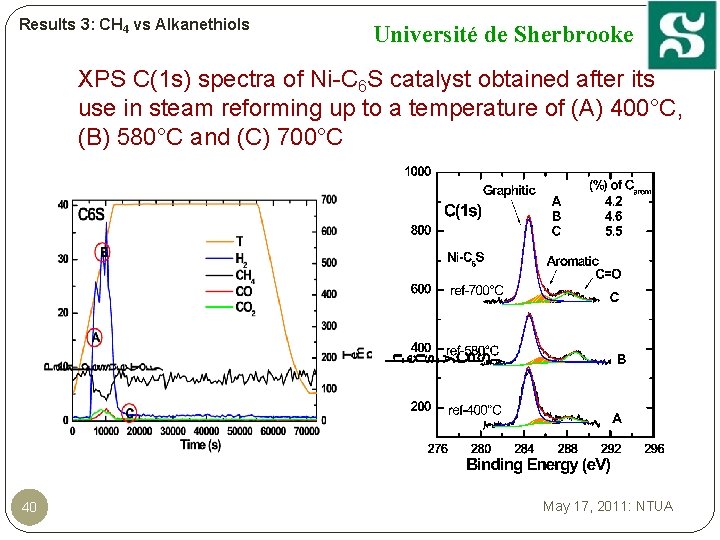
Results 3: CH 4 vs Alkanethiols Université de Sherbrooke XPS C(1 s) spectra of Ni-C 6 S catalyst obtained after its use in steam reforming up to a temperature of (A) 400°C, (B) 580°C and (C) 700°C 40 May 17, 2011: NTUA
Results 3: CH 4 vs Alkanethiols Université de Sherbrooke Observations (4) The Ni-C 6 S catalyst was deactivated as the temperature exceeded ~580 o. C and at this temperature the area coverage percentage of aromatic carbon was 4. 6% Estimated threshold for significant surface deactivation 41 May 17, 2011: NTUA
Université de Sherbrooke Conclusions Ø The longer alkyl chain species lead to increased surface coverage on the catalyst Ø The catalytic activity of the Ni-C 4 S, Ni-C 5 S, Ni-C 6 S and Ni-C 10 S catalysts depends on the alkyl chain lengths Ø The deactivation of the unsupported Ni catalysts is mainly due to the coverage of the catalyst surface by aromatic-aliphatic carbon 42 May 17, 2011: NTUA
Université de Sherbrooke Conclusions (cont. ) Ø The formation of aromatic-aliphatic carbon during steam reforming was found to be due to the pyrolysis of carbon from n-alkanethiols preadsorbed on the catalyst surface and not from the methane feed gas Ø A Ni surface area coverage by aromatic carbon of over 4. 6% leads to complete deactivation of Ni catalyst surface 43 May 17, 2011: NTUA
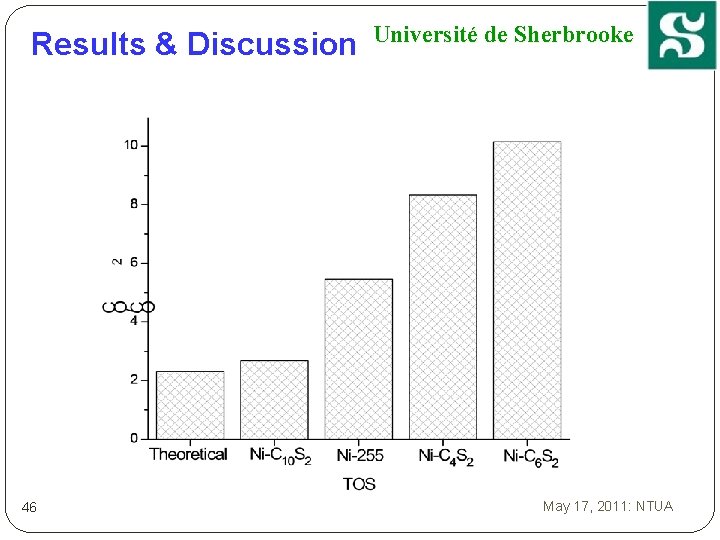
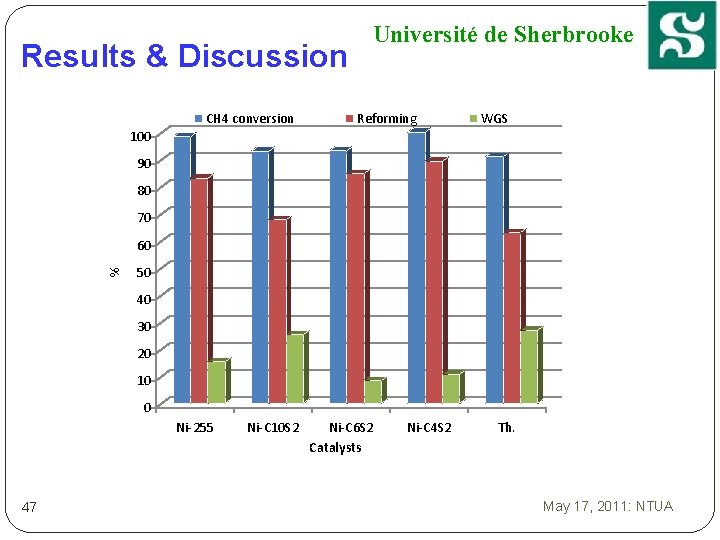
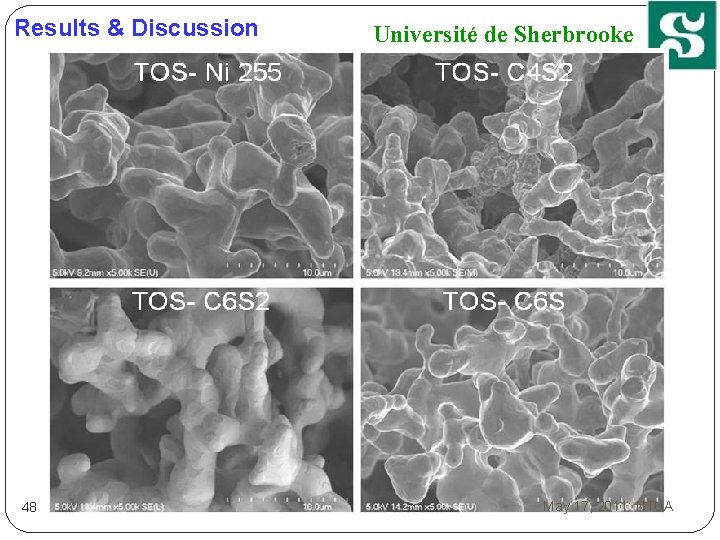
Université de Sherbrooke Recent Experimental campaigns • Q 1 : Compare Ni-255 disulfide vs thiol impregnation • Q 2 : What happens if the disulfide impregnated catalysts were thermally treated (TT) followed by SR? • Q 3 : Is there any change in the ratio of reforming to WGS reaction due to the different chain length of disulfides? • Q 4: What is the reason for the catalyst deactivation as chain length of disulfide increases; surface C or S species? 44 May 17, 2011: NTUA
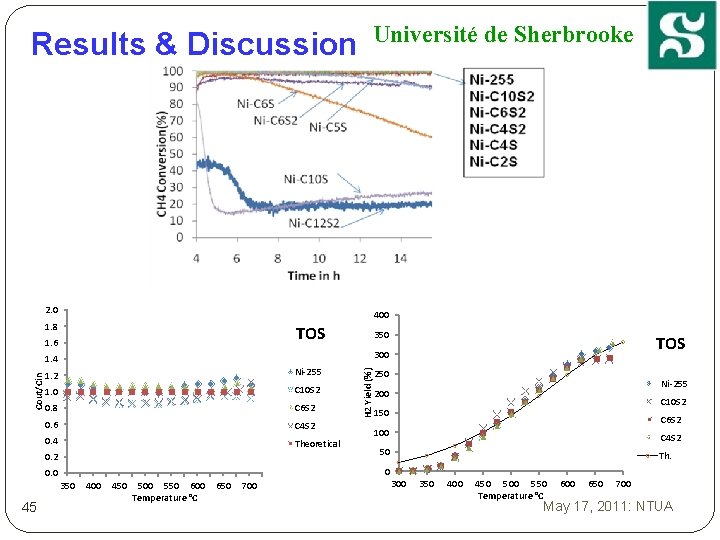
Results & Discussion Université de Sherbrooke 2. 0 400 1. 8 TOS 1. 6 350 Ni-255 1. 0 C 10 S 2 0. 8 C 6 S 2 0. 6 C 4 S 2 0. 4 Theoretical H 2 Yield (%) Cout/Cin 1. 2 0. 2 250 Ni-255 200 C 10 S 2 150 C 6 S 2 100 C 4 S 2 50 Th. 0 0. 0 350 45 TOS 300 1. 4 400 450 500 550 600 Temperature °C 650 700 350 400 450 500 550 Temperature °C 600 650 700 May 17, 2011: NTUA
Results & Discussion 46 Université de Sherbrooke May 17, 2011: NTUA
Results & Discussion CH 4 conversion Université de Sherbrooke Reforming WGS 100 90 80 70 % 60 50 40 30 20 10 0 Ni-255 47 Ni-C 10 S 2 Ni-C 6 S 2 Catalysts Ni-C 4 S 2 Th. May 17, 2011: NTUA
Results & Discussion 48 Université de Sherbrooke May 17, 2011: NTUA
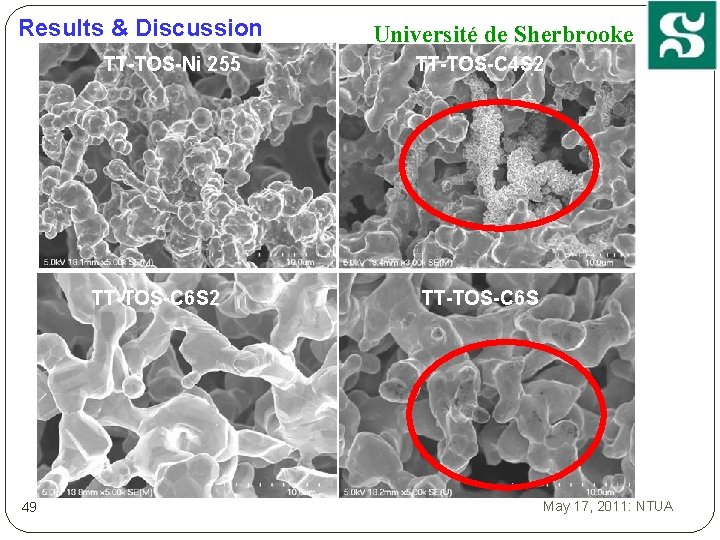
Results & Discussion TT-TOS-Ni 255 TT-TOS-C 6 S 2 49 Université de Sherbrooke TT-TOS-C 4 S 2 TT-TOS-C 6 S May 17, 2011: NTUA
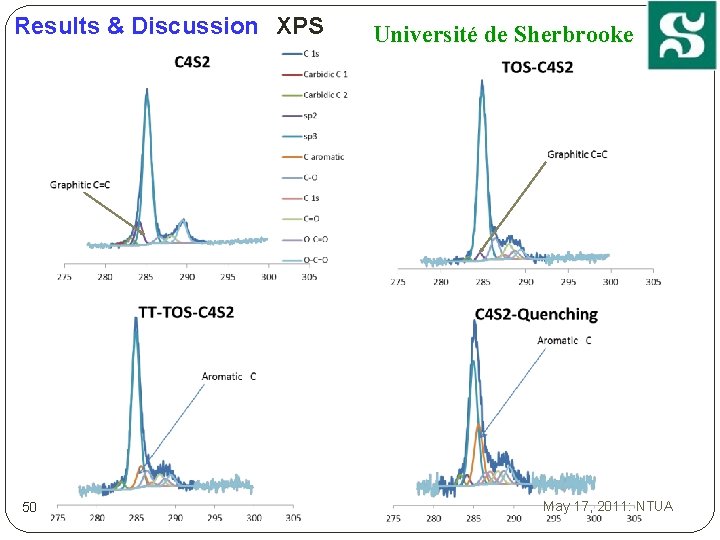
Results & Discussion XPS 50 Université de Sherbrooke May 17, 2011: NTUA
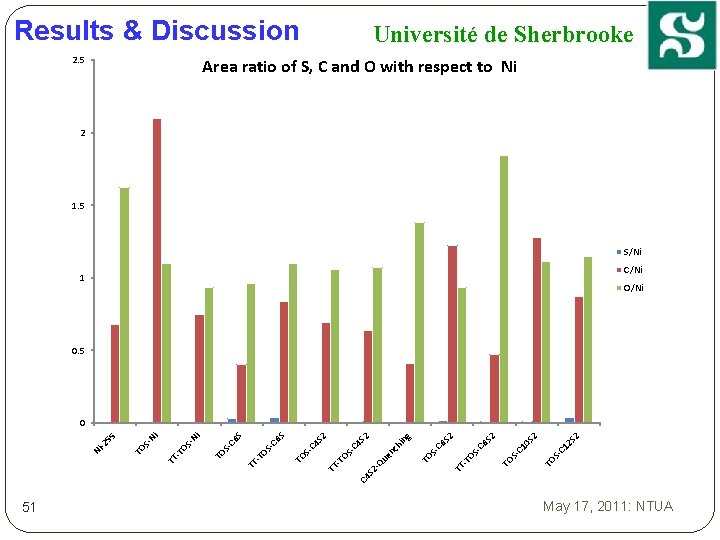
Results & Discussion 2. 5 Université de Sherbrooke Area ratio of S, C and O with respect to Ni 2 1. 5 S/Ni C/Ni 1 O/Ni 0. 5 51 2 SC 1 2 S TO 2 SC 1 0 S TO S 2 -T O SC 6 S 2 TT SC 6 TO -Q ue nc hi ng S 2 SC 4 S 2 -T O TT TO SC 4 S 2 S SC 6 -T O TT TO SC 6 S i TO S -N i TT - -N TO S Ni -2 55 0 May 17, 2011: NTUA
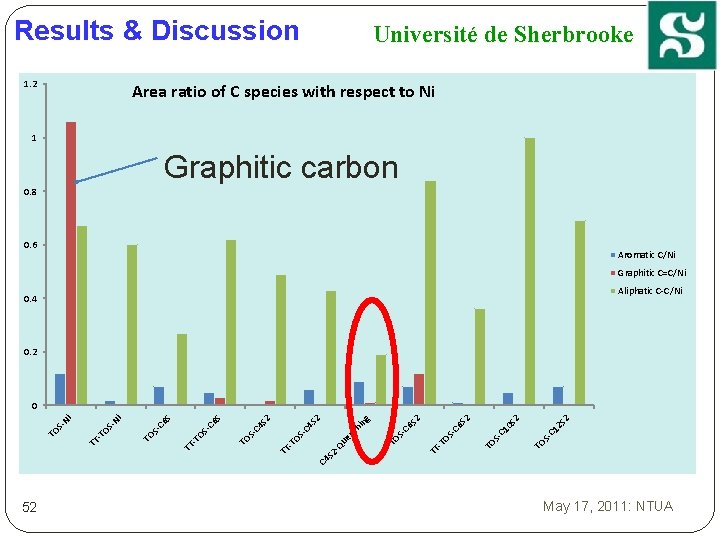
Results & Discussion 1. 2 Université de Sherbrooke Area ratio of C species with respect to Ni 1 Graphitic carbon 0. 8 0. 6 Aromatic C/Ni Graphitic C=C/Ni Aliphatic C-C/Ni 0. 4 0. 2 52 2 SC 1 2 S TO S 2 10 TO SC S 2 TT -T O SC 6 S 2 SC 6 ch en -Q u C 4 S 2 TO in g S 2 SC 4 -T O TT TO SC 4 S 2 S TT -T O SC 6 S SC 6 TO -N TO S TT - TO S -N i i 0 May 17, 2011: NTUA
Université de Sherbrooke Conclusion v Short chain DADS impregnated Ni-255 catalysts were the most stable impregnated catalysts with respect to deactivation during SRM. v The main proven advantage of modifying the catalyst is the decrease of graphitic-like carbon formation / deposition at the surface of the catalyst during SRM. v There is a gradual increase in the aromatic carbon peak with increase in the chain length of DADS molecule during TOS. v Relatively small amounts of sulfur moieties (S/Ni≤ 0. 03) present on the surface of the modified catalysts highly determine the carbon content and is found responsible for the formation of different species of carbon on the surface of the catalyst. v Surface chemistry of the catalysts tested is highly complex. Ni, S and C species/moieties, affecting differently the chemisorption and adsorbed C, H and O bearing chemical groups, must be studied throughly using advanced surface analysis techniques (ie. , TOF-SIMS and nano-SIMS). 53 May 17, 2011: NTUA
Université de Sherbrooke Ongoing Work 1. Identify (and quantify? ) the factors responsible for the catalyst deactivation; S and/or C moieties 2. Use catalysts impregnated with molarity ratios ranging from 0. 2 M to 0. 3 M 3. Estimate the amount of C and S by XPS and relate to catalytic activity. 4. Find out the mechanism of adsorption of disulfides on Ni surface and adsorption phase of Ni-S, the criteria factor responsible for the higher carbon tolerance in Ni-C 4 S 2 (TPD & XPS) 54 May 17, 2011: NTUA
Université de Sherbrooke Acknowledgments Ø Funding Organisms q. CFI (Canadian Foundation for Innovation) q. NSERC (National Science and Engineering Research Council) Ø Sonia Blais for her assistance in the XPS analysis 55 May 17, 2011: NTUA
Université de Sherbrooke It has pleased no less than surprised me that of the many studies whereby I have sought to extend the field of general chemistry, the highest scientific distinction has been awarded for those on Catalysis Wilhelm Ostwald 56 May 17, 2011: NTUA
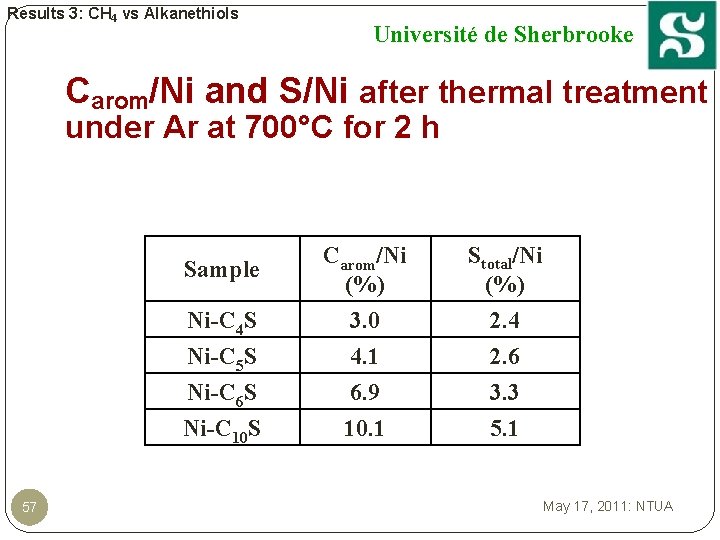
Results 3: CH 4 vs Alkanethiols Université de Sherbrooke Carom/Ni and S/Ni after thermal treatment under Ar at 700°C for 2 h Sample Ni-C 4 S Ni-C 5 S Ni-C 6 S Ni-C 10 S 57 Carom/Ni (%) 3. 0 4. 1 6. 9 10. 1 Stotal/Ni (%) 2. 4 2. 6 3. 3 5. 1 May 17, 2011: NTUA
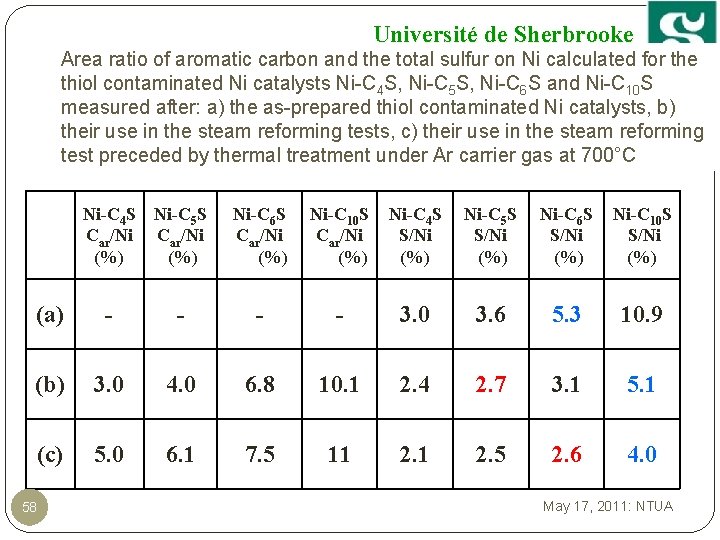
Université de Sherbrooke Area ratio of aromatic carbon and the total sulfur on Ni calculated for the thiol contaminated Ni catalysts Ni-C 4 S, Ni-C 5 S, Ni-C 6 S and Ni-C 10 S measured after: a) the as-prepared thiol contaminated Ni catalysts, b) their use in the steam reforming tests, c) their use in the steam reforming test preceded by thermal treatment under Ar carrier gas at 700°C Ni-C 4 S Car/Ni (%) Ni-C 5 S Car/Ni (%) Ni-C 6 S Car/Ni (%) Ni-C 10 S Car/Ni (%) Ni-C 4 S S/Ni (%) Ni-C 5 S S/Ni (%) Ni-C 6 S S/Ni (%) Ni-C 10 S S/Ni (%) (a) - - 3. 0 3. 6 5. 3 10. 9 (b) 3. 0 4. 0 6. 8 10. 1 2. 4 2. 7 3. 1 5. 1 (c) 5. 0 6. 1 7. 5 11 2. 5 2. 6 4. 0 58 May 17, 2011: NTUA
- Slides: 58