
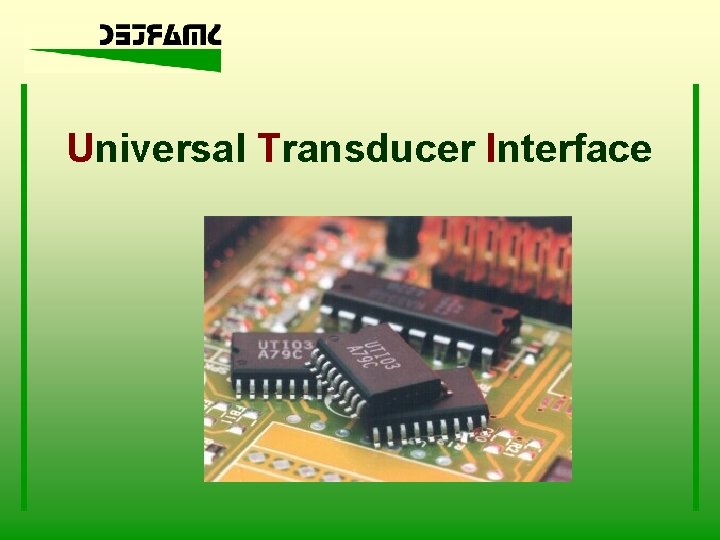
Universal Transducer Interface Universal Transducer Interface Technical aspects

- Slides: 33
Universal Transducer Interface
Universal Transducer Interface Technical aspects and examples
Universal Transducer Interface A single chip digitiser for Resistive sensors Capacitive sensors
Universal Transducer Interface The one chip digitiser Configuration of output signal Excitation for resistive sensors Selfcalibrating by three signal technique Measuring capacitive sensors without parasitics
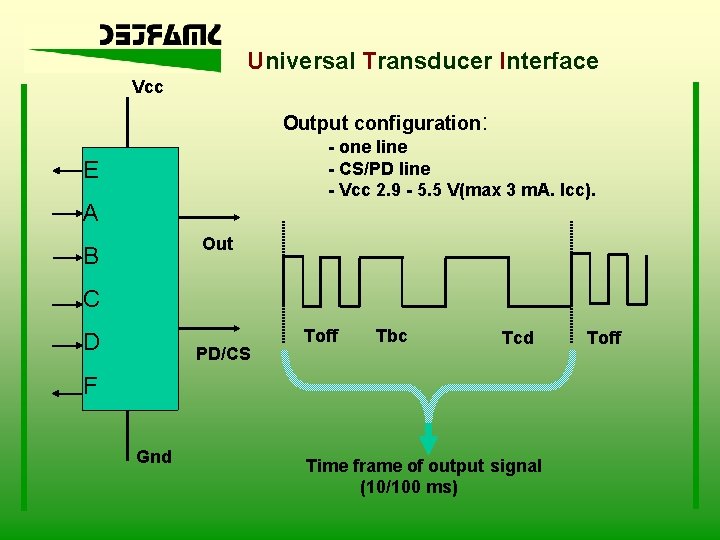
Universal Transducer Interface Vcc Output configuration: - one line - CS/PD line - Vcc 2. 9 - 5. 5 V(max 3 m. A. Icc). E A Out B C D PD/CS Toff Tbc Tcd F Gnd Time frame of output signal (10/100 ms) Toff
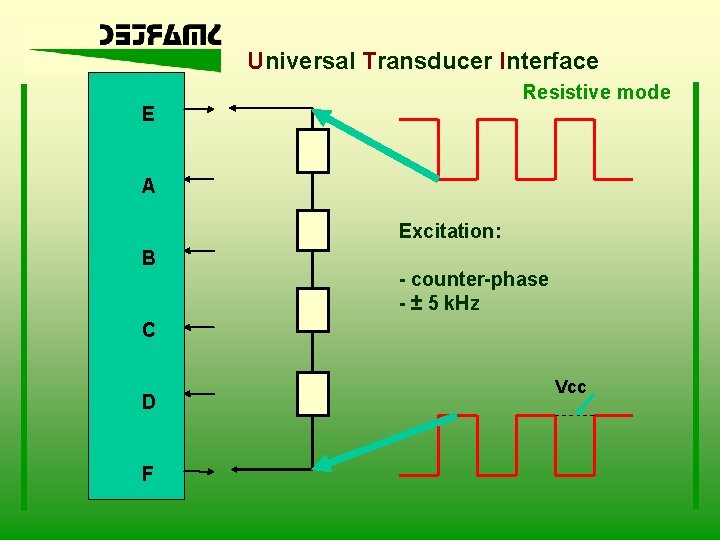
Universal Transducer Interface Resistive mode E A Excitation: B - counter-phase - ± 5 k. Hz C D F Vcc
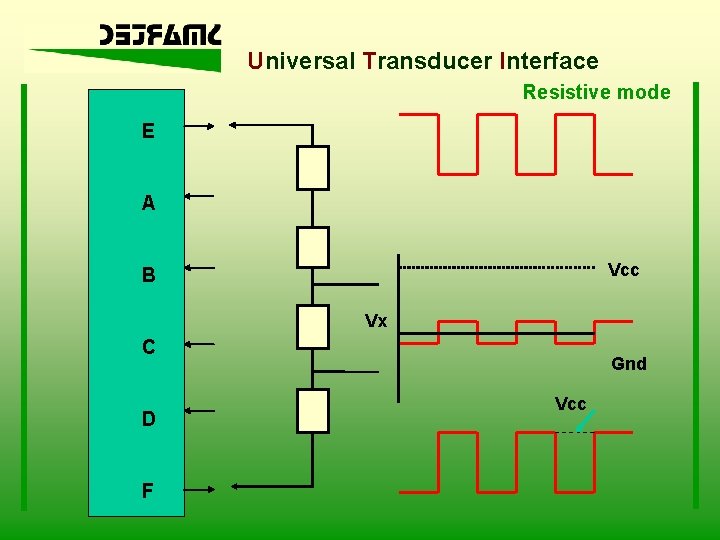
Universal Transducer Interface Resistive mode E A Vcc B Vx C D F Gnd Vcc
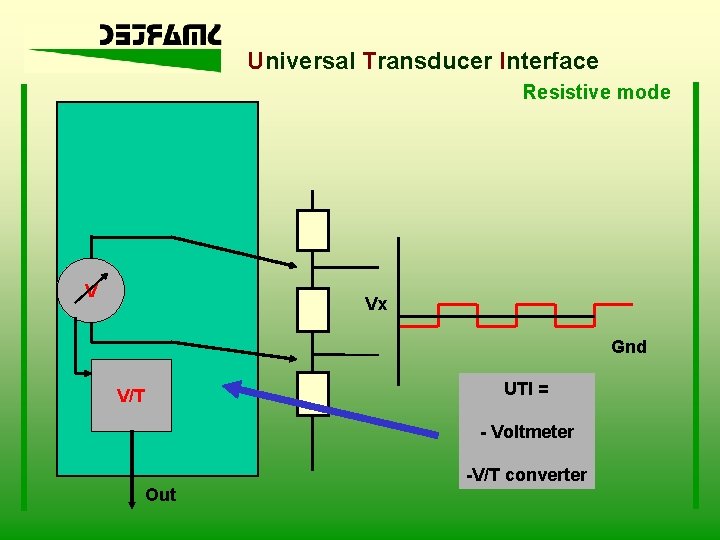
Universal Transducer Interface Resistive mode V Vx Gnd V/T UTI = - Voltmeter Out -V/T converter
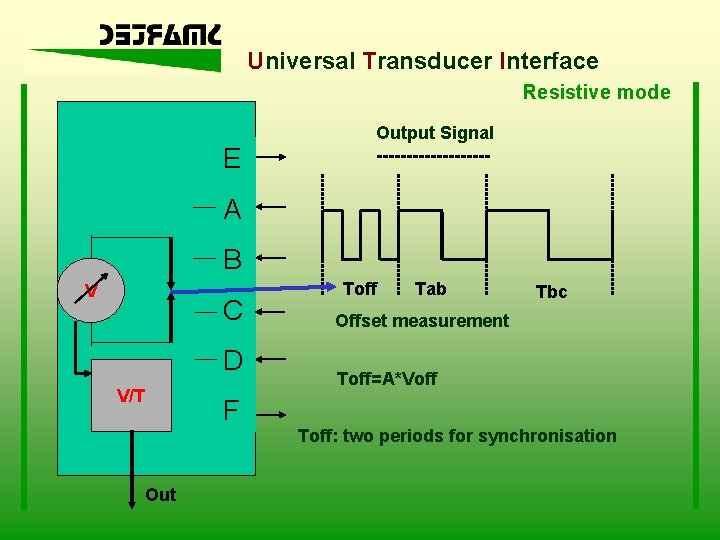
Universal Transducer Interface Resistive mode E Output Signal ---------- A B V C D V/T Out F Toff Tab Tbc Offset measurement Toff=A*Voff Toff: two periods for synchronisation
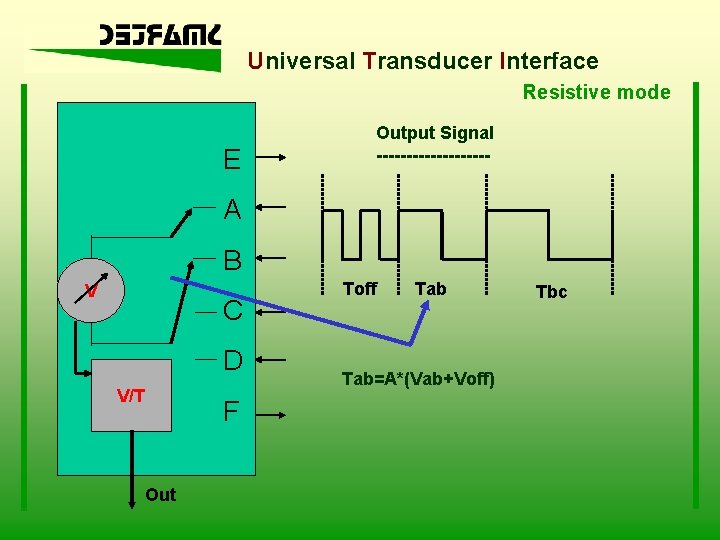
Universal Transducer Interface Resistive mode E Output Signal ---------- A B V C D V/T Out F Toff Tab=A*(Vab+Voff) Tbc
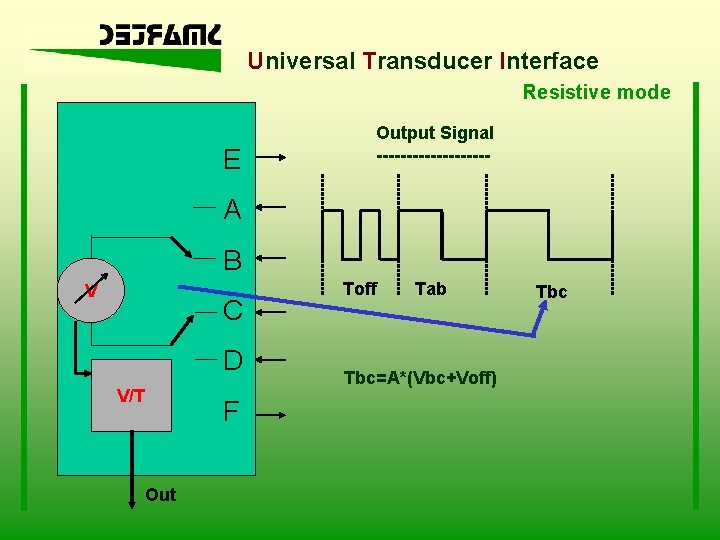
Universal Transducer Interface Resistive mode E Output Signal ---------- A B V C D V/T Out F Toff Tab Tbc=A*(Vbc+Voff) Tbc
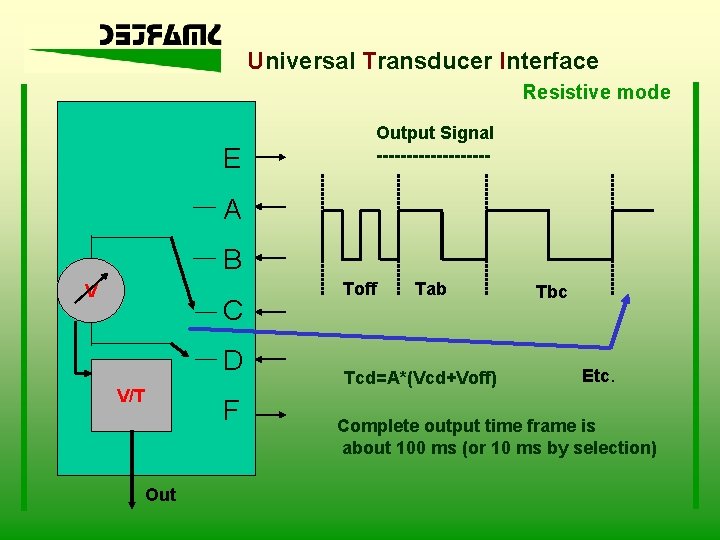
Universal Transducer Interface Resistive mode E Output Signal ---------- A B V C D V/T Out F Toff Tab Tcd=A*(Vcd+Voff) Tbc Etc. Complete output time frame is about 100 ms (or 10 ms by selection)
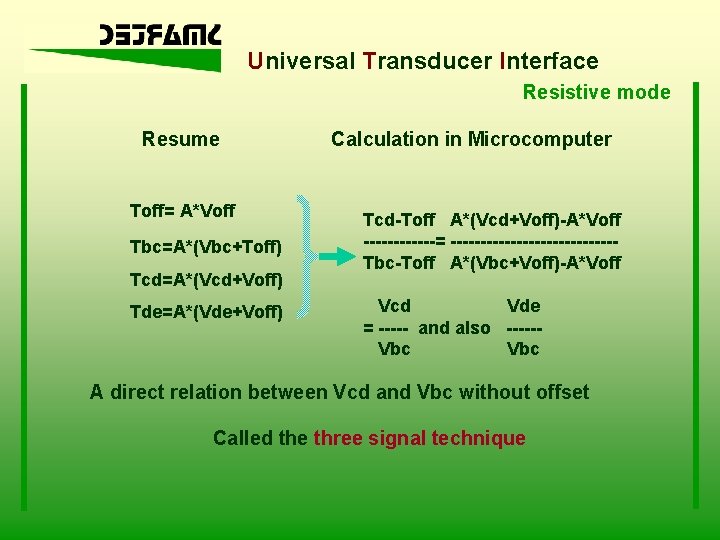
Universal Transducer Interface Resistive mode Resume Toff= A*Voff Tbc=A*(Vbc+Toff) Tcd=A*(Vcd+Voff) Tde=A*(Vde+Voff) Calculation in Microcomputer Tcd-Toff A*(Vcd+Voff)-A*Voff ------= --------------Tbc-Toff A*(Vbc+Voff)-A*Voff Vcd Vde = ----- and also -----Vbc A direct relation between Vcd and Vbc without offset Called the three signal technique
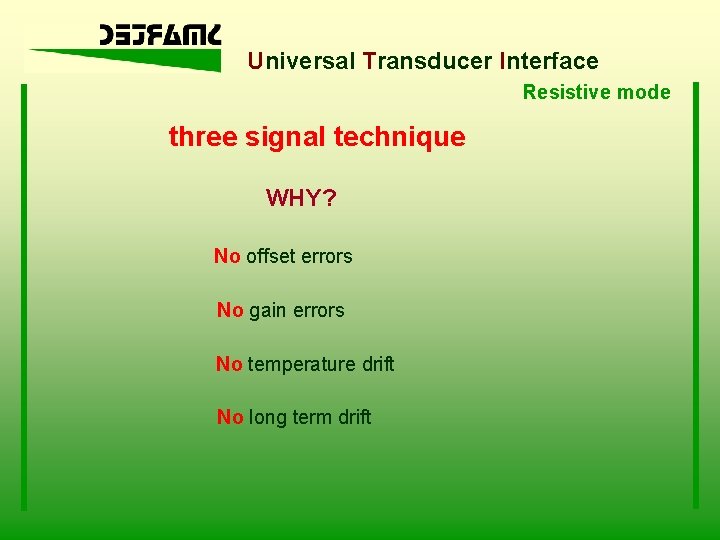
Universal Transducer Interface Resistive mode three signal technique WHY? No offset errors No gain errors No temperature drift No long term drift
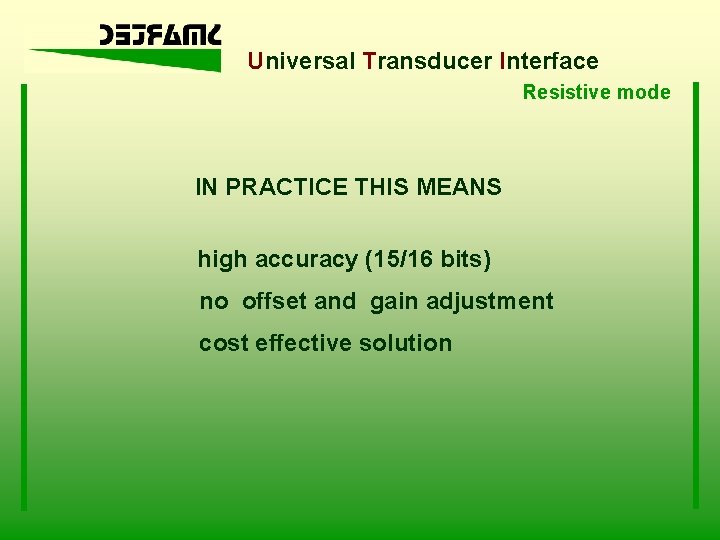
Universal Transducer Interface Resistive mode IN PRACTICE THIS MEANS high accuracy (15/16 bits) no offset and gain adjustment cost effective solution
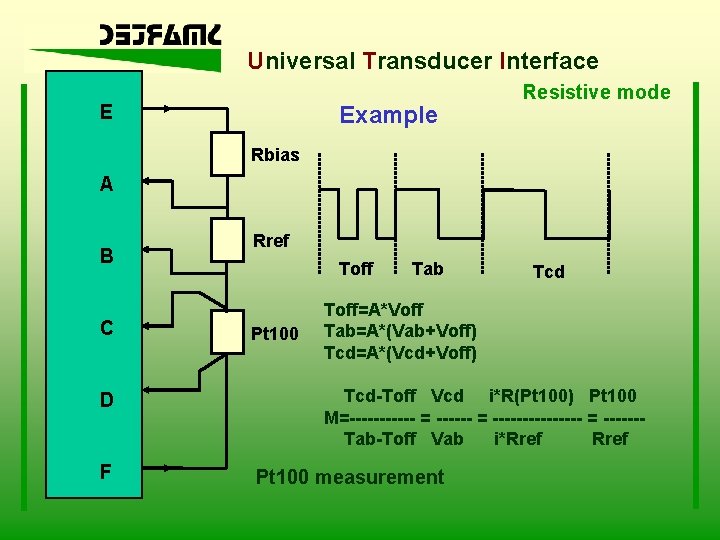
Universal Transducer Interface E Example Resistive mode Rbias A B C D F Rref Toff Pt 100 Tab Tcd Toff=A*Voff Tab=A*(Vab+Voff) Tcd=A*(Vcd+Voff) Tcd-Toff Vcd i*R(Pt 100) Pt 100 M=------ = ---------- = ------Tab-Toff Vab i*Rref Pt 100 measurement
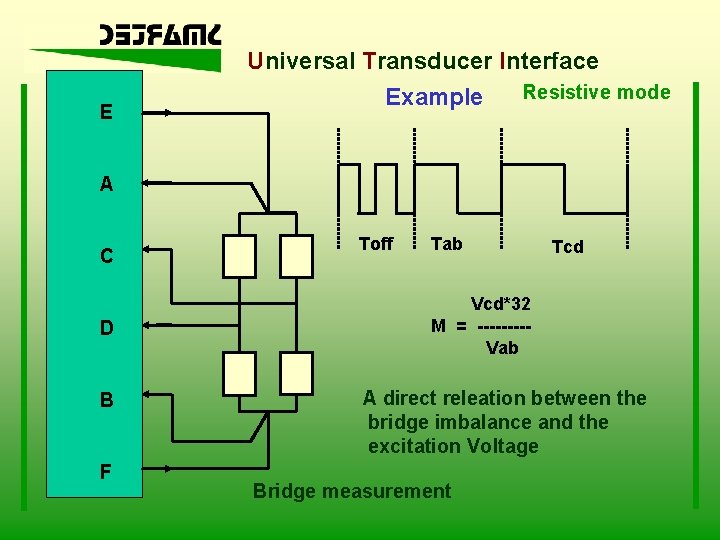
Universal Transducer Interface E Example Resistive mode A C D B F Toff Tab Tcd Vcd*32 M = ----Vab A direct releation between the bridge imbalance and the excitation Voltage Bridge measurement
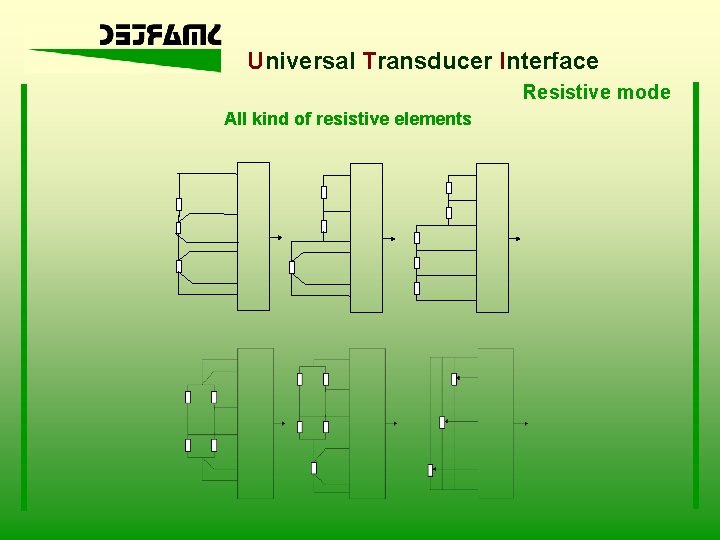
Universal Transducer Interface Resistive mode All kind of resistive elements
Universal Transducer Interface A real revolution in Sensor Interfacing digitises not only resistive elements but also all kind of capacitive sensors
Universal Transducer Interface The next slide tells you how the UTI scores!
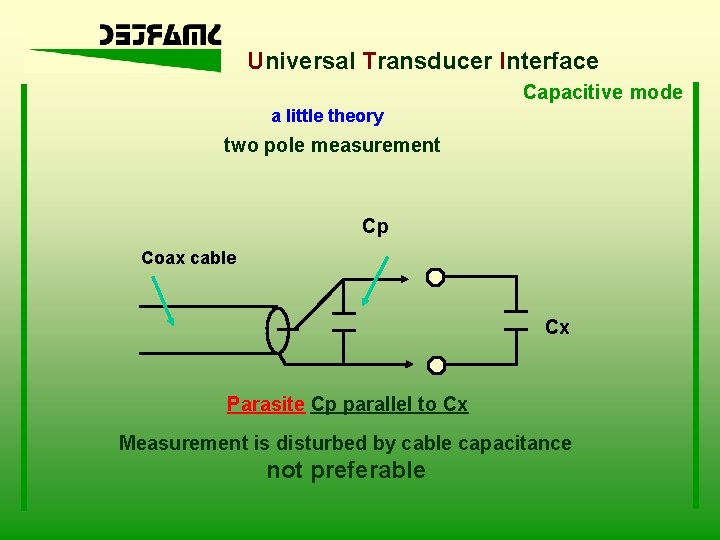
Universal Transducer Interface Capacitive mode a little theory two pole measurement Cp Coax cable Cx Parasite Cp parallel to Cx Measurement is disturbed by cable capacitance not preferable
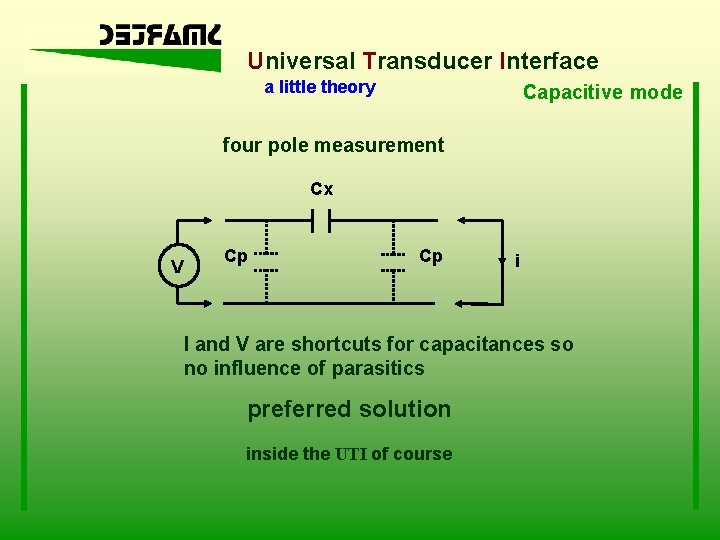
Universal Transducer Interface a little theory Capacitive mode four pole measurement Cx V Cp Cp i I and V are shortcuts for capacitances so no influence of parasitics preferred solution inside the UTI of course
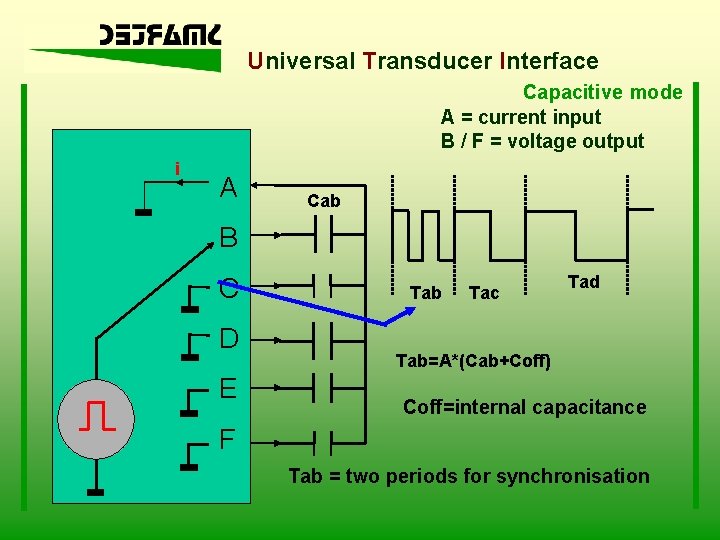
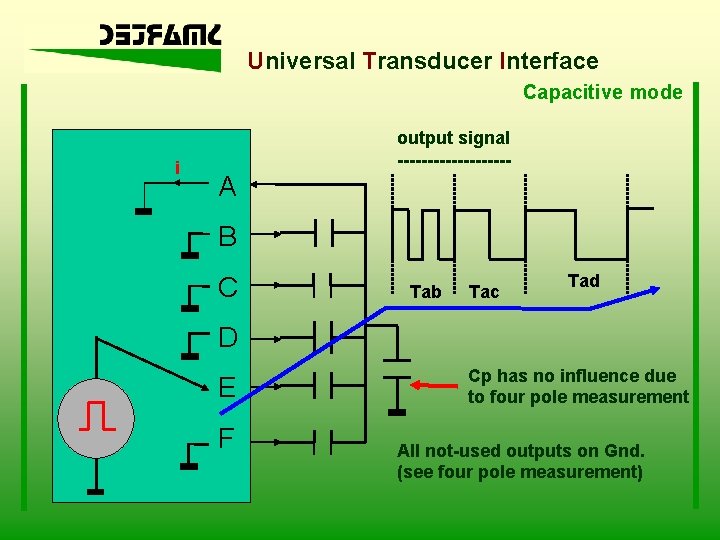
Universal Transducer Interface Capacitive mode A = current input B / F = voltage output i A Cab B C D E Tab Tac Tad Tab=A*(Cab+Coff) Coff=internal capacitance F Tab = two periods for synchronisation
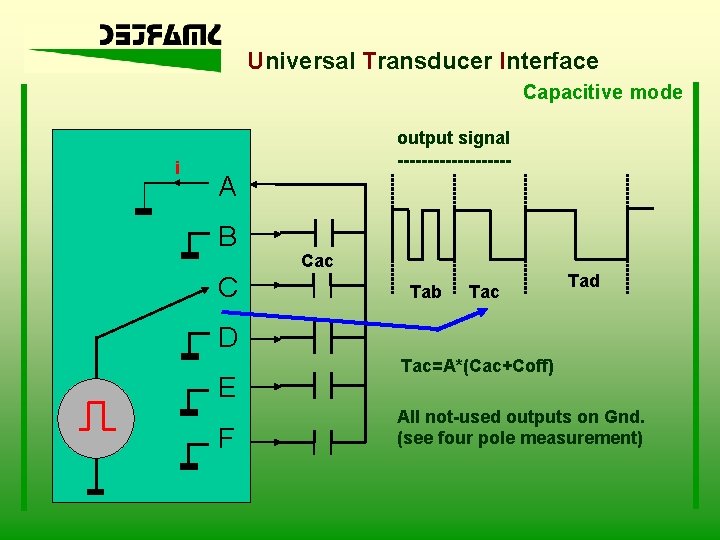
Universal Transducer Interface Capacitive mode i output signal ---------- A B C Cac Tab Tac Tad D E F Tac=A*(Cac+Coff) All not-used outputs on Gnd. (see four pole measurement)
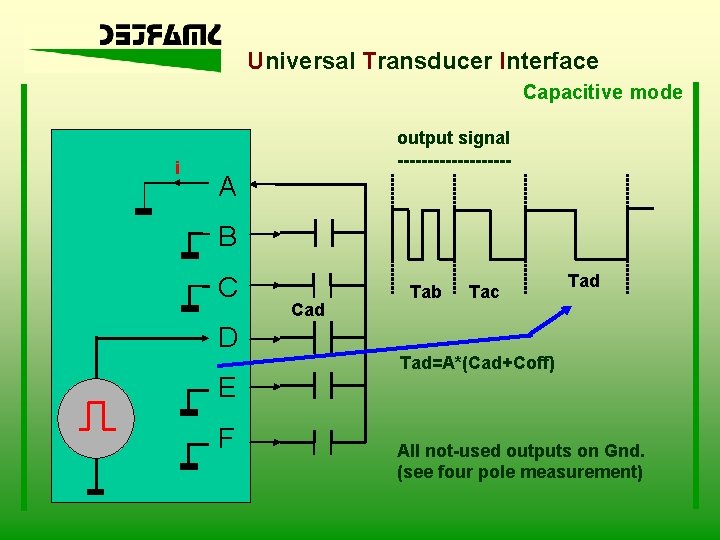
Universal Transducer Interface Capacitive mode i output signal ---------- A B C D E F Cad Tab Tac Tad=A*(Cad+Coff) All not-used outputs on Gnd. (see four pole measurement)
Universal Transducer Interface Capacitive mode i output signal ---------- A B C Tab Tac Tad D E F Cp has no influence due to four pole measurement All not-used outputs on Gnd. (see four pole measurement)
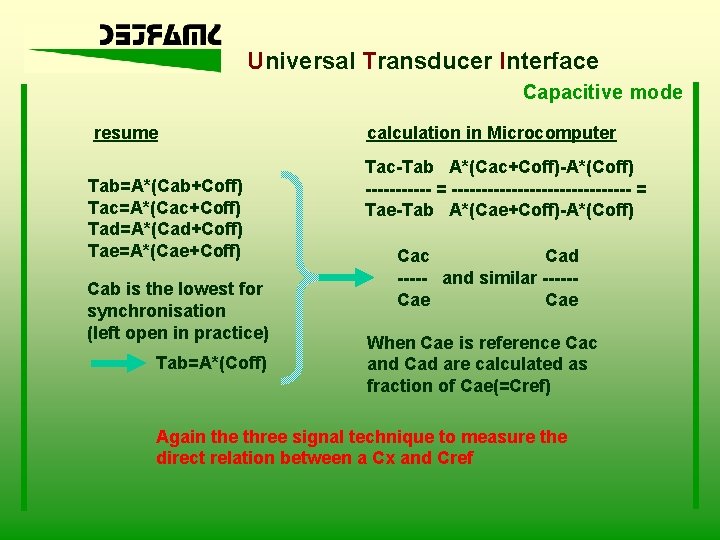
Universal Transducer Interface Capacitive mode resume Tab=A*(Cab+Coff) Tac=A*(Cac+Coff) Tad=A*(Cad+Coff) Tae=A*(Cae+Coff) Cab is the lowest for synchronisation (left open in practice) Tab=A*(Coff) calculation in Microcomputer Tac-Tab A*(Cac+Coff)-A*(Coff) ------ = --------------- = Tae-Tab A*(Cae+Coff)-A*(Coff) Cac Cad ----- and similar -----Cae When Cae is reference Cac and Cad are calculated as fraction of Cae(=Cref) Again the three signal technique to measure the direct relation between a Cx and Cref
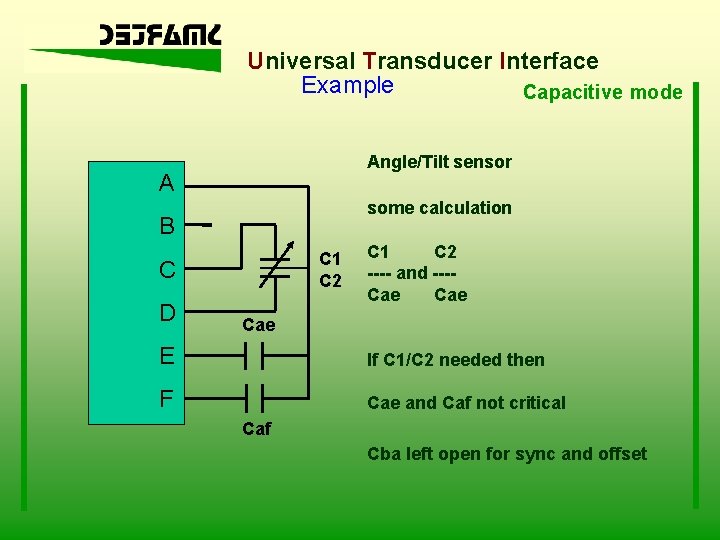
Universal Transducer Interface Example Capacitive mode Angle/Tilt sensor A some calculation B C 1 C 2 C D C 1 C 2 ---- and ---Cae Cae E If C 1/C 2 needed then F Cae and Caf not critical Caf Cba left open for sync and offset
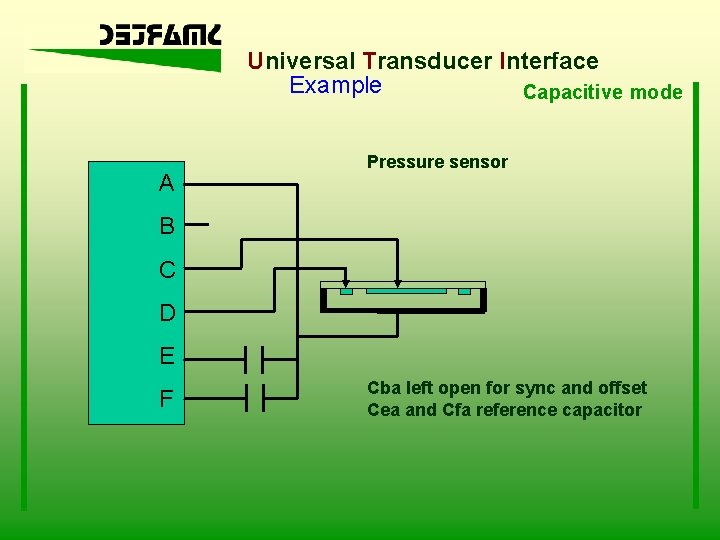
Universal Transducer Interface Example Capacitive mode A Pressure sensor B C D E F Cba left open for sync and offset Cea and Cfa reference capacitor
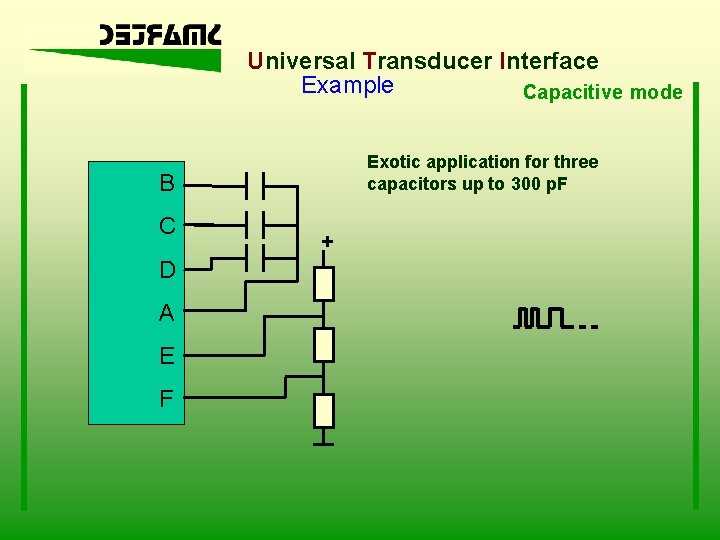
Universal Transducer Interface Example Capacitive mode Exotic application for three capacitors up to 300 p. F B C D A E F +
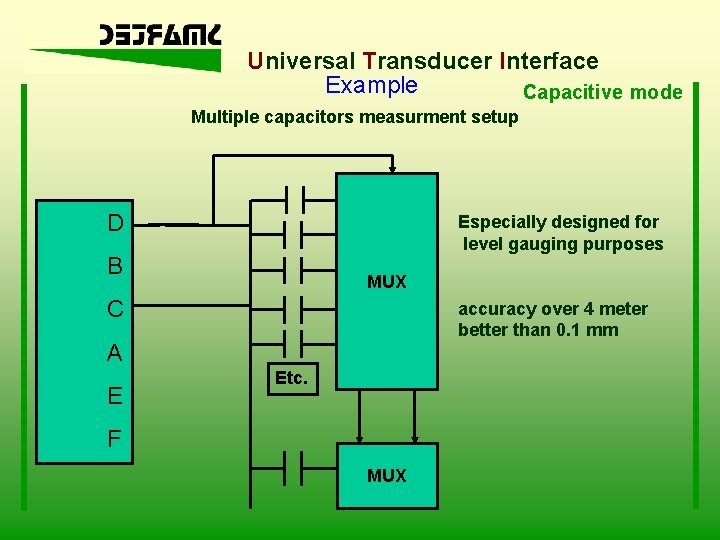
Universal Transducer Interface Example Capacitive mode Multiple capacitors measurment setup D Especially designed for level gauging purposes B MUX C accuracy over 4 meter better than 0. 1 mm A E Etc. F MUX
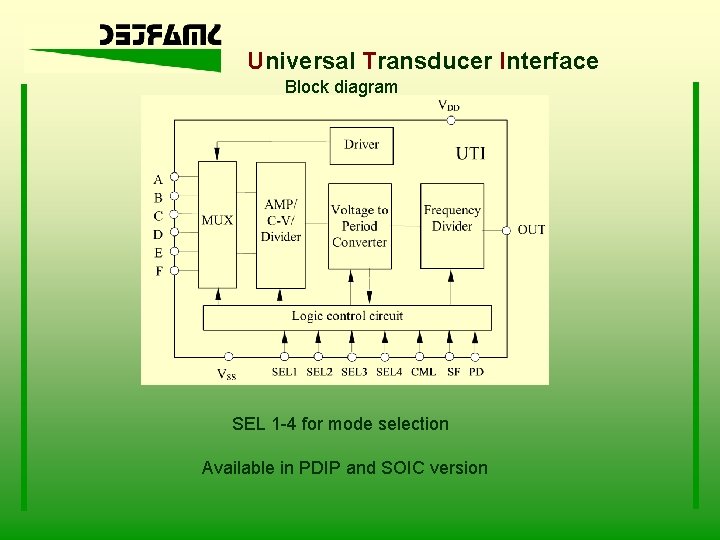
Universal Transducer Interface Block diagram SEL 1 -4 for mode selection Available in PDIP and SOIC version
Thank you for your attention Ask for a demonstration tel +31 76 520 53 53 Smartec. NL@compuserve. com