
Universal Screening for Mental Health Challenges with a
- Slides: 30
Universal Screening for Mental Health Challenges with a Multi-Level System of Support ELIZABETH COOK, ED. S SCHOOL MENTAL HEALTH CONSULTANT WI DEPARTMENT OF PUBLIC INSTRUCTION ELIZABETH. COOK@DPI. WI. GOV
Overview of the Presentation Part 1: Why screen students? Screening Defined Purpose of Screening Limitations of Traditional Methods Other Considerations Part 2: 10 steps to Screening Success
What is Mental Health Screening Mental health screening is a process for identifying students at risk of developing emotional & behavioral problems, so interventions can be set in place to prevent such problems from developing or getting worse. Twyford, J. , Eklund, K. , Chin , J. & Dowdy, E. ( March 2010). Behavioral RTI Model: Implementing Screening for Emotional and Behavioral Problems. Minisession presented at the meeting of the National Association of School Psychologists, Chicago IL.
Why Use Screening Tools? May lead to better recommendations Evidence-base Supplements clinical judgment More information to make decisions Documentation Helps when sharing concerns with families Boosts credibility of referrals
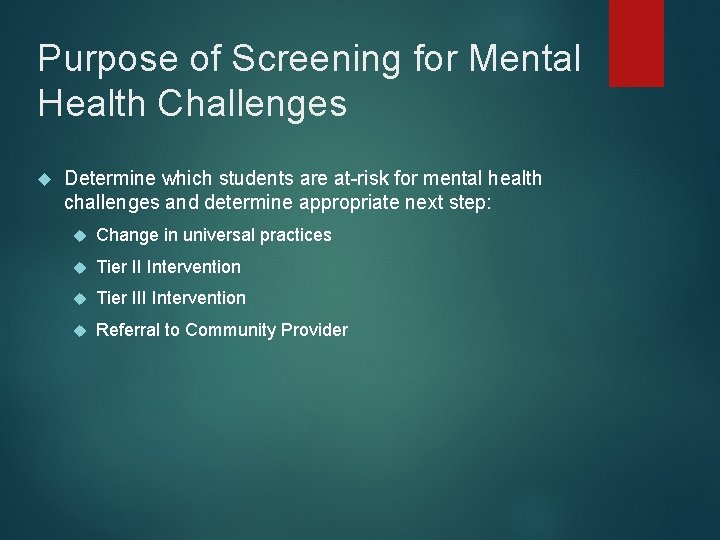
Purpose of Screening for Mental Health Challenges Determine which students are at-risk for mental health challenges and determine appropriate next step: Change in universal practices Tier II Intervention Tier III Intervention Referral to Community Provider
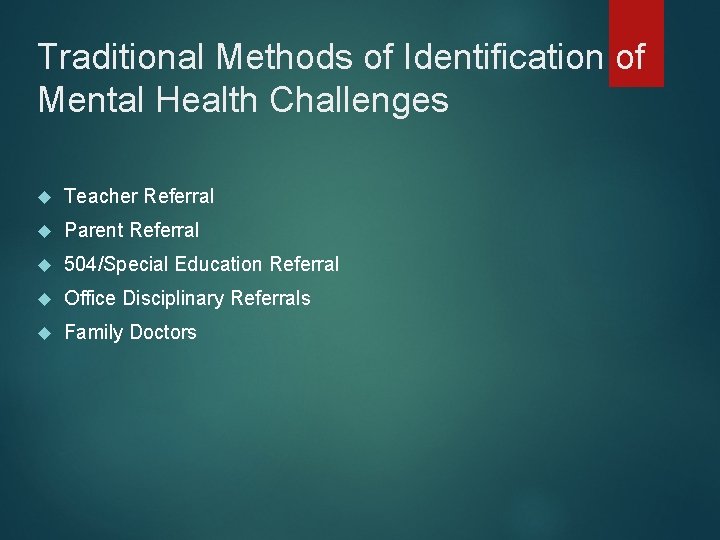
Traditional Methods of Identification of Mental Health Challenges Teacher Referral Parent Referral 504/Special Education Referral Office Disciplinary Referrals Family Doctors
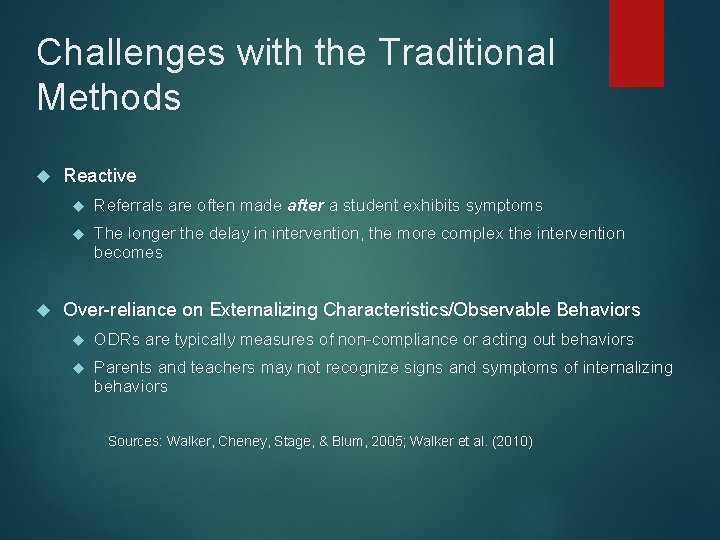
Challenges with the Traditional Methods Reactive Referrals are often made after a student exhibits symptoms The longer the delay in intervention, the more complex the intervention becomes Over-reliance on Externalizing Characteristics/Observable Behaviors ODRs are typically measures of non-compliance or acting out behaviors Parents and teachers may not recognize signs and symptoms of internalizing behaviors Sources: Walker, Cheney, Stage, & Blum, 2005; Walker et al. (2010)
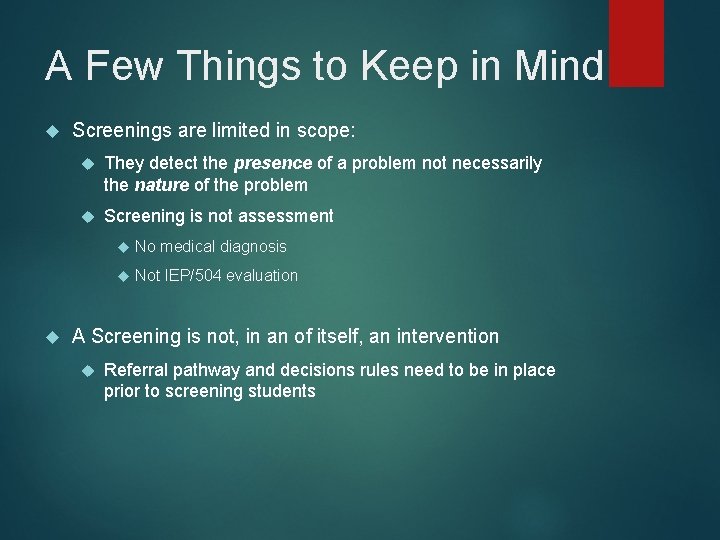
A Few Things to Keep in Mind Screenings are limited in scope: They detect the presence of a problem not necessarily the nature of the problem Screening is not assessment No medical diagnosis Not IEP/504 evaluation A Screening is not, in an of itself, an intervention Referral pathway and decisions rules need to be in place prior to screening students
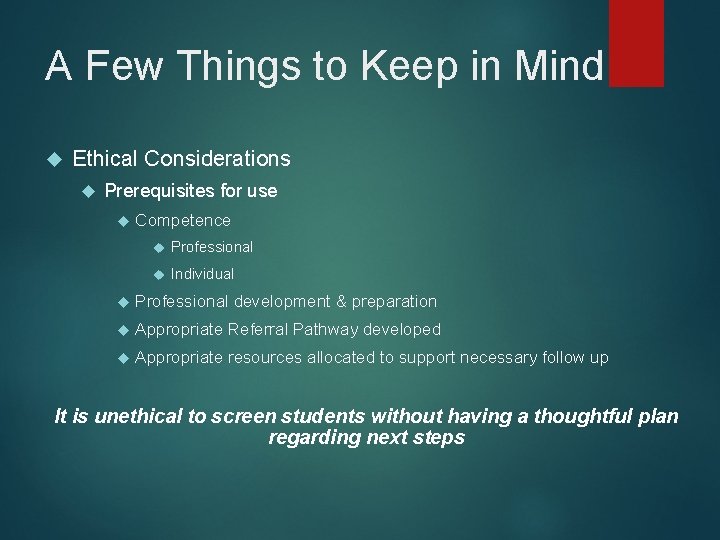
A Few Things to Keep in Mind Ethical Considerations Prerequisites for use Competence Professional Individual Professional development & preparation Appropriate Referral Pathway developed Appropriate resources allocated to support necessary follow up It is unethical to screen students without having a thoughtful plan regarding next steps
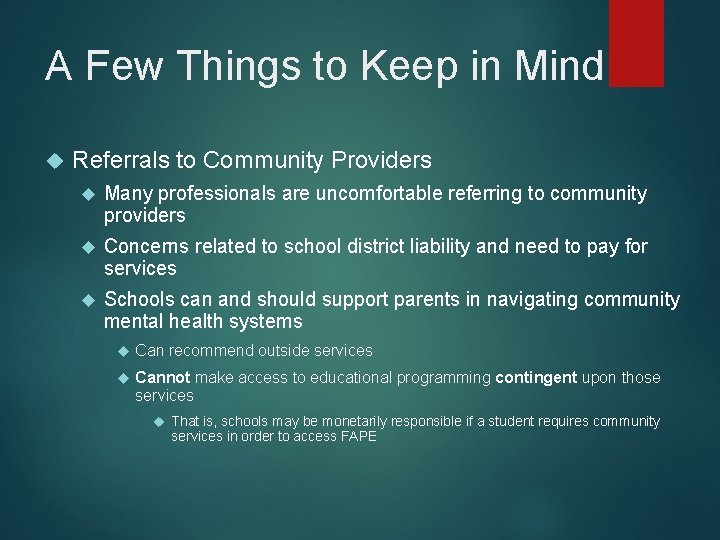
A Few Things to Keep in Mind Referrals to Community Providers Many professionals are uncomfortable referring to community providers Concerns related to school district liability and need to pay for services Schools can and should support parents in navigating community mental health systems Can recommend outside services Cannot make access to educational programming contingent upon those services That is, schools may be monetarily responsible if a student requires community services in order to access FAPE
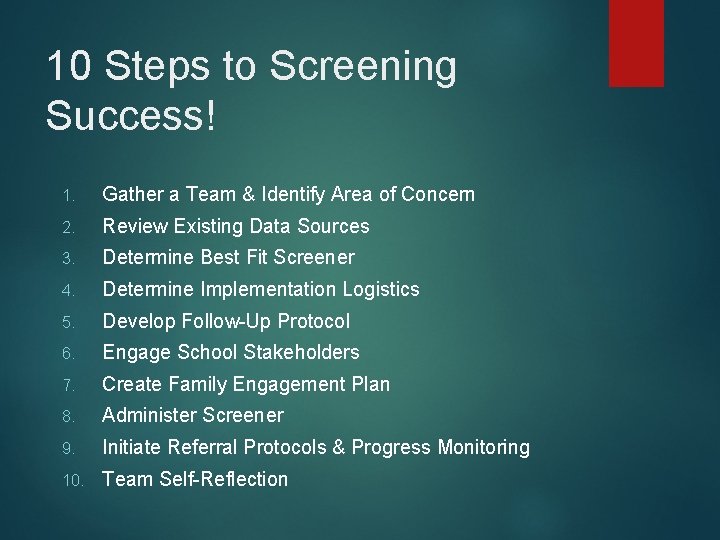
10 Steps to Screening Success! 1. Gather a Team & Identify Area of Concern 2. Review Existing Data Sources 3. Determine Best Fit Screener 4. Determine Implementation Logistics 5. Develop Follow-Up Protocol 6. Engage School Stakeholders 7. Create Family Engagement Plan 8. Administer Screener 9. Initiate Referral Protocols & Progress Monitoring 10. Team Self-Reflection
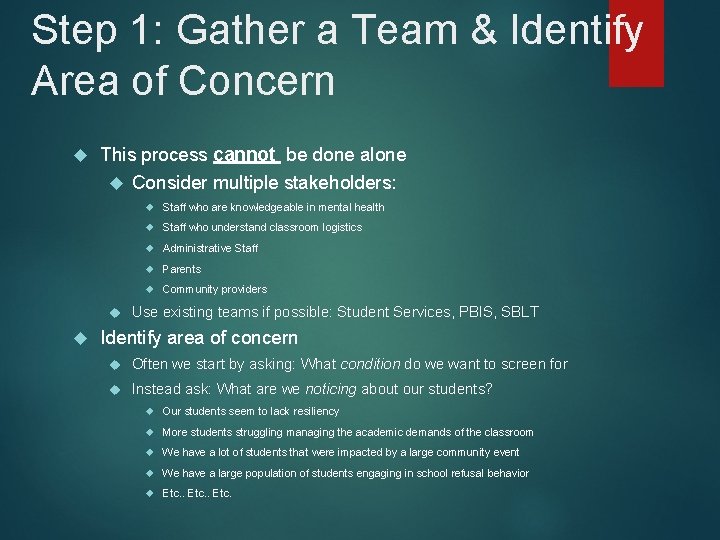
Step 1: Gather a Team & Identify Area of Concern This process cannot be done alone Consider multiple stakeholders: Staff who are knowledgeable in mental health Staff who understand classroom logistics Administrative Staff Parents Community providers Use existing teams if possible: Student Services, PBIS, SBLT Identify area of concern Often we start by asking: What condition do we want to screen for Instead ask: What are we noticing about our students? Our students seem to lack resiliency More students struggling managing the academic demands of the classroom We have a lot of students that were impacted by a large community event We have a large population of students engaging in school refusal behavior Etc.
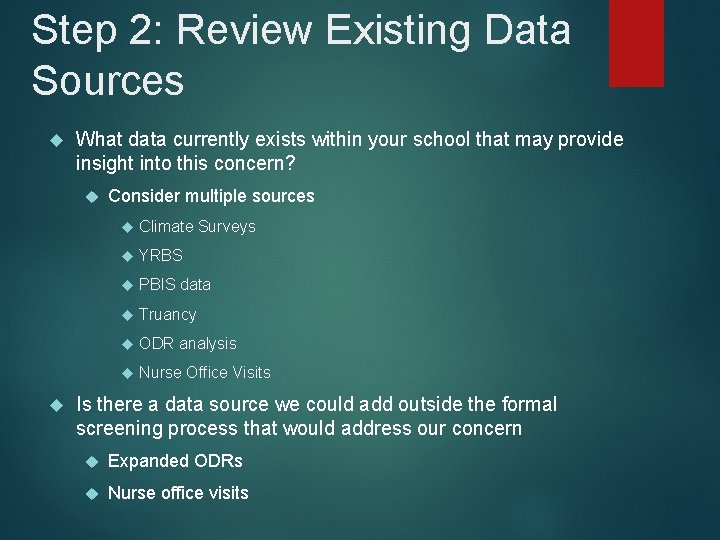
Step 2: Review Existing Data Sources What data currently exists within your school that may provide insight into this concern? Consider multiple sources Climate Surveys YRBS PBIS data Truancy ODR analysis Nurse Office Visits Is there a data source we could add outside the formal screening process that would address our concern Expanded ODRs Nurse office visits
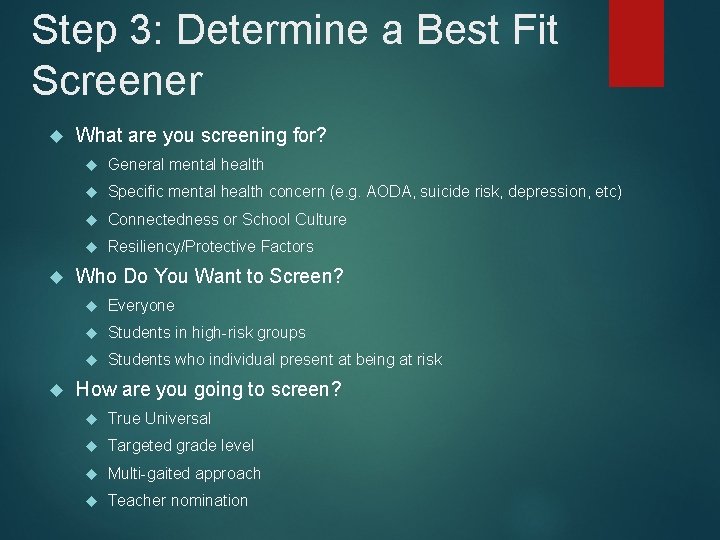
Step 3: Determine a Best Fit Screener What are you screening for? General mental health Specific mental health concern (e. g. AODA, suicide risk, depression, etc) Connectedness or School Culture Resiliency/Protective Factors Who Do You Want to Screen? Everyone Students in high-risk groups Students who individual present at being at risk How are you going to screen? True Universal Targeted grade level Multi-gaited approach Teacher nomination
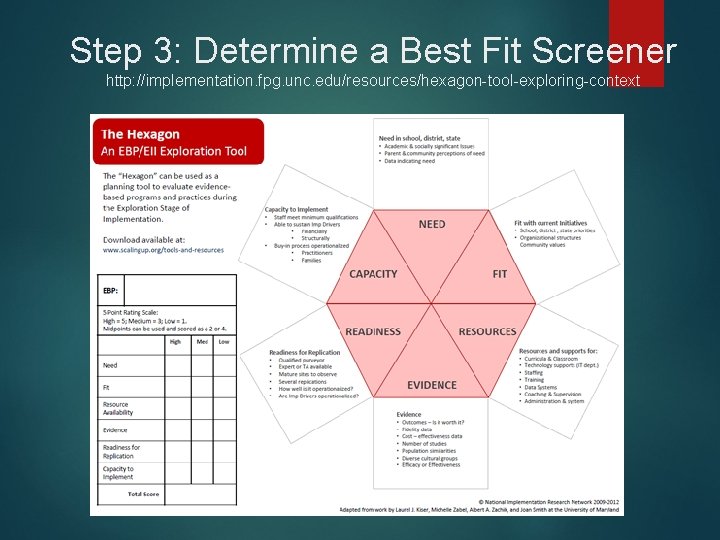
Step 3: Determine a Best Fit Screener http: //implementation. fpg. unc. edu/resources/hexagon-tool-exploring-context
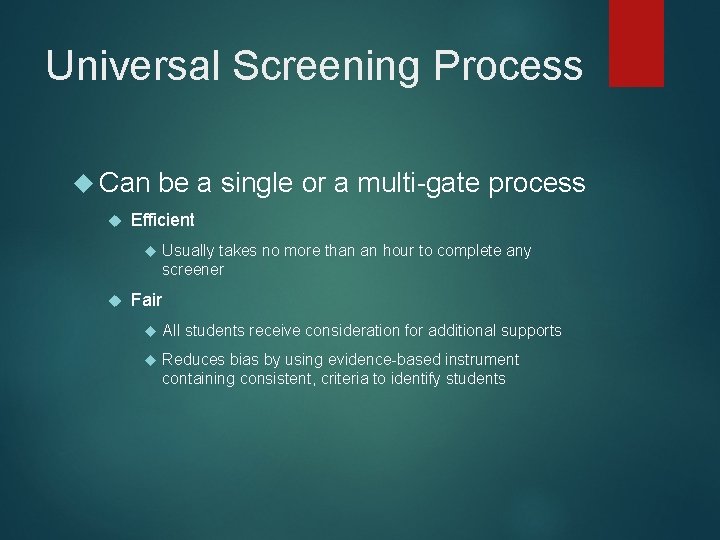
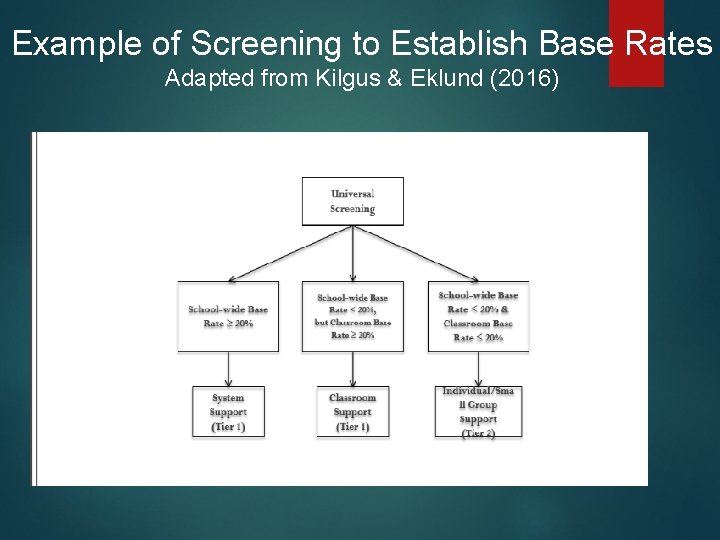
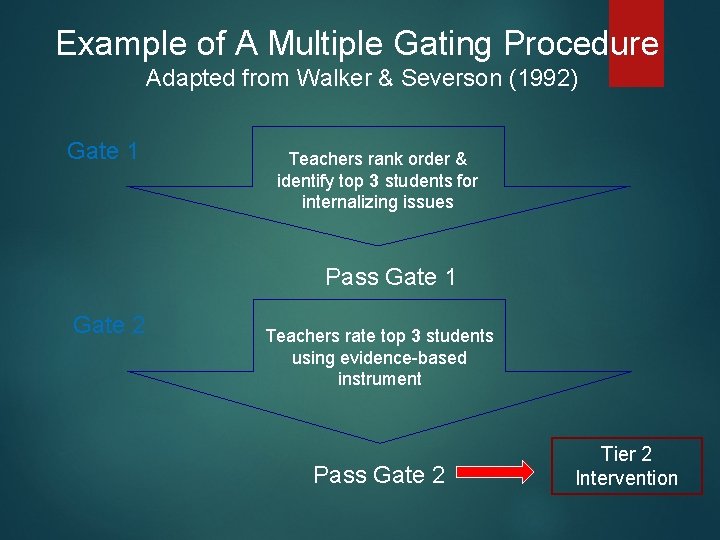
Universal Screening Process Can be a single or a multi-gate process Efficient Usually takes no more than an hour to complete any screener Fair All students receive consideration for additional supports Reduces bias by using evidence-based instrument containing consistent, criteria to identify students
Example of Screening to Establish Base Rates Adapted from Kilgus & Eklund (2016)
Example of A Multiple Gating Procedure Adapted from Walker & Severson (1992) Gate 1 Teachers rank order & identify top 3 students for internalizing issues Pass Gate 1 Gate 2 Teachers rate top 3 students using evidence-based instrument Pass Gate 2 Tier 2 Intervention
Step 4: Determine Implementation Resources & Logistics Identify resources & logistics Create a timeline for executing screening process including frequency of screening (e. g. , once annually? ) Develop budget for materials, staff, etc. Create administration materials (e. g. , presentation to share process with staff, parents & community members; consent forms; teacher checklists) Schedule dates for screening(s) & meetings to share school-wide results Determine follow up dates for school personnel Ensure staff have dedicated time to follow up Determine what type of consent is needed
Consent & Screening for Mental Health Concerns Critical question from Protection of Pupil Rights Amendment (PPRA): Is student participation required? If YES Active Consent from parents required If NO No consequences to student for not participating or incentives for participating Student able to provide assent/dissent Passive Consent from parents OK USDE Annual Notice about FERPA & PPRA – March 2011 http: //www 2. ed. gov/policy/gen/guid/fpco/pdf/pprasuper. pdf https: //dpi. wi. gov/sites/default/files/imce/sped/pdf/rti-consent. pdf
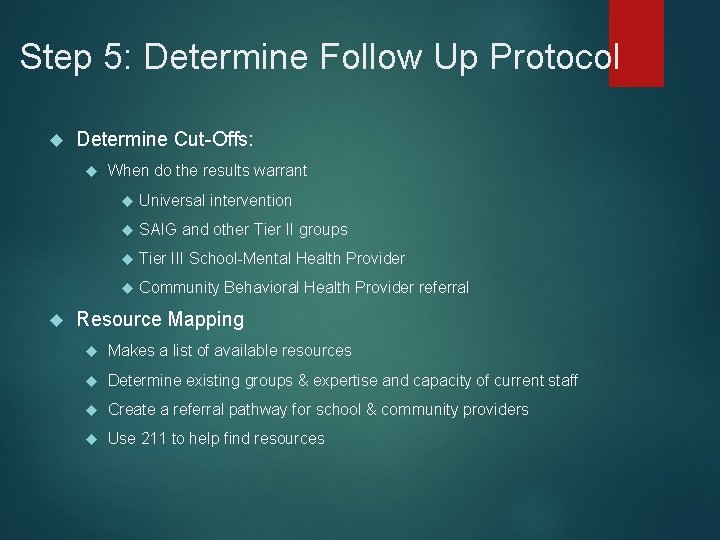
Step 5: Determine Follow Up Protocol Determine Cut-Offs: When do the results warrant Universal intervention SAIG and other Tier II groups Tier III School-Mental Health Provider Community Behavioral Health Provider referral Resource Mapping Makes a list of available resources Determine existing groups & expertise and capacity of current staff Create a referral pathway for school & community providers Use 211 to help find resources
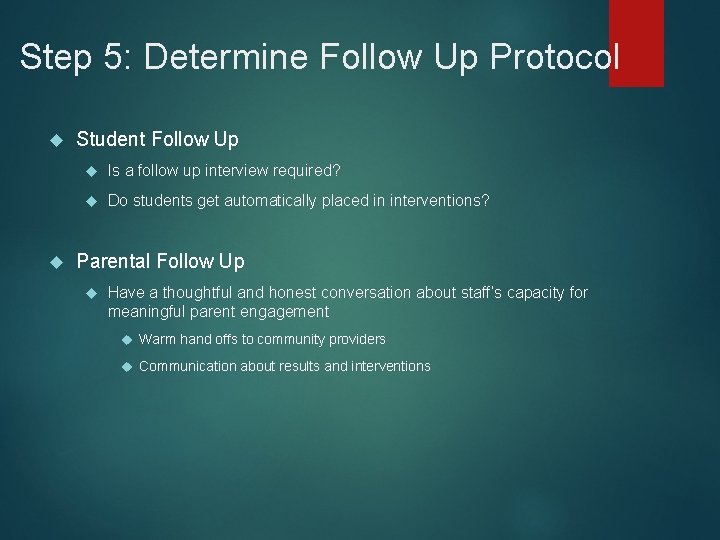
Step 5: Determine Follow Up Protocol Student Follow Up Is a follow up interview required? Do students get automatically placed in interventions? Parental Follow Up Have a thoughtful and honest conversation about staff’s capacity for meaningful parent engagement Warm hand offs to community providers Communication about results and interventions
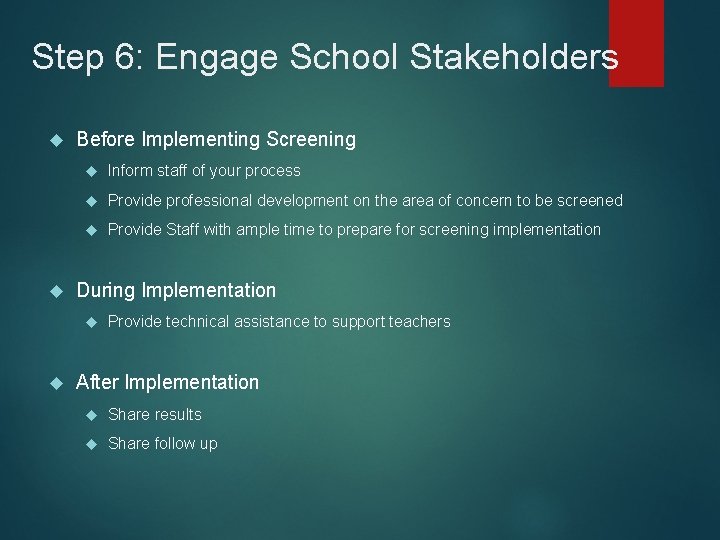
Step 6: Engage School Stakeholders Before Implementing Screening Inform staff of your process Provide professional development on the area of concern to be screened Provide Staff with ample time to prepare for screening implementation During Implementation Provide technical assistance to support teachers After Implementation Share results Share follow up
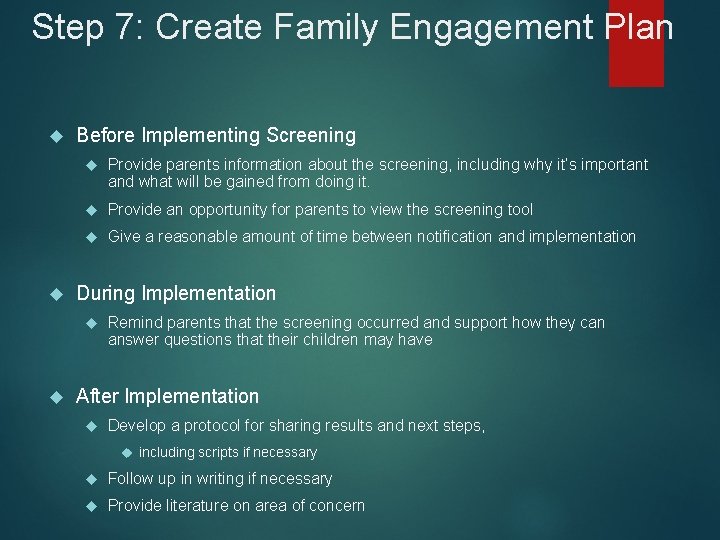
Step 7: Create Family Engagement Plan Before Implementing Screening Provide parents information about the screening, including why it’s important and what will be gained from doing it. Provide an opportunity for parents to view the screening tool Give a reasonable amount of time between notification and implementation During Implementation Remind parents that the screening occurred and support how they can answer questions that their children may have After Implementation Develop a protocol for sharing results and next steps, including scripts if necessary Follow up in writing if necessary Provide literature on area of concern
Addressing Common Parental Concerns Screening may raise “red flag” for parent Are you saying my child needs medication? You think I’m a bad parent. I can’t let anybody know about this. Stigma & shame associated with mental illness Focus on the purpose of the screening – to improve student functioning in school
Step 8: Administer Screener
Step 9: Refer Students & Implement Interventions Monitor Progress Develop Systems of Care Signed releases and continuous contact with community provider Link back to Universal MLSS
Step 10: Team Self-Reflection Gather the team together and review Implementation logistics Data Effectives of treatment Whether you got the information and outcomes you were looking for
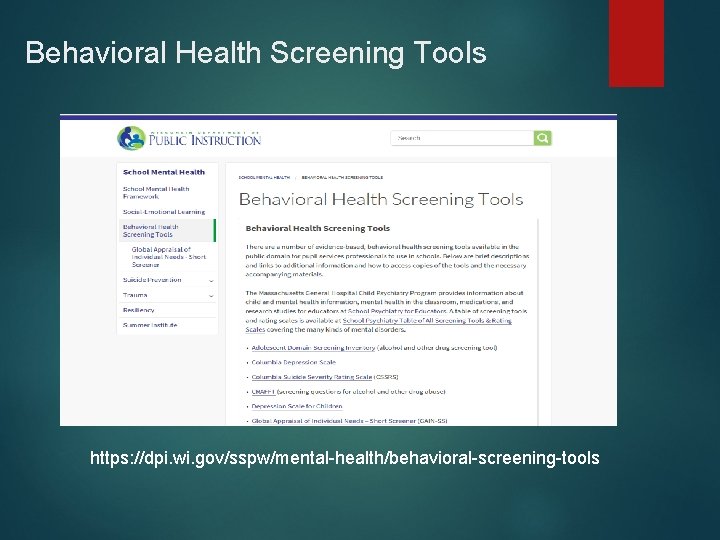
Behavioral Health Screening Tools https: //dpi. wi. gov/sspw/mental-health/behavioral-screening-tools
Questions? Resource on Developing a Universal Screening Protocol within a MLSS: https: //www. researchgate. net/publication/299437499_Consideration_of_Base_Rates_Within_Universal_Screening_for_Be havioral_and_Emotional_Risk_A_Novel_Procedural_Framework