
Universal Plug and Play protocol UPn P Introduction
- Slides: 32
Universal Plug and Play protocol (UPn. P) Introduction, design and implementation Thang Tran Manh Department of Mathematics and Computer Science Eindhoven University of Technology
• UPn. P Definition A Connected Environment What is Universal Plug and Play Technology UPn. P Features UPn. P Example UPn. P Position in the Internet Protocol Stack • How UPn. P works UPn. P Components UPn. P Networking Media UPn. P Protocol Stack - Addressing - Discovery - Description - Control - Eventing - Presentation UPn. P Summary • Design Decision Architectural Model Device Overview Control Point Overview • Prototype Television Control Coffee Machine • State Of The Art
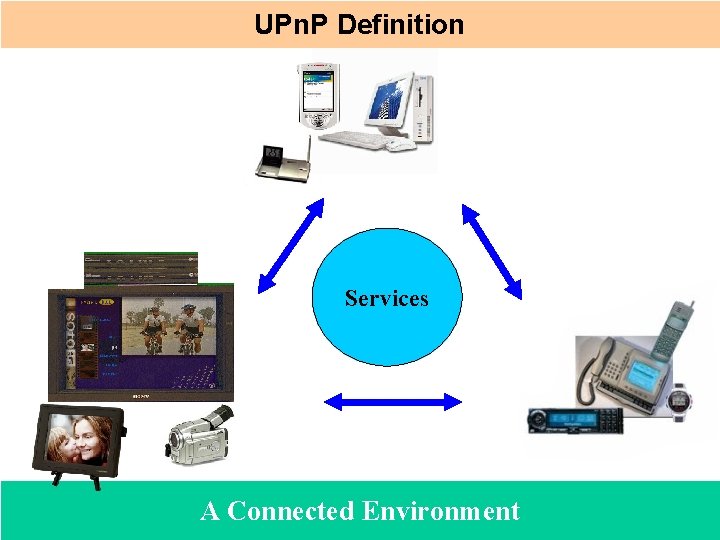
UPn. P Definition Services A Connected Environment
UPn. P Definition • Provide invisible home networking • Architectural framework for self-configuring, self-describing devices Leverages existing Internet technologies Enables dynamic peer-to-peer networking • Key to making the connected home experiences Affordable, mainstream reality for users Significant opportunity for the industry What is Universal Plug and Play Technology
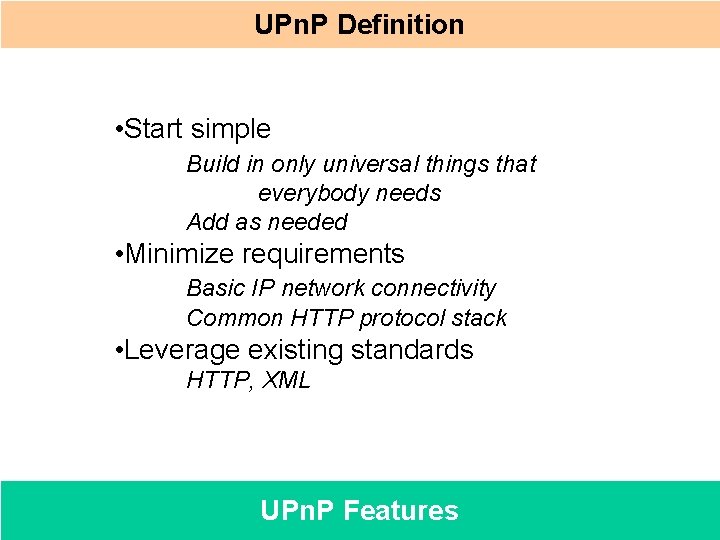
UPn. P Definition • Start simple Build in only universal things that everybody needs Add as needed • Minimize requirements Basic IP network connectivity Common HTTP protocol stack • Leverage existing standards HTTP, XML UPn. P Features
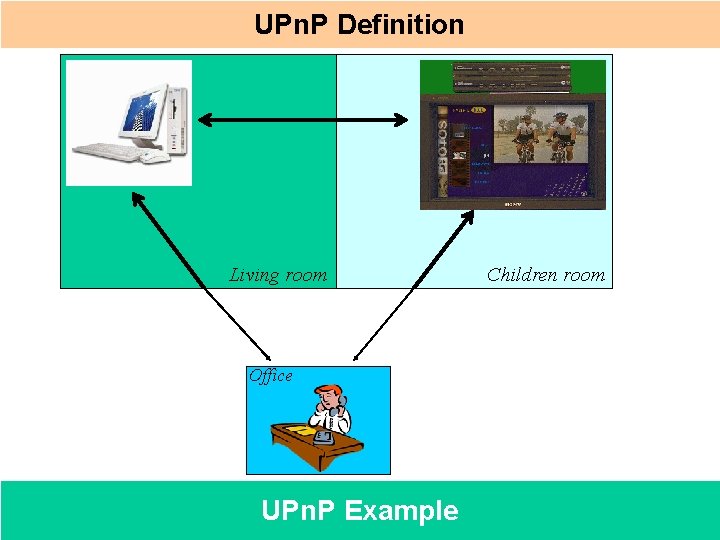
UPn. P Definition Living room Office UPn. P Example Children room
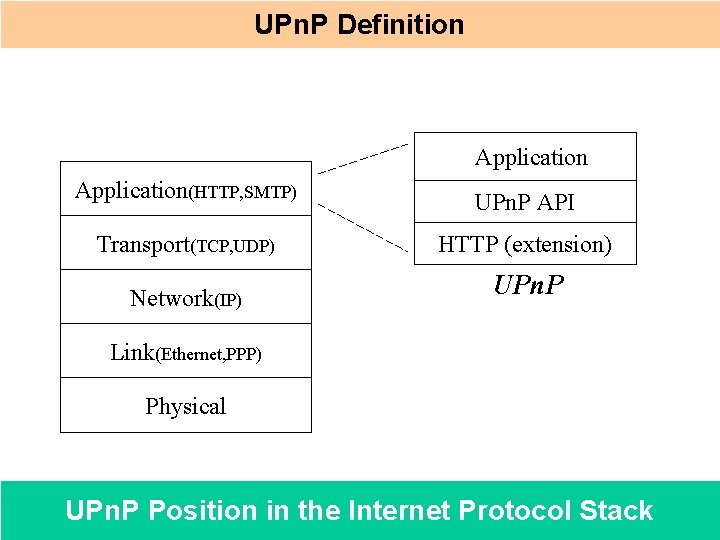
UPn. P Definition Application(HTTP, SMTP) UPn. P API Transport(TCP, UDP) HTTP (extension) Network(IP) UPn. P Link(Ethernet, PPP) Physical UPn. P Position in the Internet Protocol Stack
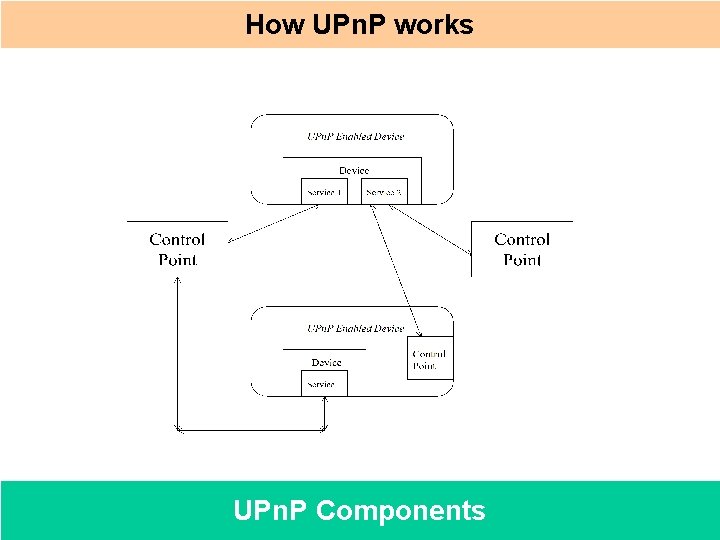
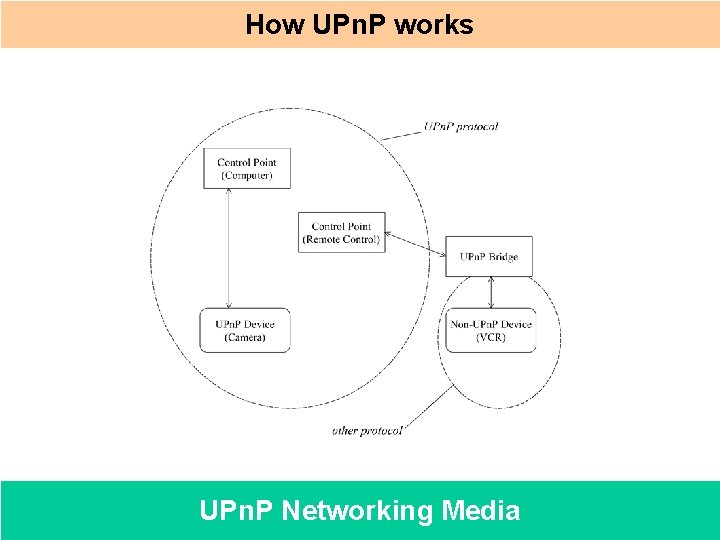
How UPn. P works UPn. P Components
How UPn. P works UPn. P Networking Media
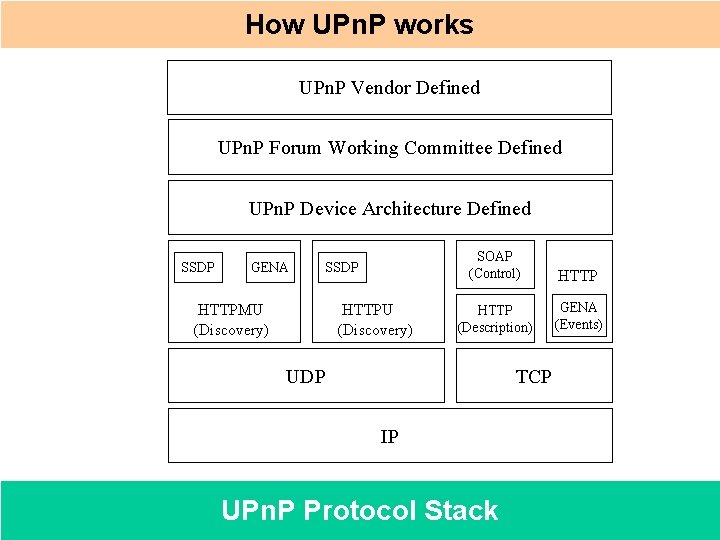
How UPn. P works UPn. P Vendor Defined UPn. P Forum Working Committee Defined UPn. P Device Architecture Defined SSDP GENA SSDP HTTPMU (Discovery) HTTPU (Discovery) SOAP (Control) HTTP (Description) GENA (Events) UDP TCP IP UPn. P Protocol Stack
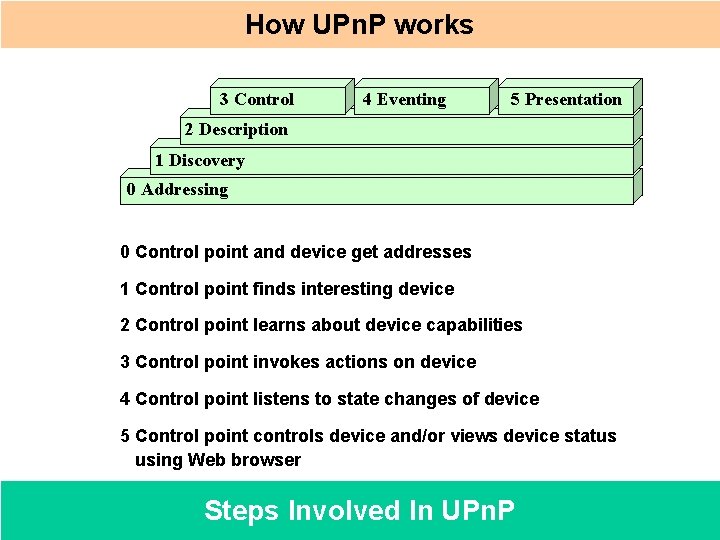
How UPn. P works 3 Control 4 Eventing 5 Presentation 2 Description 1 Discovery 0 Addressing 0 Control point and device get addresses 1 Control point finds interesting device 2 Control point learns about device capabilities 3 Control point invokes actions on device 4 Control point listens to state changes of device 5 Control point controls device and/or views device status using Web browser Steps Involved In UPn. P
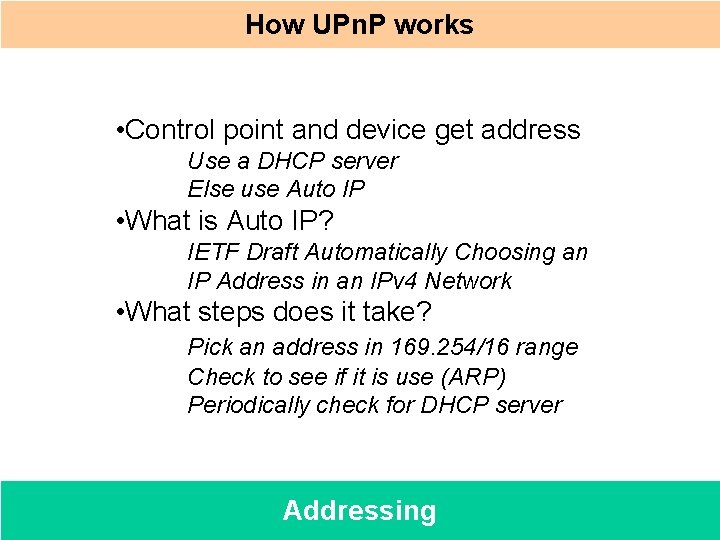
How UPn. P works • Control point and device get address Use a DHCP server Else use Auto IP • What is Auto IP? IETF Draft Automatically Choosing an IP Address in an IPv 4 Network • What steps does it take? Pick an address in 169. 254/16 range Check to see if it is use (ARP) Periodically check for DHCP server Addressing
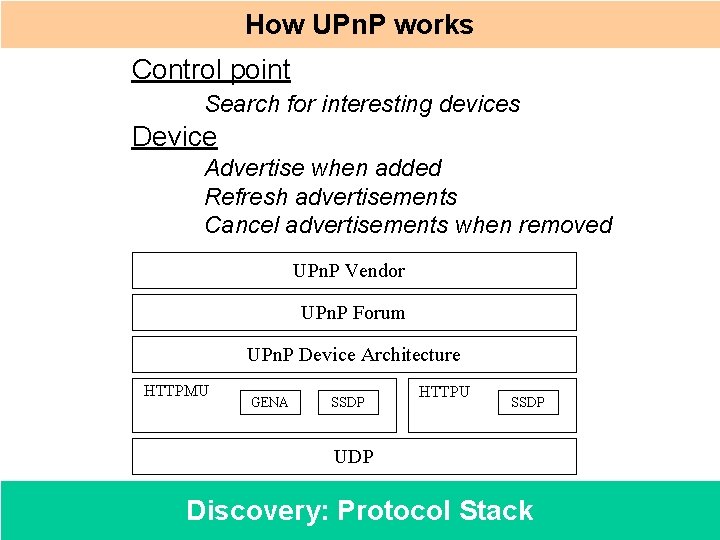
How UPn. P works Control point Search for interesting devices Device Advertise when added Refresh advertisements Cancel advertisements when removed UPn. P Vendor UPn. P Forum UPn. P Device Architecture HTTPMU GENA SSDP HTTPU SSDP UDP Discovery: Protocol Stack
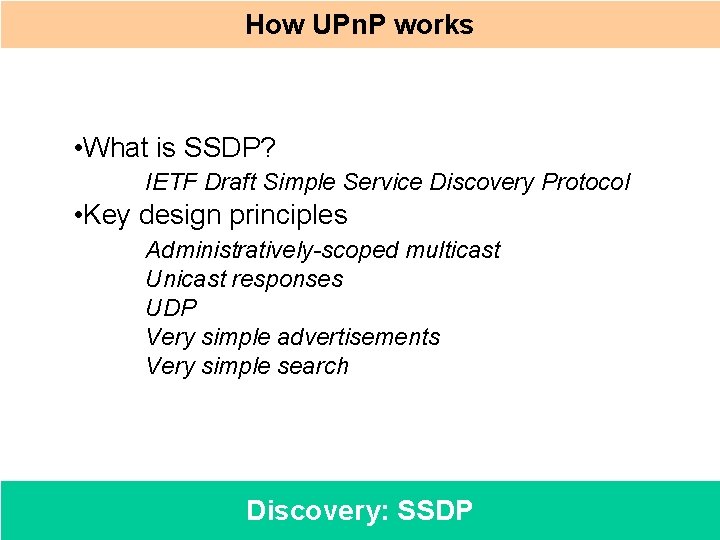
How UPn. P works • What is SSDP? IETF Draft Simple Service Discovery Protocol • Key design principles Administratively-scoped multicast Unicast responses UDP Very simple advertisements Very simple search Discovery: SSDP
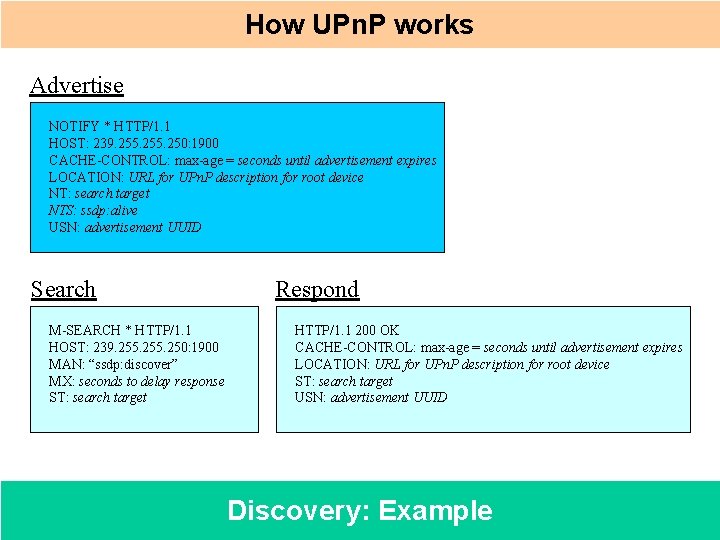
How UPn. P works Advertise NOTIFY * HTTP/1. 1 HOST: 239. 255. 250: 1900 CACHE-CONTROL: max-age = seconds until advertisement expires LOCATION: URL for UPn. P description for root device NT: search target NTS: ssdp: alive USN: advertisement UUID Search M-SEARCH * HTTP/1. 1 HOST: 239. 255. 250: 1900 MAN: “ssdp: discover” MX: seconds to delay response ST: search target Respond HTTP/1. 1 200 OK CACHE-CONTROL: max-age = seconds until advertisement expires LOCATION: URL for UPn. P description for root device ST: search target USN: advertisement UUID Discovery: Example
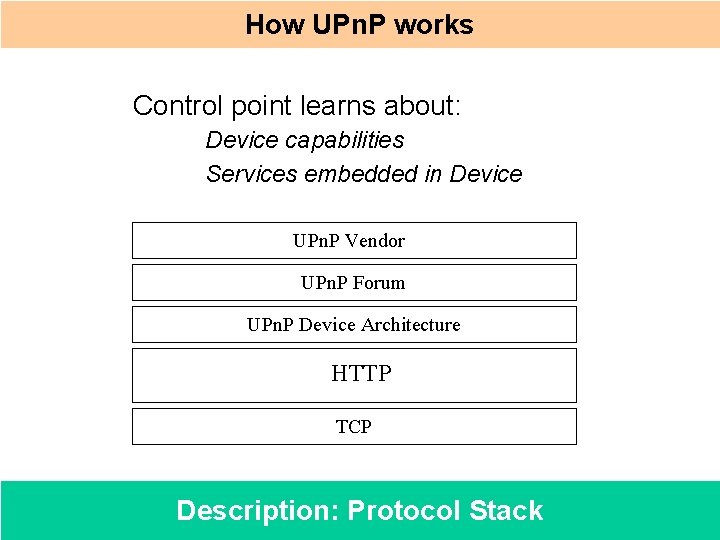
How UPn. P works Control point learns about: Device capabilities Services embedded in Device UPn. P Vendor UPn. P Forum UPn. P Device Architecture HTTP TCP Description: Protocol Stack
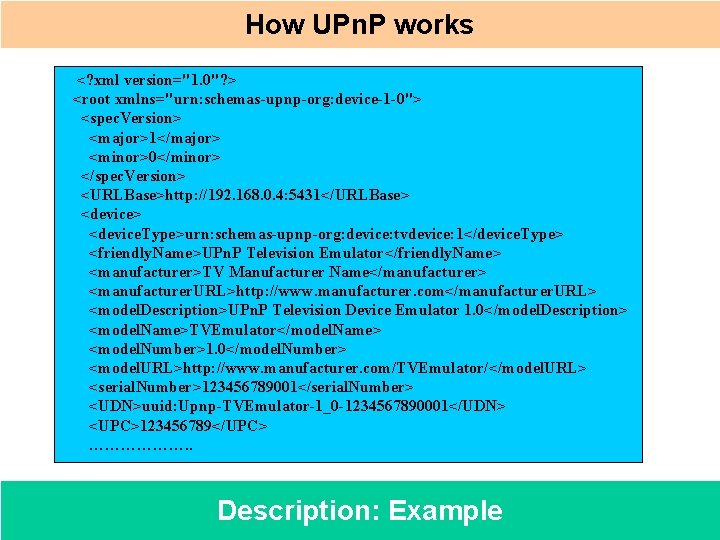
How UPn. P works <? xml version="1. 0"? > <root xmlns="urn: schemas-upnp-org: device-1 -0"> <spec. Version> <major>1</major> <minor>0</minor> </spec. Version> <URLBase>http: //192. 168. 0. 4: 5431</URLBase> <device. Type>urn: schemas-upnp-org: device: tvdevice: 1</device. Type> <friendly. Name>UPn. P Television Emulator</friendly. Name> <manufacturer>TV Manufacturer Name</manufacturer> <manufacturer. URL>http: //www. manufacturer. com</manufacturer. URL> <model. Description>UPn. P Television Device Emulator 1. 0</model. Description> <model. Name>TVEmulator</model. Name> <model. Number>1. 0</model. Number> <model. URL>http: //www. manufacturer. com/TVEmulator/</model. URL> <serial. Number>123456789001</serial. Number> <UDN>uuid: Upnp-TVEmulator-1_0 -1234567890001</UDN> <UPC>123456789</UPC> ………………. . Description: Example
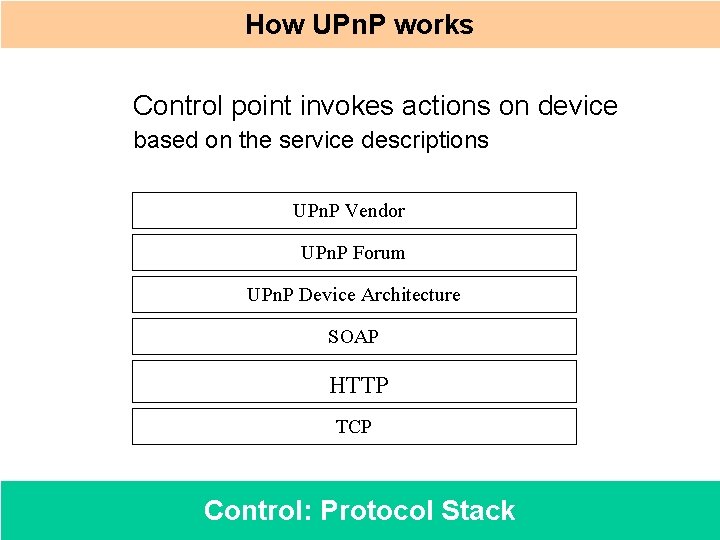
How UPn. P works Control point invokes actions on device based on the service descriptions UPn. P Vendor UPn. P Forum UPn. P Device Architecture SOAP HTTP TCP Control: Protocol Stack
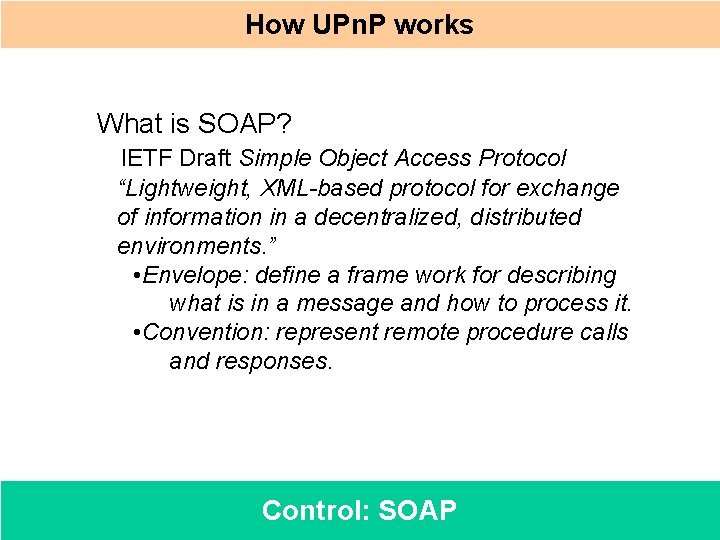
How UPn. P works What is SOAP? IETF Draft Simple Object Access Protocol “Lightweight, XML-based protocol for exchange of information in a decentralized, distributed environments. ” • Envelope: define a frame work for describing what is in a message and how to process it. • Convention: represent remote procedure calls and responses. Control: SOAP
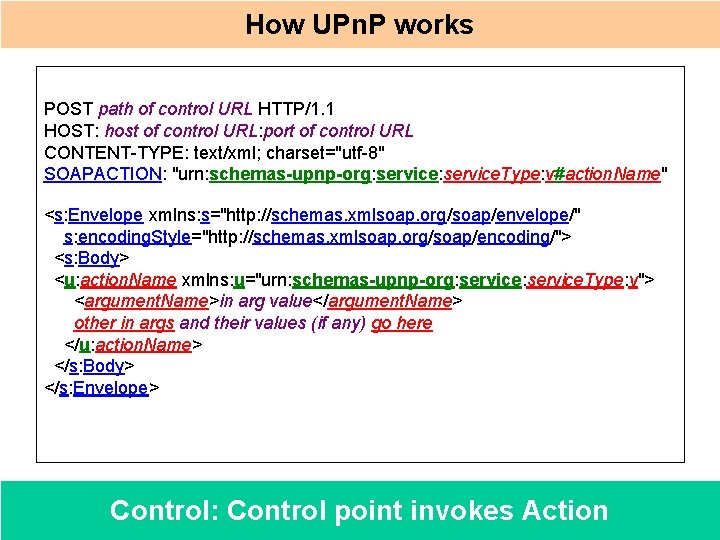
How UPn. P works POST path of control URL HTTP/1. 1 HOST: host of control URL: port of control URL CONTENT-TYPE: text/xml; charset="utf-8" SOAPACTION: "urn: schemas-upnp-org: service. Type: v#action. Name" <s: Envelope xmlns: s="http: //schemas. xmlsoap. org/soap/envelope/" s: encoding. Style="http: //schemas. xmlsoap. org/soap/encoding/"> <s: Body> <u: action. Name xmlns: u="urn: schemas-upnp-org: service. Type: v"> <argument. Name>in arg value</argument. Name> other in args and their values (if any) go here </u: action. Name> </s: Body> </s: Envelope> Control: Control point invokes Action
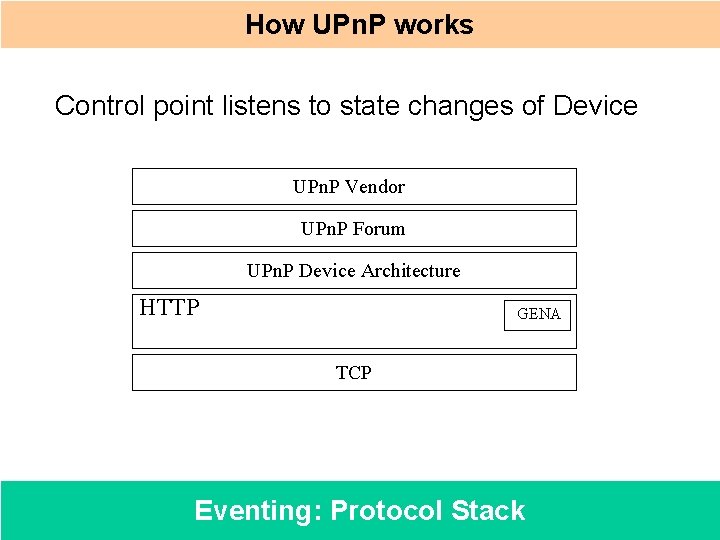
How UPn. P works Control point listens to state changes of Device UPn. P Vendor UPn. P Forum UPn. P Device Architecture HTTP GENA TCP Eventing: Protocol Stack
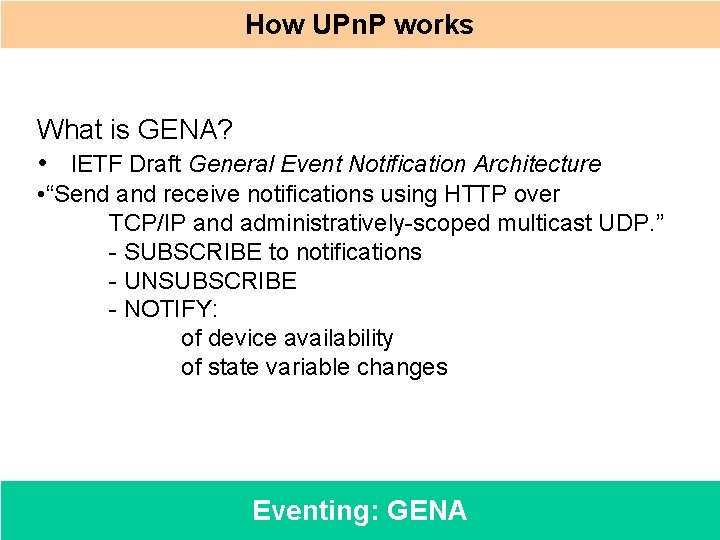
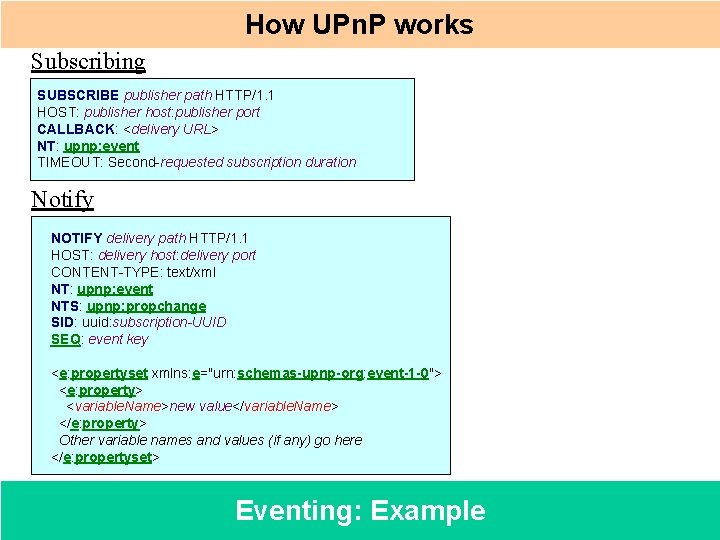
How UPn. P works What is GENA? • IETF Draft General Event Notification Architecture • “Send and receive notifications using HTTP over TCP/IP and administratively-scoped multicast UDP. ” - SUBSCRIBE to notifications - UNSUBSCRIBE - NOTIFY: of device availability of state variable changes Eventing: GENA
How UPn. P works Subscribing SUBSCRIBE publisher path HTTP/1. 1 HOST: publisher host: publisher port CALLBACK: <delivery URL> NT: upnp: event TIMEOUT: Second-requested subscription duration Notify NOTIFY delivery path HTTP/1. 1 HOST: delivery host: delivery port CONTENT-TYPE: text/xml NT: upnp: event NTS: upnp: propchange SID: uuid: subscription-UUID SEQ: event key <e: propertyset xmlns: e="urn: schemas-upnp-org: event-1 -0"> <e: property> <variable. Name>new value</variable. Name> </e: property> Other variable names and values (if any) go here </e: propertyset> Eventing: Example
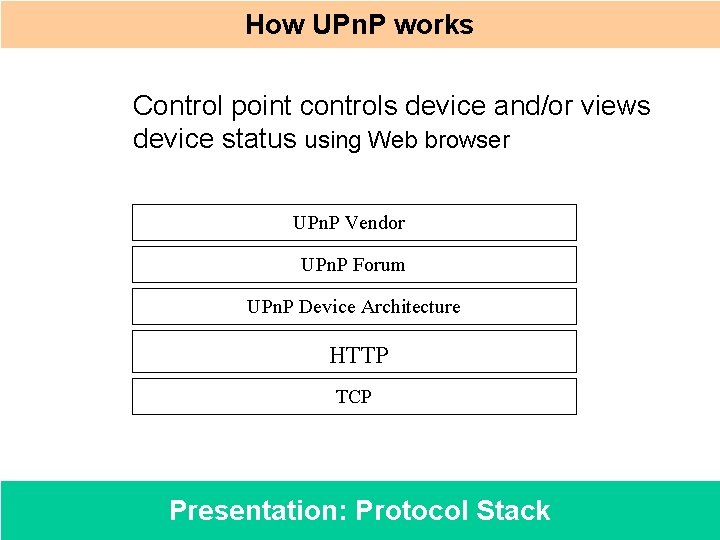
How UPn. P works Control point controls device and/or views device status using Web browser UPn. P Vendor UPn. P Forum UPn. P Device Architecture HTTP TCP Presentation: Protocol Stack
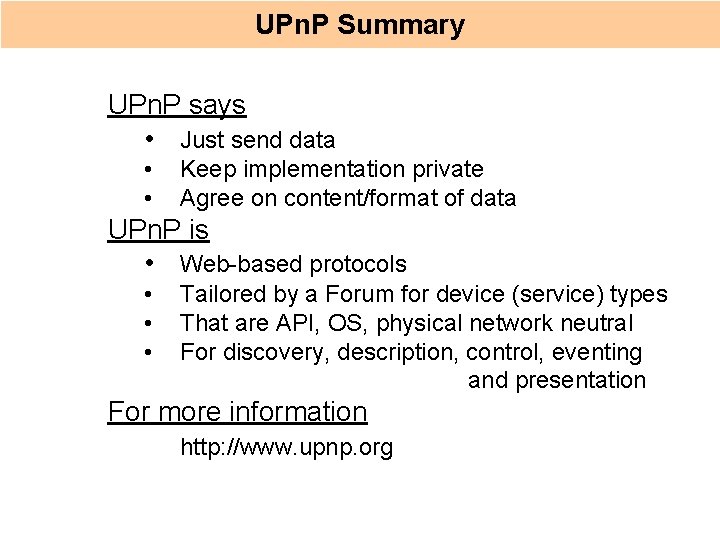
UPn. P Summary UPn. P says • Just send data • • Keep implementation private Agree on content/format of data UPn. P is • Web-based protocols • • • Tailored by a Forum for device (service) types That are API, OS, physical network neutral For discovery, description, control, eventing and presentation For more information http: //www. upnp. org
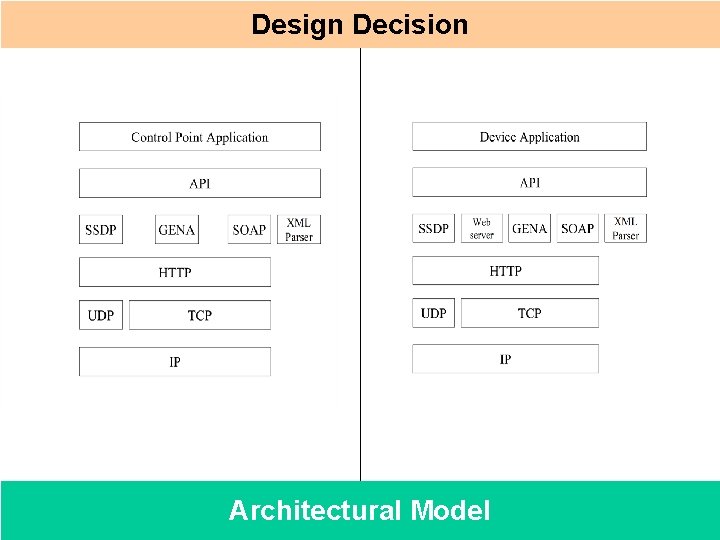
Design Decision Architectural Model
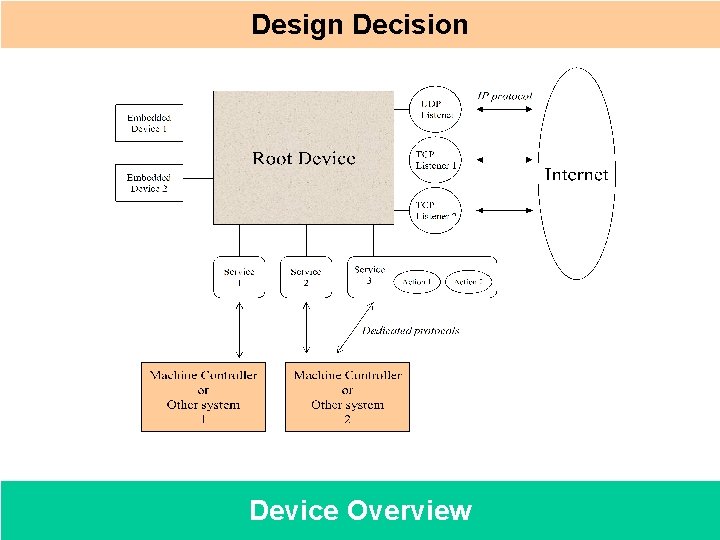
Design Decision Device Overview
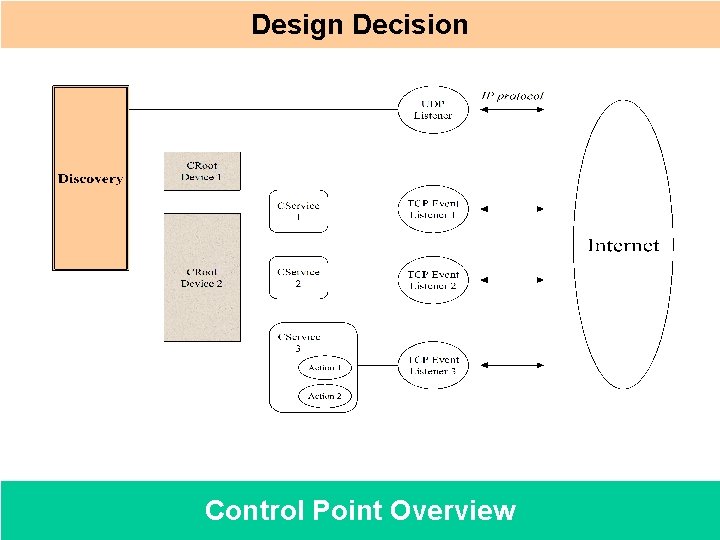
Design Decision Control Point Overview
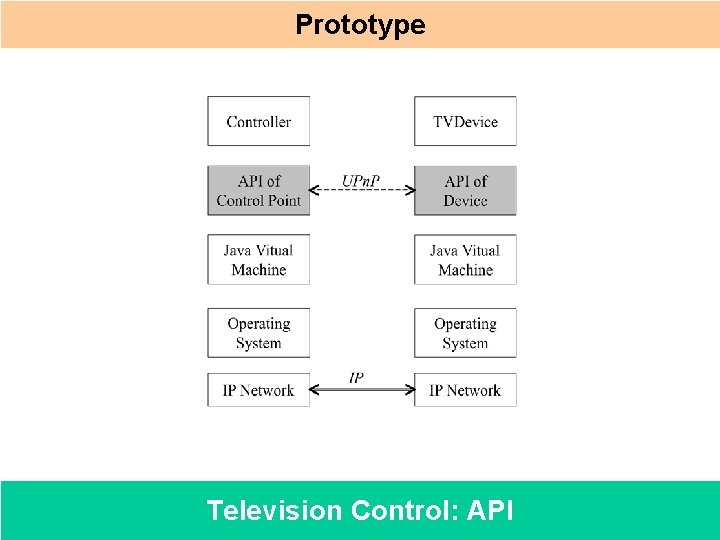
Prototype Television Control: API
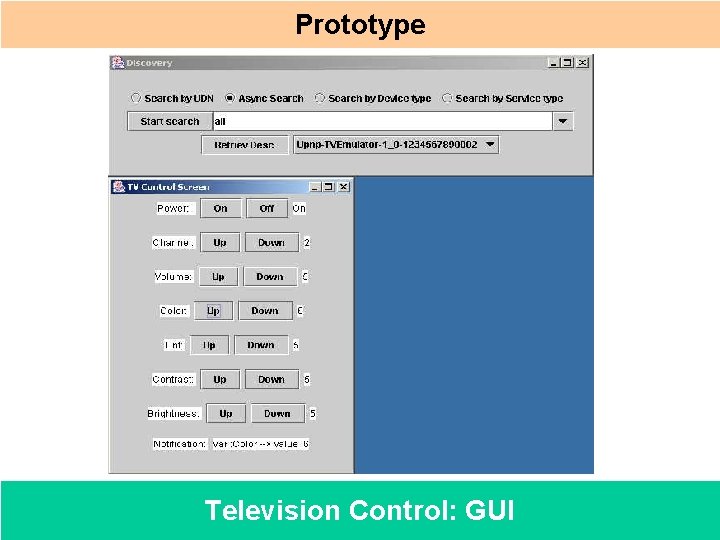
Prototype Television Control: GUI
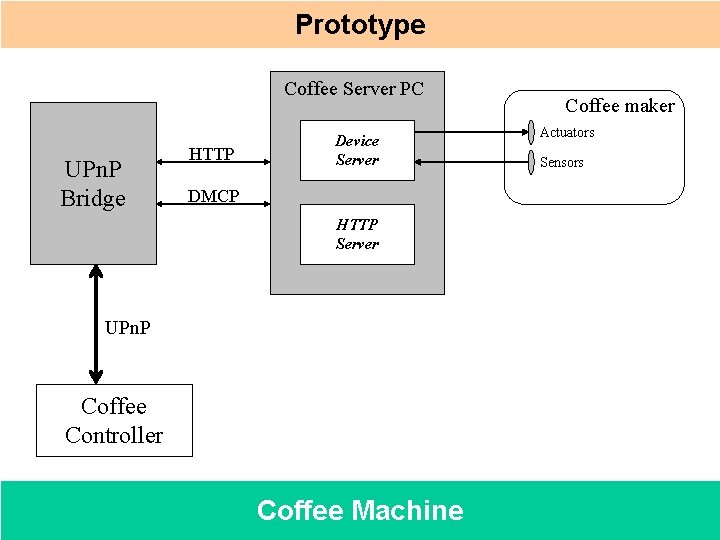
Prototype Coffee Server PC UPn. P Bridge HTTP Device Server DMCP HTTP Server UPn. P Coffee Controller Coffee Machine Coffee maker Actuators Sensors
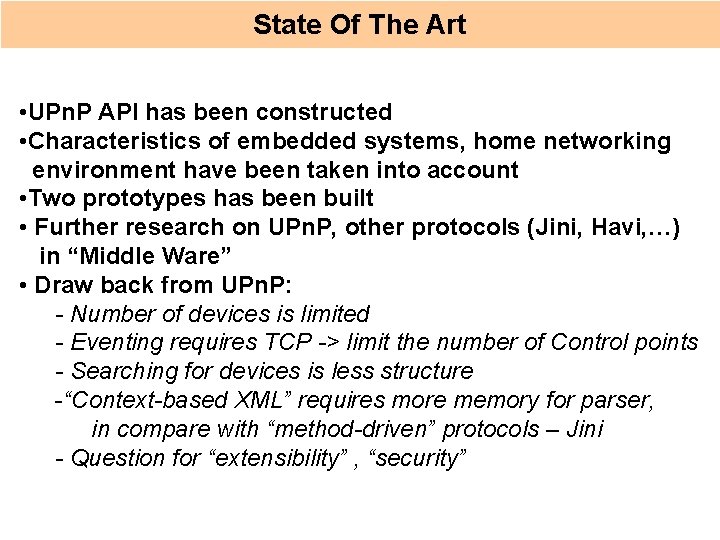
State Of The Art • UPn. P API has been constructed • Characteristics of embedded systems, home networking environment have been taken into account • Two prototypes has been built • Further research on UPn. P, other protocols (Jini, Havi, …) in “Middle Ware” • Draw back from UPn. P: - Number of devices is limited - Eventing requires TCP -> limit the number of Control points - Searching for devices is less structure -“Context-based XML” requires more memory for parser, in compare with “method-driven” protocols – Jini - Question for “extensibility” , “security”