
Universal Law of Gravitation Every object attracts every
Universal Law of Gravitation Every object attracts every other object with a force that is directly proportional to the product of the masses of the objects and inversely proportional to the square of the distance between them.
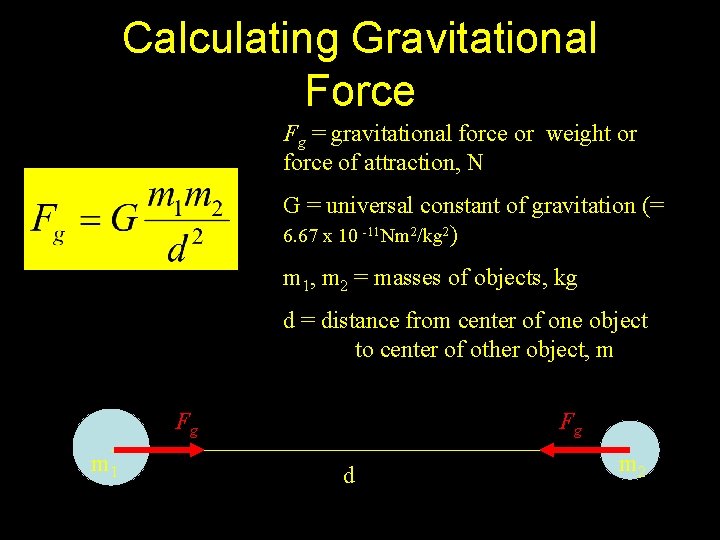
Calculating Gravitational Force Fg = gravitational force or weight or force of attraction, N G = universal constant of gravitation (= 6. 67 x 10 -11 Nm 2/kg 2) m 1, m 2 = masses of objects, kg d = distance from center of one object to center of other object, m Fg m 1 Fg d m 2
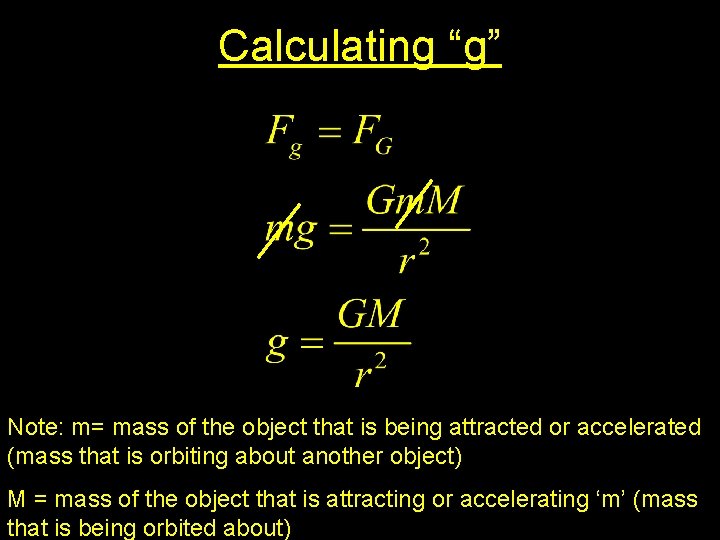
Calculating “g” • Note: m= mass of the object that is being attracted or accelerated (mass that is orbiting about another object) M = mass of the object that is attracting or accelerating ‘m’ (mass that is being orbited about)
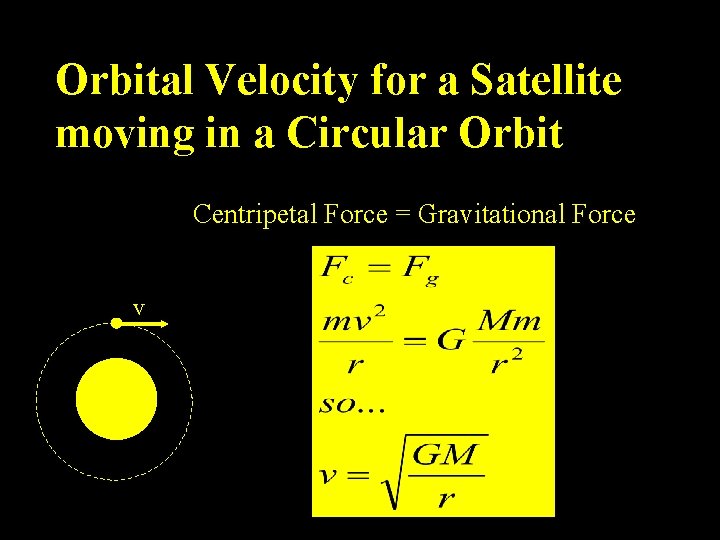
Orbital Velocity for a Satellite moving in a Circular Orbit Centripetal Force = Gravitational Force v
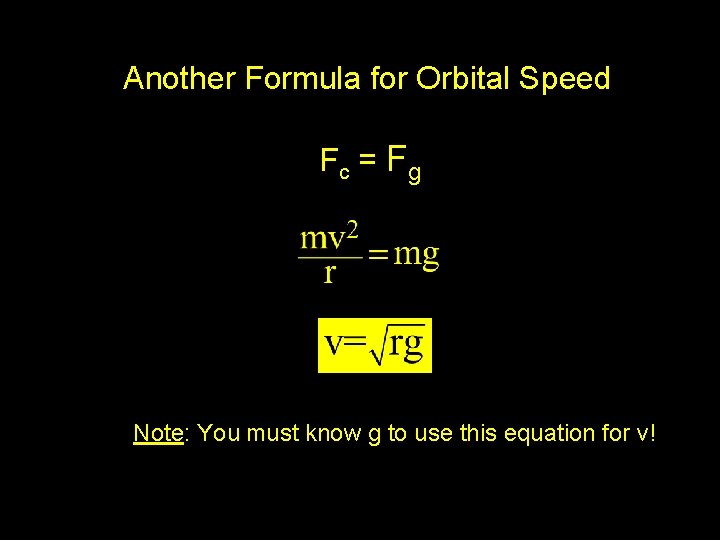
Another Formula for Orbital Speed Fc = Fg Note: You must know g to use this equation for v!
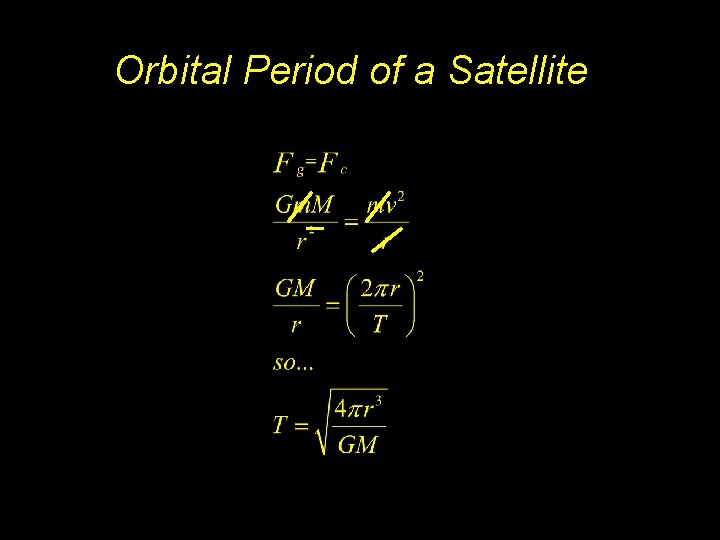
Orbital Period of a Satellite
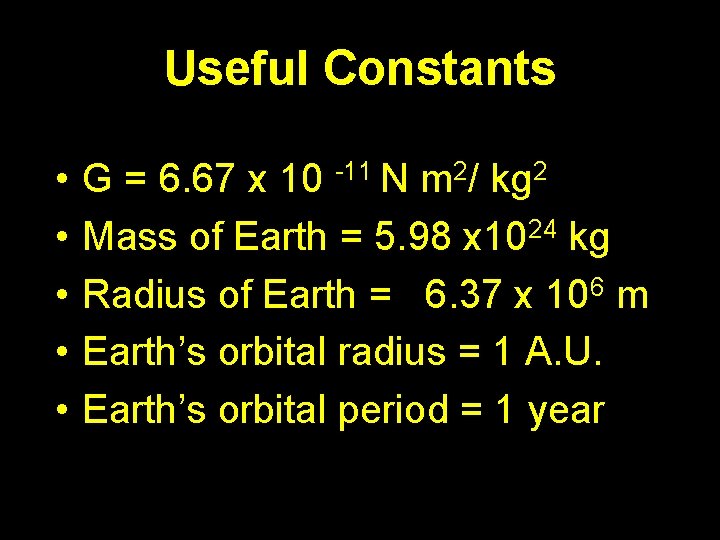
Useful Constants • • • G = 6. 67 x 10 -11 N m 2/ kg 2 Mass of Earth = 5. 98 x 1024 kg Radius of Earth = 6. 37 x 106 m Earth’s orbital radius = 1 A. U. Earth’s orbital period = 1 year
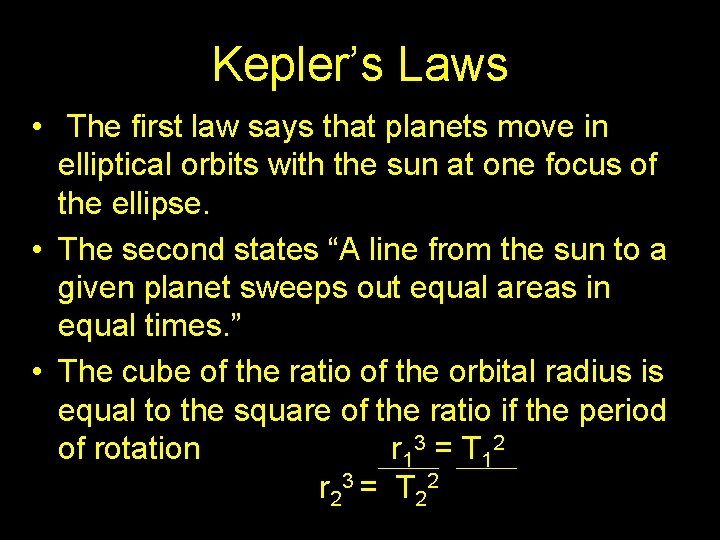
Kepler’s Laws • The first law says that planets move in elliptical orbits with the sun at one focus of the ellipse. • The second states “A line from the sun to a given planet sweeps out equal areas in equal times. ” • The cube of the ratio of the orbital radius is equal to the square of the ratio if the period of rotation r 1 3 = T 1 2 r 2 3 = T 2 2
- Slides: 8