
Universal Law of Gravitation and Orbits AP Physics
Universal Law of Gravitation and Orbits AP Physics C
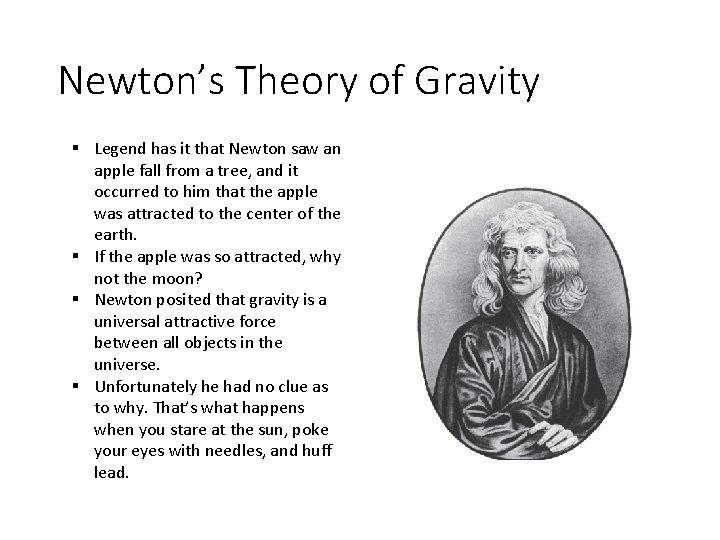
Newton’s Theory of Gravity § Legend has it that Newton saw an apple fall from a tree, and it occurred to him that the apple was attracted to the center of the earth. § If the apple was so attracted, why not the moon? § Newton posited that gravity is a universal attractive force between all objects in the universe. § Unfortunately he had no clue as to why. That’s what happens when you stare at the sun, poke your eyes with needles, and huff lead.
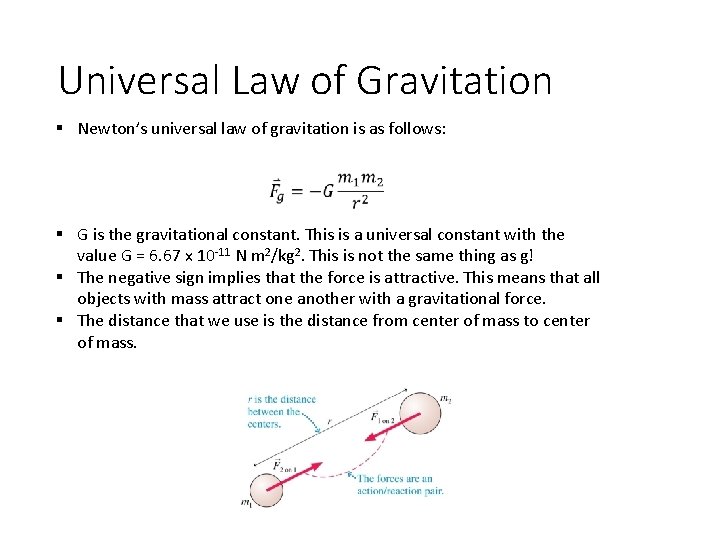
Universal Law of Gravitation § Newton’s universal law of gravitation is as follows: § G is the gravitational constant. This is a universal constant with the value G = 6. 67 x 10 -11 N m 2/kg 2. This is not the same thing as g! § The negative sign implies that the force is attractive. This means that all objects with mass attract one another with a gravitational force. § The distance that we use is the distance from center of mass to center of mass.

Inverse-Square § The force of gravity is an inverse square relation, meaning that as the separation distance increases, the force drops substantially. § We often are simply concerned with the magnitude of the force of gravity, so often the formula is written this way: § When bringing up gravitational potential energy we will consider the force to be negative for constancy.
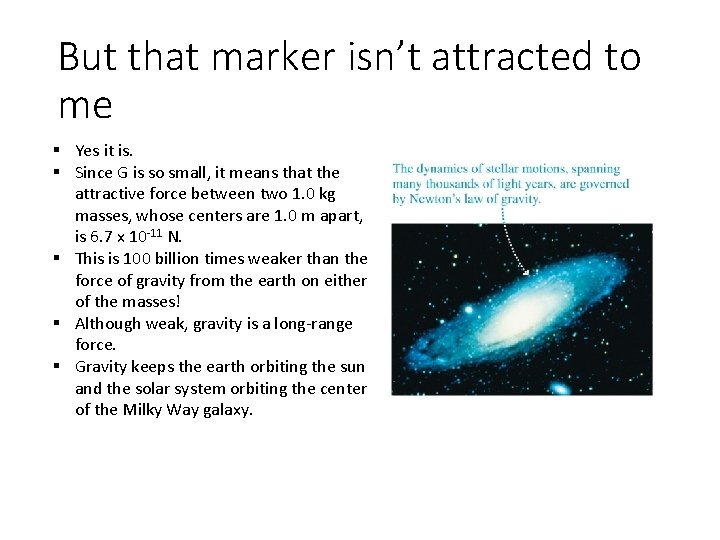
But that marker isn’t attracted to me § Yes it is. § Since G is so small, it means that the attractive force between two 1. 0 kg masses, whose centers are 1. 0 m apart, is 6. 7 x 10 -11 N. § This is 100 billion times weaker than the force of gravity from the earth on either of the masses! § Although weak, gravity is a long-range force. § Gravity keeps the earth orbiting the sun and the solar system orbiting the center of the Milky Way galaxy.
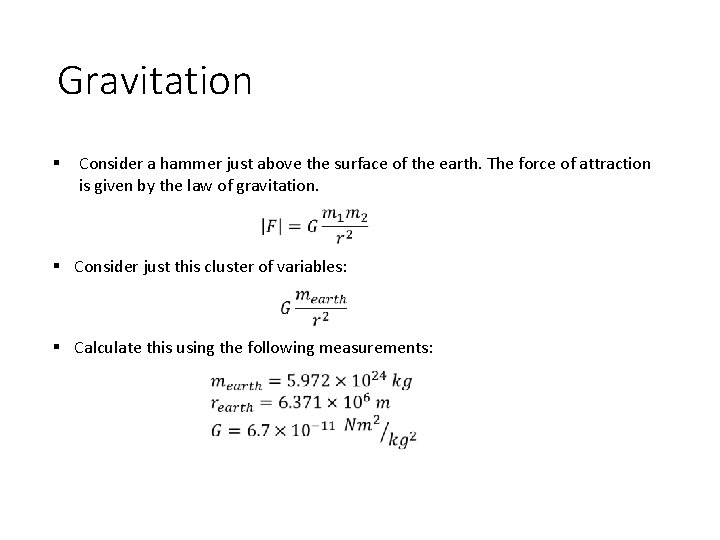
Gravitation § Consider a hammer just above the surface of the earth. The force of attraction is given by the law of gravitation. § Consider just this cluster of variables: § Calculate this using the following measurements:
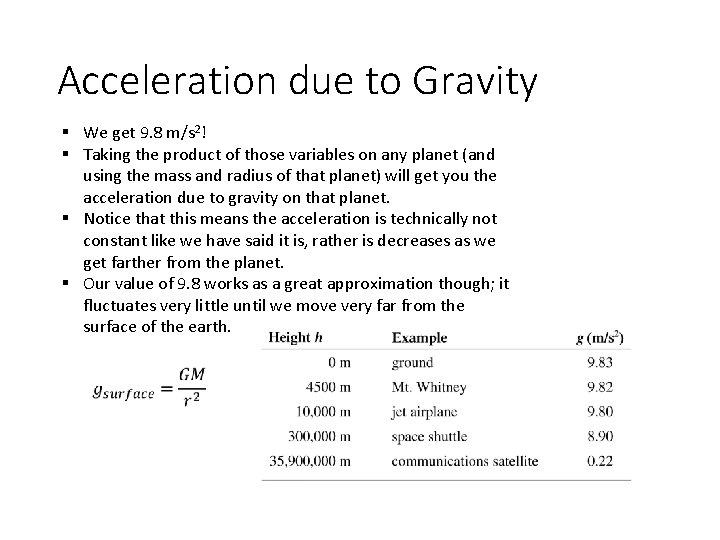
Acceleration due to Gravity § We get 9. 8 m/s 2! § Taking the product of those variables on any planet (and using the mass and radius of that planet) will get you the acceleration due to gravity on that planet. § Notice that this means the acceleration is technically not constant like we have said it is, rather is decreases as we get farther from the planet. § Our value of 9. 8 works as a great approximation though; it fluctuates very little until we move very far from the surface of the earth.

Falling through the Earth § Suppose we dig a hole through the center of the Earth. § If we jump into the hole, we experience an acceleration of 9. 8 m/s 2 at the surface. § As we fall, the acceleration (and force) decreases. § Once we reach the center of the planet, the net force is zero, but we continue moving due to our kinetic energy and momentum. § After we pass the center, we experience a growing force towards the center, slowing us down. § This means that we will oscillate!
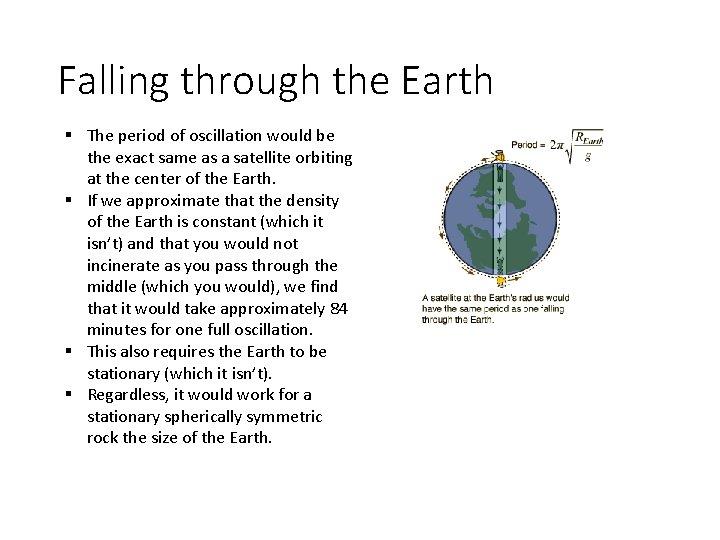
Falling through the Earth § The period of oscillation would be the exact same as a satellite orbiting at the center of the Earth. § If we approximate that the density of the Earth is constant (which it isn’t) and that you would not incinerate as you pass through the middle (which you would), we find that it would take approximately 84 minutes for one full oscillation. § This also requires the Earth to be stationary (which it isn’t). § Regardless, it would work for a stationary spherically symmetric rock the size of the Earth.
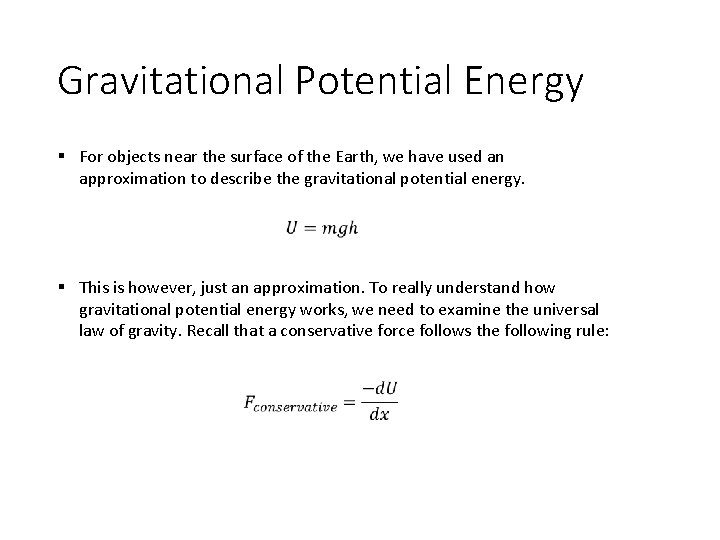
Gravitational Potential Energy § For objects near the surface of the Earth, we have used an approximation to describe the gravitational potential energy. § This is however, just an approximation. To really understand how gravitational potential energy works, we need to examine the universal law of gravity. Recall that a conservative force follows the following rule:
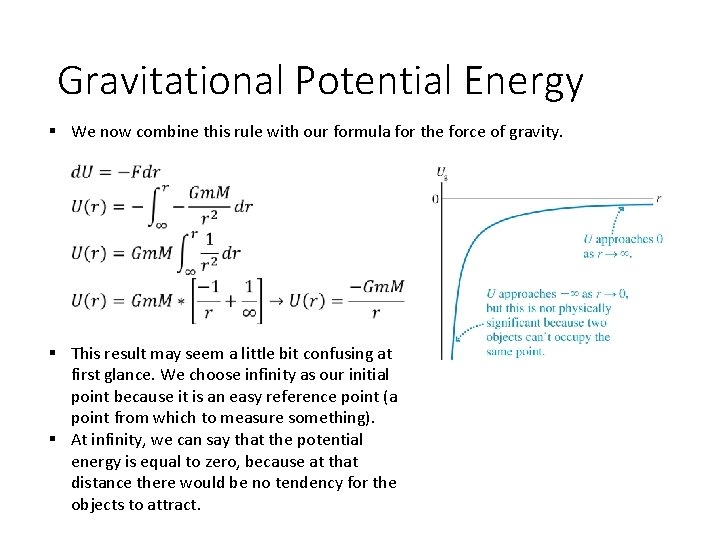
Gravitational Potential Energy § We now combine this rule with our formula for the force of gravity. § This result may seem a little bit confusing at first glance. We choose infinity as our initial point because it is an easy reference point (a point from which to measure something). § At infinity, we can say that the potential energy is equal to zero, because at that distance there would be no tendency for the objects to attract.
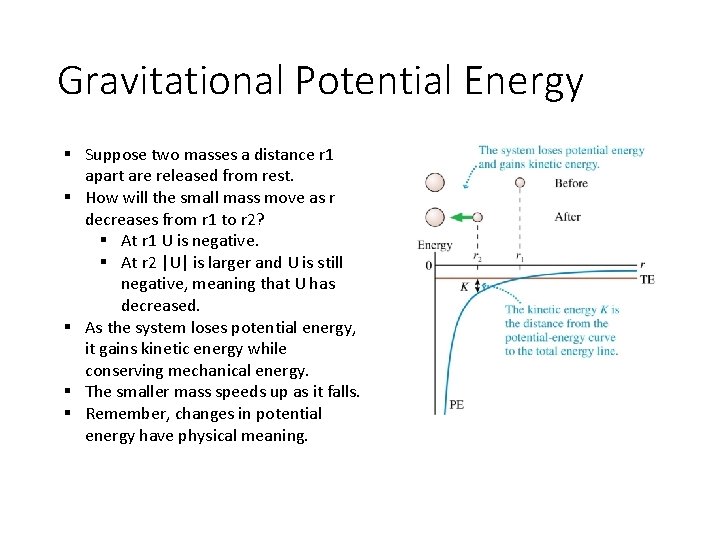
Gravitational Potential Energy § Suppose two masses a distance r 1 apart are released from rest. § How will the small mass move as r decreases from r 1 to r 2? § At r 1 U is negative. § At r 2 |U| is larger and U is still negative, meaning that U has decreased. § As the system loses potential energy, it gains kinetic energy while conserving mechanical energy. § The smaller mass speeds up as it falls. § Remember, changes in potential energy have physical meaning.
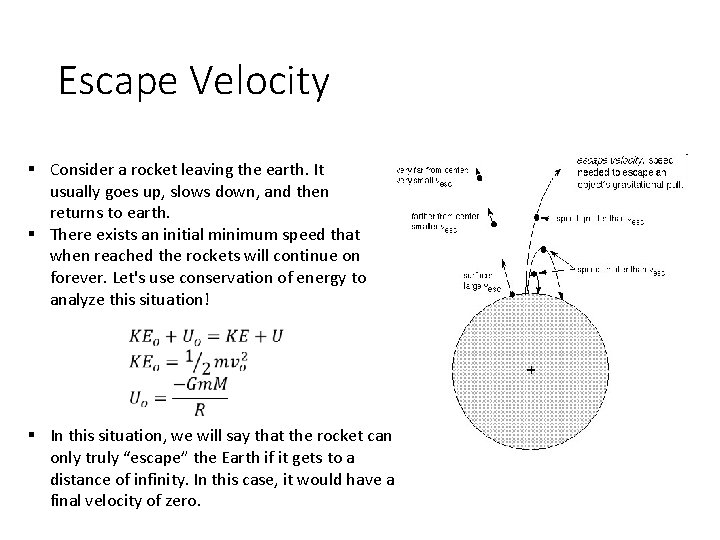
Escape Velocity § Consider a rocket leaving the earth. It usually goes up, slows down, and then returns to earth. § There exists an initial minimum speed that when reached the rockets will continue on forever. Let's use conservation of energy to analyze this situation! § In this situation, we will say that the rocket can only truly “escape” the Earth if it gets to a distance of infinity. In this case, it would have a final velocity of zero.
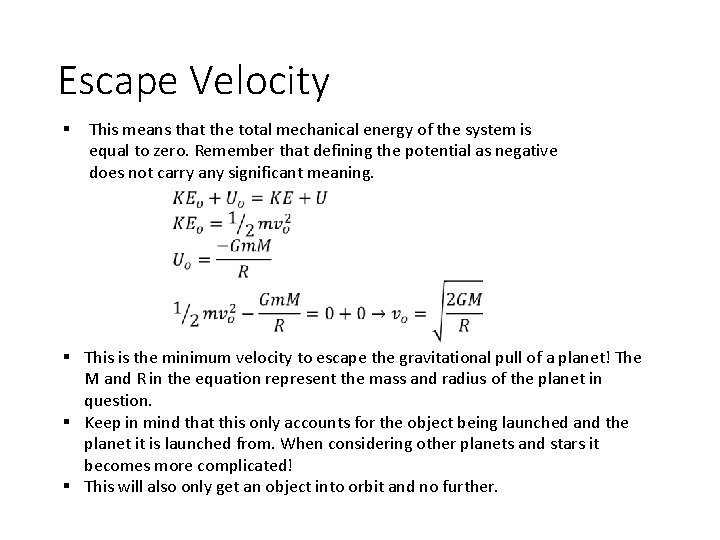
Escape Velocity § This means that the total mechanical energy of the system is equal to zero. Remember that defining the potential as negative does not carry any significant meaning. § This is the minimum velocity to escape the gravitational pull of a planet! The M and R in the equation represent the mass and radius of the planet in question. § Keep in mind that this only accounts for the object being launched and the planet it is launched from. When considering other planets and stars it becomes more complicated! § This will also only get an object into orbit and no further.
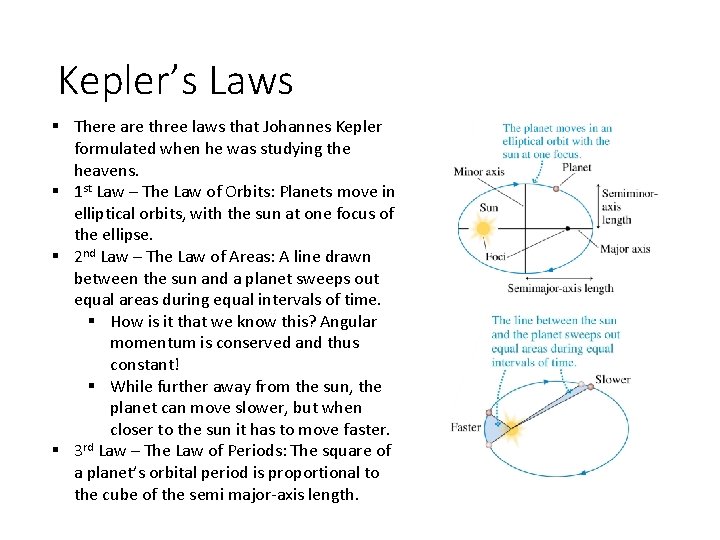
Kepler’s Laws § There are three laws that Johannes Kepler formulated when he was studying the heavens. § 1 st Law – The Law of Orbits: Planets move in elliptical orbits, with the sun at one focus of the ellipse. § 2 nd Law – The Law of Areas: A line drawn between the sun and a planet sweeps out equal areas during equal intervals of time. § How is it that we know this? Angular momentum is conserved and thus constant! § While further away from the sun, the planet can move slower, but when closer to the sun it has to move faster. § 3 rd Law – The Law of Periods: The square of a planet’s orbital period is proportional to the cube of the semi major-axis length.

Orbital Kinetic Energy § The velocity of an object in circular orbit is given by the following equation: § We can substitute this for velocity in our kinetic energy formula to express the kinetic energy of an orbiting body. § The question is WHY? Why do we need a new equation for kinetic energy? Well, the answer is that greatly simplifies the math. § If we use regular kinetic energy along with potential, we will need both the orbital velocity AND the orbital radius. In this case, we need only the orbital radius.

Orbital Energy § We can now create an expression for total mechanical energy of an orbiting object in terms of only the masses of the objects and the distance between them (center of mass to center of mass). § So by inspection we see that the kinetic energy function is always positive, the potential is negative and the total energy function is negative. § In fact the total energy equation is the negative inverse of the kinetic. § The negative is symbolic because it means that the mass “m” is BOUND to the mass of “M” and can never escape from it. It is called a BINDING ENERGY. § Notice that we also have a relationship between orbital kinetic and potential energy:
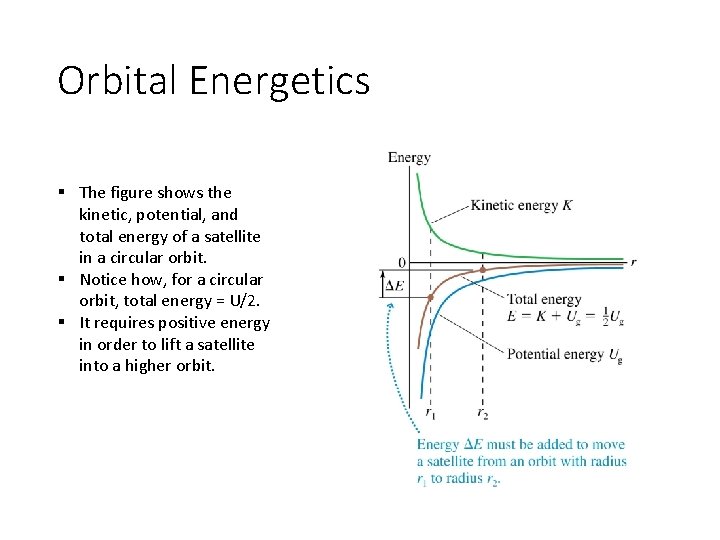
Orbital Energetics § The figure shows the kinetic, potential, and total energy of a satellite in a circular orbit. § Notice how, for a circular orbit, total energy = U/2. § It requires positive energy in order to lift a satellite into a higher orbit.
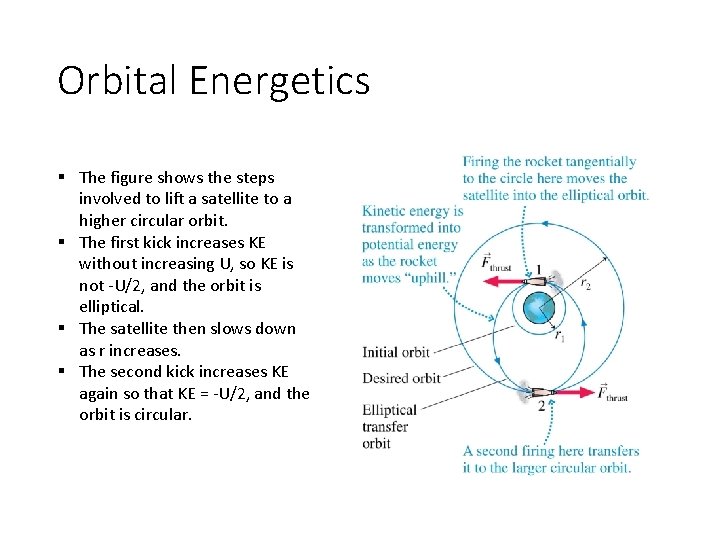
Orbital Energetics § The figure shows the steps involved to lift a satellite to a higher circular orbit. § The first kick increases KE without increasing U, so KE is not -U/2, and the orbit is elliptical. § The satellite then slows down as r increases. § The second kick increases KE again so that KE = -U/2, and the orbit is circular.
- Slides: 19