
UNIVERSAL DESIGN Incorporating UD into your classroom Presented


- Slides: 26
UNIVERSAL DESIGN Incorporating UD into your classroom Presented by Stacey M. Davis PD Coordinator for Teaching Excellence February 6, 2018
Agenda • Communication • Universal Design - General • Universal Design for Learning • Applying the 7 Principles in Class • Discussion
Universal Design • Ronald Mace, architect, coined the phrase in the 1970 s – the concept of designing all products and environments to be usable by all people, to the greatest extent possible, without the need for adaptation or specialized design The Center for Universal Design. (1997) About UD. Raleigh: North Carolina State University
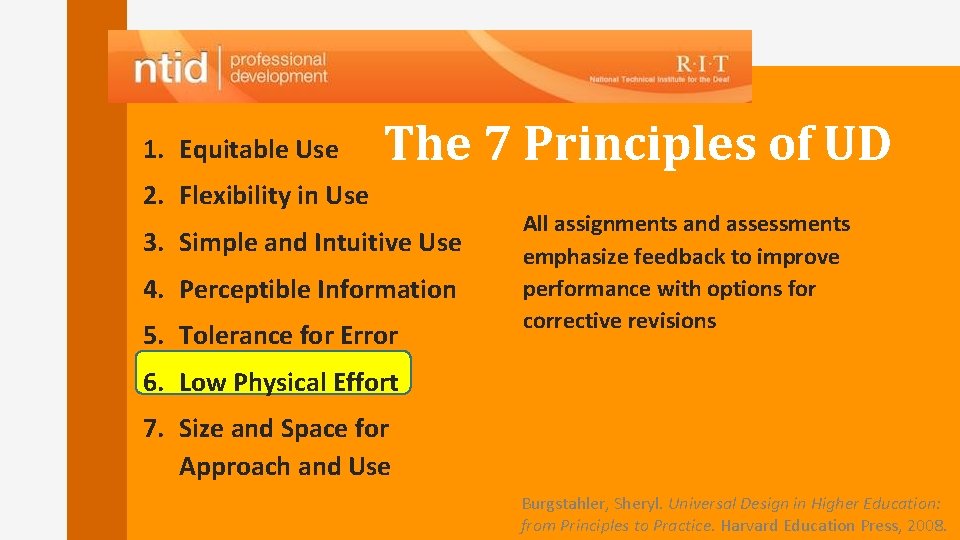
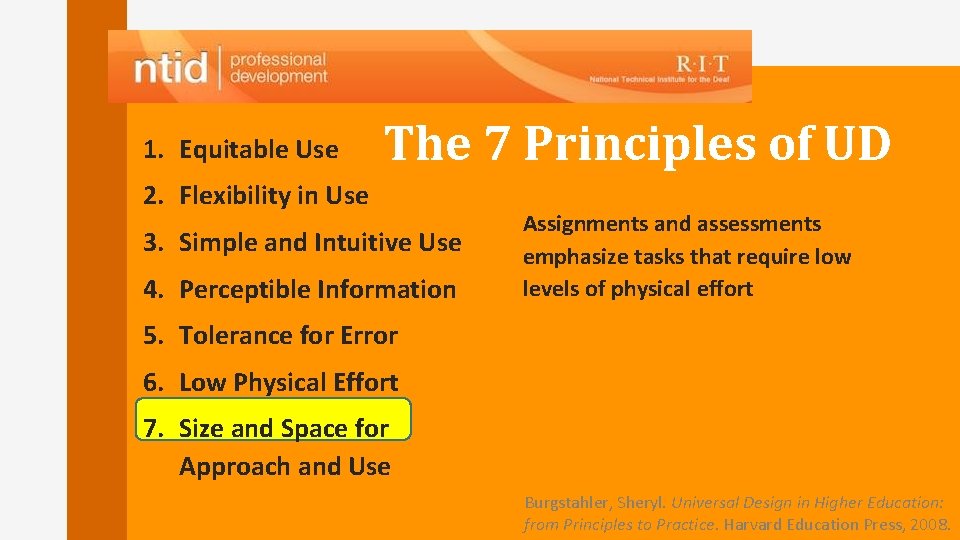
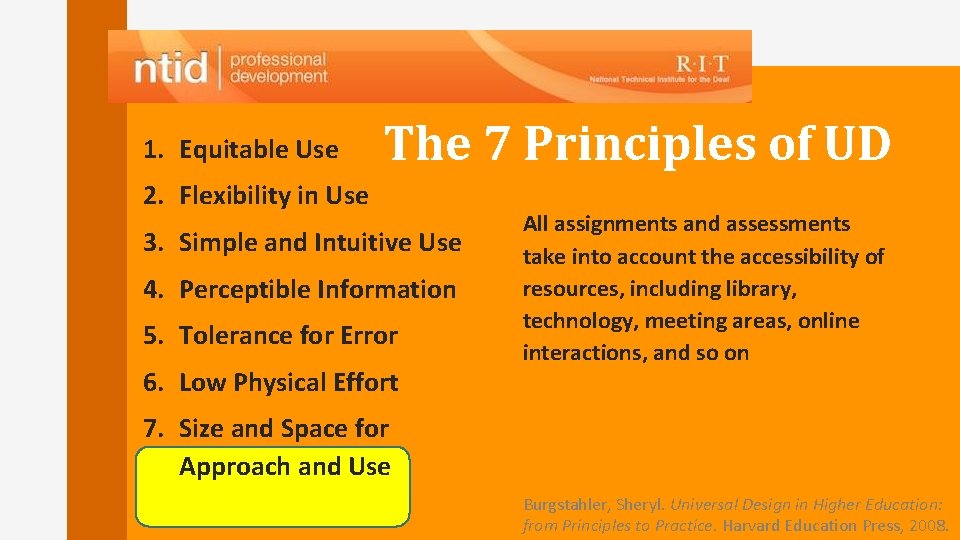
The 7 Principles of UD 1. Equitable Use 2. Flexibility in Use 3. Simple and Intuitive Use 4. Perceptible Information 5. Tolerance for Error 6. Low Physical Effort 7. Size and Space for Approach and Use
Examples of Universal Design • Dropped curb or curb cut • Automatic door • Flexible drinking straw • Low-floor bus • Electric toothbrush • Contrast colors
Universal Design for Learning • A set of 3 principles that guide the design of inclusive classroom instruction and accessible course materials. 1. Multiple methods of representation that give learners a variety of ways to acquire information and build knowledge. 2. Multiples means of student action and expression that provide learners alternatives for demonstrating what they have learned. 3. Multiple modes of student engagement that tap into learners’ interests, challenge them appropriately, and motivate them to learn. Burgstahler, Sheryl. Universal Design in Higher Education: from Principles to Practice. Harvard Education Press, 2008.
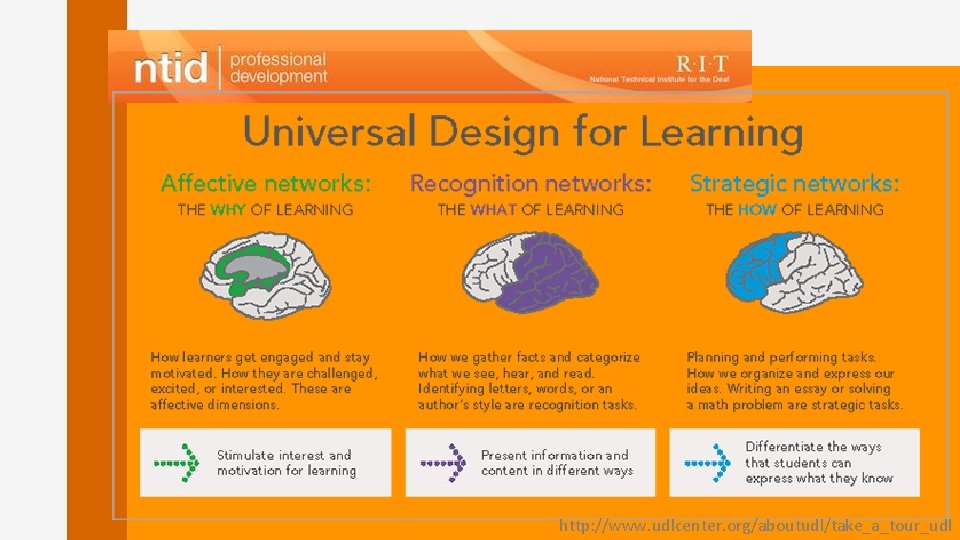
Universal Design for Learning • A framework for teaching and learning that includes proactive planning of curricula, taking into account the variability of all learners. UDL is based on research from education, psychology, and neuroscience and is organized around three learning networks of the brain – Recognition network – Strategic network – Affective network http: //www. udlcenter. org/aboutudl/take_a_tour_udl
http: //www. udlcenter. org/aboutudl/take_a_tour_udl
Recognition Networks • The “what” of learning – How we gather facts, categorize what we see, hear and read. • Guidelines – Provide Options for perception • Provide the same information through different modalities • Provide it in a format that allows adjustability by the user – Provide options for language, expressions and symbols – Provide options for comprehension http: //www. udlcenter. org/aboutudl/udlguidelines/principle 1
Recognition Networks • Provide options for comprehension – Activate or supply background knowledge – Highlight patterns, critical features, big ideas and relationships • Prompts, organizational methods, models, scaffolds, chunks – Maximize transfer and generalization • Provide checklists, prompt the use of mnemonic strategies, concept maps, scaffolds, embed new ideas into familiar ideas, provide explicit, supported opportunities to generalize learning to new situations, offer opportunities to revisit ideas and their links http: //www. udlcenter. org/aboutudl/udlguidelines/principle 1
Strategic Networks • The ”how” of learning – Planning and performing tasks • How we organize and express ideas (writing or solving a math problem) • Guidelines – Provide options for physical action – Provide options for expression and communication • Use multiple media for communication http: //www. udlcenter. org/aboutudl/udlguidelines/principle 2
Strategic Networks – Provide options for executive functions • Guide goal setting • Support planning and strategy development • Facilitate managing information and resources • Enhance capacity for monitoring progress http: //www. udlcenter. org/aboutudl/udlguidelines/principle 2
Affective Networks • The “why” of learning – How learners get engaged and stay motivated; how they are challenged, excited or interested • Guidelines – Provide options for recruiting interest • Optimize individual choice and autonomy • Optimize relevance, value and authenticity • Minimize threats and distractions http: //www. udlcenter. org/aboutudl/udlguidelines/principle 3
Affective Networks – Provide options for sustaining effort and persistence • Remind students of the goal • Vary the demands and resources to optimize challenge • Foster collaboration and communication • Increase mastery-oriented feedback – Provide options for self-regulation • Promote expectations and beliefs that optimize motivation • Facilitate personal coping skills and strategies • Develop self-assessment and reflection http: //www. udlcenter. org/aboutudl/udlguidelines/principle 3
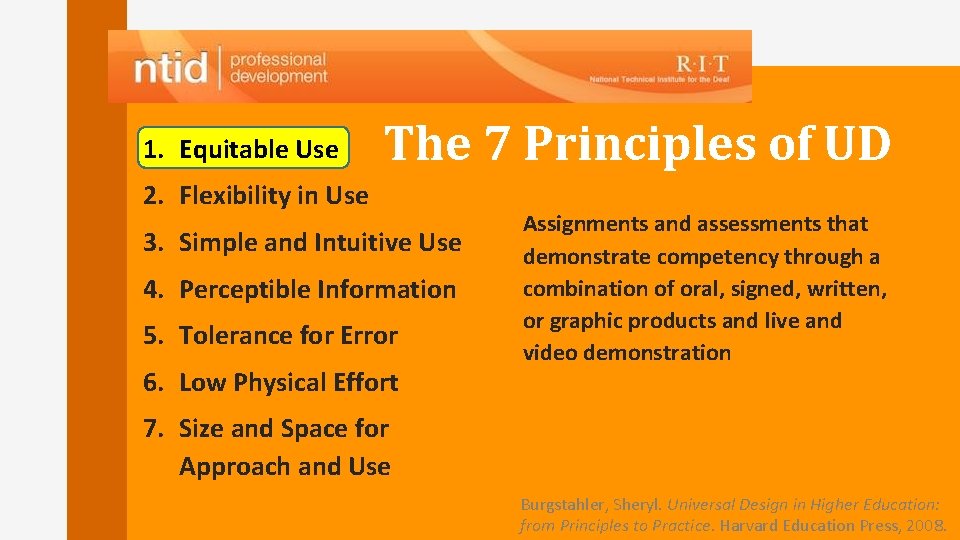
1. Equitable Use The 7 Principles of UD 2. Flexibility in Use 3. Simple and Intuitive Use 4. Perceptible Information 5. Tolerance for Error 6. Low Physical Effort Assignments and assessments that demonstrate competency through a combination of oral, signed, written, or graphic products and live and video demonstration 7. Size and Space for Approach and Use Burgstahler, Sheryl. Universal Design in Higher Education: from Principles to Practice. Harvard Education Press, 2008.
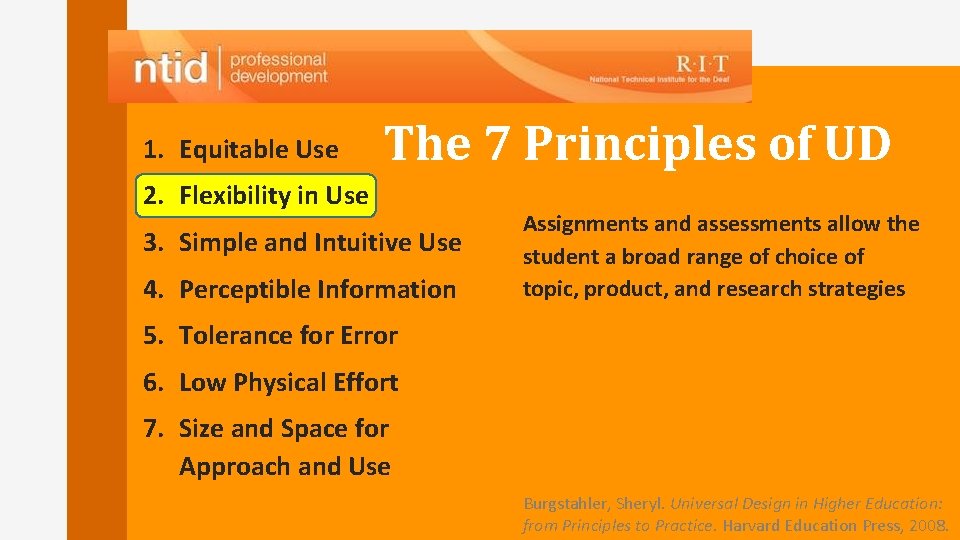
1. Equitable Use The 7 Principles of UD 2. Flexibility in Use 3. Simple and Intuitive Use 4. Perceptible Information Assignments and assessments allow the student a broad range of choice of topic, product, and research strategies 5. Tolerance for Error 6. Low Physical Effort 7. Size and Space for Approach and Use Burgstahler, Sheryl. Universal Design in Higher Education: from Principles to Practice. Harvard Education Press, 2008.
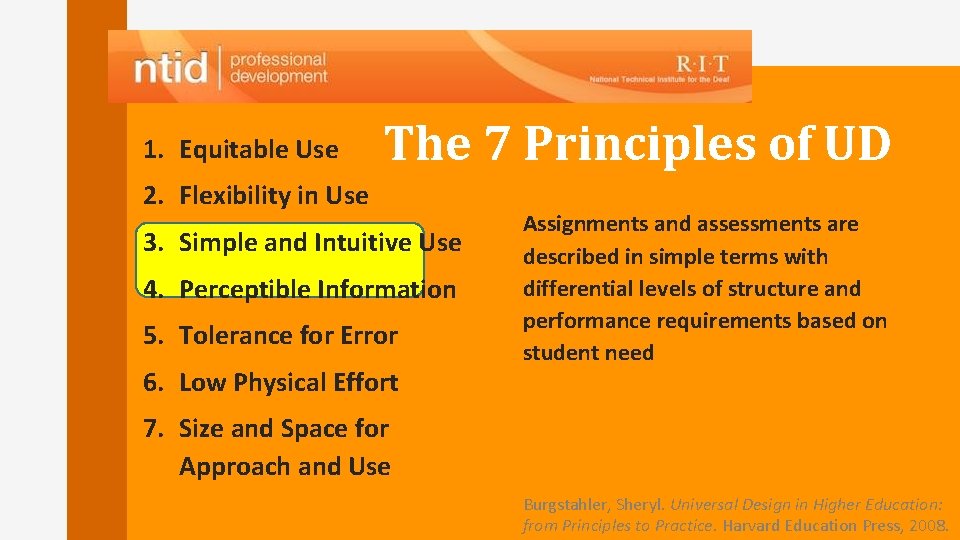
1. Equitable Use The 7 Principles of UD 2. Flexibility in Use 3. Simple and Intuitive Use 4. Perceptible Information 5. Tolerance for Error 6. Low Physical Effort Assignments and assessments are described in simple terms with differential levels of structure and performance requirements based on student need 7. Size and Space for Approach and Use Burgstahler, Sheryl. Universal Design in Higher Education: from Principles to Practice. Harvard Education Press, 2008.
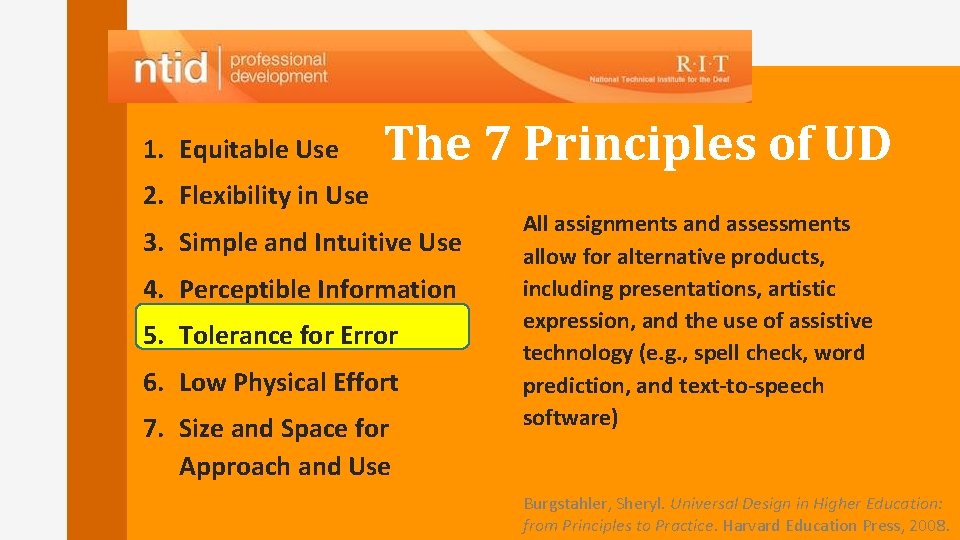
1. Equitable Use The 7 Principles of UD 2. Flexibility in Use 3. Simple and Intuitive Use 4. Perceptible Information 5. Tolerance for Error 6. Low Physical Effort 7. Size and Space for Approach and Use All assignments and assessments allow for alternative products, including presentations, artistic expression, and the use of assistive technology (e. g. , spell check, word prediction, and text-to-speech software) Burgstahler, Sheryl. Universal Design in Higher Education: from Principles to Practice. Harvard Education Press, 2008.
1. Equitable Use The 7 Principles of UD 2. Flexibility in Use 3. Simple and Intuitive Use 4. Perceptible Information 5. Tolerance for Error All assignments and assessments emphasize feedback to improve performance with options for corrective revisions 6. Low Physical Effort 7. Size and Space for Approach and Use Burgstahler, Sheryl. Universal Design in Higher Education: from Principles to Practice. Harvard Education Press, 2008.
1. Equitable Use The 7 Principles of UD 2. Flexibility in Use 3. Simple and Intuitive Use 4. Perceptible Information Assignments and assessments emphasize tasks that require low levels of physical effort 5. Tolerance for Error 6. Low Physical Effort 7. Size and Space for Approach and Use Burgstahler, Sheryl. Universal Design in Higher Education: from Principles to Practice. Harvard Education Press, 2008.
1. Equitable Use The 7 Principles of UD 2. Flexibility in Use 3. Simple and Intuitive Use 4. Perceptible Information 5. Tolerance for Error 6. Low Physical Effort All assignments and assessments take into account the accessibility of resources, including library, technology, meeting areas, online interactions, and so on 7. Size and Space for Approach and Use Burgstahler, Sheryl. Universal Design in Higher Education: from Principles to Practice. Harvard Education Press, 2008.
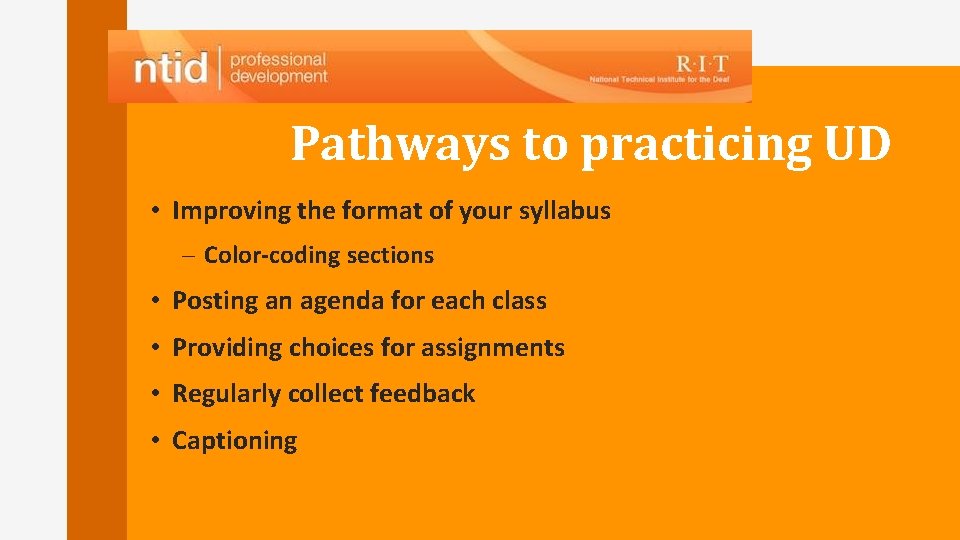
Pathways to practicing UD • Improving the format of your syllabus – Color-coding sections • Posting an agenda for each class • Providing choices for assignments • Regularly collect feedback • Captioning
Your ideas for UD in your classroom • Dividing responsibilities for assignments or lab activities • Provide different ways to collect feedback for student understanding (in class, write a note, come to office hours, etc. ) • Providing resources in different formats (films, articles, books, social media, etc. ) • Posting materials before class • Deaftec. org – check it out for other UDI (Universal Design for Instruction) ideas
Your ideas for UD in your classroom • Making materials visually accessible (font, colors (contrast), size, pictures) • Reading level and words on slides • Design well from the start, proactively • Vary activities, hand-on and short lectures, turn-taking for short attention spans • Image description
Your ideas for UD in your classroom • Include a study guide in PP presentations on my. Courses • Hyperlink vocab • Provide electronic files so students can translate to other languages o text-to-speech
Questions