
Universal Design For Transition 1072020 1 Dare to



- Slides: 31
Universal Design For Transition 10/7/2020 1
Dare to Dream (Le. Derick R. Horne) We are gathered here today to bear witness, to bear witness to the union of two beautiful people Yes, today is the day we merge who you are with who you want to be, making the vision and the reality – one An integration Born of communication And made tangible By your commitment to yourself. 10/7/2020 2 2
Universal Design for Transition (UDT) Purpose: to bridge the perceived discrepancies between ◦ Preparing students to meet academic standards and their transition outcomes ◦ Universal and Individual instructional goals. 10/7/2020 3
Universal Design for Transition (UDT) Based on ◦ Principles of Universal Design The design of products and environments to be usable by all people, to the greatest extent possible, without the need for adaptation or specialized design. ” (Center for Universal Design, 2007). ◦ Educational Applications Universal Design for Instruction and Universal Design for Learning characterize efforts to create universal access to education for all students including those with cognitive, physical, and emotional disabilities 10/7/2020 4
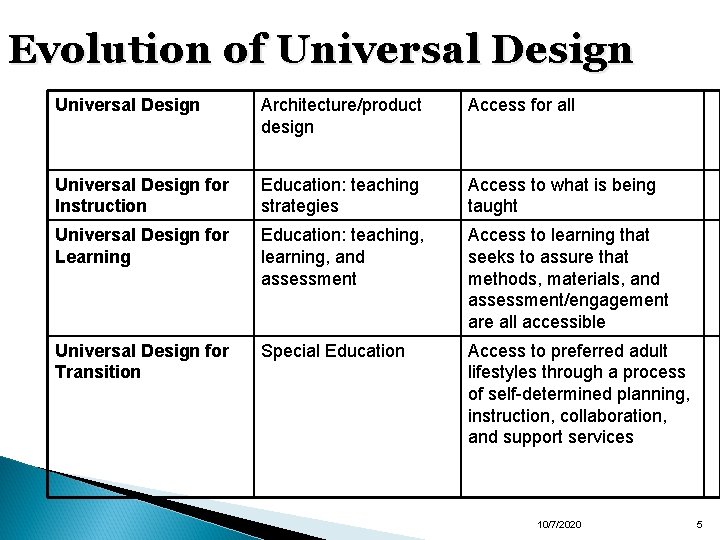
Evolution of Universal Design Architecture/product design Access for all Universal Design for Instruction Education: teaching strategies Access to what is being taught Universal Design for Learning Education: teaching, learning, and assessment Access to learning that seeks to assure that methods, materials, and assessment/engagement are all accessible Universal Design for Transition Special Education Access to preferred adult lifestyles through a process of self-determined planning, instruction, collaboration, and support services 10/7/2020 5
UDL-three characteristics: “Multiple means of representation, to give learners various ways of acquiring information and knowledge, Multiple means of expression, to provide learners alternatives for demonstrating what they know, Multiple means of engagement, to tap into learners' interests, offer appropriate challenges, and increase motivation. ” (Cast, 2007) These principles assure that products, environments, instruction and learning opportunities “are usable by all people, to the greatest extent possible, without the need for adaptation or specialist design” (Center for Universal Design, 1997). 10/7/2020 6
Seven Principles of UDI Equitable Use Flexible Use Simple and Intuitive Use Perceptible Information Tolerance for Error Low Physical Effort Size and Space 10/7/2020 7
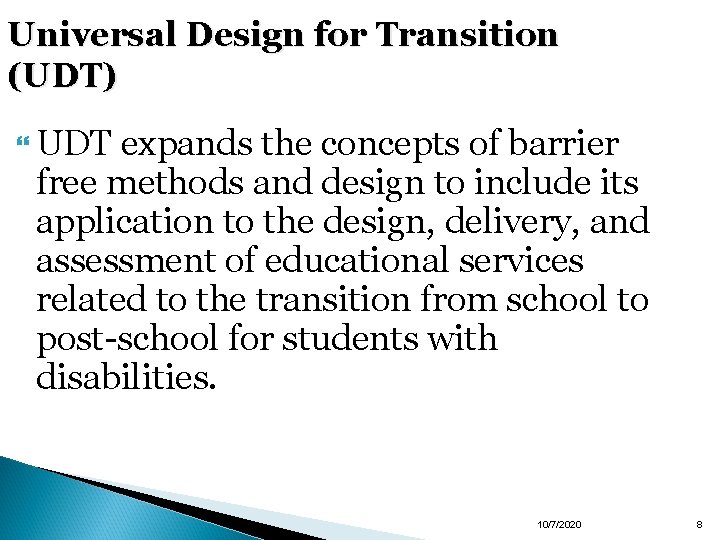
Universal Design for Transition (UDT) UDT expands the concepts of barrier free methods and design to include its application to the design, delivery, and assessment of educational services related to the transition from school to post-school for students with disabilities. 10/7/2020 8
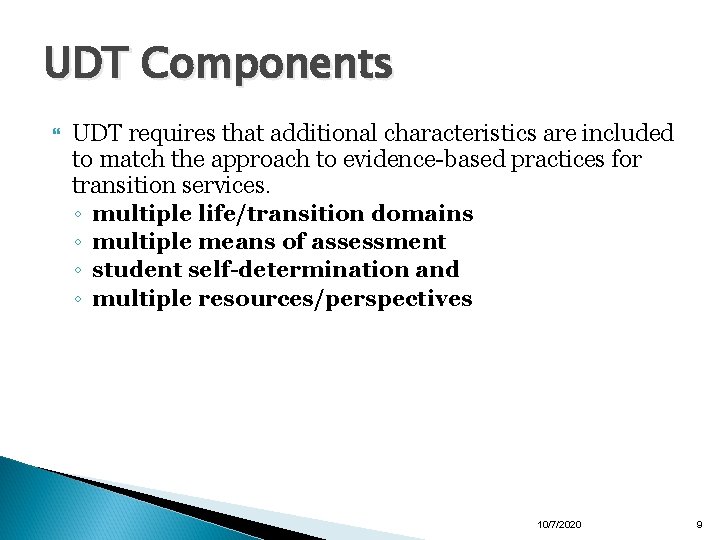
UDT Components UDT requires that additional characteristics are included to match the approach to evidence-based practices for transition services. ◦ multiple life/transition domains ◦ multiple means of assessment ◦ student self-determination and ◦ multiple resources/perspectives 10/7/2020 9
Multiple transition domains 10/7/2020 10
Multiple means of assessment Transition assessment: information gathering designed to determine student preferences and interests for their adult lives and the supports, services, and instruction necessary to help students achieve those life goals. UDT approach to transition assessment: ◦ starts with general education curriculum, identifying authentic, real-world tasks that can be linked to the instruction of those standards ◦ Creates links between academics and transition outcomes through assessment ◦ Characteristics of UDL applied to assessment process 10/7/2020 11
Student self-determination Self-determination is a critical component of quality transition planning ◦ The focus is on a student’s preferences and interests for an adult lifestyle. Focus on self-determination throughout the curriculum-identify links in standards and objectives Provide opportunities through UDT in the classroom-creates links in transition process 10/7/2020 12
Multiple resources/perspectives Universal design for transition ◦ Multiple perspectives beyond school and immediate student family must be included in the planning process (who has the information necessary for the team to make decisions) Person-centered planning and Student-directed planning procedures to invite participation of nonschool personnel in the educational planning process helps the planning team think "outside the box" Links to curriculum and others involved in academic planning can create additional supports in transition process 10/7/2020 13
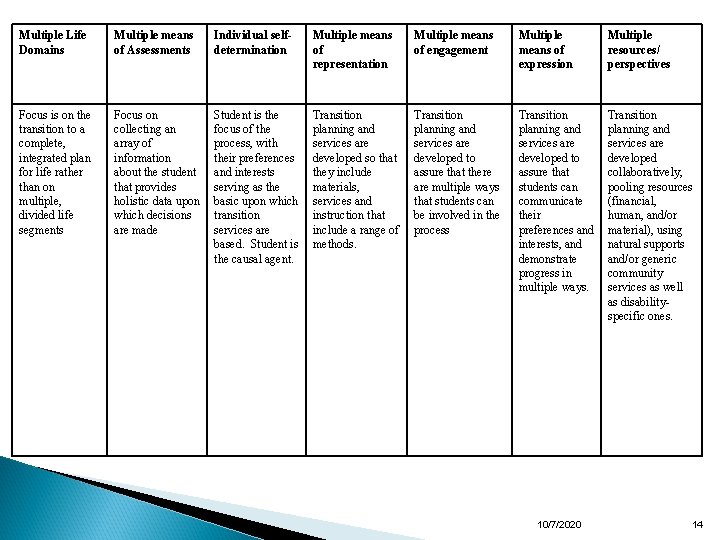
Multiple Life Domains Multiple means of Assessments Individual selfdetermination Multiple means of representation Multiple means of engagement Multiple means of expression Multiple resources/ perspectives Focus is on the transition to a complete, integrated plan for life rather than on multiple, divided life segments Focus on collecting an array of information about the student that provides holistic data upon which decisions are made Student is the focus of the process, with their preferences and interests serving as the basic upon which transition services are based. Student is the causal agent. Transition planning and services are developed so that they include materials, services and instruction that include a range of methods. Transition planning and services are developed to assure that there are multiple ways that students can be involved in the process Transition planning and services are developed to assure that students can communicate their preferences and interests, and demonstrate progress in multiple ways. Transition planning and services are developed collaboratively, pooling resources (financial, human, and/or material), using natural supports and/or generic community services as well as disabilityspecific ones. 10/7/2020 14
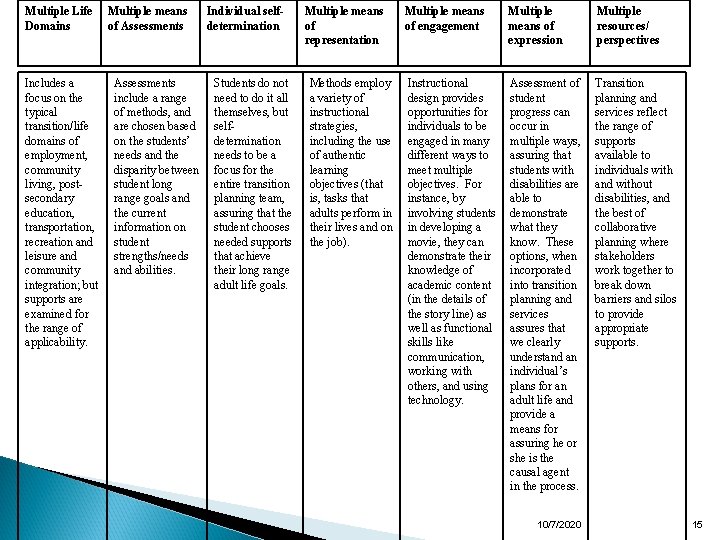
Multiple Life Domains Includes a focus on the typical transition/life domains of employment, community living, postsecondary education, transportation, recreation and leisure and community integration; but supports are examined for the range of applicability. Multiple means of Assessments include a range of methods, and are chosen based on the students’ needs and the disparity between student long range goals and the current information on student strengths/needs and abilities. Individual selfdetermination Students do not need to do it all themselves, but selfdetermination needs to be a focus for the entire transition planning team, assuring that the student chooses needed supports that achieve their long range adult life goals. Multiple means of representation Methods employ a variety of instructional strategies, including the use of authentic learning objectives (that is, tasks that adults perform in their lives and on the job). Multiple means of engagement Multiple means of expression Multiple resources/ perspectives Instructional design provides opportunities for individuals to be engaged in many different ways to meet multiple objectives. For instance, by involving students in developing a movie, they can demonstrate their knowledge of academic content (in the details of the story line) as well as functional skills like communication, working with others, and using technology. Assessment of student progress can occur in multiple ways, assuring that students with disabilities are able to demonstrate what they know. These options, when incorporated into transition planning and services assures that we clearly understand an individual’s plans for an adult life and provide a means for assuring he or she is the causal agent in the process. Transition planning and services reflect the range of supports available to individuals with and without disabilities, and the best of collaborative planning where stakeholders work together to break down barriers and silos to provide appropriate supports. 10/7/2020 15
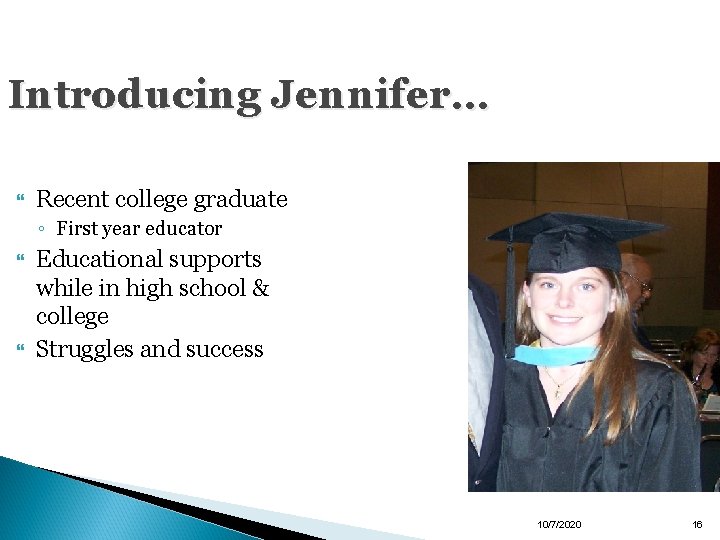
Introducing Jennifer… Recent college graduate ◦ First year educator Educational supports while in high school & college Struggles and success 10/7/2020 16
High School Focus similar to that of peers… ◦ Post-secondary education dreams ◦ Post-secondary education plans (SATs) Focus dissimilar to that of peers… ◦ Disclose disability to others? Who? When? How? ◦ Accommodations & modifications (notetakers/access to information) ◦ College disability services 10/7/2020 17
High School Advocates… Mother Guidance counselor High school Case Manager 10/7/2020 18
College Transition Hidden disability ◦ perception of friends (social) Getting started (coordinating services, meetings, forms, procedures) Assistive technology ◦ Learned about supports in high school / this aided in college 10/7/2020 19
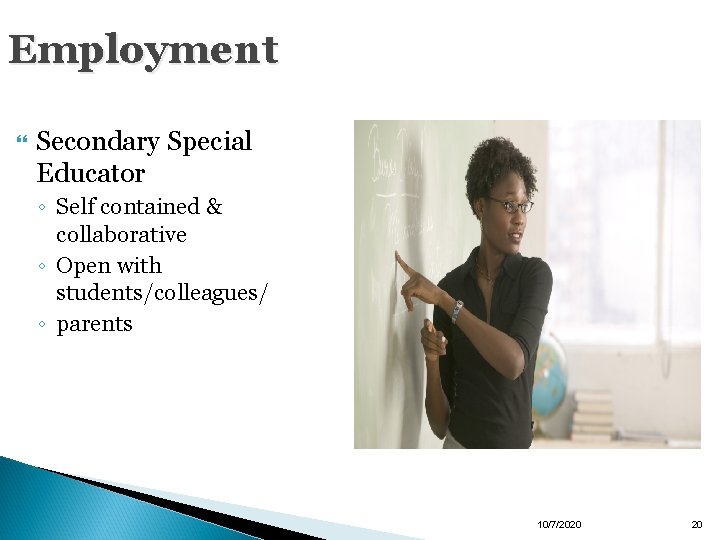
Employment Secondary Special Educator ◦ Self contained & collaborative ◦ Open with students/colleagues/ ◦ parents 10/7/2020 20
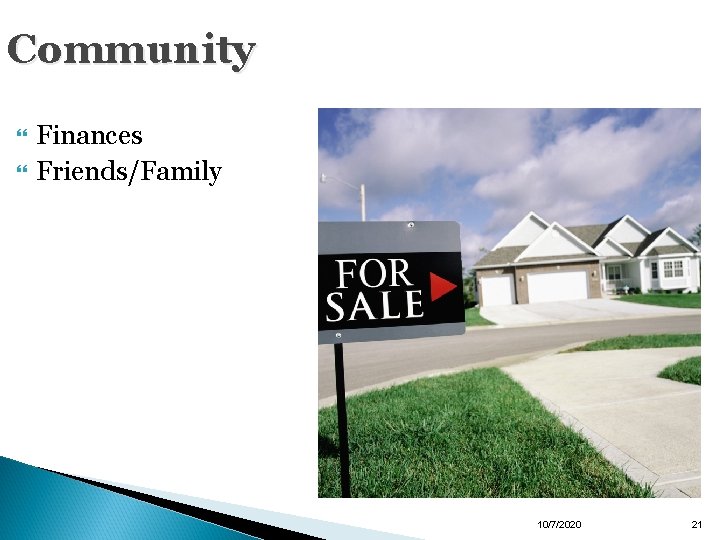
Community Finances Friends/Family 10/7/2020 21
Transition IEPs and Multiple transition domains Assure that students have thought about all areas of their lives, and how they impact each other Find ways to collect assessment data in many of these transition domain areas Be sure that you are addressing student preferences and use that as a starting point! Link the transition areas to academic requirements and other aspects of participating in the school environment. 10/7/2020 22
Transition IEPs and Student self-determination Prepare the student for participation in the meeting ◦ Organizing the meeting (inviting others, choosing day/time) ◦ Practice introducing others, and other steps of the process ◦ Work with peers to organize graphic organizers Use person-centered planning, student-led or directed IEP processes for the meeting itself Involve student in the implementation process Use the SDLMI to help the student prepare and share information in the meeting. 10/7/2020 23
Transition IEPs and Multiple assessments Use good decisions for choosing assessments that collect the information you need Find ways to change the assessment so that it can be used with a variety of students who have a variety of needs. Make sure that you summarize information you have from being with students throughout the day. Assessments are happening all the time…recognize and document them! Have student organize assessment/work to share with others at meeting 10/7/2020 24
Transition IEP and Multiple representation Complete the necessary paperwork, but also consider: ◦ Videotaped examples of work performance ◦ Use large paper to record meeting discussion/information using pictures, words, colors, etc. to illustrate and express thoughts and feelings ◦ Students can express ideas and feeling during or prior to meeting through pictures, collages, video/multimedia, scrapbooks, or other digital tools 10/7/2020 25
Transition IEP and Multiple Means of Engagement Real participation: ◦ Participation according to comfort level of student ◦ Powerpoint presentation can be read by student or other student, or use animated/recorded voice. ◦ Inviting individuals to the meeting (phone calls, emails, paper invitations, contacting outside agencies, e-vites). 10/7/2020 26
Transition IEP and multiple means of expression For students to communicate preferences, needs, feelings during the meeting, you or the student may need…. ◦ To pre-record or preprogram augmentative communication systems to include all possible options needed for the meeting ◦ Student can collaborate with teacher on the powerpoint presentation for meeting 10/7/2020 27
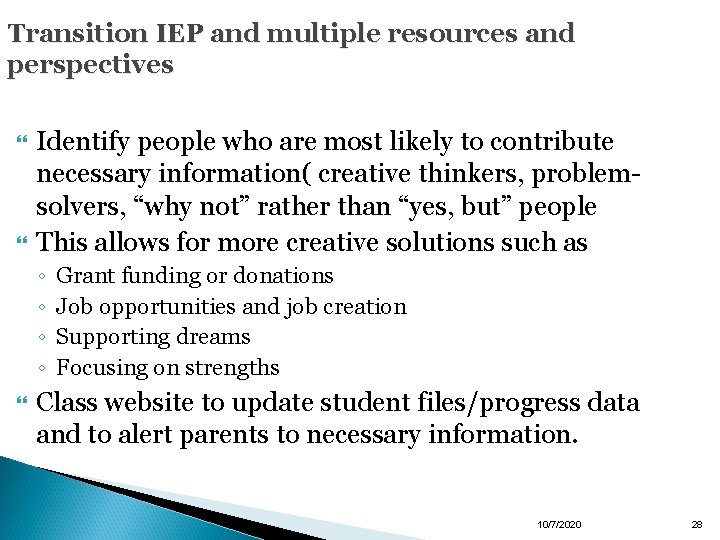
Transition IEP and multiple resources and perspectives Identify people who are most likely to contribute necessary information( creative thinkers, problemsolvers, “why not” rather than “yes, but” people This allows for more creative solutions such as ◦ ◦ Grant funding or donations Job opportunities and job creation Supporting dreams Focusing on strengths Class website to update student files/progress data and to alert parents to necessary information. 10/7/2020 28
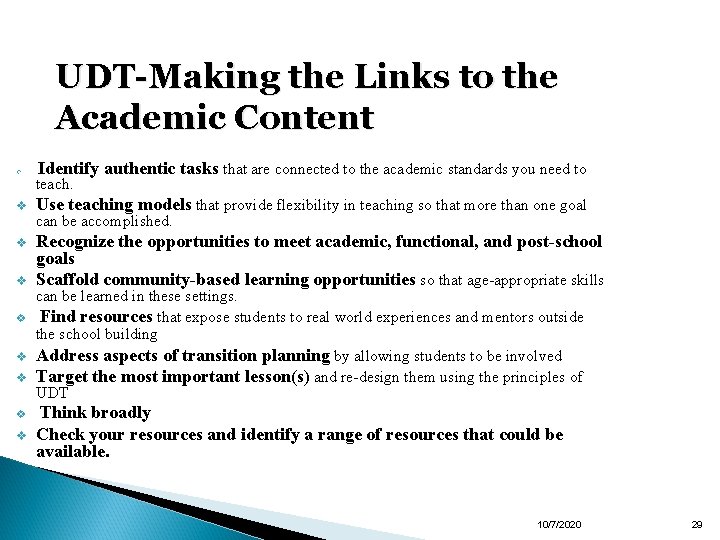
UDT-Making the Links to the Academic Content v Identify authentic tasks that are connected to the academic standards you need to teach. v Use teaching models that provide flexibility in teaching so that more than one goal v Recognize the opportunities to meet academic, functional, and post-school goals Scaffold community-based learning opportunities so that age-appropriate skills v v v can be accomplished. can be learned in these settings. Find resources that expose students to real world experiences and mentors outside the school building Address aspects of transition planning by allowing students to be involved Target the most important lesson(s) and re-design them using the principles of UDT Think broadly Check your resources and identify a range of resources that could be available. 10/7/2020 29
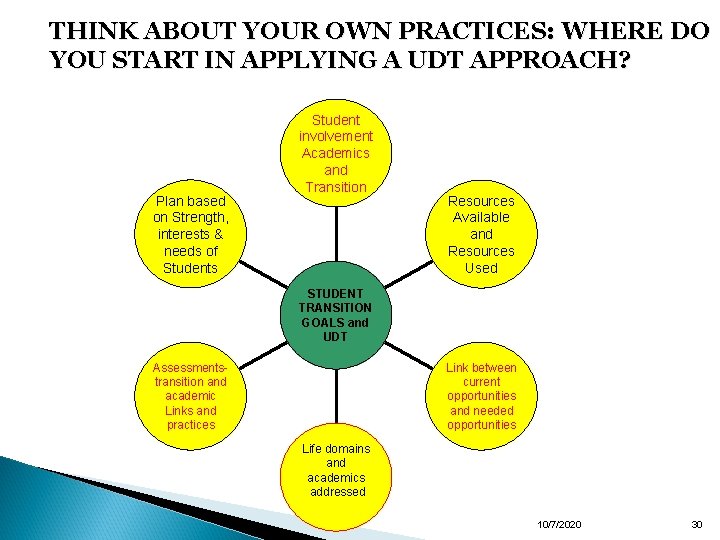
THINK ABOUT YOUR OWN PRACTICES: WHERE DO YOU START IN APPLYING A UDT APPROACH? Plan based on Strength, interests & needs of Students Student involvement Academics and Transition Resources Available and Resources Used STUDENT TRANSITION GOALS and UDT Assessmentstransition and academic Links and practices Link between current opportunities and needed opportunities Life domains and academics addressed 10/7/2020 30
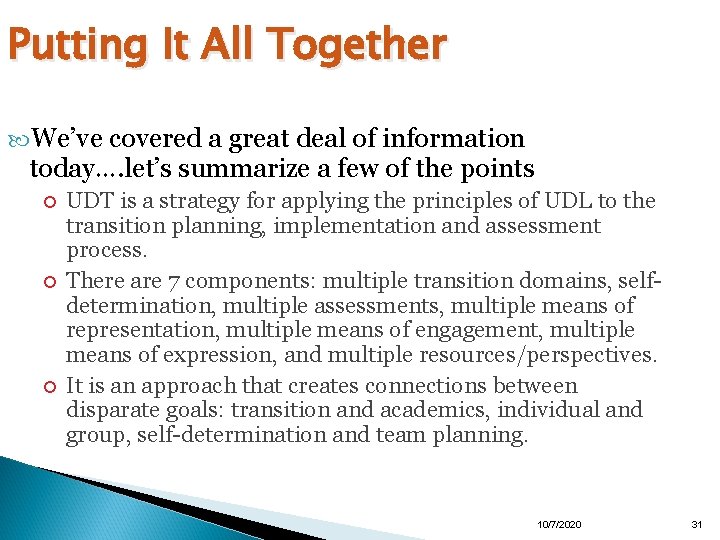
Putting It All Together We’ve covered a great deal of information today…. let’s summarize a few of the points UDT is a strategy for applying the principles of UDL to the transition planning, implementation and assessment process. There are 7 components: multiple transition domains, selfdetermination, multiple assessments, multiple means of representation, multiple means of engagement, multiple means of expression, and multiple resources/perspectives. It is an approach that creates connections between disparate goals: transition and academics, individual and group, self-determination and team planning. 10/7/2020 31