
UNIVERSAL DESIGN FOR LEARNING Nicole Ofiesh Ph D

- Slides: 24
UNIVERSAL DESIGN FOR LEARNING Nicole Ofiesh, Ph. D. Stanford University February 22, 2019 UDL Webinar Johns Hopkins University
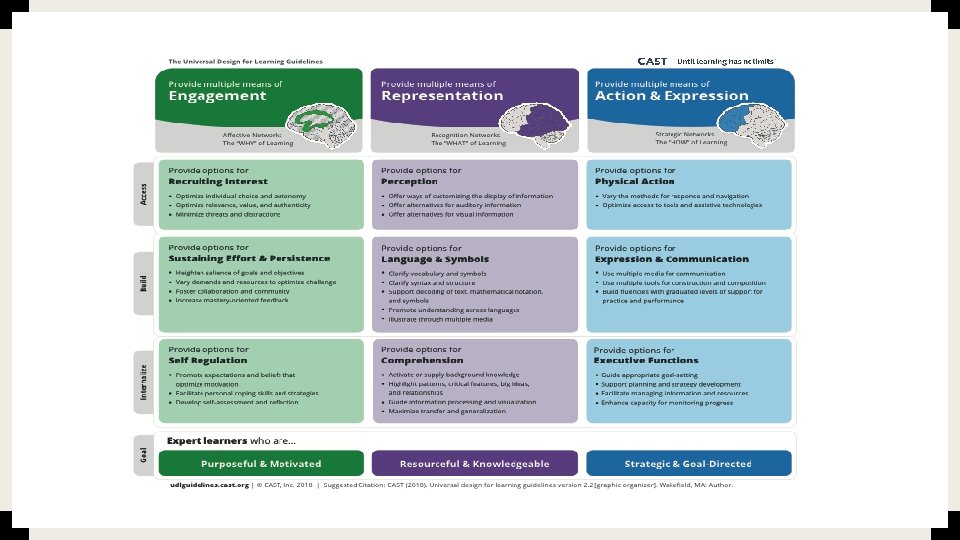
Definition of UDL Universal Design for Learning (UDL) is a framework that integrates what we know about the learning brain to inform the design of environments that support all learners and emphasize expert learning. q Inspired by advances in cognitive neuroscience q Optimizes teaching and learning q Removes barriers to expert learning
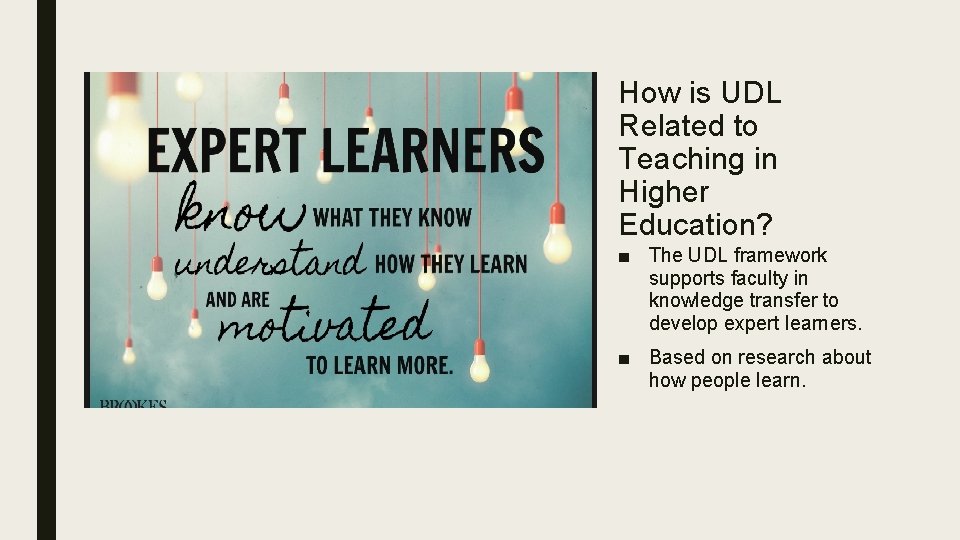
How is UDL Related to Teaching in Higher Education? ■ The UDL framework supports faculty in knowledge transfer to develop expert learners. ■ Based on research about how people learn.
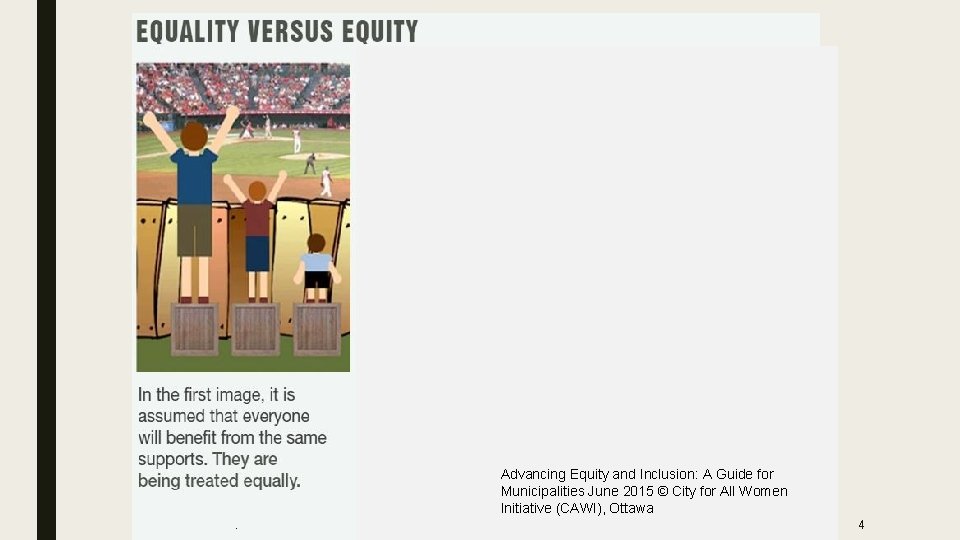
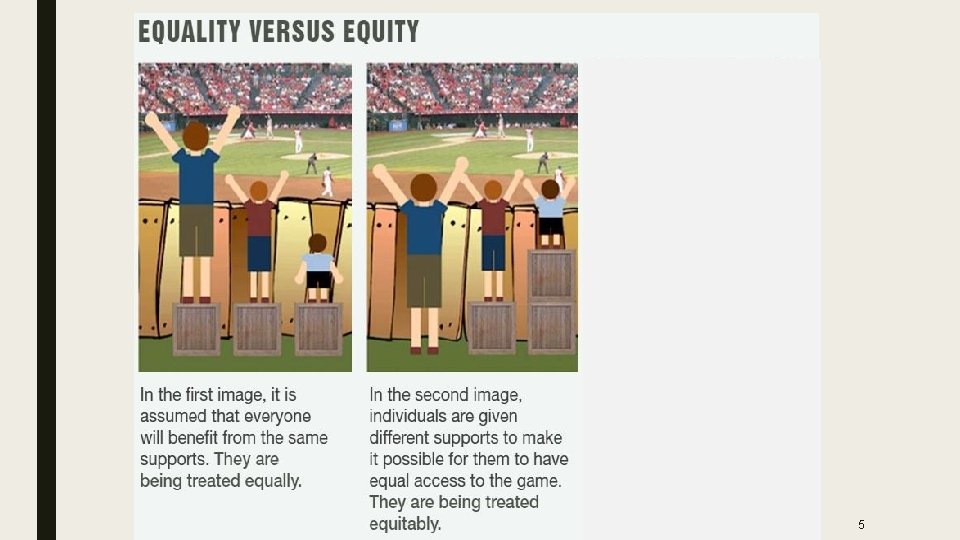
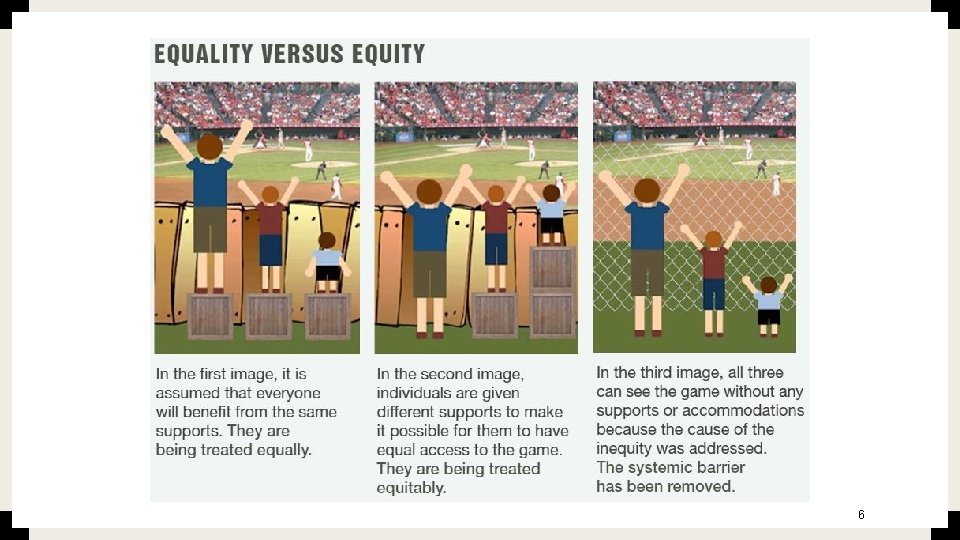
Advancing Equity and Inclusion: A Guide for Municipalities June 2015 © City for All Women Initiative (CAWI), Ottawa. 4
5
6
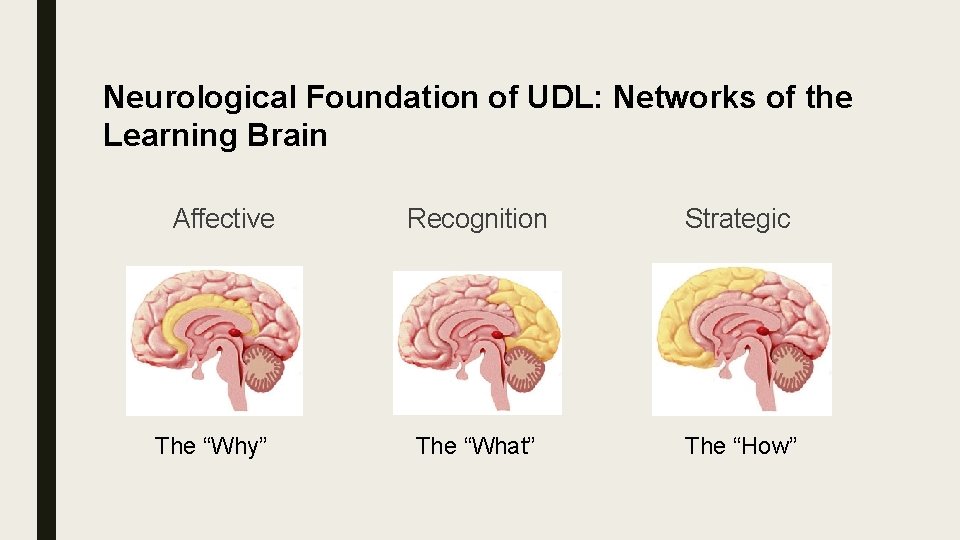
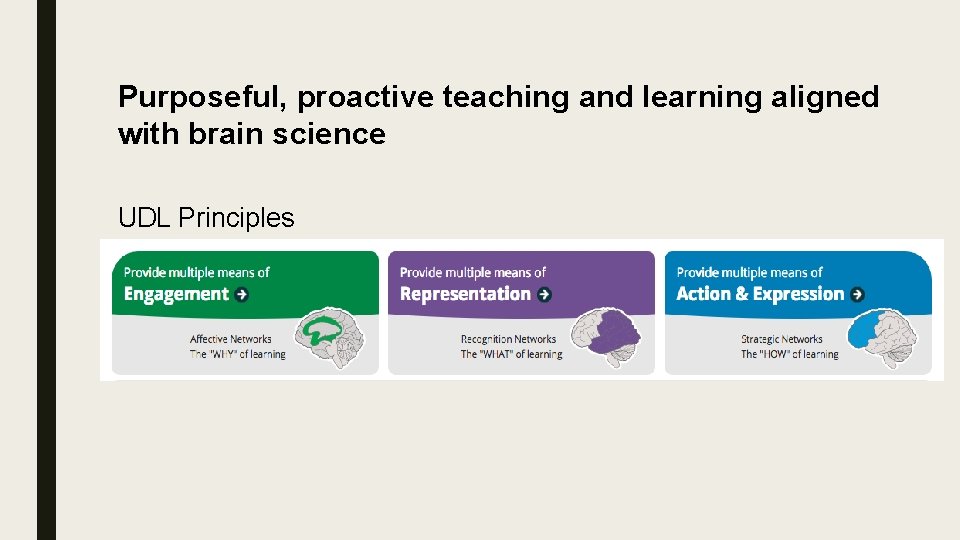
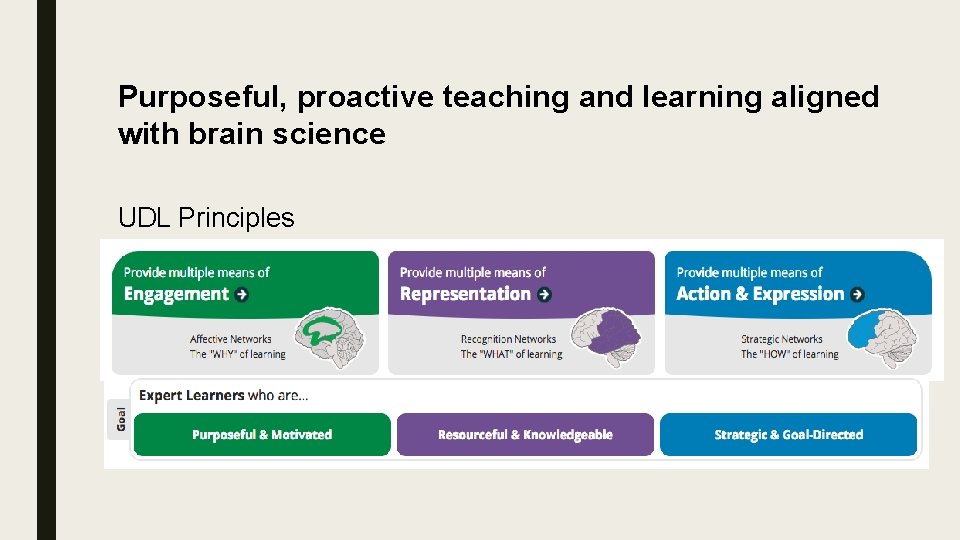
Neurological Foundation of UDL: Networks of the Learning Brain Affective The “Why” Recognition Strategic The “What” The “How”
How People Learn II ■ National Academies of Sciences, Engineering, and Medicine 2018. How People Learn II: Learners, Contexts, and Cultures. Washington, DC: The National Academies Press. ■ https: //doi. org/10. 17226/24783
Purposeful, proactive teaching and learning aligned with brain science UDL Principles
Purposeful, proactive teaching and learning aligned with brain science UDL Principles
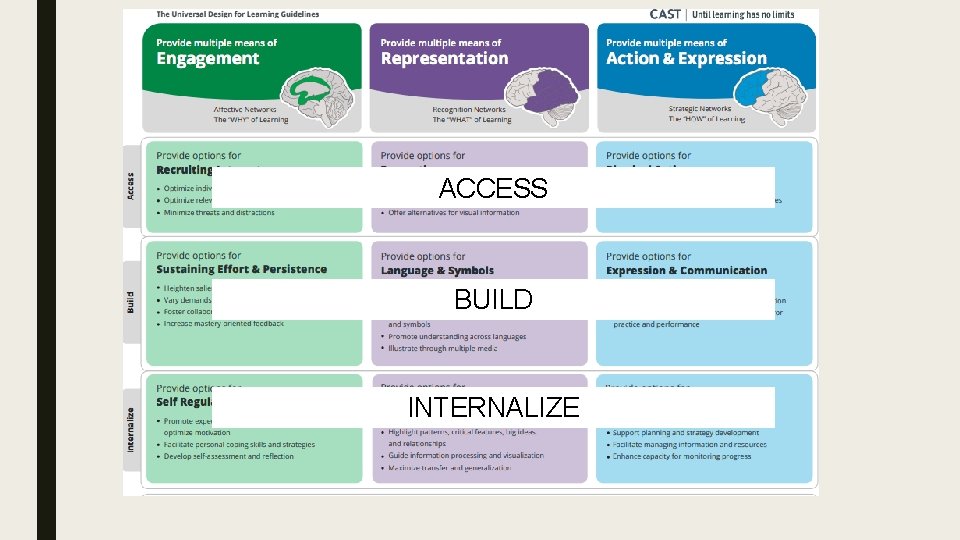
ACCESS BUILD INTERNALIZE
Why is This Important Now? Citation: National Research Council. (2012). Education for Life and Work: Developing Transferable Knowledge and Skills in the 21 st Century. Committee on Defining Deeper Learning and 21 st Century Skills, J. W. Pellegrino, and M. L. Hilton, Editors. Board on Testing and Assessment and Board on Science Education, Division of Behavioral and Social Sciences and Education. Washington, DC: The National Academies Press. 1. Educational and business leaders are increasingly interested in promoting deeper learning and 21 st century skills. “Deeper learning” has been defined as the process through which an individual becomes capable of taking what was learned in one situation and applying it to new situations (i. e. transfer). The product is transferable knowledge. While other types of learning may allow an individual to recall facts, concepts, or procedures, deeper learning allows transfer of what was learned to solve new problems.
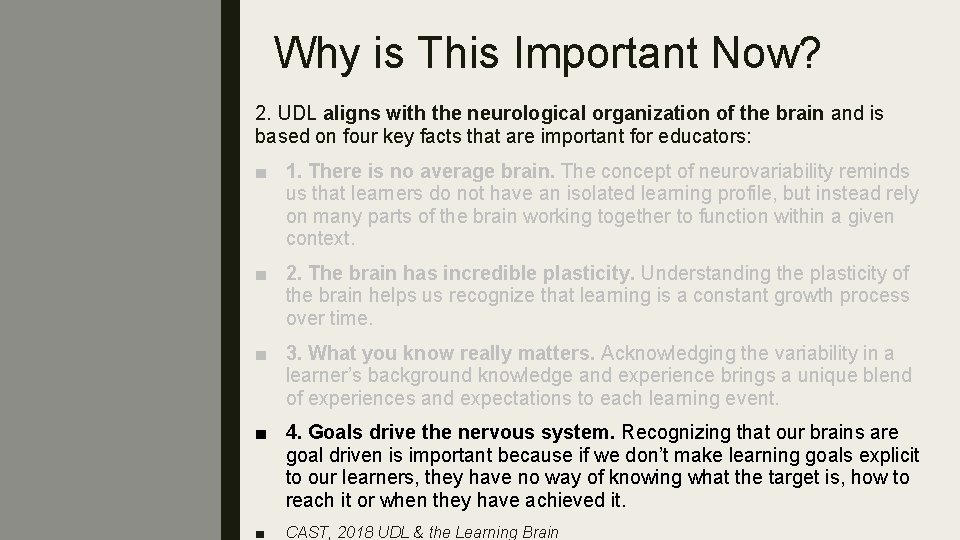
Why is This Important Now? 2. UDL aligns with the neurological organization of the brain and is based on four key facts that are important for educators: ■ 1. There is no average brain. The concept of neurovariability reminds us that learners do not have an isolated learning profile, but instead rely on many parts of the brain working together to function within a given context. ■ 2. The brain has incredible plasticity. Understanding the plasticity of the brain helps us recognize that learning is a constant growth process over time. ■ 3. What you know really matters. Acknowledging the variability in a learner’s background knowledge and experience brings a unique blend of experiences and expectations to each learning event. ■ 4. Goals drive the nervous system. Recognizing that our brains are goal driven is important because if we don’t make learning goals explicit to our learners, they have no way of knowing what the target is, how to reach it or when they have achieved it. ■ CAST, 2018 UDL & the Learning Brain
Why is This Important Now? 2. UDL aligns with the neurological organization of the brain and is based on four key facts that are important for educators: ■ 1. There is no average brain. The concept of neurovariability reminds us that learners do not have an isolated learning profile, but instead rely on many parts of the brain working together to function within a given context. ■ 2. The brain has incredible plasticity. Understanding the plasticity of the brain helps us recognize that learning is a constant growth process over time. ■ 3. What you know really matters. Acknowledging the variability in a learner’s background knowledge and experience brings a unique blend of experiences and expectations to each learning event. ■ 4. Goals drive the nervous system. Recognizing that our brains are goal driven is important because if we don’t make learning goals explicit to our learners, they have no way of knowing what the target is, how to reach it or when they have achieved it. ■ CAST, 2018 UDL & the Learning Brain
Why is This Important Now? 2. UDL aligns with the neurological organization of the brain and is based on four key facts that are important for educators: ■ 1. There is no average brain. The concept of neurovariability reminds us that learners do not have an isolated learning profile, but instead rely on many parts of the brain working together to function within a given context. ■ 2. The brain has incredible plasticity. Understanding the plasticity of the brain helps us recognize that learning is a constant growth process over time. ■ 3. What you know really matters. Acknowledging the variability in a learner’s background knowledge and experience brings a unique blend of experiences and expectations to each learning event. ■ 4. Goals drive the nervous system. Recognizing that our brains are goal driven is important because if we don’t make learning goals explicit to our learners, they have no way of knowing what the target is, how to reach it or when they have achieved it. ■ CAST, 2018 UDL & the Learning Brain
Why is This Important Now? 2. UDL aligns with the neurological organization of the brain and is based on four key facts that are important for educators: ■ 1. There is no average brain. The concept of neurovariability reminds us that learners do not have an isolated learning profile, but instead rely on many parts of the brain working together to function within a given context. ■ 2. The brain has incredible plasticity. Understanding the plasticity of the brain helps us recognize that learning is a constant growth process over time. ■ 3. What you know really matters. Acknowledging the variability in a learner’s background knowledge and experience brings a unique blend of experiences and expectations to each learning event. ■ 4. Goals drive the nervous system. Recognizing that our brains are goal driven is important because if we don’t make learning goals explicit to our learners, they have no way of knowing what the target is, how to reach it or when they have achieved it. ■ CAST, 2018 UDL & the Learning Brain
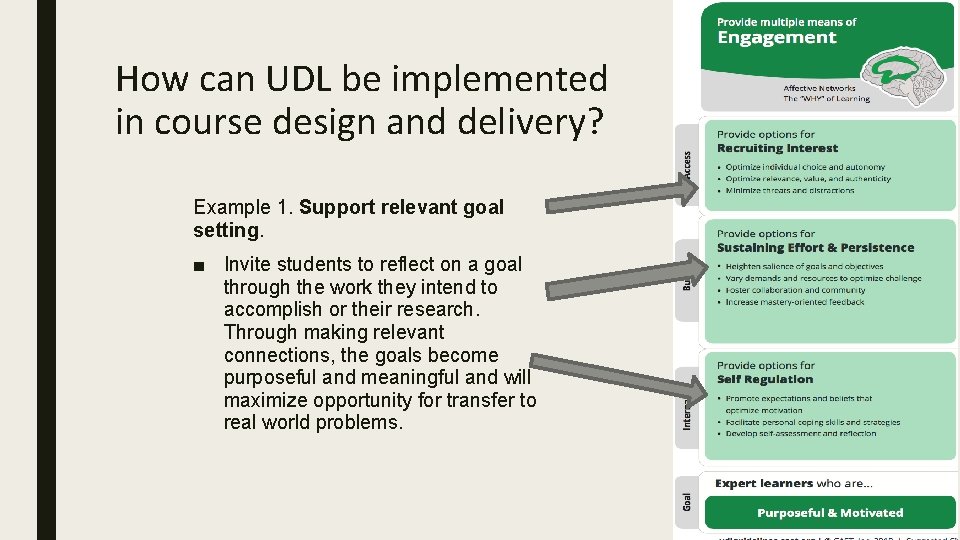
How can UDL be implemented in course design and delivery? Example 1. Support relevant goal setting. ■ Invite students to reflect on a goal through the work they intend to accomplish or their research. Through making relevant connections, the goals become purposeful and meaningful and will maximize opportunity for transfer to real world problems.
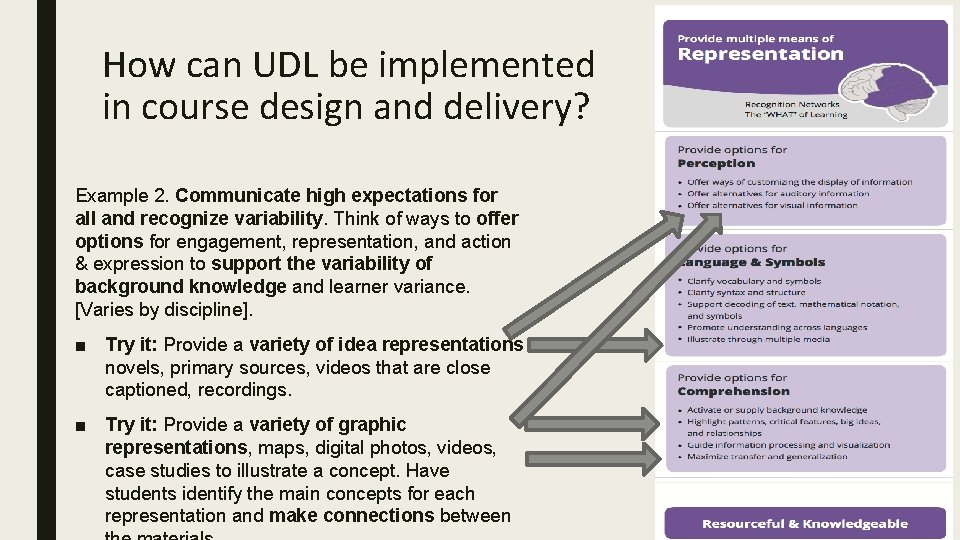
How can UDL be implemented in course design and delivery? Example 2. Communicate high expectations for all and recognize variability. Think of ways to offer options for engagement, representation, and action & expression to support the variability of background knowledge and learner variance. [Varies by discipline]. ■ Try it: Provide a variety of idea representations novels, primary sources, videos that are close captioned, recordings. ■ Try it: Provide a variety of graphic representations, maps, digital photos, videos, case studies to illustrate a concept. Have students identify the main concepts for each representation and make connections between
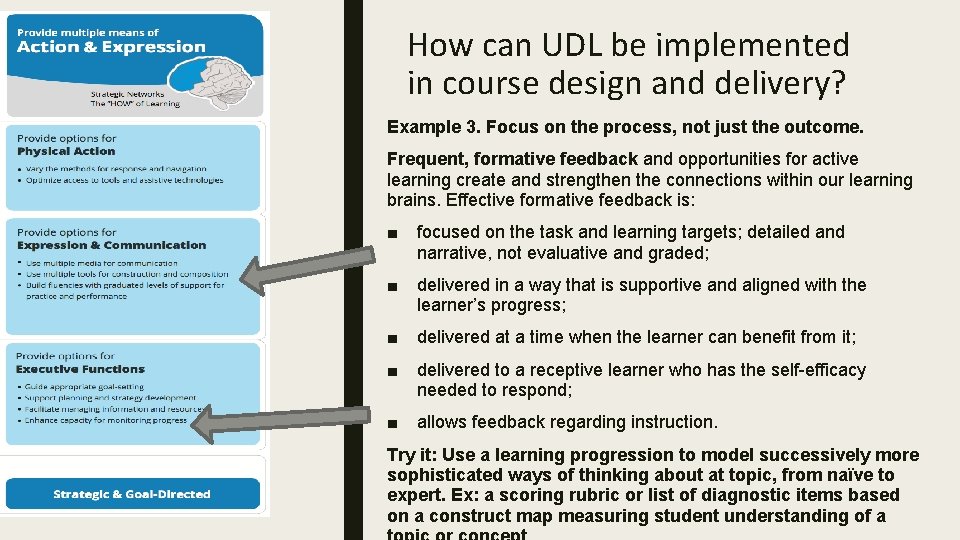
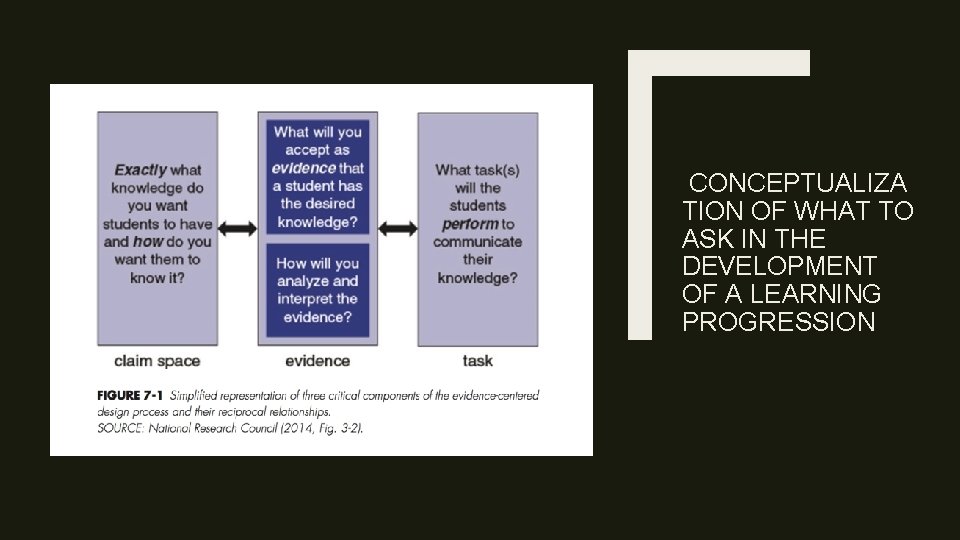
How can UDL be implemented in course design and delivery? Example 3. Focus on the process, not just the outcome. Frequent, formative feedback and opportunities for active learning create and strengthen the connections within our learning brains. Effective formative feedback is: ■ focused on the task and learning targets; detailed and narrative, not evaluative and graded; ■ delivered in a way that is supportive and aligned with the learner’s progress; ■ delivered at a time when the learner can benefit from it; ■ delivered to a receptive learner who has the self-efficacy needed to respond; ■ allows feedback regarding instruction. Try it: Use a learning progression to model successively more sophisticated ways of thinking about at topic, from naïve to expert. Ex: a scoring rubric or list of diagnostic items based on a construct map measuring student understanding of a
CONCEPTUALIZA TION OF WHAT TO ASK IN THE DEVELOPMENT OF A LEARNING PROGRESSION
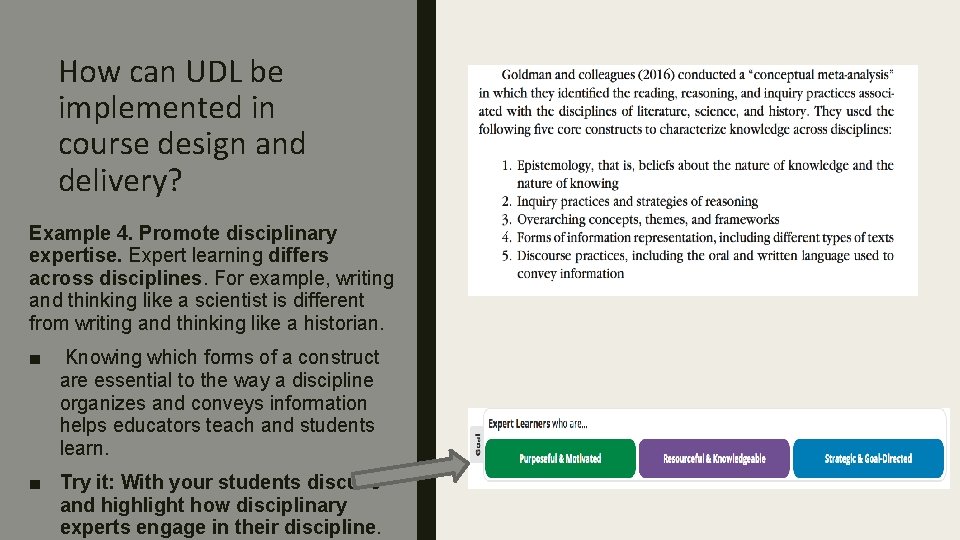
How can UDL be implemented in course design and delivery? Example 4. Promote disciplinary expertise. Expert learning differs across disciplines. For example, writing and thinking like a scientist is different from writing and thinking like a historian. ■ Knowing which forms of a construct are essential to the way a discipline organizes and conveys information helps educators teach and students learn. ■ Try it: With your students discuss and highlight how disciplinary experts engage in their discipline.
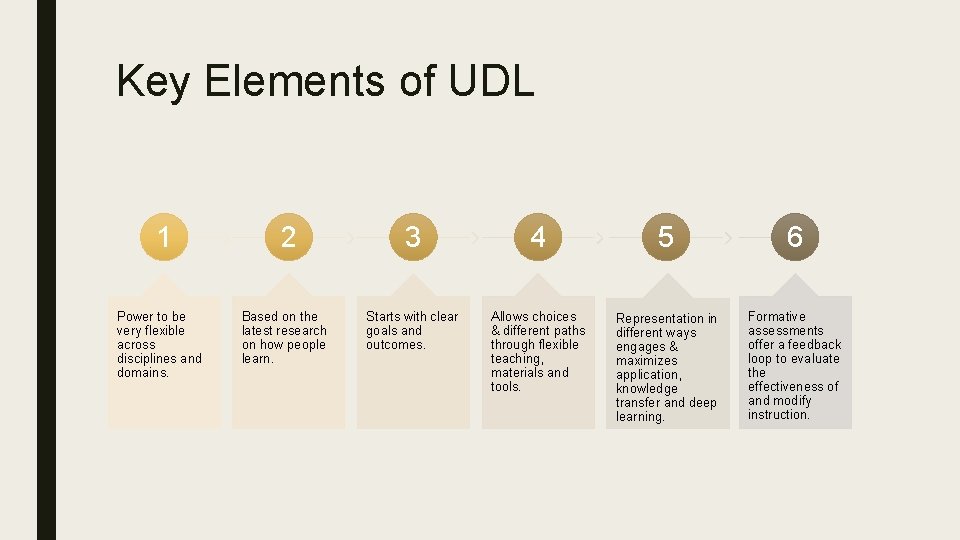
Key Elements of UDL 1 Power to be very flexible across disciplines and domains. 2 Based on the latest research on how people learn. 3 4 5 6 Starts with clear goals and outcomes. Allows choices & different paths through flexible teaching, materials and tools. Representation in different ways engages & maximizes application, knowledge transfer and deep learning. Formative assessments offer a feedback loop to evaluate the effectiveness of and modify instruction.
THANK YOU!