
Universal Design for Learning and Music Education How
- Slides: 1
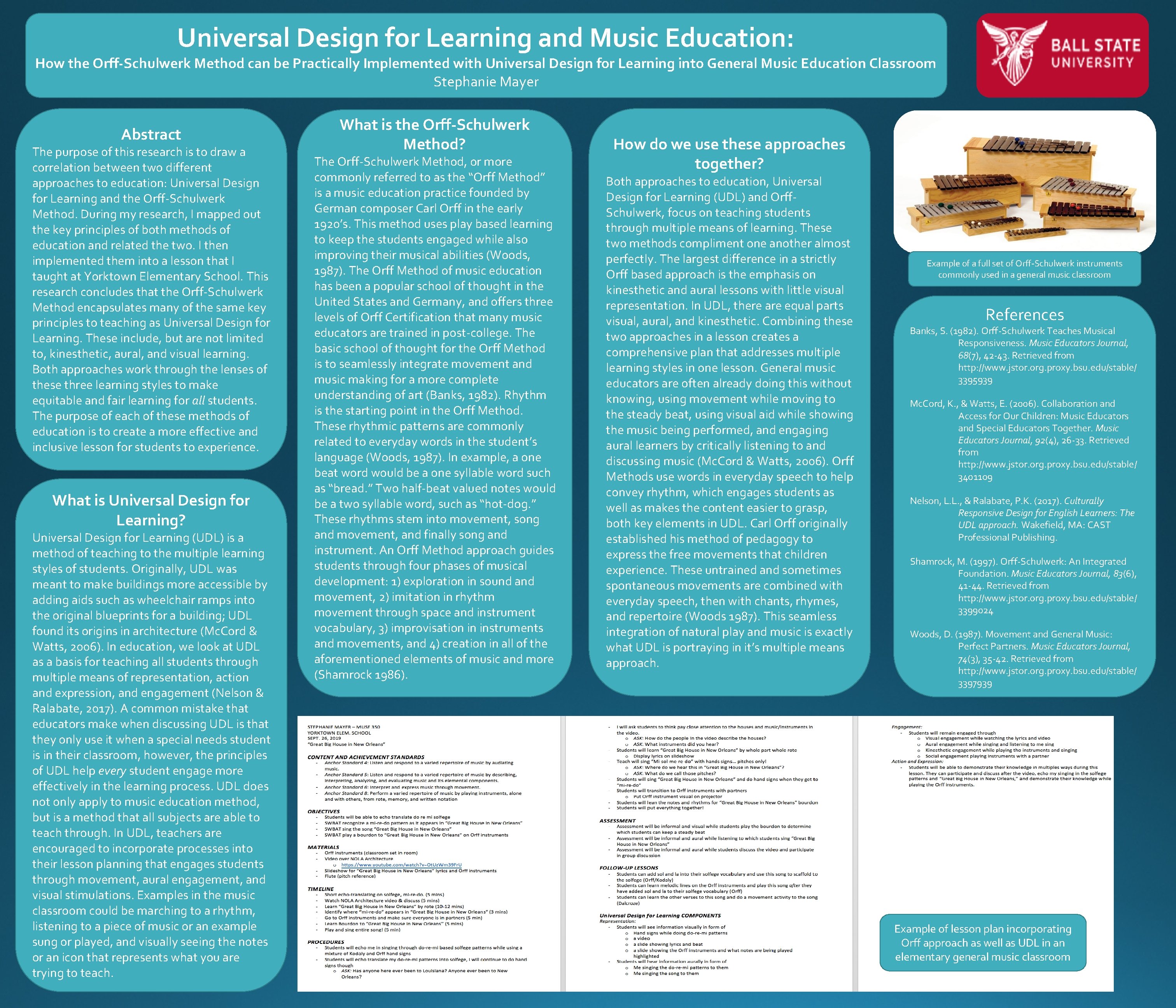
Universal Design for Learning and Music Education: How the Orff-Schulwerk Method can be Practically Implemented with Universal Design for Learning into General Music Education Classroom Stephanie Mayer Abstract The purpose of this research is to draw a correlation between two different approaches to education: Universal Design for Learning and the Orff-Schulwerk Method. During my research, I mapped out the key principles of both methods of education and related the two. I then implemented them into a lesson that I taught at Yorktown Elementary School. This research concludes that the Orff-Schulwerk Method encapsulates many of the same key principles to teaching as Universal Design for Learning. These include, but are not limited to, kinesthetic, aural, and visual learning. Both approaches work through the lenses of these three learning styles to make equitable and fair learning for all students. The purpose of each of these methods of education is to create a more effective and inclusive lesson for students to experience. What is Universal Design for Learning? Universal Design for Learning (UDL) is a method of teaching to the multiple learning styles of students. Originally, UDL was meant to make buildings more accessible by adding aids such as wheelchair ramps into the original blueprints for a building; UDL found its origins in architecture (Mc. Cord & Watts, 2006). In education, we look at UDL as a basis for teaching all students through multiple means of representation, action and expression, and engagement (Nelson & Ralabate, 2017). A common mistake that educators make when discussing UDL is that they only use it when a special needs student is in their classroom, however, the principles of UDL help every student engage more effectively in the learning process. UDL does not only apply to music education method, but is a method that all subjects are able to teach through. In UDL, teachers are encouraged to incorporate processes into their lesson planning that engages students through movement, aural engagement, and visual stimulations. Examples in the music classroom could be marching to a rhythm, listening to a piece of music or an example sung or played, and visually seeing the notes or an icon that represents what you are trying to teach. What is the Orff-Schulwerk Method? The Orff-Schulwerk Method, or more commonly referred to as the “Orff Method” is a music education practice founded by German composer Carl Orff in the early 1920’s. This method uses play based learning to keep the students engaged while also improving their musical abilities (Woods, 1987). The Orff Method of music education has been a popular school of thought in the United States and Germany, and offers three levels of Orff Certification that many music educators are trained in post-college. The basic school of thought for the Orff Method is to seamlessly integrate movement and music making for a more complete understanding of art (Banks, 1982). Rhythm is the starting point in the Orff Method. These rhythmic patterns are commonly related to everyday words in the student’s language (Woods, 1987). In example, a one beat word would be a one syllable word such as “bread. ” Two half-beat valued notes would be a two syllable word, such as “hot-dog. ” These rhythms stem into movement, song and movement, and finally song and instrument. An Orff Method approach guides students through four phases of musical development: 1) exploration in sound and movement, 2) imitation in rhythm movement through space and instrument vocabulary, 3) improvisation in instruments and movements, and 4) creation in all of the aforementioned elements of music and more (Shamrock 1986). How do we use these approaches together? Both approaches to education, Universal Design for Learning (UDL) and Orff. Schulwerk, focus on teaching students through multiple means of learning. These two methods compliment one another almost perfectly. The largest difference in a strictly Orff based approach is the emphasis on kinesthetic and aural lessons with little visual representation. In UDL, there are equal parts visual, aural, and kinesthetic. Combining these two approaches in a lesson creates a comprehensive plan that addresses multiple learning styles in one lesson. General music educators are often already doing this without knowing, using movement while moving to the steady beat, using visual aid while showing the music being performed, and engaging aural learners by critically listening to and discussing music (Mc. Cord & Watts, 2006). Orff Methods use words in everyday speech to help convey rhythm, which engages students as well as makes the content easier to grasp, both key elements in UDL. Carl Orff originally established his method of pedagogy to express the free movements that children experience. These untrained and sometimes spontaneous movements are combined with everyday speech, then with chants, rhymes, and repertoire (Woods 1987). This seamless integration of natural play and music is exactly what UDL is portraying in it’s multiple means approach. Example of a full set of Orff-Schulwerk instruments commonly used in a general music classroom References Banks, S. (1982). Orff-Schulwerk Teaches Musical Responsiveness. Music Educators Journal, 68(7), 42 -43. Retrieved from http: //www. jstor. org. proxy. bsu. edu/stable/ 3395939 Mc. Cord, K. , & Watts, E. (2006). Collaboration and Access for Our Children: Music Educators and Special Educators Together. Music Educators Journal, 92(4), 26 -33. Retrieved from http: //www. jstor. org. proxy. bsu. edu/stable/ 3401109 Nelson, L. L. , & Ralabate, P. K. (2017). Culturally Responsive Design for English Learners: The UDL approach. Wakefield, MA: CAST Professional Publishing. Shamrock, M. (1997). Orff-Schulwerk: An Integrated Foundation. Music Educators Journal, 83(6), 41 -44. Retrieved from http: //www. jstor. org. proxy. bsu. edu/stable/ 3399024 Woods, D. (1987). Movement and General Music: Perfect Partners. Music Educators Journal, 74(3), 35 -42. Retrieved from http: //www. jstor. org. proxy. bsu. edu/stable/ 3397939 Example of lesson plan incorporating Orff approach as well as UDL in an elementary general music classroom