
Universal Design as a Strategy Towards an Inclusive
- Slides: 17
Universal Design as a Strategy Towards an Inclusive Learning Environment Anne Nylund ESOK, Helsinki May 7 2009 Nasjonal pådriver for tilgjengelighet til høyere utdanning Norwegian National Coordinator for Accessibility in Higher Education
2 Role of the National Coordinator • Established by the Ministry of Education in 2003 – Follow up HEIs’ action plans for accessibility – Build networks for staff working with accessibility – Contribute to raising awareness and building competence • • • Web page Mailing list Annual conference/biannual theme day Visiting HEIs Projects National coordinator, Norway
3 Projects • Accessible literature and study materials • Studying Universal Design • Nordic network • Universal Design as a strategy towards an inclusive learning environment. National coordinator, Norway
4 Universal Design – an official approach • Universal design has been adopted by the Norwegian government as the chosen strategy in a number of political areas. Among these are: – Public transport – Planning – Building and housing – Information and communication technology – Health and social services National coordinator, Norway
5 The right to Universal Design • Higher Education Act (2003) – All HEIs are required to create conditions that enable disabled students to study at the institution – The students’ learning environment is to be based on the principles of Universal Design • Discrimination and Accessibility Act (2009) – Confirms disabled students’ right to access to higher education on equal terms – The physical environment of HEIs is to be based on Universal design – Students have right to individual adjustments if necessary National coordinator, Norway
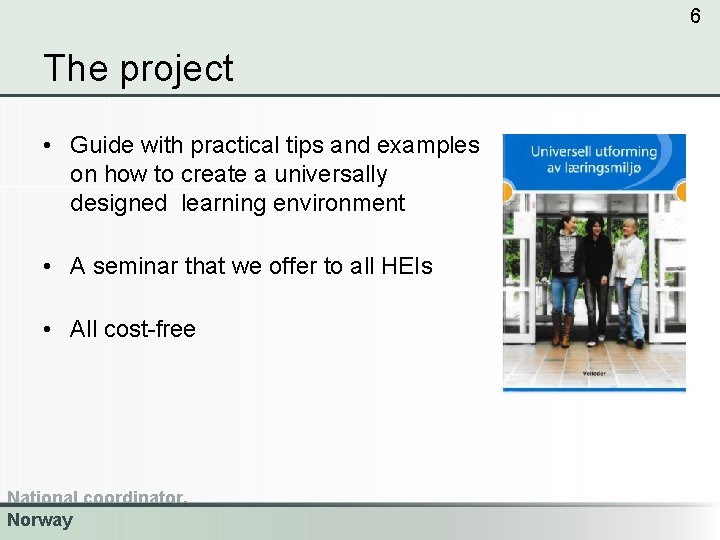
6 The project • Guide with practical tips and examples on how to create a universally designed learning environment • A seminar that we offer to all HEIs • All cost-free National coordinator, Norway
7 Why Universal Design? • Disability – a consequence of society’s inadequacy rather than the characteristics of an individual • Universal design as a strategy for inclusion and equity can be applied on all aspects of a society • Universal design will not solve all challenges National coordinator, Norway
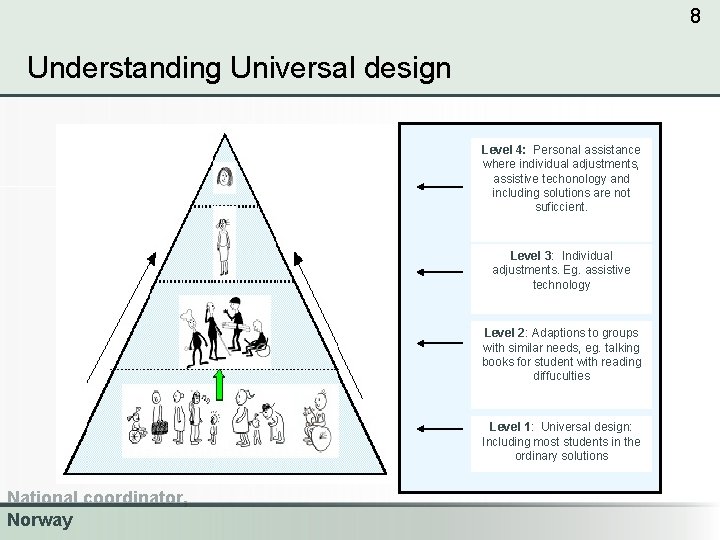
8 Understanding Universal design Level 4: Personal assistance where individual adjustments, assistive techonology and including solutions are not suficcient. Level 3: Individual adjustments. Eg. assistive technology Level 2: Adaptions to groups with similar needs, eg. talking books for student with reading diffuculties Level 1: Universal design: Including most students in the ordinary solutions National coordinator, Norway
9 Learning environment The concept of ”learning environment” includes all institutional and organizational conditions that contribute to a student’s learning. This includes physical, psychological and organizational working conditions, social welfare, and tutorial and pedagogical quality. (from the Learning Environment Handbook, University of Oslo) National coordinator, Norway
10 4 aspects of learning environment 1. Buildings and outdoor areas 2. Teaching and assessment 3. Information and information and communication technology 4. Student life National coordinator, Norway
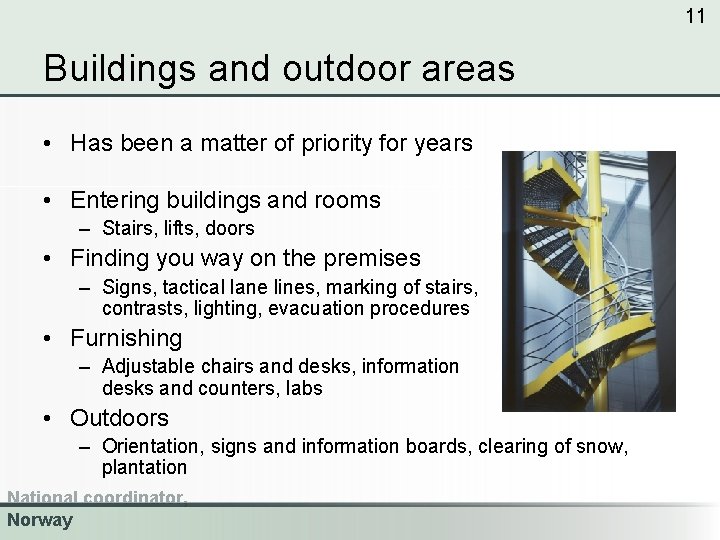
11 Buildings and outdoor areas • Has been a matter of priority for years • Entering buildings and rooms – Stairs, lifts, doors • Finding you way on the premises – Signs, tactical lane lines, marking of stairs, contrasts, lighting, evacuation procedures • Furnishing – Adjustable chairs and desks, information desks and counters, labs • Outdoors – Orientation, signs and information boards, clearing of snow, plantation National coordinator, Norway
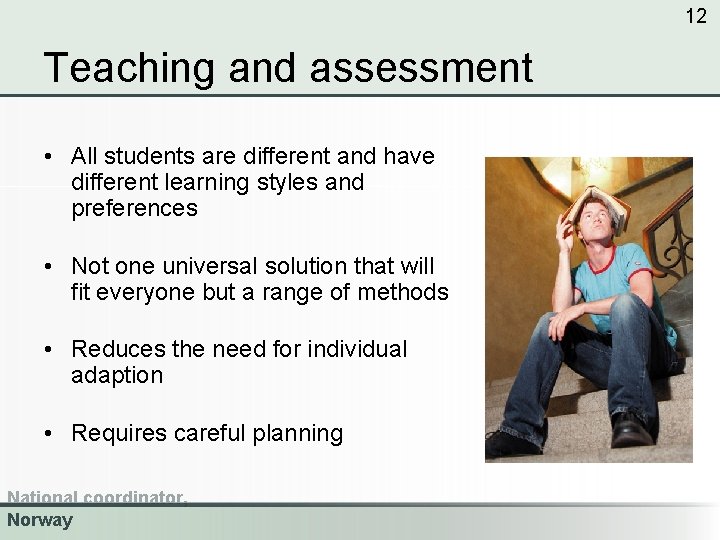
12 Teaching and assessment • All students are different and have different learning styles and preferences • Not one universal solution that will fit everyone but a range of methods • Reduces the need for individual adaption • Requires careful planning National coordinator, Norway
13 Teaching and assessment – where are we? • 2003 – a shift in exam and assessment methods • • • More guidance and feedback from teachers Some subjects have different choices of assessment form Easier to apply for alternatives and adaptations Greater variety of teaching, more use of ICT Some projects on universal design of study programs National coordinator, Norway
14 Information and information technology • Equal access to information is essential • • Web pages Web-based student registration system Learning management systems Formats • • National coordinator, Norway
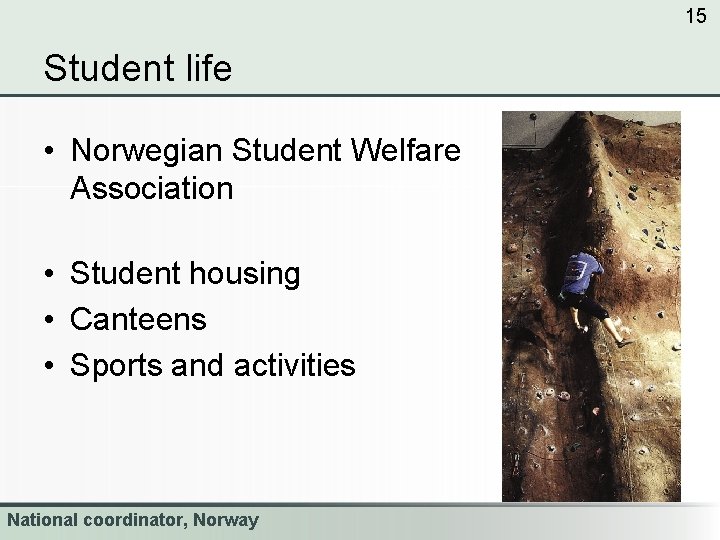
15 Student life • Norwegian Student Welfare Association • Student housing • Canteens • Sports and activities National coordinator, Norway
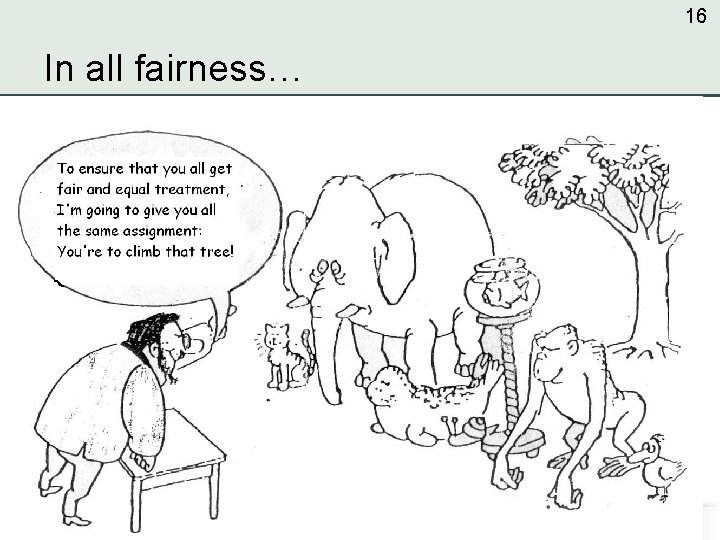
16 In all fairness… National coordinator, Norway
17 Contact info National Coordinator for Accessibility in Higher Education in Norway Kjetil Knarlag Email: kjetil. knarlag@ntnu. no Tel: +47 73 55 06 80 Anne Nylund Email: anne. nylund@ntnu. no Tel: +47 73 59 74 43 www. universell. no National coordinator, Norway