
Universal Design and Students with Disabilities What Works

Universal Design and Students with Disabilities: What Works? cnm. edu
Objectives • Universal Design Defined • Principles of Universal Design • Universal Design in Action • Application to Students with Disabilities (SWD) • Resources for Universal Design cnm. edu
What is UDL? Universal Design for Learning (UDL) is about creating flexible, accessible learning materials and environments to enhance the learning success of ALL learners. The incorporation of additional assistive technologies and media is a major component of creating flexible materials for learning. cnm. edu 3
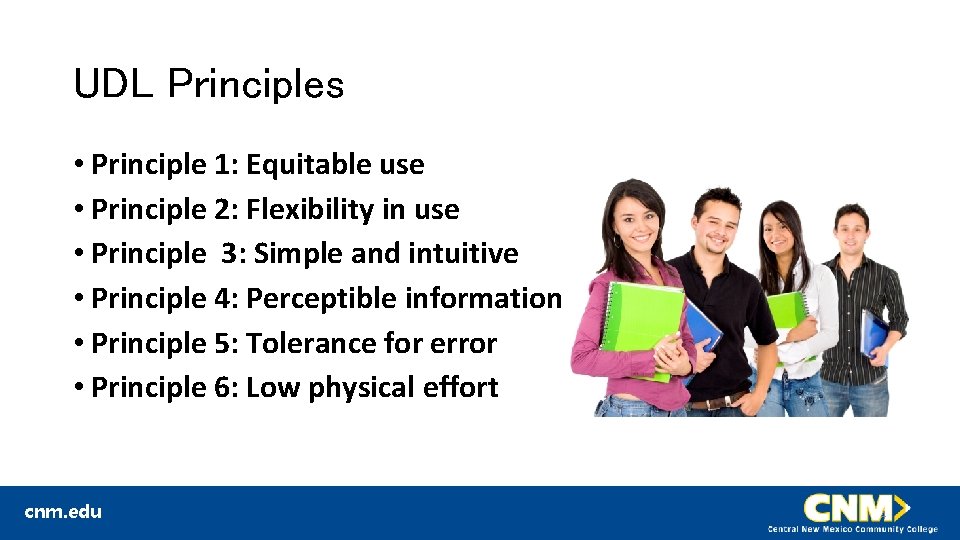
UDL Principles • Principle 1: Equitable use • Principle 2: Flexibility in use • Principle 3: Simple and intuitive • Principle 4: Perceptible information • Principle 5: Tolerance for error • Principle 6: Low physical effort cnm. edu 4

Principle 1: Equitable use Instructional material that is accessible by all • Videos with closed captioning. • Present information in at least two different formats. • Offering office hours in an accessible location or online through email, chat rooms, or video conferencing tools. • Use charts, graphs, photos, concept maps and graphic organizers to complement written information. cnm. edu
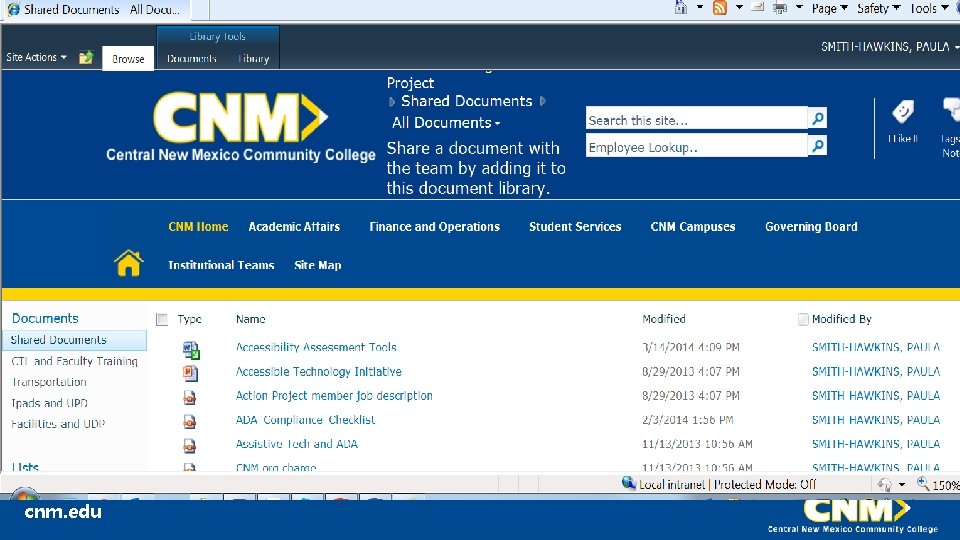
Accessible Information cnm. edu
Students with Disabilities – Equitable Use Related Barriers: • Sensory impairment • Low reading comprehension • Poor organization • Difficulty with instructions • Difficulty with integration of materials cnm. edu
Solutions Accommodations: • Accessible format for all materials • One on one instruction • Written and Verbal directions • Alternative assignments • Note taker/audio recording cnm. edu UDL: • Create welcoming environment • Employ interactive teaching techniques: face the class, speak clearly, use a microphone, make eye contact • Accessible format for all materials for all students • Clearly outlined instructions • Color coded cue cards with step by step process • Multiple ways of acquiring info (interactive white boards, graphic organizers, pictorial supports) • Summarizing major points/providing outlines • Copy of notes/handouts prior to class
Principle 2: Flexibility in use Use of various instructional approaches • Provide an agenda or flowchart at the beginning of class, highlighting the order of topics and the connections. • Incorporate interdisciplinary teaching, working with instructors, students, and guest speakers from other disciplines. • Assist students in determining how they learn using a learning styles inventory, then allow choices in assignments. cnm. edu
Student with Disabilities – Flexibility in use Related barriers: • Auditory processing disorder • Writing disability • Focus, concentration, memory • Sequencing difficulties • Fatigue, pain, medication • Mobility, posture cnm. edu
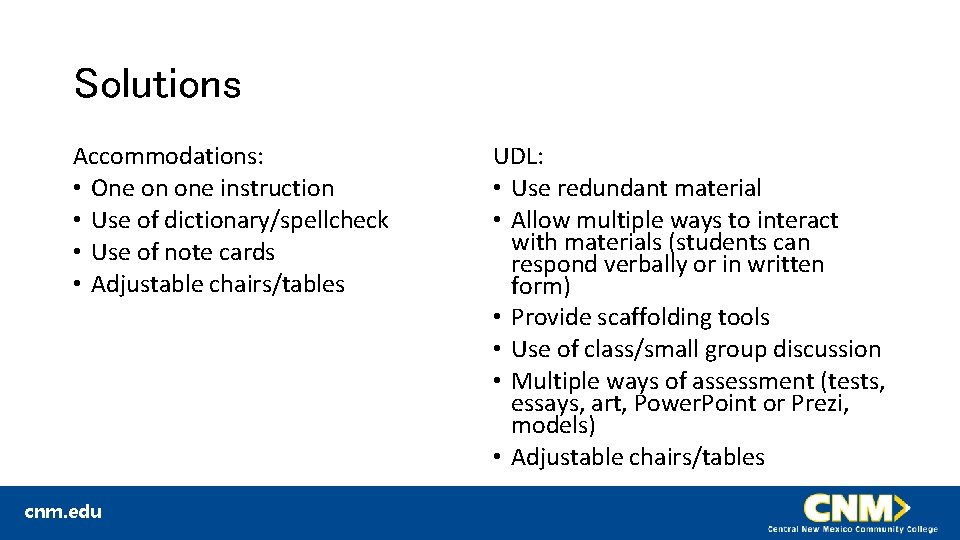
Solutions Accommodations: • One on one instruction • Use of dictionary/spellcheck • Use of note cards • Adjustable chairs/tables cnm. edu UDL: • Use redundant material • Allow multiple ways to interact with materials (students can respond verbally or in written form) • Provide scaffolding tools • Use of class/small group discussion • Multiple ways of assessment (tests, essays, art, Power. Point or Prezi, models) • Adjustable chairs/tables
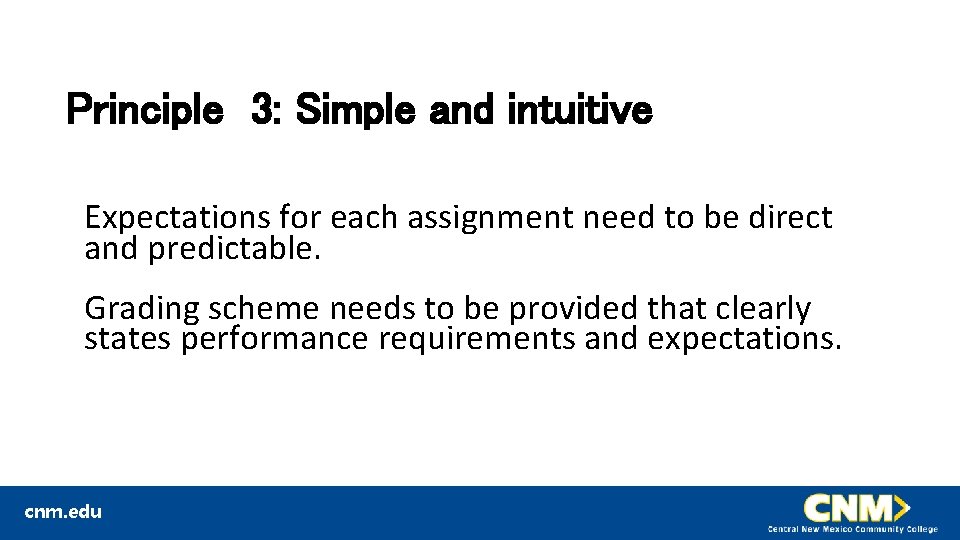
Principle 3: Simple and intuitive Expectations for each assignment need to be direct and predictable. Grading scheme needs to be provided that clearly states performance requirements and expectations. cnm. edu
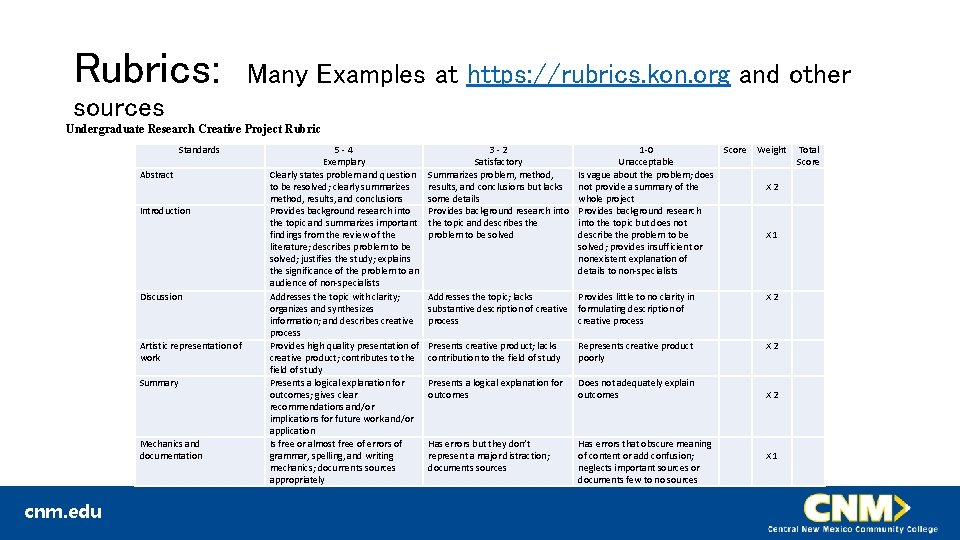
Rubrics: Many Examples at https: //rubrics. kon. org and other sources Undergraduate Research Creative Project Rubric Standards Abstract Introduction Discussion Artistic representation of work Summary Mechanics and documentation cnm. edu 5 - 4 Exemplary Clearly states problem and question to be resolved; clearly summarizes method, results, and conclusions Provides background research into the topic and summarizes important findings from the review of the literature; describes problem to be solved; justifies the study; explains the significance of the problem to an audience of non-specialists Addresses the topic with clarity; organizes and synthesizes information; and describes creative process Provides high quality presentation of creative product; contributes to the field of study Presents a logical explanation for outcomes; gives clear recommendations and/or implications for future work and/or application Is free or almost free of errors of grammar, spelling, and writing mechanics; documents sources appropriately 3 - 2 Satisfactory Summarizes problem, method, results, and conclusions but lacks some details Provides background research into the topic and describes the problem to be solved 1 -0 Score Unacceptable Is vague about the problem; does not provide a summary of the whole project Provides background research into the topic but does not describe the problem to be solved; provides insufficient or nonexistent explanation of details to non-specialists Weight X 2 Total Score X 1 Addresses the topic; lacks Provides little to no clarity in substantive description of creative formulating description of process creative process X 2 Presents creative product; lacks contribution to the field of study Represents creative product poorly X 2 Presents a logical explanation for outcomes Does not adequately explain outcomes X 2 Has errors but they don’t represent a major distraction; documents sources Has errors that obscure meaning of content or add confusion; neglects important sources or documents few to no sources X 1
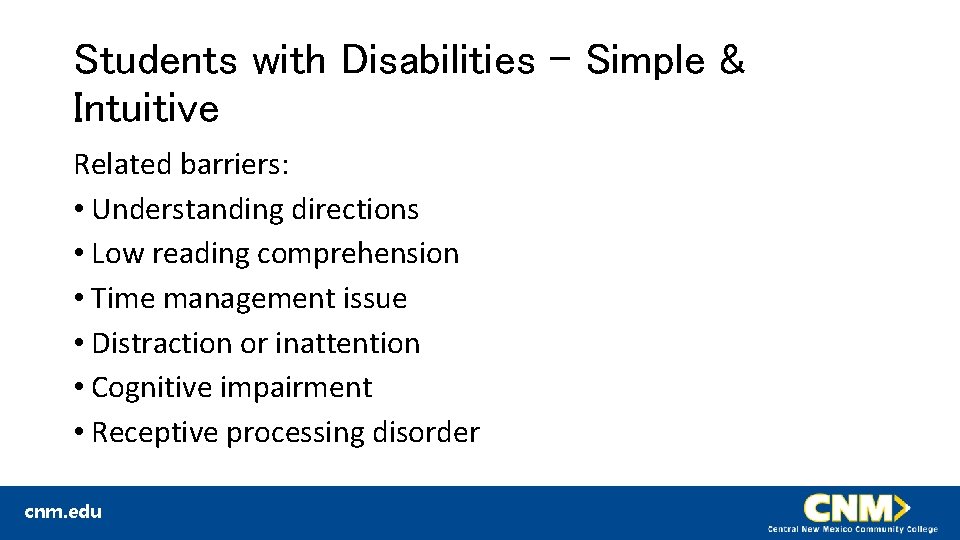
Students with Disabilities – Simple & Intuitive Related barriers: • Understanding directions • Low reading comprehension • Time management issue • Distraction or inattention • Cognitive impairment • Receptive processing disorder cnm. edu
Solutions Accommodations: • One on one instruction • Alternative texts • Extra time on tests/assignments • Note cards • Note taker, audio recorder cnm. edu UDL: • Clear expectations/use of rubrics • Stating objectives at each class • Summarizing at end of each class • Providing bullet points
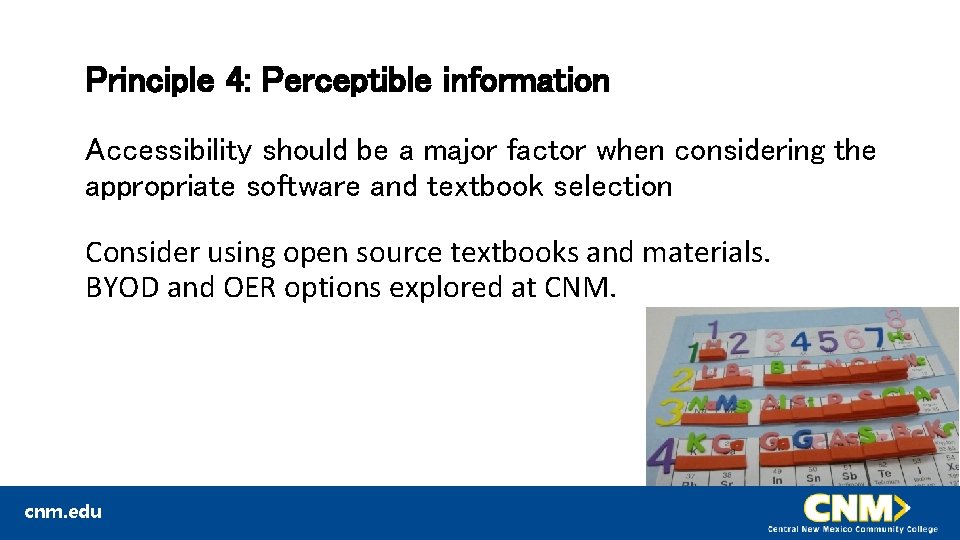
Principle 4: Perceptible information Accessibility should be a major factor when considering the appropriate software and textbook selection Consider using open source textbooks and materials. BYOD and OER options explored at CNM. cnm. edu
Open Educational Resources • Open. Stax textbooks: A project of Rice University • Free Peer-reviewed textbooks in many subject areas • https: //openstax. org/ cnm. edu • Tammy Wolf and Jennifer Schaller are presidential fellows working on making open source materials available to faculty and students. • twolf 1@cnm. edu • jjordan 6@cnm. edu
Students with Disabilities – Perceptible Information Related barriers: • Sensory impairment • Low reading comprehension • Processing disorders • Concentration and focus cnm. edu
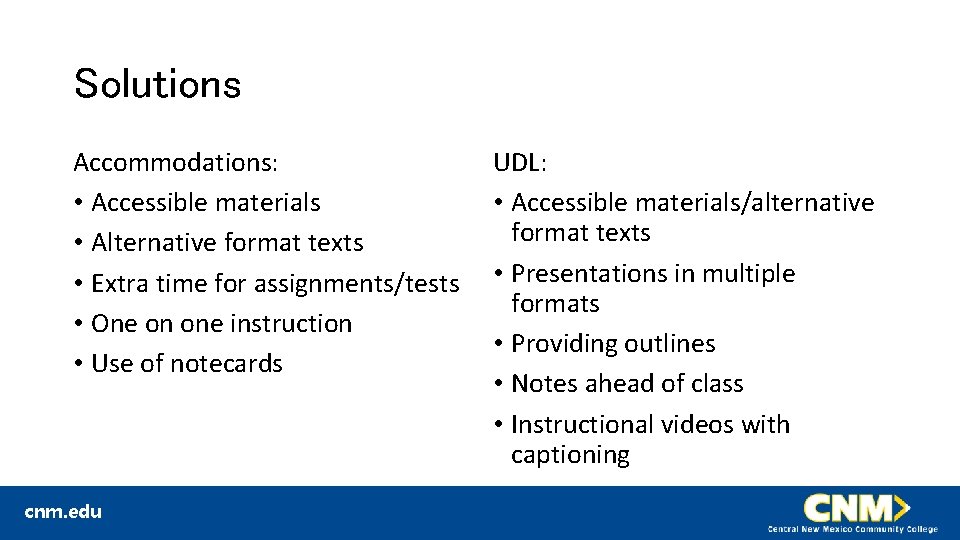
Solutions Accommodations: • Accessible materials • Alternative format texts • Extra time for assignments/tests • One on one instruction • Use of notecards cnm. edu UDL: • Accessible materials/alternative format texts • Presentations in multiple formats • Providing outlines • Notes ahead of class • Instructional videos with captioning
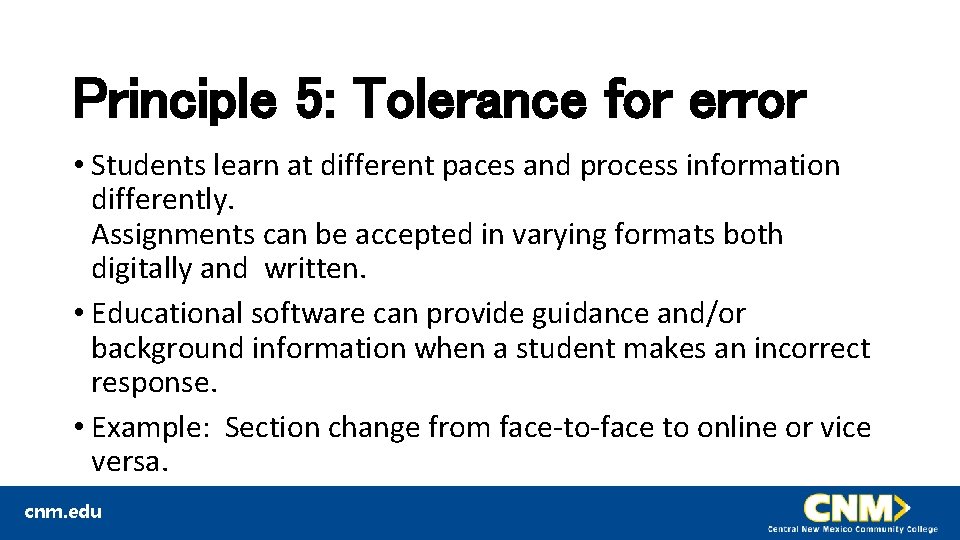
Principle 5: Tolerance for error • Students learn at different paces and process information differently. Assignments can be accepted in varying formats both digitally and written. • Educational software can provide guidance and/or background information when a student makes an incorrect response. • Example: Section change from face-to-face to online or vice versa. cnm. edu
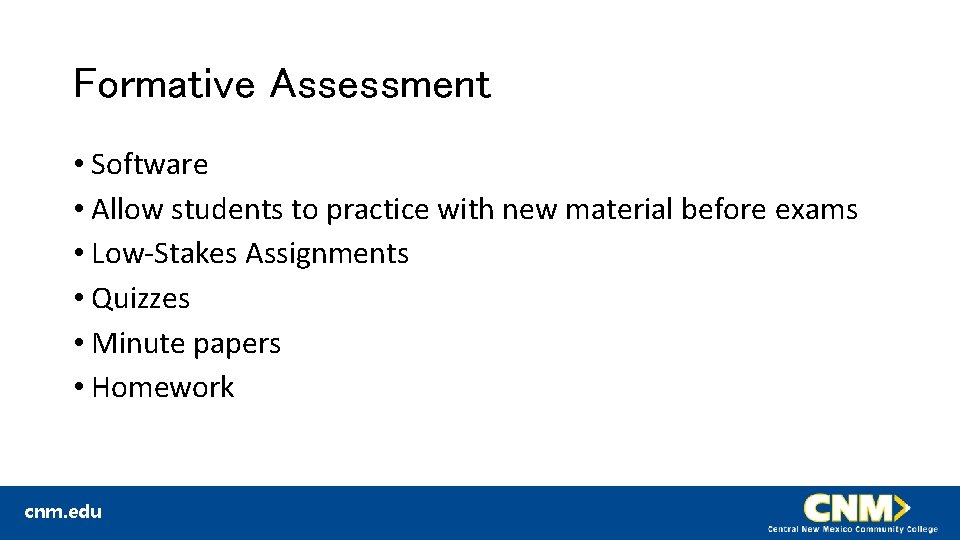
Formative Assessment • Software • Allow students to practice with new material before exams • Low-Stakes Assignments • Quizzes • Minute papers • Homework cnm. edu
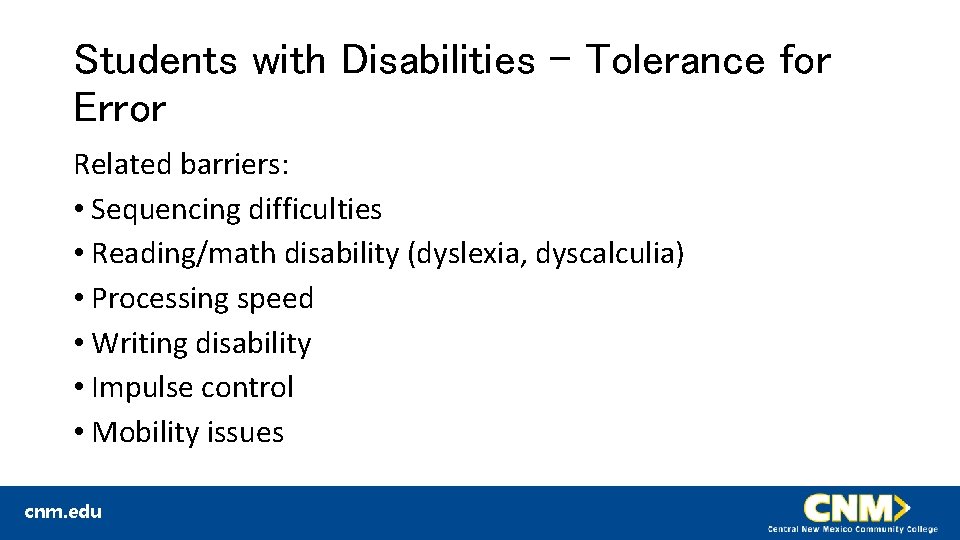
Students with Disabilities – Tolerance for Error Related barriers: • Sequencing difficulties • Reading/math disability (dyslexia, dyscalculia) • Processing speed • Writing disability • Impulse control • Mobility issues cnm. edu
Solutions Accommodations: • Extra time on assignments/tests • Use of spell check/dictionary • Adaptive technology cnm. edu UDL: • Writing labs • Allow drafts & feedback • Allow multiple submissions • Self-paced learning • Encourage students to create test bank • More frequent, shorter tests
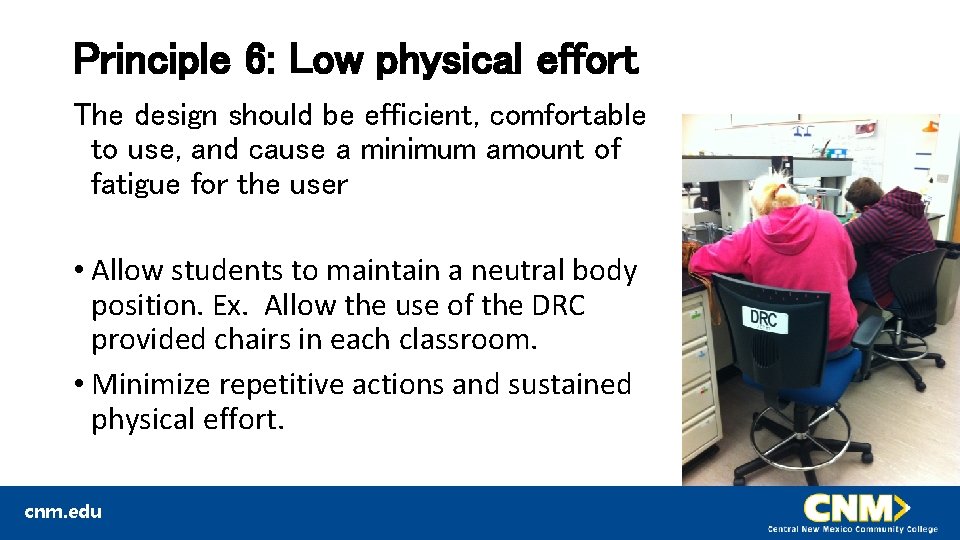
Principle 6: Low physical effort The design should be efficient, comfortable to use, and cause a minimum amount of fatigue for the user • Allow students to maintain a neutral body position. Ex. Allow the use of the DRC provided chairs in each classroom. • Minimize repetitive actions and sustained physical effort. cnm. edu
Students with Disabilities – Low Physical Effort Related barriers: • Mobility issues • Sensory impairment • Low attention • Memory, concentration, & focus cnm. edu
Solutions Accommodations: • Adaptive technology cnm. edu UDL: • Adaptive technology • Choice of assessments (tests, essays, creative projects) • Clearly label equipment and materials • Arrange seating for maximum interaction • Use large, tactile displays
cnm. edu
Questions? cnm. edu
References • Black, R. D. , Weinberg, L. A. , & Brodwin, M. G. (2015). Universal design for learning and instruction: Perspectives of students with disabilities in higher education. Exceptionality Education International, 25(2), 1 -26. Retrieved from https: //ir. lib. uwo. ca/eei/vol 25/iss 2/2/ • Burgstahler, S. (ed. ). (2008). Universal design in higher education: From principles to practice. Boston, MA: Harvard University Press. • Davies, P. L. , Schelly, C. L. , & Spooner, C. L. (2013, Fall). Measuring the effectiveness of universal design for learning intervention in postsecondary education. Journal of Postsecondary Education and Disability, 26(3), 195 -200. Retrieved from https: //files. eric. ed. gov/fulltext/EJ 1026883. pdf • Missouri State University. (n. d. ). Universal design for learning (UDL) vs. individual accommodation. Retrieved from https: //www. missouristate. edu/assets/disability/UDLIndiv. Accomm. pdf • Temple University. (2017). Universal design for learning (UDL): The challenge of inclusive higher education in the 21 st century. Retrieved from http: //disabilityresources. temple. edu/universaldesign-learning-udl • University of Michigan. (n. d. ). Universal design for learning. Retrieved from http: //dyslexiahelp. umich. edu/print/104 cnm. edu
- Slides: 29